Original Research Article
Assessment of compliance with iron-folic acid therapy during
pregnancy among postnatal mothers in a tertiary care centre, Mysuru
Manasa K., Chandrakumar S. G.
2*, Prashantha B.
INTRODUCTION
Anemia is a condition where the red blood cells and their capacity to carry oxygen is not adequate to meet the physiological needs. Anemia can be caused by defective red cell production or excessive red cell destruction. Hemoglobin synthesis needs iron and iron deficiency is a major cause of anemia. The other causes are nutritional deficiency, chronic inflammation, parasitic infections, inherited or acquired disorders affecting hemoglobin synthesis. Anemia has adverse health effect on all the age groups. In children it can affect growth and cognitive factors. In adults it can affect work capacity, immunity. In pregnant women the adverse events which can be caused by anemia are increased postpartum blood loss, low birth weight babies, preterm delivery and maternal
deaths.1 India has a large number of women with anemia
which is around 50.3% and in Karnataka it is 45.4%.2,3 Low intake of iron in the diet is the most important reason for iron deficiency anemia. In pregnancy iron demand is high and loss of appetite can adversely affect this condition.4 Therefore, guidelines to combat anemia has provisions to provide iron in the form of iron folic acid tablets to pregnant women during antenatal and postnatal care. Currently, iron folic acid tablets are given for hundred days during antenatal period and postnatal period.1 But these interventions have not succeeded much because compliance to iron folic acid tablets is still low among pregnant women. Reasons are many which can be patient related or health care related. Side effects, forgetfulness, ignorance are patient related factors for non-compliance. Lack of supply of tablets, lack of
ABSTRACT
Background: Anemia is a condition where the red blood cells and their capacity to carry oxygen is not adequate to
meet the physiological needs. In pregnancy iron demand is high and loss of appetite can adversely affect this condition. So, guidelines to combat anemia has provisions to provide iron in the form of iron folic acid tablets to pregnant women during antenatal and postnatal care. But compliance is still low among pregnant women who needs attention.
Methods: This study included 192 postnatal mothers in Cheluvamba hospital, Mysore. Details about socio-demographic factors and number of tablets taken during antenatal period were collected using proforma. Pregnant women who had taken less than hundred tablets during antenatal period were considered non-compliant.
Results: The overall compliance to iron folic tablets was 71%. The factors which were independently associated with non-compliance are nuclear family, less number of antenatal visit, tablets from private source, and anemia in current pregnancy. The reasons for non-compliance among the pregnant women who were non-compliant were inadequate counselling by health care worker followed by side effects, cost of tablets, ignorance and fear of side effects.
Conclusions: Family support, adequate counselling and continuous supply of tablets free of cost would increase the compliance to tablets among pregnant women.
Keywords: Compliance, Iron, Folic acid, Health care workers
Department ofCommunity Medicine, MMC and RI, Mysore, Karnataka, India
Received: 30 January 2019
Accepted: 06 March 2019
*Correspondence:
Dr. Chandrakumar S. G.,
E-mail: [email protected]
Copyright: © the author(s), publisher and licensee Medip Academy. This is an open-access article distributed under the terms of the Creative Commons Attribution Non-Commercial License, which permits unrestricted non-commercial use, distribution, and reproduction in any medium, provided the original work is properly cited.
counselling patients by health care workers will affect compliance among pregnant women. Therefore there is a need to know which factors are important, so that proper interventions can be taken to increase compliance and reduce the adverse health outcomes of iron deficiency anemia. So this study was conducted to estimate the compliance with iron-folic acid tablet during pregnancy and to study the factors influencing the non-compliance with iron-folic tablets.
METHODS
This cross sectional study was conducted in Cheluvamba hospital, which is a tertiary care center in Mysore district providing maternal and child health services. Study was conducted over a period of six months from March 2017 to August 2017. The pregnant women who delivered in the hospital and available on the day of interview were the study subjects. The sample size was calculated by using anticipated 64.7% compliance to iron folic acid tablets and 7% absolute error as 192.5 Systematic random sampling was used to select the participants. Pregnant women who refused to participate were excluded. The semi structured proforma was used to collect information on sociodemographic factors, number of iron folic acid tablets taken during pregnancy, factors influencing the compliance and the reasons for non-compliance. Informed consent was taken from all the participants. Pregnant women who took minimum 100 tablets of iron and folic acid during their antenatal period were considered compliant to therapy, otherwise non-compliant. Hemoglobin level of less than 11 g/dl was considered anemic. Results on compliance are expressed as proportions. R software was used to analyze the data. To compare the differences across the groups, chi square test was used and p<0.05 was considered statistically significant. Multivariable logistic regression was done to
identify variables independently associated with non-compliance with iron folic acid tablets supplementation.
RESULTS
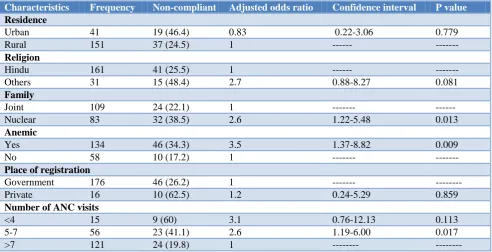
The study included 192 participants who delivered in the hospital during the study period. The overall compliance to iron folic tablets were seen in 136 participants which is 71% and 56 participants were non-compliant to therapy which is 29%. The socio demographic factors of the study participants are as follows. Among the 192 participants, 78.6% were from rural area, 92.2% were literate, 84% were Hindus, 57% belonged to joint family, 48% were primigravida, 83% received their iron folic tablets from government hospitals , 88% had at least one visit by health worker, 92% were registered in government hospital, 85% participants had taken tablets in their previous pregnancy, 70% anemic. Compliance was higher among participants from rural area, Hindu religion, joint family, receiving tablets from government hospital, who had more than three visits from health worker, and registered in government hospital with more than seven visits and non-anemic in current pregnancy which were statistically significant (Table 1, 2). Adjusted odds ratio from logistic regression analysis for non-compliance to therapy and the variables included were place of residence, religion, family, place of registration, number of antenatal visits, source of tablets, visits by health worker, number of health visits and anemia in current pregnancy. The factors which were independently associated with non-compliance are nuclear family, less number of antenatal visit, tablets from private source, and anemic in current pregnancy (Table 3 and 4). The reasons for non-compliance to therapy are inadequate counselling by health care workers was the main reason for non-compliance followed by side effects, cost of tablets, ignorance and fear of side effects (Table 5).
Table 1: Factors associated with compliance to IFA therapy among study subjects.
Characteristics Frequency Compliant Non-compliant P value
Residence
0.006
Urban 41 22 (53.6) 19 (46.4)
Rural 151 114 (75.5) 37 (24.5)
Education
0.378
Illiterate 15 9 (60) 6 (40)
Literate 177 127 (71.7) 50 (28.3)
Religion
0.010
Hindu 161 120 (74.5) 41 (25.5)
Others 31 16 (51.6) 15 (48.4)
Type of family
0.013
Joint 109 85 (77.9) 24 (22.1)
Nuclear 83 51 (61.5) 32 (38.5)
Order of pregnancy
0.064
First 92 71 (77.2) 21 (22.8)
Second And Above 100 65 (65) 35 (35)
Anemic
0.017
Yes 134 88 (65.7) 46 (34.3)
Table 2: Factors associated with compliance to IFA therapy among study subjects.
Characteristics Frequency Compliant Non-compliant P value
Source of IFA tablets
Government 159 125 (78.6) 34 (21.4)
0.000
Private 33 11 (33.3) 22 (66.7)
Visits by health worker
Yes 169 125 (74) 44 (26)
0.010
No 23 11 (47.8) 12 (52.2)
Number of health visits
0.000
Nil 23 11 (47.8) 12 (52.2)
1 to 3 visits 40 22 (55) 18 (45)
>3 visits 129 103 (79.8) 26 (20.2)
Place of registration
Government 176 130 (73.8) 46 (26.2)
0.007
Private 16 6 (37.5) 10 (62.5)
Number of ANC visits
<4 visits 15 6 (40) 9 (60)
0.000
5-7 visits 56 33 (58.9) 23 (41.1)
>7 visits 121 97 (80.2) 24 (19.8)
Taken IFA in previous pregnancy
0.005
Yes 85 60 (70.6) 25 (29.4)
No 15 5 (33.3) 10 (66.7)
Table 3: Predictors of non-compliance to IFA therapy from logistic regression analysis.
Characteristics Frequency Non-compliant Adjusted odds ratio Confidence interval P value
Residence
Urban 41 19 (46.4) 0.83 0.22-3.06 0.779
Rural 151 37 (24.5) 1 --- ---
Religion
Hindu 161 41 (25.5) 1 --- ---
Others 31 15 (48.4) 2.7 0.88-8.27 0.081
Family
Joint 109 24 (22.1) 1 --- ---
Nuclear 83 32 (38.5) 2.6 1.22-5.48 0.013
Anemic
Yes 134 46 (34.3) 3.5 1.37-8.82 0.009
No 58 10 (17.2) 1 --- ---
Place of registration
Government 176 46 (26.2) 1 --- ---
Private 16 10 (62.5) 1.2 0.24-5.29 0.859
Number of ANC visits
<4 15 9 (60) 3.1 0.76-12.13 0.113
5-7 56 23 (41.1) 2.6 1.19-6.00 0.017
>7 121 24 (19.8) 1 --- ---
Table 4: Predictors of non-compliance to IFA therapy from logistic regression analysis.
Characteristics Frequency Non-compliant Adjusted odds ratio Confidence interval P value
Source of IFA tablets
Government 159 34 (21.4) 1 --- ---
Private 33 22 (66.7) 6.3 1.91-20.76 0.002
Visits by health worker
Yes 169 44 (26) 1 --- ---
No 23 12 (52.2) 1.6 0.36-7.14 0.518
Characteristics Frequency Non-compliant Adjusted odds ratio Confidence interval P value Number of health visits
Nil 23 12 (52.2) 2.2 0.15-30.29 0.567
1 to 3 visits 40 18 (45) 1.05 0.22-4.05 0.943
>3 visits 129 26 (20.2) 1 --- ---
Table 5: Reason for non-compliance to therapy (n=56).
Reasons Frequency
Inadequate counselling 28
Side effects 19
Cost 5
Ignorance 3
Fear 1
DISCUSSION
In this study, we found compliance to iron folic acid tablet of about 71%. The other study conducted in
Mangalore and Pune had shown the compliance to be
around 64%.5,6 The reasons for non-compliance in our study were belonging to nuclear family, less number of antenatal visits, taking tablets from private set up and being anemic in current pregnancy. Less number of antenatal visits leading to non-compliance was similar to a study done in Pakistan.7 The main reasons for non-compliance to therapy were inadequate counselling by health care workers which is similar to study done in Brazil.8 Side effects of the tablets including nausea, vomiting leading to non-compliance was similar to studies done in Surat, West Iran, Ethiopia.9-11 Ignorance as a cause of non-compliance is similar to study done in Nepal.12 The other study done in Nigeria also shows similar results about side effects.13 NFHS4 data shows that around 45% of the pregnant women in Karnataka have taken minimum 100 tablets during the antenatal period.3 But in our study it is around 71% which may be due to the fact that all the participants were selected from tertiary centre who would have better access to health care. Most of the participants in our study were from rural area which is also another contributing factor that they belong to joint families and health worker has done more visits in rural area. These reasons may have led to more compliance among females from rural area. Pregnant women from urban area have chosen private hospitals for their treatment and cost of purchasing tablets has led to low compliance among them. Counseling from health workers has played a major role here. If they have not given counseling or the number of visits to patient’s home is less, then the motivation to adhere to tablets is less which has led to non-compliance among pregnant women. Lack of supply of tablets in hospitals were quoted by some patients as the reason for non-compliance which is heath system related.
CONCLUSION
Compliance to iron folic acid tablets during antenatal period is about 71% in this study. Family support is an important factor for pregnant women from nuclear family
since their compliance was less. Regular antenatal checkups and visits by health care workers is crucial so that pregnant women are made aware of the importance of therapy and the adverse events which they can prevent. Behavior change communication strategy can be implemented and also provision of incentives for healthcare workers for monitoring completion of treatment by patients. Supply of tablets at all levels of healthcare to patients in time and free of cost would increase compliance. Since side effects are major reason, alternative methods can be adopted for treating them.
Funding: No funding sources Conflict of interest: None declared
Ethical approval: The study was approved by the Institutional Ethics Committee
REFERENCES
1. Ministry of health and family welfare Government of India. Guidelines for control of iron deficiency anemia, 2013. Available at: http://www.pbnrhm.org/
docs/iron_plus_guidelines.pdf. Accessed on 2
January 2019.
2. Ministry of health and family welfare Government of India. National family health survey-4, 2016. Available at: http://rchiips.org /NFHS/pdf/NFHS4/ India.pdf. Accessed on 3 January 2019.
3. Ministry of health and family welfare Government of India. National family health survey4, State fact sheet, Karnataka, 2016. Available at: http://rchiips. org/NFHS/pdf/NFHS4/KA_FactSheet.pdf.
Accessed on 3 January 2019.
4. Galloway R, McGuire J. Determinants of
compliance with iron supplementation: Supplies, side effects, or psychology? Social Sci Med. 1994;39:381-90.
5. Mithra PP, Unnikrishnan B, Rekha T, Nithin K,
Mohan K, Kulkarni V, et al. Compliance with iron-folic acid (IFA) therapy among pregnant women in an urban area of south India. African Health Sci. 2013;13(4):880-1.
6. Sajith M, Nimbargi V, Shah S, Tekawade S,
Agiwale J, Pawar A. Correlations of adherence to iron supplements and prevalence of anemia in antenatal women. Int J Reprod Contracept Obstet Gynecol. 2016;5(10):3449-50.
7. Nisar YB, Dibley MJ, Mir AM. Factors associated with non-use of antenatal iron and folic acid supplements among Pakistani women a cross sectional household survey. BMC Pregnancy Childbirth. 2014;14:6-7.
8. Niquini RP, Bittencourt SDA, Lacerda EMA,
non-adherence to prescribed iron supplement use a study with pregnant women in the city of Rio de Janeiro.
Rev Bras Saúde Matern Infant Recife.
2016;16(2):191-3.
9. Dutta AJ, Patel P, Bansal, RK. Compliance to iron supplementation among pregnant women a cross sectional study in urban slum. National J Community Med. 2014;5(4):459-60.
10. Siabani S, Arya MM, Babakhani M, Rezaei F,
Siabani S. Determinants of adherence to iron and folate supplementation among pregnant women in West Iran a population based cross-sectional study. Quality in Primary Care. 2017;25(3):159-60.
11. Gebremedhin S, Samuel A, Mamo G, Moges T,
Assefa T. Coverage, compliance and factors associated with utilization of iron supplementation during pregnancy in eight rural districts of Ethiopia a cross-sectional study. BMC Public Health. 2014;14:3-5.
12. Rai SS, Ratanasiri T, Arkaravichien T, Thapa P, Koju R. Compliance and its determinants regarding iron and folic acid supplementation during pregnancy in Kathmandu, Nepal. Kathmandu University Med J. 2016;14(4):312-4.
13. Ugwu EO, Olibe AO, Obi SN, Ugwu AO.
Determinants of compliance to iron supplementation among pregnant women in Enugu, Southeastern Nigeria. Nigerian J Clin Practice. 2014;17(5):609-11.
Cite this article as: Manasa K, Chandrakumar SG,
Prashantha B.Assessment of compliance with