IJSRSET173422 | Received : 26 Aug 2017 | Accepted : 08 Sep 2017 | September-October-2017 [(3)6: 56-64]
© 2017 IJSRSET | Volume 3 | Issue 6 | Print ISSN: 2395-1990 | Online ISSN : 2394-4099 Themed Section: Engineering and Technology
56
Study of Solar Energy Storage in Solar Cooker with Phase
Change Materials and Improving its Performance
Dr. J. H. Bhangale
Department of Mechanical Engineering, SPPU, Nashik, India
ABSTRACT
The crisis of conventional energy sources is one of the major problem in India. The solar energy is pollution free and abundently available renewable energy source. Generally the solar energy is used in applications like solar water heater,solar cookers,solar batteries,solar panels etc. But the main limitatation of using solar energy for solar cooking is that cooking is possible only in sunshine hours.So to made availability of solar energy in off sunshine hours is major problem. To overcome this; the storage system is to be developed with storage modification in solar cooker . This paper discussed the solar cooker with storage system. The solar energy is stored in phase change materials as a latent heat storage. The better model that build’s both traditional heat trapping cum concentrator mechanism. It will have two way supply of heat directly from sun during day time for cooking and from the phase change material during night time. Parabolic dish collector is selected because it gives better solar energy with minimum loss. It reviews relevant issues related with solar cooking using latent heat storage that include cooking pot and concentrating parabolic collector.
Keywords : Latent Heat, Phase Change Material, Solar Cooker, Parabolic Collector
I.
INTRODUCTION
Energy is the backbone of human activities. The importance of energy in economic development is very critical as there is a strong relationship between energy and economic activity. Historically fossil fuel in its solid phase, i.e. wood and coal, has been the prime source of energy. The increment in global energy demands due to population growth and 20th century industrial revolution leads fossil fuel through a transitional phase. It is being widely realized that for sustainable development presently used energy mediums such as fossil fuel and nuclear power have to be quickly replaced by renewable energy sources. The latter are sustainable and have the potential to meet present and future projected global energy demands without indicting any environmental impacts. Renewable energy sources such as solar, wind, hydropower and biogas are potential candidates to meet global energy requirements in a sustainable way [1].
Thermal energy storage (TES) is the temporary storage of high or low temperature energy for later use. It bridges the time gap between energy requirements and
number of PCMs are known to melt with a heat of fusion in any required range [3].
Phase change materials possess the ability to change their state with a certain temperature range. These materials absorb energy during the heating process as phase change takes place, otherwise this energy can be transferred to the environment in the phase change range during a reverse cooling process. The insulation effect reached by the PCM depends on temperature and time; it takes place only during the phase change ( in the temperature range of the phase change) and terminates whenthe phase change in all of the PCMs would complete. Since, this type of thermal insulation is temporary; therefore, it can be referred to as dynamic thermal insulation. Numerous engineering applications have made the topic melting of phase change material as one of the most active fields in heat transfer research today [2].
The solar thermal energy is clean, cheap and abundantly available renewable energy which has been in use since ancient times. The sun is a sustainable source providing solar energy in the form of radiations, visible light and infrared radiations. This solar energy is captured naturally by different surfaces and converted into thermal energy by using solar collectors. The STE are more efficient nowadays. However, there are certain limitations of STE which are given below:
i) Availability is limited to sun hours. ii) In cloudy days and during night time efficiency of STE reduces. iii) Need of storage. iv) Large area entails high capital cost. v) Owing to change in the position of sun, tracking is required. vi) It will take more time to heat fresh water entering in tank.
Solar cooking with all its benefits, starting from environment-friendliness to its cost effectiveness, is yet to be accepted as a viable option for cooking. The main reason for this can be traced out as;
i) Cooking occurs only in sunshine hours. ii) No ease of cooking as the user has to wait longer for simple cooking processes like boiling. iii) Limited number of dishes that can be cooked.
While in the day time cooking will not be an issue, for the night there has to be some form of back-up energy stored throughout the day. This is achieved by selecting a material that has high heat retention capability. However recent studies show that sensible heating is not the option, even if the material has a high Specific heat.
This is why we opted for Latent Heat storage using phase change materials. Latent heat storage is a relatively new area of research which can be used for storing heat by changing the phase of the material without rise in its temperature. To improve the ease of cooking one must separate the traditional model of a solar cooker that has its absorber, cooking surface and heat storage system all jammed to the same place. We can implement the design by having an outdoor arrangement for heat absorption and storage. Solar cookers are heat exchangers designed to use solar energy in cooking processes [6].
II.
METHODS AND MATERIAL
1. Literature Review
has reviewed the available literature on solar cookers is presented. The review is performed in a thematic way in order to allow an easier comparison, discussion and evaluation of the findings obtained by researchers, especially on parameters affecting the performance of solar cookers. The review covers a historic overview of solar cooking technology, detailed description of various types of solar cookers, geometry parameters affecting performance of solar cookers such as booster mirrors, glazing, and absorber plate, cooking pots, heat storage materials and insulation. Moreover, thermodynamic assessment of solar cooking systems and qualitative evaluation of thermal output offered by solar cookers are analysed in detail.
2. System Modelling
One of the most important aspects in the selection of the material is conformable melting point and high latent heat of fusion. The choice of the substances used largely depends upon the temperature level of the application. Residential and commercial cooking often has requirements at around 150°C. The right melting point enables that the phase changing comes off during every usage cycle. Thereby the latent heat could be fully utilized. According to the required temperature of the domestic solar cooker the melting point should be between 1050C and 1100C [4, 5, 6].
Latent heat storage is one of the most efficient ways of storing thermal energy. Unlike the sensible heat storage method, the latent heat storage method provides much higher storage density, with a smaller temperature difference between storing and releasing heat. Every material absorbs heat during heating process while its temperature is rising constantly. The heat stored in the material is released into the environment through a reverse cooling process. During the cooling process, the material temperature decreases continuously. Comparing the heat absorption during the melting process of a phase change material (PCM) with those in normal materials, much higher amount of heat is absorbed if a PCM melts. A paraffin-PCM, for an example, absorbs approximately 200 kJ/ kg of heat if it undergoes a melting process. High amount of heat absorbed by the paraffin in the melting process is released into the surrounding area in a cooling process starts at the PCM‘s crystallization temperature. After comparing the heat storage capacities of textiles and PCM, it is obvious that by applying paraffin-PCM to
textiles their heat storage capacities can substantially enhanced [2].
Figure 1. Latent heat thermal energy storage system
During complete melting process, temperature of PCM as well as its surrounding area remains nearly constant. The same is true for the crystallisation process; during the entire crystallisation process the temperature of the PCM does not change significantly either. Phase change process of PCM from solid to liquid and vice versa is schematically shown in Figure 3.2 the large heat transfer during the melting process as well as the crystallization process without significant temperature change makes PCM interesting as a source of heat storage material in Practical applications. When temperature increases, the PCM microcapsules absorbed heat and storing this energy in the liquefied phase change materials. When the temperature falls, the PCM microcapsules release this stored heat energy and PCM solidify [2].
Figure 2. Schematic representation of phase change process
A) Working principle of PCM
latent heat utilization, utilization of reversible chemical heat, and utilization of heat of dilution. Material has four state viz. solid, liquid, gas and plasma. When a material converts from one state to another, this process is called phase change. There are four kinds of phase change processes, such as (a) solid to liquid (b) liquid to gas (c) solid to gas and (d) solid to solid. Heat is absorbed or release during the phase change process. This absorbed or released heat content is called latent heat. PCM which can convert from solid to liquid or from liquid to solid state is the most frequently used latent heat storage material, and suitable for the manufacturing of heat- storage and thermo-regulated textiles and clothing [2].
Modes of heat transfer are strongly depend on the phase of the substances involve in the heat transfer processes. For substances that are solid, conduction is the predominate mode of heat transfer. For liquids, convection heat transfer predominates, and for vapours convection and radiation are the primary modes of heat transfer. For textile applications, we will only consider the phase change from solid to liquid and vice versa. Therefore, the principle of solid to liquid phase change and vice versa would be discussed. When the melting temperature of a PCM is reached during heating process, the phase change from the solid to the liquid occurs.
Typical differential scanning calorimetry (DSC) heating thermo-gram for PCM melting is schematically shown in Figure 3.4 during this phase change, the PCM absorbs large quantities of latent heat from the surrounding area. PCM may repeatedly converted between solid and liquid phases to utilize their latent heat of fusion to absorb, store and release heat or cold during such phase conversions.
Figure 3. Schematic of DSC heating thermo-gram of PCM [2]
Phase change materials as such are not new. They already exist in various forms in nature. The most common example of a PCM is water at 0oC, which crystallizes as it changes from liquid to a solid (ice). A phase change also occurs when water is heated to a
temperature of 100oC at which point it becomes steam. In order to compare the amount of heat absorbed by a PCM during the actual phase change with the amount of heat absorbed in an ordinary heating process; water can be used for comparisons. When ice melts into water it absorbs approximately a latent heat of 335 kJ/kg. When water is further heated, a sensible heat of only 4 kJ/kg is absorbed while the temperature rises by one degree Celsius.
B) Work on Solar Cooker with PCM
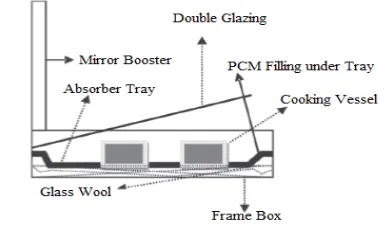
Energy storage not only reduces the mismatch between supply and demand but also improves the performance and reliability of energy systems and plays an important role in conserving the energy. Solar energy applications require an efficient thermal storage. Hence, the successful application of solar energy depends, to a large extent, on the method of energy storage used [1]. Figure 3.5 Shows the sketch of a box-type solar cooker for one vessel using a PCM to store the solar energy. In the center of the absorbing plate A, a cylindrical container of 0.165 m diameter and 0.02 m in depth was welded and the cooking pot is to be kept tightly in it. This container will provide a heat transfer from the absorbing plate and PCM. Moreover, aluminium fins were also provided at the inner side of the tray and cylindrical container. The outer tray ‗B‘ is also made from the same aluminium sheet. Tray B was filled with 3.5 kg of commercial grade stearic acid (PCM) and it was made sure that the PCM was in good contact with the bottom side of tray A. The experimental results demonstrate the feasibility of using a PCM as the storage medium in solar cookers, i.e., it is possible to cook the food even in the evening with a solar cooker having latent heat storage. It also provides nearly constant plate temperature in the late evening. Problem with this design was low heat transfer from PCM storage unit to Cooking vessel [4].
Figure 5. Latent heat storage unit for evening cooking in a solar cooker
C] Recent Improvement in Solar Cooker Using PCM
In the recent study, a novel indirect solar cooker with outdoor elliptical cross section, wickless heat pipes, flat-plate solar collector and integrated indoor PCM thermal storage and cooking unit shown in figure 3.7 is designed, constructed and tested under actual meteorological conditions two plane reflectors are used to enhance the insolation falling on the cooker‘s collector, while magnesium nitrate hexahydrate (Tm = 89 oC, latent heat of fusion 134 kJ/kg) is used as the PCM inside the indoor cooking unit of the cooker. It is found that the average daily enhancement in the solar radiation incident on the collector surface by the south and north facing reflectors is about 24%. Different experiments have been performed on the solar cooker without load and with different loads at different loading times to study the possibility of benefit from the virtues of the elliptical cross section wickless heat pipes and PCMs in indirect solar cookers to cook food at noon and evening and to keep food warm at night and in early morning. The results indicate that the present solar cooker can be used successfully for cooking different kinds of meals at noon, afternoon and evening times, while it can be used for heating or keeping meals hot at night and early morning [9].
Figure 6. C/S side view of the present solar cooker
Another relevant issue on solar cooking in order to define and evaluate an innovative layout of a portable solar cooker of the standard concentrating parabolic
type that incorporates a daily thermal storage utensil. This utensil is formed by two conventional coaxial cylindrical cooking pots, an internal one and a larger external one shown in figure 3.8
Figure 7. (a) Cooker in operation. (b) Focused sun on utensil. (c) Inner pot view with water.
Solar cooking and among them stearic acid (commercial grade) is found to be a good latent heat storage which is experimentally tested in a simple box type solar cooker and the comparison is made with another similar design solar cooker without PCM. The thermal performance of the cooker B and cooker A were determined by conducting the stagnation temperature. Many of PCM’s are under testing for solar cooking but stearic acid (commercial grade) is commonly used due to easy availability and economically suitable till now.
Figure 8. A Solar Box type Cooker with Latent Heat Storage
III.
RESULTS AND DISCUSSION
Experimental Setup and results
The primary objective of the project is to develop solar cooker system with PCM. It was decided to select parabolic dish based solar cooker system. Modifications were done in the cooking vessel of the conventional system by adding PCM in the vessel. From cooking temperature requirement Acetanilide is selected as a PCM.
thermal storage unit. The test section of solar cooker is based on parabolic dish collector. This system consists of parabolic dish collector, solar cooker, and insulator box. Acetanilide is used as a phase change material and it is filled in between the hollow space of inner and outer wall of solar cooker. The experimental setup consists of following components: Parabolic solar dish collector, Solar cooker, Phase change material, Insulator box, Parabolic solar dish collector.
The parabolic dish collector as shown in fig 4.1 refers to a point focusing device which includes the concentrator and the absorber. In this system, segments of the reflecting material are joined to form the concentrator. A flat surface works as the absorber which absorbs the solar energy concentrated on a point. The outer ring frame of the parabolic dish collector is made of the mild steel circular channel. The tracking of parabolic dish collector is done manually and for that tracking screw is provided at the top of outer ring. The parabolic dish collector is adjusted in such a way that the shadow of tracking screw does not visible. After setting this position, the parabolic dish collector is locked in that position by the holding screw provided at the bottom of tracking screw. A wheel is provided at the bottom of parabolic dish so that the dish can be tracked with the movement of sun.
Figure 9. Parabolic solar dish collector
Solar cooker is made up of two hollow concentric cylinders of aluminium. The hollow space between the cylinders is filled with commercial grade Acetanilide having melting point 118oC and latent heat of fusion 222 kJ/kg. Enough space is left in the solar cooker to allow the volumetric expansion of PCM. The selection of phase change material depends upon its properties such as melting temperature, latent heat of fusion, toxicity, etc. In this paper, the phase change material used is commercial grade Acetanilide with its thermo-physical properties given as follow i) Required melting point of PCM - 105oC to 125oC ii) Name – Acetanilide iii) Melting point - 118oC iv) Appearance- White
powder v) Latent heat L - 222 kJ/kg. vi) Specific heat capacity Cp – 2 kJ/kg oC
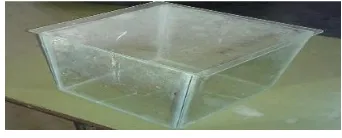
A box made up of wood is used for insulation. The box is filled with glasswool for better insulation and in the Centre of box a space is provided for placing solar cooker. The bottom side of space is also filled with thermocoal and plaster of Paris. In order to avoid effect of air velocity glazing is used. Glazing box made up of white glass is provided around the cooking vessel and has dimensions according to cooking vessel.
Figure 10. Glazing
A) System Operation
In the experimental setup, acetanilide as phase change material is filled in between the hollow space of inner and outer wall of solar cooker and thermocouples are used for measuring the outer surface temperature of solar cooker, inner surface temperature of solar cooker, PCM temperature and cooking medium temperature. Initially, at the start of the experiment, PCM was at ambient temperature (31–340C). Solar cooker is placed on the absorbing plate of dish collector and the system is exposed to solar radiation. Solar radiations as well as various temperatures are measured from 11 am to 4 pm, at an interval of 60 min. The dish collector is tracked manually in every 15 min with the movement of sun. After 4 pm, the solar cooker is lifted from the dish collector with the help of handle and placed in the insulator box and readings are taken without load. Next day, for the same case, readings are taken with load in which water is used as cooking medium. 0.5 litters of water having temperature 30 0C is poured in the solar cooker. A thermocouple is hanged in the water to measure its temperature during discharging process of PCM. The insulator box is then covered with lid and temperatures are measured at an interval of 60 min, from 4 pm to late night. Three cases are considered to enhance the thermal performance of solar cooker and for each case; the readings are taken for two days, i.e., without cooking load and with cooking load. Following are the cases used for experimentation
• Solar cooker with cooking load and glazing.
• Solar cooker without cooking load and without glazing.
In TES generally three modes occur i.e. changing mode, discharging mode and standby mode. The absorption of heat is called as charging mode while release of energy is called as discharge mode. Standby mode occurs when there is no energy transformation occurs.
B)Charging Mode
The charging mode starts with heating of PCM in a collection system. This mode occurs in day time and terminates upon complete melting of PCM. During the charging process water is also poured in cooking vessel as cooking medium. PCM absorbs solar energy and exchanges this heat with the cooking medium in the pot, which is initially at room temperature. The PCM slowly gets heated, sensibly at first, until it reaches its melting point temperature. As the charging proceeds, energy storage as Latent heat is achieved as the PCM melts at constant temperature .After complete melting is achieved; further heat addition causes the PCM to superheat, thereby again storing heat sensibly. Temperatures of the PCM and water are recorded at regular interval in pot.
C) Discharge Mode:-The discharge mode is started by
addition of food in cooking pot. The heat transfer fluid exit temperature is time dependent because rate solidification of PCM varies with time. This mode terminates upon complete solidification of PCM.
D) Standby Mode:-This mode occurs when there is no
further storage occurring because of decreasing heat transfer fluid temperature or the storage pot is completely charged or energy is directly fed to utility without using storage and no heating from the system is required. This is the transition period between charging and discharging modes. The temperature change in the complete cycle is as shown in Figure 4.3
Figure 11.Temperature Time Profile during Three Modes of Storage
Figure 12. Experimental Variation of Temperature with
Time in Cooker with Glazing (Loading at 10 am)
Figure 13. Experimental Variation of Temp with Time
in Case of Solar Cooker without Glazing (Loading at
10 am)
Figure 14. Experimental Variation of Temp with
Cooking Load and Glazing (Loading at 3 pm)
Figure 15. Experimental Variation of Temp with
Figure 16. Box type Solar Cooker with PCM Storage Unit for Night Cooking in Indian Climate (Sharma S.D.)
In this project Acetanilide is used for latent heat storage(PCM)along with parabolic type solar collector then this results are compared with the results of Someshwer Dutt Sharma.the maximum temperature of PCM he achieved 1200Cand this project will give maximum temperature of 1750C. Hence with the latent heat storage properties of PCM ; solar cooking with parabolic type solar collector is more effective than box type of collector.
IV.
CONCLUSION
In this paper parabolic dish collector is selected because it gives better solar energy with minimum loss. Acetanilide is selected as PCM material according to temperature required for cooking and its high latent heat of fusion which is about 222 kJ/kg. To avoid heat loss to surrounding air we also find out the possible use of glazing and decide to use during our study to avoid loss of solar energy due to air flow and to improve its performance.
1) The above results show the feasibility of solar cooker based on parabolic dish collector with thermal storage unit for late evening cooking in Indian climatic conditions. This system is initially expensive but shows good potential for community applications.
2) It provides high PCM temperatures of up to 1750C with tracking and allows cooking in the shade and also in a conventional kitchen during non-sunshine hours or in the evening.
3) The higher melting heat and conductivity of a PCM like Acetanilide is an advantage for fast cooking indoors. Heat storage and retention is much better when water is removed from the inner pot or a high boiling temperature cooking medium.
4) The use of parabolic solar collector gives better results than box type of solar collector.
V.
REFERENCES
[1]. Shukla A., Buddhi D., Sawhney R.L., Solar Water Heaters with Phase Change Material Thermal Energy Storage Medium: A Review, Renewable and Sustainable Energy Reviews, 13 (2009) 2119–2125
[2]. Mondal S., Phase Change Materials for Smart Textiles AnOvervie, 28 (2008) 1536– 1550. [3]. Sharma A., Tyagi V., Chen C.,Buddhi D.,
Review On Thermal Energy Storage With Phase Change Materials and Applications, Applied Thermal Engineering, 13 (2009) 318– 345. [4]. Erdem cuce,Pinar Mert cuce; A comprehensive
review on Solar Cookers; Applied energy 102(2013)1399-1421
[5]. Zalba B., Jose M., Cabeza L., Review on Thermal Energy Storage with Phase Change: Materials, Heat Transfer Analysis and Applications, Applied Thermal Engineering, 23 (2003) 251–283
[6]. Mathana S., Srinivasan V., Modified Solar Collector Annexed With Residential Solar Cooker, International Journal of Mechanical Engineering and Technology, Volume 4 ( 2013) 62-70.
[7]. Belen Zalba , Jose M Marin , Luisa F. Cabeza , Harald Mehling; Review on thermal energy storage with phase change: materials, heat transfer analysis and applications; Applied Thermal Engineering 23 (2003) 251-283.
[8]. B. He, V. Martin, F. Setterwall, Phase Transition Temperature Ranges and Storage Density of Paraffin Wax Phase Change Materials, Energy, 29 (11) (2004) 1785–1804.
[9]. Hussein H.M.S., Ghetany H.H. El ., Experimental Investigation of Novel Indirect Solar Cooker With Indoor PCM Thermal Storage and Cooking Unit, Energy Conversion and Management, 49 (2008) 2237–2246.
[10]. Belen Zalba , Jose M Marin , Luisa F. Cabeza , HaraldMehling; Review on thermal energy storage with phase change: materials, heat transfer analysis and applications; Applied Thermal Engineering 23 (2003) 251-283.
[12]. D.Zou,C.Y.Zhao,Y.Tian; Review on thermal energy storage with phase change materials and applications; Applied Energy 92 (2012) 593-605. [13]. Daniel. R. Rousse, Nizar Ben Salah, and Stephane Lassue; An Overview of Phase Change Materials and their Implication on Power Demand.
[14]. Francis Agyenima,, Neil Hewitta, Philip Eamesb, Mervyn Smytha. A review of materials, heat transfer and phase change problem formulation for latent heat thermal energy storage systems (LHTESS) ; Renewable and Sustainable Energy Reviwes 14 (2010) 615-628.
[15]. Manufacturing and performance analysis of solar flat plate collector with phase change material; B.K. Gond, M. K. Gaur, C. S. Malvi

![Figure 3. Schematic of DSC heating thermo-gram of PCM [2]](https://thumb-us.123doks.com/thumbv2/123dok_us/1200208.1623122/4.595.320.550.616.702/figure-schematic-dsc-heating-thermo-gram-pcm.webp)