Original Research Article
A cross sectional study to assess the awareness and satisfaction level
among the beneficiaries regarding Mission Indradhanush in selected
districts of Indore division
Anand Kumar Patidar, A. K. Khatri*, Bhagwan Waskel, Sanjay Dixit
INTRODUCTION
Despite India being a leading producer of vaccines, it harbours one-third of the world’s unimmunized children.1 The current scenario depicts that immunization coverage has been steadily increasing but the average level remains far less than the desired. Still only 62% (NFHS-4) of the infants in India are fully immunized which is much less than the desired goal of achieving 85% coverage.2 Between 2009-2013 immunisation coverage has
in coverage every year. To accelerate the process of immunization by covering 5% and more children every year, the Mission Mode has been adopted to achieve target of full coverage by 2020. As a strategic endeavor, the Ministry of Health and Family Welfare (MoHFW), GoI, launched Mission Indradhanush in December 2014 to achieve more than 90% full immunization coverage in the country. This initiative will eventually close immunity gaps and strengthen immunization coverage. Mission Indradhanush will target all children under the
ABSTRACT
Background: Only 62% (NFHS-4) of the infants in India are fully immunized which is much less than the desired goal of achieving 85% coverage. To accelerate the process of immunization by covering 5% and more children every year, the Mission Mode has been adopted to achieve target of full coverage by 2020. Mission Indradhanush will target all children under the age of two years and pregnant women with all available vaccines.
Methods: It is a cross sectional study done in 3 randomly selected districts of Indore division. The beneficiaries selected were children <2 years and pregnant women. The selection of beneficiaries was done by exit interview technique. Data collection was done by using pre-designed, semi-structured questionnaire which assess the awareness and satisfaction level of the beneficiaries.
Results: About 88% were aware about the immunization. Overall 78% beneficiaries agreed that vaccination is compulsory, 62% agreed that vaccination schedule should be followed, 30% beneficiaries considered that vaccination was harmful. Most of the beneficiaries were satisfied with behaviour of the health provider, with all key messages given by health provider.
Conclusions: Most common reasons found for drop out or left out were, fear of side effects due to vaccination followed by lack of awareness regarding session sites. Satisfaction level was found relatively low regarding difficulty in finding the place where vaccination was done and distance of session sites.
Keywords: Awareness, Satisfaction, Mission Indradhanush
Department of Community Medicine, MGM Medical College, Indore, Madhya Pradesh, India
Received: 21 July 2019
Revised: 25 July 2019
Accepted: 30 July 2019
*Correspondence:
Dr. A. K. Khatri,
E-mail: [email protected]
Copyright: © the author(s), publisher and licensee Medip Academy. This is an open-access article distributed under the terms of the Creative Commons Attribution Non-Commercial License, which permits unrestricted non-commercial use, distribution, and reproduction in any medium, provided the original work is properly cited.
vaccines.3 Mission Indradhanush depicting seven colours of the rainbow, aims to cover all those children by 2020 who are either unvaccinated or are partially vaccinated against seven vaccine preventable diseases. Vaccination against tetanus will be provided to the pregnant women.4 Though a proven cost-effective preventive intervention, the benefits of immunization is not reaching many children who are at the maximum risk of the diseases preventable by these vaccines. Majority of the children who do not receive these vaccines live in developing countries. Studies have revealed that children are left uncovered by the routine immunisation programme either because the parents and guardians are unaware of the drive, or there is some element of apprehension or fear due to vaccination.5 Drop out is defined by if a child received immunization (minimum one antigen) but not received immunization as per age with gap of more than one months. Left out is defined by if a child not received any antigen till date (child age 2 month or more).6
Aim
The aim of the present study was to assess the awareness about the Mission Indradhanush and to assess the satisfaction level of beneficiaries regarding Mission Indradhanush.
METHODS
It was a cross sectional study done in 12 months of study period (March 2016-April 2017) in 3 randomly selected districts of Indore division where the Mission Indradhanush campaign was held. The beneficiaries selected were children <2 years (n=182) and pregnant women (n=25). The selection of beneficiaries was done
by exit interview technique. Data collection was done by using pre-designed, semi-structured questionnaire which assess the awareness and satisfaction level of the beneficiaries. Responses from the caregivers of children and pregnant women was collected and entered in Microsoft Excel sheet. Data were analysed using SPSS software version 20 using appropriate statistical tests. Beneficiaries those were present on the session sites and given consent were included and beneficiaries not within the defined age group (children age >2 years and women those were not pregnant) and not given consent were excluded. Written consent was taken from each beneficiary prior to give responding the questionnaire.
RESULTS
Present study was done to assess the awareness and satisfaction level of pregnant women and caretakers of the children age less than 2 years regarding the immunization services under the campaign Mission Indardhanush.
About 88% were aware about the immunization. Overall 78% beneficiaries agreed that vaccination is compulsory, 62% agreed that vaccination schedule should be followed, 30% beneficiaries considered that vaccination was harmful. About 44% considered that child with cold can be vaccinated while 38% beneficiaries considered that child with mild fever can be vaccinated. Most of the beneficiaries told that health workers explained them about importance and side effects (92%) due to vaccination. About 79% beneficiaries considered that they heard miking or drum beating regarding immunization in their community.
Table 1: Demographic distribution of the beneficiaries.
Demographic profile Options No. of
Beneficiaries N (%) Age of pregnant women in years (n=25). <18 2 (8)
18-25 12 (48)
26-30 8 (32)
>30 3 (12)
Age of child <2 years (n=182). <6 months 36 (19.7) 6 months-1 year 75 (41.2)
1-2 year 71 (39.1)
Gender of the child (n=182). Male 93( 51)
Female 89 (49)
Educational status of beneficiaries (pregnant women and caregivers of children age <2 years) (n=207).
Illiterate 25 (12.1)
Primary 79 (38.2)
Secondary 79 (38.2)
High-secondary 23 (11.1)
Graduation 1 (0.4)
Occupational status of beneficiaries (pregnant women and caregivers of children age <2 years) (n=207).
Table 2: Assessment of awareness among the beneficiaries regarding the Mission Indradhanush.
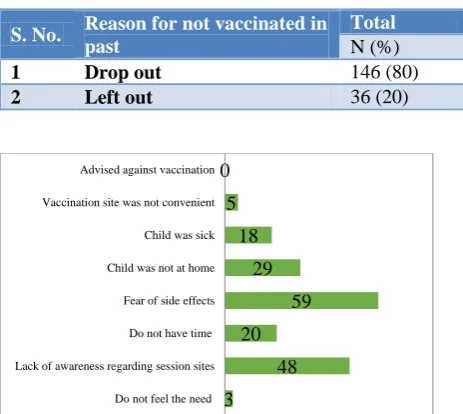
Table 3 depicts that among unvaccinated beneficiaries major were in the category of drop out (80.2%) and less were fall under category of left out (19.8%).
Table 3: Main cause of children <2 years not vaccinated in past (n=182).
Figure 1: Reasons for drop out/left out in children<2 years of age (n=182).
Figure 2: Main source of information about immunization session/services.
Figure 1 shows that main reason for drop out or left out was fear of side effects due to vaccination (32.4%) followed by lack of awareness regarding session sites (26.37%) and child was not at home during vaccination in past (15.9%).
Figure 2 shows that main source of information to the beneficiaries about the immunization session/services were ASHA (48%) and AWW (39%). Miking/ IEC material (8%) and neighbours (4.3%) were also source of information for some beneficiaries.
Table 4: Assessment of satisfaction level of the beneficiaries regarding the Mission Indradhanush (n=207).
3 48 20
59 29 18 5 0
Do not feel the need Lack of awareness regarding session sites Do not have time Fear of side effects Child was not at home Child was sick Vaccination site was not convenient Advised against vaccination
1%
48% 39%
8% 4%
ANM ASHA AWW Miking/ IEC material Neighbours
S.
No. Knowledge assessment
Yes No
N (%) N (%) 1 Awareness about immunization. 182 (88) 25 (12)
2 Vaccination is compulsory. 161 (78) 46 (22)
3 Vaccination schedule should be followed. 128 (62) 79 (38)
4 Vaccination is harmful. 62 (30) 145 (70)
5 Can child with cold be vaccinated? 91 (44) 116 (56)
6 Can child with mild fever be vaccinated? 78 (38) 129 (62)
7 Did the health workers told you about the importance of immunization? 191 (92) 16 (8)
8 Did the health workers told you about the side effects could be occur during
immunization? 190 (92) 17 (8)
9 Did you hear any miking, drum beating regarding immunization in your
community? 164 (79) 43 (21)
S. No. Reason for not vaccinated in past
Total
N (%)
1 Drop out 146 (80)
2 Left out 36 (20)
S.
No. Satisfaction assessment
Satisfied Neutral Dissatisfied
N (%) N (%) N (%) 1 Satisfied with behaviour of the health provider. 200 (96.7) 2 (0.9) 5 (2.4)
2 Satisfied with all key messages given by health
provider. 190 (92) 10 (4.8) 7 (3.2) 3 Clear direction and advice regarding vaccination site. 172 (83) 4 (2) 31 (15)
4 Easy accessibility of the session site. 143 (69) 17 (8.2) 47 (22.8)
5 Regarding distance of immunization centre from your
resident. 128 (62) 13 (6) 66 (32)
In present study most of the beneficiaries were satisfied with behaviour of the health provider, with all key messages given by health provider, clear direction and advice regarding vaccination site. Most of the beneficiaries were satisfied with easy accessibility of the session site, with the cleanliness at the session site and with waiting time for vaccination. Most of the beneficiaries were satisfied with the way in which vaccination provides and regarding any expenses due to vaccination. The main reasons for dissatisfaction was difficulty in finding the place where vaccination was done, distance of session sites was far from their home, improper waiting area at session sites, wastage of their time which interfere in their routine work and loss of daily wages due to vaccination of their child.
DISCUSSION
In this study most common age group in pregnant women was between 18-25 years (48%) followed by 25-30 years (32%), most common age group among children was between 6 months-1 year (41.2%) followed by 1-2 years (39.1%). Education status of most of the beneficiaries (pregnant women and caretakers of child age <2 years) was primary (38.2%) and secondary level (38.2%). About 57.5% were unskilled workers, 33.3% were unemployed/housewife and skilled workers were only 9.2%. While In study of Ms. Mereena et al 50.3% mothers belongs to the age group between 26-30 years and majority (45.3%) mothers have completed higher primary and high school education. Majority (49.3%) mothers were home makers.7In study of Kapoor 72% of the mothers were housewives.8 In study of Ravishankaret al Majority of the mothers were educated up to preschool (61.60%) and most of them were housewives (63.30%).9 In this study about 88% were aware about the immunization. Overall 78% beneficiaries agreed that vaccination is compulsory, 62% agreed that vaccination schedule should be followed, 30% beneficiaries considered that vaccination was harmful. About 44% considered that child with cold can be vaccinated while 38% beneficiaries considered that child with mild fever can be vaccinated whereas in their study Josephet al state that only 28% of parents were aware that vaccines prevent some infectious diseases while 70% did not know. 96% of the parents know that they have to vaccinate their children as per the scheduled date.10 Nisar et al in their study found lack of knowledge of mothers regarding immunization of child which leads to incomplete immunization status of child.11 Ravishankaret al in their study found that most of mothers believe that vaccines are not harmful. Most of the mothers were not
willing to vaccinate her child when he/she was suffering from cold and fever.9
In this study main reason for drop out or left out was fear of side effects due to vaccination (32.4%) followed by lack of awareness regarding session sites (26.37%) while in the study ofJoseph et alchild being sick was the most cited reason for missing the vaccination followed by inconvenience, unawareness and inaccessibility to the health care services.10 In another study conducted by Nisar et al found the causes of missing vaccination schedule were non availability of immunization centers 23.4%, busy in domestic work 32%.11 Patel et al states that mother’s residence at father’s home and far distance were associated with ‘missed’ vaccination.12 Agrawal et
al found reason for non-vaccination were lack of
knowledge about vaccination, time and place of vaccination (92%), wrong idea when to vaccinate the child (36%), no faith in vaccination (21%), time not available (18%), vaccinator not present (78%), place of vaccination (64%) etc.13 In study of Khargekar et al the most common reasons for not immunizing the child were fear of side effects (40%) followed by unaware of need for immunization (28%) and time of immunization inconvenient (32.5%).14
In this study main source of information to the beneficiaries about the immunization session/services were ASHA (48%) and AWW (39%). Miking/IEC material (8%) and neighbours (4.3%) whereas in study of Nisar et al the source of information were health workers 62.2%, media 19% , neighbours 16.7% and school/college 2%.11 Similarly in study of Singh et al health workers and nurses were the major source of information and can spread the adequate knowledge regarding immunisation schedule. Other sources were neighbours (28%), media (26%) then self (22%) and relatives (12%).15
In this study 97% of the beneficiaries were satisfied with behaviour of the health provider, with easy accessibility of the session site (69%), with the way in which vaccination provide and regarding any expenses due to vaccination. The main reasons for dissatisfaction was difficulty in finding the place where vaccination was done, distance of session sites was far from their home (32%), improper waiting area at session sites (55%), wastage of their time which interfere in their routine work (24%) and loss of daily wages due to vaccination of their children (15%). While in study of Sharma et al 81.8% were satisfied by services provided there while 15.9% were dissatisfied. The reasons for dissatisfaction were long queue and long waiting period, insufficient
S.
No. Satisfaction assessment
Satisfied Neutral Dissatisfied
N (%) N (%) N (%) 8 Satisfied with waiting time for vaccination. 138 (67) 19 (9) 50 (24)
9 Satisfied with the way in which vaccination provided. 207 (100) 0 0
vaccines which finish off before their turn and rough attitude of the staff.16 In another study Gammalfound that 95.2% of mothers were satisfied with childhood immunization services compared to 4.8% who were unsatisfied with them. Maternal satisfaction about staff attitude was 66.7%, satisfaction about waiting place was 62.9%, satisfaction about waiting time 61.5%, satis-faction about information giving was 61% and satisfaction about cost was 50.5%.17
CONCLUSION
Most common reasons found for drop out or left out were, fear of side effects due to vaccination followed by lack of awareness regarding session sites and child was not at home during vaccination in the past. Most of the beneficiaries were satisfied with the services provided under Mission Indradhanush. Satisfaction level was found relatively low regarding difficulty in finding the place where vaccination was done, distance of session sites from their home, improper waiting area at session sites, wastage of their time and loss of daily wages.
Recommendations
Efforts should be taken to raise the awareness of the community about importance of immunization along with providing complete information about the immunization services.
Regular home visit should be done by health workers for pregnant women and children those who remained unvaccinated/ partially vaccinated due to various obstacles.
Important steps needed to be taken to improve accessibility and reduce the waiting time.
Funding: No funding sources Conflict of interest: None declared
Ethical approval: The study was approved by the Institutional Ethics Committee
REFERENCES
1. Vashistha VM, Kumar P. 50 years of immunization in India: Progress and Future. Indian Pediatr. 2013;50:11-18.
2. National Family Health Survey-II (1998-99), Jammu and Kashmir. International Institute for Population Sciences, Mumbai. Maryland, USA: 2002: 129.
3. Mission Indradhanush-vikaspedia vikaspedia.in/ health/NRHM/National health programmme. Accessed 15 August 2019.
4. Keshavamurthy HR. Director in Press Information Bureau, Kolkata. Mission Indradhanush to put vaccination efforts on high speed; 2015.
5. UNICEF. Global immunization data; World Health Organization (WHO): 2011.
6. Session site communication monitoring tool for routine immunization and Mission Indradhanush (Prepared by MoHFW), 2016. Available at https://mohfw.gov.in/sites/default/files/2168462912 01489665182.pdf. Accessed 16 July 2019.
7. Mereena, Sujatha R. A study on knowledge and attitude regarding vaccines among mothers of under five children attending pediatric OPD in a selected hospital at Mangalore. J Nurs Health Sci. 2014;3(5):39-46.
8. Kapoor R, Vyas S. Awareness and knowledge of mothers of under-five children regarding immunization in Ahmedabad. Healthline. 2010;1(1):12-15.
9. Ravishankar K, Kumar VM. Knowledge, attitude and practices of rural mothers with children under five years of age about vaccination: a non-experimental study. 2015;3;88-93.
10. Joseph J, Devarashetty V, Reddy SN, Sushma M. Parent’s knowledge, attitude, and practice on childhood immunization. Int J Basic Clin Pharmacol. 2015;4(6):1201-7.
11. Nisar N, Muddasir M. Knowledge, attitude and practices of mothers regarding immunization of one year old child at Mawatch goth, Kemari town, Karachi. Pakistan J Med Sci. 2010;26:183-6. 12. Patel TA, Pandit NB. Why infants miss vaccination
during routine immunization sessions? Study in a rural area of Anand district Gujrat. Indian J Public Health. 2011;55(4):321-3.
13. Agrawal A, Hanspal R. To study the knowledge regarding immunization schedule among parents and the source of information regarding vaccination. Int J Paedtr Res. 2016;3:871-6.
14. Khargekar NC, Khargekar VC. Immunization status of children under 5 years in a tribal area, Parol, Thane District. ScopeMed. 2015;6(4):522-7. 15. Singh MC, Badole CM, Singh MP. Immunization
coverage and the knowledge and practice of mothers regarding immunization in rural area. Indian J Public Health. 1994;38(3):103-7.
16. Sharma S, Kohli C, Sharma N, Mehra D. Incomplete immunization coverage in Delhi: reasons and solutions. Primary Health Care. 2016; 6:240.
17. El Gammal HA. Maternal satisfaction about childhood immunization in primary health care center, Egypt. Pan Afr Med J. 2014;18:157.