Original Research Article
A study to develop and evaluate a need-based curriculum
on addiction for students of madrasahs in a rural block
of Hooghly district, West Bengal
Nazrul Mallick
1*, Rabindra Nath Sinha
2, Indranil Saha
3, Aparajita Dasgupta
4, Bobby Pal
4INTRODUCTION
A healthy lifestyle is a way of living that lowers the risk of being seriously ill or dying early. It is composed of behavioural patterns and lifelong personal habits (e.g., smoking, alcoholism) that have developed through processes of socialization.1 Positive role model is
provided, when a healthy life style is adopted, for other people in the community, particularly among students.2
Noncommunicable diseases (NCDs) are slowly progressing diseases which are not transmitted from person to person. World Health Organisation (WHO) has recognized diabetes, cardiovascular disease and stroke,
ABSTRACT
Background: Tobacco smoking habit is imbibed at a very early stage of life and once it is taken up it becomes very difficult to give up. In fact the vast majority of tobacco users worldwide begin the use of tobacco during adolescence. Objective of the study was to develop and evaluate a need-based training curriculum on healthy life style in terms of addiction for Madrasah students of rural West Bengal.
Methods: It was a school-based health educational intervention study in rural area of Hooghly district, West Bengal among 189 Madrasahs students.
Results: The mean pre-test knowledge score in study Madrasah was 6.06±2.69 and post test score was 10.83±1.69. The calculated t-value was 24.06 and p value was 0.00 with effect size 2.12 (Cohen’s D). The observed increase in the knowledge of consequences of smoking in the study Madrasah after the health education was statistically significant. There was no significant difference in the knowledge of the control Madrasah on the health consequences associated with cigarette smoking in pre and post-test.
Conclusions: As adolescent period is the ideal period to impart life-style related training it is obvious that vital opportunities are being missed due to lack of need-based training on life-style issues for this important population group. So, a well-designed need-based health educational intervention may play active role in bringing desired knowledge and behavior among the population group.
Keywords: Adolescent health, Addiction, Non-communicable disease 1
Department of Community Medicine, Raiganj Government Medical College and Hospital, Uttar Dinajpur, West Bengal, India
2
Department of Health Education and Promotion, 4Department of Preventive and Social Medicine, All India Institute of Hygiene and Public Health, Kolkata, West Bengal, India
3
Department of Community Medicine, I Q City Medical College and Hospital, Durgapur, West Bengal, India
Received: 02 June 2019
Revised: 19 July 2019
Accepted: 24 July 2019
*Correspondence:
Dr. Nazrul Mallick,
E-mail: [email protected]
Copyright: © the author(s), publisher and licensee Medip Academy. This is an open-access article distributed under the terms of the Creative Commons Attribution Non-Commercial License, which permits unrestricted non-commercial use, distribution, and reproduction in any medium, provided the original work is properly cited.
cancer and chronic lung disease or COPD as major non-communicable diseases.3 Tobacco and harmful use of alcohol, physical inactivity are the common lifestyle related risk factors.4 Recent WHO estimates (June 2017) reveal that NCDs kill about 40 million people each year, equivalent to 70% of all deaths globally.5 In India NCDs are estimated to account for 53% of all deaths. A rapid rising trend in the burden of NCDs is expected to occur in future.6
Tobacco use both smoke and non-smoke is detrimental to the health of an individual. Tobacco use is responsible for at least one million deaths globally each year.7 Currently, more than 150 million adolescents use tobacco, and this number is increasing globally.8 NFHS-4 revealed that 44.5 per cent of males and 6.8 per cent of females aged 15 to 49 years consumed tobacco and 29.2 percent men consumed alcohol nationwide.9 Global Youth Tobacco Survey (GYTS) 2006 and 2009 across India covering 13 to 15 years old adolescents in 180 schools highlighted an increase in the current users of any form of tobacco from 13.7 to 14.6 per cent and current users of cigarette from 3.8 to 4.4 per cent from 2006 to 2009.10
Tobacco smoking habit is imbibed at a very early stage of life and once it is taken up it becomes very difficult to give up. In fact the vast majority of tobacco users worldwide begin the use of tobacco during adolescence. Therefore this habit must be nipped in the bud and for this each and every child must be made aware of the hazards of tobacco so that they grow up completely deprived of this deadly habit For this primordial prevention in the form of health education at school level is very important and if successfully implemented a generation may even emerge who will not touch tobacco.
To be effective and sustainable trainers for such school-based training programmes should be the teachers of the schools. So, an intermediate step of such training programmes would be orienting and educating teachers using pre-developed structured training contents.
There are some educational intervention studies to address issues related to healthy life style among school studentsbut very few studies have been conducted among madrasah students, where majority of students belong to a particular minority community with low socio-economic status.11,12
This was a part of the study named ‘a study to develop and evaluate a need-based curriculum on healthy life style for students of Madrasahs in a rural block of Hooghly district West Bengal’.
With this background this educational intervention study was conducted to develop and evaluate a need-based training curriculum on healthy life style in terms of addiction for Madrasah students of rural West Bengal which can be implemented by trained teachers. The result of the study may provide good evidence for the policy
makers in favour of more focused and need-based educational interventions to equip school students with age appropriate knowledge required for promotion of healthy lifestyle and reduction of risky behaviours in relation to different diseases.
METHODS
It was a school-based health educational intervention study for Madrasahs students. All students of class VII and VIII of the two selected Madrasahs (study and control) attending in January 2016 constituted the study population i.e. complete enumeration method was followed and no sampling was done for selection of the students Health educational intervention was undertaken in one of the two selected Madrasahs: which acted as the study madrasah and the other madrasah (without active intervention) acted as control. A total of 187 students of class VII and VIII of the two Madrasahs constituted the study population of which numbers of students (class VII and VIII) in study and control Madrasahs were 107 and 80 respectively. Exclusion criteria were students who were not willing to participate and any newly admitted student after baseline data collection.
Study tools
Two different tools were developed for the study:
Questionnaire used for assessment of training needs of students and also to evaluate effectiveness of the educational intervention.
Module for imparting training of students through trained teachers. Module was prepared based on the assessment of training needs of the students.
Methodology for development of tool for assessment of training needs
A questionnaire was developed to assess baseline knowledge and practice regarding healthy life style of class VII and VIII students of the two Madrasahs. Age/ maturity appropriate knowledge and practice related to life style in terms of addiction were assessed. Same questionnaire was used to evaluate effectiveness of the educational intervention.
Preparation of questionnaire
The prepared draft was sent to different experts/ stake-holders both in different departments within the institute and outside the institute for their opinion/ suggestions and validation of the contents.
Experts in pediatric health and adolescent medicine.
Expert faculty in community medicine, maternal & child health, biochemistry and nutrition, health promotion and education and public health administration of AIIH and PH, Kolkata.
Epidemiologist of National Institute of Cholera and Enteric Diseases.
Experts from the Department of Community Medicine of some medical colleges in West Bengal.
Draft questionnaire was modified in accordance to the suggestions or comments of the different experts.
Pretesting of the questionnaire was done in one Madrasah among 41 students.
The questionnaire contained true/ false, yes/ no, explanation type of questions. Face validity of each item and content validity of each domain had been checked by experts in child and adolescent medicine, experts from the Department of Community Medicine of some medical college in West Bengal and the experts of different departments of AIIH and PH.
A scoring system was developed for assessment of knowledge. All questions were given same weightage. For each correct response ‘1’ and for negative or no response ‘0’, score was ascribed. As there were total 13 questions, maximum attainable score was 13 and minimum attainable score was 0.
Methodology for development of training module
Following steps were undertaken to develop the training module.
Gap analysis.
Draft module preparation by researcher.
Finalization of the questionnaire.
Gap analysis
Difference between desired/ and existing knowledge of both the study and control Madrasah students were assessed question wise, domain wise and misconception or incorrect knowledge were also assessed.
Preparation of the module
Based on gap analysis a need based module covering different aspects of healthy life style (nutrition, physical activity and addiction) was prepared in Bengali language by the researcher under guidance of departmental faculty and guide or co-guide. Syllabuses of biology or physical education or environmental science of different boards of examination (like West Bengal Board, CBSC, ICSC, NCERT, Madrasah board etc.) were also consulted during preparation of the draft. Opinion or suggestions of some senior school teachers of different boards were also collected informally. The prepared draft was sent to following group of experts or stake-holders, both within the institute and outside the institute for their opinion or suggestions. Teachers of the study Madrasah were oriented to impart life-style related training to their students using the module. Trained teachers then imparted the module based training to the students.
Statistical analysis
Data were analyzed using the IBM statistical package for social sciences, SPSS statistical software program (version 16) (Chicago, USA).
RESULTS
There is no statistical significant difference in back ground characteristics of the students of study and control Madrasahs except in the proportion of students in class VII and VIII and religion of students.
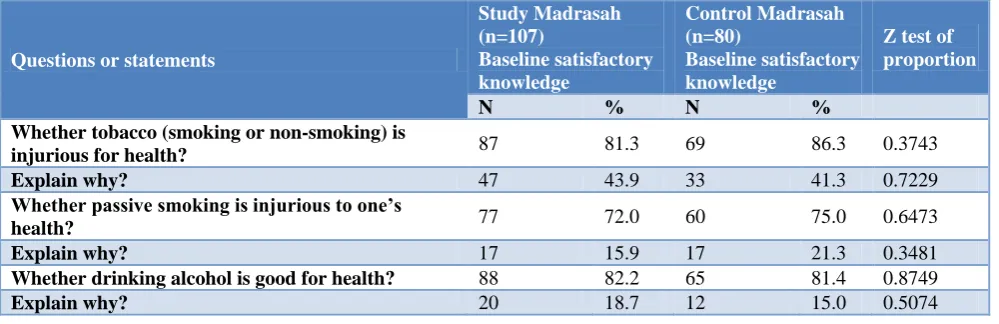
Table 1: Comparison of baseline knowledge regarding addiction of the students of the study and the control Madrasah (n=187).
Questions or statements
Study Madrasah (n=107)
Baseline satisfactory knowledge
Control Madrasah (n=80)
Baseline satisfactory knowledge
Z test of proportion
N % N %
Whether tobacco (smoking or non-smoking) is
injurious for health? 87 81.3 69 86.3 0.3743
Explain why? 47 43.9 33 41.3 0.7229
Whether passive smoking is injurious to one’s
health? 77 72.0 60 75.0 0.6473
Explain why? 17 15.9 17 21.3 0.3481
Whether drinking alcohol is good for health? 88 82.2 65 81.4 0.8749
Explain why? 20 18.7 12 15.0 0.5074
Questions or statements
Study Madrasah (n=107)
Baseline satisfactory knowledge
Control Madrasah (n=80)
Baseline satisfactory knowledge
Z test of proportion
N % N %
“Only cigarette or bidi contain tobacco”–
True/ false/ don’t know 26 24.3 29 36.3 0.0780 “Costly filter cigarette is not injurious to health” –
true or false or don’t know 53 49.5 43 53.8 0.5616 “Smoking relief tension” - true/ false/ don’t know 49 45.8 30 37.5 0.2569
“Gutka is a tobacco product” -true/ false/ don’t
know 56 52.3 39 48.8 0.6270
“Khoini does not contain any tobacco” - true/ false/
don’t know 38 35.5 32 40.0 0.5304
“Tobacco is present in cough lozenges” - true/ false/
don’t know 39 36.4 29 36.3 1.0000
“If someone smoke he / she looks smart” 51 47.8 27 33.8 0.0554
Table 2: Questions wise distribution of difference between existing and desired knowledge related to addiction of the students of two Madrasahs (n=187).
Questions / statements Satisfactory knowledge Gap
N (%) N (%)
Whether tobacco (smoking or non-smoking) is injurious for health? 156 (83.4) 31 (16.5)
Explain why? 80 (42.8) 107 (57.2)
Whether passive smoking is injurious to one’s health? 137 (73.3) 50 (26.7)
Explain why? 34 (18.2) 153 (81.8)
Whether drinking alcohol is good for health? 153 (81.8) 34 (18.2)
Explain why? 32 (17.1) 155 (82.9)
“Only cigarette or bidi contain tobacco’– true/false/don’t know 55 (29.4) 132 (70.6)
“Costly filter cigarette is not injurious to health”- true/false/don’t
know 96 (51.3) 91 (48.7)
“Smoking relief tension” - true/false/don’t know 79 (42.2) 108 (57.8)
“Gutka is a tobacco product” - true/false/don’t know 95 (50.8) 92 (49.2)
“ Khoini does not contain any tobacco” - true/false/don’t know 70 (37.4) 117 (62.6)
“Tobacco is present in cough lozenges” - true/false/don’t know 68 (36.4) 119 (63.6)
“If someone smoke he / she looks smart” - true/false/don’t know 78 (41.7) 109 (58.3)
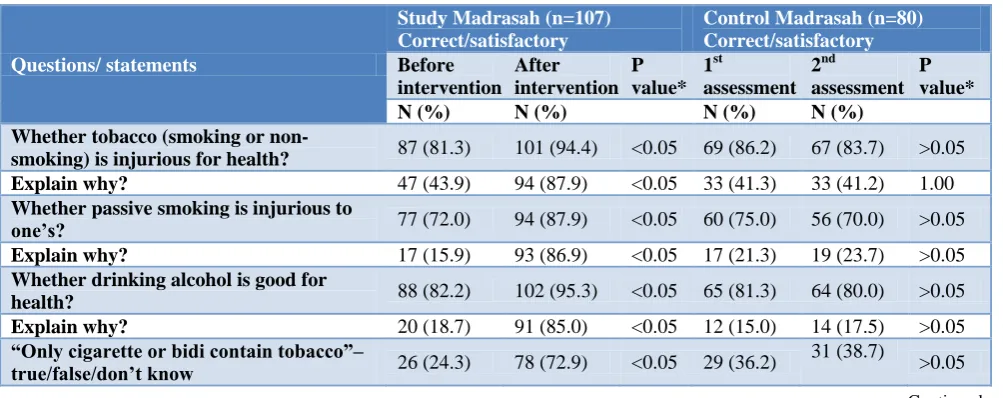
Table 3: Baseline knowledge regarding addiction and change in knowledge with or without intervention among the students of the study and control Madrasahs (n=187).
Questions/ statements
Study Madrasah (n=107) Correct/satisfactory
Control Madrasah (n=80) Correct/satisfactory
Before intervention
After intervention
P value*
1st
assessment 2nd
assessment P value* N (%) N (%) N (%) N (%)
Whether tobacco (smoking or
non-smoking) is injurious for health? 87 (81.3) 101 (94.4) <0.05 69 (86.2) 67 (83.7) >0.05 Explain why? 47 (43.9) 94 (87.9) <0.05 33 (41.3) 33 (41.2) 1.00
Whether passive smoking is injurious to
one’s? 77 (72.0) 94 (87.9) <0.05 60 (75.0) 56 (70.0) >0.05 Explain why? 17 (15.9) 93 (86.9) <0.05 17 (21.3) 19 (23.7) >0.05
Whether drinking alcohol is good for
health? 88 (82.2) 102 (95.3) <0.05 65 (81.3) 64 (80.0) >0.05 Explain why? 20 (18.7) 91 (85.0) <0.05 12 (15.0) 14 (17.5) >0.05
“Only cigarette or bidi contain tobacco”–
true/false/don’t know 26 (24.3) 78 (72.9) <0.05 29 (36.2) 31 (38.7) >0.05
Questions/ statements
Study Madrasah (n=107) Correct/satisfactory
Control Madrasah (n=80) Correct/satisfactory
Before intervention
After intervention
P value*
1st
assessment 2nd
assessment P value* N (%) N (%) N (%) N (%)
“Costly filter cigarette is not injurious to
health” true/false/don’t know 53 (49.5) 85 (79.4) <0.05 43 (53.8) 42 (52.5) >0.05 “Smoking relief tension”–true/false/don’t
know 49 (45.8) 83 (77.6) <0.05 30 (37.5) 33 (41.2) >0.05 “Gutka is a tobacco product” -
True/false/don’t know 56 (52.3) 89 (83.2) <0.05 39 (48.7) 41 (51.2) >0.05 “Khoini does not contain any tobacco”–
true/false/don’t know 38 (35.5) 85 (79.4) <0.05 32 (40.0) 31 (38.7) >0.05 “Tobacco is present in cough lozenges”-
true/false/don’t know 39 (36.4) 84 (78.5) <0.05 29 (36.4) 29 (36.2) >0.05 “If someone smoke he / she looks smart”–
true/false/don’t know 51 (47.7) 80 (74.8) <0.05 27 (33.7) 26 (32.5) >0.05
*Mc Nemar Chi-square.
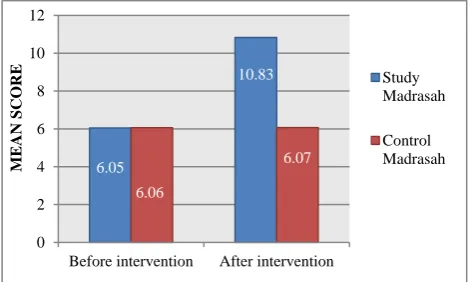
Figure 1: Comparison of mean score of knowledge regarding addiction in both the study and control
Madrasahs before and after intervention.
The mean pretest knowledge score in study Madrasah was 6.06±2.69 and post test score was 10.83±1.69. The calculated t-value was 24.06 and p value was 0.00 with effect size 2.12 (Cohen’s D). The observed increase in the knowledge of consequences of smoking in the study Madrasah after the health education was statistically significant.
In control Madrasah the mean pretest knowledge score was 6.06±2.67 and post test score was 6.07±2.50. The calculated t-value was 0.05 and p value was 0.95 with effect size 0.003 (Cohen’s D). There was no significant difference in the knowledge of the control Madrasah on the health consequences associated with cigarette smoking in pre and post-test.
DISCUSSION
It was an educational intervention pre-post study on healthy life style among Madrasahs students where intervention given to the study Madrasah with the help of need based curriculum through trained teachers where
teachers were trained beforehand by the researcher himself.
The present study showed that 39.3%% students in study Madrasah and 43.8% in control Madrasah had smoker in their family. No statistically significant difference was observed according to smoking habits of family members of the students of the study and control Madrasahs. Study done by Salaudeen et al among young adults in tertiary institutions in Northern Nigerian state found that among the study group, 54 (22.5%) had family members who were cigarette smokers; while in the control group 74 (27.3%) had family members that smoked.13 Global Youth Tobacco Survey (GYTS) in India (ages 13-15) found that 26.4% have one or more parents who smoke.14 Study done by Kaya et alamong adolescent found 74.1% study participants mentioned that there was at least one smoking person in their household and 43.3% declared that they were exposed to second‐hand smoking at home.15
The present study showed that, students were asked to provide their opinion on whether tobacco (smoking or non-smoking) is injurious for health. Surprisingly 8.4% students in study Madrasah and 6.3% in control Madrasah had the belief tobacco is not injurious to health. On further inquiry commonly cited by the students who knew that tobacco is injurious because it causes cancer, respiratory problem, heart problem. Its needs to be mention that those students who belief tobacco in not injurious to health could not provide any justification of their beliefs.
Study done by Zahiruddin et alamong tribal adolescents in India found a significant proportion of adolescents (94.2%) were aware of the hazard of tobacco use, but most of them have either incomplete or incorrect knowledge.16 The commonest diseases due to tobacco use, as mentioned by them, were cough, tuberculosis, cancer, and asthma.
6.05
10.83
6.06
6.07
0 2 4 6 8 10 12
Before intervention After intervention
M
EAN
SCO
RE Study
CONCLUSION
The school-based health educational intervention study was conducted among students of two Madrasahs of Hooghly district, West Bengal with the objectives of developing a need-based curriculum on addiction which can be implemented by school teachers to impart training in class-room setting and to evaluate the effectiveness of that curriculum.
The study has revealed the effectiveness of the training by showing significant improvement of knowledge and practice of students of the study madrasah where students were imparted training by teachers using the module developed by the researcher. No significant improvement was observed among students of the control madrasah where no educational intervention was provided to the students. This proves effectiveness of the curriculum which can be implemented by school teachers. As adolescent period is the ideal period to impart life-style related training it is obvious that vital opportunities are being missed due to lack of need-based training on life-style issues for this important population group. So, a well-designed need-based health educational intervention may play active role in bringing desired knowledge and behavior among the population group. In the present study students were taught life style related issues by their own teachers.
Analysis of pre and post training knowledge and practice of students reveal that the method could successfully improve the understanding and practices of important health and life-style related issues of the students.
Teachers required onetime training for a few days only. Successive batches of students will continue to be exposed and sensitized by the trained teachers to the ideas and practices of healthy life-style. The training module was developed based on assessed training needs of the students.
The curricular research study has been conducted by a single researcher with limited resources. To substantiate the effectiveness of the training in terms of retention of knowledge gained another evaluation after 6 months of the training should have been done. Students of class IX, X could not be included in the study as they were too busy with their academic priorities.
ACKNOWLEDGEMENTS
We would like to thank The Head Teachers, assistant teachers and all the staffs of those Madrasahs; Madrasah students and their parents; members of ethical committee or ethical review board of All India Institute of Hygiene and Public Health; Director, All India Institute of Hygiene and Public Health.
Funding: No funding sources Conflict of interest: None declared
Ethical approval: The study was approved by the Institutional Ethics Committee of All India Institute of Hygiene and Public Health
REFERENCES
1. Park K. Park s Textbook of Preventive And Social Medicine. 24th ed. Jabalpur, (MP) India: M/s Banarsidas Bhanot; 2017: 13-19.
2. World Health Organization. What is healthy life style. Available at: http://www. Eru/icp/lvng. Accessed on 10 August 2015.
3. WHO, Noncommunicable diseases. Available from: www.who.int/topics/noncommunicable_diseases/en Accessed on 15 August 2015.
4. WHO India, Noncommunicable diseases. Available at: www.searo.who.int/india/topics/non-communi cable_diseases/ncd/en Accessed on 17 August 2017. 5. Non-communicable diseases, Fact sheet, Updated June 2017. Available at: www.who.int/mediacentre/ factsheets/fs355/en/. Accessed on 12 August 2017. 6. World Health Organization - NCD Country Profiles,
2011. Available at: www.who.int/nmh/countries/ ind_en.pdf. Accessed on 12 August 2017.
7. WHO: Action plan for the prevention and control of non-communicable diseases in South-East Asia, 2013–2020. Available at: www.searo.who.int/ entity/noncommunicable_diseases/documents/sea-ncd-89(reduced).pdf. Accessed on 14 August 2017. 8. World Health Organization. 10 facts on adolescent
health. 57. Available at: www.who.int/features/ factfiles/adolescent_health/facts/en Accessed on 14 January 2016.
9. National Family Health Survey (2015-16): West Bengal Fact sheet. Ministry of Health and Family Welfare. GOI. Available at: http://rchiips.org/ nfhs/factsheet_nfhs-4. Accessed on 20 March 2017. 10. Gururaj G, Girish N. Tobacco use amongst children
in 74. Karnataka. Indian J Pediatr. 2007;74:1095-8. 11. Hasan I, Zulkifle M, Ansari A. An assessment of
nutritional status of the children of government Urdu higher primary schools of Azar Nagar and its surrounding area of Bangalore. Arch Applied Sci Res. 2011;3(3):167-77.
12. Rashim M, Shewta B, Fathima F, Agrawal T, Shal M, Sequeira S. Prevalence of malnutrition and relationship with scholastic performance among primary and secondary school children in two select private schools in Bangalore rural district ( India). Indian J Community Med. 2015;40(2):97-102. 13. Salaudeen A, Musa O, Akande T, Bolarinwa O.
Effects of health education on cigarette smoking habits of young adults in tertiary institutions in a northeen Nigerian state. Health Sci J. 2013;7(1):54-67.
http://www.who.int/fctc/reporting/Annexoneindia.p df. Accessed on 14 January 2016.
15. Kaya CA, Unalan PC. Factors associated with adolescents' smoking experience and staying tobacco free. Ment Health Fam Med. 2010;7(3):145-53.
16. Zahiruddin QS, Gaidhane A, Bawankule S, Nazli K, Zodpey S. Prevalence and pattern of tobacco use among tribal adolescents: Are tobacco prevention
messages reaching the tribal people in India?. Ann Topical Med Public Health. 2011;4(2):74-80.