Original Research Article
Assessment of functioning of public health facilities
in a North Indian state
Tarundeep Singh
1, Ankita Kankaria
2, Nidhi Bhatnagar
3, Gopal Singh Jat
1,
Sukhwinder Kaur
4, Rajesh Kumar
1*
INTRODUCTION
Health system consists of all organizations, people and actions whose primary function is to promote, restore or maintain health. World Health Organisation (WHO) suggested that a health system is comprises of six building blocks: service delivery; health workforce, information, medical products, vaccines, technologies,
financing, leadership and governance (stewardship).1 Each of these blocks needs to be functioning well to deliver robust services and achieve appropriate outcomes. A three tier health delivery system is functional in India with primary, secondary and tertiary levels. Sub centres (SC) and primary health centre (PHC) constitute the primary level, community health centre (CHC) or block PHCs form the first referral units (FRUs), district ABSTRACT
Background: This study was conducted to assess the current status of functioning of health facilities in Punjab. Methods: A checklist based on six building blocks of health system proposed by WHO and the IPHS was developed, validated and pretested. District hospital (DH), one sub district hospital (SDH) and two Community Health Centres or Block Primary Health Centres (CHCs/BPHCs) were randomly selected from each of 22 districts of Punjab and evaluated against checklist. Total score was thus assigned to each facility. Additionally, workload of healthcare workforce, presence of health functionaries as against total posted strength and feedback from administrators of these facilities were also recorded.
Results: Health services are concentrated at the DH and SDH. Functional equipment like ECG, oxygen, mask, ambubag etc. are deficient at all levels of health facilities. Nearly 50% of expected medicines were in stock at the DH and SDH and 66% at CHC/BPHC level. Patient to doctor ratio is highest at SDH in outpatient department and CHC/BPHC in emergency section. Number of lab tests per lab technician are highest at CHC/BPHC level. Administrators express the need for reducing staff shortage, more intensive training in the financial and administrative processes and simplification of procedures for management of equipment.
Conclusions: Strengthening CHC/BPHC level institutions may improve utilization of public health system and reduce referrals. Lifesaving drugs and equipment need to be available and operational at all levels of facilities. Content of training to administrators needs to be tailored to the felt needs.
Keywords: Functional assessment, Building block of health system, Healthcare workload
1
Department of Community Medicine and School of Public Health, 2Department of Pediatrics, Advanced Pediatrics Center, PGIMER, Chandigarh, Punjab, India
3
Department of Community Medicine, Maulana Azad Medical College, New Delhi, India
4
Directorate of Health Services, Government of Punjab, Punjab, India
Received: 03 May 2019 Revised: 18 June 2019 Accepted: 25 June 2019
*Correspondence: Dr. Rajesh Kumar,
E-mail: [email protected]
Copyright: © the author(s), publisher and licensee Medip Academy. This is an open-access article distributed under the terms of the Creative Commons Attribution Non-Commercial License, which permits unrestricted non-commercial use, distribution, and reproduction in any medium, provided the original work is properly cited.
hospitals (DH) and sub district hospitals (SDH) constitute the secondary level and medical colleges constitute tertiary level. One of the key interventions under National Rural Health Mission (NRHM), launched in 2005, is upgradation and strengthening the public health facilities.2 To facilitate this, Indian Public Health Standards (IPHS) were formulated in 2007 to provide standards for infrastructure, manpower, equipment, drugs, standard treatment protocols, citizen’s charter and accountability through hospital management societies at primary and secondary healthcare facilities and quality assurance committees at district and state level.
Desired health outcomes may not be achieved because of constraints like poor infrastructure, drugs and supply systems, and information systems and poorly supervised healthcare workers.3 Government of India acknowledges the fundamental right of people to adequate health. To ensure this, an assessment of health facilities in terms of status of equipment, drugs, and workload shall provide valuable inputs for framing policy on achieving goals of Universal Health Coverage (UHC) which aims to provide equitable and affordable healthcare to all with security against poverty due to ill health. An enhancement in the functional capacity along with restructuring of the health system on lines with the felt need of the population is fundamental to improve utilization of health services through public health system. To this end, Government of Punjab (GOP) has initiated a process of supportive supervision of all major health facilities in the public domain along with feedback from the consumers for services rendered by these institutions to provide inputs on institutional functioning and to identify gaps between the felt need of people and the provided services.
A baseline inspection of public healthcare facilities in Punjab was conducted by Punjab Health Services with the technical support of School of Public Health, Post Graduate Institute of Medical Education and Research, Chandigarh, to assess the functioning of public healthcare system including observations on infrastructure, manpower, workload and availability of drugs.
METHODS
This cross sectional study was carried out in public health facilities of the state of Punjab, North India, between November 2013 and March 2014. All district hospitals (DHs), sub-district hospitals (SDHs), community health centres (CHCs) and block primary health centres (BPHCs) in state were listed and all DHs, one SDH and two Block PHC or CHC from each district were selected for inspection through simple random sampling method. A total of 22 district hospitals, 19 sub-divisional hospitals and 44 CHCs/ block PHCs were included in the study. Two districts do not have SDH and data of one SDH and two CHC/PHCs was lost. The inspection was conducted
by a team of doctors and public health nurse. The study utilized multiple investigative methods, e.g., checklists, observations record review and interviews to address the study questions. Checklists based on the six building blocks of health system as suggested by WHO, and with reference to IPHS standards, were developed and checked for face, criterion and content validity by taking inputs from five public health experts. Further, the checklists were pretested at each of the three levels in facilities of a neighboring state which has similar socio-cultural norms and administrative set up. All selected health facilities were scored using a checklist so developed. Equipment was considered as functional if along with its availability and functional state, there was trained staff to operate and interpret the findings. Variables like functional equipment, available health personnel, cleanliness, work load of each section of health facility, services offered and disposal of bio-medical waste was scored 0 or 1 with 1 denoting the presence or availability of equipment or service. A final score was computed in percentage which summarized the relative performance of health facilities. Co-relation of the final score attained by different levels of facilities was examined against the distance from the state capital. Availability of drugs was compared with the essential drug lists prepared by the state for various levels of health facilities. Absence rate of doctors was calculated from the number of doctors posted and number of doctors available when the inspection team visited. Inputs from the hospital administrators were sought on perceived problems.
Data was tabulated using Microsoft excel sheet and descriptive analysis was done using SPSS (Version 16.0, Illinois, Chicago, USA).
Study was approved by the Institute Ethics Committee of the Post Graduate Institute of Medical Education and Research, Chandigarh, India, and was funded by the Government of Punjab.
RESULTS
With some exceptions, the overall scores of district hospitals were greater than that of SDH which in turn were greater than the CHCs/BOHCs. Overall scores of CHCs/Block PHCs declined significantly as the distance from the state capital increased. There was no significant co-relation between the overall scores of DHs and SDHs with increasing distance from the state capital (Table 1).
Table 1: Co –relation between distance from the state capital and the overall facility level score.
Facility level Mean absolute score
Score (std dev)
Distance of district headquarter from state capital Km (std dev.)
Pearson
co-relation coefficient P value
DH (n=22) 79.5 (7.3) 164.6 (79.6) - 0.076 0.736
SDH (n=19) 76.0 (7.5) 164.6 (79.6) -0.260 0.255
CHC/Block PHC (n=42) 61.6 (11.7) 164.6 (79.6) -0.462 0.035
Table 2:Health services available at different levels of health facilities of Punjab.
Type of services Availability at different facility (%)
DH SDH CHC/BPHC
Dental Services 96 84 66
Refractive services 100 90 55
Free spectacle 68 68 39
X-ray services 100 100 61
USG services 86 32 2
Functional labour room 95 79 80
Functional Operation theatre 100 95 52
Blood storage units 91 58 2
Adequate number blood units available storage units 82 42 0
Biomedical waste removed in 48 hours 63 68 52
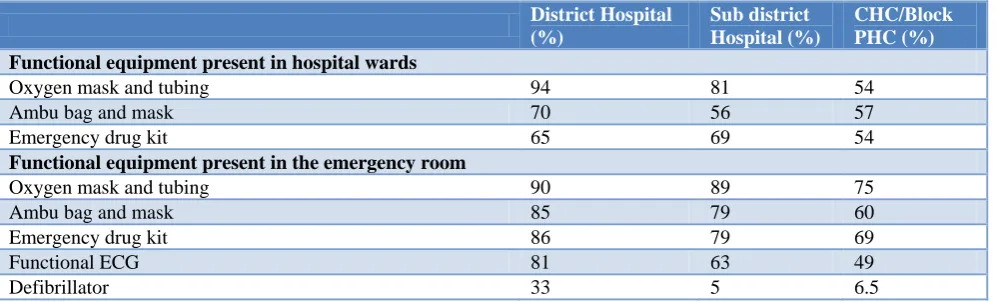
Table 3: Availability of equipment in different levels of hospitals of Punjab.
District Hospital (%)
Sub district Hospital (%)
CHC/Block PHC (%) Functional equipment present in hospital wards
Oxygen mask and tubing 94 81 54
Ambu bag and mask 70 56 57
Emergency drug kit 65 69 54
Functional equipment present in the emergency room
Oxygen mask and tubing 90 89 75
Ambu bag and mask 85 79 60
Emergency drug kit 86 79 69
Functional ECG 81 63 49
Defibrillator 33 5 6.5
More functional equipment was available at the DH followed by the SDH and then the CHC/Block PHC level. Overall, districts Kapurthala, SBS Nagar and Fatehgarh Sahib had the most functional equipment whereas Ferozepur, Hoshiarpur and Pathankot had the least. Facilities like oxygen, ambu bag, and tubing were lacking in almost 40% of the hospitals. The emergency tray containing lifesaving drugs was present in only 86%, 79% and 69% of the emergency rooms at DH, SDH and CHC/BPHC level respectively (Table 3).
Nearly 50% of the expected drugs were present in district and sub district level hospitals and about 66% of the drugs were in stock at the CHCs and BPHCs. About 40% of the drugs at district and sub district level and 22% of the drugs at the CHC/BPHC level had been out of supply for the past 2 years. Oral medication for diabetes and hypertension were available in 71% and 63% of district hospitals and sub district hospitals combined together and
CHCs/PHCs had 66% and 84% of anti-diabetics and antihypertensive drugs available respectively. Iron and folic acid tablets were in stock at 87% and oral rehydration solution was present in 90% of the CHCs/PHCs. Vitamin A oral solution was in stock in 70% CHCs/PHCs.
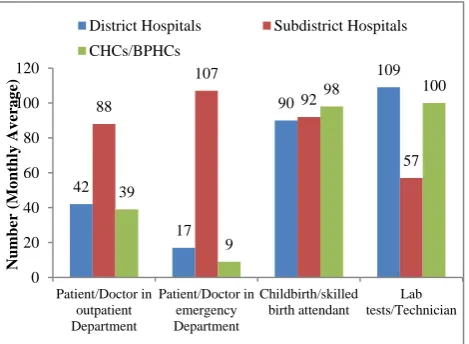
monthly. Number for CHCs/Block PHC was 100 and 120 for lab tests and X-rays respectively.
Sub district hospitals had maximum doctor to patient ratio in both the outpatient and emergency departments followed by the district hospitals. Number of lab tests per technician and number of child births per skilled attendant were highest in the CHCs/Block PHCs (Figure 1).
Mean absence rate of doctors was nearly similar in all levels of institutions and ranged from 33.4% at CHCs/Block PHCs to 36.6% in DH and SDH. Common reasons cited for absence were being post duty off after night duty, compensatory off after duty to accompany VIPs visiting the area or after religious-cultural-social gatherings and fairs, being present in courts for evidence for medico-legal cases and leaves for sickness and personal work.
Figure 2: Work load in health facilities of Punjab.
Nearly 53% of district hospitals had clean wards compared to 70% CHC/Block PHCs and 87.5% SDHs. Nearly 48% of DHs and SDHs and 70% of CHC/Block PHC had clean emergency area.
Administrators of public health facilities gave suggestions for improvement of health system and service conditions. The common themes of the suggestions were, (a) provide adequate hospital management training especially financial management to hospital administrators; (b) plan hospital buildings and infrastructure well in advance so that haphazard and piecemeal additions are reduced to minimum; (c) simplify procedures for repair or disposal of damaged/defective equipment at local level; (d) Reduce human resource shortage, especially nurses, lab technicians, radiographers and radiologists; (e) Provide facilities, training and human resource for treating rising numbers of trauma cases and acute events due to non-communicable diseases; (f) Allow more flexibility to use funds in day to day hospital expenditure; (g) Ensure
sufficient and regular supply of medicines and consumables.
DISCUSSION
We examined the status of first referral units and the secondary healthcare level facilities in the North Indian state of Punjab. Most of the infrastructure, health services and human resources for health are concentrated at the district and sub district level. These centers also have higher work load per healthcare provider. We find that significant variation in equipment availability exists across different types of health facilities in various districts of Punjab. Similarly, we find that all essential drugs were not available in different health facilities in Punjab and problem of stock outs exist.
Most of the health services are concentrated in the district and sub district hospitals with lesser facilities available in the CHCs/Block PHCs. While such distribution may be important for efficient resource utilization, even primary level services like labor rooms, ECG machines, oxygen, ambu bags and emergency drugs were lacking in some of the peripheral health facilities. These shortcomings are by no means limited to the state of Punjab. Malhotra et al in their study from MP and Rajasthan documented gaps in either availability or functional status of resuscitation bags and masks suction device, radiant warmer and phototherapy unit.4 Sodani et al, documented that availability of investigative services was found in 63.2%, ECG was present in 10.5% and X ray facility was present in only one PHC out of 19 which had been declared 24×7 PHCs, expected to have all these facilities in Bharatpur district of Rajasthan.5 Authors also highlighted non-uniform distribution of equipment by reporting that most of the essential equipment was found at the district level but at the CHCs, there were large gaps in availability. Reviews of the NRHM in India in 2010 and 2011 also documented gaps in availability of functioning equipment.6,7 Sharma et al in their study from Udaipur reported that out of 21 CHCs around 71 % did not have ECG facility, 43% of CHCs did not have X-ray facilities, and 95.2% of CHCs labelled as FRUs did not have ultrasound facility and more than 80% CHCs did not have equipment like cardiac monitors, defibrillators or ventilators.8 With epidemiological change resulting in cardiovascular diseases being now responsible for almost 30% of deaths and respiratory illness responsible for another 9%, provision of ECG, oxygen and other associated consumables like tubing, masks and intubation equipment shall help in early diagnosis and treatment and save lives.9
Although health workforce is concentrated in the DHs and SDHs, patient per doctor workload in outpatient department and the emergency room is higher at the SDH level. Assuming a typical work day of 6 hours, each doctor can spend an average of a little over 4 minutes per patient in a SDH. Even this is an overestimation as it takes into account the total working hours and not the
42
17
90
109
88
107
92
57
39
9
98 100
0 20 40 60 80 100 120
Patient/Doctor in outpatient Department
Patient/Doctor in emergency Department
Childbirth/skilled birth attendant
Lab tests/Technician
Num
ber
(Mo
nthly
Av
erag
e)
District Hospitals Subdistrict Hospitals
time actually spent in patient care. Time spent in patient-physician interaction is known to affect health outcomes and patient and doctor satisfaction with care. The average observed actual time spent per patient interaction in Great Britain is 5-8 minutes and in the USA and Sweden it is 10-20 minutes.10,11 Patients with chronic disease in USA are known to be more satisfied if they spend an average of 30 minutes with the physician because of the complexity of their illness and multiple information points required. Increasing patient time interaction has been known to increase screening for chronic diseases, better patient education and participation in decision making.12 Although time spent per patient-physician interaction varies with context, some minimal time is required for establishing rapport, appropriate history taking, examination, prescription writing and communication with the patient. Per patient-physician encounter time in India appears woefully short for effective interaction to happen.
The ratio of number of tests conducted per lab technician was higher in CHC/Block PHC as compared to DH and the SDH.
Sodani et al reported shortage of staff at CHCs and PHCs of Bharatpur district, Rajasthan.5 Sharma et al documented that facilities like labor room, operation theatre etc were available in almost all the CHCs, but there was shortage of medical officers, specialists and support staff like staff nurses, public health nurses, pharmacists and lab technicians against required under IPHS in Rajasthan. 8 Ghosh et al highlighted imbalance in workforce in PHC in West Bengal. The authors reported that IPHS criteria are incompletely met regarding adequacy and health workforce distribution where 27.27% posts were vacant and 13% left jobs in last 3 years.13 As on 31st March, 2014, Punjab had a shortfall of 398 specialist doctors, 35 pharmacists and 95 lab technicians. About 57 PHCs were without a single doctor, 165 without a lab technician and 38 without a pharmacist. The corresponding figures for India stand at a shortfall of 17371 specialists, 5257 pharmacists and 13897 lab technicians and 2225 PHCs without a doctor.14 Hence manpower and workforce distribution between different levels of healthcare facilities remains imbalanced in most of the states. Posting more doctors at the SDH level and lab technicians at the CHC/Block PHC level may reduce the work pressure on the cadres in these institutions.
Punjab has made considerable progress in reducing infant mortality rate (IMR) and maternal mortality ratio (MMR). The IMR of Punjab stands at 26/1000 live births against the national figure of 40/1000 live births and MMR of Punjab stand at 155/100000 live births against the national figure of 178/100000 live births.15 Institutional deliveries in in the public health institutions in rural Punjab have increased from 19.2% (2007-2008) to about 43.5% in 2012-13.16 The number of deliveries per skilled birth attendant observed in this study is almost the same at all levels of facilities, perhaps reflecting the well-staffed and well equipped labor rooms at almost all
facilities. Further supporting the nonfunctional or partially functional labor rooms and provision of newborn care corners at all levels of healthcare facilities will add momentum to these declining figures.
Drug availability in the health facilities was on the lower side especially for chronic illness like hypertension and diabetes for which patients have to take medicines on a prolonged and regular basis. It is reported that expenditure on drugs constitutes almost 80% of the out of pocket expenditure on health.17 Availability of drugs through the public health system shall go a long way in reducing out of pocket expenditures in a country where about 28% and 20% of sick in rural and urban areas do not seek treatment due to financial constraints.16 Prinja et al have suggested that it is possible to provide drugs at 40% less cost if generic drugs are made available.18 Recently the state of Punjab has adopted the centralized drug purchase and decentralized distribution system as being implemented in the states of Tamil Nadu, Kerala, Rajasthan and Odisha where drug availability in the public hospitals has much improved after the implementation of such system.
It is imperative that all health facilities should maintain adequate hygiene and cleanliness. Ray et al in their study of three districts from West Bengal have found that hospital premises including outdoor and indoor area were unclean.19 In our study also we find that cleanliness in the DHs were better than SDHs and CHCs.
As per IPHS standards, all public health facilities should have well displayed citizen’s charter. Citizen’s charter was available in 50% of the health facilities and display of user charges and list of services available in the hospital was displayed in 92% of health facilities in Punjab. Sharma et al documented that majority 90.5% of the CHCs have citizen charters in place in district Udaipur of Rajasthan.8 More prominent display of citizen’s charter may create better awareness of citizen rights and demand for better services.
Government of Punjab imparts training to doctors before they are assigned to administrative posts. However, as voiced, perhaps this needs to be further improved. Also, apart from training, the administrative procedures may need to be simplified as indicated by the comments on use of untied funds and procedures for disposal of condemned equipment and repair of damaged equipment. Administrators have also voiced the felt need for infrastructure and trained human resource to manage acute events related to non-communicable diseases and accidents. Indeed, these are the leading causes of death now as shown by numerous studies and require systematic and sustained investment to stem the tide.9,20
CONCLUSION
need to be addressed and a periodic revision of essential equipment and drugs required at different levels of health facilities needs to be carried out. The drug procurement, storage, distribution and indenting systems need to be streamlined. Although Punjab is witnessing improvement in most of the health related indicators, there is a need to alleviate staff shortage and provide adequate logistic support to ensure quality care. Strengthening primary and secondary level of care needs to be given emphasis with continuing upgradation of tertiary level care so that access of care is enhanced in the periphery.
Funding: The study was funded by the National Health Mission, Punjab, India. The funding agency had no role in design, conduct, analysis of the study and the decision to publish the findings.
Conflict of interest: None declared
Ethical approval: The study was approved by the Institute Ethics Committee of the Post Graduate Institute of
Medical Education andResearch, Chandigarh, India
REFERENCES
1. The WHO Health Systems Framework. Available at http://www.wpro.who.int/health_services/health_sys tems_framework/en. Accessed 13 December 2014. 2. Ministry of Health and Family Welfare. National
Rural Health Mission (2005-2012): Mission Document. New Delhi; 2005: 184-192.
3. Travis P, Bennett S, Haines A, Pang T, Bhutta Z, Hyder AA, et al. Overcoming health-systems constraints to achieve the Millennium Development Goals. The Lancet. 2004;364(9437):900-6.
4. Malhotra S, Zodpey SP, Vidyasagaran AL, Sharma K, Raj SS, Neogi SB, et al. Assessment of Essential Newborn Care Services in Secondary-level Facilities from Two Districts of India. J Health Popul Nutr, 2014;32(1):130-41.
5. Sodani PR, Sharma K. Assessing Indian Public Health Standards for 24x7 primary health centres: A Case Study with Special Reference to Essential Newborn Care Services. Ind J Public Health, 2011;55(4):260-6.
6. National Rural Health Mission. Third common review mission report. New Delhi, India: National Rural Health Mission, Ministry of Health and Family Welfare, Government of India; 2009: 151. 7. National Rural Health Mission. Fourth common
review mission report 2010. New Delhi, India: National Rural Health Mission, Ministry of Health and Family Welfare, Government of India; 2011. 130.
8. Sharma CP, Mittal M, Uppadhaya S, Sharma S, Kumar A, Sharma S. A study to assess healthcare facilities at community health centres in Udaipur district and their conformance to Indian Public
Health Standards 2007. J Res Med Den Sci 2014;2(1):45-50.
9. Report on Medical Certification of Cause of Death 2012. Office of the Registrar General of India. Ministry of Home affairs. New Delhi, India: Vital Statistics Division; 2015. Available at
http://www.censusindia.gov.in/2011-Documents/ mccd_Report1/MCCD_2012.pdf. Accessed 10 April 2019.
10. Groenewegen PP, Hutten JBF. Workload and job satisfaction among general practitioners: a review of the literature. Soc Sci Med. 1991;32(10):1111–9.
11. Camasso MJ, Camasso AE. Practitioner
productivity and the product content of medical care in publicly supported health centers. Soc Sci Med. 1994;38(5):733–48.
12. Andersson SO, Mattsson B. Length of consultations in general practice in Sweden: views of doctors and patients. Fam Pract. 1989;6(2):130–4.
13. Ghosh N, Chakrabarti I, Chakraborty M. Imbalances in health force in a primary health center (PHC) of Darjeeling District, West Bengal, India. IOSR J of Den and Med Sci. 2013;8(6):18-22.
14. Rural Health Statistics 2013-2014. Ministry of Health and Family Welfare. Statistics division. Government of India. New Delhi: 2014.
15. Sample Registration System Bulletin. Registrar General. New Delhi, India: Vital statistics division, 2014;49(1).
16. National Sample Survey Organisation (NSSO). Key indicators of social consumption in India, Health. Government of India. New Delhi. 2015.
17. Alam M, Tyagi RP. A study of out of pocket household expenditure on drugs and medical services. An exploratory analysis of UP, Rajasthan and Delhi. Population Research Center. Delhi, India: Institute of Economic Growth; 2009.
18. Prinja S, Bahuguna P, Pinto AD, Sharma A, Bharaj G, Kumar V, et al. The cost of universal health care in India: a model-based estimate. PLoS One 2012;7(1): e30362.
19. Ray SK, Basu SS, Basu AK. An assessment of rural health care delivery system in some areas of West Bengal-An overview. Indian J Public Health, 2011;55(2):70-80.
20. Kumar R, Kumar D, Jagnoor J, Aggarwal AK, Lakshmi PV. Epidemiological transition in a rural community of northern India: 18-year mortality surveillance using verbal autopsy. J Epidemiol Community Health. 2012;66(10):890-3.
Cite this article as: Singh T, Kankaria A, Bhatnagar N, Jat GS, Kaur S, Kumar R.Assessment of