DEVELOPING AN ebXML COMPATIBLE B2B COLLABORATION PROTOTYPE AND REFERENCE MODEL: The Viewpoint of Business Process Integration
Huei-Huang Chen
Department of Information Management, Tatung University, Taipei, Taiwan
Chiang-Hsien Tai
Department of Computer Science and Engineering, Tatung University, Taipei, Taiwan
Tsung-Yi Tsai
Department of Accounting Information, Southern Taiwan University of Science and Technology Tainan, Taiwan
Chien-Hung Hsueh
Department of Accounting Information, Southern Taiwan University of Science and Technology Tainan, Taiwan
Chao-Hsien Lu
Department of Accounting Information, Southern Taiwan University of Science and Technology Tainan, Taiwan
ABSTRACT
In the digital information networking age, because of circulation and convergence of the information, the cost for enterprises to find trading partners to do business is getting lower and lower. By the emergence of e-Marketplace, it gathers a great number of buyers and sellers. It can promote business transactions and break the barriers, such as country and time, among trading partners. The enterprise may increase business revenue on the e-Marketplace. But only via integrating the e-Marketplace operation processes and corporation’s internal processes, it can fulfill the requests and provide services on e-Marketplace as rapidly as possible. In this research we follow the Electronic Business XML (ebXML) specification that is planned by The United Nations Center for Trade Facilitation and Electronic Business (UN/CEFACT) and The Organization for the Advancement of Structured Information Standards (OASIS). The vision of ebXML is to create a single global electronic marketplace where enterprises of any size and in any geographical location can meet and conduct business with each other through the exchange of XML based messages. We build an ebXML compatible collaboration module to deal with Business-to-Business integration issues. Via this module we can run business-to-business processes integration smoothly and reduce the integration cost with using ebXML specification.
Keywords: ebXML, Electronic Commerce, Collaborative Commerce.
1 INTRODUCTION
Electronic commerce (EC) could become a significant global economic element in this century [1]. The infrastructure for EC is networked computing, which is emerging as the standard computing environment in business, home, and government. EC is an emerging concept that describes the process of buying and selling or exchanging of products, services, and information via computer networks including the Internet.
Industries that were once vertically integrated and manufactured product to stock are evolving into virtual corporations with legions of specialists producing products and services for current demand. Demand and supply chains are evolving into flexible, technology-enabled partnerships that can produce custom products. Consequently, traditional manufacturing should move closer to project, flow-based manufacturing across multiple partners. More components and services will get outsourced because it will be easier to coordinate and synchronize with partners. Likewise, services organizations will be able to coordinate with channel partners and independent agents more easily to present a united front to the customer. This e-hub and spoke architecture eliminates the point-to-point connections, and suddenly all suppliers, customers, and trading partners only need one connection—to the cloud in the sky (the exchange) [3].
Online markets, also known as B2B marketplaces, are commerce sites on the public Internet that allow large communities of buyers and suppliers to “meet” and trade with each other. All businesses will buy on a marketplace, sell on a marketplace, host a marketplace, or be marginalized by a marketplace. For organizations committed to participating in the coming wave of online business, B2B marketplaces offer a compelling entry point into the new economy. As EC becomes more central to the operations of mainline companies, a diversity of marketplaces will arise in every sector. So far, most of the early movers have been small, aggressive third-party dot-coms seeking first-mover advantage which they hope to leverage into market dominance. But they will not have the playing field to themselves for long. Already, the established brick-and-mortar players are moving to leverage their existing trade relationships and access to buyer liquidity into established B2B marketplaces. B2B marketplaces are redefining how businesses interact with each other. Inevitably, all businesses will be affected by this revolution. The important question that all companies must answer is: “How to integrate inter-organization’s processes to achieve collaboration?”
In this study, we use the ebXML specifications to build a B2B collaboration module prototype that to deal with the B2B integration issues in e-Marketplace. The trading partners in the marketplace, either the buyers or sellers, can perform smoothly business messages exchanging and processes interaction. Our research objectives are as follows:
Using ebXML Business Process Specification Schema to create a collaboration module to provide a
solution of B2B integration in the electronic marketplace.
Using the ebXML compatible B2B collaboration module to monitor the interaction status of business
activities when trading partners perform the business collaborations.
Using Microsoft Biztalk Server to provide message transporting mechanism to conduct the business
integrations and messages exchanging both in seller side and buyer side.
2 RELEVANT CONCEPT 2.1 Collaborative Commerce
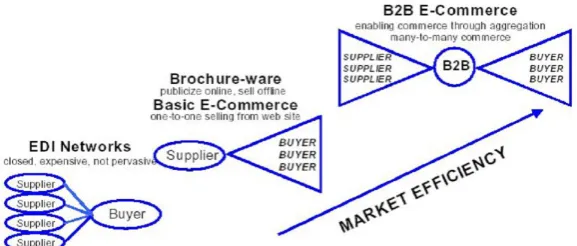
Figure 1 shows the states of B2B commerce in recent years [4]. There are four phases of the evolution:
EDI network: EDI has had a major impact in reducing errors and shrinking processing times for certain
types of transactions—but with significant costs.
Basic commerce: initiated basic e-commerce between buyers and seller without an intermediary. A few
early adopters began pushing their Web sites as a primary sales channel (e.g., Cisco and Dell).
Communities commerce: third-party Web destinations that bring together trading partners into a common
community.
Collaborative commerce (built on communities commerce): Collaborative commerce builds on Phase 3 by
adding support for other business processes before, during, and after the order.
Business-to-Business (B2B) integration is the automated exchange of information between different organizations. Occurring independent of or alongside manual process, it is most accurately described as application-to-application integration that crosses corporate boundaries, as depicted in Figure 2 Increasingly, this integration is being done over the Internet, rather than over proprietary Value Added Networks (VANs), and the dominant trend is towards the use of open standards such as XML and HTTP, rather than proprietary protocols that are not well suited to the Internet. B2B integration improves external processes such as supply chain integration or shipping/logistics tracking by enabling rapid, cost-effective real-time links between business partners [5].
Figure 2 - B2B Integration
2.2 Using XML Vocabulary to Converge the Communities
XML is only a syntax for the exchange of data and text-oriented documents; yet we need more than a common syntax for successful communication. Communication requires shared models of both the underlying domain semantics, and the processes and policies used to engage in electronic commerce [6]. These models are the very essence of B2B integration. They may be implicit in the applications that process the XML documents; or they may be explicit in definition of the model’s concepts, relationships, and constraints. In practice, the models are defined both implicitly and explicitly. There are three aspects of modeling B2B communication [7]:
Modeling system requirements with use cases.
Modeling processes and communication policies.
Modeling business vocabularies.
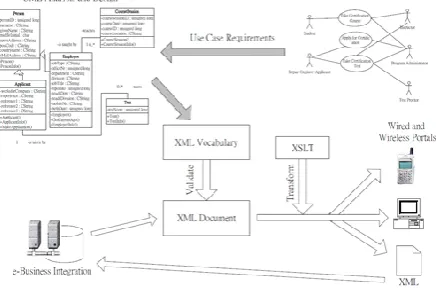
Figure 3 shows the three aspects of modeling B2B communication. First, define the roles of stakeholders and the use case actors who are involved in B2B interactions. Second, adopt UML class diagrams to analyze and design the XML vocabularies. Third, use XML vocabularies to do e-business integration issues or using XSLT to transform for presentation [8].
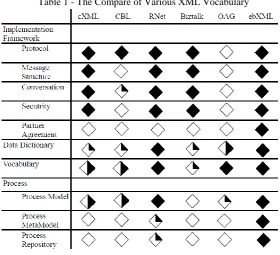
XML is becoming widely used for representing both the process and the content information when deploying models [9]. Process information includes the messaging infrastructure and workflow control that guides the process execution. Many B2B processes are asynchronous and long running, so the XML-based message header information identifies the parties, process, and purpose of the message [E]. Table 1[10] shows the business vocabularies define the heart of the message—its content.
Table 1 - The Compare of Various XML Vocabulary
2.3 ebXML E-Business Collaboration
The strength of the ebXML technical architecture is that it provides a framework for electronic business collaboration. The architecture enables businesses to work together to specify business process, discover each other, negotiate collaboration agreements, and execute business processes [11]. The significant activities implementing and executing this ebXML electronic business collaboration are shown in Figure 4. The overall process starts with Process Definition, utilizing Business Process and Business Document Analysis and logically progresses to Partner Discovery, Partner Sign-Up, Electronic Plug-in, Process Execution, Process Management, and Process Evolution [12].
Figure 4 - ebXML Business Collaboration Process
3 SYSTEM ARCHITECTURE
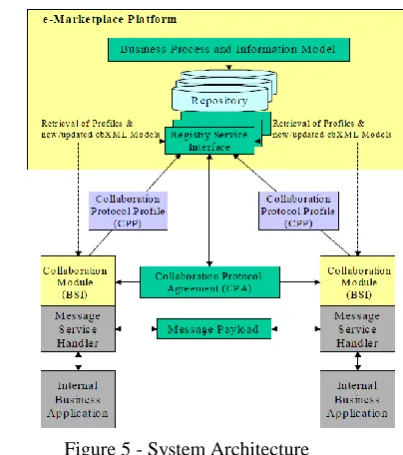
In order to deal with B2B collaboration, the whole ebXML Technical Architecture provide a reference mode to build the collaboration module. In this study, we call Business Service Interface (BSI) as Collaboration module. We only focus on the functionality of BSI and how it will perform in the context of an ebXML compatible architecture.
The system architecture is composed of four main components including:
Business Process and Information Model
Repository and Registry Service Interface
Collaboration Protocol Profile(CPP) and Collaboration Protocol Agreement(CPA)
Figure 5 - System Architecture
Figure 5 illustrates the main functional components of the ebXML compatible system architecture that can meet the business collaboration requirement.
3.1 Business Process & Information Model
The ebXML Business Process Specification Schema (ebXML BPSS) defines how business processes are described. Business Processes represent the "verbs" of electronic business and can be represented using modeling tools, as shown in Figure 3.2. The specification for business process definition enables an organization to express its business processes so that they are understandable by other organizations [13]. This enables the integration of business processes within a company, or between companies.
The Information models define reusable components that can be applied in a standard way within a business context. These Core Components represent the "nouns and adjectives" of electronic business, as shown in Figure 6. They are defined using identity items that are common across all businesses. This enables users to define data that is meaningful to their business while also maintaining interoperability with other business applications.
Figure 6 - Relationship of Business Process and Core Component
3.2 Registry & Registry Service Interface
The Registry and Repository provides a number of key functions. For the user (application) it stores company profiles and Trading Partner specifications. These give access to specific business processes and information models to allow updates and additions over time. For the application developer it will store not only the final business process definitions, but also a library of core components.
The ebXML Registry provides a set of services that enable sharing of information between interested parties for the purpose of enabling business process integration between such parties based on the ebXML specifications. The shared information is maintained as objects in a repository and managed by the ebXML Registry Services.
3.3 Collaboration Protocol Profile and Collaboration Protocol Agreement
The exchange of information between two Parties requires each Party to know the other Party's supported Business Collaborations, the other Party's role in the Business Collaboration, and the technology details about how the other Party sends and receives Messages. In some cases, it is necessary for the two Parties to reach agreement on some of the details.
The way each Party can exchange information, in the context of a Business Collaboration, can be described by a Protocol Profile (CPP). The agreement between the Parties can be expressed as a Collaboration-Protocol Agreement (CPA).
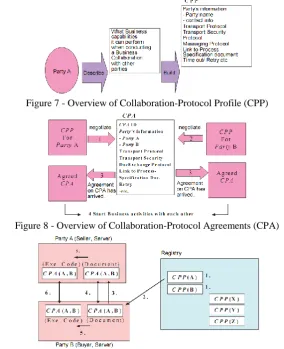
Figure 7 illustrates forming a CPP. Party A tabulates the information to be placed in a repository for the discovery process, constructs a CPP that contains this information, and enters it into an ebXML Registry or similar repository along with additional information about the Party. The additional information might include a description of the Businesses that the Party engages in. Once Party A's information is in the repository, other Parties can discover Party A by using the repository's discovery services. In Figure 8, Party A and Party B use their CPPs to jointly construct a single copy of a CPA by calculating the intersection of the information in their CPPs. The resulting CPA defines how the two Parties will behave in performing their Business Collaboration. Figure 9 illustrates the entire process. The steps are listed at the left. The end of the process is that the two Parties configure their systems from identical copies of the agreed CPA and they are then ready to do Business.
Figure 7 - Overview of Collaboration-Protocol Profile (CPP)
Figure 8 - Overview of Collaboration-Protocol Agreements (CPA)
Figure 9 - Overview of Working Architecture of CPP/CPA with ebXML Registry
3.4 Collaboration Module and Message Service Handler
Interface (BSI). The ebXML Business Process Specification Schema is used to specify the business process related configuration parameters for configuring a BSI to execute these collaborations. The ebXML concept of a business transaction and the semantics behind it are central to predictable, enforceable commerce [15]. It is expected that any BSI will be capable of managing a transaction according to these semantics.
ebXML does not specify how these transaction semantics are implemented but it is assumed that any Business Service Interface (BSI) will be able to support these basic transaction semantics at runtime. If either party cannot provide full support, then the requirements may be relaxed as overrides in the CPP/CPA.
4 SYSTEM IMPLEMENTATION
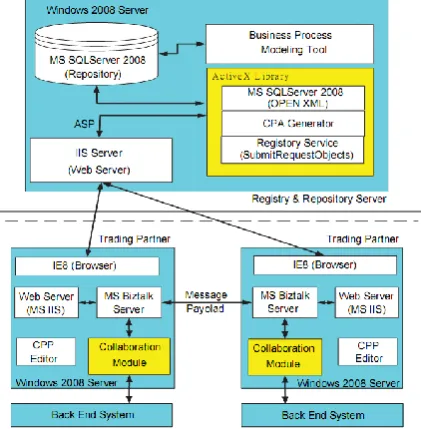
Figure 11 shows our implementation framework prototype of ebXML compatible collaboration module. In this framework, we focus on the implementation of design time and run time.
The Design Time artifacts enable the Run Time systems to execute the agreed business processes. Business processes and business documents are defined during the Business Process and Business Information Analysis activity. The Business Process Specifications for the defined Business Processes and Business Documents which contain catalogs of Business Processes and Business Information Objects (document components).
Figure 11 - Implementation Framework
The business process modeling tools results in an ebXML Business Process Specification, which MAY be referenced in the Collaboration Protocol Profiles (CPPs), of businesses and form the basis for Collaboration Protocol Agreements (CPAs) established between business parties. Ultimately, the business processes specified in the CPAs drive the business service interfaces to execute those processes and send the REQUIRED documents.
4.1 Using Business Process Modeling Tool
Business process models define how business processes are described. Business processes represent the “verbs” of electronic business and can be represented using modeling tools. The specification for business process definition enables an enterprise to express its business processes so that they are understandable by other enterprises. This enables the integration of business processes within an enterprise or between enterprises.
Figure 12 - Using BindPartner Collaboration Designer to Model Business Process
4.1 Creating Collaboration Module
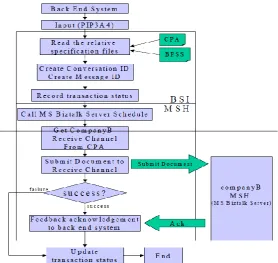
BSI will be able to support the basic transaction semantics at runtime. In our collaboration module, we use the BSI and Message Service Handler (MSH) to monitor the states of business collaboration and to perform the business activities. Figure 13 illustrates the flowchart of BSI and MSH (MS Biztalk Server). Assuming that Company A (the buyer) want to send a business document (PIP3A4) to Company B (the seller). It will perform in following steps.
Step1. The Internal application wants to send a PO (PIP3A4) to companyB. It calls BSI to perform this business activity.
Step2. BSI load the relative specification documents such as CPA, BPSS. According to BPSS, it creates
new business transaction information and records it as a start status. BSI create ConversationID and MessageID to assign the MS document for passing to MSH later.
Step3. Calling the MS Biztalk XLANG Schedule file that described in section to start to initialize the
transporting parameter.
Step4. According to the content of CPA, the Endpoint element specifies the Party’s communication
addressing information associated with ReceiveProtocol element (Figure 14).
Step5. When submit successfully, it will return the acknowledge DOM object. The acknowledge DOM
object is created by CompanyB’s receive service.
Step6. When we receive the acknowledgement, we can pass it to the back end system to do farther
processing about this transaction.
Step7. BSI will monitor the state of business collaboration and launch the appropriate reaction to perform
until success or failure.
Step8. No matter the return is success or failure, BSI will record the result of the collaboration (Figure 15).
Figure 14 - Generate CPA from Two CPPs
5 CONCLUSION
Online markets, also known as B2B marketplaces, are commerce sites on the public Internet that allow large communities of buyers and suppliers to “meet” and trade with each other [16]. They present ideal structures for commercial exchange, achieving new levels of market efficiency by tightening and automating the relationship between supplier and buyer. They allow participants to access various mechanisms to buy and sell almost anything, from services to direct materials.
In this study, we had surveyed the situation happened in EC, e-Marketplace development, and the lack of B2B integration across trading partner, etc. We try to build an ebXML compatible collaboration module to provide a solution for this kind of problems. ebXML is a complete set of specifications to enable, global, electronic business using proven, open standards such as TCP/IP, HTTP, and XML. ebXML is also evolutionary in nature designed to work with existing EDI solutions, or be used to develop an emerging class of Internet-based electronic business applications based on XML.
In this study, we use collaboration mechanism that was defined in ebXML Business Process Specification Schema [17] to deal with the B2B integration issues in e-Marketplace. We hope the trading partners, either the buyers or sellers, can find their appropriate partners more easily and perform smoothly business messages exchanging and processes interaction.
REFERENCES
1. Efraim Turban, Jae Lee, and David King (2000). Electronic Commerce: a Managerial Perspective,
Prentice Hall.
2. Michael Fitzgerald, Building B2B Application with XML, John Wiley & Sons, 2001.
3. Morgan Stanley Dean Witter, The B2B Internet Report, April 2000, http://www.morganstanley.com.
4. WebMethods White Paper, B2B Integration: The Drive to Gain and Maintain Competitive Advantage,
May 2000, http://www.webmethods.com.
5. J.-S Lee, Y.-F. Chang and C.-C. Chang (2008). Secure authentication protocols for mobile commerce
transactions, International Journal of Innovative Computing, Information and Control, vol.4 no.9, pp.2305-2314.
6. David Carlson (2001), Modeling XML Application with UML, Addison-Wesley.
7. F. Lampathaki, S. Mouzakitis, G. Gionis, Y. Charalabidis, and D. Askounis (2009). Business to business
interoperability: A current review of XML data integration standards. Computer Standards & Interfaces, vol.31, no.6, pp.1045-1055.
8. T.-P. Chang, C.-H. Yeh (2011), A graph-based concurrency control protocol for XML metadata
knowledge bases, International Journal of Innovative Computing, Information and Control, vol.7, no.6, pp.3317-3329.
9. ebXML (2002). Message service specification version 2.0. http://www.ebxml.org/specs/ebMS2.pdt
10.Chung-Ping Liang, Development of Electronic Commerce Standard,
http://taiweb.compaq.com.tw/cmain/news/d_file.asp.
11.Gibb, B.K., & Damodaran, S. (2002). ebXML: concepts and application. New York, USA: John Wiley
& Sons.
12.Y. Kabak, and A. Dogac (2010), A survey and analysis of electronic business document standards,
ACM Computing Surveys, vol.42, no.3, pp.1-31.
13.P.F. Green, M. Rosemann, and M. Indulska (2005), Ontological evaluation of enterprise systems
interoperability using ebXML. IEEE Transactions on Knowledge and Data Engineering, vol.17, no.5, pp.713-725.
14.ebXML (2001). OASIS ebXML registry information model v2.0.
http://www.ebxml.org/specs/ebrim2.pdf
15.N.-W. Lo and K.-H. Yeh, A novel authentication scheme for mobile commerce transactions,''
International Journal of Innovative Computing, Information and Control, vol.6, no.7, pp.3093–3103, 2010.
16.E. Kajan, and L. Stoimenov, Toward an ontology-driven architectural framework for B2B.
Communications of the ACM, vol.48, no.12, pp.66-72, 2005.
17.ebXML (2001). ebXML business process specification schema version 1.01.