* To whom all correspondence should be addressed. Mob.: +91- 9884003428;
E-mail: [email protected],
An Intervention Study to Combat Iron Deficiency
Anaemia in Adolescent Girls - Food Fortification Strategy
E. Lakshmi, Parvathy Easwaran and E. Saraswathy
1Depatment of Nutrition,S.R.M. College of Nursing,S.R.M University 2Sri Avinashilingam Deemed University-HomeScience, Coimbatore, India.
http://dx.doi.org/10.13005/bbra/2144
(Received: 02 March 2016; accepted: 26 April 2016)
The study aimed at assessing the impact of nutrition education and intervention with a novel iron rich fortified beet-root extract among adolescent (12-18yrs) girls on the haemoglobin level and clinical symptoms related to nutritional iron deficiency anaemia. 80 study participants (Haemoglobin <9gm/dl) were randomly assigned to two study groups. 150ml of fortified beetroot extract was served to each of the interventional subject on every alternate days for three months(45days). Control group was served with a placebo. Nutrition education was given to the study participants(n=80). Haemoglobin(cyanmethaemoglobin) and clinical assessment on nutritional iron deficiency anaemia assessed . one way anova and students paired ‘t’ test was performed. Hypothesis was tested at 95 per cent confidence interval. Results: Conjunctival- paleness declined from seventy five percent (n=15) at the pre-test (13-15yrs) level to 5 per cent(n=1),with a significant (t=18.47, p< .0001) impact(16-18yrs) in the mean haemoglobin level. Conclusion: Fortified beet-root extract intervention had high impact on the nutritional status and blood profile. School girls model was found to be an effective intervention strategy to reach the susceptible population.
Key words: Fortification, Iron deficiency anaemia ,Intervention, Placebo.
Iron deficiency anaemia is one of the most common nutritional disorder in developing country like India. Chronic anaemia in adolescents when associated with severe micronutrient deficiency may affect school performance and physical work capacity1. The haemoglobin count in most of the
adolescent girls in india is less than the standard (12 g/dl) accepted worldwide2. Widespread
prevalence of anaemia in adolescent girls is gaining increased recognition. Adolescent girls are stated as important beneficiary group in national and state level nutrition policy3,4. This has resulted in various
programmes to combat under nutrition and iron
deficiency anaemia in recent years in this group. Though iron and folic acid supplementation remains the corner stone in treatment of anaemia nutrition education and food supplementation are long term measures in preventing the recurrence. Food based approaches are gaining high potential for long lasting benefits in improving nutritional status of folate and serum iron status. Fortification of a micronutrient poor staple food with a micronutrient dense food is an under explored strategy5. For effective food
is possibly the best natural remedy for anaemia. Folate, a major form of iron in beet-root is a novel and natural alternative to iron supplementation. Beet-root provides 37per cent of daily requirement of folate and 6per cent of iron7.
The study aimed at assessing the impact of nutrition education and intervention of a novel iron rich fortified beet-root extract among adolescent (12-18yrs) girls of nutritional iron deficiency anaemia.
MATERIALS AND METHODS
The study protocol was approved by the research committee of Sri Avinashilingam deemed university. Government- aided girls school at zone x(mylapore) of Chennai city was selected and designed to include eligible adolescent students in the age group of 12 – 18 years. Consent was obtained from school authorities, students and parents. They were briefed about the supplementation study with fortified beetroot extract and collection of blood through letter and meetings.
Sample Size
A double blind placebo control randomised trial was followed. 118 adolescent students (12–18 yrs) were screened for baseline haemoglobin (cyanmethaemoglobin method) with the help of trained biochemist. 98 adolescents were found to be anaemic (Haemoglobin <9gm/dl). The inclusion criteria for the supplementation study consists of those willing to participate in the study with haemoglobin leveld” 9gm/dl. The exclusion criteria was those unwilling to participate in the study, haemoglobin leveld” 5mg/dl and subjects allergic to beetroot extract. After several stages of inclusion and exclusion criteria 80 study participants were randomly assigned to two study groups. The intervention group 12 -15yrs (n=20), control 12 -15yrs (n=20)and intervention group16– 18yrs (n=20), control 16– 18yrs(n=20). The participants were appraised of anaemia and the importance of fortified beetroot extract in combating anaemia through nutrition lecture.
Product Development
Idea generation and screening of ideas were the initial step in product development using food-to-food fortification strategy. After a series of trials using ingredients in various proportion
the concept of the enriched product took shape. Beetroot(fresh)
↓
Washed and cut to pieces (1kg) ↓ + Ginger( 10gms)
Crushed(Food mixer)
↓
Pulp+Water (2lit) w/v: 1:2
↓
Freshlime juice ( 30ml) +sugar
↓ To prevent oxidation of vitamin C add at the time of consumption.
Fortified Beetroot Extract. 2000ml of extract contains 1000gms beetroot 100ml contains 50gms beetroot
150ml contains 75gms beetroot
Intervention
Helminthes infection is an important contribution to anaemia.The study participants were dewormed (Bitter-gourd).150ml of beetroot extract was given to each of the intervention subject on every alternate days for three months (45days). In rare cases some people observe beeturia (red urine) after consumtion of beetroot in any form, while it is not a problem but an indicator of defect in iron metabolism8. The control group were served
with a placebo containing fruit essence in water sweetened with sugar..Nutrition education was given to all the study participants (n=80).
Haematology and Assessment
The haemoglobin (cyanmethaemoglobin) was estimated every month. The study participants were screened for clinical symptoms related to nutritional iron deficiency anaemia based on standard WHO (1963) procedure.
Statistical analysis results
Consists of performing one way anova to test the hypothesis that the mean at period of interval differ. Students paired ‘t’ test was performed to analyse the difference between pre and post intervention datas.Hypothesis testing was done at 95 per cent confidence interval.
RESULTS
Table 1(a). Clinical assessment on nutritional status of adolescent girls
13-15Years
S. Factors Intervention (n=20) Control(n=20)
No Pre-test Post-test Pre-test Post-test
No Percent No Percent No Percent No Percent
1 Paleconjunctiva 15 75 1 5 14 70 11 55
2 Angular stomatitis 7 35 - - 7 35 6 30
3 Cheilosis - - -
-4 Glossitis - - -
-5 Swollen,bleeding gums 3 15 - - 3 15 3 15
6 Loss of luster 11 55 1 5 10 50 9 45
7 Dry brittle hair 11 55 1 5 10 50 10 50
8 Dermatitis 9 45 2 10 12 60 12 60
9 Pallor of skin 10 50 - - 10 50 8 40
10 Brittle nails 11 55 - - 12 60 10 50
11 Dry nails 11 55 1 5 12 60 10 50
12 Dental caries 6 30 2 10 4 20 4 20
Table 1(b). Clinical assessment on nutritional status of adolescent girls
16-18Years
S. Factors Intervention (n=20) Control(n=20)
No Pre-test Post-test Pre-test Post-test
No Percent No Percent No Percent No Percent
1 Paleconjunctiva 16 80 1 5 15 75 11 55
2 Angular stomatitis 8 40 - - 7 35 6 30
3 Cheilosis - - -
-4 Glossitis - - - - -
-5 Swollen,bleeding gums 3 15 - - 3 15 3 15
6 Loss of luster 12 60 2 10 12 60 9 45
7 Dry brittle hair 11 55 1 5 13 65 10 50
8 Dermatitis 10 50 2 10 10 50 12 60
9 Pallor of skin 10 50 2 10 9 45 8 40
10 Brittle nails 11 55 1 5 11 55 10 50
11 Dry nails 11 55 1 5 11 55 10 50
12 Dental caries 5 25 2 10 6 30 4 20
screened with pale-conjunctiva. Fortified beet-root extract intervention for three months (45-days) had clinical significance as the symptoms came down to five percent (n=1). Food to food fortification is a simple and effective way of iron enrichment. Vitamin –C content of lime juice increases the bio-availability of iron from beet-root and helps in regeneration of red blood cells9.
In the control with seventy percent (n=14) symptoms and only nutrition education
conjunctival-paleness persisted in fifty five percent (n=11) adolescents .Angular stomatitis is the real bane and sorrowful symptom in young adolescent girls. Thirty five percent (n=7) of adolescents were screened with the symptoms in the pre-intervention and control group. The impact study clinically nullified the symptoms in the post-intervention stage. If a deficiency for one micronutrient exists it is likely that multiple deficiencies are also present10.
in fifty five percent(n=11) completely diminished to five per cent(n=1) after intervention. The percentage of ionisable iron increases during processing of foods and enhances iron bio-availability. At the pre- intervention stage Paleness of skin observed in fifty percent (n=10) and brittleness of nails in fifty five percent(n=11) adolescents were completely cured with fortified beet-root extract intervention. Drinking beet-root extract helps in healthy and glowing skin.
Post- adolescent (16-18yrs) age group as evident (Table-1b) were susceptible to nutrition related iron deficiency anaemia. Adolescent period is an age of rapid growth stress, strain and peer group influence. Conjunctival- paleness clinically screened in eighty percent (n=16) adolescents declined with fortified beet-root extract intervention(45days) to five percent(n=1). The anthocyanin in beet root is a blue purple pigment similar to chlorophyll capable of enhancing the haemoglobin status.With nutrition education alone in the control the impact was not clinically significant and symptoms was prevalent in fifty five percent (n=11).
Angular stomatitis clinically observed in forty percent of adolescents in the pre-intervention group was absent.in the post- intervention stage. The detoxifying ability of beet-root helps in curing skin problem and helps to hydrate the skin. Symptoms like dermatitis and paleness of skin clinically was present only in ten percent (n=2) after intervention. Iron availability is influenced by the adequacy of intestinal secretions, various components in foods and the degree of iron deficiency of the individual11. The nail colour was
seen brighter in the interventional group. Lack luster hair observed in sixty percent (n=12) of the intervention group declined significantly to five percent (n=1).
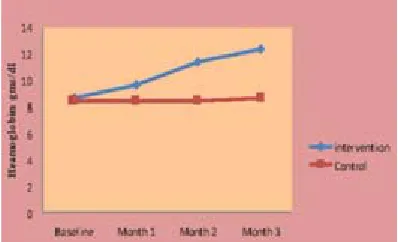
Significant increase in the mean haemoglobin level (Table-2) was observed across different age groups with fortified beet-root extract intervention. In the pre- adolescent (13-15years) age group the baseline mean haemoglobin value of 8.73±0.68 improved significantly. Towards the first month(15days) the iron status reached 9.56±0.67. The deficiency of iron is not always due to absolute lack of the element in the diet but rather due to its poor bioavailability.
After three months (45days) of
T
able 2.
Mean serum heamoglobin values of adolescents
Groups First Month Second Month Third Month Mean W H O Baseline 1 5 days 30 days 45 days diff T v a lu e 1992 Experimental(13-15yrs) A 1 8.73±0.68 9.56±0.67 11.46±0.65 12.29±0.46 3.6±0.36 20.62 P<.0001 1 2 – 1 4 Control(13-15yrs) B 1 8.62±0.44 8.73±0.53 8.8±0.48 8.88±0.51 0.26±0.11 4.77 P = 0 .0 0 0 7 gms/dl A1 vsB 1 :26.96 P<.0001 Experimental(16-8yrs) A2 8.55±0.46 9.6±0.82 11.43±0.49 12.44±0.70 3.9±0.38 21.15 P <.0001
Control(16-18yrs) B
Fig. 1. Mean Heamoglobin value (13-15 years) Fig. 2. Mean Heamoglobin value (16-18 years)
intervention haemoglobin level improved to 12.29 ±0.46 (Figure 1). Compared to oral iron, fortified food supplementation is a sustainable strategy to maintain blood haemoglobin level even after cessation12. The mean difference between the
baseline and post- test level was highly significant (t=20.62, p<.0001). The addition of certain vegetables or fruits containing ascorbic acid can double or triple iron absorption thereby counteracting the effects of the iron inhibitors. The impact of fortified beet-root extract had statistically high significance (t=26.96,p<.0001) in the intervention group as compared to the control.
A review of Indian studies on anaemia revealed that more than seventy percent of adolescent girls in the low socio-economic communities had haemoglobin level less than 9gms/dl13. In the post- adolescent (16-18yrs) age
group the baseline mean haemoglobin value of 8.55±0.46 gradually improved with fortified beet-root extract to 9.6±0.82 in the first month (15days) and thereafter to 11.43±0.49 in the second month(30days). Home food processing is a natural way of increasing the iron bio-availability. It includes fortification,soaking, germination, fermentation and malting of grains. They help to activate phytases that break down phytic acid, the important anti-nutrient that inhibits iron absorption14. After fourty five days of intervention
the mean haemoglobin level improved to 12.44±0.70 (figure 2).The mean difference (3.9±0.38) was statistically significant (t=21.15,p< .0001). Beet-root is known to be a good home remedy for menstral disorders and menopause symptoms.
In the control group with only nutrition education the mean difference(0.15±0.12) between
the baseline haemoglobin and the third month intervention was not significant (t=2.64,p=.0161). cereals are only fair source of iron, hence iron rich foods are to be included in the diet to fulfill the requirements. Fortified beet-root extract intervention for three months (45days) had significant (t=18.47, p< .0001) impact on the mean haemoglobin level compared to control.
DISCUSSION
The study explored an alternative strategy to supplement iron in adolescent school girls with iron deficiency anaemia. Fortified beet-root extract intervention on alternate days for three months (45days) was statistically and clinically significant.It had a high impact on clinical symptoms related to nutritional iron deficiency anemia and blood haemoglobin status. Symptoms like bleeding gums and paleness of skin and dermatitis (13-15yrs) clinically subsided after intervention. The nail colour was seen enhanced in both age groups. The antioxidant property of beet-root helps to scavenge free radicals to prevent aging, cancer and reduce blood pressure to help the muscles in uptake of oxygen15.
jain-2013 with two iron enriched variants each of biscuit, handwa, idli and soy chat. The majority of the population in india rely on plant foods for most of the nutrients. The availability of iron from these plant sources are very low. Low dietary intake of iron, excess menstral flow and stress of education are the leading causes of high prevalence of IDA in this age group. The haemoglobin level improved significantly each month in both the groups. Beet-root extract is the best natural remedy for anaemia and the bio-availability of iron can be enhanced by fortification with lime juice containig vitamin-c. Each meal preferably should contain at least 25 mg of ascorbic acid and possibly more if the meal contains many inhibitors of iron absorption.. Beet-root is to be used only in its raw state as the betalin in beet-root when cooked is reduced and oxalic acid crystals are released forming calcium stones. Fortified beet-root extract intervention with nutrition education can improve the haemoglobin level and nutritional status of adolescents.
A change from pill to natural food is a difficult challenge but should be considered as the best and most natural solution for iron deficiency anaemia.
CONCLUSION
Fortified beet-root extract supplementation on alternate days along with nutrition education proved its potential of improving the nutritional status, haemoglobin level and circulating iron index. As compared to oral iron, fortified food supplementation is a sustainable strategy to maintain blood haemoglobin level even after cessation. School girls model was found to be an effective intervention strategy to reach the susceptible population.
ACKNOWLEDGMENTS
The author wishes to acknowledge the help rendered by the school staff, students and the Bio chemist in completing this project.
REFERENCES
1. Kotecha, P.V., Nirupam, S., Karkar, P.D. Adolescent girls’ anaemia control programme, Gujarat, India. Indian Journal of Medical Research; 2009
2. International institute for population sciences, Deonar, Mumbai, Maharashtra, India .National Family Health Survey Report; July 17, 2008. 3. National nutrition policy,New Delhi: Health and
Family Welfare Department, Government of India;1993.
4. Tamil Nadu state nutrition policy; 1982. 5. Monika Jain. Combating iron deficiency anaemia
through food-to-food fortification: recipe development, iron bioavailability and effect of supplementation. International Journal of Food and Nutritional Sciences; 2013; 2(1).
6. Brian.Thompson.Food-based approaches for combating iron deficiency.Food and Agriculture Organization (FAO); Rome, Italy.
7. Lilian Hoagland Meyer. Food chemistry, Avi Publishing Company;1974; 3: 46-48.
8. Walter, W.T; Charles,S; Frank, A.O. Beeturia A Sign of Iron Deficiency. Am J Dis Child; 1969;
117(4): 424-426.
9. Shruti Pandey., Vasudeva Singh. Food fortification to combat iron deficiency anaemia. International Journal of Advanced Nutritional and Health Science; 2013; 1(1): 39-47. 10. Demaeyer, E.M. A guide for health
administrators and programme managers. World health organization, Geneva, 1989, Reprinted, 1990.
11. Mittal, M.B; Abhay, R. S; Yadunath, M.J; Vilasrao, J. K. An intervention on iron deficiency anemia and change in dietary behavior among adolescent girls. International Journal of Pharmacy and Pharmaceutical Sciences; 2011; 3(1). 12. Richard, F.H. Prevention of iron deficiency by
food fortification.Nutrition Reviews; 1997; 1. 13. Nutritional anaemia. Report of a WHO Scientific
Group,Technical Report Series No405,Geneva: World Health Organization; 1968.
14. Sujata, V. P; Prakash, M. D; Satish,V.K; Shruti,D. An assessment of interventional strategies for control of anemia among adolescent girls in an urban slum of karad,dist. satara, Maharashtra.
Al Ameen Journal of Medical Science; 2014;
7(3): 195-200.