
Study on Activated from Melon (
Citrullus lanatus
) Husk as
Natural Adsorbent for Removal of Hardness in Water
Mustapha S.1,*, Ndamitso M. M.1, Mohammed U. M.2, Adeosun N. O.3, Idris M.4
1Department of Chemistry, Federal University of Technology, Minna, Nigeria 2Department of Chemistry, Federal College of Education, Kontagora, Nigeria 3Department of Chemistry, Federal College of Education (Technical), Asaba, Nigeria 4Department of Primary Education Studies, Federal College of Education, Kontagora, Nigeria
Abstract
Batch adsorption process using activated melon (Citrullus lanatus) husk was studied to remove hardness (Ca2+ and Mg2+) from water sample. The adsorption of the metal ions was investigated by varying the adsorbent dose, contact time, solution pH and solution temperature. Experimental results showed that optimum times required for adsorption were 20 min for Ca2+ and 25 min for Mg2+. Also adsorption of the two metal ions increased with increasing adsorbent dosages. Thermodynamic parameters such as ∆Gθ, ∆Hθ, ∆Sθ and E
a have been computed. The data showed the higher solution
temperature values favoured the hardness removal by activated melon husk. It also revealed that the sorption process was spontaneous and exothermic in nature. The activation energy (Ea) and sticking probability (S*) were used to assess
physisorption mechanism between the adsorbate and adsorbent. The results showed that activated melon (Citrullus lanatus) husk is an alternative absorbent for the removal of Ca2+ and Mg2+ ions from hard water.
Keywords
Hardness, thermodynamic, sorption, Citrullus lanatus1. Introduction
Wastes are arbitrarily disposed into the water bodies by industrial and household activities in some parts of the countries. The increase in water quality parameters such as heavy metals, nutrients and organic matter is as a result of the contamination of coastal and inland water bodies by generated wastes [1]. In some cases, water resources do not satisfy the desirable qualities regarding hardness and conductivity [2].
Calcium and magnesium are dominant divalent ions responsible for water hardness [3, 4] and problems of such water include scaling in boilers, washing machines and pipes [5], difficult lathering with soap, undesirable spots on sinks and clothes as well as toughening of skin and hair [6].
The determination of electrical conductivity provides a rapid and convenient means of estimating the concentration of electrolytes in water containing mostly mineral salts [7]. Calcium and magnesium play vital roles in the structure and functions of the human body. High intake of calcium and magnesium in drinking water could result in symptoms of toxicity such as a kidney stones [8], gastric and breast cancer, low blood pressure, muscle weakness, confusion and abnormal cardiac rhythm [9]. Therefore, the need to purify
* Corresponding author:
[email protected] (Mustapha S.) Published online at http://journal.sapub.org/aac
Copyright © 2016 Scientific & Academic Publishing. All Rights Reserved
water which is not suitable for human consumption such as hard water cannot be overemphasized.
Over the years, conventional methods such as electro- dialysis [10], ion-exchange [11], lime softening [12] and membrane filtration [13] have been studied for the removal of ionic species responsible for hardness. It is obvious that hard water treatment by these methods required high capital operations. Hence, finding inexpensive and efficiency developed processes remains a major concern. Adsorption process has become a promising approach for water treatment [14]. For the purpose of removing hardness ions from water, various adsorbent materials have been used such as Moringa oleifera [15, 16], Peanut hull [17], pumice [18] and Phyllanthus emblica [19].
2. Materials and Methods
Water sample obtained from a river in Kaduna metropolis, Nigeria was collected and parameters such as total solids, total dissolved solids, alkalinity, hardness, conductivity and turbidity was determined by standard methods described by [20] with slight modification.
Total Hardness
50 cm3 of sample was measured in an Erlenmeyer flask. 1 cm3 of ammonia buffer solution and 2 drops of Erichrome black-T indicator were added. The mixture was titrated with 0.01 M EDTA solution until the wine red colour of solution turns blue.
Total Hardness (mg/L) = T ×1000V (1) Where, T = volume of titrant (cm3); V = volume of sample (cm3).
Calcium
50 cm3 of sample was measure in an Erlenmeyer flask. 1 cm3 of 1 M sodium hydroxide solution and pinch of murexide (ammonium purpurate) indicator were added. The mixture was titrated with 0.01 M EDTA solution until the pink colour turns purple
Calcium Hardness (mg/L) = T×1000×1.05V (2) Where, T = volume of titrant (cm3); V = volume of sample (cm3).
Magnesium
The value magnesium content was calculated as given below:
Magnesium (mg/L) = (T − C) × 0.243 (3) Where, T = total hardness (mg/L, as CaCO3);
C = calcium hardness (mg/L, as CaCO3) Alkalinity
50 cm3 of sample was measured in a flask and 2 drops of phenolphthalein indicator was added. The mixture was titrated with 0.02 M H2SO4 until the solution became colourless.
Total Alkalinity =P×1000V (4) Where, P = volume of titrant used; V = volume of sample (cm3).
Total Dissolved Solid (TDS)
A clean evaporating dish was heated to 180°C for 1 hour in a drying oven and cooled in a desiccator. The water sample was stirred with magnetic stirrer and 50 cm3 pipetted into a glass fiber filter with applied vacuum. It was washed with three 10cm3 volumes of distilled water, allowing complete drainage between washings and continued suction for 3 minutes after complete filtration. The total filtrate was transferred into a cooled evaporating dish and evaporated to dryness on a steam bath. The dish and sample was oven dried at 180°C for 1 hour, cooled in desiccator and weighed. The process of drying, cooling, desiccating and weighting was
repeated until constant weight was attained.
mg Dissolved solids/L =(A−B)×1000V (5) Where, A = weight of dried residue + dish, mg; B = weight of dish, mg.
Total Suspended Solids (TSS)
The same procedure as mentioned above was used to determine the total solids (TS) but the sample was not filtered.
TSS = TDS − TS (mg L⁄ ) (6) Dissolved Oxygen (DO)
200 cm3 of a glass stoppered BOD bottle was filled with water sample. 1 cm3 f MgSO4 followed by 1 cm3 of 0.0021 M alkaline potassium iodide solution were added. The bottle was shaken thoroughly and allowed to stand for few hours. 2 cm3 of H2SO4 solution was added and shaken thoroughly to dissolve the precipitate. 50 cm3 f the content was transferred into a conical flask and 2 drops of starch indicator was added. The mixture was titrated with 0.025 M Na2S2O3 solution until the blue colour turns to colourless.
DO (mg L⁄ ) =V1×0.025×8×1000
V2−V3 (7)
Where, V1 = volume of tyrant (cm3); 𝑉𝑉2= volume of
sampling bottle after placing the stopper; V3= volume of
manganous sulphate + potassium iodide solution (cm3). Electrical Conductivity (EC)
The sample was measured using electrical conductivity meter at 25°C.
Electrical conductivity (ms cm⁄ ) = Cm×Kc
0.0191(t−25)+1 (8)
Where, Kc= the cell constant, cm1 ; Cm=measured
conductance of the sample; t = observed temperature of the sample, °C.
2.1. Preparation of the Adsorbent
Melon husk was washed several times with deionized water before use in order to remove impurities. The adsorbent was then treated with 0.5 M solution of H2SO4 for further purification. It was then washed with deionized water to remove the acid. The melon husk was then dried dehydrated at 55°C for 24 hours in an oven. The dried sample was milled and sieved to obtain 200 micrometer fraction. The sample was then carbonized in an electric furnace at 550°C for 15 min. The activated carbon produced was washed with deionized water and later oven dried before use.
2.2. Batch Experiments
mass of 0.5 g per 0.04 dm3 of solution. The mixture was then shaken at 180 rpm at different predetermined time intervals and filtered. The percentage adsorption was determined as:
Adsorption (%) = (Ci− Ce)
Ci × 100 (9)
The adsorption measurements were measured using following relation:
qe= (Ci− CMe)V (10)
Where Ci is initial concentration of metal uions in the
solution (mgdm-3) C
e is the equilibrium concentration or
initial concentration of metal ions in the solution (mgdm-3),
V is the initial volume of metal ion solution used (dm3) and
M is the mass of adsorbent (g). 2.3. Thermodynamic Studies
Thermodynamic parameters were determined for temperatures ranging from 30 to 70°C using the equilibrium constant Kc= �qCee�. The standard change in free energy
(∆Gθ) was determined as follows:
∆Gθ= −RTlnK
c (11)
Where ∆Gθthe standard free energy (kJ/mol), R is is the gas constant (8.314 J/molK) and T is temperature (K).
ln Kc=∆SR −∆HRT (12)
The parameters of standard enthalpy, ∆Hθ, and standard entropy, ∆Sθ, were calculated from the slope and the intercept of the linear plot of lnKc against T1.
3.
Results and Discussion
3.1. Physicochemical Properties of Water Sample
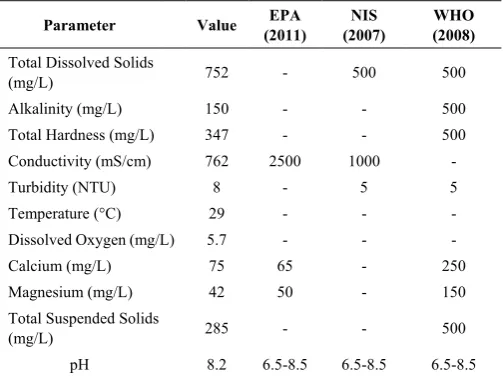
Table 1, presents the physical parameters obtained from the analysis of the water sample from Kaduna urban area, Nigeria. Total dissolved solids (TDS) which measure the dissolved matter such as salts, organic matter and minerals in water were determined and the results show that the value of TDS was 752 mg/L. Nigeria Industrial Standard [20] recommended safe permissible limit for total dissolved solids in water is 500 mg/L. The water sample analyzed was considerably above the limit permitted by NIS [21]. Alkalinity aids in estimating the buffering capacity of wastewaters. The estimated value of alkalinity was found to be 150 mg/L. This finding does not corroborate the result reported by Rosal et al. [22], who reported alkalinity of 492 mg/L on effectiveness of wastewater treatment process. The low alkalinity value was due to the absence of dissolved limestone in the area. Hardness in water is due to carbonates, bicarbonates, sulphates and chlorides of Ca and Mg [23]. The recorded value for calcium was 75 mg/L respectively which is higher than standards of Environmental Protection Agency [24]. Water with a total hardness above 180 mg/L is termed hard [25]. Based on the information provided, water sample in this study can be classified as hard water.
Turbidity was higher than the desirable limit of the World Health Organization 5.0 NTU. The increase in value could be associated with the mobilization of accumulated particles (organic and inorganic) from and within distribution networks. Total suspended solid (TSS) content of water depends on the amount of suspended particles related to turbidity of water. The present study recorded 285 mg/L for TSS, which is lower than the WHO guideline [8]. Its presence could be due to disposal of sewage and industrial effluent to the river.
Table 1. Physicochemical parameter of water sample
Parameter Value (2011) EPA (2007) NIS WHO (2008)
Total Dissolved Solids
(mg/L) 752 - 500 500 Alkalinity (mg/L) 150 - - 500 Total Hardness (mg/L) 347 - - 500 Conductivity (mS/cm) 762 2500 1000 - Turbidity (NTU) 8 - 5 5 Temperature (°C) 29 - - - Dissolved Oxygen (mg/L) 5.7 - - - Calcium (mg/L) 75 65 - 250 Magnesium (mg/L) 42 50 - 150 Total Suspended Solids
(mg/L) 285 - - 500 pH 8.2 6.5-8.5 6.5-8.5 6.5-8.5
3.2. Effect of the Contact Time
3.3. Effect of the pH
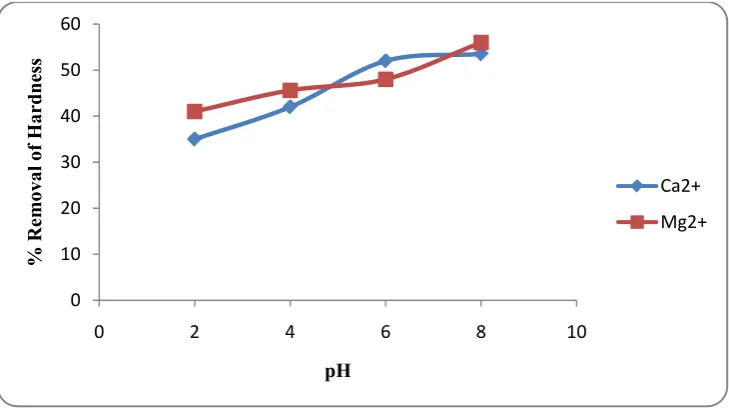
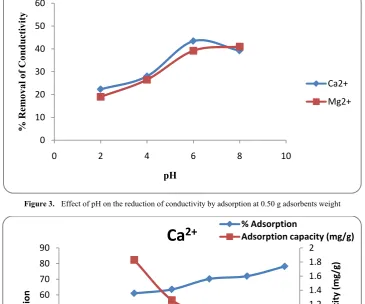
Figures 2 and 3 show optimized pH for the removal of calcium and magnesium ions which were in the range 4-6. The pH of the solution is considered as an essential factor affecting metal adsorption process due to its impact on the degree of ionization of metal specie and the surface charge of the adsorbent [28]. At low pH values (acidic media), protons were available to protonate the active sites of the sorbent surface. While in basic media, cations will begin to precipitate as a result of metal hydroxide and the adsorption rate decreases [29]. Similar results were reported for the removal of calcium using raw sugar cane bagasse modified with tartaric acid and citric acid [30] and in the dynamic study of adsorption isotherms for the effluents [7].
3.4. Effect of Adsorbent Mass
The plot of the percentage adsorption of calcium and
magnesium ions against the adsorbent dosage employed is shown in Figures 4 and 5. These reveal that the amounts of the metal ions adsorbed increased with an increase in the amount of activated melon (Citrullus lanatus) husk from 1.0 g to 3.0 g with 40cm3 of the water sample. It implies that the corresponding removal efficiency increases for both Ca2+ and Mg2+ with increase in adsorbent masses. These increases in the sorption of the amounts of metal ions are due to the existence of larger surface area as well as larger number of active binding sites for the ions. Similar trend was also observed by Saeed and Hamzah [14] who studied and applied commercial polyacrylic acid hydrogel beads for the removal of total hardness from water. It was obvious that at high sorbent dosage, the available metal ions are sufficient to cover the exchangeable sites on the activated melon (Citrullus lanatus) husk which results in high metal ions uptake.
Figure 1. Effect of contact time on the removal of calcium and magnesium ions by adsorption at 0.50 g adsorbent weight and pH 7
Figure 2. Effect of pH on the removal of hardness (Ca2+ and Mg2+) by adsorption at 0.50 g adsorbent weight
0 10 20 30 40 50 60 70
0 10 20 30 40
%
A
dso
rpt
io
n
Contact Time (min)
Ca2+ Mg2+
0 10 20 30 40 50 60
0 2 4 6 8 10
%
R
em
oval
of
H
ar
dn
es
s
pH
Figure 3. Effect of pH on the reduction of conductivity by adsorption at 0.50 g adsorbents weight
Figure 4. Effect of adsorbent dose on the removal of calcium ion by adsorption at contact time 20 min and pH 7.0
Figure 5. Effect of adsorbent dose on the removal of magnesium ion by adsorption at contact time 25 min and pH 7.0 0
10 20 30 40 50 60
0 2 4 6 8 10
%
R
em
oval
of
Con
du
ct
ivi
ty
pH
Ca2+ Mg2+
0 0.2 0.4 0.6 0.8 1 1.2 1.4 1.6 1.8 2
0 10 20 30 40 50 60 70 80 90
0 20 40 60 80
A
ds
or
pt
ion
ca
pa
ci
ty
(mg
/g
)
%
A
dso
rpt
io
n
Solution of dosage (gdm-3)
Ca
2+
% AdsorptionAdsorption capacity (mg/g)0 0.2 0.4 0.6 0.8 1 1.2
0 10 20 30 40 50 60 70 80 90
0 20 40 60 80
A
ds
or
pt
ion
ca
pa
ci
ty
(mg
/g
)
%
A
dso
rpt
io
n
Solution of dosage (gdm-3)
3.5. Effect of Temperature
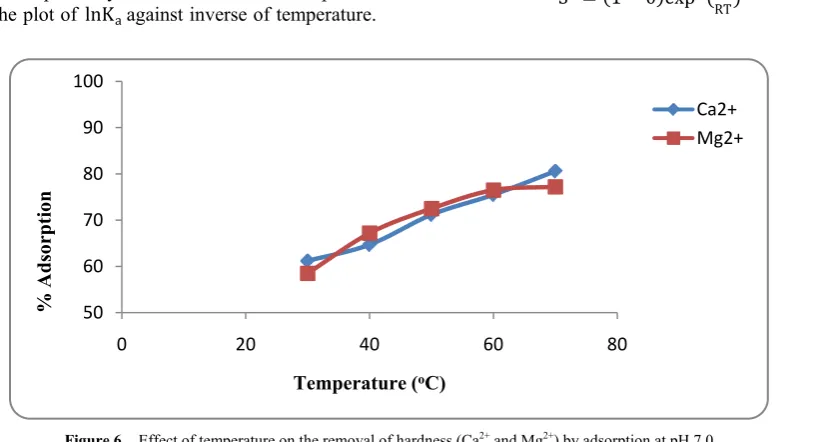
The removal studies were conducted at different temperatures of 30, 40, 50, 60 and 70°C. Temperature plays a major role in the adsorption of heavy metals on the surface of adsorbent and has two major effects on the adsorption process; increase in the temperature increases the rate of adsorbate diffusion across the external boundary layer and in the internal pores of the adsorbate particles as the liquid viscosity decreases with increase in temperature and the other affects the equilibrium capacity of the adsorbate. Figure 6 reveals that the removal of hardness (Ca2+ and Mg2+) increases as temperature increases, this may be due to the increase in ion mobility to the adsorbent. Temperature affects the interaction between the adsorbent and the metal ions which influences the stability of the metal–sorbent complex [31]. Higher temperatures enhance sorption due to the increased surface activities and kinetic energy of the solute. However, physical change can be expected at higher temperatures [32].
3.6. Thermodynamic Parameters of Adsorption
The thermodynamic parameters (standard free energy,
∆Gθ, standard enthalpy change, ∆Hθ and standard free entropy, ∆Sθ) are presented in Table 2. The values of ∆Hθ and ∆Sθ were respectively determined from the slope and intercept of the plot of lnKa against inverse of temperature.
The Gibbs free energy is calculated for adsorption of (Ca2+ and Mg2+) on activated melon (Citrullus lanatus) husk using equation (11). The ∆Gθ values are negative for the metal ions onto the adsorbent which indicates that adsorption is thermodynamically feasible and spontaneous. It was observed that ∆Gθ decreased with temperature and better adsorption was obtained at higher temperatures. The positive values of the standard enthalpy change (∆Hθ) indicates that the adsorption process is endothermic. It was reported by Ozdemira et al. [31] that adsorption of ∆Hθ lower than 40 kJ/mol is physiosorption. It indicates that adsorption is physical by nature and involves weak forces of attraction. The positive value of ∆Sθ shows an increase in the randomness at the activated melon (Citrullus lanatus) husk and wastewater interface during adsorption process. Positive values of ∆Sθ reveal the affinity of the adsorbents for Ca2+ and Mg2+ which suggests some structural changes in the adsorbate and adsorbent. Also, it was observed that correlation coefficient, R2, for magnesium ion was much lower than calcium ion. This showed that adsorption rate of Ca2+ was greater than Mg2+.
The value of activation energy (𝐸𝐸𝑎𝑎) and sticking
probability (S*) were calculated from the experimental data using Arrhenius equation related to surface coverage as expressed in the equation:
S∗= (1 − θ)exp−(Ea
RT) (13)
Figure 6. Effect of temperature on the removal of hardness (Ca2+ and Mg2+) by adsorption at pH 7.0
Table 2. Thermodynamic parameters for the adsorption of Ca2+ and Mg2+ onto the activated melon (Citrullus lanatus) husk
Temp Ca2+ Mg2+
∆G
(kJ/mol)
Ea
(kJ/mol) ∆
S
(kJ/molK)
∆H
(kJ/mol) 𝐒𝐒 ×10
-4 ∆G
(kJ/mol)
Ea
(kJ/mol) ∆
S
(kJ/molK)
∆H
(kJ/mol) S×10
-3
30 -3.27 -1.34
40 -3.57 -1.70
50 -3.88 14.55 30.27 5.90 5.47 -2.05 17.13 35.46 9.40 1.25
60 -4.18 -2.41
70 -4.48 -2.76
50 60 70 80 90 100
0 20 40 60 80
%
A
ds
or
pt
io
n
Temperature (oC)
The linear plot of ln(1 − θ) against 1T with intercepts of lnS and slope of Ea
R were as shown in Figure 8. The
activation energy (Ea) values computed from the slopes of
the plots were found to be 14.55 kJ/mol and 17.13 kJ/mol for Ca2+ and Mg2+ respectively. The positive values of E
a
indicate that higher temperature will favour the removal of the metal ions responsible for hardness (Ca2+ and Mg2+) on the activated melon (Citrullus lanatus) husk which signifies the endothermic nature of the sorption process. The sticking probability, S*, is a function of the sorbate and sorbent system. The measurements of sticking potential of sorbate and sorbent were as shown in Table 3. The sticking probability values for the metal ions (Ca2+ and Mg2+) to the sorbent were in the range 0 < S* < 1 which were also temperature dependent. These values confirmed that the
adsorption process maintained a physiosorption mechanism.
Table 3. The potential sticking probability relationship between adsorbate and adsorbent [33]
Values of
S* Potential sticking probability
S* > 1 Adsorbate unsticking adsorbent
S* = 1 Linear sticking between adsorbate and adsorbent- possible mixture of physisorption and chemisorption mechanism
S* = 0 Indefinite sticking of adsorbate to adsorbent mechanism predominant 0 < S* < 1 Favourable sticking of adsorbate to adsorbent-physisorption mechanism predominant S* Sticking probability
Figure 7. Plot of lnKc against reciprocal of temperature for Ca2+ and Mg2+ adsorption on melon (Citrullus lanatus) husk
Figure 8. The relationship between temperature and sticking probability for Ca2+ and Mg2+ adsorption on melon (Citrullus lanatus) husk
y = -710x + 3.641 R² = 0.996
y = -1130x + 4.265 R² = 0.491
0 0.5 1 1.5 2
0.0028 0.0029 0.003 0.0031 0.0032 0.0033 0.0034
ln
Kc
T-1 (K-1)
Ca2+ Mg2+
-1.8 -1.6 -1.4 -1.2 -1 -0.8 -0.6 -0.4 -0.2 0
0.0028 0.0029 0.003 0.0031 0.0032 0.0033 0.0034
ln
(1
-θ)
T-1(K-1)
4. Conclusions
Physicochemical parameters of water sample collected from an urban area in Kaduna, Nigeria and removal of hardness (Ca2+ and Mg2+) were studied using activated melon (Citrullus lanatus) husks as adsorbent. Application of operational conditions such as contact time, sorbent mass, pH and temperature led to increase of hardness removal. Higher degrees of adsorption for calcium ions onto the adsorbent when compared to magnesium were observed. Thermodynamic results clearly found that adsorption of Ca2+ and Mg2+ on to activated melon husks was favoured at higher temperature and that the biosorption process is spontaneous (∆G negative) and exergonic. The activation energy (Ea) further supports higher solution temperatures,
excellent sticking of the metal ions on to the adsorbent and the mechanism is physisorption. Thus, this study has showed that activated melon husk could provide another valuable material for the removal of hardness. This could be of significant interest to water treatment operations since it is environmental friendly and can also be an affordable technology for industries.
REFERENCES
[1] U.U. Solomon, “The state of solid waste management in Nigeria.” Waste Management Journal, Elsevier, vol. 29, no 2009, pp. 2787 – 2790, 2009.
[2] M.R. Teixeira, M.J. Rosa, The impact of the water background inorganic matrix on the natural organic matter removal by nanofiltration, J. Membr. Sci. 279, 513–520, 2010.
[3] J.S. Park, J.H. Song, K.H. Yeon, S.H. Moon, “Removal of hardness ions from tap water using electromembrane processes,” Desalination, vol. 202, pp. 1–8, 2007.
[4] M. Yan, D. Wang, J. Ni, J. Qu, Y. Yan, C.W.K. Chow, “Effect of polyaluminum chloride on enhanced softening for the typical organic-polluted high hardness North-China surface waters,” Sep. Purif. Technol., Vol. 62, pp. 401–406, 2008.
[5] S.J. Seo, H. Jeon, J.K. Lee, G.Y. Kim, D. Park, H. Nojima, J. Lee, S.H. Moon, “Investigation on removal of hardness ions by capacitive deionization (CDI) for water softening applications,” Water Research, vol. 44, pp. 2267–2275, 2010. [6] R Johnson, T. Scherer, “Drinking Water Quality,” Testing and Interpreting Your Results: NDSU Extension Service, 2012.
[7] J. Singh, R.K. Himsheta, “Dynamics of Adsorption Isotherms for the treatment conductivity and hardness of effluent with Novel Isolated Microorganism,” International Journal of Environmental Sciences, vol. 1, no 6, pp. 1921-1926, 2011. [8] World Health Organization, “Guidelines for Drinking-water
Quality,” WHO Press, Geneva, 2008. www.lentech.com /WHO-drinking-waterstandards06. htm. Accessed 9/01/2008. [9] C.Y. Yang, H.F. Chiu, “Calcium and magnesium in drinking
water and risk of death from rectal cancer,” Int. J. Cancer, vol. 77, pp. 528-537, 1998.
[10] B. Karabacakoğlu, F. Tezakıl, A. Güvenç, “Removal of Hardness by Electrodialysis using Homogeneous and Heterogeneous Ion Exchange Membrane,” Desalination and Water Treatment, vol. 1, pp. 1-7, 2014.
[11] S.O. Skimpton, B.I. Dvorak, S.M. Niemeyer, “Drinking Water Treatment: Water Softening (Ion exchange).” University of Nebraska Lincoln. 2008.
[12] American Water Works Association and American Society of Civil Engineers. “Water Treatment Plant Design,” McGraw-Hill. New York, NY., 1998.
[13] Dow Water, Process Solutions, FILMTEC™ Reverse Osmosis Membranes Technical Manual, 2013.
[14] A.M. Saeed, M.J. Hamzah, “New Approach for Removal of total Hardness (Ca2+, Mg2+) from Ware Using Commercial Polyacrylic Acid Hydrogel Beads, Study and Application,” International Journal of Advanced Biological and Biomedical Research, vol. 1, no 9, pp. 1142-1156, 2013.
[15] S.A. Muyibi, L.M. Evison, Moringa oleifera Seeds for Softening Hard water. Water Research, vol. 29, no 4, pp. 1099-1105, 1994.
[16] M.R. Fahmi, N.W.A.Z. Najib, P.C. Ping, N. Hamidin, “Mechanism of Turbidity and Hardness Removal in Hard Water Sources by using Moringa oleifera,” Journal of Applied Sciences, vol. 11, no 16, pp. 2947-2953, 2011. [17] G.O. El-Sayed, “Removal of Water Hardness by Adsorption
on Peanut Hull,” Journal of International Environmental Application and Science, vol. 5, no 1, pp. 47-55, 2010. [18] M.N. Sepehr, M. Zarrabi, H. Kazemian, A. Amrane, K.
Yaghmaian, H.R Ghaffari, “Removal of Hardness Agents, Calcium and Magnesium, by Natural and Alkaline Modified pumice Stones in Single and Binary Systems,” Applied Surface Science, vol. 274, pp. 295-305. 2013.
[19] O. Kannan, N. Mani, “Removal of hardness (Ca2+ and Mg2+) and alkalinity from ground water by low cost adsorbent using Phyllanthus emblica wood,” International Journal of Chemical and Pharmaceutical Analysis, vol. 1, no 4, 208-212, 2014.
[20] APHA-AWWA/WEF, “Standard Methods for the Examination of water and Wastewater,” 20th edition. American Public Health Association, Washington, DC, USA, 1999.
[21] Nigerian Industrial Standard (NIS) (2007). “Nigeria Standard for drinking Nigeria water quality,” Nigeria, SON, pp.1-30. [22] R. Rosal, A. Rodriguez, J.A. Perdigon-Melon, A. Petre, E.
Garcia-Calvo, M.J. Gomez, A. Aguera, A.R. Fernandez-Alba, “Occurrence of emerging pollutants in urban wastewater and their removal through biological treatment followed by ozonation,” Water Research, vol. 44, pp. 578-588, 2010. [23] M.M. Ruma, A.M. AliBader, S.A. Khater, A.M.M. El-tantawi,
“Assessm,ent of some physicochemical parameters levels in sachet drinking water and its effects on human health in Kastina urban area, Nigeria,” Science World Journal, vol. 9, pp. 19-27, 2014.
Analytical Methods,” USA, 2011. Available online at: http://www.water.epa.gov/scitech/methods/cwa/contact.cfm. [25] H.S Mandal, A. Das, A.K. Nanda, “Study of some
physicochemical water quality parameters of Karola river, west Begal: An attempt to estimate pollution status,” International Journal of Environmental Protection, vol. 2, no 8, pp. 16-22, 2012.
[26] W. Jr. Weber, “Physicochemical Processes for Water Quality Control,” Wiley Interscience, New York, 1972.
[27] R.A. Ipeaiyeda, O.G. Tesi, “Sorption and Desorption Studies on Toxic Metals From Brewery Effluent Using Eggshell as Adsorbent,” Advances in Natural Sciences, vol. 7, no 2, pp. 15-24, 2014.
[28] M. Arshadi, M.J. Amiri, S. Mousari, “Kinetic, equilibrium and thermodynamic investigation of Ni(II), Cd(II), Cu(II) and Co(II) adsorption on barley straw ash,” Water Resources and Industry, vol. 6, pp. 1-17, 2014.
[29] S. Mustapha, B.E.N. Dauda, Y.A. Iyaka, T.J. Mathew, I.A. Aliyu, E.Y. Shaba, “Removal of Heavy Metals from Aqueous Solutions by Modified Activated Carbon from Bombaxbuonopozense,” International Journal of Engineering
Science Invention, vol. 3, no 8, pp. 17-24, 2014.
[30] E.A. Soliman, S.A. Ahmed, A.A. Fadl, “Removal of calcium ions from aqueous solutions by sugar cane bagasse modified with carboxylic acids using microwave-assisted solvent-free synthesis,” Desalination, vol. 278, pp.18–25, 2011.
[31] S. Ozdemir, E. Kilinc, A. Poli, B. Nicolaus, K. Guvena, “Biosorption of Cd, Cu, Ni, Mn and Zn from aqueous solutions by thermophilic bacteria, Geobacillus toebii sub.sp. decanicus and Geobacillus thermoleovorans sub.sp. stromboliensis: Equilibrium, kinetic and thermodynamic studies,” Chemical Engineering Journal, vol 152, pp. 195–206. 2009.
[32] K. Vijayaraghavan, Y.S. Yun, “Chemical Modification and Immobilization of Corynebacterium glutamicum for Biosorption of Reactive Black 5 from Aqueous Solution,” Industrial and Engineering Chemistry Research, vol 46, pp. 608-617, 2007.
![Table 3. The potential sticking probability relationship between adsorbate and adsorbent [33]](https://thumb-us.123doks.com/thumbv2/123dok_us/8696606.1737335/7.595.132.478.467.670/table-potential-sticking-probability-relationship-adsorbate-adsorbent.webp)
