INTRODUCTION
Previously, the introduction of a bundle for the prevention of ventilator-associated pneumonia (VAP) was associated with a decreased incidence of VAP [1,2]. Different measures for VAP prevention have been described up until now. These measures may vary between institutions, and may include: elevation of the head of the bed to 30-45 degrees, daily seda-tion interrupseda-tion, daily assessment for extubaseda-tion, daily eval-uation of the need for proton-pump inhibitors, and the use of endotracheal tubes (ETTs) with subglottic suctioning among others [3,4]. Although at different institutions the preventive measures can be used in different ways [4], a broad availability of the measures is important when introducing a new bun-dle for the prevention of VAP [1,2]. The introduction of pre-vention measures can be incremental (i.e., one measure at a
time) or simultaneous (i.e., all measures are introduced at the same time) [4-6]. At our institution, the following measures were introduced simultaneously as a bundle: elevation of the head of the bed at least 30 degree, oral care with chlorhexidine two times a day, use of subglottic suctioning ETTs, subglot-tic suctioning every 4 hours, daily assessment for extubation and the need for proton-pump inhibitors, use of closed suc-tion systems, and maintaining endotracheal cuff pressure at 25 cmH2O. In this study, we aimed to determine the efficacy of the VAP prevention bundle implemented at our institution, by evaluating the incidence of VAP before and after the intro-duction of the bundle.
MATERIALS AND METHODS
Study design and setting
We retrospectively evaluated the data for patients who were treated in a 12-bed adult medical intensive care unit (ICU) at a tertiary hospital. All patients were adults and admit-ted to the ICU from the departments of internal medicine,
*Corresponding author: Sandra Burja, Chair of Internal Medicine, Faculty of Medicine, University of Maribor, Taborska ulica 8, 2000 Maribor, Slovenia. E-mail: [email protected]
Submitted: 15 July 2017/Accepted: 17 August 2017
Efficacy of a bundle approach in preventing the incidence
of ventilator associated pneumonia (VAP)
Sandra Burja1*, Tina Belec1, Nika Bizjak1, Jernej Mori2, Andrej Markota1,2, Andreja Sinkovič1,2
1Chair of Internal Medicine, Faculty of Medicine, University of Maribor, Maribor, Slovenia, 2Medical Intensive Care Unit, University Medical
Centre Maribor, Maribor, Slovenia
ABSTRACT
Ventilator-associated pneumonia (VAP) is a potentially preventable iatrogenic illness that may develop following mechanical ventilation. A bundle for the prevention of VAP consists of different measures which may vary between institutions, and may include: elevation of the head of the bed, oral care with chlorhexidine, subglottic suctioning, daily assessment for extubation and the need for proton-pump inhibitors, use of closed suction systems, and maintaining endotracheal cuff pressure at 25 cmH2O. Our aim was to determine the efficacy of a VAP prevention bundle, consisting of the above-mentioned measures, by evaluating the incidence of VAP before (no-VAP-B group) and after (VAP-B group) the introduction of the bundle. We retrospectively evaluated the data for patients who were mechanically ventilated with an endotracheal tube, in the period between 1 September and 31 December 2014 (no-VAP-B group, n = 55, 54.5% males, mean age 67.8 ± 14.5 years) and between 1 January to 30 April 2015 (VAP-B group, n = 74, 62.1% males, mean age 64.8 ± 13.7 years). There were no statistically significant differences between no-VAP-B and VAP-B groups in demographic data, intensive care unit (ICU) mortality, hospital mortality, duration of ICU treatment, and duration of mechanical ventilation. No significant differences in the rates of VAP and early VAP (onset ≤7 days after intubation) were found between no-VAP-B and VAP-B groups (41.8% versus 25.7%, p = 0.06 and 10.9% versus 12.2%, p > 0.99, respectively). However, a signifi-cant decrease in the late VAP (onset >8 days after intubation) was found in VAP-B group compared to no-VAP-B group (13.5% versus 30.9%,
p = 0.027). Overall, our results support the use of VAP prevention bundle in clinical practice.
KEY WORDS: Ventilator-associated pneumonia; VAP; primary prevention; epidemiology; medical devices; intratracheal intubation; bundle
neurology, infectious diseases, or emergency department. In the case of presumed non-surgical conditions, the patients were intubated in the prehospital setting, bypassing the emergency department. The need for informed consent was waived by the institutional ethics committee due to retrospec-tive design of the study.
Study groups and VAP intervention
In no-VAP-B group, we included all patients who were mechanically ventilated with an ETT before the introduc-tion of VAP bundle, in the period between 1 September and 31 December 2014. In VAP-B group, patients were mechani-cally ventilated with an ETT after the VAP prevention mea-sures were introduced, between 1 January and 30 April 2015. The inclusion criteria were mechanical ventilation with an ETT and the presence/absence of VAP.
VAP was defined as: appearance of new onset inflamma-tory changes on a chest radiograph >48 hours after the intuba-tion, aspiration of purulent fluid >48 hours after the intubation (documented in the patient handover), or VAP as a discharge diagnosis. We defined early VAP as the onset of VAP ≤7 days after the intubation, and late VAP as the onset of VAP >8 days after the intubation.
At our hospital, all measures for the prevention of VAP were introduced into clinical practice between 2011 and 2013, and had been used before the introduction of the bundle, but not with a structured approach and in every mechanically ven-tilated patient. The clinical teams were familiar with all devices and treatment techniques. The medial staff was additionally educated before the introduction of the bundle (15-minute lectures at scheduled team meetings).
During the study period, subglottic suctioning ETTs were available only in the ICU. Patients who were intubated in the prehospital setting or in the other hospital departments were not re-intubated with a subglottic suctioning ETT after the admission to the ICU. In those patients, the effect of the bundle for VAP prevention was observed excluding subglot-tic suctioning. The 30-45 degree elevation of the head of the bed was determined according to the in-built meter (our ICU is equipped with Hill Rom TotalCare P1900 Treatment beds, Hill-Rom, Inc., Batesville, IN, USA). The head of the bed was elevated during the entire study period, except when the bed linen were changed and upon the removal of the femoral sheath, after coronary angiography. No patient had contrain-dications due to the long-term elevation of the bed head.
All data were obtained from medical charts and electronic medical records, including data on: age and sex, duration and outcome of the ICU or hospital treatment, VAP diagnosis and isolated pathogens, and previous hospitalization (i.e., whether the patients were admitted to the ICU from hospital
departments or from home). We also recorded data on the location of endotracheal intubation (i.e., the ICU, prehospital setting, hospital departments, or emergency department) and the use of an ETT with subglottic suctioning for the patients admitted to the ICU.
Statistical analysis
Data were analyzed using IBM SPSS Statistics for Windows, Version 19.0. (IBM Corp., Armonk, NY, USA). No-VAP-B group was compared to VAP-B group. The results were expressed as percentages or mean ± standard deviation (SD). Fisher’s exact test was used for categorical variables, and unpaired t-test was used to compare the means between the two groups. A two-sided p-value <0.05 was considered statis-tically significant.
RESULTS
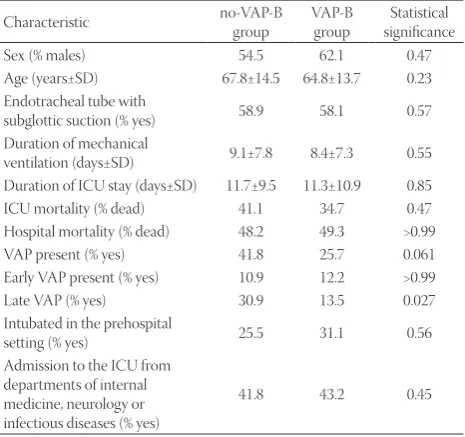
We included 55 patients in no-VAP-B group (54.5% males, mean age 67.8 ± 14.5 years), and 74 patients in VAP-B group (62.1% males, mean age 64.8 ± 13.7 years). There were no statis-tically significant differences between no-VAP-B and VAP-B groups in the ICU mortality (41.1% versus 34.7%, p = 0.47), hospital mortality (48.2% versus 49.3%, p > 0.99), age, and sex (Table 1). No major differences were observed between no-VAP-B and VAP-B group in the rate of the use of subglottic suctioning ETTs (60% versus 58.1%, p = 0.57) nor in the rate of intubation in the prehospital setting (25.5% versus 31.1%,
p = 0.56). In the two groups, the duration of ICU treatment (11.7 ± 9.5 days versus 11.3 ± 10.9 days, p = 0.85) and mechanical
TABLE 1. Characteristics of patients treated before (no-VAP-B group) and after (VAP-B group) the introduction of VAP prevention bundle
Characteristic no-VAP-B group VAP-B group significanceStatistical
Sex (% males) 54.5 62.1 0.47 Age (years±SD) 67.8±14.5 64.8±13.7 0.23 Endotracheal tube with
subglottic suction (% yes) 58.9 58.1 0.57 Duration of mechanical
ventilation (days±SD) 9.1±7.8 8.4±7.3 0.55 Duration of ICU stay (days±SD) 11.7±9.5 11.3±10.9 0.85 ICU mortality (% dead) 41.1 34.7 0.47 Hospital mortality (% dead) 48.2 49.3 >0.99 VAP present (% yes) 41.8 25.7 0.061 Early VAP present (% yes) 10.9 12.2 >0.99 Late VAP (% yes) 30.9 13.5 0.027 Intubated in the prehospital
setting (% yes) 25.5 31.1 0.56 Admission to the ICU from
departments of internal medicine, neurology or infectious diseases (% yes)
41.8 43.2 0.45
ventilation (9.1 ± 7.8 days versus 8.4 ± 7.3 days, p = 0.55) was similar. In addition, we observed no significant improvement in the duration of ICU stay and the rate of mortality after the implementation of VAP prevention bundle.
No significant differences in the rates of VAP and early VAP were found between the two groups. In no-VAP-B group, 41.8% of patients developed VAP (45 episodes of VAP per 1000 ventilator days) compared to 25.7% of patients in VAP-B group (30 episodes of VAP per 1000 ventilator-days) [p = 0.06]. In no-VAP-B group, 10.9% of patients developed early VAP com-pared to 12.2% in VAP-B group (p > 0.99). On contrary, a sig-nificant decrease in the late VAP was found in VAP-B group compared to no-VAP-B group (13.5% versus 30.9%, p = 0.027).
In both groups, we observed no differences in the inci-dence of VAP between patients who were intubated with and those intubated without ETTs with subglottic suctioning. In no-VAP-B group, 33 patients (60%) received an ETT with subglottic suctioning. Of those, 16 patients (48.5%) developed VAP, compared to 7/22 patients (31.8%) who were intubated with a standard ETT and developed VAP (p = 0.18). Similarly, in VAP-B group, 43 patients (58.1%) received an ETT with sub-glottic suctioning, and of those, 7 patients (16.3%) developed VAP, compared to 11/31 patients (35.5%) who were intubated with a standard ETT and developed VAP (p = 0.09).
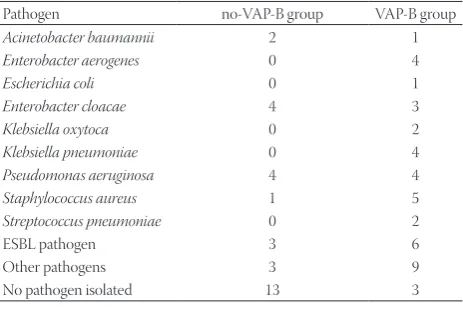
There was no difference in the frequency of causative pathogens between no-VAP-B and VAP-B patients (18.2% ver-sus 21.6%, p = 0.66). The causative pathogens are presented in Table 2.
DISCUSSION
In the present study, we showed that the implementation of the VAP prevention bundle is associated with a trend toward a lower incidence of VAP and a significantly lower incidence of late VAP. Moreover, we observed no significant differences in the mortality between the two groups of patients. Our results on the incidence of VAP and the effect of the VAP prevention
bundle on the VAP incidence and mortality are in line with previous studies. The incidence of VAP reported in other cen-ters across Europe, Asia, and Latin America ranged between 9 and 27%, while it was 4.8-7.5% in the U.S. In addition, the sets of measures for the prevention of VAP described in those studies are similar to our VAP prevention bundle [1-3,7-9].
In our study, the differences in the rates of VAP (41.8% ver-sus 25.7%, p = 0.06) and early VAP (10.9% versus 12.2%, p > 0.99) were not significant between no-VAP-B and VAP-B groups. However, we observed a significantly lower rate of late VAP in VAP-B group. A positive effect a VAP prevention bundle on the incidence of late VAP was also indicated previously [10].
Kollef et al. [6] compared the duration of mechanical venti-lation, ICU stay, and hospitalization as well as the cost of treat-ment between patients with and without VAP. They retro-spectively analyzed 88,689 patients, of which 2,238 (2.5%) were diagnosed with VAP. Their inclusion criteria were duration of mechanical ventilation for more than 2 days and VAP as a discharge diagnosis. Patients with VAP had longer duration of mechanical ventilation (21.8 versus 10.3 days), ICU stay (20.5 versus 11.6 days), and hospitalization (32.6 versus 19.5 days) compared to patients without VAP. The cost of treatment was 40% higher in their patients with VAP, due to longer hospi-talization, higher medical therapy and antibiotic consump-tion, prolonged ventilaconsump-tion, and greater need for radiological diagnostics [6]. In this study, VAP as a discharge diagnosis was also used as one of the inclusion criteria. However, using a dis-charge diagnosis of VAP as a tool to determine the incidence of VAP may lead to underreporting, which occurs in approxi-mately 50% of patients [11]. The underreporting may be due to subjective diagnostic criteria or reimbursement issues among other reasons [11].
Several other studies used a VAP prevention bundle sim-ilar to ours. Daniel et al. [8] prospectively included patients from two ICUs in Scotland, with more than 400 admissions per department per year. Their set of prevention measures consisted of: daily evaluation of the possibility for the reduc-tion of sedareduc-tion, daily assessment for extubareduc-tion, 30-degree elevation of the head of the bed, and oral care with chlorhex-idine. They introduced all measures simultaneously in 2008. The education of clinical teams was performed through five learning sessions during the first two years. A decrease in VAP incidence from 6.9 to 1.0/1000 ventilation days (p = 0.0002) after the implementation of VAP prevention bundle was reported in their study [8]. Marini et al. [3] conducted a sin-gle-center prospective study at King Abdulaziz Medical City (KAMC) in Riyadh, Saudi Arabia. Their VAP prevention bun-dle comprised of: elevation of the head of the bed to 30-45 degrees, daily evaluation of the possibility for the interrup-tion of sedainterrup-tion and assessment for extubainterrup-tion, peptic ulcer disease prophylaxis, deep venous thrombosis prophylaxis,
TABLE 2. Causative pathogens of VAP before (no-VAP-B group) and after (VAP-B group) the introduction of VAP prevention bundle
Pathogen no-VAP-B group VAP-B group
Acinetobacter baumannii 2 1
Enterobacter aerogenes 0 4
Escherichia coli 0 1
Enterobacter cloacae 4 3
Klebsiella oxytoca 0 2
Klebsiella pneumoniae 0 4
Pseudomonas aeruginosa 4 4
Staphylococcus aureus 1 5
Streptococcus pneumoniae 0 2
ESBL pathogen 3 6
Other pathogens 3 9
No pathogen isolated 13 3
daily mouth care with chlorhexidine, the use of an ETT with subglottic suctioning, and maintaining endotracheal cuff pres-sure between 25 to 30 cmH2O. These authors also showed a decrease in VAP rates from 4.0 to 0.8/1000 ventilation days [3]. In their study, all patients were intubated with an ETT with subglottic suctioning, and they indicated a role of subglottic suctioning in decreasing the incidence of VAP [3]. However, in our study, the incidence of VAP was not significantly higher in patients intubated with ETTs without subglottic suction-ing (58.9% of patients). This discrepancy might be due to the small number of patients included in our study, as well as the combined effect of all measures on the incidence of VAP. In a single-center study at an adult ICU of a private hospital in Brazil, Rodriguez et al. [9] reported similar higher rates of VAP, as in our study. Their VAP prevention bundle included: bed head elevation, daily evaluation of sedation interruption, deep venous thrombosis and stress ulcer prophylaxis. The rate of VAP decreased from 21.1 to 10.5/1000 ventilation days after the implementation of the VAP prevention bundle. The duration of mechanical ventilation also decreased from 10.7 to 8.9 days [9], which was similar to our results (from 9.1 to 8.4 days).
There are several limitations to our study. First, this was a small, single-center retrospective study. Second, we studied the effectiveness of a VAP prevention bundle that was com-prised of measures available at our institution, which makes our results less applicable to other settings and institutions. Also, some of the officially recommended measures for VAP prevention were not included in our bundle. Early extubation to non-invasive ventilation could have contributed to the incidence of VAP, however, in our hospital, this technique is used based on the individual decision of a clinician. Third, we only performed a short-term evaluation, immediately after the introduction of VAP prevention measures. The efficacy of our measures could have been reduced over a long-term period due to a possible lack of adherence to the bundle over time. Also, seasonal variability may have affected our results because the current evaluation of the bundle efficacy was per-formed mainly in the winter months, compared to the control group treated in the autumn and winter months. Nevertheless, no major differences in general characteristics of the study and control group were observed, and two sequential four-month periods were selected as study intervals to simplify the collec-tion of data. Fourth, we used simplified diagnostic criteria for VAP due to the retrospective analysis of data.
To our knowledge, this is the first study evaluating the rate of VAP in Slovenian patients. The opinion of clinical teams on the introduction of VAP prevention bundle was generally positive, although their comments were only noted in infor-mal team meetings. The clinician adherence to the bundle was not formally studied, however, it was outlined in the daily
clinical rounds. For example, the adherence to the head-of-bed elevation measure was the most difficult, mostly due to the general use of lower degrees of head elevation. Moreover, daily assessment for extubation and the need for proton-pump inhibitors was difficult for some clinicians in cases where they felt that the patient required longer-term mechanical venti-lation because of the nature of the disease. Nevertheless, the VAP prevention measures included in our bundle are widely applicable and, apart from ETTs with subglottic suctioning, no specialized equipment is necessary.
CONCLUSION
Overall, our results support the use of VAP prevention bundle in clinical practice. We showed a trend toward a lower incidence of VAP and a significantly lower incidence of late VAP after the implementation of a multifaceted VAP preven-tion bundle comprising of head-of-bed elevapreven-tion, oral care with chlorhexidine, the use of an ETT with subglottic suction-ing every 4 hours, daily assessment for extubation and the need for proton-pump inhibitors, use of closed suction systems, and maintaining endotracheal cuff pressure at 25 cmH2O.
DECLARATION OF INTERESTS
The authors declare no conflict of interests.
REFERENCES
[1] Blot SI, Poelaert J, Kollef M. How to avoid microaspiration? A key element for the prevention of ventilator-associated pneumonia in intubated ICU patients. BMC Infect Dis 2014;14:119.
https://doi.org/10.1186/1471-2334-14-119.
[2] Kalanuria AA, Zai W, Mirski M. Ventilator-associated pneumonia in the ICU. Crit Care 2014;18(2):208.
https://doi.org/10.1186/cc13775.
[3] Marini AL, Khan R, Mundekkadan S. Multifaceted bundle inter-ventions shown effective in reducing VAP rates in our multi-disciplinary ICUs. BMJ Open Quality 2016;5(1):u205566.w2278. DOI: 10.1136/bmjquality.u205566.w2278.
[4] Russell CJ, Shiroishi MS, Siantz E, Wu BW, Patino CM. The use of inhaled antibiotic therapy in the treatment of ventilator-associated pneumonia and tracheobronchitis: A systematic review. BMC Pulm Med 2016;16:40.
https://doi.org/10.1186/s12890-016-0202-8.
[5] Coffin SE, Klompas M, Classen D, Arias KM, Podgorny K, Anderson DJ, et al. Strategies to prevent ventilator-associated pneumonia in acute care hospitals. Infect Control Hosp Epidemiol 2008;29(Suppl 1):S31-40. DOI: 10.1086/591062.
[6] Kollef MH, Hamilton CW, Ernst FR. Economic impact of ventila-tor-associated pneumonia in a large matched cohort. Infect Control Hosp Epidemiol 2012;33(3):250-6.
https://doi.org/10.1086/664049.
[7] Wong T, Schlichting AB, Stoltze AJ, Fuller BM, Peacock A, Harland KK, et al. No decrease in early ventilator-associated pneumonia after early use of chlorhexidine. Am J Crit Care 2016;25(2):173-7. DOI: 10.4037/ajcc2016823.
common and contrasting methods to prevent ventilator associ-ated pneumonia. BMJ Open Quality 2015;4(1):u207660.w3069. DOI: 10.1136/ bmjquality.u207660.w3069.
[9] Rodriguez FB, Monteiro CA, Lain JI, Guimaraes BL, Soares LS, Menezes WB, et al. A three-step approach to reduce ventilator-associ-ated pneumonia. Crit Care 2009;13(Suppl 3):P25. DOI: 10.1186/cc7827.
[10] Chastre J, Fagon JY. Ventilator-associated pneumonia. Am J Respir Crit Care Med 2002;165(7):867-903.
https://doi.org/10.1164/ajrccm.165.7.2105078.