R E S E A R C H A R T I C L E
Open Access
The MEDEA FAR-EAST Study: Conceptual
framework, methods and first findings of a
multicenter cross-sectional observational
study
Sophia Hoschar
1,6†, Jiangqi Pan
2†, Zhen Wang
2, Xiaoyan Fang
1,7, Xian
’
e Tang
2, Weiqi Shi
2, Rongxiang Tu
2, Peng Xi
2,
Wenliang Che
3, Hongbao Wang
4, Yawei Li
5, Kurt Fritzsche
6, Xuebo Liu
2†, Karl-Heinz Ladwig
1,7*†and Wenlin Ma
2†Abstract
Background:The substantial increase in cardiovascular diseases (CVD) in China over the last three decades warrants comprehensive preventive primary and secondary strategies. Prolonged prehospital delay (PHD) has been identified as a substantial barrier to timely therapeutic interventions for acute myocardial infarction (AMI). Despite worldwide efforts to decrease the patient’s decision-making time, minimal change has been achieved so far. Here, we aim to describe the conceptual framework and methods and outline key data of the MEDEA FAR-EAST Study, which aimed to elucidate in-depth barriers contributing to delay in Chinese AMI-patients.
Methods:Data sources of this multicenter cross-sectional observational study are a standardized bedside interview, a self-administered tailored questionnaire tool and the patient chart. PHD was defined as the main outcome and triangulated at bedside. Standard operation procedures ensured uniform data collection by trained study personnel. The study was ethically approved by Tongji-Hospital and applied to all participating hospitals.
Results:Among 379 consecutively screened patients, 296 (78.1%) fulfilled eligibility criteria. A total of 241 (81.4%) AMI-patients were male and 55 (18.6%) female. Mean age was 62.9 years. Prehospital delay time was assessed for 294 (99.3%) patients. Overall median PHD was 151 min with no significant sex difference. Symptom mismatch was present in 200 (69. 7%) patients and 106 (39.0%) patients did not attribute their symptoms to cardiac origin. A total of 33 (12.4%) patients suffered from depression, 31 (11.7%) from anxiety and 141 (53.2%) patients employed denial as their major coping style. Conclusion:This is the first study on prehospital delay with emphasis on psychological variables in Chinese AMI-patients. A comprehensive assessment tool to measure clinical and psychological factors was successfully implemented. Socio-demographic key data proved a good fit into preexisting Chinese literature. Potential barriers including cardiac denial and symptom-mismatch were assessed for the first time in Chinese AMI-patients. The pretested selection of instruments allows future in depth investigations into barriers to delay of Chinese AMI-patients and enables inter-cultural comparisons.
Keywords:Acute myocardial infarction, Prehospital delay, Cross-sectional observational, Multicenter study, China,
© The Author(s). 2019Open AccessThis article is distributed under the terms of the Creative Commons Attribution 4.0 International License (http://creativecommons.org/licenses/by/4.0/), which permits unrestricted use, distribution, and reproduction in any medium, provided you give appropriate credit to the original author(s) and the source, provide a link to the Creative Commons license, and indicate if changes were made. The Creative Commons Public Domain Dedication waiver (http://creativecommons.org/publicdomain/zero/1.0/) applies to the data made available in this article, unless otherwise stated. * Correspondence:[email protected]
†Sophia Hoschar, Jiang Qi Pan, Xue Bo Liu, Karl-Heinz Ladwig and Wen Lin
Ma contributed equally to this work.
1Institute of Epidemiology II, Mental Health Research Unit, Helmholtz
Zentrum München, German Research Center for Environmental Health (GmbH), Ingolstädter Landstr 1, 85764 Neuherberg, Germany
7Department of Psychosomatic Medicine and Psychotherapy, Technical
University Munich, Munich, Germany
Background
In China, the burden of cardiovascular disease (CVD) is substantially increasing and is now the leading cause of death [1], accounting for a 1-year incidence of two mil-lion acute myocardial infarction (AMI) patients in China in the year 2011 [2]. AMI was responsible for 64.25 deaths per 100.000 inhabitants in 2014 [3].
Therapeutic interventions of AMI are highly time-dependent [4]. Despite recommendations by international guidelines to arrive at the hospital door within 2 h upon symptom-onset, prehospital delay (PHD) remains a global obstacle to timely treatment [4, 5]. A recent worldwide review on prehospital delay which included studies from Southeast Asia and China has estimated median prehospital delay time to range between 1.6-12.9 h [6]. The major component of PHD is patient-related delay [7], which is widely acknowledged to account for about 75% of overall prehospital delay [8]. Up to now, a total of eight internationally recognized clinical studies on delay time during AMI have been performed in China [9– 16] (see Table 1). Compared to estimates of median delay times in high-income countries [17], median prehospital delay times in these Chinese investigations ranged in a relatively favorable time window of 130 to 150 min [9, 10, 12, 13, 15], nevertheless showing that still more than half of Chinese MI-patients fail to reach emergency facilities within the recommended time window of 120 min.
Substantial efforts have been undertaken to reduce patient-related prehospital delay in numerous populations and secondary based prevention campaigns [18], yet, the results were mostly disappointing [19]. Recently, positive effects on prehospital delay could be demonstrated in in-terventions that specifically addressed subjective risk-perception in patient decision-making [20, 21], pro-viding a promising concept for future preventive efforts. Unfortunately, the major bulk of delay research in both the western world and in China (see Table1) is currently restricted to data assessments on sociodemographic and symptom-related variables which do not target those“ psy-chological barriers” increasingly acknowledged as major drivers [22] in the final decision to dispatch emergency medicine services (EMS) [23].
At AMI-onset, several factors such as slow symptom-onset, intermittent symptoms, symptom vague-ness [24] and experiencing symptoms which do not match one’s expectations of AMI-symptoms [25] or are attrib-uted to causes other than the heart can act as barriers to recognizing symptoms in a timely manner. Additionally, the decision process to seek immediate medical help may be compromised by low perceived personal risk or by health attitudes like cardiac denial [26] even when symp-toms are acknowledged as cardiac in origin [27].
Little is known about the impact of depression, anxiety and other psychosocial conditions on the delay process. It is yet not unlikely that depressed patients might delay due to a lack of motivation and energy to seek help [28] whereas anxiety may sharpen the patients self-perceived risk and thus render them more capable of making deci-sions to get immediate help [29]. Though generalized anxiety may decrease delay time [29], insufficient know-ledge of the time dependent nature of treatment as well as being afraid of causing a“false alarm”or“not wanting to bother the physicians”might keep patients from seek-ing professional help [30].
The MEDEA Study in Munich (Germany, 2007–2012) was developed to overcome shortcomings in delay research focusing on symptom patterns only, and to broaden the horizons of this research. It provided a conceptual framework and subsequent data assessment to identify barriers to help-seeking behavior during an acute infarction situation. The multicenter cross-sectional MEDEA FAR-EAST Study was designed to replicate this study, with its major objective being the application of a holistic approach in addressing patient-related delay by examining somatic, clinical, health-psychology related concepts and influential affective factors on prehospital delay in Chinese AMI-patients. The preselection of instruments was guided by (a) theoretical framework, (b) validated instru-ments in the Chinese language and (c) and the applic-ability within the particular Chinese cultural background. The aim of this paper is to present the framework, methods and descriptive study data on pre-hospital delay times as well as factors related to patient characteristics and symptom-onset.
Methods Study design
The main inclusion criterion was hospitalization with an acute myocardial infarction (AMI), confirmed by typical symptoms at onset, and elevated cardiac biomarkers (troponin I or troponin T) as well as corresponding ECG-diagnosis. No restrictions were made regarding age and sex. Exclusion criteria were an out-of-hospital car-diac arrest as well as cognitive impairment and language barrier.
Study setting
years in 2016 [31]. Combined with decreasing birth rates, this confronts Shanghai with an overall aging population. In China, 90% of inhabitants have basic health insurance [30]. This health insurance, however, varies in its coverage depending on population groups and registration area, and patients have to pay variable shares. Family physicians present only a negligible 5.6% of all Chinese physicians [33]. Instead, the majority of doctor visits (90% in 2012) take place in outpatient de-partments of public hospitals which results in over-crowding, long waiting times and short patient-doctor encounters [34]. Medical insurance covers all expenses for emergency treatments in public hospitals, neverthe-less, non-life-threatening emergency-department visits and hospitalizations require the patient to pay a deposit [35]. Ambulance services are only used among a third of AMI-patients [13], possibly due to costs, low efficacy or missing awareness of emergency medical services. Insur-ance covers a variable proportion of the fee that is charged for ambulance use [36].
Clinical setting and organization
The patient sample was recruited from four cardiology de-partments in Shanghai, all providing acute coronary care units. After preselection of instruments (by S. Hoschar et al.), a Chinese version of the study protocol was presented to the Ethics Commission of the Tongji-University affiliated Tongji-Hospital (by W. Ma). The Commission approved the study on 16th of March 2016 (伦审-KYSB-2016-74). The ethics approval applied to all participating centers. Recruitment started in Tongji-Hospital in Mid-April together with Yangpu-Hospital and 455 People’s Hospital. By end of July, recruitment was expanded to Tenth-Hospital. Recruit-ment was ended in Mid-January 2017.
Patient inclusion and data collection were performed within two days after hospitalization (SD: +/−1.87 days,
n= 86). On average, between one to 2 h were spent by trained personnel conducting the interview and assisting patients with completing the questionnaire. Regular newsletters informed all study-affiliated members of the study’s progress and developments. The study personnel received training prior to their participation and were closely monitored during the data acquisition process in order to avoid reporting bias. Standard operating proce-dures (SOP) were implemented to ensure the training of new members and these methods were kept consistent for all participating hospitals.
Data sources
The data collection procedure was divided into three parts. First, a bedside interview was conducted with trained study personnel. After this, a self-administered questionnaire was handed to the patient for
self-assessment. Lastly, basic epidemiological and medical information were collected from the hospitals’ patient charts. The patients were followed up at bedside or via telephone calls for any missing or incoherent answers.
Information from the interview
Assessment of prehospital delay times Prehospital delay time was the primary outcome defined as the time interval between symptom-onset and arrival at the hos-pital door, measured in minutes. Symptom-onset was clearly defined as symptoms that worsened or stayed continuous without decreasing over time. Nevertheless, defining symptom-onset remained a challenge (for ex-ample, patients often had difficulties to differentiate be-tween prodromal symptoms and intermittent acute onset). The onset-time was triangulated by trained personnel in the interview, using events from the pa-tient’s daily routine to help them establish the chron-ology of symptom-onset. Patients were asked to give a broad estimate of the time of symptom-onset, which was then further specified by placing it in relation to times of regular activities, meals, sleeping habits and other rou-tines. This technique has previously been developed and tested by Moser et al., who found that this technique en-abled patients who did not initially remember onset-time to successfully recall it [37]. The hospital registration receipt (挂 号 单, Guàhàodān) was used as the hospital arrival time, either directly or through the hospital information center. Additionally, an effort was made to distinguish decision from transportation, by coding time of decision to seek help as a secondary out-come. Prompting the time of decision to seek help pro-vided patients with an additional anchor item and followed the recommendations of Mackay et al. to col-lect at least two components of prehospital delay [38].
Health related behavior At bedside, comprehensive data on sociodemographic and health-related behaviors were assessed (physical activity, burden of work, smok-ing). Health attitudes and frequency of doctor consult-ation prior to AMI helped to portray patient’s overall approach to health. Angina pectoris six months prior to AMI was assessed following the Rose Angina Question-naire [39] which allowed the evaluation of any pro-dromal chest pain (PCP), chest pain of unknown origin (unexplained PCP), possible angina or definite angina.
was measured by the items patient expectation and symptom attribution.
Behavioral responses to AMI and context variables
The Response of Symptoms Questionnaire [40] was used to obtain information factors contributing to delay in the following domains: (1) the context in which AMI-symptoms appeared (at home, during work etc.); (2) to address with whom the patient was and what they were doing when the signs and symptoms occurred; (3) the responses of witnesses to the patient’s symptoms; (4) the behavioral responses to symptoms (e.g. wait and see; trying to relax; calling the emergency system); (5) the affective response to the symptoms. Subjective rating of helplessness, fear of death and fear before seeking help was assessed in single-item instruments. Mode of trans-portation was coded in the interview as self-transportation, transportation by others and trans-portation via ambulance.
Information from the self-administered questionnaire
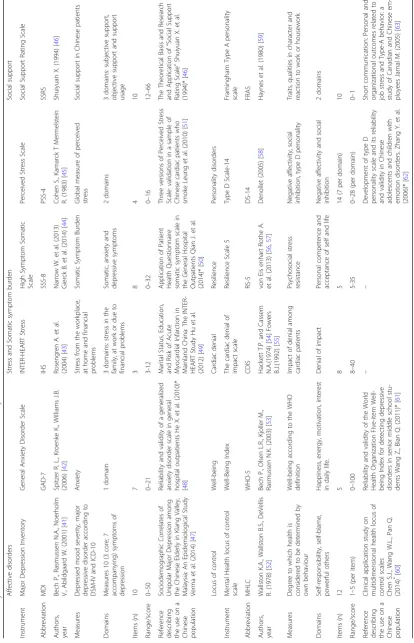
The self-administered questionnaire assessed variable psy-chometric variables including psychological characteristics, personality concepts as well as AMI-related knowledge. Except for the instrument measuring AMI-related know-ledge, all psychometric instruments used were standardized instruments, summarized in detail in Table2.
We used two scales to measure affective disorders. De-pression was measured using the Major DeDe-pression In-ventory (MDI), a 10-domain instrument able to generate an ICD-10 diagnosis. Following the suggestion of Bech et al. [64], a cut-off point (> 25) was chosen when using the MDI as a rating scale. Anxiety was measured using a validated translation of the Generalized Anxiety Disorder Scale (GAD-7) [42], where scores of above or equal to 10 highlights anxious patients.
Denial regarding cardiac illness was measured in the 8-item Cardiac Denial of Impact Score (CDIS) [55]. A score of≥25 indicates cardiac denial.
Stress was measured by two items, a) the INTER-HEART Stress Scale (IHS) [43], a 3-item instru-ment measuring stress in financial, family and work-related context. Furthermore, the short version of the perceived stress scale [45] depicts a global measure of stress in 4 items. The somatic symptom burden was captured by the somatic symptom scale (SSS-8) [44] which comprises 8 items to detect somatic, anxiety and depression-related symptoms.
Health locus of control was measured using the Multi-dimensional Health Locus of Control Scale (MHLC). It consists of 12 items and was initially developed by Wallston et al. [52] and features 3 domains.
The social support was measured by the Chinese 10-item Social Support Rating Scale (SSRS) [46]. It
measures social support in 3 domains, namely subjective, objective and usage of social support.
Well-being was measured by the WHO-5 [53], a 5-item instrument developed by the WHO to measure happiness, energy, motivation and interest in daily life.
Type-D personality was measured using the Type-D Scale 14 (DS-14) which is divided into two subscales with 7 items each, measuring social inhibition and negative affectivity [58]. Type-A personality was measured using the Framingham Type A behavior score (FRAS), consisting of 10 items to measure behavior indicative of Type A [59].
Resilience was measured in a short 5-item version (RS-5) developed from the original version of the RS-14 [65]. This tool measures the domains of personal com-petence and acceptance of self and life.
Knowledge of AMI-symptoms and appropriate actions to be taken when experiencing those symptoms was measured in the questionnaire in two subscales. In the interview, sources of AMI-knowledge were identified, in-cluding physician, media, heart association and friends/ acquaintances as possible sources.
As can be further seen in Table2, the majority of psycho-metric instruments applied in the present investigation had been validated and applied in Chinese language and were published in Chinese research papers prior to our investi-gation [46–51,60–63]. However, the Major Depression In-ventory (MDI) [41], the INTER-HEART Stress Scale (IHS-Scale) [43], the short version of the Resilience Scale (RS-4) [57] and the Cardiac Denial of Impact Scale (CDIS) [55] were not available in Chinese. Therefore, these instru-ments were translated following the recommended transla-tion guidelines of back-and-forth translatransla-tion by the WHO [66]. Previous to enrollment, these four instruments were pretested in 20 patients to ensure that patients were able to understand all items.
Information from the hospital chart
Detail of the infarction diagnosis, elevation of cardiac biomarkers and the number of days spent in CCU, com-plications throughout the stay as well as therapy of the MI were documented in the hospital chart. The patient chart additionally examined if the patient was previously transferred from a hospital not capable of treating the patient for AMI.
Data entry
The study coordinator entered the data in an Excel sheet. Checklists were created in order to monitor pro-gress of data collection.
Sample size calculation
Table 2 Psychometric instruments of the MEDEA FAR-EAST study Affective disorders Stress and Somatic symptom burden Social support Instrument Major Depression Inventory General Anxiety Disorder Scale INTER-HEART Stress High Symptom Somatic Scale Perceived Stress Scale Social Support Rating Scale Abbreviation MDI GAD-7 IHS SSS-8 PSS-4 SSRS Authors, year Bech P., Rasmussen N.A., Noerholm V., Abildgaard W. (2001) [ 41 ] Spitzer R. L., Kroenke K., Williams J.B. (2006) [ 42 ] Rosengren A. et al. (2004) [ 43 ] Narrow W. et al. (2013) Gierck B. et al. (2014) [ 44 ] Cohen S., Kamarck T Mermelstein R. (1983) [ 45 ] Shuiyuan X. (1994) [ 46 ] Measures Depressed mood severity, major depressive disorder according to DSM-IV and ICD-10 Anxiety Stress from the workplace, at home and financial problems Somatic Symptom Burden Global measure of perceived stress Social support in Chinese patients Domains Measures 10 (3 core; 7 accompanying) symptoms of depression 1 domain 3 domains: stress in the family, at work or due to financial problems Somatic, anxiety and depressive symptoms 2 domains 3 domains: subjective support, objective support and support usage Items (n) 10 7 3 8 4 10 Range/score 0 – 50 0 – 21 3-12 0 – 32 0 – 16 12 – 66
Reference describing the
use on a Chinese population Sociodemographic Correlates of Unipolar Major Depression among the Chinese Elderly in Klang Valley, Malaysia: An Epidemiological Study Verma et al. (2014) [ 47 ] Reliability and validity of a generalized anxiety disorder scale in general hospital outpatients He X. et al. (2010)* [ 48 ] Marital Status, Education, and Risk of Acute Myocardial Infarction in Mainland China: The INTER-HEART Study Hu et al. (2012) [ 49 ] Application of Patient Health Questionnaire somatic symptom scale in the General Hospital Outpatients Qian J. et al. (2014)* [ 50 ] Three versions of Perceived Stress Scale: validation in a sample of Chinese cardiac patients who smoke Leung et al. (2010) [ 51 ] The Theoretical Basis and Research and Application of “ Social Support Rating Scale ” Shuiyuan X. et al. (1994)* [ 46 ] Locus of control Well-being Cardiac denial Resilience Personality disorders Instrument Mental Health locus of control scale Well-Being Index The cardiac denial of impact scale Resilience Scale 5 Type D Scale-14 Framingham Type A personality scale Abbreviation MHLC WHO-5 CDIS RS-5 DS-14 FRAS Authors, year Wallston K.A., Wallston B.S., DeVellis R. (1978) [ 52 ] Bech P., Olsen L.R., Kjoller M., Rasmussen N.K. (2003) [ 53 ] Hackett T.P. and Cassem N.A.(1974) [ 54 ] Fowers B.J.(1992) [ 55 ] von Eis enhart Rothe A. et al. (2013) [ 56 , 57 ] Denollet (2005) [ 58 ] Haynes et al. (1980) [ 59 ] Measures Degree to which health is considered to be determined by own behaviour Well-being according to the WHO definition Impact of denial among cardiac patients Psychosocial stress resistance Negative affectivity, social inhibition, type D personality Traits, qualities in character and reaction to work or housework Domains Self-responsibility, self-blame, powerful others Happiness, energy, motivation, interest in daily life. Denial of impact Personal competence and acceptance of self and life Negative affectivity and social inhibition 2 domains Items (n) 12 5 8 5 14 (7 per domain) 10 Range/score 1 – 5 (per item) 0 – 100 8 – 40 5-35 0 – 28 (per domain) 0 – 1
Reference describing the
ensure a power of 0.80 in proving a clinically relevant odds ratio of 2.0.
Data analysis
Differences between continuous variables were assessed using Mann Whitney Test. All statistical analysis was run in IBM SPSS Statistics version 20 (SPSS Inc., Chi-cago). The distribution of delay was available as a con-tinuous variable in minutes and heavily left-skewed, thus reporting medians delay times. Dichotomized measures of symptom expectation (≤3 vs > 3 on 5 point Likert scale) and symptom attribution (cardiac vs. non-cardiac) were used. The significance levelαwas set at .05. Differ-ences in median PHD were assessed using the non-parametric Wilcoxon test. The analysis and descrip-tion in this paper follow the STROBE guidelines for cross-sectional studies [67].
Results
Sample size and dropout-analysis
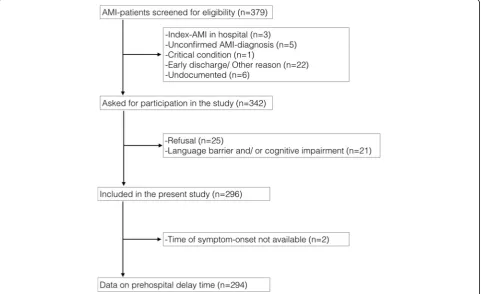
A total of 379 patients were considered eligible from mid-April 2016 to mid-January 2017, of which 83 (21.9%) were excluded (see Fig.1). Causes for exclusion were refusal (n= 25, 30.1%) language barrier or/and cog-nitive impairment (n= 21, 25.3%), as well as other rea-sons such as unconfirmed diagnosis (n= 5, 6.0%) or missing data (n= 22, 26.5%). One patient (1.2%) was in a
too critical condition to be interviewed and three pa-tients (3.6%) were already in hospital when they experi-enced AMI. For six patients (7.2%), the reason for exclusion remained undocumented. In the present ana-lysis, two patients had missing values of onset time, so that prehospital delay could not be determined. A dropout-analysis showed that older age was a significant factor of dropout, with patients dropping out being a mean of 69.3 years old (compared to a mean of 62.9 years in our study, p< 0.001). Comparison of included and excluded patients showed no significant differences in gender (p= 0.46).
Patient characteristics
A total of 296 patients participated in the MEDEA FAR-EAST Study and completed the bedside interview. Among them, 241 (81.4%) were male and 55 (18.6%) fe-male (see Table 3). The mean age of the study popula-tion was 62.9 years (median age: 63.0 years, IQR: 14 years, SD: 13. 2 years) following a near to normal distri-bution (see Fig.2). The mean age of men was 61.3 years and differed significantly from women’s mean age of 69.9 years (p< 0.001). The mean age, the proportion of male patients and prehospital delay did not vary signifi-cantly between the four recruitment hospitals (p= 0.17;
p= 0.42, p= 0.88). Among the study population, 29 (9.8%) had attended six years of elementary school and
114 (38.5%) an additional three years of junior-high school. 93 (31.4%) patients attained a senior-high school degree and 46 (15.5%) had a university degree.
A total of 14 patients (4.7%) had completed no educa-tion at all. 236 (80.5%) out of 293 patients were medic-ally insured. A total of 24 (8.1%) patients had previously experienced AMI. A total of 178 (60.1%) patients experi-enced prodromal chest pain (PCP) prior to AMI, which could be classified as angina pectoris in 76 (25.7%) cases. Among our patient sample, 31 (11.7%) patients suffered from anxiety, 33 (12.4%) from depression, and 141 (53.2%) from cardiac denial during the 6 months prior to AMI. The response rate for all three question-naires was at least 89.5%.
Factors surrounding symptom-onset
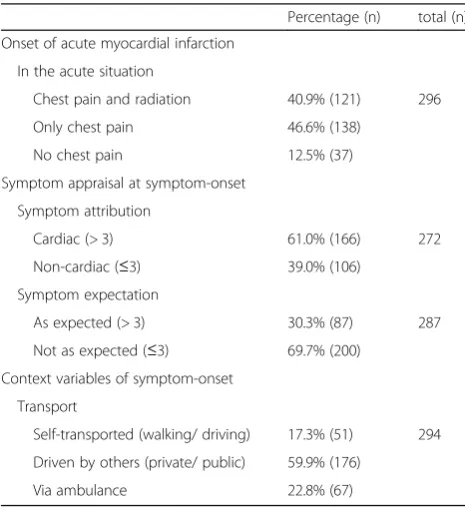
Upon symptom-onset of AMI, 121 (40.9%) of patients ex-perienced a ‘classical’ onset with chest pain and radiating pain into left arm, right arm, neck/jaw, shoulders or epigas-tric region (see Table4). Chest pain without radiation was experienced by 138 (46.6%) patients. 37 (12.5%) patients stated that they did not experience any form of chest pain. 166 (61.0%) patients attributed their symptoms to cardiac origin. 200 (69.7%) patients felt that their symptom didn’t match their previous expectation of a heart attack. A major-ity of the patients (176 of 294, 59.9%) were driven to the hospital by either private or public transportation (see Table
4). 67 (22.8%) patients reached the hospital via ambulance. The remaining 51 (17.3%) patients stated that they walked or drove to the hospital themselves.
Prehospital delay
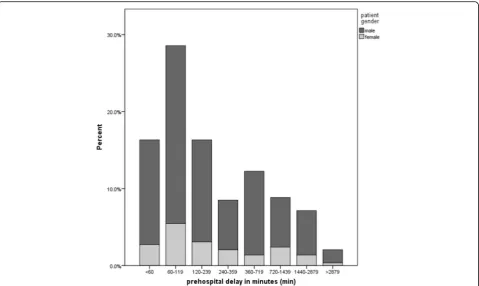
Prehospital delay was available for 294 patients. The over-all median prehospital delay time in the patient sample was 150.5 min, with 152 min (IQR: 70, 495) for men and 143 min for woman (IQR: 80,662). This difference was not significant (p= 0.88) (see Fig.3). A total of 132 (44.9%) pa-tients arrived at the hospital door within a favorable time window of less than 120 min (see Fig.3). 48 (16.3%) pa-tients delayed within a critical time window of 120 to 239 min. In 25 (8.5%) patients, delay times between 240 and 359 min were documented. A total of 89 (30.3%) patients exhibited a detrimental delay of 360 min (6 h) and more.
Discussion
Despite an often imperative and severe pain pattern in the face of an acute myocardial infarction, and despite increasing knowledge in the population of the need to access therapeutic help as quick as possible, inadequate delay times of AMI patients remain an universal prob-lem with a reported average median delay time of about 204 min among 23 studies worldwide [6]. In contrast to this finding, the MEDEA FAR EAST Study including 296 AMI-patients revealed a clinically-relevant median
prehospital delay of 151 min, with more than half of the patients delaying over 2 h. This finding is in line with previous investigations on median delay times in Chin-ese AMI-patients with a substantially lower time window ranging between 130 and 150 min over time [10, 12, 13,
15,68].
The study has been performed in Shanghai - one of the world’s biggest cities. Nevertheless, our descriptive analysis demonstrates that the population under investi-gation in the MEDEA FAR-EAST Study has comparable characteristics to related investigations in China. This is particularly true concerning mean age [10, 12, 14, 16], gender distribution [12, 14], education [10] and insur-ance rate [12,16].
The MEDEA FAR-EAST Study is, to the best of our knowledge, the first clinical study in the context of car-diac emergency facilities in China to comprehensively assess clinical, psychological and health-behavior related
Table 3Sociodemographic, clinical and psychological
characteristics of Chinese AMI-patients
Percentage (n) total (n)
Baseline patient characteristics
Sex
Male 81.4% (241) 296
Female 18.6% (55)
Age
Older age (≥60 years) 60.8% (180) 296
Younger age (< 60 years) 39.2% (116)
Years of education
6 years (elementary school) 9.8% (29) 296
9 years (middle school) 38.5% (114)
12 years (senior high-school) 31.4% (93)
Over 12 years (university degree) 15.5% (46)
Less than 6 years or none 4.7% (14)
Medical insurance
Insured 80.5% (236) 293
Not-insured 19.5% (57)
Clinical patient characteristics
AMI-history
First infarction 91.9% (272) 296
Reinfarction 8.1% (24)
Prodromal chest pain
Chest pain 60.1% (178) 296
No chest pain 39.9% (118)
Psychological patients characteristics
Anxiety (Score≥10) 11.7% (31) 265
Depression (Score > 25) 12.4% (33) 267
features in a homogeneous population of acute cardiac patients. In order to gain a deeper understanding of pa-tients’decision processes, it is also one of the first stud-ies worldwide to assess depression, anxiety and self-perceived stress, but also the patient’s level of resili-ence and attitude towards the medical system. It not only screens for typical but also atypical symptoms and complaints, and furthermore assesses factors like symp-tom expectation and knowledge.
Patient characteristics
Our results showed that the majority of patients were male, 60 years of age or older, and had attended school for at least six years. A majority of patients were experi-encing acute myocardial infarction for the first time. About 12% of them suffered from anxiety and/or depres-sion while cardiac denial was more common, with ap-proximately half of the patients exhibiting cardiac denial in the prodromal phase. To date, the prevalence of de-pression, anxiety and cardiac denial prior to AMI has not been investigated in China. In the German counter-part study, prevalence of anxiety and cardiac denial among STEMI-patients was 11% and 42%, which corre-lates well with our figures [26,29]. In a study examining depression among elderly Chinese in Malaysia, the prevalence of depression using the MDI was found to be 10.7% among 150 participants [47]. A prevalence of 12.4% in our patient sample corresponds well to that
Fig. 2Patient age divided into 5-year intervals, split by gender,n= 296 AMI-patients
Table 4Factors surrounding symptom-onset in Chinese
AMI-patients
Percentage (n) total (n)
Onset of acute myocardial infarction
In the acute situation
Chest pain and radiation 40.9% (121) 296
Only chest pain 46.6% (138)
No chest pain 12.5% (37)
Symptom appraisal at symptom-onset
Symptom attribution
Cardiac (> 3) 61.0% (166) 272
Non-cardiac (≤3) 39.0% (106)
Symptom expectation
As expected (> 3) 30.3% (87) 287
Not as expected (≤3) 69.7% (200)
Context variables of symptom-onset
Transport
Self-transported (walking/ driving) 17.3% (51) 294
Driven by others (private/ public) 59.9% (176)
figure. The validation study of the GAD-7 scale in 600 Chinese outpatient patients found a prevalence of 4.7%. Our figure was higher, possibly explained by a higher perceived risk of MI among cardiovascular patients which has been shown to be associated with anxiety [29].
Factors surrounding symptom-onset
In the acute situation, the vast majority of patients expe-rienced chest pain which corresponds to figures previ-ously reported in China [10]. “It is noteworthy that, in the current investigation, a total of 39% of patients attributed their symptoms to non-cardiac origin and around 70% of patients stated that they experienced symptoms other than they had expected. In previous studies in China, the prevalence of patients attributing their symptoms to non-cardiac origin was around 42-45%, [12,14] which corresponds with our data, while symptom-mismatch among Chinese AMI-patients was reported to be much lower in the literature, with a figure around 31% [12]”. As a response to these symptoms most patients were driven to the hospital or walked/ drove themselves. 22.6% of patients used the ambulance. A slightly higher proportion of around 31% was reported in a prehospital delay study set in Shanghai [13], which might be explained by the higher insurance rate reported
in that study. The consistency of our results with Chin-ese literature can be seen as a measure of the validity of the data collected on AMI-patients in this investigation.
Strengths and limitations
The strength of this study is that efforts were made to re-duce recall bias by conducting a bedside interview within a narrow time-frame upon hospitalization, while additionally using an approved technique for triangulation of onset-time. Yet recall bias might still exist, as data collec-tion was retrospective. Due to the cross-seccollec-tional study de-sign, causal attributions cannot be made. Furthermore, despite our best efforts, consecutive inclusion is likely but cannot be fully guaranteed. The study was conducted in an urban setting in China which may prevent conclusions for rural areas and countries other than China. Furthermore, prehospital delay puts patients at risk of sudden cardiac ar-rest, the major cause of out-of-hospital death in the pre-hospital phase [69]. These patients were not included in our investigation. Furthermore, four instruments (MDI-s-cale, IHS-s(MDI-s-cale, RS-5-scale and CDI-scale) were not avail-able in Chinese and had to be translated and pre-tested.
Conclusions
Substantial progress has been made in minimizing trans-portation and door-to-needle time. However, patient
delay remains a major unresolved concern of public health. In order to develop effective prevention cam-paigns for the future, the patient-related barriers to seek medical help must be better understood. Clarifying psy-chological and bio-behavioral factors as well as intercul-tural comparisons will provide key evidence for developing new approaches in prevention.
Symptom perception and miscellaneous psychological and behavioral factors may contribute equally, in a com-plex interaction, to inner barriers of the patient’s decision-making process. The present investigation is the first study in a Chinese population to capture comprehen-sive data applying theory-guided standardized instru-ments, allowing focus on the particularly vulnerable decision process. The prevalence of potential contributors to prehospital delay, such as symptom interpretation, and psychological barriers such as depression and cardiac de-nial were measured. In particular, symptom mismatch and cardiac denial were present in more than half of the pa-tients, and we aim to conduct further analysis in the fu-ture to examine their association with prehospital delay.
Furthermore, barriers in treatment seeking behavior have been shown to vary by region and culture [70]. It is of note that this investigation strictly follows the proto-col previously applied in the German MEDEA Study, en-abling us, in the future, to conduct in-depth analyses of possible psychological and cultural differences in behav-ior and perception of threat cues during a critical and highly stressful event. Of note, in the German MEDEA-study, overall median delay time of all 619 study participants was 203 min and was 151 min in the MEDEA FAR-EAST Study - a first difference to be fur-ther clarified in future comparisons of delay between German and Chinese AMI-patients.
Abbreviations
AMI :Acute myocardial infarction; CCU: Coronary Care Unit; CDIS: Cardiac Denial of Impact Scale; CVD: Cardiovascular disease; DS-14: Type-D Personality Scale; ECG: Electrocardiogram; EMS: Emergency Medical Services; FRAS: Framingham Type A behavior score; GAD-7: Generalized Anxiety Disorder Scale with 7 items; ICD-10: International Classification of Diseases; IHS: Interheart stress scale; IQR: Interquartile Range; MDI: Major depression inventory; MHLC: Multidimensional health locus of control scale; NSTEMI: Non-ST-elevated myocardial infarction; PCP: Prodromal chest pain; RS-4: Resilience Scale with 4 items; SD: Standard deviation; SOP: Standard operating procedures; SSRS: Social Support Rating Scale; SSS-8: Somatic symptom scale with 8 items; STEMI: ST-elevated myocardial infarction; WHO: World Health Organization; WHO-5: Well-being scale by the WHO
Acknowledgements
We would like to acknowledge the work of the following MEDEA FAR-EAST interviewers: Zhaoyu Zhang, Wei Sun, Yuxing Wu, Jinqin, Zhangyuan Gu, Haili Gan, Jiaojiao Hou, Dingfeng Liu, Yuqing Wang, Kexiong, Siyuan Hu, Ziwen Zhu, Tiansheng Zheng and Yinglei Zhang. We furthermore thank Dr. Wu Heng for advising us on the final instruments. We thank all enrolled patients for their participation in our study.
Funding
This work was supported by the Science and Technology Committee Foundation of Shanghai, PR China (16411965500, 16511102802) to Prof. Ma
Wenlin and by the German Heart Foundation to Prof. Karl-Heinz Ladwig. The funding was used to cover printing fees and to pay the study personnel.
Availability of data and materials
The dataset that was used and analyzed during the current study is available from the corresponding author on reasonable request.
Authors’contributions
SH served as the study coordinator from April 2016 to October 2016, and performed data collection and data entry, prepared the final dataset, analyzed and interpreted the data and drafted the manuscript. JQP served as the study coordinator from October 2016 to January 2017 and was responsible for data collection, data entry and drafting the manuscript. ZW participated in data collection and data entry. XYF contributed to the study design. XT, WQS, RXT and PX carried out data collection at Tongji-Hospital and organizational tasks. WLC coordinated the study in Tenth- Hospital and critically revised the final manuscript. WHB coordinated the study in Yangpu-Hospital and critically revised the manuscript. YWL coordinated the study in 455-Hospital and critically revised the manuscript. KF contributed to design-ing and settdesign-ing up the study. XBL coordinated the study in Tongji-Hospital and critically revised the manuscript. KHL was a study investigator and partic-ipated in study conception, study design, data analysis and drafting the manuscript. WLM served as a study investigator and was responsible for recruiting team members, data collection, supervising the data-entry and submitting the application for ethical approval. All authors critically revised the script and approved the final manuscript and furthermore agreed to be held accountable for all aspects of the work.
Ethics approval and consent to participate
The Ethics Commission of Tongji-University affiliated Tongji-Hospital
ap-proved the study on 16th of March 2016 (Reference Number:伦审
-KYSB-2016-74). This approval is applicable for all participating centers (Tongji-Hos-pital, Yangpu-Hos(Tongji-Hos-pital, Tenth-Hospital and 455 Hospital). All patients with suspected AMI were asked for their permission to be interviewed and had to give written consent. Study participation was voluntary, patients were in-formed about the procedures of the study and they were assured that re-fusal would not affect their treatment. When written consent was not possible due to somatic weakness (e.g. poor eyesight), oral consent had to be given and was documented.
Consent for publication Not applicable.
Competing interests
The authors declare that they have no competing interests.
Publisher’s Note
Springer Nature remains neutral with regard to jurisdictional claims in published maps and institutional affiliations.
Author details 1
Institute of Epidemiology II, Mental Health Research Unit, Helmholtz Zentrum München, German Research Center for Environmental Health (GmbH), Ingolstädter Landstr 1, 85764 Neuherberg, Germany.2Department of
Cardiology, Tongji-Hospital, Tongji-University, Shanghai, People’s Republic of China.3Department of Cardiology, Tenth-Hospital, Tongji-University, Shanghai, People’s Republic of China.4Department of Cardiology,
Yangpu-Hospital, Tongji-University, Shanghai, People’s Republic of China.
5Department of Cardiology, 455-Hospital, Tongji-University, Shanghai,
People’s Republic of China.6Department of Psychosomatic Medicine and Psychotherapy, Medical Center- University of Freiburg, Faculty of Medicine, Freiburg, Germany.7Department of Psychosomatic Medicine and
Psychotherapy, Technical University Munich, Munich, Germany.
Received: 4 October 2018 Accepted: 14 March 2019
References
1. Yang G, Wang Y, Zeng Y, Gao GF, Liang X, Zhou M, et al. Rapid health
transition in China, 1990–2010: findings from the global burden of disease
2. Li H, Ge J. Cardiovascular diseases in China: current status and future
perspectives. IJC Heart Vasc. 2015;6:25–31.
3. Chang J, Liu X, Sun Y. Mortality due to acute myocardial infarction in China
from 1987 to 2014: secular trends and age-period-cohort effects. Int J
Cardiol. 2017;227:229–38.
4. O’Gara PT, Kushner FG, Ascheim DD, Casey DE Jr, Chung MK, de Lemos JA,
et al. 2013 ACCF/AHA guideline for the management of ST-elevation myocardial infarction: a report of the American College of Cardiology Foundation/American Heart Association task force on practice guidelines.
J Am Coll Cardiol. 2013;61:e78–140.
5. Spencer FA, Montalescot G, Fox KAA, Goodman SG, Granger CB, Goldberg
RJ, et al. Delay to reperfusion in patients with acute myocardial infarction presenting to acute care hospitals: an international perspective. Eur Heart J.
2010;31:1328–36.
6. Wechkunanukul K, Grantham H, Clark RA. Global review of delay time in
seeking medical care for chest pain: an integrative literature review. Aust
Crit Care. 2017;30:13–20.
7. Doggen CJM, Zwerink M, Droste HM, Brouwers PJAM, van Houwelingen GK,
van Eenennaam FL, et al. Prehospital paths and hospital arrival time of patients with acute coronary syndrome or stroke, a prospective observational study. BMC Emerg Med. 2016;16(3).
8. C-H R, A M, J K, T H. Patient delay from onset of chest pain suggesting
acute coronary syndrome to hospital admission. Scand Cardiovasc J. 2003;
37:183–6.
9. Gao Y, Zhang H. The effect of symptoms on prehospital delay time in
patients with acute myocardial infarction. J Int Med Res. 2013;41:1724–31.
10. Peng YG, Feng JJ, Guo LF, Li N, Liu WH, Li GJ, et al. Factors associated with
prehospital delay in patients with ST-segment elevation acute myocardial
infarction in China. Am J Emerg Med. 2014;32:349–55.
11. Qian L, Ji K, Nan J, Lu Q, Zhu Y, Wang L, et al. Factors associated with
decision time for patients with STsegment elevation acute myocardial
infarction. J Zhejiang Univ Sci B. 2013;14:754–8.
12. Song L, Yan H-B, Yang J-G, Sun Y-H, Hu D-Y. Impact of patients’symptom
interpretation on care-seeking behaviors of patients with acute myocardial
infarction. Chin Med J (Engl). 2010;123:1840–5.
13. Wang X, Hsu LL. Treatment-seeking delays in patients with acute
myocardial infarction and use of the emergency medical service. J Int Med
Res. 2013;41:231–8.
14. Wu Y, Zhang Y, Li Y, Hong B, Huang C. Factors associated with the extent of
care-seeking delay for patients with acute myocardial infarction in Beijing.
Chin Med J (Engl). 2004;117:1772–7.
15. Zhang B, Zhang W, Huang R, Zhu H, Liu J, Jiang D, et al. Gender and age
differences associated with prehospital delay in Chinese patients presenting
with ST-elevation myocardial infarction. J Cardiovasc Nurs. 2016;31:142–50.
16. Zhang S, Hu D, Wang X, Yang J. Use of emergency medical Services in Patients
with acute myocardial infarction in China. Clin Cardiol. 2009;32:137–41.
17. Moser DK, Kimble LP, Alberts MJ, Alonzo A, Croft JB, Dracup K, et al.
Reducing delay in seeking treatment by patients with acute coronary syndrome and stroke: a scientific statement from the American Heart Association Council on cardiovascular nursing and stroke council.
Circulation. 2006;114:168–82.
18. Kainth A, Hewitt A, Sowden A, Duffy S, Pattenden J, Lewin R, et al.
Systematic review of interventions to reduce delay in patients with
suspected heart attack. Emerg Med J. 2004;21:506–8.
19. Mooney M, McKee G, Fealy G, O’Brien F, O’Donnell S, Moser D. A review of
interventions aimed at reducing pre-hospital delay time in acute coronary
syndrome: what has worked and why? Eur J Cardiovasc Nurs. 2012;11:445–53.
20. Mooney M, McKee G, Fealy G, O’Brien F, O’Donnell S, Moser D. A
Randomized Controlled Trial to Reduce Prehospital Delay Time in Patients
With Acute Coronary Syndrome (ACS). J Emerg Med. 2014;46:495–506.
21. Bray JE, Stub D, Ngu P, Cartledge S, Straney L, Stewart M, et al. Mass media
campaigns’influence on prehospital behavior for acute coronary
syndromes: an evaluation of the Australian Heart Foundation’s warning
signs campaign. J Am Heart Assoc. 2015;4:e001927.
22. Dracup K, Moser DK. Beyond sociodemographics: factors influencing the
decision to seek treatment for symptoms of acute myocardial infarction.
Heart Lung. 1997;26:253–62.
23. Ladwig K-H, Gärtner C, Walz LM, Smenes KR, Ronel J. The inner barrier: how
health psychology concepts contribute to the explanation of prehospital delays in acute myocardial infarction: a systematic analysis of the current
state of knowledge. Psychother Psychosom Med Psychol. 2009;59:440–5.
24. Nymark C, Mattiasson A-C, Henriksson P, Kiessling A. The turning point: from
self-regulative illness behaviour to care-seeking in patients with an acute
myocardial infarction. J Clin Nurs. 2009;18:3358–65.
25. Abed MA, Abu Ali RM, Abu Ras MM, Hamdallah FO, Khalil AA, Moser DK.
Symptoms of acute myocardial infarction: a correlational study of the
discrepancy between patients’expectations and experiences. Int J Nurs
Stud. 2015;52:1591–9.
26. Fang XY, Albarqouni L, von Eisenhart Rothe AF, Hoschar S, Ronel J, Ladwig K-H.
Is denial a maladaptive coping mechanism which prolongs pre-hospital delay in patients with ST-segment elevation myocardial infarction? J Psychosom Res.
2016;91:68–74.
27. Li PW, Yu DS. Predictors of pre-hospital delay in Hong Kong Chinese patients
with acute myocardial infarction. Eur J Cardiovasc Nurs. 2018;17:75–84.
28. Bunde J, Martin R. Depression and prehospital delay in the context of
myocardial infarction. Psychosom Med. 2006;68:51–7.
29. Fang XY, Spieler D, Albarqouni L, Ronel J, Ladwig K-H. Impact of generalized
anxiety disorder (GAD) on prehospital delay of acute myocardial infarction patients. Findings from the multicenter MEDEA study. Clin Res Cardiol. 2018;
107:1–8.
30. Albarqouni L, Smenes K, Meinertz T, Schunkert H, Fang X, Ronel J,
et al. Patients’knowledge about symptoms and adequate behaviour
during acute myocardial infarction and its impact on delay time: findings from the multicentre MEDEA study. Patient Educ Couns. 2016;
99:1845–51.
31. Shanghai Statistical Bureau. Shanghai Statistical Yearbook 2017, vol. 2019.http://
www.statssh.gov.cn/html/sjfb/201801/1001529.html. Accessed 22 Jan 2019
32. Yang F, Gu D, Mitnitski A. Frailty and life satisfaction in Shanghai older
adults: the roles of age and social vulnerability. Arch Gerontol Geriatr. 2016;
67:68–73.
33. Wu D, Lam TP. At a Crossroads: Family Medicine Education in China. Acad
Med. 2017;92:185–91.
34. Bao Y, Fan G, Zou D, Wang T, Xue D. Patient experience with outpatient
encounters at public hospitals in Shanghai: examining different aspects of physician services and implications of overcrowding. PLoS One. 2017;12: e0171684.
35. Pei YV, Xiao F. Emergency medicine in China: present and future. World J
Emerg Med. 2011;2:245–52.
36. Hung KKC, Cheung CSK, Rainer TH, Graham CA. EMS systems in China.
Resuscitation. 2009;80:732–5.
37. Moser DK, McKinley S, Dracup K, Chung ML. Gender differences in reasons
patients delay in seeking treatment for acute myocardial infarction
symptoms. Patient Educ Couns. 2005;56:45–54.
38. Mackay MH, Ratner PA, Nguyen M, Percy M, Galdas P, Grunau G.
Inconsistent measurement of acute coronary syndrome patients’
pre-hospital delay in research: a review of the literature. Eur J Cardiovasc Nurs.
2014;13:483–93.
39. Rose G, McCartney P, Reid DD. Self-administration of a questionnaire on
chest pain and intermittent claudication. Br J Prev Soc Med. 1977;31:42–8.
40. Burnett RE, Blumenthal JA, Mark DB, Leimberger JD, Califf RM.
Distinguishing between early and late responders to symptoms of acute
myocardial infarction. Am J Cardiol. 1995;75:1019–22.
41. Bech P, Rasmussen NA, Olsen LR, Noerholm V, Abildgaard W. The sensitivity
and specificity of the major depression inventory, using the present state
examination as the index of diagnostic validity. J Affect Disord. 2001;66:159–64.
42. Spitzer RL, Kroenke K, Williams JBW, Löwe B. A Brief Measure for Assessing
Generalized Anxiety Disorder. Arch Intern Med. 2006;166(10):1092.
43. Rosengren A, Hawken S, Ôunpuu S, Sliwa K, Zubaid M, Almahmeed WA,
et al. Association of psychosocial risk factors with risk of acute myocardial infarction in 11 119 cases and 13 648 controls from 52 countries (the
INTERHEART study): case-control study. Lancet. 2004;364:953–62.
44. Gierk B, Kohlmann S, Kroenke K, Spangenberg L, Zenger M, Brähler E, et al.
The somatic symptom scale-8 (SSS-8): a brief measure of somatic symptom
burden. JAMA Intern Med. 2014;174:399–407.
45. Cohen S, Kamarck T, Mermelstein R. A global measure of perceived stress.
J Health Soc Behav. 1983;24:385–96.
46. Shuiyuan X. Theoretical Background Study and Application of Social
Support Rate Scale (in Chinese). J Clin Psychiatry. 1994;02:98–100.
47. Verma RK, Min TH, Chakravarthy S, Barua A, Kar N. Sociodemographic
correlates of unipolar major depression among the Chinese elderly in Klang
Valley, Malaysia: an epidemiological study. Sci World J. 2014;https://doi.org/
48. He X, Li C, Q J. Reliability and validity of a generalized anxiety disorder scale
in general hospital outpatients. 22.4 (2010): 200-203. 2010;22:200–3.
49. Hu B, Li W, Wang X, Liu L, Teo K, Yusuf S. Marital Status, Education, and Risk
of Acute Myocardial Infarction in Mainland China: The INTER-HEART Study.
J Epidemiol. 2012;22(2):123–9.
50. Qian J, Ren Z, Yu D, He X, Li C. Application of patient health questionnaire
somatic symptom scale in the general hospital outpatients. Chin Mental
Health J. 2014;28:173–8.
51. Leung DYP, Lam T-h, Chan SSC. Three versions of Perceived Stress Scale:
validation in a sample of Chinese cardiac patients who smoke. BMC Public Health. 2010;10(1).
52. Wallston KA, Wallston BS, DeVellis R. Development of the multidimensional
health locus of control (MHLC) scales. Health Educ Behav. 1978;6:160–70.
53. Bech P, Olsen LR, Kjoller M, Rasmussen NK. Measuring well-being rather
than the absence of distress symptoms: a comparison of the SF-36 mental health subscale and the WHO-five well-being scale. Int J Methods Psychiatr
Res. 2003;12:85–91.
54. Hackett TP, Cassem NH. Development of a quantitative rating scale to
assess denial. J Psychosom Res. 1974;18(2):93–100.
55. Fowers BJ. The cardiac denial of impact scale: a brief, self-report research
measure. J Psychosom Res. 1992;36:469–75.
56. von Eisenhart Rothe A, Zenger M, Lacruz ME, Emeny R, Baumert J, Haefner
S, et al. Validation and development of a shorter version of the resilience
scale RS-11: results from the population-based KORA–age study. BMC
Psychology. 2013;1.
57. von Eisenhart Rothe A, Zenger M, Lacruz ME, Emeny R, Baumert J, Haefner
S, et al. Validation and development of a shorter version of the resilience
scale RS-11: results from the population-based KORA–age study. BMC
Psychol. 2013;1:25.
58. Denollet J. DS14: standard assessment of negative affectivity, social
inhibition, and type D personality. Psychosom Med. 2005;67:89–97.
59. Haynes S, Feinleib M, Kannel WB. The relationship of psychosocial factors to
coronary heart disease in the Framingham study. III. Eight-year incidence of
coronary heart disease. Am J Epidemiol. 1980;111:37–58.
60. Chen S, Wang W, Pan Q. Clinical application study on multidimensional
health locus of control scales. Chin Nurs Res. 2014;28:1682–4.
61. Wang Z, Bian Q. Reliability and validity of the World Health Organization
Five-item Well-being Index for detecting depressive disorders in senior
middle school students (in Chinese). Chin Ment Health J. 2011:279–83.
62. Zhang Y, Zhang Y, Zhou S, Li H. Development of type D personality scale
and its reliability and validity in Chinese adolescents and children with
emotion disorders. Chin J Behav Med Sci. 2006;15:757–9.
63. Jamal M. Personal and organizational outcomes related to job stress and
Type-A behavior: a study of Canadian and Chinese employees. Stress and
Health. 2005;21(2):129–37.
64. Bech P, Timmerby N, Martiny K, Lunde M, Soendergaard S. Psychometric
evaluation of the major depression inventory (MDI) as depression severity scale using the LEAD (longitudinal expert assessment of all data) as index of
validity. BMC Psychiatry. 2015;15https://doi.org/10.1186/s12888-015-0529-3.
65. Wagnild GM, Young HM. Development and psychometric evaluation of the
resilience scale. J Nurs Meas. 1993;1:165–78.
66. WHO. Process of translation and adaptation of instruments. WHO.http://
www.who.int/substance_abuse/research_tools/translation/en/. Accessed 13 Apr 2017.
67. von Elm E, Altman DG, Egger M, Pocock SJ, Gøtzsche PC, Vandenbroucke
JP. The strengthening the reporting of observational studies in epidemiology (STROBE) statement: guidelines for reporting observational
studies. J Clin Epidemiol. 2008;61:344–9.
68. Hu D, Yang J, Pi L, Sun Y. Prehospital Delay After Acute
ST-Segment-Elevation Myocardial Infarction in Beijing, China. In: CIRCULATION. LIPPINCOTT WILLIAMS & WILKINS 530 WALNUT ST, PHILADELPHIA, PA
19106–3621 USA; 2010. p. E57.
69. Karam N, Bataille S, Marijon E, Giovanetti O, Tafflet M, Savary D, et al.
Identifying Patients at Risk for Pre- Hospital Sudden Cardiac Arrest at the Early Phase of Myocardial Infarction: The e-MUST Study. Circulation. 2016;
134:2074–83 CIRCULATIONAHA.116.022954.
70. McKinley S, Dracup K, Moser DK, Ball C, Yamasaki K, Kim CJ, et al.
International comparison of factors associated with delay in presentation for