R E S E A R C H A R T I C L E
Open Access
Understanding carers
’
fall concern and
their management of fall risk among older
people at home
Seng Giap Marcus Ang
*, Anthony Paul O
’
Brien and Amanda Wilson
Abstract
Background:Many older people (care recipients) experience long-term psychological distress due to the fear of falling again. Falls can affect carers due to concerns about their care recipients falling. Understanding carers’fall concern is crucial to determine if carers are coping with the provision of care or have adequate knowledge and support in preventing their care recipients from falling at home.
Methods:A descriptive qualitative study was conducted to explore carers’concern about their care recipients being at risk of falling and their management of fall risk at home. Twenty-two carers were recruited from two research registers and a large tertiary hospital in a regional centre of Australia. Carers were interviewed face-to-face, or by telephone using a semi-structured interview guide about their fall concern. The data was analysed using an inductive content analysis method.
Results:Eight major themes emerged from the interviews. Four themes described key factors influencing carers’fall concern which include: 1) carers’perception of fall and fall risk, 2) care recipients’behaviour and attitude towards fall risk, 3) care recipients’health and function, and 4) care recipients’living environment. Another four themes described the management of care recipients’fall risk which include: 5) fall prevention strategies used, 6) risk of preventing falls, 7) support from family and friends, and 8) support from healthcare professionals.
Conclusions:The findings from this qualitative study provide an insight into the carers’ awareness of fall risk, knowledge, and the availability of support in preventing their care recipients from falling at home. Healthcare professionals are encouraged to include carers and address their fall concern to improve fall prevention programmes for care recipients at risk of falling at home.
Keywords:Carer, Older people, Fall concern, Fall risk, Fear of falling, Qualitative research
Background
Falls are a serious problem among older people which result in injuries, deaths, and long-term psychological
consequences [1]. Globally, 28 to 35% of people aged 65
and above fall each year with the rate of falls increasing
with age and frailty [2]. There were 98,704 older people
hospitalised for injuries sustained by falling in Australia between 2012 and 2013; an increase of 24,000 cases over
10 years [3]. A common complication of a fall is the fear
of falling again, which affects between 3 and 85% of the
older people [4]. This psychological concern about
falling can pose a significant threat to an older person’s
autonomy resulting in self-imposed activity restriction and a loss of confidence in their ability to ambulate safely [5].
Like older people (care recipients), falls can also affect
their carers [6]. Previous research has highlighted that
after a fall has occurred, most carers experience in-creased concern about their care recipients falling again
[7, 8]. This concern is significantly associated with
in-creased psychological distress, social restriction, and
caregiving burden among carers [8–11]. Concerns about
their care recipients falling have resulted in many carers adopting various strategies to prevent falls, including, in-creased vigilance and not leaving them alone at home
© The Author(s). 2019Open AccessThis article is distributed under the terms of the Creative Commons Attribution 4.0
International License (http://creativecommons.org/licenses/by/4.0/), which permits unrestricted use, distribution, and
reproduction in any medium, provided you give appropriate credit to the original author(s) and the source, provide a link to the Creative Commons license, and indicate if changes were made. The Creative Commons Public Domain Dedication waiver (http://creativecommons.org/publicdomain/zero/1.0/) applies to the data made available in this article, unless otherwise stated. * Correspondence:[email protected]
[12–15]. However, such approaches often lead to carers not having enough time for themselves, or to fulfil other social and work duties.
Carers are an essential part of the caring support net-work for older people which enables them stay at home longer, delaying institutional care if they (older people)
should deteriorate with their physical health [11].
Previ-ous fall prevention programmes that included carers have found significant improvement in fall risk aware-ness and knowledge among cancer patients at risk of
falling [16], and better balance and fall efficacy among
older people living with dementia [17]. However, carers
who are overly supportive and prevent their care recipi-ents from engaging in their daily activities, can
inadvert-ently increase care recipients’ dependence [18]. Such
outcomes have been attributed to the loss of confidence
in their care recipients’ balance, and the need to
con-stantly provide assistance to the care recipients in their daily activities also restrict carers from participating in
their personal or social activities [18].
Carers are closely involved in the care of older people and are important for the successful implementation of fall prevention strategies at home. However, there is no published research on the perceived impact of fall risk among older people (with and without falls) on carers.
Previous qualitative studies of carers’ perspectives have
focused on care recipients who have fallen or diagnosed
with medical conditions such as Parkinson’s disease or
cognitive impairment which places them at a higher risk
of falling [12, 14, 15]. In addition, there is no evidence
regarding the common fall prevention strategies used by carers looking after care recipients from the general population of older people.
The aims of this study were to explore 1) carers’
con-cern for the risk of falling among care recipients, known
as carers’ fall concern, and 2) their management of fall
risk at home. The outcomes of this study have implica-tions for future improvements of fall prevention
pro-grammes targeting carers’ fall concern, while reducing
falls and fall risk of the care recipients living at home under their care. The findings from this study will facili-tate healthcare professionals to assess how carers are coping with the provision of care and if they have appro-priate access to support, or relevant knowledge in pre-venting their care recipients from falling at home.
Methods Design
This study was conducted between October 2017 and February 2018. A descriptive qualitative design was
ap-plied because little is known about the topic of carers’
fall concern [19]. The method of data collection and
analysis in a descriptive qualitative study allows re-searchers to stay close to the data by presenting a
comprehensive summary of everyday events using sim-ple language to increase agreement among researchers and carers [20].
Participants
Participants were recruited from three study sites: 1) Hunter Medical Research Institute (HMRI) (research register and Facebook Page), 2) Carers New South Wales (Carers NSW) (membership register), and 3) the Rheumatology outpatient clinic at a large regional teach-ing hospital in NSW. The study sites provided access to carers living in metropolitan and regional New South
Wales, Australia [21]. At HMRI and Carers NSW, study
invitations were sent to the registry members by the re-search coordinators. Participants who were keen to
par-ticipate responded to the HMRI coordinator by
completing a study response form containing their con-tact information, which was then forwarded to the re-searchers for contacting purposes. Other interested participants who received study information from the HMRI Facebook page or Carers NSW contacted the re-searchers directly regarding their interest. In the out-patient clinic, the rheumatology nurses assisted with distributing the study flyers to carers who had accom-panied their family members for follow-up appoint-ments. Interested participants could either contact the researchers directly or approach the nurses who would then refer them to one of the researchers.
The inclusion criteria consisted of people currently providing care for a family member or friend aged 60 years and over and living at home. The carer did not have to live with the care recipient, however participants who were aged below 18 years old, or working as profes-sional or paid carers were excluded. As the study intended to explore the fall concern of the general popu-lation of carers, the recruitment was not restricted to carers looking after care recipients with an increased risk of falling. In addition, carers of care recipients with and without the use of professional support services were also included. The study was approved by the Hunter New England Health Human Research Ethics Commit-tee [17/09/20/4.03]. All participants were provided with the study details and written consent was taken before the interview.
Twenty-two participants were recruited using purpos-ive sampling, which involved a deliberate selection of participants to obtain a complete understanding of
carers’fall concern [19]. The carers differed in terms of
age, gender, and the care recipients’ frequency of falls
and severity of injury sustained. These factors have been
associated with older people’s fear of falling which could
potentially affect carers’ fall concern [5]. The
caring for their spouses versus carers caring for their parents may affect the fall prevention strategies used
[22]. The recruitment continued until no new themes
were emerging from the qualitative data.
Data collection
Face-to-face or telephone interviews were conducted using a semi-structured interview guide by one re-searcher (MA, first author) who was a registered nurse with experience in caring for older people. The face-to-face interviews occurred at a convenient and quiet place, such as an unused office, or quiet area close to the out-patient department. The option of telephone interview was provided to encourage participation from carers who were unable to leave their care recipients alone at home because they were afraid of their care recipients falling when unsupervised. Examples of the interview questions were: 1) can you tell me about your concerns caring for your family member and their risk of falling, 2) what helps you care for a family member/friend at risk of falling, 3) have you encountered any problems during your caring, 4) are there any risks in preventing your family member/friend from falling, and 5) have you received any advice, or support regarding fall prevention and from whom? Socio-demographic details such as age, relationship to the care recipient, time spent caring and
the care recipients’number of falls in the last 12 months
were also collected.
As agreed by the carers, the interviews were audio-recorded. The researcher avoided interrupting the carers to allow them to speak freely about their concerns
re-garding their care recipient’s fall risk. However, the
re-searcher would lead the carers back to the subject if they deviated from the topic, for example sharing only about the general caregiving burden. Sometimes, the questions were repeated, and probes were used to gain more insight or to find out if the carers understood what was being asked. The interviews lasted between 10 and 30 min.
Data analysis
The audio-recorded interviews were transcribed verba-tim and analysed by the first author MA using inductive
content analysis [23]. Before the analysis, the transcripts
were reviewed and verified against the audio recordings. The researcher first immersed himself in the data by
reading the transcripts several times [24]. Codes
describ-ing content related to the study aims and interview questions were written in the transcripts during open
coding [25]. These codes were transferred to the coding
sheets and grouped to form categories. Similar ies were further combined to form higher order
categor-ies/ themes [24]. The first author met with two senior
researchers (OB and AW) in the team every 2 weeks to review and refine the codes and themes formulated from
the transcripts. The codes and themes were revised con-tinuously as the study progressed to ensure that they fit the study data and addressed the study aims. After the interviews were completed, all transcripts were recoded using the final coding scheme. Summaries of the themes
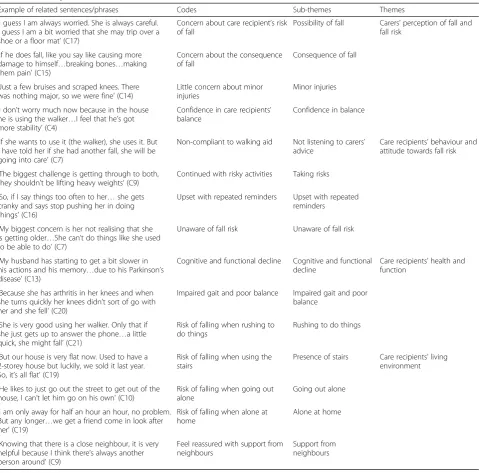
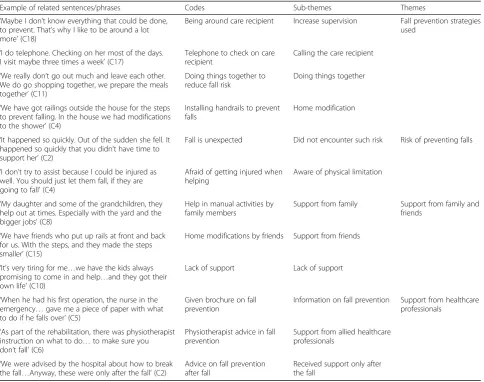
and sub-themes are illustrated in Tables1and2.
Trustworthiness of the study findings was ensured following four criteria suggested by Lincoln and Guba which include credibility, transferability, dependability,
and confirmability [26]. Confidence in the truth of
study findings known as credibility was ensured by having two researchers (OB and AW) independently reviewing the congruence between selected content and themes generated. Any disagreement in the themes was discussed among the three researchers to reach consensus. Transferability, which refers to the applicability of study findings to other settings was determined by providing a detailed description of
carers’ account for each theme and recruiting
partici-pants of different socio-demographic and caring
rela-tionships [25]. Dependability, which refers to stability
of the findings was ensured by keeping an audit trail of the audio recordings, interview transcripts, coding sheets, and socio-demographic questionnaires to keep track of coding decisions and changes made to the
codes during analysis [25]. To maintain objectivity of
the findings known as confirmability, only carers will-ing to share about their concerns were recruited and
the data were critically analysed by all three
researchers.
Results
The socio-demographic details of the carers are
pre-sented in Table3. Of the 22 carers, 16 were females and
6 were males. Twelve were caring for their spouses, nine were caring for their parents, and one cared for a friend. The mean age of carers was 68 years (55 to 88) and care recipients was 81 years (61 to 99). The average length of caring was 7 years. Only eight carers had care recipients who had not fallen during the past year. Six carers re-ported that their care recipients sustained minor injur-ies, while six had sustained severe injurinjur-ies, such as fractures, from the falls. Two care recipients had not
sustained any injury. The carers were numbered C1–22
in this study. From the data analysis, four themes
highlighted the causes of carers’ fall concern which
in-clude 1) carers’perception of fall and fall risk, 2) care
re-cipients’ behaviour and attitude towards fall risk, 3) care
recipients’ health and function, and 4) care recipients’
living environment. Another four themes described the
management of care recipients’fall risk which include 5)
Causes of fall concern
Theme 1: Carers’perception of fall and fall risk
The perception of fall and fall risk varied among carers regardless of whether their care recipients had fallen previously. Many carers were constantly worried about the possibility of their care recipients falling again. For example, one older male carer whose wife had fallen more than three times over the past year commented
that ‘You spend a lot of time worrying about where she
is, if she is going to fall down the stairs, or fall in the
shower…’ (C3). Another female carer also expressed
concerns for her mother’s fall risk even though she had
not fallen: ‘I guess I am always worried. She is always
careful. I guess I am a bit worried that she may trip over
a shoe or a floor mat’(C17).
A few carers were concerned about the consequences of the fall causing additional harm to their care recipi-ents and bringing an end to their independent living. This concern was illustrated by one female carer looking
after her husband: ‘…if he does fall, like you say like
causing more damage to himself, with arthritis and everything like that, breaking bones, or making them
worst, and making them pain’(C15).
In contrast, few carers were unconcerned about their care recipients sustaining minor injuries such as bruises and abrasions from the fall. When asked about the care
Table 1Summary of themes and sub-themes (Causes of fall concern)
Example of related sentences/phrases Codes Sub-themes Themes
‘I guess I am always worried. She is always careful. I guess I am a bit worried that she may trip over a shoe or a floor mat’(C17)
Concern about care recipient’s risk of fall
Possibility of fall Carers’perception of fall and fall risk
‘If he does fall, like you say like causing more damage to himself…breaking bones…making them pain’(C15)
Concern about the consequence of fall
Consequence of fall
‘Just a few bruises and scraped knees. There was nothing major, so we were fine’(C14)
Little concern about minor injuries
Minor injuries
‘I don’t worry much now because in the house he is using the walker…I feel that he’s got more stability’(C4)
Confidence in care recipients’ balance
Confidence in balance
‘If she wants to use it (the walker), she uses it. But I have told her if she had another fall, she will be going into care’(C7)
Non-compliant to walking aid Not listening to carers’ advice
Care recipients’behaviour and attitude towards fall risk
‘The biggest challenge is getting through to both, they shouldn’t be lifting heavy weights’(C9)
Continued with risky activities Taking risks
‘So, if I say things too often to her…she gets cranky and says stop pushing her in doing things’(C16)
Upset with repeated reminders Upset with repeated reminders
‘My biggest concern is her not realising that she is getting older…She can’t do things like she used to be able to do’(C7)
Unaware of fall risk Unaware of fall risk
‘My husband has starting to get a bit slower in his actions and his memory…due to his Parkinson’s disease’(C13)
Cognitive and functional decline Cognitive and functional decline
Care recipients’health and function
‘Because she has arthritis in her knees and when she turns quickly her knees didn’t sort of go with her and she fell’(C20)
Impaired gait and poor balance Impaired gait and poor balance
‘She is very good using her walker. Only that if she just gets up to answer the phone…a little quick, she might fall’(C21)
Risk of falling when rushing to do things
Rushing to do things
‘But our house is very flat now. Used to have a 2-storey house but luckily, we sold it last year. So, it’s all flat’(C19)
Risk of falling when using the stairs
Presence of stairs Care recipients’living environment
‘He likes to just go out the street to get out of the house, I can’t let him go on his own’(C10)
Risk of falling when going out alone
Going out alone
‘I am only away for half an hour an hour, no problem. But any longer…we get a friend come in look after her’(C19)
Risk of falling when alone at home
Alone at home
‘Knowing that there is a close neighbour, it is very helpful because I think there’s always another person around’(C9)
Feel reassured with support from neighbours
recipient’s fall injuries, one female carer looking after her mother, who had sustained more than three falls in
the past 1 year, replied that: ‘…just a few bruises and
scraped knees. There was nothing major, so we were
fine’ (C14). Many carers believed that their care
recipi-ents had a low risk of falling because they had employed paid home carers to assist them in their daily activities or with the household chores. The majority of carers highlighted that the presence of assistive devices such as walkers, shower chairs, and grab bars gave them
confi-dence in helping with their care recipients’ balance. For
instance, one older female spouse carer said that:‘I don’t
worry much now because in the house he is using the walker and he walks around he uses that all the time now. And when we go out shopping, he has another
walker that he uses. So, I feel that he’s got more stability’
(C4). Another female spouse carer (81 years old) said
that:‘When he (her husband) is walking with his walker,
he is very good. But if he holds onto the furniture and
tries to walk, he could fall over then’(C5).
Theme 2: care recipients’behaviour and attitude towards fall risk
Theme 2 describes carers’perception of their care
recip-ients’ fall risk including actions which may increase
carers’fall concern. Carers, especially those looking after
their parents said they had difficulty communicating fall risk to their care recipients. Several carers were con-cerned about the care recipients not listening to their fall prevention advice. This often resulted in feelings of frustration, stress, and helplessness. For example, one fe-male carer, whose mother had sustained a fracture from
her recent fall, commented that: ‘She should look after
herself. If she wants to use it (the walker), she uses it. But I have told her if she had another fall, she will be
go-ing into care (institutional care) or I won’t be caring for
her shoulder. She will hopefully use the walker’ (C7).
Another female carer said that her parents refused to seek help when needed and continued with activities against advice, which put them at increased risk of
fall-ing: ‘The biggest challenge is getting through to both,
Table 2Summary of themes and sub-themes (Management of care recipients’fall risk)
Example of related sentences/phrases Codes Sub-themes Themes
‘Maybe I don’t know everything that could be done, to prevent. That’s why I like to be around a lot more’(C18)
Being around care recipient Increase supervision Fall prevention strategies used
‘I do telephone. Checking on her most of the days. I visit maybe three times a week’(C17)
Telephone to check on care recipient
Calling the care recipient
‘We really don’t go out much and leave each other. We do go shopping together, we prepare the meals together’(C11)
Doing things together to reduce fall risk
Doing things together
‘We have got railings outside the house for the steps to prevent falling. In the house we had modifications to the shower’(C4)
Installing handrails to prevent falls
Home modification
‘It happened so quickly. Out of the sudden she fell. It happened so quickly that you didn’t have time to support her’(C2)
Fall is unexpected Did not encounter such risk Risk of preventing falls
‘I don’t try to assist because I could be injured as well. You should just let them fall, if they are going to fall’(C4)
Afraid of getting injured when helping
Aware of physical limitation
‘My daughter and some of the grandchildren, they help out at times. Especially with the yard and the bigger jobs’(C8)
Help in manual activities by family members
Support from family Support from family and friends
‘We have friends who put up rails at front and back for us. With the steps, and they made the steps smaller’(C15)
Home modifications by friends Support from friends
‘It’s very tiring for me…we have the kids always promising to come in and help…and they got their own life’(C10)
Lack of support Lack of support
‘When he had his first operation, the nurse in the emergency…gave me a piece of paper with what to do if he falls over’(C5)
Given brochure on fall prevention
Information on fall prevention Support from healthcare professionals
‘As part of the rehabilitation, there was physiotherapist instruction on what to do…to make sure you don’t fall’(C6)
Physiotherapist advice in fall prevention
Support from allied healthcare professionals
‘We were advised by the hospital about how to break the fall…Anyway, these were only after the fall’(C2)
Advice on fall prevention after fall
they shouldn’t be lifting heavy weights. Mum chops
wood sometimes and getting up on ladders’ (C9). Only
one female spouse carer (C10) discussed about the diffi-culty of communicating fall risk to her husband. Instead, the majority of carers of spouses had concerns related to
their care recipients’ health and functional status, and
environmental risk factors.
In some cases when the care recipients were repeat-edly reminded about their fall risk, they became upset and felt that their carers were trying to control them. One female carer looking after her mother (85 years old)
said that: ‘So if I say things too often to her, oh what
about doing this? What about doing that? Then she gets
cranky and says stop pushing her in doing things’(C16).
There were several reasons suggested by carers about why the care recipients would not adhere to their fall prevention advice. Some carers believed that the care re-cipients were aware of their fall risk but resisted
ac-knowledging their physical limitations by being
dependent. This was explained by the previous carer
that: ‘I think it’s the dignity thing that they still want
their independence but it’s disappearing on them
be-cause of age and some of them can’t accept it where
others their age accept it’ (C16). Another female carer
felt her mother (79 years old) was unaware of her fall risk and therefore did not take any measures to protect
herself: ‘…my biggest concern is her not realising that
she is getting older. I must keep reminding her she is
getting older. She can’t do things like she used to be able
to do then’(C7).
Theme 3: care recipients’health and function
The care recipients’ cognitive and functional decline
leading to an increased risk of falling was highlighted when carers discussed fall concern. This was often asso-ciated with issues of ageing, or other pre-medical
condi-tions, such as dementia and Parkinson’s disease. For
example, one older female carer (C13) noticed that her
husband (84 years old) had started to‘get a bit slower’in
his actions and memory due to his Parkinson’s disease.
A younger female carer (C16), was extremely concerned about her mother (85 years old) falling, as she realised that her mother was starting to lose her memory and would forget what she was saying, or supposed to be doing. One female carer, looking after her mother (99 years old), described the issue of cognitive decline as
un-avoidable and likely to worsen over time: ‘I think that
will pretty go on for as long as she lives because she just
forgets, forgets more with some things’(C14).
Impaired gait and poor balance were emphasised by
several carers when talking about their care recipients’
fall risk. In some instances, it was also the main reason for the fall. One female carer, who was looking after her
mother (92 years old), described an event that: ‘She
turned quickly and her knees kind of didn’t because she
has arthritis in her knees and when she turns quickly
her knees didn’t sort of go with her and she fell broke
her hip’(C20).
Furthermore, a few daily activities such as showering, getting up from bed, or a chair, and using the stairs, were highlighted by carers as potential risks in causing a fall. This prompted carers to try to supervise and assist their care recipients in these activities. There were also concerns that the care recipients rushed to do things, or forgot to use their walking aid, especially when carers were not around to remind them, resulting in a fall. One male participant caring for his mother commented that:
‘She is very good using her walker, which is, you know is
great. Only that if she just gets up to answer the phone,
or something and is a little quick, that’s all, that she
might fall in her unit’(C21).
Besides increasing carers’fall concern, the issue of the
care recipients’health and function may affect the
over-all caregiving process and level of support required. This
was illustrated in one female carer’s account: ‘Since
mum has dementia, I have become more involved with
her care. I don’t just think of her risk of falling, but I
ac-tually think of everything else and that she’s safe’(C18).
Theme 4: care recipients’living environment
Several carers discussed concern regarding their care re-cipients using stairs and falling at home. This concern
was often associated with the care recipients’ health
is-sues such as syncope or functional decline. One female
carer mentioned that: ‘if she (her mother) is going to
have another one of these episodes where she blacks out a little bit, if she is going to be going down the stairs,
that’s a big risk and there is no hand rails’(C16). A few
carers also expressed relief that there were no stairs at home, especially after their care recipients had sustained an injury from a fall. One older male carer whose wife
had broken her hip from a fall said that:‘But our house
is very flat now. Used to have a 2-storey house but
luck-ily, we sold it last year. So, it’s all flat’(C19). Other
con-cerns expressed by carers included tripping over uneven floors, or objects, walking on a slope, or a wet surface.
This was highlighted in one female carer’s account: ‘my
bathroom is lower than the floor. About a good 6 inches
lower than the floor. So, you’re not only stepping into a
bath, you step into a drop (C10)’.
The concerns about care recipients falling outside the home were similar to those in the home. Nevertheless, these outdoor concerns were often considered inevitable and difficult to control. For example, one female carer whose mother (92 years old) was living alone said that:
‘we have taken all the precaution we need to, like
remov-ing mats and makremov-ing the house as safe as possible. But
is going out of the house and unless she avoids using the
steps at all’ (C20). A few carers were even reluctant to
let their care recipients to go out alone. For instance, one female carer whose husband had fallen twice last
year added that: ‘I won’t put him alone no, and I won’t
let him go anywhere on his own, no. Like if he wants to go. He likes to just go out the street to get out of the
house, I can’t let him go on his own’(C10).
Many carers expressed concern about their care recipi-ents falling when alone at home. A few carers would only leave their care recipients alone for a short period of time or get someone else to look after them. Others could not leave their care recipients alone at all. For carers who were not living with their care recipients, many were reassured that they are living near to them, or their care recipients have had neighbours to look out for them. This was highlighted by one female carer who
was looking after her mother: ‘Knowing that there is a
close neighbour, it is very helpful because I think there’s
always another person around’(C9).
Management of care recipients’fall risk
Theme 5: fall prevention strategies used
Carers identified various strategies to prevent their care recipients from falling which included increasing super-vision, assisting with daily activities, providing support during mobility, or encouraging physical activity. Close monitoring of the care recipients was the most com-monly used method in situations such as making sure that they use their walking aid and being around when they shower. For example, one female carer chose to spend more time with her mother who was suffering from dementia because of the lack of fall prevention
knowledge: ‘Maybe I don’t know everything that could
be done, to prevent. That’s why I like to be around a lot
more’(C18).
Most carers regularly called to check on their care re-cipients if they were not living with them. For example,
one female carer said that: ‘I do telephone. Checking on
her (her mother) most of the days. I visit maybe three times a week and that will generally include an outing,
we go out like the social occasion, coffee or lunch’(C17)
. Another female carer looking after her father with
mo-bility impairment also said that:‘I ring him several times
a day to make sure he’s okay’(C22). Additionally, one
fe-male carer (C16) had encouraged her mother with an impaired gait to carry a phone with her at home, just in case she fell and needed to call someone. A majority of carers also mentioned helping out with the difficult chores such as preparing meals, doing grocery shopping, cleaning the house, and doing laundry in an effort to re-duce the fall risk of their care recipients.
Several carers, who were looking after their spouses, were at risk of falling themselves. This group described
strategies such as looking out for each other’s risk,
plan-ning and doing things together. For instance, one older
female spouse carer said that: ‘…we really don’t go out
much and leave each other. We do go shopping together, we prepare the meals together, and we do the dishes to-gether. So, we were 85% of the time we were in our own
home’(C11). However, regardless of the caring
relation-ship, the majority of carers discussed about making changes to the environment to prevent their care recipi-ents from falling. This included installing handrails, re-placing the bathtub with a shower, levelling the floor, and removing of carpets or mats. This was highlighted
in one female spouse carer’s account:‘…we have got
rail-ings outside the house for the steps to prevent falling. In the house we had modifications to the shower and
rail-ings in the shower’(C4).
Theme 6: risk of preventing falls
When asked about the risks of preventing their care re-cipients from falling, only one carer (C1) mentioned sus-taining an injury (i.e. sprain) while trying to assist her husband get up from the fall. Most carers claimed they had not encountered this problem. For example, one
younger male spouse carer mentioned that:‘It happened
so quickly. Out of the sudden she fell. It happened so
quickly that you didn’t have time to support her or
any-thing like that’ (C2). A few carers were aware of their
physical limitation and the risk of sustaining an injury when assisting their care recipients during the fall. For
instance, one older female spouse carer said that:‘I don’t
think he would be able to get up on his own. I don’t try
to assist because I could be injured as well. You should
just let them fall, if they are going to fall’(C4). Another
female carer who was looking after her mother when the
fall occurred said that: ‘I can’t hold her if she falls. I
think there was one fall which I was holding onto her arm. I had to let go because when she fell, it was dead
weight and I would have landed on top of her’(C14).
Theme 7: support from family and friends
Several carers received support from their family and friends in fall prevention, which included assistance in activities requiring manual handling, monitoring of care recipients, and home modification. As previously men-tioned, some older spouse carers were also at risk of fall-ing due to functional decline and increasfall-ing age. Support in undertaking complex activities may help these older carers better manage their care, minimise the risk of falling for both carers and their care recipi-ents, and alleviate their fall concern. For example, one
female spouse carer said that:‘My daughter and some of
the grandchildren, they help out at times. Especially with
the yard and the bigger jobs’(C8). Another female carer
I visit my mother every day, my sister does some nights, my niece does some nights, and another niece does
some nights’ (C14). One female spouse carer (C15) said
that her friends came to install hand rails and modify the stairs (made smaller steps) in her house. This sup-port helped mitigate her disappointment with the delay in professional help from the hospital and community disability services.
In contrast, some carers expressed frustration with the lack of support from their family members in the general provision of care and activities which may be beyond the physical limitation of carers and were potential falling risks. For example, one female spouse carer (67 years
old) said that: ‘It’s very tiring for me. So, it’s a bit of
everything. He doesn’t listen, we have the kids always
promising to come in and help, mow the lawn, and
things like that, and they got their own life’(C10).
Simi-larly, another younger female carer looking after her
mother also said that:‘My sister and her children
some-times visit. But they just go and have a chit chat and leave, while I used to spend the whole day there and do stuff’(C16).
Theme 8: support from healthcare professionals
The majority of carers did not receive any fall prevention information from healthcare professionals. Among those who had received advice on the management of their
care recipients’ fall risks, information was delivered in
the form of brochures provided by nurses in the hos-pital. For example, one older female spouse carer said:
‘When he had his first operation, the nurse in the
emer-gency took me into a quiet room and she gave me a piece of paper with what to do if he falls over and what
to do if he’s disoriented. That was very helpful’ (C5). A
few carers also reported that their care recipients had re-ceived services from occupational therapists for home assessment and modification, and physiotherapists for body strengthening exercises to prevent falls. For
in-stance, one male spouse carer said that: ‘As part of the
rehabilitation, there was physiotherapist instruction on what to do and how to look after yourself and what
muscles to build up to make sure you don’t fall’(C6).
While the majority of carers who had received advice and support on fall prevention from healthcare profes-sionals were satisfied with these services, one male carer whose wife had sustained multiple fractures from a fall
felt that this advice had come too late:‘We were advised
by the hospital about how to break the fall if things like that were to happen again, like if it is possible. Anyway,
these were only after the fall’ (C2). He added that: ‘My
wife, prior the hospitalisation only had two falls. She had talked to the doctor about it. The doctor said well that
happens when you get old. That wasn’t very good
ad-vice’. Another female carer (C17) wanted to know more
about fall prevention but did not know who to seek ad-vice from since her mother has not fallen.
Discussion
This study explores the complex relationship between carers and their concerns for their older care recipients who were at risk of falling at home. The findings con-tribute to the literature in two major ways. First, the
study reveals four main themes contributing to carers’
fall concern, which include carers’perception of fall and
fall risk, care recipients’ behaviour and attitude towards
fall risk, their health and function, and living
environ-ment. Second, the findings highlight the carers’ level of
knowledge and strategies used in preventing their care recipients from falling. Since carers such as family mem-bers and friends are often the main support person for older people at home, these findings could create the po-tential for collaboration between healthcare providers and carers to develop a comprehensive fall prevention programme tailoring to both the care recipients and their carers.
A systematic review and meta-analysis of exercise in-terventions found that exercises including Tai Chi, yoga, balance training, strength and resistance training have only small to moderate short-term effect in reducing fear of falling among older people, but no significant
long-term effect [27]. Therefore, the inclusion of carers in fall
prevention programmes; improving their understanding of fear of falling and providing strategies to appropriately support their care recipients, could potentially reduce
care recipients’ fear of falling and maintain this effect
over time. This hypothesis is supported by a study where care recipients reported greater satisfaction in managing the fear of falling, especially when strategies to minimise their fall risk and fear of falling were supported by family
members [28]. These strategies included providing
in-strumental support such as installing handrails and obtaining assistive devices to increase their independ-ence, or emotional support such as discussing fall con-cern with the care recipients. Another study found that care recipients with lower social support demonstrated significant increase in falls self-efficacy after a fall pre-vention programme (including group exercises) and at
5-months follow-up [29].
The findings from this study provide an understanding of how carers see potential contributory factors to the risk of their care recipients falling at home. Previous re-search shows carers of fallers are concerned about the
likelihood of their care recipients falling again [8, 9, 12,
14]. This study shows that carers of non-fallers are
equally concerned about the risk of their care recipients
falling. Moreover, carers’ concern for their care
recipi-ents’risk of falling is not only due to ageing and intrinsic
impaired gait, and poor balance [14]. Factors, such as the presence of stairs, the care recipients living alone, or support from neighbours can either increase or mitigate their concern.
A small group of carers in this study were not con-cerned about their care recipients sustaining minor in-juries as a result of the falls. This finding corresponds with another study, which found that carers have little
concern about their care recipients with Parkinson’s
dis-ease falling, as it was accepted as part of the disdis-ease
pro-gression [30]. However, care recipients were at risk of
entering long-term care if they sustained severe injuries from the falls. Therefore, it is important for healthcare professionals to assist carers in developing accurate ap-praisals of their care recipients’fall risk [31].
Another finding is the possible influence of the
car-ing relationship on carers’ fall concern and strategies
used to prevent their care recipients from falling. As with other studies, carers reported difficulty commu-nicating fall risk to their care recipients as they
re-fused to follow carers’ advice [14], walked without
their walking aid [13, 32], and took risks by not
seek-ing help [12]. This concern was mainly discussed by
carers looking after their parents. It seems that carers in the child-parent relationship may have a greater disparity in appraisals of fall risk compared to those in spousal relationships. Carers who were looking after their spouses were about the same age and may have similar fall risk as their care recipients. There-fore, they could be unaware of their fall risk and were less likely to take appropriate measures to prevent their care recipients from falling.
In addition to differences in perceptions of fall con-cern among carers, the choice of fall prevention strat-egy also varied among carers who were looking after their parents and those looking after their spouses. Our study revealed that supervision in the form of close monitoring, regular visiting and contacting their care recipients by telephone are commonly used by female carers looking after their parents to prevent a fall. This finding is different from another study, which found that sons but not the daughters took on
a more ‘protective’ role of supervision in preventing
their mothers from falling [22]. The latter study also
found that daughters were involved in working to-gether with their parents to provide falls supervision. In contrast, the fall prevention strategies used by spouse carers in our study tended to be more
collab-orative, such as looking out for each other’s fall risk
and doing things together. The difference in fall pre-vention strategies used may be attributed to the power imbalance between carers and their care recipi-ents, with younger carers having more control in the
caring relationship. However, future research is
needed to ascertain the difference in management of fall risk between spouse carers and those caring for their parents.
This study found that support from family and friends is important for carers to cope with the
man-agement of their care recipients’ fall risk. However,
not all carers had external support and some also did not have adequate knowledge about preventing falls. As found in other studies, the use of inappropriate
strategies such as over-protection and increased
supervision could lead to stress, exhaustion, and
so-cial isolation among carers [12–14]. These strategies
may also increase the risk of care recipients falling. For example, calling the care recipients several times per day could be a fall risk if care recipients with mobility impairment try to answer the telephone. Therefore, it is important that carers are supported when implementing fall prevention strategies for their care recipients such as improving their awareness of fall risk and providing them with strategies to prevent falls.
Implications for practice
The increasing onus on carers for the implementation of sustainable fall prevention interventions at home
[33] means it is important that healthcare
profes-sionals develop fall prevention programmes which are inclusive of carers. To date, fall prevention strategies are designed only for care recipients (older people)
targeting falls [34] and their fear of falling [27]. An
individualised approach for carers when implementing fall prevention strategies is recommended. This would
mean identifying the impact of care recipients’ fall
risk on their carers and their management strategies in preventing care recipients from falling. Healthcare professionals could assist carers to recognise their
care recipients’ fall risk, provide counselling for fall
concern, and discourage potentially harmful strategies such as increasing supervision or restricting outings. Positive strategies already in use, such as doing household chores together (with care recipients) and seeking help from family and friends should be rein-forced. Future fall prevention programmes should also cater to carers whose care recipients have not fallen
so that they are aware of their care recipients’ risk of
falling.
Regarding implications for research and practice, this study has generated a pool of measurable items which will be used to develop an instrument for
assessing carers’ fall concern. This instrument will
associated with increased carers’ fall concern, health-care professionals need to be mindful of this during
the assessment of care recipients’ fall risk before
de-veloping an individualised fall prevention programme for carers and their care recipients. The multiple
fac-tors associated with carers’fall concern also highlights
the need for a multidisciplinary team to manage the physical, psychological and social needs of carers and their care recipients when preventing falls at home.
Limitations
There are several limitations of this study. One of the limitations was the length of the interviews lasted only between 10 and 30 min. However, we stopped recruiting when no new themes emerged from the qualitative data. The study was conducted with a small sample of carers in one state of Australia and is not representative of the larger population of carers, such as those living in nearby Asia, or the rest of Australia. Nevertheless, it is likely that the findings would be common to other carers looking after older people at home. The use of telephone interviews
pre-vents direct observation of carers’ gestures and
ac-tions which could be used for comparison with the interview data during analysis to determine the
accur-acy of information shared [35]. Furthermore, the lack
of prolonged engagement and personal contact in telephone interviews may also prevent the researcher from building trust and rapport with carers, which is
important for obtaining meaningful information.
However, we found that this option gave carers more flexibility to participate in the interview at a time of their convenience and allowing them to feel more
re-laxed and to share their private concerns freely [35].
The researcher who conducted the interviews was also involved in the data analysis. To ensure trustworthiness of the findings, investigator triangulation was achieved by the involvement of two other researchers (OB and
AW) to validate the categories derived [26]. This study
was motivated by the first author’s experience of
work-ing with older people who were admitted to the hospital for recurrent falls and interaction with their anxious carers. His prior experience interviewing carers to de-velop discharge plans for their care recipients (older people) may strengthen his ability to probe in-depth
about carers’concern. However, this experience may also
affect the researcher’s objective interpretation of the
findings [36].
Conclusion
This study reveals that concern about care recipients at risk of falling may be attributed to four themes (i.e.
carers’ perception of fall and fall risk) involving carers
and their care recipients. Different strategies were used
for managing the care recipients’ fall risk, and some
carers had extra support from family and friends, or healthcare professionals in falls prevention. An indivi-dualised fall prevention programme catering to carers is encouraged in assisting carers to accurately identify their
care recipients’fall risk, cope with fall concern, and
im-plement strategies for preventing falls. This could
poten-tially improve carers’confidence in managing their care
recipients’fall risk and, potentially reduce the incidence
of falling among older people, and allowing them to stay at home longer.
Abbreviations
Carers NSW:Carers New South Wales; HMRI: Hunter Medical Research Institute
Acknowledgements
This study is supported by an Australian Government Research Training Programme (RTP) Scholarship. We would like to thank Sushilla Pogmore-Wagener, Fiona Niddrie, Margot Paterson, Shelley L. Dunlap, and Kirrie Maguire from the John Hunter Hospital, Trisha D’Accione, and Cathy Wise-man from the Hunter Medical Research Institute, Zoi Triandafilidis, Amelia Hawkshaw, and Timothy Broady from Carers NSW for their support in this study.
Authors’contributions
SGMA drafted and revised the manuscript. AOB and AW reviewed and revised the manuscript. All the authors read and approved the final manuscript.
Funding
The study did not receive funding/ assistance from a commercial organization.
Availability of data and materials
The data generated during the current study are not available due to ethics requirement that the interview transcripts are to be kept in password protected files and accessible only by the researchers.
Ethics approval and consent to participate
The study protocol has received ethical approval from the Hunter New England Human Research Ethics Committee (ref. 17/09/20/4.03). Written informed consent was obtained from all participants before the interviews.
Consent for publication
Not applicable.
Competing interests
The authors declare that they have no competing interests.
Received: 4 December 2018 Accepted: 21 May 2019
References
1. Peel NM. Epidemiology of falls in older age. Can J Aging. 2011;30(1):7–19. 2. World Health Organisation. WHO global report on falls prevention in older
age. 2007.http://www.who.int/ageing/publications/Falls_prevention7March. pdf. Accessed 16 Mar 2019.
3. Kreisfeld R, Pointer S, Bradley C. Trends in hospitalisations due to falls by older people, Australia 2002–03 to 2012–13. Canberra: AIHW; 2017. 4. Scheffer AC, Schuurmans MJ, van Dijk N, van der Hooft T, de Rooij SE. Fear
of falling: measurement strategy, prevalence, risk factors and consequences among older persons. Age Ageing. 2008;37(1):19–24.
6. Ang SGM, O'Brien AP, Wilson A. Fall concern about older persons shifts to carers as changing health policy focuses on family, home-based care. Singap Med J. 2018;59(1):9–11.
7. Faes MC, Reelick MF, Melis RJ, Borm GF, Esselink RA, Olde Rikkert MG. Multifactorial fall prevention for pairs of frail community-dwelling older fallers and their informal caregivers: a dead end for complex interventions in the frailest fallers. J Am Med Dir Assoc. 2011;12(6):451–8.
8. Liddle J, Gilleard C. The emotional consequences of falls for older people and their families. Clin Rehabil. 1995;9(2):110–4.
9. Forster A, Young J. Incidence and consequences of falls due to stroke: a systematic inquiry. BMJ. 1995;311(6997):83–6.
10. Kuzuya M, Masuda Y, Hirakawa Y, Iwata M, Enoki H, Hasegawa J, et al. Falls of the elderly are associated with burden of caregivers in the community. Int J Geriatr Psychiatry. 2006;21(8):740–5.
11. Meyer C, Dow B, Bilney BE, Moore KJ, Bingham AL, Hill KD. Falls in older people receiving in-home informal care across Victoria: influence on care recipients and caregivers. Australas J Ageing. 2012;31(1):6–12.
12. Davey C, Wiles R, Ashburn A, Murphy C. Falling in Parkinson's disease: the impact on informal caregivers. Disabil Rehabil. 2004;26(23):1360–6. 13. Dow B, Meyer C, Moore KJ, Hill KD. The impact of care recipient falls on
caregivers. Aust Health Rev. 2013;37(2):152–7.
14. Faes MC, Reelick MF, Joosten-Weyn Banningh LW, Md G, Esselink RA, Olde
Rikkert MG. Qualitative study on the impact of falling in frail older persons and family caregivers: foundations for an intervention to prevent falls. Aging Ment Health. 2010;14(7):834–42.
15. Habermann B, Shin JY. Preferences and concerns for care needs in advanced Parkinson's disease: a qualitative study of couples. J Clin Nurs. 2017;26(11–12):1650–6.
16. Potter P, Pion S, Klinkenberg D, Kuhrik M, Kuhrik N. An instructional DVD fall-prevention program for patients with cancer and family caregivers. Oncol Nurs Forum. 2014;41(5):486–94.
17. Taylor ME, Lord SR, Brodaty H, Kurrle SE, Hamilton S, Ramsay E, et al. A home-based, carer-enhanced exercise program improves balance and falls efficacy in community-dwelling older people with dementia. Int Psychogeriatr. 2017;29(1):81–91.
18. Honaker JA, Kretschmer LW. Impact of fear of falling for patients and caregivers: perceptions before and after participation in vestibular and balance rehabilitation therapy. Am J Audiol. 2014;23(1):20–33. 19. Armstrong J. Naturalistic inquiry In: Salkind NJ, editor. Encyclopedia of
research design. Thousand Oaks: SAGE Publications, Inc; 2012. p. 881–5. 20. Sandelowski M. Whatever happened to qualitative description? Res Nurs
Health. 2000;23(4):334–40.
21. Ang SGM, O’Brien AP, Wilson A. Carers’concerns about their older persons (carees) at risk of falling–a mixed-methods study protocol. BMC Health Serv Res. 2018;18(819).
22. Horton K, Arber S. Gender and the negotiation between older people and
their carers in the prevention of falls. Ageing Soc. 2004;24(1):75–94. 23. Elo S, Kyngas H. The qualitative content analysis process. J Adv Nurs. 2008;
62(1):107–15.
24. Burnard P. A method of analysing interview transcripts in qualitative research. Nurse Educ Today. 1991;11(6):461–6.
25. Bengtsson M. How to plan and perform a qualitative study using content analysis. NursingPlus Open. 2016;2:8–14.
26. Lincoln YS, Guba EG. Naturalistic inquiry. New York: Sage; 1985. 27. Kumar A, Delbaere K, Zijlstra GAR, Carpenter H, Iliffe S, Masud T, et al.
Exercise for reducing fear of falling in older people living in the community: Cochrane systematic review and meta-analysis. Age Ageing. 2016;45(3):345–52.
28. Huang TT. Managing fear of falling: Taiwanese elders’perspective. Int J Nurs Stud. 2005;42(7):743–50.
29. Fukukawa Y, Kozakai R, Niino N, Nishita Y, Ando F, Shimokata H. Social support as a moderator in a fall prevention program for older adults. J Gerontol Nurs. 2008;34(5):19–25.
30. Abendroth M, Lutz BJ, Young ME. Family caregivers’decision process to institutionalize persons with Parkinson's disease: a grounded theory study. Int J Nurs Stud. 2012;49(4):445–54.
31. Ang SGM, Wilson A, O'Brien AP. Concern of older people falling. Aust Nurs Midwifery J. 2018;25(11):36.
32. Kelley CP, Graham C, Christy JB, Hersch G, Shaw S, Ostwald SK. Falling and mobility experiences of stroke survivors and spousal caregivers. Phys Occup Ther Geriatr. 2010;28(3):235–48.
33. American Geriatrics Society. British geriatrics society. Summary of the updated American Geriatrics Society/British geriatrics society clinical practice guideline for prevention of falls in older persons. J Am Geriatr Soc. 2011; 59(1):148–57.
34. Hopewell S, Adedire O, Copsey BJ, Boniface GJ, Sherrington C, Clemson L, et al. Multifactorial and multiple component interventions for preventing falls in older people living in the community. Cochrane Database Syst Rev. 2018;7:CD012221.
35. Novick G. Is there a bias against telephone interviews in qualitative research? Res Nurs Health. 2008;31(4):391–8.
36. Patton MQ. Enhancing the quality and credibility of qualitative analysis. Health Serv Res. 1999;34(5 Pt 2):1189–208.
Publisher’s Note