Open Access
Study protocol
Preventing falls in older multifocal glasses wearers by providing
single-lens distance glasses: the protocol for the VISIBLE
randomised controlled trial
Mark J Haran
1, Stephen R Lord*
2, Ian D Cameron
3, Rebecca Q Ivers
4,
Judy M Simpson
5, Bonsan B Lee
6,7, Mamta Porwal
2, Marcella MS Kwan
2and
Connie Severino
2Address: 1Department of Aged Care and Rehabilitation, Royal North Shore Hospital, St Leonards, Sydney, NSW, Australia, 2Prince of Wales Medical Research Institute, University of New South Wales, Sydney, NSW, Australia, 3Rehabilitation Studies Unit, University of Sydney 2006, Sydney, NSW, Australia, 4Injury Division, The George Institute for International Health, The University of Sydney, Sydney, NSW, Australia, 5School of Public Health, The University of Sydney, Sydney, NSW, Australia, 6Department of Rehabilitation, Prince of Wales Hospital, Sydney, NSW, Australia and 7School of Public Health and Community Medicine, The University of New South Wales, Sydney, NSW, Australia
Email: Mark J Haran - [email protected]; Stephen R Lord* - [email protected]; Ian D Cameron - [email protected]; Rebecca Q Ivers - [email protected]; Judy M Simpson - [email protected]; Bonsan B Lee - [email protected]; Mamta Porwal - [email protected]; Marcella MS Kwan - [email protected]; Connie Severino - [email protected] * Corresponding author
Abstract
Background: Recent research has shown that wearing multifocal glasses increases the risk of trips and falls in older people. The aim of this study is to determine whether the provision of single-lens distance glasses to older multifocal glasses wearers, with recommendations for wearing them for walking and outdoor activities, can prevent falls. We will also measure the effect of the intervention on health status, lifestyle activities and fear of falling, as well as the extent of adherence to the program.
Methods/Design: Approximately 580 older people who are regular wearers of multifocal glasses people will be recruited. Participants will be randomly allocated to either an intervention group (provision of single lens glasses, with counselling and advice about appropriate use) or a control group (usual care). The primary outcome measure will be falls (measured with 13 monthly calendars). Secondary measures will be quality of life, falls efficacy, physical activity levels and adverse events.
Discussions: The study will determine the impact of providing single-lens glasses, with advice about appropriate use, on preventing falls in older regular wearers of multifocal glasses. This pragmatic intervention, if found to be effective, will guide practitioners with regard to recommending appropriate glasses for minimising the risk of falls in older people.
Trial Registration: The protocol for this study was registered with the Clinical Trials.gov Protocol Registration System on June 7th 2006 (#350855).
Published: 26 March 2009
BMC Geriatrics 2009, 9:10 doi:10.1186/1471-2318-9-10
Received: 12 February 2009 Accepted: 26 March 2009
This article is available from: http://www.biomedcentral.com/1471-2318/9/10
© 2009 Haran et al; licensee BioMed Central Ltd.
BMC Geriatrics 2009, 9:10 http://www.biomedcentral.com/1471-2318/9/10
Background
Refractive error due to presbyopia is the most prevalent form of visual impairment in older people [1]. Presbyopia is a visual condition in which the crystalline lens of the eye loses its flexibility, making focusing on close objects difficult [2]. To correct for presbyopia, older people are either prescribed separate single lens glasses for distant and near vision, or for convenience, a single pair of multi-focal (bimulti-focal, trimulti-focal or progressive lens) glasses. Multi-focal glasses have specific benefits for tasks that require changes in focal length, including everyday tasks of driv-ing, shopping and cooking. However, multifocal glasses also have certain disadvantages as outlined below.
Bifocal glasses have optical defects, such as prismatic jump at the top of the reading segment, which causes an apparent displacement of fixed objects [2,3]. The lower lenses of all types of multifocal glasses blur distant objects in the lower visual field and this factor, in particular, may represent a significant problem for older people [3,4]. Multifocal glasses have been shown to impair distant depth perception and contrast sensitivity [5] and two recent studies have found that multifocal glasses impair step negotiation and the accuracy of foot placement when stepping onto a raised surface in older people [6,7]. These studies reported that when wearing multifocal glasses ver-sus single-lens glasses, older people displayed more varia-bility in minimum vertical toe clearance when stepping up [7] and in foot placement (lead or trail toe-to-platform distance) when negotiating a raised surface [6]. Contacts with the raised platform's edge [7] and trips [6] only occurred in the multifocal glasses conditions.
Other studies have reported significant associations between wearing multifocal glasses and tripping incidents [8,9] and a prospective study of 156 older people found that multifocal glasses wearers were significantly more likely to fall during 12 months of follow-up, after adjust-ing for age and known physiological risk factors for falls [5]. Findings from this study also indicated that multifo-cal glasses wearers were more likely to fall when outside their homes, and when walking up or down stairs. The population attributable risks of regular multifocal glasses use were 35% for any falls and 41% for falls outside the home.
To date, there is no evidence that falls can be prevented by restricting the use of multifocal glasses. To address this need we are conducting the Visual Intervention Strategy Incorporating Bifocal & Long-distance Eyewear (VISIBLE) study. The primary aim of this randomized controlled trial is to determine whether the provision of supplemen-tary single-lens distance glasses to elderly multifocal glasses wearers, together with recommendations for wear-ing them for standwear-ing and outdoor activities, can reduce
falling rates over a 13-month period. Secondary aims include determining whether, as a result of fewer falls, the intervention has beneficial effects for physical and emo-tional wellbeing, falls efficacy and activity levels, and whether a range of physical, psychological and socio-demographic factors can predict compliance in the inter-vention group.
Methods
ParticipantsParticipants will be recruited from the following sources: sampling of older people from the electoral roll in north-ern Sydney, residents of retirement (self-care apartment) villages in the Central Coast, Blue Mountains and Illa-warra regions of New South Wales, outpatients and inpa-tients discharged from rehabilitation and orthopaedic wards at hospitals within northern and eastern Sydney, and responders to newspaper advertisements and media coverage.
Eligibility will be assessed primarily with a telephone screening questionnaire. Participants will be eligible for the trial if they are at a relatively high risk of falls defined as (a) aged 65–79 years with a Timed Up and Go Test (TUG) of 15+ seconds [10] and/or a history of one or more falls in the last 12 months or b) aged 80 years and over. Other inclusion criteria comprise: a user of bifocal, trifocal or progressive-lens glasses 3+ times/week when walking outdoors; having had a review by an optometrist or ophthalmologist in the last 12 months; not currently using single-lens distance glasses; and indicating that they are at least 'quite confident' of complying with the study recommendations.
People will be ineligible if they: reside in a high-care resi-dential facility, have a cognitive impairment (a Mini-Men-tal State Examination (MMSE) [11] score of less than 24), a severe visual impairment (Melbourne Edge Test score of <16 dB) [12], insufficient English language skills to under-stand the assessment and/or intervention procedures, have planned ophthalmic surgery in the next 12 months, or have an unstable medical condition at enrolment.
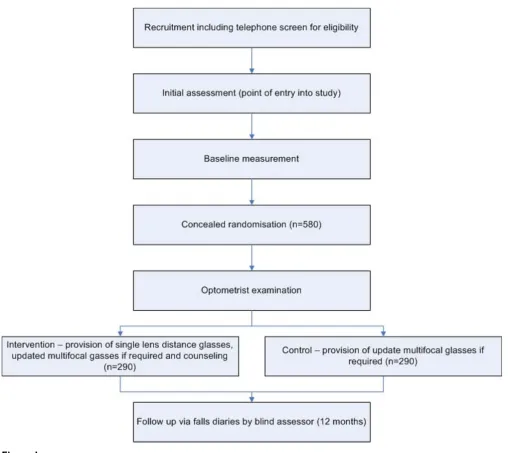
The University of New South Wales Human Research Eth-ics Committee (HREC) approved the study protocol (HREC Number 04229) as have ethics committees at the participating hospitals. The participant flow diagram is presented as figure 1 (Figure 1).
Initial Assessment
unconfident', will undergo consent, assessments and ran-domisation. The approach of targeting the intervention to those who consider it to be reasonable and manageable is based on strong evidence from hip protector trials [13].
Demographic details and potential confounders will be recorded, including age, gender, living alone status, MMSE [10], number of falls in past year, number and type of medications, physical activity levels, gait aids, medical conditions relevant to falls (e.g. arthritis, syncope, diabe-tes and depression), current glasses use and ocular history. Baseline lifestyle activities (using the Adelaide Activities Profile (AAP)) [14], health status (SF-12) [15], and falls
efficacy (Falls Efficacy Scale – International (FES-I scale) [16] will be measured.
The following vision and physical assessments will then be carried out. Corrected and uncorrected uniocular and binocular visual acuity will be assessed using a 3-metre logMAR chart [17]. Falls risk will be measured with the short-form Physiological Profile Assessment (PPA) [18] which includes five validated measures of physiological falls risk (visual contrast sensitivity, postural sway, quad-riceps strength, reaction time and lower limb propriocep-tion). In multivariate models these variables provide an overall falls risk score, and can predict those at risk of
fall-Flow of participants through the trial
Figure 1
BMC Geriatrics 2009, 9:10 http://www.biomedcentral.com/1471-2318/9/10
ing with 75% accuracy in community and retirement vil-lage settings. Functional mobility will be assessed with the TUG test [10], and the sit-to-stand test [19].
Randomisation
After completion of the initial assessment, participants will be formally entered into the study and randomised to intervention or control groups. Participants will be strati-fied by assessment site (Greenwich or Prince of Wales Hospitals) and recruitment source (hospital or commu-nity contact).
Then each stratum will be randomly allocated in per-muted blocks of 10 using sequentially-numbered opaque envelopes containing group assignment.
Intervention
Following the initial assessment, participants in the inter-vention group will have an optometrist examination that will include measurement of objective refraction. These participants will then be prescribed a pair of single-lens distance glasses. For the estimated 80% of intervention participants who will not need an update of multifocal lens prescription (n = 234), the correction for the single-lens glasses will be matched with the prescription of the upper segment of their pre-trial multifocal glasses. For the expected 20% of participants (n = 56) who have had a sig-nificant change in distance correction since the most recent prescription [defined as a change of +/- 0.5 dioptres for refractive error (using the spherical equivalent: sphere + half cylinder), or more than 0.75 dioptres for
astigma-tism (measured in minus cylinders) and at least +0.50 dioptres change in the reading addition], updated multi-focal lenses will be provided. The distance component of the updated multifocal correction will then be used for the prescription of new single-lens distance glasses, thereby making the transition between the two types of glasses easier.
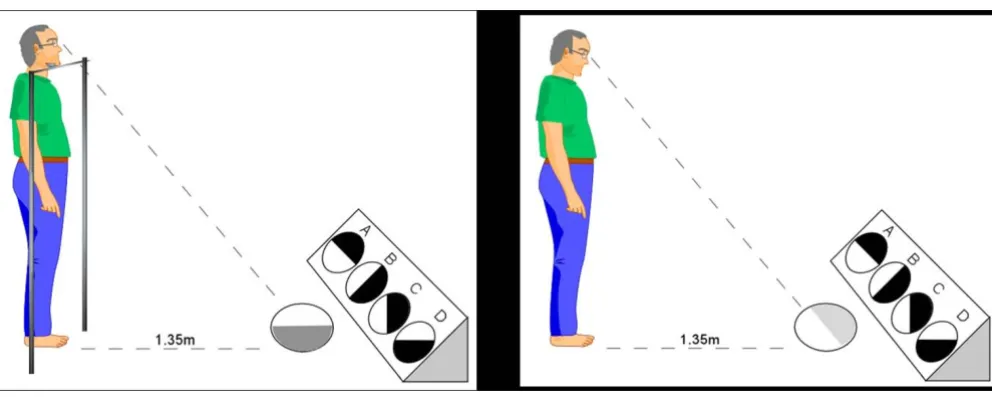
At a second visit (approximately four weeks following the initial assessment) participants will be fitted with their glasses. An optometrist/counsellor will then demonstrate how multifocal glasses can impair the visual abilities required for detecting obstacles and judging depth. This will be achieved by administering the tests of distance edge contrast sensitivity and depth perception with partic-ipants viewing the visual stimuli through the upper and lower portion of their multifocal lenses and distance lenses [5]. The difference in upper and lower visual per-formance will be shown to the participant and the ration-ale for performing these tests will then be explained. Figure 2 shows the tests for measuring upper and lower lens contrast sensitivity used in the counselling (Figure 2).
Participants will also be shown photographs of steps and streetscapes with and without simulated lower field blur to further reinforce why multifocal glasses may increase the risk of falls. Figure 3 shows the photographs of a sim-ulated view of a street scene as viewed through single-lens distance (panel a) and bifocal glasses (panel b) (Figure 3). This counselling session will be conducted in line with the health belief model [20], and is considered crucial to
con-The distance contrast sensitivity tests
Figure 2
vince older wearers of multifocal glasses that they are per-sonally at risk of fall-related injuries and that the benefits of wearing single lens glasses outweighs the inconven-ience of dealing with two pairs of glasses.
The optometrist/counsellor will then instruct participants to use their new single-lens glasses for most walking and standing activities, and in particular when undertaking the following activities: walking up or down stairs outside the home, walking in the street and at shopping centres, walking or standing in other people's homes and unfamil-iar buildings, negotiating rough or uneven ground and getting off and on public transport. Multifocal glasses use will not be discouraged for seated tasks, especially those that require frequent changes in focal length such as driv-ing, and indoor standing and walking tasks that require
changes in focal depth where there is minimal risk (e.g. cooking and selecting items in the supermarket).
To assist with the swapping of glasses, participants will be provided with a "glasses cord" for wearing around the neck and/or a hard or cloth glasses holder for keeping the second pair of glasses in a pocket. Intervention group par-ticipants will also be provided with a booklet reinforcing the advice. Table 1 outlines the strategies that will used to maximise compliance throughout the trial (Table 1). Any perceived barriers to compliance will be recorded.
Participants in the control group will also have the same optometric examination as participants in the interven-tion group. For the estimated 80% of participants who will not need a change of prescription (n = 234), no new
Simulated view of street scene as viewed through single-lens distance (panel A) and bifocal glasses (panel B)
Figure 3
BMC Geriatrics 2009, 9:10 http://www.biomedcentral.com/1471-2318/9/10
glasses will be prescribed. For the expected 20% who will require a prescription change (n = 56), updated multifocal lenses will be prescribed according to the above criteria and fitted at a second visit. Control group participants will be given no specific advice regarding the use of their glasses.
Outcomes
Primary outcome measure
The primary outcome measure will be the number of par-ticipant falls in the 13-month follow-up period following randomisation (this allows for an average time of one month for the provision of single-lens glasses following randomisation and 12-month further follow-up). Falls will be defined as 'inadvertently coming to rest on the ground or other lower level with or without loss of con-sciousness, and other than as a consequence of sudden onset of paralysis, epileptic seizure, excess alcohol intake or overwhelming external force' [21]. All participants will receive 13 calendars and questionnaires at the time of the baseline assessment. Participants will be asked to record falls (as well as information regarding any fall injuries and need for medical care) on the calendars and return them in pre-paid envelopes to the research centre each month. Participants who do not return calendars will be tele-phoned to ask for the information. Staff who receive falls calendars, make follow-up phone calls and enter data will be unaware of group allocation.
Secondary outcome measures
Secondary outcome measures will include physical activ-ity levels, falls efficacy and qualactiv-ity of life assessed at base-line and 12 months. These measures are included to determine whether, as a result of fewer falls, the
interven-tion has beneficial effects on an older person's abilities and quality of life. Physical activity levels will be assessed with the Adelaide Activities Profile, a validated scale which measures lifestyle activities using 21 items which generate four domains (domestic chores, household maintenance, service to others, and social activities) [14]. Physical and emotional wellbeing will be assessed using the SF 12 Version 2 composite physical and mental scores [15]. Falls efficacy will be assessed using the FES-I [16] in which level of concern about falling when carrying out 16 activities is rated on a 4-point scale.
Compliance and adverse events
Compliance in the intervention group will be measured monthly by asking how often the participants complied with recommendations about wearing single-lens dis-tance glasses when undertaking activities such as walking outdoors and descending steps etc. Reporting of the type of glasses worn during any fall will be recorded on the same questionnaire. Participants will be asked to return their compliance questionnaires in a separate pre-paid envelope to the falls calendar to the research centre each month. Staff who receive compliance questionnaires, make follow-up phone calls and enter data will be una-ware of the occurrence of any participant falls. Any per-ceived barriers to compliance will be recorded at baseline and throughout the trial.
Adverse effects Falls occurring as a result of switching from single-lens to multifocal glasses or vice versa while under-taking an activity or any non-fall adverse outcome occur-ring as a result of the intervention will be recorded on the falls calendars.
Table 1: Strategies to be used to maximise compliance
1 A strong evidence-based rationale for the intervention and clear recommendations will be provided.
2 The mechanism by which multifocal glasses can predispose to falls will be demonstrated during counselling using the example of the most commonly reported environmental factor involved in outdoor falls (Figure 2).
3 New glasses will be provided at no cost.
4 Perceived barriers to using two pairs of glasses will be identified and discussed during counselling.
5 An information brochure with recommendations and illustrations on appropriate use of glasses will be provided.
6 A hard/soft case glasses holder (to be worn around the neck and/or placed in the participant's pocket) to aid the swapping of glasses will be provided.
7 Second counselling sessions delivered over the phone or at home visits will address perceived barriers to use of glasses for participants with inadequate compliance, i.e. "never/occasionally" complying with the recommendations.
Sample size calculation
Approximately 580 participants (290 per group) will be recruited. The study will have 80% power to detect as sig-nificant at the 5% level a 23% reduction in the rate of fall-ing (i.e. an IRR of 0.77 usfall-ing negative binomial regression analysis) in the 13-month follow-up period. This repre-sents a reduction from 0.85 falls/person (an established rate of falling in a high-risk control group equivalent to our sample) [22,23] to 0.65 falls/person in the interven-tion group. This allows for an 8% loss to follow-up defined as withdrawing from the study and/or not com-pleting the falls diaries, 70% compliance in the interven-tion participants and a rate of 0.57 falls/person among those complying with the intervention
Statistical analysis
The primary analysis will be by intention to treat. The number of falls per person-year will be analysed using negative binomial regression to estimate the difference in falls rates between the two groups, adjusted for confound-ing variables if required. This analysis takes into account all falls during the trial, and the distribution of falls, which is Poisson-like but containing a wider, higher tail in the distribution [24]. Three a priori subgroup analyses will be performed using a test for statistical interaction to assess whether the intervention effect size differs accord-ing to: (i) baseline physiological falls risk [18]; (ii) number of participant-reported falls in the year prior to the trial; and (iii) participant-reported outdoor activity levels during the trial as assessed with the AAP [14]. Sec-ondary analyses will assess the effects of the intervention on falls that occur (i) within and (ii) beyond the partici-pants' homes. Longitudinal mixed models will be used to assess the effect of group allocation on the continuously-scored secondary outcome measures. Predictors of adher-ence will be established using multivariate modelling techniques. Analyses will be conducted using the SPSS [25] and Stata [26] computer programs.
Discussion
Falls are the leading cause of injury-related death and hos-pitalisation in older persons [26]. Falls can also result in disability, restriction of activity and fear of falling – all of which reduce quality of life and independence [27,28]. Furthermore, falls can contribute to the placement of an older person into institutional care [28]. There is mount-ing evidence that multifocal glasses impair vision, hinder obstacle avoidance and increase the risk of falls in older people.
There are over 2.4 million people over 65 years of age in Australia, one-third of whom fall annually at least once [27]. Given that 52% of older people rely solely on multi-focal glasses [1] and only 1% use separate reading and dis-tance glasses [1], over one million Australians could
potentially benefit from this trial immediately. Current guidelines recognise the importance of vision in falls and recommend that older people not walk while wearing multifocal glasses [29,30]. It is worth noting, however, that this recommendation also removes the correction of distance refractive error which may increase falls risk in some people. Our intervention, which involves providing multifocal glasses wearers with an additional pair of sin-gle-lens distance glasses for high-risk situations that increase postural threats (such as walking on stairs and in unfamiliar outdoor settings), will avoid this problem.
Thus, this program is optimally designed to address the major problem of falls in older people and could be read-ily translated into clinical practice. The study we are undertaking is designed and adequately powered to assess the effect of the program. There will be far-reaching bene-fits for older people, their carers and the community if this program can be demonstrated to assist in reducing the number of falls in this high-risk population.
Conclusion
The study will determine the impact of providing single-lens glasses, with advice about appropriate use, on pre-venting falls in older regular wearers of multifocal glasses.
Competing interests
The authors declare that they have no competing interests.
Authors' contributions
This manuscript was drafted by SL and MH. The other authors are also actively involved in the study. Many con-tributed to the writing of the grant application for this project which was funded by the Australian National Health and Medical Research Council in 2005. The grant application formed the basis for this manuscript. All authors contributed to the manuscript's critical review and approved the final version.
Acknowledgements
This study is funded by an Australian National Health and Medical Research Council (Reference Number: NHMRC ID 350855).
References
1. Attebo K, Ivers RQ, Mitchell P: Refractive errors in an older pop-ulation: the Blue Mountains Eye Study. Ophthalmology 1999,
106:1066-72.
2. Donahue SP: Loss of accommodation and presbyopia. In Oph-thalmology Edited by: Yanoff M, Duker JS. Mosby, London; 1999. 3. Duke Elder S: The practice of refraction. Churchill, London;
1963.
4. Tinetti ME: Clinical practice. Preventing falls in elderly per-sons. N Eng J Med 2003, 348:42-9.
5. Lord SR, Dayhew J, Howland A: Multifocal glasses impair edge contrast sensitivity and depth perception and increase the risk of falls in older people. J Am Geriatr Soc 2002, 50:1760-66. 6. Johnson L, Buckley JG, Harley C, Elliott DB: Use of single-vision
Publish with BioMed Central and every scientist can read your work free of charge "BioMed Central will be the most significant development for disseminating the results of biomedical researc h in our lifetime."
Sir Paul Nurse, Cancer Research UK
Your research papers will be:
available free of charge to the entire biomedical community
peer reviewed and published immediately upon acceptance
cited in PubMed and archived on PubMed Central
yours — you keep the copyright
Submit your manuscript here:
http://www.biomedcentral.com/info/publishing_adv.asp
BioMedcentral
BMC Geriatrics 2009, 9:10 http://www.biomedcentral.com/1471-2318/9/10
7. Johnson L, Buckley JG, Scally AJ, Elliott DB: Multifocal spectacles increase variability in toe clearance and risk of tripping in the elderly. Investigative OphthalmolVis Sci 2007, 48:1466-71.
8. Connell BR, Wolf SL: Environmental and behavioral circum-stances associated with falls at home among healthy elderly individuals. Atlanta FICSIT Group. Arch Phys Med Rehabil 1997,
78:179-86.
9. Davies JC, Kemp GJ, Stevens G, Frostick SP, Manning DP: Bifocal/ varifocal spectacles, lighting and missed-step accidents.
Safety Sci 2001, 38:211.
10. Mathias S, Nayak US, Isaacs B: Balance in elderly patients: The 'get-up and go' test. Arch Phys Med Rehab 1986, 67:387-9. 11. Folstein MF, Folstein SE, McHugh PR: Mini-mental state: a
practi-cal method for grading cognitive state of patients for the cli-nician. J Psychiatr Res 1975, 12:189-98.
12. Verbaken JH, Johnston AW: Population norms for edge contrast sensitivity. Am J Opt and Physiol Optics 1986, 63:724-732. 13. Kurrle SE, Cameron ID, Quine S: Predictors of adherence with
the recommended use of hip protectors. J Gerontol 2004,
59:M958-61.
14. Clark MS, Bond MJ: The Adelaide Activities Profile: A measure of the lifestyle activities of elderly people. Aging Clin Exp Res 1995, 7:174-84.
15. Gandek B, Ware JE, Aaronson NK, Apolone G, Bjorner JB, Brazier JE, Bullinger M, Kaasa S, Leplege A, Prieto L, Sullivan M: Cross-valida-tion of item selecCross-valida-tion and scoring for the SF-12 Health Sur-vey in nine countries:results from the IQOLA Project. J Clin Epidemiol 1998, 51:1171-8.
16. Yardley L, Beyer N, Hauer K, Kempen G, Piot-Ziegler C, Todd C:
Development and initial validation of the Falls Efficacy Scale International (FES-I). Age Ageing 2005, 34:614-9.
17. Bailey IL, Lovie JE: New design principles for visual acuity letter charts. Am J Optom Physiol Opt 1974, 53:740-5.
18. Lord SR, Menz HB, Tiedemann A: A physiological profile approach to falls risk assessment and prevention. Phys Ther 2003, 83:237-252.
19. Csuka M, McCarty DJ: Simple method for measurement of lower extremity muscle strength. Am J Med 1985, 78:77-81. 20. Rosenstock I: The health belief model and preventive health
behaviour. Health Education Monographs 1978, 2:354-386. 21. Gibson MJ, Andres RO, Isaacs B, Radebaugh T, Worm-Petersen J:
The prevention of falls in later life. Danish Medical Bulletin 1987,
34(Supplement No. 4):1-24.
22. Campbell AJ, Robertson MC, Gardner MM, Norton RN, Tilyard MW, Buchner DM: Randomized controlled trial of a general prac-tice programme of home based exercise to prevent falls in elderly women. BMJ 1997, 315:1065-69.
23. Cumming RG, Thomas M, Szonyi G, Salkeld G, O'Neill E, Westbury C, Frampton G: Home visits by an occupational therapist for assessment and modification of environmental hazards: a randomized trial of falls prevention. J Am Geriatr Soc 1999,
47:1397-1402.
24. Glynn RJ, Buring JE: Ways of measuring rates of recurrent events. BMJ 1996, 312:364-6.
25. SPSS for windows: Release 17. SPSS Inc, Chicago, Il; 2008. 26. StataCorp: Stata Statistical Software: Release 7.0. Stata
Corpo-ration, College Station, TX; 2001.
27. Lord SR, Sherrington C, Menz H, Close JCT: Falls in Older People: Risk factors and Strategies for Prevention. Second edition. Cambridge University Press, Cambridge, UK; 2007.
28. Tinetti ME, Williams CS: Falls, injuries due to falls, and the risk of admission to a nursing home. New Eng J Med 1997,
337:1279-1284.
29. Kenny RA, Rubenstein LZ, Martin FR, Tinetti ME: Guideline for the prevention of falls in older people. J Am Geriatr Soc 2001,
49:664-672.
30. Tinetti ME: Where is the vision in fall prevention. J Am Geriatr Soc 2001, 49:676-677.
Pre-publication history
The pre-publication history for this paper can be accessed here: