R E S E A R C H
Open Access
Effect of consecutive shoot-cutting for
3 years on saplings
’
sprouting regeneration
ability of six deciduous oak species in
Korea
Seung-Yeon Lee, Kyu-Tae Cho, Rae-Ha Jang and Young-Han You
*Abstract
Background:The sprouts of oak species play an important role in maintaining the oak community in a disturbed environment. In this study, we cut 1-year-old oak in three times during the 3 years and measured the sprout responses to know sprouting ability of six deciduous oaks in Korea.
Results:Oak sprouts have appeared in spring and fall, and some of the sprouts had lifespan as short as a month. As the number of cutting increases, sprout number ofQuercus acutissimaincreased whereas the other oak species decreased or died. The average number of sprouts over the 3 years was from 1.4 (Quercus mongolica) to 2.2 (Q. acutissima) per individual.Quercus serratadied after the second cutting, andQuercus dentatadied after the third cutting. So, the two species have the lowest sprouting ability among six oak species. The sprouts grew actively during fall and slowly in summer. The sprout length during the 3 years was in the following descending order:Q. acutissima,Quercus aliena,Q. dentata,andQ. mongolica. Sprout ofQ. acutissimaandQ. alienagenerated steadily over the 3 years, and sprout ofQuercus variabilisandQ. mongolicawas changed by year. After the 3 years, the number of sprouts increased only inQ. acutissimabut sprout number of the other five oak species decreased. The sprout length ofQ. acutissima,Q. aliena, andQ. variabilisincreased, but sprout length of the other three oak species decreased. The average survival rate of saplings over the 3 years was in the following descending order:Q. acutissima,Q. aliena,Q. variabilis, andQ. mongolica.
Conclusions:As a result, the sprouting ability ofQ. acutissimawas the highest. Such level of sprouting ability may be the evidence of howQ. acutissimacommunity exists as a dominant species in a disturbed environment in lowlands of Korea peninsula.
Keyword:Six deciduous oaks, Sprouting ability, Cutting the saplings, Consecutive cutting
Background
The oak forests in Korea provide food to many wild animals and are considered an important source for silviculture and landscaping. Currently, the genus oaks, which are widely dispersed in Korea, consist of six taxa, namely, Qeurcus mongolica,Qeurcus variabilis, Qeurcus aliena, Qeurcus acutissima, Qeurcus serrata, Qeurcus dentata, and 12 natural hybrids (Lee 2003).
These oak species have different ecological niche; therefore, they live under very diverse conditions (Lee
and You 2009; Lee and You 2012). The existing oak for-ests in Korea are secondary forfor-ests that developed after being disturbed by felling, for firewood and heating, or by natural forest fires (Yang 2002).Q. acutissima, which has a high tolerance to cold, dryness, and shade, is typic-ally distributed in mountains, roadsides, and residential areas.Q. variabilis, which has a high tolerance to dryness, grows well even in dry regions, and it has a high growth rate as well as high sprouting ability (Lee 2003).Q. aliena
partially remain in well-reserved secondary understory vegetation in lowlands of Korea. Q. dentata are grown well in mountain bases, mountainsides, beaches, and even * Correspondence:[email protected]
Department of Biology, Kongju National University, Gongju, South Korea
on islands. In addition, it is distributed as a dominant species in limestone zone (Lim et al. 2012). Q. serrata
grow well on sunny valleys or mountains with altitudes ranging 100~1, 800 m except in the northern regions.Q. mongolica generally are found in mountain ridges with altitude over 700 m, and many sprouts grow from the stem when it becomes old (Jo 1989). About 29% of forests in Korea is comprised of oak species that have a high growth rate, sprouting ability, and environment adaptabil-ity; and their demand is increasing due to their excellent timber quality (Kwon et al. 1998; Lee et al. 2000; Jung et al. 2013). The study on regeneration of oak forest is based more on sprouts rather than saplings (Kwon et al. 1998; Lee et al. 2000).
On the one hand, sprouting is a method of a vegetative reproduction; it is the main maintenance mechanism of oak individuals and community (Imanishi et al. 2010). The sprouts usually grow from buds near the stump or stems. Generally, plants’ sprout wakes up from its dor-mant state and starts to grow like an individual from the shoot if it gets disturbed by environmental factors or gets cut (Barbour et al. 1980). The sprouts growing from cutting tree have fast growth and high resistance to di-verse stress factors than individuals that germinate from the seed because sprout use accumulates from the shoot and roots of the tree (Smith 1986). Thus, sprouting is af-fected by various factors, such as cutting time, tree size, growth stage, light, moisture level, and type (Griffin 1980; Kim et al. 1991; Kwon et al. 1998).
This study was conducted to examine the sprouting ability of six dominant oak species in Korea in response to artificial disturbances. So, we studied the number of sprouts, sprout length, sprout reduction rate, and sur-vival rate of saplings after the three cuttings over the 3 years.
Methods
Study design and measurements
Oak species used in the experiment were six deciduous species which were collected in the mountains around Gongju from September to October in 2009 and kept in cold storage. The species were Q. acutissima (Qa), Q. mongolica(Qm),Q. variabilis(Qv),Q. dentata(Qd), Q. aliena(Qa), and Q. serrata(Qs). Fifty acorns, similar in
size and condition, were selected for each species, and they were sowed in March 2010. The germinated saplings were grown in the experimental field with consistent soil and moisture until February 2011. Among the saplings, only eight individuals that have stable growth condition, without any withered leaf or stem, were selected for each oak to be used for the experiment (Fig. 1).
The sprouting ability was determined by measuring the number of sprouts and the sprout length after ting the saplings at about 5 cm aboveground. The cut-tings were performed three times over 3 years in the same manner, and the measurements were taken at the end of the growth period which was 8–10 months after the cutting. The first cutting was performed in March 2011 whereas other two cuttings were performed at the end of the growth period each following year. The num-ber of sprouts and the sprout length were recorded each season (spring, summer, and fall) until November 2011 to analyze the periodic characteristics of sprouting. The growth period was a year before the first and the third cutting, but it was 2 years before the second cutting. Almost all the saplings of Q. serratadied after the first cutting, so we increased the growth period to 2 years be-fore the second measurement for increasing the survival of saplings. The cutting was performed either in spring or in fall because the number of sprouts and the sprout growth rate of oaks is usually higher in spring or fall than summer period (Kim 1995; Lee et al. 2000).
The number of sprouts and the sprout length measured after the first cutting was compared with those measured after the third cutting to analyze the changes in the sprouting ability. The mean value of measurements after the first cutting and that of the third cutting were used to calculate the changes in sprouting ability [(third value -first value)/-first value*100] in order to examine which oaks have high sprouting ability. In the calculation, the positive value refers to the increase in the number of sprouts and the sprout length over the measured period and the nega-tive value refers to the reduction of those parameters.
The survival rates were calculated for each year by div-iding the remaining number of saplings that survived after each cutting by the initial number of saplings (n= 8) to find out which oaks had the highest survival rate of sap-lings under consecutive cuttings.
Statistical analyses
We applied normal distribution test (Kolmogorov-Smir-nov test) on the number of sprouts, sprout length, and survival rate because the number of sample is small. The significance between groups was confirmed by perform-ing Kruskal-Wallis post hoc test (p< 0.05).
All the statistical analysis was conducted using Statistica Statistics Package (Statsoft CO. 2007) (No and Jeong 2002).
Results and discussion
Number of sprouts
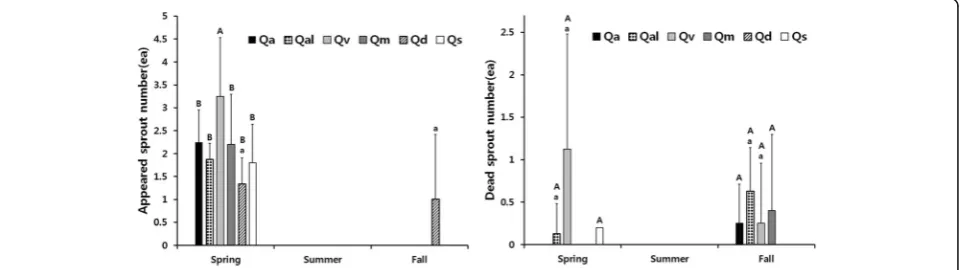
The sprouts of six oaks all started growing from spring, none appeared during summer, and only sprouts of Q. dentatashowed development in fall (Fig. 2, left). Our re-sult was different from the report of Kwon (2002) who stated that sprouts of mature oak trees continued to ap-pear from spring to autumn because it seems that the saplings of oaks used in this study contain much less assimilates than mature trees used in his experiment. The number of sprouts inQ. variabilis that appeared in spring after the first cutting was greater than other five oaks. The number of sprouts that appeared on Q. dentata in fall was the same as in spring. In case of
Q. dentata, the sprouts that appeared in the first year all survived displaying the highest survival rate after the first cutting (Fig. 2, right). On contrary, 20–60% of sprouts in other five oaks died in spring and autumn displaying a low initial survival rate. The differences in sprouting abil-ity among oaks in the same genus seem to be caused by individual variation, such as assimilate storage (Mroz et al. 1985).
The number of sprouts that survived for a year after the first cutting was high in Q. dentata and low in Q. aliena,but there was no significance among six oaks as they showed similar trends (Fig. 3). Only Q. acutissima
showed a consistent increase in the number of sprouts after the cuttings whereas other five oaks showed a de-crease after each cutting (Qv, Qm) or an inde-crease slightly
after the second cutting (Qal, Qd). After the third cutting, the number of sprouts in Q. acutissima was higher than those ofQ. variabilis,Q. aliena, andQ. mon-golica(p< 0.05) but it was the same in the later three oaks (Qv, Qal, Qm).Q. acutissimashowed relatively high aver-age number of sprouts, which appeared three times over 3 years, among four oaks, but there was no significant differences (p< 0.05). However, the sprouts ofQ. serrata
and Q. dentata did not appear after the second and the third cutting because all their individuals died. This result proves that Q. serrata have the lowest sprouting ability and Q. dentata have lower sprouting ability among six oaks in this study.
The fact that the number of shoot inQ. acutissimais higher than other oaks, even after consecutive cuttings, does not agree with the result of studies on regions dis-turbed with frequent forest fires (Jung et al. 2013). This
Fig. 2The number of appeared sprouts of six oaks for each season after the first cutting (left) and the number of dead sprouts (right).The capital letter above the barrepresents comparison between oaks according to season andthe small letterrepresents comparison within the oaks (different letters represent statistical differences,p< 0.05) (Qa Q. acutissima,Qm Q. mongolica,Qal Q. aliena,Qv Quercus varibilis,Qd Q. dentata, andQs Q. serrata)
difference in result can be attributed to the difference between the development stage of trees used in our study and their trees, which were mature trees growing in the region frequently affected with forest fires (Bar-bour et al. 1980). In other words, the sprouts can grow from bud located high up in the stem if the fire is weak but even the location of bud distributed on stem and number of bud can be different according to the devel-opment stage of the tree and state of growth.Q. acutis-sima, which has thinner bark than other oaks such asQ. variabilis, is presumed to have relatively low sprout re-generation ability in regions frequently affected with for-est fires considering the fact that thick bark of the trunk plays an important role in trees surviving through the forest fires (Griffin 1980; Hengst & Dawson 1994; Pinard & Huffman 1997; Odhiambo et al. 2014).
Sprout length
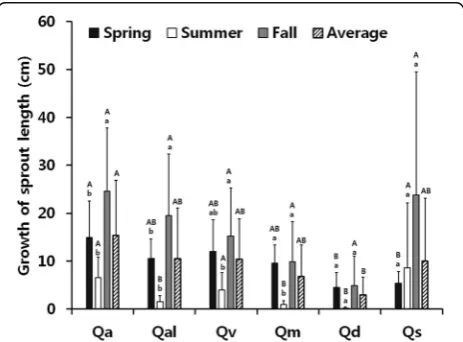
The sprout length of six oaks after the first cutting grew the most in fall than other two seasons in all six oaks but the growth was low in all the oaks during summer except for Q. serratai (Fig. 4). Q. acutissima grew the most during spring whereas grow length of Q. aliena
and Q. variabilis were lower. Q. mongolica, Q. dentata, andQ. serratahave intermediate level. The sprouts grew the most over the year inQ. acutissimawhereasQ. den-tata grew the least. The other four oaks had similar growth level.
After the first cutting of six oaks, the sprout length of
Q. acutissimawas the longest,Q. aliena andQ. variabi-lis were lower.Q. serrata,Q. mongolica, andQ. dentata
have intermediate level (Fig. 5). The reason for such
growth in Q. acutissima can be explained by relatively acorn of large size in comparison to other oaks (Shin et al. 2011). After the second cutting, there were no stat-istical differences in the sprout length among five oaks. OnlyQ. serratadied. After the third cutting, there were no statistical differences among Q. variabilis, Q. acutis-sima, andQ. aliena. ButQ. serrataandQ. dentata died. The sprout length is the longest after 2 years from its initial cutting in all five surviving oaks. This can be ex-plained by the increase in photosynthetic assimilates that plants accumulated over the 2 years of growth period (Barbour et al. 1980).
In our study, the sprout growth of Q. acutissima was higher than that of Q. mongolica and Q. dentata. Such result is similar to the experiment on sprout regener-ation of mature oak trees after the first cutting (Kwon et al. 2002; Lee et al. 2000), but it is different from the experiment conducted in regions frequently affected by forest fires (Jung et al. 2013).
On the other hand, the sprout growth is affected not only among oaks but also by cutting time, stump diam-eter when cutting in the same oaks. It is expected that most of the regeneration of oaks comprises of sprouting in regions where stem cutting rarely happens while they are still saplings as in our study. However, it seems that maintaining the community ofQ. serrataandQ. dentata
may not be possible if the disturbance, such as felling that continually has been done over decades in Korea for firewood or heating. Currently, Q. acutissimais dis-tributed widely in lowlands of central regions of Korea whereasQ. dentatacommunity has the least distribution (Yang 2002; Song 2007; Kim et al. 2009). This may have Fig. 4The sprout length of six oaks after the first cutting.The capital
letter above the barrepresents comparison between oaks, andthe small letterrepresents comparison within the oaks (Qa Q. acutissima, Qm Q. mongolica,Qal Q. aliena,Qv Quercus varibilis,Qd Q. dentata, andQs Q. serrata)
been caused by the poor sprouting ability of Q. dentata
in response to artificial disturbances.
The number of sprouts showed positive correlation with the sprout growth (Fig. 6). The study of Lee et al. (2000) on mature oak trees reports that the number of sprouts and the sprout growth has an inverse relation-ship. Such contrasting result can be attributed to the fact that the mature trees only have chlorophyll in their leaves whereas the saplings used in our study have chlorophyll even in their stems. The more sprout of saplings has more chlorophyll content that can photosynthesize. So, it is able to store more assimilates that can be used for sprout growth. But most of mature trees cannot photosynthesize as their stems have gone through lignification and that have a high rate of energy consuming organism. So, if mature trees have more sprouts, those will be not grown well.
Sprout reduction rate
The number of sprouts only increased in Q. acutissima
after the cutting whereas other five oaks all decreased (Fig. 7). The sprout length increased in Q. acutissima,Q. aliena, and Q. variabilis as time passed whereas it decreased in Q. mongolica, Q. dentata, and Q. serrata. Hence, the only oak that increased in both the number of sprouts and the sprout length was Q. acutissima among six oaks. The number of sprouts decreased in Q. aliena
and Q. variabilis, but their sprout length increased. The other three oaks decreased in both the number of sprouts and the sprout length. This result means that Q. acutis-sima has the highest sprouting ability under a disturbed environment where consecutive cuttings occur. Nonethe-less, the sprouting ability of oaks will vary according to the change of ecological niche responding to environmen-tal conditions, such as light, moisture, nutrients, and cli-mate change (Mroz et al. 1985).
Survival rate
All saplings ofQ. acutissima,Q. aliena, andQ. variabilis
survived after the first cutting but only 62.5% ofQ. mon-golica and 25% of Q. mongolica and Q. serratasurvived (Fig. 8). All saplings of Q. acutissima survived after the second cutting, all saplings ofQ. serratadied, and other four oaks showed 10–50% survival rate. But, the survival rate of Q. acutissima andQ. mongolicawas 37.5% after the third cutting and it was 12.5% for Q. aliena and Q. variabilis. The saplings of Q. mongolica and Q. serrata
all died by this time. The average survival rate over the 3 years was as follows: Q. acutissima(79.2%), Q. aliena
(54.2%), Q. variabilis (50.0%), Q. mongolica (45.8%), Q. dentata (12.5%), and Q. serrata (8.3%). Q. acutissima,
Fig. 6Regression analysis of the number of sprouts and the sprout length
Fig. 7The relative change in the number of sprouts and the sprout length of six oaks. It shows the ratio of the third measurement to the first measurement. Positive value shows that the number of sprouts and the sprout length increased over time whereas negative value shows a reduction (Qa Q. acutissima,Qm Q. mongolica,Qal Q. aliena, Qv Q. varibilis,Qd Q. dentata, andQs Q. serrata)
whose saplings all survived until the second cutting, showed the highest survival rate, and Q. serrata, whose saplings all died after the second cutting, showed the lowest survival rate. The early death of saplings of the above two oaks (Q. dentata andQ. serrata) is probably caused by more rapid decrease of assimilates resulted in consecutive cutting than others (Griffin 1980; Kim 1995). Based on the above result, the saplings ofQ. acu-tissima had the highest survival rate under a condition where a frequent disturbance, such as cutting, occurred. This could be attributable to the acorn size ofQ. acutis-simawhich has greater amount of assimilates than other oaks.
Conclusions
The regeneration of sprouts plays a crucial role in the regeneration of oaks community. Our study result re-vealed that even the saplings of six oaks that are less than a year can develop sprouts, grow, and survive. This means that oak community can still continue to exist/ grow even after being affected by a disturbance which could totally destroy the aboveground part, shoot. More-over, we could conclude that Q. acutissima, among six oaks, had the highest sprouting ability. Such difference in the sprouting ability of oak saplings is an important evidence that could explain why Q. acutissima commu-nity currently dominates the forests in the lowlands of Korea where artificial disturbances continually occurred in the past.
Abbreviations
Q. acutissima:Quercus acutissima;Q. aliena:Quercus aliena;Q. dentata:Quercus dentata;Q. mongolica:Quercus mongolica;Q. serrata:Quercus serrata;Q. variabilis:Quercus variabilis
Acknowledgements
This study was supported by the Mid-career Researcher Program (NRF-2016R1A2B1010709) through NRF grant funded by the MEST.
Funding
The institute is not involved in any way in the preparation of this manuscript or the decision to submit it.
Availability of data and materials Not applicable
Authors’contributions
All authors conducted a survey together during the study period. LSY wrote the manuscript. YYH participated in the design of the study and examined the manuscript. All authors read and approved the final manuscript.
Competing interests
The authors declare that they have no competing interests.
Consent for publication Not applicable
Ethics approval Not applicable
Received: 7 December 2016 Accepted: 7 February 2017
References
Barbour, M. G., Burk, J. H., & Pitts, W. D. (1980). Terrestrial plant ecology (p. 634). Menlo Park: The Benjamin Cummings.
Griffin JR. Sprouting in fire damaged valley oaks, Chews Ridge, California. Forest service, US Department of Agriculture. 1980. p. 216-219.
Hengst, G. E., & Dawson, J. O. (1994). Bark properties and fire resistance of selected tree species from the central hardwood region of North America. Canadian Journal of Forest Research, 24(4), 688–696.
Imanishi, A., Morimoto, J., Imanishi, J., Shibata, S., Nakanishi, A., Osawa, N., & Sakai, S. (2010). Sprout initiation and growth for three years after cutting in an abandoned secondary forest in Kyoto, Japan.Landscape and Ecological Engineering, 6(2), 325–333.
Jo, M. H. (1989). Coloured woody plants of Korea (p. 498). Academic Publisher. Jung, S. C., Seo, Y. O., & Kim, K. M. (2013). Study on growth and sprouts of oak forest for forest fire site in South Korea.Life Science Journal, 10(2), 1256–1260. Kim, S. K. (1995). Tending method for regenerative afforestation ofQ. acutissima.
Forest, 52, 84–87.
Kim, D. G., Hwang, G. Y., Kim, M. S., & Hong, H. P. (1991). Growth and development of stump sprout of twenty deciduous broadleaf trees.The Research Reports Forestr Research Institude, 42, 20–35.
Kim, I. T., Ms, S., & Jung, S. H. (2009). Analysis of distribution and association structure on the sawtooth oak (Quercus accutissima) forest in Korea.Journal of Life Science, 19(3), 356–361.
Kwon, K. W., Jung, J. C., & Choi, J. H. (1998). Studies on coppice regeneration of oak stands 1—sprouts and their growth ofQuercus variabilisandQuercus mongolica. J Life Sci & Res Wonkwang Univ., 20, 19–26.
Kwon KW, Choi JH, Song HG. Studies on regeneration strategy establishment of oak species—biomass production, sprouts and their growth ofQuercus mongolica, Quercus variabilisandquercus acutissima. J Aca Res. 2002. p. 177-179. Lee, T. B. (2003). Coloured flora of Korea (p. 910). Hyangmun Publisher. Lee, H. J., & You, Y. H. (2009). Ecological niche breadth ofQ. mongolicaand
overlap withQ. acutissimaandQ. variabilisalong with three environment gradients.Korean journal of environmental biology, 27, 191–197.
Lee, S. H., & You, Y. H. (2012). Measurement of ecological niche ofQuercus aliena andQ. serrataunder environmental factors treatments and its meaning to ecological distribution.Journal of Ecology and Environment, 35(3), 227–234. Lee, D. K., Kwon, K. C., Kim, Y. H., & Kim, Y. S. (2000). Sprouting and sprout growth
of fourQuercusspecies—at natural stands ofQuercusmongolica,Q. variabilis, Q. acutissimaandQ. dentatagrowing at Kwangju-gun, Kyonggi-Do.J Kor For En, 19, 61–68.
Lim, H., Kim, H. R., & You, Y. H. (2012). Growth difference between the seedlings ofQuercus serrataandQ. alienaunder light, moisture and nutrient gradients. J Wetl Res, 14, 237–242.
Mroz, G. D., Frederick, D. J., & Jurgensen, M. F. (1985). Site and fertilizer effects on northern hardwood stump sprouting.Can J For Res., 15, 535–543. No, H. J., & Jeong, H. Y. (2002). Well defined statistica analysis according to
Statistica (p. 627). Hyeongseol Publisher.
Odhiambo, B., Meincken, M., & Seifert, T. (2014). The protective role of bark against fire damage: a comparative study on selected introduced and indigenous tree species in the Western Cape, South Africa.Trees, 28(2), 555–565.
Pinard, M. A., & Huffman, J. (1997). Fire resistance and bark properties of trees in a seasonally dry forest in eastern Bolivia.Journal of Tropical Ecology, 13(05), 727–740. Shin, J. H., & You, Y. H. (2011). Effects of seed size on the rate of germination,
early growth and winter survival in four oak species.Korean journal of environmental biology., 29, 274–279.
Smith, D. M. (1986). The practice of silviculture (p. 527). John wiley and Sons, Inc. Song, M. S. (2007). Analysis of distribution and association structure on the
sawtooth oak (Quercus acutissima) forest in Korea. Doctor's Thesis. Changwon: University of Chanwon.