Educating the Pediatrician of the 21st Century: Defining and
Implementing a Competency-Based System
Carol Carraccio, MD*; Robert Englander, MD, MPH‡; Susan Wolfsthal, MD*; Christine Martin, PhD*; and Kevin Ferentz, MD*
ABSTRACT. Purpose. The final product of the Ac-creditation Council for Graduate Medical Education (ACGME) Outcomes Project is to improve health care through ensuring the competence of physicians during their training and beyond. Its success depends on a par-adigm shift to a competency-based model of medical education. This article presents an overview of the model and describes the first stages of this multistep transition in a university setting. Our hope is to raise awareness of the impact on the pediatric community at large and pro-vide a foundation on which other educators can continue to build.
Methods. The ACGME established 6 domains of
competence as the first step in the paradigm shift. To begin work on the second step of establishing bench-marks for evaluation of competence and thresholds at which they should be achieved, the educational leader-ship from the primary care departments formed a work group with the support of a Health Resources and Ser-vices Administration grant.
Results. Review of the literature led us to embark on a stepwise process for initiating a competency-based sys-tem of medical education. We established the bench-marks by a process of individual effort followed by group consensus. These benchmarks, in the aggregate, permit an evaluator to determine whether a given com-petency has been achieved. The next phases of step 2 required setting thresholds for the demonstration of competence and finally establishing consensus regarding the threshold for competence at each level of training for each specific benchmark. To accomplish the latter, we surveyed the program directors of the 202 accredited pediatric training programs that are members of the As-sociation of Pediatric Program Directors. Eighty-one members (40%) completed our survey. Although some controversy existed for thresholds during the postgradu-ate-year-1 level, majority consensus was reached for nearly all benchmarks at the upper levels of training. Impact of the shift to competencies for medical students and practicing physicians is also reviewed.
Conclusion. Having defined the benchmarks and thresholds for the 6 ACGME domains of competence, we are well positioned to move to step 3: developing the necessary tools to evaluate competence. The move to competency-based education impacts the entire pediatric community. Lessons learned from our experience may be generalized and thus be of value to the community at
large.Pediatrics2004;113:252–258;competency-based edu-cation, medical eduedu-cation, residency training, mainte-nance of certification.
ABBREVIATIONS. ACGME, Accreditation Council for Graduate Medical Education; ABMS, American Board of Medical Special-ties; APPD, Association of Pediatric Program Directors; ABP, American Board of Pediatrics; PGY, postgraduate year.
T
he Accreditation Council for Graduate Medical Education (ACGME) has partnered with the American Board of Medical Specialties (ABMS) in responding to public concerns regarding account-ability in health care and medical education through the “Outcomes Project.”1 As a result, allgraduate-level training programs have been mandated to change the infrastructure of the training process to one that is competency based. Although the changes in graduate medical education have received the most focused attention, generalization to undergrad-uate education of medical students and to the certi-fication process of practicing physicians is also un-derway. The purpose of this article is twofold: 1) to update pediatricians about competency-based edu-cation and its impact on the pediatric community at large and 2) to describe the first stages of the multi-step process to implement a competency-based sys-tem of education in a university setting.
DEFINITIONS
In an attempt to define a competency-based sys-tem of education, one must first come to grips with a definition of “competency.” Review of the literature shows a number of definitions that, when synthe-sized and simplified, describe “competency” as a complex set of behaviors built on the components of knowledge, skills, and attitudes.2–9In contrast
“com-petence” refers to one’s ability to perform a task. The focus on competencies differs significantly from our current structure/process system of education, in which the focus of training is on knowledge acqui-sition and the process is teacher centered. In a com-petency-based system, the focus is on outcome, which is the application of the knowledge, and the process is learner centered with input from a mentor. The ACGME named the following 6 competencies that all graduate-level trainees must attain by the completion of formal training: patient care, medical knowledge, interpersonal and communication skills, professionalism, practice-based learning and
im-From the *University of Maryland School of Medicine, Baltimore, Mary-land; ‡University of Connecticut School of Medicine, Hartford, Connecticut. Received for publication Apr 14, 2003; accepted Sep 10, 2003.
Address correspondence to Carol Carraccio, MD, Department of Pediatrics, University of Maryland, 22 South Greene St, Baltimore, MD 21201. E-mail: [email protected]
provement, and systems-based practice. The former 4 competencies are traditionally areas of focus within graduate medical education with the emphasis on professionalism being more recent. The latter 2 do-mains of competence are less familiar but critically important as one reflects on the environment in which medical care is practiced in the 21st century. The essence of practice-based learning and improve-ment is the commitimprove-ment to practice improveimprove-ment by 1) designing and evaluating interventions to address identified problems, 2) the use of technology in the acquisition and application of “best evidence,” and 3) the commitment to life-long learning. Competence in systems-based practice requires us to demonstrate an “awareness of and responsiveness to the larger context and system of health care and to effectively call on system resources to provide care that is of optimal value.”1 It includes one’s ability to partner
with other professionals to navigate and advocate for patients within the context of the health care delivery system. The practitioner is challenged to balance cost with quality. Also included is a focus on system errors and one’s ability to improve the system by impacting these errors.
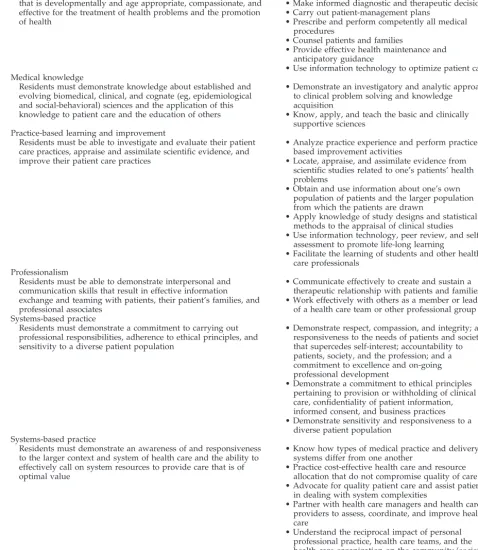
The sequel to identifying the broad competencies was to define the elements that comprise them. The ACGME and ABMS laid the groundwork for this step but garnered the help of 24 teams, 1 for each of the 24 ABMS specialties. Each team was comprised of a representative from the specialty board, pro-gram directors association, residency review com-mittee, and a resident, hence earning the name “spe-cialty quad.” Thus the initial draft of competencies was refined and specialty specific language and ele-ments were incorporated (see Table 1).10At this
junc-ture, the education community was challenged to continue the effort initiated by the ACGME by de-veloping best-practice models to bring the Outcomes Project to fruition.
LAYING THE GROUNDWORK FOR CHANGE Accepting this challenge, the program directors from the departments of pediatrics, internal medi-cine, and family medicine applied for and received an academic administrative unit grant from the Health Resources and Services Administration to de-velop a collaborative educational initiative that would move us in the direction of a competency-based system of education. The program directors, clerkship directors, and ambulatory clinic directors, as well as a medical educator, became members of the work group that brought this initiative to frui-tion.
In an effort to understand the logistics and process for implementation of a competency-based system of education, we performed a literature search on com-petency-based education dating back to the begin-ning of both the ERIC and MEDLINE systems.2
Re-view of the literature on the development of competency-based curricula and evaluation outlines a 4-step process. The 4 steps include 1) competency identification, 2) determination of competency com-ponents and performance levels, 3) evaluation of competence, and 4) an overall assessment of the
pro-cess itself. The ACGME took the first step with the initiation of the Outcomes Project in 1999 by defining the 6 competencies.1 The remainder of this article
describes how we accomplished step 2, determina-tion of competency components and performance levels.
As we began this undertaking, the working group met to develop the framework for this project. Our first major task was to mesh discipline-specific cur-ricula, the traditional goals and objectives, with the 6 competencies. Consensus was that we develop benchmarks for the 5 competencies that crossed dis-ciplinary lines as well as the 2 components of the medical-knowledge competency that dealt with knowledge acquisition and application. For the third component of the medical-knowledge competency, dealing with specialty-specific content in the form of goals and objectives, faculty within each specialty developed their own curriculum. Our framework then embodies the traditional curriculum as 1 com-ponent of the medical-knowledge competency.
STEP 2: DETERMINATION OF COMPETENCY COMPONENTS AND PERFORMANCE LEVELS Phase 1: Defining Benchmarks
Step 2 in the process of shifting to a competency-based system is to further define the elements of the competencies by determining the measurable behav-ioral objectives that comprise the elements of the competency. These behavioral objectives are referred to as benchmarks or performance indicators. For ex-ample, the patient care competency includes a num-ber of elements that were defined by the ACGME in conjunction with the specialty quad. One of these elements is “gather essential and accurate informa-tion about the patient.” Each element of the compe-tencies was assigned to a program director or asso-ciate program director with the charge to develop a draft of measurable benchmarks or performance in-dicators for that element. (See the Appendix for an excerpt. The full grid can be found on the Associa-tion of Pediatric Program Directors [APPD] web site at www.appd.org under resources for competency evaluation, evaluation portfolio). The working group reviewed the drafts in an effort to minimize errors of omission or commission and to ensure that bench-marks were assigned to the most appropriate com-petency, especially in areas of overlap. Attention also was focused on the specific use of behavioral verbs to define the benchmarks as measurable tasks. This pro-cess was reiterated until there was consensus from the group. The entire first phase of the project took several months to complete. Subsequently, the clerk-ship directors developed a parallel document to ad-dress the same domains of competence for under-graduate trainees. The literature describing a similar process for preventive medicine was particularly helpful in guiding us through this exercise.11–14
Phase 2: Defining the Thresholds
deter-mining whether competence for a given benchmark was achieved. In a focus-group session of the Pro-gram Director’s Committee of the American Board of Pediatrics (ABP), 3 types of thresholds were sug-gested. The first involved the percentage of time that a learner accomplished a task. An example of a benchmark that would fit with this type of threshold is “interviews patients with an appreciation of their
developmental level and/or age,” where one may expect a competent junior resident to perform this task 25% to 50% of the time while expecting a com-petent senior resident to demonstrate this skill⬎75% of the time. The second type is based on one’s ability to complete the task based on acuity/complexity of patient problems, with more junior learners demon-strating competence in a skill with routine patients
TABLE 1. Pediatrics General Competencies and Synopsis of Competency Elements
Competencies Elements of Competency:
Patient care
Residents must be able to provide family-centered patient care that is developmentally and age appropriate, compassionate, and effective for the treatment of health problems and the promotion of health
• Gather essential and accurate information
• Make informed diagnostic and therapeutic decisions • Carry out patient-management plans
• Prescribe and perform competently all medical procedures
• Counsel patients and families
• Provide effective health maintenance and anticipatory guidance
• Use information technology to optimize patient care Medical knowledge
Residents must demonstrate knowledge about established and evolving biomedical, clinical, and cognate (eg, epidemiological and social-behavioral) sciences and the application of this knowledge to patient care and the education of others
• Demonstrate an investigatory and analytic approach to clinical problem solving and knowledge
acquisition
• Know, apply, and teach the basic and clinically supportive sciences
Practice-based learning and improvement
Residents must be able to investigate and evaluate their patient care practices, appraise and assimilate scientific evidence, and improve their patient care practices
• Analyze practice experience and perform practice-based improvement activities
• Locate, appraise, and assimilate evidence from scientific studies related to one’s patients’ health problems
• Obtain and use information about one’s own population of patients and the larger population from which the patients are drawn
• Apply knowledge of study designs and statistical methods to the appraisal of clinical studies • Use information technology, peer review, and
self-assessment to promote life-long learning
• Facilitate the learning of students and other health care professionals
Professionalism
Residents must be able to demonstrate interpersonal and communication skills that result in effective information exchange and teaming with patients, their patient’s families, and professional associates
• Communicate effectively to create and sustain a therapeutic relationship with patients and families • Work effectively with others as a member or leader
of a health care team or other professional group Systems-based practice
Residents must demonstrate a commitment to carrying out professional responsibilities, adherence to ethical principles, and sensitivity to a diverse patient population
• Demonstrate respect, compassion, and integrity; a responsiveness to the needs of patients and society that supercedes self-interest; accountability to patients, society, and the profession; and a commitment to excellence and on-going professional development
• Demonstrate a commitment to ethical principles pertaining to provision or withholding of clinical care, confidentiality of patient information, informed consent, and business practices • Demonstrate sensitivity and responsiveness to a
diverse patient population Systems-based practice
Residents must demonstrate an awareness of and responsiveness to the larger context and system of health care and the ability to effectively call on system resources to provide care that is of optimal value
• Know how types of medical practice and delivery systems differ from one another
• Practice cost-effective health care and resource allocation that do not compromise quality of care • Advocate for quality patient care and assist patients
in dealing with system complexities
• Partner with health care managers and health care providers to assess, coordinate, and improve health care
but more-senior learners needing to demonstrate competence in the skill regardless of patient acuity or complexity. An example of such a benchmark would be “performs a detailed and accurate physical exam-ination.” The third type of threshold involved di-chotomous categories of behavior (eg, does or does not demonstrate a behavior). This would be the most-frequent type of threshold for the professional-ism competency. Two of the authors (C.C. and R.E.) applied 1 of the 3 specific types of thresholds to each benchmark listed under each of the 6 domains of competence. These designations were brought back to the multidisciplinary group for approval. This preliminary work was presented to the Residency Review Committee for Pediatrics in October 2001 and modified further based on input from committee members.
Phase 3: Setting Thresholds for Competence
The third phase of step 2 required the establish-ment of consensus regarding the threshold for com-petence at each level of training for each specific benchmark. To accomplish this task, the document was sent to the membership of the APPD along with a cover letter explaining the content and process of the draft. Each program director was asked to assign the most-appropriate threshold for each level of training for each benchmark at the end of that post-graduate year (PGY). Responses were sought for res-idents at the following PGYs of training: PGY-0.5 (half-way through year 1), PGY-1, PGY-2, and PGY-3 (the end of years 1, 2, and 3, respectively). Follow-up to the initial mailing was done through several e-mail communications. All surveys were anonymous. Survey results were analyzed by using the Statis-tical Package for the Social Sciences. Frequencies of responses were determined for each benchmark at each of the specified levels of training. A consensus response was considered one in which⬎50% of pro-gram directors agreed on the threshold for the level of training for the specific benchmark. In cases for which there was not a clear-cut consensus, the min-imum threshold was chosen. For example, if 45% of program directors felt that a PGY-1 should be able to perform a task for routine patients to have achieved competence for that benchmark and 40% felt that a PGY-1 should be able to perform a task on most patients, the minimum threshold (ie, demonstrating the task for routine patients) was considered to be the consensus for that benchmark at the PGY-1 level of training.
Of the 208 programs in categorical pediatrics ac-credited by the ACGME, 202 are members of the APPD. Of these 202 programs, 81 completed the survey, for a response rate of 40%. Although some controversy existed for thresholds at the PGY-0.5 and PGY-1 levels, 95% and 100% agreement were reached for the PGY-2 and PGY-3 levels, respec-tively. Although the 40% response rate is a limitation of these data, the fact that clear consensus was achieved for 95% of benchmarks at the PGY-2 level and 100% of benchmarks at the PGY-3 level adds to the face validity of the threshold. Additionally, for all benchmarks the consensus threshold increased as
level of experience of the trainee increased, thus lending discriminant validity to the instrument. Ex-amples of the consensus thresholds for each bench-mark at each level of training are shown in the Ap-pendix.
STEP 3: EVALUATING COMPETENCE
Steps 1 and 2 of the shift to competency-based education are challenging but pale in comparison to step 3, which requires the evaluation of competence. The process for evaluating competence differs from the typical approach to evaluation that has been used in the current medical education system. Most pro-grams use global evaluations that are generic in na-ture, with a single evaluation form serving as the assessment tool for a number of different clinical experiences and settings. The components of the evaluation are often a proxy for the task being eval-uated. The evaluator’s response is typically based on general interactions with the learner over a pre-scribed period of time. The evaluator may never have observed the learner performing a given task directly but rather extrapolated an assessment based on discussions with the learner regarding patient care activities. In addition, in the current system, learners are compared with each other, a process known as norm-referenced assessment. In contrast, competence is evaluated by using criterion-refer-enced assessment; that is, the learner must meet a predefined threshold to be considered competent.15
Thus, if one is to evaluate competence in patient care, one must observe directly the benchmarks that com-prise ability in patient care. A directly observed his-tory and physical or an interview with a standard-ized patient provide 2 potential ways of assessing competence in patient care. The individual’s perfor-mance of a history and physical is not measured by comparison to the other members of the team. Rather, each resident must simply meet the pre-defined standard for performing the history and physical examination. Implicit in judging a learner’s ability to meet thresholds is the teacher’s ongoing feedback to the learner as part of the educational process to guide the learner in meeting standards that have been set. A competency-based system of education emphasizes formative or ongoing feed-back rather than summative feedfeed-back given at the end of the clinical experience or rotation.
di-verse range of competencies required of graduate medical trainees.
STEP 4: EVALUATING THE OUTCOME Step 4 of the process is the evaluation of the out-come of the shift to a competency-based system. This step requires us to determine whether the implemen-tation of a competency-based system of education results in “better” physicians and, ultimately, im-proved patient outcomes. Only through imim-proved patient outcomes can we establish the ultimate effec-tiveness of the ACGME Outcomes Project. This step will require the input and collaboration of national organizations such as the ACGME, ABMS, and the National Initiative for Children’s Healthcare Quality, as well as others.
GENERALIZING THE COMPETENCIES TO MEDICAL STUDENTS AND PRACTITIONERS Although the changes that are occurring in grad-uate education have received the greatest press, sim-ilar changes are occurring in both medical school and continuing medical education. The Association of American Medical Colleges supports a shift to com-petency-based education for medical students. Aligning student and resident competencies allows us to begin to address education along the contin-uum. The key here is pairing leadership in under-graduate and under-graduate education to ensure that out-come competencies from medical school match expected incoming competencies for residency train-ing.
The practicing physician is now being called on to demonstrate competence through continuous profes-sional development as a requirement for maintaining certification. At the level of board certification, the member boards of ABMS, of which the ABP is one, are shifting away from “recertification” for practic-ing physicians to “maintenance of certification.” The essence of this shift parallels what is happening at the undergraduate and graduate levels of education. The practicing physician will need to demonstrate not only current knowledge but also evidence of professional standing, a commitment to life-long learning and satisfactory performance in practice. For pediatricians, there will be 4 steps to maintaining one’s general pediatric certification.16Step 1 requires
pediatricians to maintain valid medical licenses in all states in which they hold a license. Step 2 is demon-strating a commitment to life-long learning through the Knowledge Self-Assessment and Decision Skills Self-Assessment. The Knowledge Self-Assessment is an on-line activity that the ABP will make available on its web site (www.abp.org) in late 2004. This requirement also can be accomplished by completing the PREP Self-Assessment offered by the American Academy of Pediatrics. The Decision Skills Self-As-sessment is offered only by the ABP and will require attaining a passing score. Step 3 will involve success-fully completing a secure examination at local testing centers. Step 4 will involve 2 practice improvement activities: 1) peer/patient surveys and 2) a perfor-mance in practice activity. The peer/patient process is still in the developmental stages and will not be
required for several years. Completing an ABP-ap-proved program for quality improvement can fulfill the performance in practice activity. The American Academy of Pediatrics has designed an on-line pro-gram called eQIPP (Education in Quality Improve-ment for Pediatric Practice) that meets the ABP’s standards for a performance in practice activity. The phase-in of the new maintenance of certification pro-cess will be complete by 2010. Diplomates with cer-tificates that expire before 2010 will need to complete the first (medical license) and third (examination) steps of the process; diplomates with certificates is-sued from 2010 onward will need to complete all 4 components successfully.
LESSONS LEARNED
There were several lessons learned from the pro-cess of developing these benchmarks and thresholds. The first lesson involved the identification of key faculty for the working group. The establishment of a multidisciplinary group of faculty involving indi-vidual stakeholders in the medical education pro-cess, from undergraduate through graduate training, enriches the process, garners buy-in, and improves the outcome by virtue of the collaborative process. In particular, the input of the group as a whole signif-icantly decreases the number of errors of omission that each faculty member commits on his/her own. The input of a medical educator is also extremely helpful, particularly in providing an understanding of the lexicon of competency-based education. The process requires a champion who is passionate about the project. This individual will be pivotal in moti-vating the group, particularly at the inevitable times of inertia.
The second lesson learned was that establishing the framework for relating goals and objectives to competencies is a major hurdle. Reaching this mile-stone allowed us to develop the infrastructure for the educational program. The 6 competencies became the foundation, and the elements of the competencies were defined further by benchmarks. The medical-knowledge competency embraces acquisition and application of knowledge as well as discipline-spe-cific content in the form of a curriculum. The latter is framed in traditional goals and objectives. Each de-partment would write its specific curricula, but the rewards of this collaborative effort inspired us to continue work group efforts on curricula that crossed disciplinary lines such as substance abuse, nutrition, and complementary medicine, to name a few.
expected resident performance as reported in this survey is consistent with the actual performance of our residents.
IMPACT ON THE PEDIATRIC COMMUNITY The magnitude of these changes in education has broad implications for the pediatric community. All pediatricians who hold a time-limited certificate from the ABP will need to “maintain certification.” In addition, practicing physicians and academic faculty who contribute to the education of medical students and residents will need to provide more direct ob-servation of the learner performing authentic tasks, along with formative feedback to the learner about performance. Finally, those pediatricians who have assumed roles in educational leadership will have the added responsibility of 1) developing curricula to address the required competencies and 2) creating assessment tools to demonstrate to accrediting agen-cies and the general public that our graduates have met performance standards for the 6 ACGME com-petencies. Our hope in initiating the second step in this process was to provide the pediatric community with a foundation on which to build an evaluation system that one can use to assess competence. The major challenges in the third step will be 1) creating tools that measure competence of the trainee in per-forming the tasks of the practicing physician that are
both cost-effective and practical and 2) testing the reliability and validity of any of the new develop-ment-assessment tools. We are currently in the pro-cess of creating a web-based evaluation portfolio that will address the benchmarks for the 6 ACGME com-petencies. Only when we have addressed the third step can we systematically study the pivotal question of whether this shift to a competency-based system of education makes a “difference.” This final step will require a national effort combined with a na-tional consensus on defining “difference.” We spec-ulate that various organizations and interest groups will define “difference” based on the issues critical to the organization itself. Thus, measurable differences in job satisfaction, cost of care, etc may result. We may say that we have trained “better” physicians based on higher board scores or decrease in the number of medical errors; however, the “real differ-ence” can be measured only in the quality of care delivered to our patients.
APPENDIX: EXCERPT OF BENCHMARKS AND THRESHOLDS FOR COMPETENCE IN PATIENT
CARE
Residents must be able to provide family-centered patient care that is developmentally and age appro-priate, compassionate, and effective for the treatment of health problems and the promotion of health.
Element of Competency: Gather Essential and Accurate Information About the Patient
Knowledge/Skills/Attitudes Benchmarks
Rarely Demonstrates (⬍25% of the Time)
Sometimes Demonstrates (25–50% of the Time)
Demonstrates in Most Cases (50–75% of the Time)
Demonstrates in Majority of Cases
(⬎75% of Time)
Demonstrates knowledge of how to access adjunctive sources of information to the history obtained from the family (eg, chart)
PGY-0.5 PGY-1 PGY-2, PGY-3
Interviews patients with an appreciation for their developmental level and/or age
PGY-0.5 PGY-1 PGY-2, PGY-3
Describes age-specific concerns in the approach to the physical examination
PGY-0.5 PGY-1 PGY-2, PGY-3
Conveys an appreciation for the value of the caretaker’s observations and judgments regarding the patient’s health and illness
PGY-0.5 PGY-1 PGY-2, PGY-3
Conveys an appreciation for the opportunity to be involved in the care of the patient
PGY-0.5 PGY-1, PGY-2, PGY-3
Knowledge/Skills/Attitudes Benchmarks
Unable to Demonstrate Even With Routine
Patients
Demonstrates for Routine Patients
Demonstrates for Most Patients
Demonstrates for Almost Any Patient Despite Acuity or Complexity
Performs a complete history including a chief complaint, history of the present illness, past history, family history/ social history, and review of systems
PGY-0.5 PGY-1 PGY-2, PGY-3
Performs a detailed and accurate physical examination
ACKNOWLEDGMENTS
This work was supported in part by a grant from the Health Resources and Services Administration of the Bureau of Health Professions.
We thank Drs Robert Perelman, Gail McGuinness, and Hazem Ham for their advice in preparing this manuscript.
REFERENCES
1. Accreditation Council for Graduate Medical Education. Outcomes Project. Available at: www.acgme.org/Outcome. Accessed January 2, 2003
2. Carraccio C, Wolfsthal SD, Englander R, Ferentz K, Martin C. Shifting paradigms: from Flexner to competencies.Acad Med. 2002;77:361–367 3. Bell CG. Role vs. entry-level competencies in competency-based
educa-tion.J Am Diet Assoc. 1976;69:133–137
4. Brown TC, McCleary LE, Stenchever MA, Poulson AM. A competency-based educational approach to reproductive biology.Am J Obstet Gy-necol. 1973;116:1036 –1043
5. Bell HS, Kozakowski SM, Winter RO. Competency-based education in family practice.Fam Med. 1997;29:701–704
6. Grussing PG. Education and practice: is competency-based education closing the gap?Am J Pharm Educ. 1984;48:117–124
7. Hager P, Gonczi A. Competency-based standards: a boon for continuing professional education?Stud Contin Educ. 1991;13:24 – 40
8. Rinke WJ. Competency-based education. J Am Diet Assoc. 1980;76: 247–252
9. Spady WG. Competency-based education: a bandwagon in search of a definition.Educ Res. 1977;6:9 –14
10. Accreditation Council for Graduate Medical Education. Pediatrics gen-eral competencies. Available at: www.acgme.org/RRC㛭PedDocs/ ped.GenComp.pdf. Accessed August 22, 2003
11. Lane DS, Ross V. Consensus on core competencies for preventive med-icine residents.Am J Prev Med. 1994;10:52–55
12. Lane DS, Ross V. The importance of defining physician’s competencies: lessons from preventive medicine.Acad Med. 1994;69:972–974 13. Lane DS, Ross V, Parkinson MD, Chen DW. Performance indicators for
assessing competencies of preventive medicine residents.Am J Prev Med. 1995;11:1– 8
14. Pololi LH, Coletta EM, Kern DG, et al. Developing a competency-based preventive medicine curriculum for medical schools.Am J Prev Med. 1994;10:240 –244
15. Turnbull J. What is . . . normative versus criterion-referenced assess-ment.Med Teach. 1989;11:145–150
16. Stockman JA, Ham H. Maintenance of certification: the new approach to recertification in pediatrics.Pediatric Diplomates.2001;Fall:1– 4
VIDEO IMMERSION IN INFANCY
“In the last five years, there has been an explosion in electronic media for infants and toddlers: ‘Teletubbies,’ the first television show for preverbal children; com-puter ‘lapware’ for infants to play with while sitting in a parent’s lap; and hundreds of videotapes and DVDs for even the tiniest infants. . . . Many infants are now immersed in electronic media for hours every day. In fact, more than a quarter of children under 2 have a television in their room, according to a large study of young children’s media habits that was issued yesterday by the Henry J. Kaiser Family Foundation.”
Lewin T. A growing number of video viewers watch from crib.New York Times. October 29, 2003
DOI: 10.1542/peds.113.2.252
2004;113;252
Pediatrics
Ferentz
Carol Carraccio, Robert Englander, Susan Wolfsthal, Christine Martin and Kevin
Competency-Based System
Educating the Pediatrician of the 21st Century: Defining and Implementing a
Services
Updated Information &
http://pediatrics.aappublications.org/content/113/2/252
including high resolution figures, can be found at:
References
http://pediatrics.aappublications.org/content/113/2/252#BIBL
This article cites 13 articles, 0 of which you can access for free at:
Subspecialty Collections
dev_sub
http://www.aappublications.org/cgi/collection/teaching_curriculum_
Teaching/Curriculum Development
b
http://www.aappublications.org/cgi/collection/medical_education_su
Medical Education following collection(s):
This article, along with others on similar topics, appears in the
Permissions & Licensing
http://www.aappublications.org/site/misc/Permissions.xhtml
in its entirety can be found online at:
Information about reproducing this article in parts (figures, tables) or
Reprints
http://www.aappublications.org/site/misc/reprints.xhtml
DOI: 10.1542/peds.113.2.252
2004;113;252
Pediatrics
Ferentz
Carol Carraccio, Robert Englander, Susan Wolfsthal, Christine Martin and Kevin
Competency-Based System
Educating the Pediatrician of the 21st Century: Defining and Implementing a
http://pediatrics.aappublications.org/content/113/2/252
located on the World Wide Web at:
The online version of this article, along with updated information and services, is
by the American Academy of Pediatrics. All rights reserved. Print ISSN: 1073-0397.