r"
Ia; r
.,
Indian J. PIli'" Ph"ioi.• Vol. XXIX, No.4. pp, 297-301 (December. 1986)
EFFECT OF DIFFERENT DATES OF SOWING ON YIELD AND YIELD ATTRIBUTES OF BARLEY GENOTYPES
J. SURYAPRAKASA RAO· AND P. N. WATTAL
Division of Plant Physiology
Indian Agricultural Research Institute, New Delbi-110 0)2
SUMMARY
Field experiments were conducted during rab; 1979-80 and 1980-81 to study the effect of sowing dates on yield and yield attributes of barley genotypes. Planting the crop early in season i.e., about a month and half before November was as much productive or even more in com parison to later sowing of until middle of November. Delayed plantinp around second week of December reduced the growing season and adver sely affected the grain yield. The components of grain yield were affected differently in different sowings and in the early to normal plantings the mutural compensation between these components balanced the effect of sowing dates while at late planting the grain yeiJd suffered mostly due to drastic reduction in ear number. Further. the short duration varieties yielded as much as the medium late types under early to late plantings. Long duration varieties were not superior to other types under early planting and these invariably yielded less than the other types at late sowing.
INTRODUCTION
Barley (Hordeum vulgare L.) is an important cereal and occupies fourth rank among the four principal rabi crops in India. The chief reason for the low yields in rabi cereals is the limit imposed by shortness of growing season which is largely conditioned by temperature. Planting the crop at different dates may involve various plant environmental interactions and would affect the kernel maturity, grain yield and yield components (Musick and Dusek, 1980). Advancing the sowing date by about 'a month or so (i.e., second fortnight of September or first week of October) would expose the seedlings not only to higher temperatures but also perhaps to a critical day length for flowering. It was therefore, considered desirable to assess the effects of sowing dates on yield and yield attributes of barley genotypes.
298
'9. '.,?
~;2;;
t +1.SURYAPRAKASA.RAO AND P. N. WATIAL
MATERIALS AND METHODS
A field experiment was carried out during rabi 1979-80 and 1980-81
under normal irrigated conditions at IARI, New Delhi. Seven genotypes of barley, differing widely in flowering time (ear emergence) viz., DL 88 (Hulled, early) DL 157 (Hulled, medium late), DL 287 (Naked, medium late), lyoti (Hulled, medium), Centinella (Hulled, very early), Kailash (Hulled, very late) and Himani (Hulled, late), were studied in 1979~80 (Experiment A). The varie tal response to variation in sowing dates was further examined in only four promising strains viz., DL 88, lyoti, DL 157 and Himani during 1980-81
(Experiment B). The sowing date commenced from around first week of October to the middle of December in the two seasons. The experiments were laid out in a split plot design with sowing dates as main treatment and varieties as sub-plot treatment and replicated four times.
The crop was Sown after pre-sowing irrigation under each sowing date. Nitrogen at the rate of 40 kg ha-t through urea, 20 kg each of P10S through
superphosphate and KilO through muriate of potash were applied. One hand weeding was also given after first irrigation to control the weeds.
RESULTS AND' DISCUSSION
Weatber data
The weather data during the crop growth period are presented in Table I.
During 1979-80, the rainfall was 33.6 mm for the crop growth period and the high maximum temperature at maturity was resulted in lower grain yield of barley. In 1980-81, the rainfall (88.0 mm) mostly received during the months of January and February was accompanied with low maximum temperature at maturity which were conducive for the growth of the crop and for good grain filling.
Yield and yield attributes
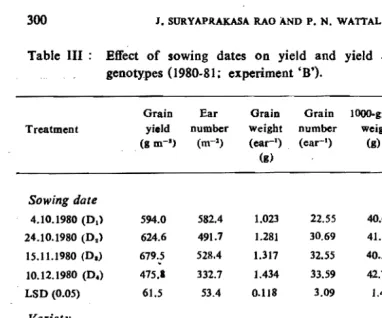
The data on yield attributes are given in Table H (experiment A. 1979-80)
and Table III (experiment B, 1980·81). The effect of sowing dates on grain yield had a small seasonal fluctuation. In Experiment A, the early plantings (01) yielded little higher than the later two plantings (.02 and D8), In Experi
,
YIELD AND YIELD ATI'RIBUTES OP' BARLEY GENOTYPES 299
Table I: Mean monthly weather data during the crop growing season.
Temperature (OC) Average R.H Rainfall
(%) (mm)
Maximum Minimum Mean
1979·801980-81 1979·80 1980-81
1979·80 1980-81 1979-80 1980-81 1979-80 i980-81
October 34.5 34.2 17.6 18.1 26.1 26.2 54 62 0.0 8.8
November 29.2 28.4 13.9 10.9 2].6 19.7 61 70 0.0 2.8
December 23.6 22.6 7.6 7.3 15.6 150 66 74 0.0 6.2
January 21.2 20.3 5.2 7.7 ]3.2 14.0 69 81 1.0 38.2
February 25.5 23.9 9.6 9.8 17.6 16.9 61 74 4.2 23.0
March 28.5 27.6 13.0 13.2 20.8 20.4 60 73 28.4 9.0
April 38.5 35.9 20.2 19.8 29.4 28.3 39 49 0.0 0.0
Table II : Effect of sowing dates on yield and yield attributes of barley genotypes (1979-80: experiment 'A').
Grain Ear Grain Grain lOOO-grain Total Harvest
Treatment yield number weight number weight (g) biolo- index
(g m-2) (m-t) ear-J(g) ear-1 gieal (%)
yield (g m-2)
Sowing date
10.10.1979 (DI ) 624.3 464 1.357 34.9 39.5 1579.4 40.1
29.10.1979 (Dt ) 545.7 446 1.250 33.2 38.2 1438.4 38.1 16.11.1979 (D.) 541.1 437 1.257 34.8 36.2 1405.4 38.5
4.12.1979 (D.) 453.3 415 1.117 32.7 34.3 1008.6 45.7
LS D (0.05) 73.2 N.S 0.084
N.s
1.1 164.0 J.1Variety
DL 88 661.4 452 1.471 36.1 40.8 1358.8 49.2
01. 157 636.3 524 1.237 32.7 37.7 1665.9 39.1
DL 287 493.8 337 1.477 43.0 34.4 1355.9 37.0
Jyoti 578.2 465 1.260 30.9 41.0 1455.7 40.7
Centinella 523.5 467 1.126 27.4 41.6 1120.9 46.9
Kailash 388.1 398 0.989 32.1 30.7 1293.0 30.2
Himani 506.1 440 1.157 35.2 32.9 1265.1 409
300
1. SURYAPRAKASA RAO AND P. N. WATfALTable III : Effect of sowing dates on yield and yield attributes of barley genotypes (1980-81; experiment 'B').
Grain Ear Grain Grain JOOO-grain Total Harvest
Treatment yield number weight number weight biologi index
(g m-") (m-1) (earl) . (ear-I) (g) cal yield (%)
(g) m-1
Sowing date
4.10.1980 (D1> 594.0 582.4 1.023 22.55 40.0 1209.1 49.24
24.10.1980 (D.> 624.6 491.7 1.281 30.69 41.6 1467.3 42.49
15.11.1980 (D,) 679.5 528.4 1.317 32.55 40.3 1452.7 47.19
10.12.1980 (D.) 475.' 332.7 1.434 33.59 42.7 1097.8 43.60
LSD (0.05) 61.5 53.4 0.118 3.09 1.4 157.4 1.96
Variety
DL88 667.0 491.4 1.381 32.94 41.9 1315.5 49.29
DL 157 613.4 4745 1.300 31.03 41.9 1389.5 43.94
lyoti 575.9 443.8 1.339 31.18 42.8 1192.6 48.66
Himani 517.7 525.6 1.037 27.23 38.1 1287.3 4062
LSD (0.05) 67.6 N.S 0.075 1.93 1.2 N.S 1.20
this they perform equally well when grown out of their normal climatic range. Thus. it is reasonable to conclude that planting the crop at first week of October (Dl ) would be as much productive or even more (in experiment A) in compari
son to plantings sown at later dates. until middle of November (Ds and Dl).
The grain yield under late sowing clearly lagged behind in both the experiments. The lower grain yield with later sowings (D..) was due to the plants not getting full benefit of soil and water resources because of shorter growing period. Moreover. preftowering phase of the crop was also reduced witb delayed sowings. Continuous low temperature during vegetative phase and high temperature at maturity. adversely affected the number of ears and grain weight per ear. which ultimately reduced the grain yields in last sowing (Singh and Tomar. 1970 and Randhawa et al., 1977).
r
_ . . .~.c-_YIELD AND YIELD ATIRISltrEs OF BARLEY GENOTYPPS 301
in ear number m-2 (or grain number m-2
) depressed the grain yield under the
last sowing. This was partially and only to a small extent compensated by the increase in grain weight per ear which was increased both by the increase in grain number per ear and individual grain size. Early planting had fewer grains per ear which might be attributed to warm and long days at differentiation and development of inflorescence. but cooler weather prevailing during the subse quent phases of crop development sustained the survival of larger number of cars and compensated for the decreased in grain weight per ear. Thus. the tendency of one of the components of grain yield to compensate for the lack of another is subjected to environmental stress and may not be consistent in diffe rent seasons. The total biological yield and harvest index varied unsystemati cally with variation in sowing dates.
Different varieties responded differently to variation in sowing dates (experiment A). The components of grain yield were also affected differently in different varieties in both the experiments. In some cases mutual compensat ion between these components balanced the effect of sowing dates. However, in experiment A, DL 88 yielded higher than DL 157, Jyoti and Himani when sown early (DI) largely by virtue of producing more ears, where as it yielded as much as DL 157 and Jyoti with delay in sowing. The grain yield of Himani was relatively less than the other three varieties at the last two sowings due to greater reduction in grain weight per ear. The grain yields of DL 287 (naked). Centinella and Kailash were inferior only to that of DL 88 and DL 157 under Dl but they mostly suffered greater than the other varieties at the later plantings.
ACKNOWLEDGEMENTS
The author (JSR) is grateful to the Indian Agricultural Research Institute. New Delhi for the grant of Senior Research Fellowship. We arc thankful to Prof. A. Narayanan for his keen interest. constant encouragement and helpful comments on the manuscript.
REFERENCES
Musick. J. T. and Dusek. D. A. (1980). Planting date and water deficit effects on develop
ment and yield of irrigated winter wheat. Agron. J .• 72: 4S-52.
Randha~a, A. S •• Jolly. R. S. and Dhillon. S. S. (1977). R.esponse of wheat and barley to
nitrogen levels under different sowing dates. Crop Impro"ement. 4 (I): 89-94.
Singh, B. P. and Tomar. R.P.S. (1970). Comparative study of yield components of tall and