Channel capacity estimation in
MIMO-OFDM system using water filling algorithm
V.Jagan Naveen
Associate Professor Dept of E.C.E
GMR Institute of Technology, Rajam, India, Mobile: +919849722092
K.Murali Krishna
Professor Dept of ECE
AITAM Tekkali,India Mobile:+91-9490041142,
K.RajaRajeswari
Professor Dept of ECE
A.U College of Engineering Andhra University, visakhapatnam, India
Abstract :
In this paper we have implemented water filling algorithm for allocating the power in order to increase the channel capacity of MIMO-OFDM system .Channel is assumed as flat fading channel and the comparison is made for different 2x2, 2x3, 4x4 MIMO-OFDM system using water filling algorithm with allocated power. The main idea is to observe the efficiency of channel capacity of the system using water filling algorithm.
Keywords: Multi Input Multi Output (MIMO); Water filling algorithm; channel Capacity Signal to Noise Ratio (SNR); Orthogonal Frequency Division Multiplexing (OFDM).
1. Introduction
power at the transmitter using water filling algorithm to all the channels. If the channel parameters are unknown at the transmitter and known at the receiver, equal power is allocated to each transmitter and estimates the capacity using water filling algorithm. In this paper, section 2 explains the overview of MIMO OFDM channel capacity using water filling algorithm. Section 3 & 4 shows the simulation results and conclusions of mean channel capacity for 2X3, 2X4, 4X4 MIMO OFDM system.
2. Overview of MIMO OFDM channel capacity
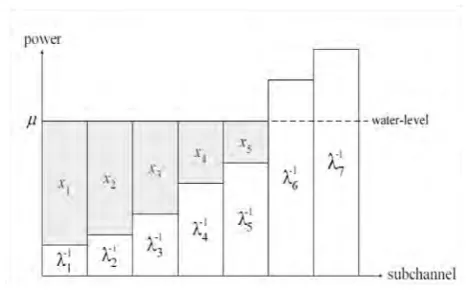
Water filling is the solution of several optimization problems related to channel capacity. The well known water filling algorithm solves the problem of maximizing the mutual information between the input and output of a channel. This capacity achieving solution has seemed to be pouring water over a surface given by the inverse of the sub channels gains hence the name water filling or water pouring[12].Consider a MIMO OFDM system with
r
N
receivers andN
t transmit antennasThe system is represented as
y
hx
n
(1)Where ‘
x
’is the Nt1 transmit vector, ‘y’ is the
Nr1
receive vector, ‘h’ is the
NrNt
channel matrix and‘n’ is the Nr1 additive white Gaussian noise (AWGN) vector at a given instant in time. Generally the
channel matrix is denoted by
h
ij and this represents the complex gain of the channel between the thj
transmitter and the
i
threceiver [13]. 2.1 MIMO OFDM channel capacityFigure 1 Water filling in parallel subchannels
The total capacity of the OFDM system is given as the sum of the capacities from each of the individual subchannels
N i
N
i
i i i
OFDM
h p c
C
1 1
2 2 21 log
(2)
Where Pi is the power assigned to each of the subchannels and perfect channel knowledge is assumed at the
receiver.OFDM is also employed in DSL systems (usually known as DMT in that case), and given the fixed nature of the channel, full channel state information can be assumed to be available at both receiver and transmitter, so the optimal power allocation is given by the well known water filling algorithm [14] among the different sub channels.The subchannels are unable to accessible when the channel knowledge is absent at the transmitter. So the power allocation in the entire subchannel is logical under this scenario. The principle of water filling algorithm is a large power is assigned to better subchannel and vice versa. The aim of this algorithm is to allocate power across the channels to enhance the total capacity. By the knowledge of channel matrix ‘h’ it reflects the channel strength and the amount of power allocated to each channel.
This power allocation is subject to the constraint that the sum of the power is equal to the total power, pT
available at transmitter [16]. From the figure 1, λ1,λ2...,λN with λi as the positive square root of ith Eigen value
The optimum power allocated to the ith sub channel is
1 22
i i h p
(3)
Where
x
max(
0
,
x
)
and
is fixed to verify the power constraintT N i i p p
12.2 Water filling iterative algorithm
Let initially
p
i=0 andp
1 be the sub channel with highest SNR.While p p tolerance
N
i i T
1 , N P P N i i T
1 thenp1p1
(4)
The New water level is calculated as
p
1
2h
12 and remaining powers are estimated asi N h
p
i
i 2 2,...
2
(5)
2.3 Outage probability
The channel capacity is associated to an outage probability [15-17]. Capacity treated as random variable depends on the channel instantaneous reasons and remains constants. If the channel capacity falls below the outage capacity there is no possibility that the transmitted block of information can be decoded with no errors, in which error coding scheme employed. The outage probability is
Pout PT
logdet(INr hQh)R
(6)Where
hh EQ is covariance, R is information rate to be transmitted. It is conjectured that
P
outis minimizedby using a uniform power allocation over a subset of the transmit antennas.
3. Simulation results
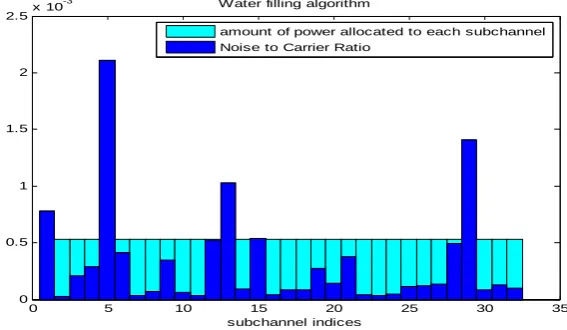
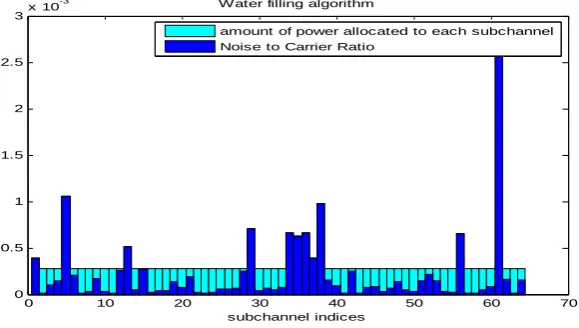
Assuming the Channel State Information (CSI) is known at the transmitter and receiver, channel is flat and noise is AWGN. The capacity performance analysis has been simulated on MATLAB using water filling algorithm. Figure 2 to 6 shows the amount of power allocated to each subchannel and number of subchannels are taken as N=4 to 64.Noise to carrier power ratio is indicated on each subchannel by taking the total power -20dB, bandwidth is 1 MHz and noise density is -80dB.
Figure 2 shows the power allocated to each sub channel N=4 using water filling algorithm
1 2 3 4
0 1 2 3 4 5 6 7x 10
-3
subchannel indices Water filling algorithm
1 2 3 4 5 6 7 8 0
1 2 3 4 5 6 7 8 9x 10
-3
subchannel indices Water filling algorithm
amount of power allocated to each subchannel Noise to Carrier Ratio
0 5 10 15 20 25 30 35 0
0.5 1 1.5 2 2.5x 10
-3
subchannel indices Water filling algorithm
amount of power allocated to each subchannel Noise to Carrier Ratio
Figure 3 shows the power allocated to each subchannel N=8 using water filling algorithm
Figure 4 shows the power allocated to each subchannel N=16 using water filling algorithm
Figure 5 shows the power allocated to each sub channel N=32 using water filling algorithm
0 2 4 6 8 10 12 14 16 18
0 0.5 1 1.5 2 2.5 3 3.5 4 4.5x 10
-3
subchannel indices Water filling algorithm
-10 -5 0 5 10 15 20 25 30 0
5 10 15 20 25 30 35 40
SNR (dB) --->
Me
an C
apa
c
it
y
bp
s
/H
z
-
-->
Mean Capacity vs SNR 2x3MIMO-OFDM
2x3MIMO-OFDM WATER FILLING
Figure 6 shows the power allocated to each subchannel N=64 using Water filling algorithm
Figure7 Mean capacity versus signal to noise ratio(dB) for 2x4 MIMO-OFDM with and without water filling algorithm with power constraint PT =1 and N=32
Figure 8 Mean capacity versus SNR in dB for 2x3 MIMO-OFDM system with and without using water filling algorithm
0 10 20 30 40 50 60 70
0 0.5 1 1.5 2 2.5
3x 10
-3
subchannel indices W ater filling algorithm
amount of power allocated to each subchannel Noise to Carrier Ratio
-10 -5 0 5 10 15 20 25 30 0
5 10 15 20 25 30 35 40
SNR (dB) --->
M
ean
C
apac
it
y
bps
/H
z
-
-->
Mean Capacity vs SNR 2x4MIMO-OFDM
-10 -5 0 5 10 15 20 25 30 0
5 10 15 20 25 30 35 40
SNR (dB) --->
M
ean
C
apac
it
y
bps
/H
z
--->
Mean Capacity vs SNR 4x4 MIMO-OFDM WATER FILLING 4x4 MIMO-OFDM
-10 -5 0 5 10 15 20
0 5 10 15 20 25
SNR in dB
C
apac
it
y
bi
ts
/s
/H
z
nt = 1 , nr = 1 nt = 2 , nr = 2 nt = 3 , nr = 2 nt = 2 , nr = 3 nt = 4 , nr = 4
Figure 9 Mean capacity versus SNR in dB for 4x4 MIMO-OFDM systemwith and without using water filling algorithm
Figure 8 shows that the Channel capacity of MIMO-OFDM system with water filling algorithm is increased compared to MIMO–OFDM system without water filling algorithm for 2x3 MIMO-OFDM system with power constraint PT=1 and N=32. Figure 9 shows that the Channel capacity of MIMO-OFDM system with water filling
algorithm is increased compared to MIMO–OFDM system without water filling algorithm for 4x4 MIMO-OFDM system with power constraint PT=1 and N=32.
Figure 10 Capacity versus signal to noise ratio for MIMO OFDM system
4. Conclusion
In this paper, Channel capacity of MIMO OFDM systems is estimated using water filling algorithm .The use of multiple antennas on both the transmitter and receiver side of a communication link have shown to greatly improve the spectral efficiency of wireless system. The mean capacity allocation in wireless cellular network based on the water filling power allocation in order to enhance the capacity of MIMO-OFDM system with different channel assumptions. It is observed that amount of power allocated to each subchannel and noise to carrier ratio for subchannels 4 to 64. It is observed that maximum power is allocated to the channel having greater gain. The graphs of capacity versus SNR, shows that the capacity of the MIMO-OFDM channels increases as the number of antennas used at the transmitter and receiver increases.
5. References
[1] E. Biglieri, J. Proakis, and S.Shamai(Shitz), Fading channels: Information-Theoretic and Communications Aspects, IEEE Transactions on Information Theory, pp. 2619-2692,Oct.1998.
[2] [2] A.J. Goldsmith and P.P. Varaiya, Capacity of fading channels with channel side information, IEEE Transactions on Information Theory, vol. 43, no. 6, pp. 1986-1992, Nov.1997.
[3] C.E. Shannon, “A mathematical theory of communication” Bell Sys. Tech. J., vol. 27, pp.379-423, 623-656, 1948.
[4] I.E. Telatar, “Capacity of multi-antenna gaussian channels” European Transactions on Telecommunications and Related Technologies, vol. 10, no. 6, pp. 585-596, 1999.
[5] M. Medard, “The effect upon channel capacity in wireless communication of perfect and imperfect knowledge of the channel” IEEE Transactions on Information Theory, vol. 46,no. 6, pp. 933-946, may 2000.
[6] Lapidoth and S.M. Moser, “Capacity bounds via duality with applications to multiple antenna systems on flat-fading channels,” IEEE Transactions on Information Theory, vol.49, no. 10, pp. 2426-2467, 2003.
[7] Lozano, A.M. Tulino, and S. Verdu, High-SNR power offset in multi antenna communication, IEEE Transactions on Information Theory, vol. 51, no. 12, pp. 4134-4151, Dec.2005.
[8] Lozano, A.M. Tulino, and S. Verdú, “Multiple-antenna capacity in the low-power regime”,IEEE Transactions on Information Theory, vol. 49, no. 10, pp. 2527-2544, Oct. 2003.
[9] S. Verdu, “Spectral Effciency in the Wideband Regime”,IEEE Transactions on InformationTheory, vol. 48, no. 6, pp. 1319-1343, June 2002.
[10] C-N. Chuah, D. Tse, J. M. Kahn, and R. A. Valenzuela, “Capacity Scaling in MIMOWireless Systems Under Correlated Fading”,IEEE Transactions on Information Theory,vol. 48, no. 3, pp. 637-650, Mar. 2002.
[11] Jang, Y.J. and Letaief, K.B (2005), “An efficient resource-allocation Scheme for spatial multiuser access in MIMO-OFDM/OFDM systems”, IEEE Transactions on Information Theory, Volume 53, Issue 1, Pages 107-116, January 2005.
[12] Guillaume Lebrun, Student Member, IEEE, Jason Gao, Member, IEEE, and Michael Faulkner, Member, IEEE “MIMO-OFDM Transmission over a Time Varying Channel Using SVD” IEEE Transactions On Wireless Communications,Vol.4, No.2, March2005. [13] Ying-Chang Liang, Rui Zhang, and Cioffi, J.M. (2003), “Sub- channel grouping and statistical water-filling for MIMO-OFDM-OFDM
systems”, Proceedings of Signals, Systems and Computers, 2003.
[14] [14]Mingxin Tan, Jingjing Chen, “Comparision and analysis of MIMO-OFDM channel capacity” IEEE Wicon International Conference, pp.299-301 2007.
[15] David Tse and Promod Viswanath “Fundamentals of Wireless Communication”, Cambridge University, 2005. [16] E.Telatar, “Capacity of Multi Antenna Gaussian Channels”, Technical memorandam, T&T Bell Laboratories, June 1995.
[17] Shi Jin, Student Member IEEE, Xiqi Gao, member IEEE and Xiaohu You, Member IEEE, “ON the Ergodic Capacity of Rank-1 Ricean-Fading MIMO-OFDM Channels”, IEEE Tranasactions On Information Theroy, Vol-53, No.2, February 2007.
Authors
V.Jagan Naveen is currently working as a Associate Professor in ECE Department G M R Institute of Technology, Rajam, India. He is working towards his PhD at AU College of Engineering, Vishakhapatnam, India. He received his M.E from Andhra University Engineering college, vishakapatnam, India. His research interests are in the areas wireless communications and signal processing.