Immunization Entry at the Point of Service Improves Quality, Saves Time,
and Is Well-Accepted
William G. Adams, MD; William P. Conners; Adriana M. Mann; and Sean Palfrey, MD
ABSTRACT. Objective. Computer-based immuniza-tion tracking is a routine part of many pediatric practices; however, data quality is inconsistent and entry often relies on dedicated data entry personnel and is time-consuming, expensive, or difficult. The purpose of this study was to evaluate data quality, nursing satisfaction, and reduction in documentation burden after the intro-duction of a point-of-service immunization entry system in an inner-city pediatric primary care center.
Design. Prospective preintervention and postinter-vention study.
Methods. Visit records from all pediatric nonurgent care visits for patients<5 years old were collected during a 2-week period before (preintervention) and after (post-intervention) the introduction of a computer-based im-munization entry system. Nurses used software designed to allow rapid entry during immunization preparation followed by printing 2 adhesive labels for documenta-tion. Satisfaction was evaluated using an 8-question sur-vey administered 3 months after the intervention.
Results. One hundred forty-seven (63.6%) of 231 pre-intervention and 132 (51.4%) of 257 postpre-intervention chil-dren received at least 1 immunization (immunized) dur-ing the study visit. Gender and mean age were similar for immunized children in the 2 groups. In the preinterven-tion group, 56 (37.9%) of 147 immunized children had at least 1 dose missing (a total of 128 of 343 doses adminis-tered) from the immunization tracking database com-pared with none in the postintervention group. Medical record review showed that 92.6% of preintervention and 91.4% of postintervention children were on-schedule af-ter the study visit. However, missing data lead to the misclassification of preintervention children— only 68.4% were reported by the database to be on-schedule. All 9 nurses reported using the program all the time to enter immunizations, 89% said that the program required somewhat or a lot less time, and 100% strongly recom-mended continued use of the program. All 9 nurses also reported that they would be somewhat or very unenthu-siastic about the system if labels were not available. During the 12 months after introduction of the system, 8273 forms containing immunization information were printed, preventing nurses from having to write>101 000 dates.
Conclusions. Immunization entry by nurses at the time of immunization preparation improves the quality of tracking data, reduces misclassification of immuniza-tion needs, saves time, and can be well-accepted. It is likely that poor data quality in some tracking systems
has led to falsely low immunization coverage estimates. Systems such as the one in this study can improve qual-ity and should be integrated into routine clinical practice.
Pediatrics 2000;106:489 – 492;immunization tracking, im-munization delivery, point of service.
ABBREVIATIONS. POS, point of service; CPR, computer-based patient record; PPCC, Pediatric Primary Care Center; BIIS, Boston Immunization Information System; WIC, Women, Infants, and Children.
I
mmunization tracking with reminders and recalls has been shown to improve immunization deliv-ery,1as well as delivery of primary care services.2Computer-based immunization tracking is now a routine part of practice for many child health care providers. However, the data quality in many immu-nization tracking systems is inconsistent, and entry often relies on dedicated data entry personnel and is time-consuming, expensive, or difficult. Published guidelines for the use of immunization tracking sys-tems recommend that providers routinely evaluate the accuracy of such systems and the few studies available have shown substantial variation in data quality with 10% to 40% of doses given missing from the tracking database.3–7 Despite the limitations of
these systems, a number of benefits have already been realized, including enhanced outreach efforts, improved immunization rates, and reduced clinical workload related to form completion.1–3,8,9
Collection of medical data at the point of service (POS) has become the focus of many new medical software packages. POS systems require clinical per-sonnel to record information at the time that the patient is being seen. These systems offer the best opportunity for accurate information collection be-cause the clinician providing the service records the desired data, which is then immediately available for clinical decision-making, form printing, or other real-time process. Integration into clinical workflow is a critical requirement of any successful clinical infor-mation system10and POS systems are no exception.
Any system that is unacceptably slow, or difficult to use will not be accepted in clinical settings, especially busy pediatric centers with high patient volumes. Innovations in information technology have finally made possible the development of user-interfaces that can substantially improve the speed and ease of data collection at the point of service while not dis-rupting the demanding clinical workflow of ambu-latory care centers. Automated immunization
track-From the Division of General Pediatrics, Boston University School of Med-icine, Boston, Massachusetts.
Received for publication Sep 29, 1999; accepted Dec 28, 1999.
ing systems have begun to use these interfaces either as isolated programs or in conjunction with comput-er-based patient records (CPR). No published studies have evaluated the data quality and acceptability of POS immunization tracking systems.
The purpose of this study was to evaluate data quality, nursing satisfaction, and reduction in docu-mentation burden after the introduction of a POS immunization entry system in an inner-city pediatric primary care center.
METHODS Setting
This study was conducted at the Boston Medical Center Pedi-atric Primary Care Center (PPCC). The PPCC is located in inner-city Boston and has over 24 000 primary care patient visits annu-ally. The clinic primarily serves poor patients of minority ethnicity (35% African American, 20% Haitian American, 30% Latino, 15% other groups).
Immunization Tracking Before POS Entry
Before introduction of POS immunization entry, tracking in the clinic had been labor-intensive and the data quality inconsistent. Immunization entry required a full-time immunization coordina-tor positioned at the end of a paper trail that began in the exam-ination room with the clinician recording immunizations given on a billing sheet. Clerical staff would then collect and transfer the billing sheet to the immunization coordinator in a separate build-ing. The coordinator then entered the data into the city of Boston Immunization Information System (BIIS).11Finally, the data were imported into the PPCC clinical data repository. Laboratory screening results (hemoglobin, hematocrit, mean corpuscular vol-ume, red cell distribution width, lead, and zinc protoporphyrin) from the central hospital computer were also imported into the repository monthly allowing clinicians to print immunization and laboratory screening data on standardized forms for school, camp, immunization certification, and the Women, Infants, and Children (WIC) program. Software for form printing was available through-out the clinic. The immunization coordinator was not aware of the study during the preintervention period.
POS Immunization Entry
As the first step in the implementation of a CPR, we developed and implemented immunization entry software to be used at the time of immunization preparation. The software was designed to allow data entry without using a keyboard via a point-and-click interface and used a vaccine lot number inventory to speed entry. Users were required to log-in, select a patient’s electronic record using the unique medical record number, select immunizations to be given for the day from a standardized list, select site of admin-istration and lot number from vaccine specific lists, and finally, to print 2 labels to record doses given in the patient’s paper record. Software was placed on a single networked computer in the clinic medication room. Nurses received 15 minutes of personalized training from the study research assistant.
Study Design
The study used a preintervention/postintervention design. The intervention was implemented on June 15, 1998. Data quality was evaluated during a preintervention phase (May 24 –June 12, 1998) and a postintervention phase (August 15–August 28, 1998). All
nonurgent care progress notes for children ⬍5 years old were reviewed to determine which doses had been given during the visit. Immunization summary pages located in the front of all patient records were also reviewed. A dose was considered miss-ing from the database if it was recorded on either the progress note or summary page, but not in the BIIS database. A child was considered to be on-schedule if no additional immunizations were due until the next regularly scheduled health maintenance visit. To assess nursing satisfaction with the system, an 8-question survey was given to each nurse 3 months after implementation. All full-time clinic nurses9were involved in the study.
Statistical Analysis
Statistical significance testing was performed using Yates cor-rected2test for comparison of categorical data and thettest for comparison of continuous data. Differences were considered sta-tistically significant forP⬍.05.
RESULTS
A total of 488 visits occurred during the 2 study periods. In the preintervention group, at least 1 im-munization was administered in 147 (63.6%) of 231 visits. In the postintervention group, at least 1 im-munization was administered in 132 (51.4%) of 257 visits. The mean age of preintervention children was 16.8 months (range: .3–59) compared with 20.2 months (range: .2–59) in the postintervention group. Forty-six percent of preintervention children were male compared with 53% of postintervention chil-dren (P⫽ .9).
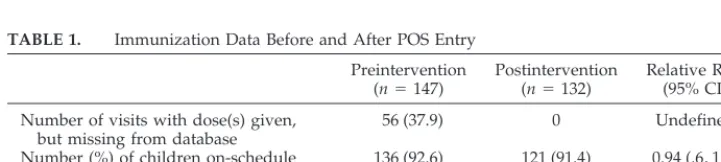
The intervention was effective—reducing the number of visits with at least 1 dose given but miss-ing from the database from 37.9% to 0% (Table 1). A total of 128 (37.3%) of 343 preintervention doses were missing from the database. In the preintervention group, 12.4%, 4.1%, 19.3%, and 2% of visits had 1, 2, 3, or 4 doses missing respectively. No doses were missing from the postintervention database; how-ever, 1 dose of varicella vaccine had been entered at the time of vaccine preparation but not removed after the decision not to administer the dose. Missing data caused a substantial number of children to be classified as not on-schedule. According to the med-ical record, a similar proportion of children in the 2 groups were on-schedule at the end of each visit (Table 1), however, missing data lead to only 64% of preintervention children being classified appropri-ately according to the database. Preintervention chil-dren were 3.7 times more likely than postinterven-tion children to be misclassified as not on-schedule (Table 1).
Six of the 9 study nurses were⬍40 years old, and 6 had been clinically active for over 10 years. Eight classified themselves as comfortable or very comfort-able with computers. Nursing satisfaction with the program was very high. All 9 nurses reported using
TABLE 1. Immunization Data Before and After POS Entry
Preintervention (n⫽147)
Postintervention (n⫽132)
Relative Risk (95% CI)
Number of visits with dose(s) given, but missing from database
56 (37.9) 0 Undefined
Number (%) of children on-schedule based on paper record
136 (92.6) 121 (91.4) 0.94 (.6, 1.5)
Number (%) of children on-schedule based on database
101 (68.4) 121 (91.4) 3.7 (2.4, 5.8)
the program all the time to enter immunizations, 89% said that the program required somewhat or a lot less time, and 100% strongly recommended contin-ued use of the program. All 9 nurses also reported that they would be somewhat or very unenthusiastic about the system if labels were not available.
Funding for the immunization coordinator ended in October 1998. Hence, we had the opportunity to determine if the POS system could be used to collect data without support from a dedicated data-entry person. After the loss of the coordinator, the number of immunization doses entered monthly did not de-crease and, in fact, inde-creased substantially (Fig 1).
During the 11 months after the intervention (July 1998 –May 1999), a total of 16 525 doses were entered compared with only 10 415 during the same period 1 year earlier—a 58% increase. This occurred during a time when the number of visits to the clinic remained constant (personal communication, clinic medical di-rector). Before POS immunization entry, only chil-dren ⬍10 years old were in the system because of limited data entry time. In the 11 months after the intervention, 12 626 doses were entered for children
⬍10 years old compared with 9799 in the same pe-riod 1 year earlier. For childrenⱖ10 years, the num-ber increased from 616 to 3899 during the same pe-riods (Fig 1).
During 1998 through 1999 the number of forms printed from the system increased substantially. A total of 8273 forms were printed during July 1998 through June 1999, preventing nurses from having to write ⬎101 000 dates. School/camp forms were the most popular form (4933), with the WIC program (2014) and Immunization Certification Forms (1326) also frequently printed.
DISCUSSION
This study demonstrates that immunization entry at the POS can improve data quality and be well-accepted. User-friendly may be one of the most over-used words in medical informatics; however, the
software in this study did not take long to learn and was quickly implemented. Although the study did not evaluate reasons for the relatively poor data quality before introduction of the intervention track-ing software, any of the followtrack-ing problems would have prevented successful entry of a dose into the database: failure of the provider to check the appro-priate dose given on the clinic billing sheet; failure of the sheet to be placed into the billing sheet recepta-cle; failure of the administrative staff to transfer all sheets to the immunization coordinator; and finally failure to enter the doses recorded into the tracking software. Each of these issues is ameliorated by POS entry. Although the study was not able to determine the relative importance of the point-and-click inter-face and the fact that entry was done at the time of immunization preparation, we believe that both fac-tors contributed to the success of the system.
In this study, 37.3% of doses given were missing from the tracking system database in the preinter-vention group. This represents a high rate compared with other studies. Our data also showed a substan-tial amount of variability during the time that the clinic coordinator did immunization entry, with the preintervention study period being one of the lowest months for doses entered. Even with a substantially lower rate of missing doses, however, the probability of being misclassified as not-up-to-date would be very high after 8 routine health care visits (the num-ber recommended before age 2 years). For example, if even 5% of doses were not entered at each visit, the probability of a correctly immunized child being classified as up-to-date (not missing a single dose by age 2 years) would only be 66.3% (.95 to the 8th power) without ongoing data quality reviews.
In this study, the pendulum swung from a large amount of missing data to a single excess dose. Al-though welcomed by those who have struggled with the work of collecting immunization data, doses en-tered at the time of preparation that are not removed when the order is cancelled are potentially
ous. These patients may be mistakenly considered up-to-date but continue to be at risk from vaccine-preventable diseases. To address this problem, peri-odic reminders to clinicians as well as periperi-odic audits will be necessary.
A limitation of this study is that nurses reported a high level of computer familiarity. Eighty-nine per-cent of nurses reported being familiar with comput-ers. The nurse who reported not being familiar with computers required approximately 30 minutes of training with 2 refresher sessions. Increased training time may be required in settings where the staff has lower levels of computer proficiency. The study is also limited by its preintervention/postintervention design. This design cannot control for factors that may have changed during the study period. The short time interval between the preintervention and postintervention evaluation should serve to mini-mize this effect. A randomini-mized trial could be used to confirm our findings. Finally, the possibility of a Hawthorne effect must be considered. Although nurses did not know that their completeness would be evaluated, the novelty of the system could im-prove attention to detail. Data quality will need to be monitored in the future.
Increasing immunization rates continues to be a high priority in many countries. With several new vaccines added recently, and more to follow, track-ing of immunization data will be critical to identify those children in need of missing doses. If we had relied entirely on the coordinator’s data, we would have substantially overestimated the number of un-derimmunized children in our clinic. POS systems such as the one described in this article will be nec-essary to maintain the quality of immunization data and when designed to fit into clinical workflow can improve quality and save time. In our clinic, we had provided clinicians with immunization summaries before each visit. The summaries were reviewed, updated, and returned to the immunization coordi-nator to recover missing data. The process was labor-intensive, and not possible without a dedicated im-munization coordinator. Ongoing data entry for new patients with previous immunizations and for pa-tients missing data from before implementation of the tracking system requires⬍4 hours per week and has been included in the clerical responsibilities of a full-time employee.
The CPR is an essential technology; however, CPRs that can be integrated into clinical workflow are still elusive. Many believe that successful pediat-ric CPRs are just around the corner. POS immuniza-tion entry systems such as the one described in this study could provide a nucleus around which pedi-atric information systems could be built. Integration of POS immunization entry into routine clinical prac-tice will lead to improved immunization data quality and substantial savings of administrative time, mak-ing them an essential technology for clinicians pro-viding high-quality preventive services to children.
ACKNOWLEDGMENTS
The study was supported by grants from the Robert Wood Johnson Foundation Generalist Physician Faculty Scholars Pro-gram and the David and Lucile Packard Foundation.
We thank Howard Bauchner, MD, for his assistance in review-ing this manuscript.
REFERENCES
1. Lieu TA, Capra AM, Makol J, Black SB, Shinefield HR. Effectiveness and cost-effectiveness of letters, automated telephone messages, or both for underimmunized children in a health maintenance organization. Pedi-atrics.1998;101(4). URL: http://www.pediatrics.org/cgi/content/full/ 101/4/e3
2. Rodewald LE, Szilagyi PG, Humiston SG, Barth R, Kraus R, Raubertas RF. A randomized study of tracking with outreach and provider prompting to improve immunization coverage and primary care. Pedi-atrics.1999;103:31–38
3. Wilton R, Pennisi AJ. Evaluating the accuracy of transcribed computer-stored immunization data.Pediatrics.1994;94:902–906
4. Richards A, Sheridan J. Reasons for delayed compliance with the child-hood vaccination schedule and some failings of computerised vaccina-tion registers.Aust N Z J Public Health.1999;23:315–317
5. Payne T, Kanvik S, Seward R, et al. Development and validation of an immunization tracking system in a large health maintenance organiza-tion.Am J Prev Med.1993;9:96 –100
6. Hobbs FD, Hawker A. Computerised data collection: practicability and quality in selected general practices.Fam Pract.1995;12:221–226 7. Davis RL, Black S, Vadheim C, et al. Immunization tracking systems:
experience of the CDC Vaccine Safety Datalink sites.HMO Pract.1997; 11:13–17
8. Lieu TA, Black SB, Ray P, et al. Computer-generated recall letters for underimmunized children: how cost-effective?Pediatr Infect Dis J.1997; 16:28 –33
9. Norman LA, Hardin PA, Lester E, Stinton S, Vincent EC. Computer-assisted quality improvement in an ambulatory care setting: a follow-up report.Jt Comm J Qual Improv.1995;21:116 –131
10. Shiffman RN, Liaw Y, Brandt CA, Corb GJ. Computer-based guideline implementation systems: a systematic review of functionality and ef-fectiveness.J Am Med Inform Assoc.1999;6:104 –114
11. LeBaron CW, Mercer JT, Massoudi MS, et al. Changes in clinic vacci-nation coverage after institution of measurement and feedback in 4 states and 2 cities.Arch Pediatr Adolesc Med.1999;153:879 – 86
DOI: 10.1542/peds.106.3.489
2000;106;489
Pediatrics
William G. Adams, William P. Conners, Adriana M. Mann and Sean Palfrey
Well-Accepted
Immunization Entry at the Point of Service Improves Quality, Saves Time, and Is
Services
Updated Information &
http://pediatrics.aappublications.org/content/106/3/489
including high resolution figures, can be found at:
References
http://pediatrics.aappublications.org/content/106/3/489#BIBL
This article cites 10 articles, 2 of which you can access for free at:
Subspecialty Collections
_sub
http://www.aappublications.org/cgi/collection/vaccine:immunization
Vaccine/Immunization
b
http://www.aappublications.org/cgi/collection/infectious_diseases_su
Infectious Disease
following collection(s):
This article, along with others on similar topics, appears in the
Permissions & Licensing
http://www.aappublications.org/site/misc/Permissions.xhtml
in its entirety can be found online at:
Information about reproducing this article in parts (figures, tables) or
Reprints
http://www.aappublications.org/site/misc/reprints.xhtml
DOI: 10.1542/peds.106.3.489
2000;106;489
Pediatrics
William G. Adams, William P. Conners, Adriana M. Mann and Sean Palfrey
Well-Accepted
Immunization Entry at the Point of Service Improves Quality, Saves Time, and Is
http://pediatrics.aappublications.org/content/106/3/489
located on the World Wide Web at:
The online version of this article, along with updated information and services, is
by the American Academy of Pediatrics. All rights reserved. Print ISSN: 1073-0397.
the American Academy of Pediatrics, 345 Park Avenue, Itasca, Illinois, 60143. Copyright © 2000 has been published continuously since 1948. Pediatrics is owned, published, and trademarked by Pediatrics is the official journal of the American Academy of Pediatrics. A monthly publication, it
at Viet Nam:AAP Sponsored on August 30, 2020 www.aappublications.org/news