Infant Victimization in a Nationally Representative
Sample
WHAT’S KNOWN ON THIS SUBJECT: Child maltreatment by caregivers is recognized as a particular risk for infants and young children who make up the largest age group among reports to child protection agencies.
WHAT THIS STUDY ADDS: This study highlights several additional victimization risks beyond maltreatment, including a high rate of infant victimization at the hands of siblings. This type of
victimization appears to be associated wtih considerable levels of emotional and behavioral symptoms.
abstract
OBJECTIVE:The objectives of this research were to (1) obtain esti-mates of child maltreatment and other forms of personal, witness-ing of, and indirect victimization among children aged 0 to 1 year in the United States and (2) examine associations between infant vic-timization exposure and the infant’s level of emotional and behav-ioral symptoms.
METHODS:The study is based on a cross-sectional national telephone survey that included caregivers of a sample of 503 children under 2 years of age.
RESULTS:Nearly one-third of the sample of infants (31.6%) had expe-rienced some form of personal, witnessing, or indirect form of victim-ization. The rate of infant maltreatment by caregivers (2.1%) was sig-nificantly lower than among older preschool-aged children. However, the rate of infant assault by siblings was considerable at 15.4%. The greatest risk of assault occurred in households with young siblings; nearly 35% of the infants with a sibling aged 2 to 3 years were as-saulted in the year before the interview. Witnessing family violence was also relatively common among the infants (9.5%). Victimization was associated with emotional and behavioral problems; sibling assault and witnessing family violence had the highest correlations with infant symptom scores.
CONCLUSION:The results of this study highlight the need for attention to infant victimization that considers a wider array of victimization sources and a broader scope of prevention efforts than has been typical in the child-maltreatment field.Pediatrics2010;126:44–52
AUTHORS:Heather A. Turner, PhD,aDavid Finkelhor,
PhD,aRichard Ormrod, PhD,aand Sherry L. Hamby, PhDb
aCrimes Against Children Research Center, University of New Hampshire, Durham, New Hampshire; andbDepartment of Psychology, University of the South, Sewanee, Tennessee
KEY WORDS
infants, maltreatment, sibling assault, emotional and behavioral symptoms, victimization
ABBREVIATIONS
RDD—random-digit dialing RR—risk ratio
Points of view or opinions in this document are those of the authors and do not necessarily represent the official position or policies of the US Department of Justice.
www.pediatrics.org/cgi/doi/10.1542/peds.2009-2526
doi:10.1542/peds.2009-2526
Accepted for publication Feb 25, 2010
Address correspondence to Heather A. Turner, PhD, University of New Hampshire, 126 Horton Social Science Center, 20 Academic Way, Durham, NH 03824. E-mail: [email protected]
PEDIATRICS (ISSN Numbers: Print, 0031-4005; Online, 1098-4275).
Copyright © 2010 by the American Academy of Pediatrics
The maltreatment of infants receives a great deal of clinical attention, in part because so many such children come to professional attention. Among cases of maltreatment re-ported to authorities, children under the age of 1 year constitute the larg-est single age group1,2 and
predom-inate among victims of
child-maltreatment homicide.3,4
Most existing studies on infant mal-treatment have included only cases identified to medical and child protec-tive authorities. Fewer authors have fo-cused on the broader spectrum of mal-treatment in very young children5that
may be revealed in community-based populations. One such study revealed the incidence of harsh discipline of in-fants, such as shaking, to be alarm-ingly high (2.6%),6 which suggests a
potential precursor to injurious mal-treatment. Thus, addressing infant maltreatment in the general popula-tion, regardless of whether it leads to injury and identification by authorities, is crucial because it may represent an important marker for ongoing abuse and other high-risk developmental trajectories.
In addition, little or no research to date has examined the incidence of infant exposure to other forms of victimiza-tion beyond caregiver maltreatment. It is widely assumed that caregivers are the most likely perpetrators of victim-ization against infants, but assaults by other juveniles are also potential sources of risk. Indeed, young children often experience a great deal of abuse at the hands of siblings and other chil-dren, some of which can be very seri-ous.7 Infants also constitute a target
population for family abduction8 and
are among children most exposed to domestic violence.9The assessment of
a wider array of potential victimiza-tions can provide greater insight into the broader contexts of risk that char-acterize vulnerability in this youngest
age group. To date, no community epi-demiologic studies, to our knowledge, have had a large enough sample and a broad enough scope to explore the di-verse forms of victimization types en-countered among the general popula-tion of infants.
The primary objectives of this re-search were to (1) estimate the 1-year incidence of different forms of victim-ization in a sample of 0- to 1-year-old children, obtained from a recent na-tional probability survey of children and youth, (2) identify perpetrator, child, and family characteristics asso-ciated with infant victimization, and (3) examine the association between vic-timization exposure and infant emo-tional and behavioral symptomatology.
METHODS
Participants
The National Survey of Children’s Expo-sure to Violence (NatSCEV) was de-signed to obtain incidence and preva-lence estimates of a wide range of childhood victimizations. Conducted between January 2008 and May 2008, the survey addressed the experiences of a nationally representative sample of 4549 children aged 0 to 17 living in the contiguous United States. Our re-search focused on the subsample of 503 children under 2 years of age.
The interviews with parents and youth were conducted over the telephone by the employees of an experienced sur-vey research firm. Telephone inter-viewing is a cost-effective methodolo-gy10,11that has been demonstrated to
be comparable to in-person interviews in data quality, even for reports of vic-timization, psychopathology, and other sensitive topics.12–17 In fact, some
evi-dence suggests that telephone inter-views are perceived by respondents as more anonymous, less intimidating, and more private than in-person modes12,18 and, as a result, may
en-courage greater disclosure of victim-ization events.12
The primary foundation of the design was a nationwide sampling frame of residential telephone numbers from which a sample of telephone house-holds was drawn by random-digit dial-ing (RDD). This nationally representa-tive cross-section yielded 3053 of the 4549 completed interviews. To ensure a sizeable proportion of minorities and low-income respondents for accurate subgroup analyses, there also was an over-sampling of US telephone ex-changes that had a population of 70% or more of black, Hispanic, or low-income households. RDD used with this second “oversample” yielded 1496 of the completed interviews. Sample weights were applied to ad-just for differential probability of se-lection dues to (1) study design, (2) demographic variations in nonre-sponse, and (3) variations in within-household eligibility.
Procedure
A short interview was conducted with an adult caregiver (usually a parent) in each household to obtain family demo-graphic information. One child was randomly selected from all eligible children who lived in a household by selecting the child with the most re-cent birthday. If the selected child was under the age of 10, the interview was conducted with the caregiver who was “most familiar with the child’s daily routine and experiences.”
contact with the respondent until the situation was resolved. All procedures were authorized by the institutional re-view board of the University of New Hampshire.
The cooperation rate for the RDD cross-section portion of this survey was 71%, and the response rate was 54%. The cooperation and response rates associated with the smaller oversample were somewhat lower, at 63% and 43%, respectively. These are good rates by current survey research standards,19,20given the steady decline
in response rates that have occurred during the last 3 decades21 and the
particular marked decrease in recent years.19,22,23Although the potential for
response bias remains a consider-ation, several recent studies have re-vealed no meaningful association be-tween response rates and response bias.24–27This survey also did not
sam-ple cell-phone– only households. Be-cause these households are most likely to consist of young adults (aged 18 –25 years),28some portion will likely
include parents of infants. Although we have no particular reason to suspect greater victimization risk in cell-phone– only households, to the extent that such differences exist, infant vic-timization might be underestimated in this community-based sample.
Measurement
This survey used an enhanced version of the Juvenile Victimization Question-naire, an inventory of childhood victim-ization.29–31A total of 27 items were
ad-ministered to the caregivers of infants, representing only those victimizations that were potentially relevant to the ex-periences of very young children. These covered 5 general areas of in-terest: conventional crimes; mal-treatment; victimization by peer and siblings; sexual victimization; and witnessing and indirect victimization, including witnessing family violence.32
Specific screener wording for all indi-vidual items is presented in the Appen-dix. Follow-up questions for each screener item (not shown) gathered additional information about each vic-timization, including perpetrator char-acteristics, the use of a weapon, and whether injury resulted. Respondents also were asked whether the event had occurred within the previous year; for the current research, only previous-year victimizations were counted. Indi-vidual items also were aggregated into summary victimizations for additional analysis (see Table 1). It is important to
note that Juvenile Victimization Ques-tionnaire items and categories were developed to be relevant across the full developmental spectrum of child-hood. We acknowledge that some ter-minology, such as peer or sibling as-sault, have crime-related connotations that do not necessarily apply to very young children.
Emotional and behavioral symptoms were assessed by using the 13 items from the Infant Traumatic Stress Ques-tionnaire and 6 additional items from the Brief Infant Toddler Social and TABLE 1 Infant Victimization Rates According to Individual and Aggregate Types (Previous Year)
Victimization Type Rate, % 95% Confidence Interval
Personal victimization
PV1. Assault with weapon 1.5 0.4–2.6
PV2. Assault without a weapon 2.0 0.7–3.3
PV3. Attempted assault 0.9 0.1–1.7
PV4. Kidnapping 0.1 ⫺0.2–0.4
PV5. Physical abuse 0.6 ⫺0.1–1.3
PV6. Neglect 0.6 ⫺0.1–1.3
PV7. Custodial interference 1.0 0.1–1.9
PV8. Peer/sibling assault 16.7 13.4–20.0
PV9. Sexual assault by a known adult 0.0 PV10. Sexual assault by another adult 0.0
PV11. Sexual assault by juvenile 0.0
PV12. Rape (completed or attempted) 0.0 Witnessing family violence
FV1. Witness partner assault 2.6 1.2–4.0
FV2. Witness physical abuse of sibling 0.7 0.0–1.4 FV3. Witness parent threatening parent 1.8 0.6–3.0 FV4. Witness parent throwing object 4.1 2.3–5.9
FV5. Witness parent push parent 3.8 2.0–5.6
FV6. Witness parent hit parent 1.6 0.5–2.7
FV7. Witness parent beat parent 0.6 0.1–1.3
FV8. Witness assault by another adult in the household 2.1 0.8–3.4 Other witnessing and indirect victimization
WI1. Witness assault with weapon 1.2 0.2–2.2
WI2. Witness assault without a weapon 4.4 2.6–6.2
WI3. Household theft 7.3 5.0–9.6
WI4. Someone close murdered 2.2 0.9–3.5
WI5. Witnessed murder 0.4 ⫺0.2–1.0
WI6. Witnessed shooting/riots 1.9 0.7–3.1
WI7. In the middle of a war 0.4 ⫺0.2–1.0
Summary of victimizations
Any infant victimization (PV1–WI7) 31.6 27.4–35.8 Any personal infant victimization (PV1–PV12) 19.3 15.8–22.8 Any assault (PV1–PV3, PV5, PV6, PV8) 17.9 14.5–21.3 Any juvenile sibling assault (any assault with sibling as perpetrator) 15.4 12.2–18.6
Any maltreatment (PV5, PV6, PV7) 2.2 0.9–3.5
Any witnessing of family violence (FV1–FV8, WI1,aand WI2a) 9.5 5.7–10.5 Any witnessing of family assault (FV 1, FV2, FV5–FV8)a 7.6 4.1–8.5 Any witnessing of partner assault (FV1, FV5, FV6, FV7) 4.6 2.7–6.5
Emotional Assessment, which as-sessed additional dimensions of emo-tional functioning (ie, depression/with-drawal, emotion regulation, negative emotionality, and separation distress). Caregivers were asked how often their child demonstrated each of 19 behav-iors in the previous month. Response options were on a 3-point scale from 1 (never) to 3 (often). The Infant Trau-matic Stress Questionnaire has dem-onstrated good internal validity,33and
in its full form the Brief Infant Toddler Social and Emotional Assessment has demonstrated adequate validity and reliability.34A factor analysis of the 19
symptoms revealed 1 dimension. This combined measure has an ␣ coeffi-cient of .75.
Demographic information was ob-tained, including the child’s gender, age (in years), race/ethnicity (coded into 4 groups: white non-Hispanic, Black non-Hispanic, Hispanic any race, and other race), socioeconomic status (a composite of family income and par-ent education), and family structure (categorized into 4 groups: children living with 2 biological or adoptive par-ents, 1 biological parent plus partner, single biological parent, and other caregiver).
RESULTS
Table 1 lists the percentage of the sam-ple exposed to individual forms of vic-timization, as well as aggregate cate-gories. Almost one-third of this sample of infants (31.6%) had experienced some form of personal, witnessing, or indirect form of victimization. How-ever, it is noteworthy that only a small proportion of the sample reported in-fant maltreatment by caregivers, with rates ranging from 0.6% for physical abuse and neglect to 1% for custodial interference. Slightly more than 2% of this sample of infants experienced any form of maltreatment in the previous year. The rates of peer/sibling assault
are much higher at nearly 17%. The large majority of these exposures (15.4%) represented assaults at the hands of siblings. No infants in this sample were exposed to any form of sexual abuse. Among the 19.3% of in-fants who were exposed to some form of personal victimization, 4.3% sus-tained some physical injury such as a bruise, cut, or broken bone (data not shown).
In assessment of indirect and witness-ing victimizations, 9.5% of the sample witnessed some form of family vio-lence. More than 7% of the sample (7.6%) witnessed some form of family assault, and nearly 5% witnessed in-terparental assault. Other witnessing and indirect victimizations such as wit-nessing an assult (no weapon) (4.4%) and household theft (7.3%) were also relatively common forms of exposure. Almost 15% of the sample experienced some form of witnessing or indirect victimization beyond family violence. Approximately 83% of all victimizations among infants occurred within the home; approximately 3% occurred in a day care setting (data not shown).
In follow-up analyses, we compared rates of victimization among infants with those of other preschool-aged children. We noted significantly lower rates of several forms of personal vic-timization among infants relative to older preschool-aged children. For ex-ample, the rate of physical abuse by
caregivers was 0.6% among infants but 1.3% and 4.6% among 2- to 3-year-olds and 4- to 5-year-3-year-olds, respectively (P⬍.001). Similarly, assault without a weapon had a rate of 2.1% among in-fants, 6.9% among 2- to 3-year-olds, and 13.5% among 4- to 5-year-old chil-dren. In contrast, most types of nessing family violence and other wit-nessing/indirect forms of victimization did not significantly differ across age groups. Additional age comparisons of victimization rates, including compari-sons with older children, were re-ported elsewhere.35
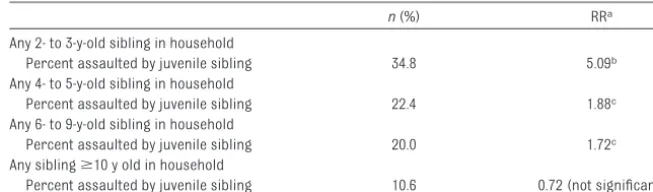
Given the relatively high rates of expo-sure to sibling-perpetrated violence, we sought to better specify the nature of this risk. Because not all infants have siblings, we first recalculated the rates of sibling assault among the sub-sample of infants who had at least 1 sibling in the household to gain a more accurate picture of this source of vic-timization risk. Nearly 21% of infants with 1 or more siblings were exposed to sibling assault. Although our data did not allow the identification of the sibling-perpetrator’s age, we were able to stratify risk according to the presence of different-aged siblings in the household. As shown in Table 2, the greatest risk of sibling assault oc-curred in households with siblings only slightly older than the target re-spondent. Nearly 35% of the infants with a sibling aged 2 to 3 were as-TABLE 2 Infant Exposure to Juvenile Sibling Assault
n(%) RRa
Any 2- to 3-y-old sibling in household
Percent assaulted by juvenile sibling 34.8 5.09b Any 4- to 5-y-old sibling in household
Percent assaulted by juvenile sibling 22.4 1.88c Any 6- to 9-y-old sibling in household
Percent assaulted by juvenile sibling 20.0 1.72c Any siblingⱖ10 y old in household
Percent assaulted by juvenile sibling 10.6 0.72 (not significant)
aBased on logistic regression controlling for other age categories of siblings in household. Relative RRs were approximated
from ORs to adjust for outcome incidence.43 bP⬍.001.
saulted in the year before the inter-view; the relative risk of a sibling as-sault was more than 5 times greater among these infants than among in-fants for whom there was not a 2- to 3-year-old in the household. Risk be-came lower as the age of siblings in-creased but remained significantly greater for infants with 4- to 5-year-old siblings (risk ratio [RR]: 1.88;P⬍.05) and those with 6- to 9-year-old siblings (RR: 1.72;P⬍.05). There were no sig-nificant differences in exposure ac-cording to the gender of the sibling-perpetrator; brothers and sisters were equally likely to be perpetrators.
Demographic variations in exposure to different categories of victimization also were evident. With respect to mal-treatment, findings should be re-garded with caution because analyses involved only a small number of cases (n⫽11). For black infants and those in single-parent families, there were sig-nificantly higher rates of maltreat-ment than for those in other race/eth-nic groups and family structures, with relative RRs of 6.6 and 8.2, respectively (P⬍.001). In contrast, for white chil-dren there were significantly higher rates of sibling assault relative to other race/ethnic groups (RR: 1.8;P⬍
.01). Infants from single-parent fami-lies were at significantly greater risk of witnessing family violence (RR: 2.1;
P⬍.05), including witnessing family assault (RR: 3.2;P⬍001), than were infants in other family structures. No other demographic differences were significant.
Additional analyses revealed signifi-cant associations between exposure to maltreatment and several other risk factors (P⬍.001). Again, these finding should be considered only suggestive given the small number of cases in-volved. Infants who (1) lived in more than 1 household in the previous year, (2) had other (nonparent) adults who regularly spent the night in the
house-hold, or (3) experienced residential moves in the previous year were more likely to have been exposed to some form of maltreatment. Finally, for in-fants whose biological mother had ever been diagnosed with a psychiatric disorder there was a higher rate of maltreatment. None of these factors were significantly related to other forms of victimization.
Exposure to any victimization in the previous year also was significantly and substantially associated with in-fant emotional and behavioral symp-tom scores (r⫽0.32;P⬍.001). This association remained significant even when we controlled for all sociodemo-graphic factors (⫽0.30;P⬍.001). Among specific aggregate types, the strongest associations were with re-spect to juvenile sibling assault (r⫽
0.21;P⬍.001) and witnessing family violence (r⫽0.25;P⬍.001). Individual symptoms that were most strongly re-lated to any victimization exposure in-cluded “acted in ways that made you want to punish him/her” (r⫽0.29;P⬍
.001), “had trouble adjusting to changes” (r ⫽ 0.22; P ⬍ .001), “had trouble calming down when upset” (r⫽0.19;P⬍.001), and “cried or had a tantrum until he/she was exhausted” (r⫽0.17;P⬍.001). The symptom pat-terns were similar for individual types of victimization with a few interesting exceptions. Juvenile sibling assault was also quite strongly related to “had trouble going to sleep” (r⫽0.20;P⬍
.001), and witnessing family violence was moderately related to both “got startled or spooked easily” (r⫽0.19;
P ⬍ .001) and “acted aggressively” (r⫽0.18;P⬍.001).
DISCUSSION
In this study we examined several forms of personal victimization, wit-nessing violence, and indirect victim-ization among infants in the United States. Using data from a large and
contemporary national survey, we were able to address infant exposure to victimization in the general popula-tion and to consider a wide range of victimization types. To our knowledge, this is the first such effort to date.
With respect to child maltreatment, we found lower rates for infants than for older, preschool-aged children. This pattern is different from official statis-tics that often show the highest mal-treatment rates among infants. The discrepancy likely reflects a difference in the types of maltreatment situations being revealed, because official statis-tics typically capture more serious cases than those identified in popula-tion surveys. In respect to serious mal-treatment, official statistics may be confounded with age-related pro-cesses of disclosure or discovery that do not equally apply to survey re-search. For example, given the fully de-pendent nature of infants, caregiving failures and abuses may have more immediate and catastrophic conse-quences for infants and, therefore, be detected more often at this stage. More frequent contact with medical, nursing, and social services in the postnatal period may also facilitate greater identification of maltreatment among infants. Both these processes would lead to a higher representation of infant-maltreatment cases in official statistics. Setting aside potential dif-ferences in detection and visibility, there is some logic to the survey re-vealing that maltreatment increases as children get somewhat older, be-come more mobile and more resistant, and require more complicated forms of care.
and residence in more than 1 house-hold were all associated with higher rates of child maltreatment.
Study findings indicate elevated levels of symptomatology among infants who have witnessed family violence. Given the limited cognitive development of infants, it is unclear whether these findings re-flect the same kinds of harmful stress reactions characteristic of older chil-dren exposed to such violence36,37 or
whether the presence of family violence in the home is a proxy for other damag-ing family characteristics. For example, 1 study that used the same measure re-vealed that witnessing severe intimate partner violence (violence directed at mothers by male partners) was most strongly related to infant symptomatol-ogy when mothers also experienced trauma symptoms.33It is clear that more
research is warranted to better delin-eate the link between witnessing family violence and emotional and behavioral symptoms in this youngest age group.
Arguably the most important finding of this study is the apparent frequency with which infants are victims of as-saults at the hands of siblings. Sibling assaults have not typically been con-sidered a significant source of victim-ization among infants, but our findings suggest that this assumption is worthy of reconsideration. In this sample, more than one-fifth of the infants with any siblings in the household experi-enced an assault from a sibling in the previous year. More important is that victims of sibling assault had signifi-cantly higher symptom scores than those without this form of exposure. Although our study could not establish that the symptoms were caused by the sibling assaults, it is both plausible and consistent with the data that in-fants subjected to physical attacks, even by quite young siblings, could ex-perience substantial stress and emo-tional impairment from such expo-sure. In a previous study with older
children, our research also confirmed associations between sibling violence and mental health symptoms.38
If sibling violence does pose a common peril to infants, it is probably not at the level of severe maltreatment reflected in familiar child-maltreatment scenar-ios involving such dynamics as abusive head trauma or failure to thrive. How-ever, exposure to assaultive siblings may result in some of the problems of hyperarousal and emotional dysregu-lation that have been discussed as se-quelae of early maltreatment.39
Our findings do suggest that child-protection specialists might wish to de-velop more interventions to protect very young children from sibling assault. For example, home visitors to families with both new infants and somewhat older children may be instructed to inquire about aggressive behavior by siblings to-ward infants. Parents in such families may benefit from suggestions about how to discourage such behavior, including such techniques as establishing clear rules, maintaining physical barriers, and using consistent limit setting and disci-pline to discourage aggression. Child-protective workers and domestic vio-lence specialists also should become sensitive to the potential for sibling abuse, even with infants, and be pre-pared to educate and train parents about its management.
More research also is warranted to help delineate more clearly the poten-tially traumatic conditions and ele-ments of sibling violence toward infants. Parents and child develop-ment specialists could benefit from evidence-based guidelines about sib-ling behavior that is harmful as op-posed to playful or accidental or phys-ically rough interaction that is benign.
Our results also highlight the discrep-ancies that frequently are apparent when results from community-based surveys are compared with those ob-tained from official agency statistics of
child maltreatment. A better under-standing of the inconsistencies across different data sources and the ways that epidemiologic data might be use-fully combined with official reports would require conducting extremely large surveys. Large-scale projects such as the National Children’s Study, based on more than 100 000 children,40
would allow a sufficient number of of-ficial report cases to be captured within a population-based sample.
Several limitations of this research should be acknowledged. First, it is possible that families who expose in-fants to maltreatment are reticent to disclose such behavior or are less likely to participate in community sur-veys, which could underrepresent in-fant maltreatment in population-based surveys. However, although not spe-cific to infant samples, the results of similar survey-based studies have demonstrated considerable willing-ness of caregivers to report violent and maltreating acts perpetrated by themselves and other household care-givers6,41and have provided evidence
that caregivers do not underreport compared with other observers.29
Second, our limited sample size of in-fants meant that we were unable to con-duct multivariate analyses to determine the independent influence of different sources of victimization on infant symp-toms. Because children are often ex-posed to multiple types of victimization,29
precision of victimization rates and greater specification of risk factors.
Finally, reports of both victimization exposure and symptoms came from the same sources (caregivers), which led to a possibility of method covari-ance. Information from the same source can yield substantially higher correlations than information from different sources (eg, parents and child-protection professionals).42
CONCLUSIONS
Our results highlight the need for attention to infant victimization within the general population that considers a wider array of victimization sources than has been typical in maltreatment studies. Findings that demonstrate significant victimization risk to infants at the hands of young siblings, and elevated symptomatology associated with such exposure, suggest the need to broaden the scope of maltreatment pre-vention and interpre-vention efforts to include sibling-related risk.
APPENDIX: VICTIMIZATION SCREENERS ADMINISTERED TO CAREGIVERS OF INFANTS
Note that only previous-year victimiza-tions were counted in this study.
Personal Victimizations
PV1: Sometimes people are attacked with sticks, rocks, guns, knives, or other things that would hurt. At any time in your child’s life, did anyone hit or attack your child on purpose with an object or weapon? Somewhere like: at home, at school, at a store, in a car, on the street, or anywhere else? PV2: At any time in your child’s life, did anyone hit or attack your child WITH-OUT using an object or weapon? PV3: At any time in your child’s life, did someone start to attack your child, but for some reason, it didn’t happen? For example, someone helped your child or your child got away?
PV4: When a person is kidnapped, it means they were made to go
some-where, like into a car, by someone who they thought might hurt them. At any time in (your child’s/your) life, has anyone ever tried to kidnap your child?
PV5: Not including spanking on (his/ her) bottom, at any time in your child’s life did a grownup in your child’s life hit, beat, kick, or physically hurt your child in any way?
PV6: When someone is neglected, it means that the grownups in their life didn’t take care of them the way they should. They might not get them enough food, take them to the doctor when they are sick, or make sure they have a safe place to stay. At any time in your child’s life, was your child neglected?
PV7: Sometimes a family fights over where a child should live. At any time in your child’s life did a parent take, keep, or hide your child to stop (him/her) from being with another parent? PV8: At any time in your child’s life, did any kid, even a brother or sister, hit your child? Somewhere like: at home, at school, out playing, in a store, or anywhere else?
PV9: At any time in your child’s life, did a grownup your child knows touch your child’s private parts when they shouldn’t have or make your child touch their private parts? Or did a grownup your child knows force your child to have sex?
PV10: At any time in your child’s life, did a grownup your child didnotknow touch your child’s private parts when they shouldn’t have, make your child touch their private parts or force your child to have sex?
PV11: Now think about other kids, like from school, a boy friend or girl friend, or even a brother or sister. At any time in your child’s life, did another child or teen make your child do sexual things? PV12: At any time in your child’s life, did anyone TRY to force your child to have sex; that is, sexual intercourse of any kind, even if it didn’t happen?
Witnessing Family Violence
FV1: At any time in your child’s life did your child SEE a parent get pushed, slapped, hit, punched, or beat up by another parent, or their boyfriend or girlfriend?
FV2: At any time in your child’s life, did your child SEE a parent hit, beat, kick, or physically hurt (his/her) brothers or sisters, not including a spanking on the bottom?
FV3: At any time in your child’s life, did one of your child’s parents threaten to hurt another parent and it seemed they might really get hurt?
FV4: At any time in your child’s life, did one of your child’s parents, because of an argument, break or ruin anything belonging to another parent, punch the wall, or throw something? FV5: At any time in your child’s life, did one of your child’s parents get pushed by another parent?
FV6: At any time in your child’s life, did one of your child’s parents get hit or slapped by another parent?
FV7: At any time in your child’s life, did one of your child’s parents get kicked, choked, or beat up by another parent? FV8: Now we want to ask you about fights between any grownups and teens, not just between your child’s parents. At any time in your child’s life, did any grownup or teen who lives with your child push, hit, or beat up someone else who lives with your child, like a parent, brother, grandparent, or other relative?
Other Witnessing and Indirect Victimization
WI1: At any time in your child’s life, in real life, did your child SEE anyone get attacked or hit on purpose WITH a stick, rock, gun, knife, or other thing that would hurt? Somewhere like: at home, at school, at a store, in a car, on the street, or anywhere else?
WI3: At any time in your child’s life, did any-one steal something from your house that belongs to your child’s family or someone your child lives with? Things like a TV, ste-reo, car, or anything else?
WI4: At any time in your child’s life, was anyone close to your child mur-dered, like a friend, neighbor or some-one in your child’s family?
WI5: At any time in your child’s life, did your child see someone murdered in real life? This means not on TV, video games, or in the movies?
WI6: At any time in your child’s life, was your child in any place in real life where (he/she) could see or hear people being shot, bombs going off, or street riots? WI7: At any time in your child’s life, was your child in the middle of a war where (he/she) could hear real fight-ing with guns or bombs?
ACKNOWLEDGMENTS
For the purposes of compliance with Section 507 of Pub L. No. 104-208 (the Stevens Amendment), readers are
advised that this program is funded entirely by federal sources. This project was supported by grant 2006-JW-BX-0003 awarded by the Of-fice of Juvenile Justice and Delin-quency Prevention, Office of Justice Programs, US Department of Justice. The total amount of federal funding is $2 709 912. All authors had full ac-cess to all the data in the study and take responsibility for the integrity of the data and the accuracy of the data analysis.
REFERENCES
1. US Department of Health and Human Ser-vices, Administration on Children, Youth, and Families.Child Maltreatment 2005: Re-ports From the States to the National Child Abuse and Neglect Data System. Washing-ton, DC: US Government Printing Office; 2007
2. US Department of Health and Human Ser-vices, Administration on Children, Youth, and Families.Child Maltreatment 2007: Re-ports From the States to the National Child Abuse and Neglect Data System. Washing-ton, DC: US Government Printing Office; 2009
3. Finkelhor D, Ormrod RK.Homicides of Chil-dren and Youth.(Juvenile Justice Bulletin No. NCJ187239). Washington, DC: Office of J u v e n i l e J u s t i c e a n d D e l i n q u e n c y Prevention; 2001
4. US Department of Health and Human Ser-vices, Administration on Children, Youth, and Families.Child Maltreatment 2004: Re-ports From the States to the National Child Abuse and Neglect Data System. Washing-ton, DC: US Government Printing Office; 2006
5. Brodowski ML, Nolan CM, Gaudiosi JA, et al. Nonfatal maltreatment of infants: United States, October 2005–September 2006. MMWR Morb Mortal Wkly Rep.2008;57(13): 336 –339
6. Theodore AD, Chang JJ, Runyan DK, et al. Epidemiologic features of the physical and sexual maltreatment of children in the Car-olinas.Pediatrics.2005;115(3). Available at: www.pediatrics.org/cgi/content/full/115/ 3/e331
7. Caffaro JV, Conn-Caffaro A.Sibling Abuse Trauma: Assessment and Intervention With Children, Families, and Adults. Binghamton, NY: Haworth Press; 1998
8. Hammer H, Finkelhor D, Sedlak AJ.Children Abducted by Family Members: National Es-timates and Characteristics.(Juvenile Jus-tice Bulletin No. NCJ196466). Washington,
DC: Office of Juvenile Justice and Delin-quency Prevention; 2002
9. Fantuzzo J, Boruch R, Beriama A, Atkins M, Marcus S. Domestic violence and children: prevalence and risk in five major U.S. cities. J Am Acad Child Adolesc Psychiatry.1997; 36(1):116 –122
10. McAuliffe WE, Geller S, LaBrie R, Paletz S, Fournier E. Are telephone surveys suitable for studying substance abuse? Cost, admin-istration, coverage, and response rate is-sues.J Drug Issues.1998;28(2):455– 481 11. Weeks MF, Kulka RA, Lessler JT, Whitmore
RW. Personal versus telephone surveys from collecting household health data at the local level.Am J Public Health.1983; 73(12):1389 –1394
12. Acierno R, Resnick H, Kilpatrick DG, Stark-Riemer W. Assessing elder victimization: demonstration of a methodology.Soc Psy-chiatry Psychiatr Epidemiol.2003;38(11): 644 – 653
13. Pruchno RA, Hayden JM. Interview modality: effects on costs and data quality in a sam-ple of older women.J Aging Health.2000; 12(1):3–24
14. Bajos N, Spira A, Ducot B, Messiah A. Analy-sis of sexual behavior in France (ACSF): a comparison between two modes of investigation—telephone survey and face-to-face survey.AIDS.1992;6(3):315–323 15. Bermack E. Effects of telephone and
face-to-face communication on rated extent of self-disclosure by female college students. Psy-chol Rep.1989;65(1):259 –267
16. Czaja R. Asking sensitive behavioral ques-tions in telephone interviews.Int Q Commu-nity Health Educ.1987;8(1):23–32
17. Marin G, Marin BV. A comparison of three interviewing approaches for studying sen-sitive topics with Hispanics.Hisp J Behav Sci.1989;11(4):330 –340
18. Taylor A. I’ll call you back on my mobile: a critique of the telephone interview with ad-olescent boys.Westminst Stud Educ.2002; 25(1):19 –34
19. Keeter S, Kennedy C, Dimock M, Best J, Craighill P. Gauging the impact of growing nonresponse on estimates from a national RDD telephone survey.Public Opin Q.2006; 70(5):759 –779
20. Babbie E.The Practice of Social Research. 11th ed. Belmont: CA: Wadsworth; 2007
21. Atrostic BK, Bates N, Burt G, Silberstein A. Nonresponse in U.S. government household surveys: consistent measures, recent trends, and new insights.J Off Stat.2001; 17(2):209 –226
22. Curtin R, Presser S, Singer E. Changes in telephone survey nonresponse over the past quarter century.Public Opin Q.2005; 69(1):87–98
23. Singer E. Introduction: nonresponse bias in household surveys. Public Opin Q. 2006; 70(5):637– 645
24. Curtin R, Presser S, Singer E. The effects of response rate changes on the index of con-sumer sentiment.Public Opin Q.2000;64(4): 413– 428
25. Keeter S, Miller C, Kohut A, Groves RM, Presser S. Consequences of reducing non-response in a national telephone survey. Public Opin Q.2000;64(2):125–148 26. Groves RM. Nonresponse rates and
nonre-sponse bias in household surveys.Public Opin Q.2006;70(5):646 – 675
27. Merkle D, Edelman M. Nonresponse in exit polls: a comprehensive analysis. In: Groves RM, Dillman DA, Eltinge JL, Little RJA, eds. Survey Nonresponse. New York, NY: Wiley; 2002:343–358
growing cell-only population.Public Opin Q. 2007;71(5):772–792
29. Finkelhor D, Hamby SL, Ormrod RK, Turner, HA. The JVQ: reliability, validity, and national norms. Child Abuse Negl. 2005;29(4): 383– 412
30. Hamby SL, Finkelhor D, Ormrod RK, Turner HA.The Juvenile Victimization Question-naire (JVQ): Administration and Scoring Manual. Durham, NH: Crimes Against Chil-dren Research Center; 2004
31. Finkelhor D, Ormrod RK, Turner HA, Hamby SL. Measuring poly-victimization using the JVQ. Child Abuse Negl. 2005;29(11): 1297–1312
32. Finkelhor D, Ormrod RK, Turner HA, Hamby SL. The victimization of children and youth: a comprehensive, national survey.Child Mal-treat.2005;10(1):5–25
33. Bogat GA, DeJonghe E, Levendosky AA, David-son WS, von Eye A. Trauma symptoms among infants exposed to intimate partner violence.Child Abuse Negl. 2006;30(2): 109 –125
34. Briggs-Gowan MJ, Carter AS.Brief Infant Toddler Social and Emotional Assessment (BITSEA) Manual, Version 1.0. Boston, MA: University of Massachusetts; 2001
35. Finkelhor D, Turner HA, Ormrod R, Hamby SL. Violence, abuse, and crime exposure in a national sample of children and youth. Pe-diatrics.2009;124(5):1411–1423
36. Lang JM, Stover CS. Symptom patterns of youth exposed to intimate partner violence. J Fam Violence.2008;23:619 – 629 37. Wolfe DA, Crooks CV, Lee V, McIntyre-Smith
A, Jaffe PG. The effects of children’s expo-sure to domestic violence: a meta-analysis and critique.Clin Child Fam Psychol Rev. 2003;6(3):171–187
38. Finkelhor D, Turner HA, Ormrod RK. Kid’s stuff: the nature and impact of peer and sibling violence. Child Abuse Negl. 2006; 30(12):1401–1421
39. Shonkof JP, Boyce WT, McEwen BS. Neuro-science, molecular biology, and the child-hood roots of health disparities: building a new framework for health promotion and
disease prevention. JAMA.2009;301(21): 2252–2259
40. National Children’s Study. Improving the health of American’s children: what is the National Children’s Study? Available at: www.nationalchildrensstudy.gov/pages/ default.aspx. Accessed December 18, 2009
41. Straus MA, Hamby SL. Measuring physical and psychological maltreatment of children with the Conflict Tactics Scales. In: Kaufman Kantor G, Jasinski JL, eds. Out of the Darkness: Contemporary Perspectives on Family Violence. Thousand Oaks, CA: Sage; 1997:119 –135
42. McGee RA, Wolfe DA, Yuen SA, Wilson SK, C a r n a c h a n J . T h e m e a s u r e m e n t o f maltreatment: a comparison of ap-proaches. Child Abuse Negl.1995;19(2): 233–249
43. Zhang J, Yu KF. What’s the relative risk? A method of correcting the odds ratio in co-hort studies of common outcomes.JAMA. 1998;280(19):1690 –1691
How Good Is That First Pick?:While we are all familiar with various drafts for
professional sports where the weaker teams get to pick first, just how much of an advantage is having an early pick? According to an article inThe New York Times(Thaler RH, April 4, 2010), the first pick in the draft is on average the least valuable in terms of value per dollar—a lesson that may apply to not just professional sports but to any organization trying to select their best applicants on the basis of talent. For example, in the National Football league, there is about a 50 percent chance that a player picked first for a given position is better than the player picked second in that position based on the number of games played in their first five years in the league. This is equivalent to a coin toss—yet the dollars expended in salary dollars or trades made to get that first pick can be quite extravagant— hence the diminished return on investment involved with that initial pick. As further proof of the players further down on the list (who are paid less for doing just as much or more) being a better value, consider New England Patriots quarterback Tom Brady, who was the 199thpick in the 2000
draft and has thus far played in four Super Bowls, winning three.
DOI: 10.1542/peds.2009-2526 originally published online June 21, 2010;
2010;126;44
Pediatrics
Services
Updated Information &
http://pediatrics.aappublications.org/content/126/1/44
including high resolution figures, can be found at:
References
http://pediatrics.aappublications.org/content/126/1/44#BIBL
This article cites 30 articles, 1 of which you can access for free at:
Subspecialty Collections
ub
http://www.aappublications.org/cgi/collection/child_abuse_neglect_s Child Abuse and Neglect
following collection(s):
This article, along with others on similar topics, appears in the
Permissions & Licensing
http://www.aappublications.org/site/misc/Permissions.xhtml
in its entirety can be found online at:
Information about reproducing this article in parts (figures, tables) or
Reprints
http://www.aappublications.org/site/misc/reprints.xhtml
DOI: 10.1542/peds.2009-2526 originally published online June 21, 2010;
2010;126;44
Pediatrics
Heather A. Turner, David Finkelhor, Richard Ormrod and Sherry L. Hamby
Infant Victimization in a Nationally Representative Sample
http://pediatrics.aappublications.org/content/126/1/44
located on the World Wide Web at:
The online version of this article, along with updated information and services, is
by the American Academy of Pediatrics. All rights reserved. Print ISSN: 1073-0397.