MINIMIZING EXECUTION TIME OF
GRID-BASED CRYPTOGRAPHY WITH
AES ALGORITHM BY USING THREAD
POOL
G. Jai Arul Jose
Research Scholar, Department of MCA, Sathyabama University Jeeppiaar Nagar, Rajiv Gandhi Road, Chennai – 600 119, Tamil Nadu, INDIA
C. Sajeev
Research Scholar, Department of MCA, Sathyabama University Jeeppiaar Nagar, Rajiv Gandhi Road, Chennai – 600 119, Tamil Nadu, INDIA
Dr. C. Suyambulingom,
Professor (Rtd.), Tamil Nadu Agricultural University, Coimbatore Abstract
In this paper, we propose and develop Grid and Thread Pool Based Encryption (GTPBE) application that uses the computational resources of multiple Personal Computers in order to e n c i p h e r large files with one of the most efficient and secure encryption algorithms, the Advanced Encryption Standard (AES). Thread pool size is determined according to number of Grid parts. Automatic generation of pool is based on Grid nodes which are participating in action. For increasing the efficiency deadlock is constantly analyzed. Simplicity of use and high performance of GTPBE makes it an ideal choice for deploying in any organization that needs this functionality. Experimental results with different sizes of data files demonstrate that the proposed Grid and Thread Pool Based Encryption system is able to perform with high efficiency.
Keywords: Grid Computing, Cryptography, Thread Pool, AES
1. Introduction
1.1. The Advanced Encryption Standard
The Rijndael algorithm is a block cipher algorithm that is selected by the U.S. government as the Advanced Encryption Standard (AES) [10]. It is the next generation of the DES cryptography method. It is also the first cryptography method for encrypting NSA’s top secret information that is available to the public. The AES algorithm can be implemented so easily and it is one of the most secure algorithms in the world. The only kind of attacks done to AES till now are Side Channel Attacks [11] that are not considered as real security threats. No one can find the key to an AES implementation with this kind of attack. Some researchers are concerned about the use of the AES in security-critical applications [12], but no successful attack has ever broke AES cipher. AES implementations have 128, 192 or 256 bit key lengths. Size of data blocks to be encrypted with AES is always 128 bits. AES has these execution rounds: KeyExpansion using Rijndael's key schedule, the initial round (including AddRoundKey step), the iterative rounds (including SubBytes, ShiftRows, MixColumns, and AddRoundKey steps). At last, the final round includes SubBytes, ShiftRows, and AddRoundKey steps. In AddRoundKey step, each byte is combined with that round’s key (which is derived from the cipher key). SubBytes step is a substitution. In this step, each byte will be replaced with another byte (according to the lookup table). In ShiftRows step, each row of the data block will be cyclically shifted with a certain offset. MixColumns combines the four bytes in each column to make new values for each byte. AES with 128 bit key length has 10 rounds. 192-bit AES has 12 rounds, and 256-bit AES has 14 rounds. After these rounds, the result is a new data block that cannot be traced back to the original in any way without having the correct key.
1.2 Grid Computing
Grid computing is a form of distributed computing that involves coordinating and sharing computing, application, data, and storage or network resource across dynamic and geographically dispersed organization. Why we go for Grid computing?
To exploit the inherent distributed nature of an application. To decrease the turn around or response time of a huge application.
To allow the execution of an application, that is outside the capability of a single architecture. To exploit the affinity between an application component and Grid resource with a specific
functionality.
2. Grid and Thread Pool Based Encryption (GTPBE) System
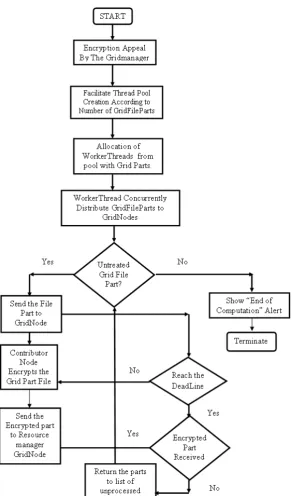
GTPBE binds its valid grid nodes in an RMI registry process by giving secure access using stub and skeleton objects. Execution flowchart for the GTPBE is shown in Figure 1.
GTPBE has fivc major components: UtilityComponent, GridManager, GridManagerGUI, GridNode, GridNodeGUI.
UtilityComponent contains WorkerNonDaemonThreadComponent, ThreadPoolResourceComponent and DaemonDeadlockAnalyzeThreadComponent. Designing an independent Project for the distributed algorithm allows us to change the application’s functionality to anything else we want.
GridManager is a component that is the main service provider for this solution. It split the large files into smaller parts. It calls UtilityComponents for making Thread Pool and allocates each Worker Thread from the Thread Pool to each Grid File Parts and sends file parts to participating GridNodes and takes them back from them after being encrypted.
GridManagerGUI & GridNodeGUI Java Swing is used for designing graphical user interface for both the GridManager and GridNodes. Swing is a special feature available in Java. It provides some powerful classes to design graphical user interface. The classes used in swing will not depend on the operating system.
Figure 1: The Structure of GTPBE System
3. Results and Discussion
3. AMD Athlon 2.11 GHz 64 bit X2 Dual processor, 512MB of RAM, running Windows XP Professional operating system.
4. Intel Pentium IV 1.6 GHz Dual Core processor, 512MB of RAM, running Windows XP Home Edition operating system.
5. Intel Pentium IV 2.2 GHz Dual Core processor, 5 1 2 M B of R A M , running Windows Vista Home Premium operating system.
In all of the execution cases, Intel Pentium IV 2.2 GHz Dual Core processor is the data owner. In the case with five GridNodes, Intel Pentium IV is also a participant node. The test environment connects the grid nodes with a 100Mbps local area network.
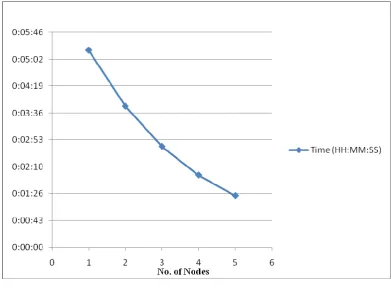
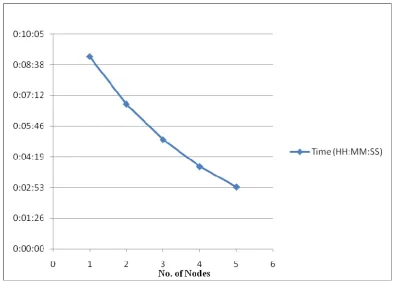
Five tests are performed for the two cases from one node to five nodes and Figures 3 and 4 shows the average time of those three tests in each case.
As it is seen in the two cases, by adding fourth and fifth executor nodes, we do not have a considerable execution time difference.
In the first test case, the execution time becomes 1.398 times less by adding each node. This number is 1.328 times for the second case.
Figure 3: Average Execution Time for the First Case
4. Conclusion
A Grid and Thread Pool Based Encryption (GTPBE) System is proposed to perform file encryption. The proposed system is called The Grid and Thread Pool Based Encryption (GTPBE) which uses the AES algorithm for file encryption. The proposed GTPBE system is tested with different file sizes and different number of grid nodes. The experimental results show that the GTPBE reduces the execution time considerably.
References
[1] William Stallings, Cryptography and Network Security Principles and Practices, Fourth Edition, Prentice Hall, 2005 [2] Popek, G., and Kline, C. "Encryption and Secure Computer Networks." ACM Computing Surveys, December 1979. [3] Feistel, H. "Cryptography and Computer Privacy." Scientific American, May 1973.
[4] Charlie Kuafmann, Network Security: Private Communication in a Public World, Second Edition, PHI.
[5] I. Foster, & C. Kesselman, The grid: blueprint for a new computing infrastructure (San Francisco, CA: Morgan Kaufmann Publishers, 1998).
[6] A. Setiawan, D. Adiutama, J. Liman, A. Luther, & R. Rajkumar Buyya, GridCrypt: high performance symmetric key
cryptography using enterprise grids, Grid Computing and Distributed Systems Laboratory, Dept. of Computer Science and Software Engineering, The University of Melbourne, Australia, Available: http://www.gridbus.org/papers/gridcrypt.pdf
[7] N. Challa, & J. Pradhan, GridNtru: high performance PKCS, Proc. 26th World Academy of Science, Engineering And Technology, Dec. 2007, 540-543.
[8] J. Daemen, & V. Rijmen, The design of rijndael: AES - the advanced encryption standard (Springer-Verlag, 2002).
[9] D. Chappell, Introducing windows communication foundation, Chappell & Associates Microsoft Whitepapers, Sept. 2007. [10] J. Daemen, & V. Rijmen, AES proposal: rijndael, 1999, Available: http://www.daimi.au.dk/~ivan/rijndael.pdf