46
A CASE STUDY ON SELECTION OF APPROPRIATE PROCUREMENT SYSTEM FOR SMALL
SCALE CONSTRUCTION INDUSTRY
N.Ganapathy Ramasamy 1, Dhanya R 2
1,2Dept. of Civil Engineering, SRM University, Chennai, India [email protected], [email protected],
Kabilan Nagappan 3, Sai santhosh 4
3Dept. of Civil Engineering, Shanmuganathan Engineering College, Pudukkottai, India 4SRM University Kattankulthur, Chennai, India
ABSTRACT
The development and practice of appropriate procurement systems helps to avoid problems related to time &cost and to attain the project specified goals. One of the characteristics of the construction industries over the last three decades or so has been the usage of various procurement methods which have investigated the criteria for their selection and performance in terms of time, cost and quality. Selecting the appropriate procurement system for construction projects is a complicated and challenging task. To assist the decision-making process, procurement selection tools and techniques have been developed. The main aim of this study is to develop a framework using Statistical Package for Social Sciences (SPSS) Software by performing Descriptive Analysis using Weighted Average Mean (WAM), Standard Deviation, Variance, Correlation and T- Test are used to compare the large scale construction industries and small scale construction industries for Construction Procurement Systems. A series of literature reviews and Questionnaire surveys were conducted to analyze the current situation of procurement system in construction industry. Traditional Procurement method is the most widely used method in the small scale and middle scale industries. Non Traditional Procurement like Design build and Engineering Procurement Construction (EPC) is being adopted by large scale industries. The framework developed in this paper gives opportunities to the small and middle scale industries to go for the Non – Traditional Procurement methods as it optimizes time and cost for the construction project by selecting the most appropriate procurement system.
Index Terms-Procurement systems, Procurement selection, Descriptive analysis, Traditional Procurement, Large scale Construction Industry, Small scale Construction Industry.
I. INTRODUCTION
Procurement Systems are important in ensuring the successful implementation of construction projects. The selection process of procurement systems has become complex, mainly because of increasing complexity for procuring construction projects, desire for commen-cement and completion, all of which has led to the demand for more sophisticated methods of selection [1]. In dealing with the selection of most appropriate procure-ment system, the various factors taken into consideration are nature of project, options available, budget of project, internal & external environment and the owners [2]. As per the survey conducted by Construction Industrial Development Council of India in 2011 there are around 31000 enterprises in the construction industry in India out of which around 29600 are the small-scale enterprises, around 1050 are the medium scale enterprises and around 350 are the large-scale enterprises [3]. Small scale const-ruction industries represent over 95 percent of the total number of construction industry in India. Hence the research has been carried out to identify the major problems faced by a small-scale construction industry in India. To establish procurement selection procedures, clients should formalize a set of suitable selection criteria based on their specific needs, objectives, project require-ments and external environrequire-ments. The fundamental issue of all procurement systems in construction is the develop- ment of a suitable framework which clearly establishes the roles and relationships of parties involved in the project. Construction procurement is a key factor which contributes to achieve the goals of the client, thus resul-ting to the project success [5-7].
It has been estimated that an appropriate procurement method could reduce project costs by an average of 5% (Contractual 1982). However this only implies for the
large scale construction industries. The small scale construction industries still lacks far behind in successful commencement and completion of projects [8]. The only reason behind this is the non – selection of an appropriate and suitable procurement system. The two main factors which lead to the above cause as mentioned are: small budget of the project and estimated time [9-11]. To tackle this problem, a modification or development to the exis-ting framework of procurement system is performed which can be selected by the small-scale industries for their construction projects. The paper aims to reduce the gap between the small-scale industry and large scale industry on the selection of procurement system for the successful implementation of building projects [14].
II.METHODOLOGY
First the literature review was performed on the journals of Procurement Systems. It has been observed that still majority of Construction Industries are following the Traditional Procurement Method (60%) than the Engi-neering Procurement Construction also known as EPC (35%) as shown in Fig. 1. Among the 35% of industries following EPC process for their construction projects none were from the small-scale industries. The EPC method is followed by the large-scale construction industries only. The small-scale construction industries support the Traditional Procurement method as it being simpler in execution and management.
criteria on a scale of 1-5. Part A deals with Environ-mental Sustainability Initiatives in procurement System. In Part B, issues related to Health & Safety (H&S) in Procurement System were asked. In Part C, the respondents were asked regarding the Sustainability Initiatives used in Procure-ment DocuProcure-ments. In Part D, various laws that are to be followed in Procurement System was asked to the respondents. The Questionnaire was mailed to different respondents all over the country.
Figure 1. Procurement Systems used by various companies
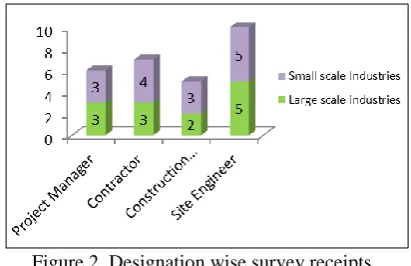
A total of 40 surveys were mailed out of which 32 Questionnaires were positively replied and mailed back that is 62% of response rate. Out of the 32 Questionnaires received, 28 were appropriate for analysis after a thorough check that is 56% of response rate. 14 Question-naires were received from the Large scale Construction Industries where as the other 14 were received by the large scale construction industries. Out of 28 replies, six were from Project Managers, seven from Contractors, five from Construction Managers and 10 were from Site Engineers from Small scale and large scale Construction Industries as shown in Fig. 2 below.
Figure 2. Designation wise survey receipts
The respondents of 28 Questionnaires were analyzed using Statistical Package for Social Sciences (SPSS) soft-ware tool and various statistical methods were performed to obtain the required results. Analytical instruments such as Weightage Average Method (WAM), Standard Devia-tion, Variance, Correlation and T- Test were performed separately based on the Questionnaire responses using the SPSS software tool.
A.WEIGHTED AVERAGE MEAN (WAM)
The Weighted average is one of the statistical methods in which each quantity to be averaged is assigned a weight. Weightage Average method (WAM) determines the relative value of each portion on the average.
WAM = (n1* m1) + (n2* m2) / (n1+ n2) (1)
Where,
WAM - Weightage average mean
m1 - Mean 1
m2 - Mean 2
x1 - No of observation of large scale industries
x2 - No of observation of small scale industries
B. STANDARD DEVIATION
Standard deviation is a measure of the distribution of a set of data from its mean. In statistics, the standard deviation is a measure that is used to quantify the amount of distribution of a set of data values. A low value indicates that the data points are close to the mean (also called the expected value) of the set, while a high value indicates that the data points are spread out over a wider range of values.
(2) Where,
σ - Standard deviation n -Sample size x -Variable - Mean of data set
C.CORRELATION
Correlation is a statistical method that is used to measure and describe the strength and direction of the relationship between two variables. It is also denoted by ‘r’. It indica-tes the extent to which two or more variables fluctuate together. A positive correlation indicates the range to which those variables increase or decrease in parallel; a negative correlation indicates the range to which one variable increases as the other decreases.
(3)
Where,
R - Correlation coefficient Σx - Sum of x scores Σy - Sum of y scores
Σxy - Sum of the products of the paired scores n -Number of pairs of scores
If,
r - Zero this means no association or
correlation between the two variables.
0 < r < 0.25 - Weak correlation.
0.25 ≤ r < 0.75 - Intermediate correlation. 0.75 ≤ r < 1 - strong correlation.
r = l - perfect correlation.
D.T–TEST
A t-test is any statistical analysis hypothesis test in which the test statistic follows a Student's t-distribution under the null hypothesis. It is also used to determine if two sets of data are significantly different from each other, and is widely applied when the test statistic would follow a normal distribution if the value of a scaling term in the test statistic parameter were known. When the scaling term is unknown and is replaced by an estimate based on the data, the test statistic (under few conditions) para-meter follows a Student's t distribution.
n
x
x
2)
(
σ
=
r = ⅀𝒙𝒚−
⅀𝒙⅀𝒚 𝒏
⅀𝒙 ² − ⅀𝒙 ²
𝒏 . ⅀𝐲 ²−
⅀𝐲 ²
𝒏
48 (4) Where,
X1 - Mean of first set of values
X2 - Mean of second set of values
S1 - Standard deviation of first set of values
S2 - Standard deviation of second set of values
n1 - Total no. of values in first set
n2 - Total no. of values in second set
III.RESULTS&DISCUSSIONS
Results and observations were used to deduce the current status of procurement in India. In the research questionnaire, question 1-4 were outlined to gain information of the respondent organizations. An overview of the respondents is as follows:
57% of respondents represented private sector and
43% of respondents represented public sector.
Out of the total respondent organization 65% have
been in operation for more than 25 years. Rest 35% of the defendant organizations was incorporated during the last 5 years.
Thirty-five percent of the respondent organizations
were ‘Site Engineers’, 25% of the respondents were ‘Contactors’. Whereas,21% of the respondents were ‘Project Managers’ and 18% of them were ‘Construction Managers’.
Respondents were asked to discuss the environ-mental considerations in the procurement process. There-fore, Part A of the questionnaire was designed to obtain respondents feedback on current environmental initiatives
in construction procurement. Respondent’s comments
were categorized according to the environmental initia-tives. The defendant’s feedback was then used in the SPSS software to perform Descriptive Analysis of the questionnaire by using Weighted Average Mean (WA M), standard deviation, variance, correlation and T- Test. frequency of environmental factors identified is in Table 1. Totally 28 observations, 1 minimum and 5 maxi-mum was observed for both environmental initiatives in construction procurement and health & safety (H & S), initiatives in construction procurement for small scale industry
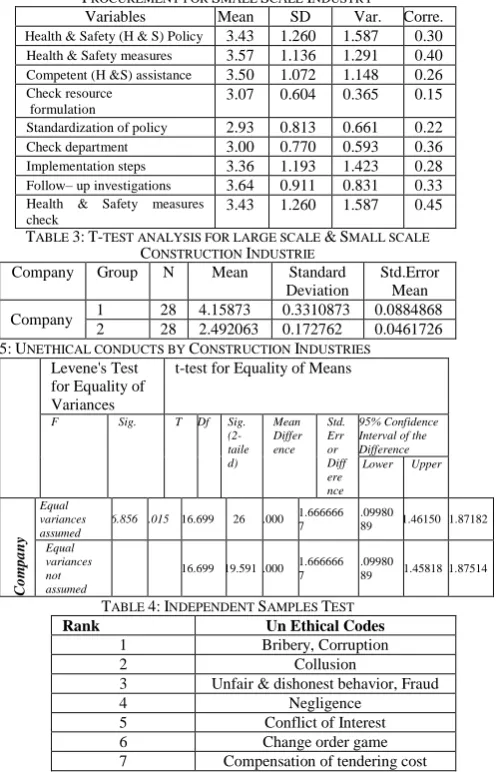
The primary consideration of sustainable procure-ment includes social and environprocure-mental criteria while achieving the best value and considering the life cycle cost of the project. Therefore, Part B of the questionnaire was designed to obtain respondents feedback on current Health & Safety (H & S) initiatives in construction procurement. The respondent’s feedback was then used in the SPSS software to perform descriptive Analysis of the questionnaire by using Weighted Average Mean (WAM), standard deviation, variance, correlation and T- Test. frequency of health & safety factors identified is in Table 2. The questionnaires received from various respondents of Large Scale Construction Industries & Small scale Construction Industries was fed into the SPSS software and a statistical hypothesis test was per-formed named as T-test. Results of the T-test were carried out on the large-scale & small large-scale Construction Industries are shown in Table 3.
It is crucial to know about the issue that comes in the procurement process. The respondents were asked to give feedback on the unethical issue in Project Procure-ment. Respondent’s comment regarding the unethical issue in Project Procurement was categorized and was arranged according to the rank. The immoral issues contributing in Project Procurement is in Table 4.
TABLE 1 ENVIRONMENTAL INITIATIVES IN CONSTRUCTION
PROCUREMENT
Variables Mean SD Var. Corre.
LEED certification 3.93 1.184 1.402 0.40
Federal Environment
Guidelines 3.71 0.460 0.212 0.40
Power consumption 3.86 0.651 0.423 0.88
Recycle system 3.64 0.488 0.238 0.41
Sustainability manual 4.29 0.460 0.212 0.26
Labor Guidelines 4.29 0.460 0.212 0.13
Reduction of toxic 3.71 0.713 0.508 0.33
Documentary of
environment policy 3.93 0.716 0.513 0.40
Agreements related to
Environment policies 3.93 0.604 0.365 0.19
Provide Training 2.21 0.686 0.471 0.50
Check department 2.43 0.504 0.254 0.46
Environment protection
measures check 2.71 0.897 0.804 0.45
TABLE 2HEALTH &SAFETY (H&S)INITIATIVES IN CONSTRUCTION PROCUREMENT FOR SMALL SCALE INDUSTRY
Variables Mean SD Var. Corre.
Health & Safety (H & S) Policy 3.43 1.260 1.587 0.30
Health & Safety measures 3.57 1.136 1.291 0.40
Competent (H &S) assistance 3.50 1.072 1.148 0.26
Check resource formulation
3.07 0.604 0.365 0.15
Standardization of policy 2.93 0.813 0.661 0.22
Check department 3.00 0.770 0.593 0.36
Implementation steps 3.36 1.193 1.423 0.28
Follow– up investigations 3.64 0.911 0.831 0.33
Health & Safety measures check
3.43 1.260 1.587 0.45
TABLE 3:T-TEST ANALYSIS FOR LARGE SCALE &SMALL SCALE CONSTRUCTION INDUSTRIE
Company Group N Mean Standard
Deviation
Std.Error Mean
Company 1 28 4.15873 0.3310873 0.0884868
2 28 2.492063 0.172762 0.0461726
5:UNETHICAL CONDUCTS BY CONSTRUCTION INDUSTRIES Levene's Test
for Equality of Variances
t-test for Equality of Means
F Sig. T Df Sig. (2-taile d) Mean Differ ence Std. Err or Diff ere nce 95% Confidence Interval of the Difference
Lower Upper
Co m p a ny Equal variances assumed
6.856 .015 16.699 26 .000 1.666666 7
.09980
89 1.46150 1.87182
Equal variances not assumed
16.699 19.591 .000 1.666666 7
.09980
89 1.45818 1.87514
TABLE 4:INDEPENDENT SAMPLES TEST
Rank Un Ethical Codes
1 Bribery, Corruption
2 Collusion
3 Unfair & dishonest behavior, Fraud
4 Negligence
5 Conflict of Interest
6 Change order game
7 Compensation of tendering cost
The defendant’s feedback was then used in the SPSS software to perform Descriptive Analysis of the questionnaire by using Weighted Average Mean (WAM), Standard Deviation, Variance, Correlation and T- Test.
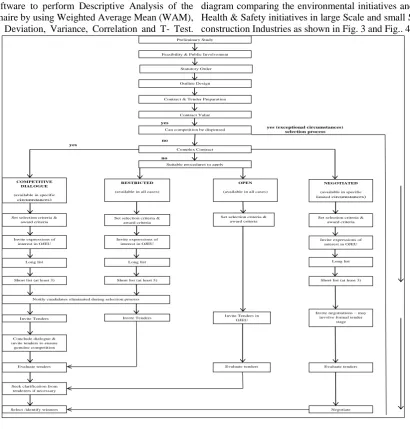
The results of the respondents were plotted in a line diagram comparing the environmental initiatives and the Health & Safety initiatives in large Scale and small Scale construction Industries as shown in Fig. 3 and Fig.. 4.
FIGURE 3.FRAMEWORK FOR THE APPOINTMENT PROCESS
FIGURE 5. GRAPHICAL REPRESENTATION OF ENVIRONMENTAL INITIATIVES IN PROCUREMENT SYSTEM OF LARGE & SMALL SCALE INDUSTRIES.
FIGURE 6. GRAPHICAL REPRESENTATION OF HEALTH & SAFETY INITIATIVES IN PROCUREMENT SYSTEM OF LARGE & SMALL SCALE INDUSTRIES.
We can clearly observe that the differences in the sustainability initiatives for procurement are huge for the large scale and small scale construction industries. To overcome these differences a framework is developed especially for the small Scale construction Industries which will result in overcoming all the major issues in acquisition.
According to the observations from the
questionnaires various procurement initiatives were identified. Questionnaire responses confirmed that a very limited number of procurement initiatives were used or followed in Small-scale Construction Industries. Obtaining the LEED certification was the main requirement defined by respondents. The weightage average mean (WAM) was 4.85 for the large-scale Construction Industries compared to 3.65 of Small-scale Construction Industries. In addition, 11 more specified environmental initiatives were stated by respondents (Table 2). Respondents of the questionnaire survey stated
yes
yes (exceptional circumstances) selection process no
yes
no
Fig 1: Framework for the appointment process
Preliminary Study
Feasibility & Public Involvement
Statutory Order
Outline Design
Contract & Tender Preparation
Contract Value
Can competition be dispensed
Complex Contract
Suitable procedures to apply
COMPETITIVE DIALOGUE
(available in specific circumstances)
RESTRICTED
(available in all cases)
OPEN
(available in all cases)
NEGOTIATED
(available in specific limited circumstances)
Set selection criteria & award criteria
Invite expressions of interest in OJEU
Long list
Short list (at least 3)
Notify candidates eliminated during selection process Set selection criteria &
award criteria
Invite expressions of interest in OJEU
Long list
Invite expressions of interest in OJEU
Short list (at least 5)
Set selection criteria & award criteria
Set selection criteria & award criteria
Invite expressions of interest in OJEU
Long list
Short list (at least 3)
Invite Tenders Invite Tenders in
OJEU
Invite negotiations – may involve formal tender
stage
Conclude dialogue & invite tenders to ensure
genuine competition
Evaluate tenders
Seek clarification from tenderers if necessary
Select /identify winners
Evaluate tenders
Negotiate Invite Tenders
50 9 Health & Safety initiatives in Small-scale Construction Industries the weightage average mean (WAM) was only 3.10 compared to 4.50 of Large-scale Construction Industries (Table3). Similarly, many more tools were used to compare the received responses of the question-naires. The Small-scale Construction Industries lacked in all respects to the Large-scale Construction Industries. Even the t-Test performed produced the same result of Small scale lacking to large scale Construction Industry. A major weakness was observed in the questionnaire that was responded. Only 25% of the respondents stated that respective organization use environmental factors as evaluation criteria in the Small-scale Construction Industries. According to the questionnaire, 90% of the interviewees reported that procurement functions led by upper management officer. Since procurement needs the backing of the directorate, the Small- scale Construction Industries lacks in following the procurement initiatives. The questionnaire survey revealed that obtaining LEED certification as the commonly referred environmental sustainability initiative and ensuring the Health & Safety of the workers was the stated social sustainability initia-tive. Procurement of construction is different from procu-rement of goods. Since construction work has not begun at the time of procurement, many parameters are un-known, making acquisition implementation more complicated. Furthermore, at the time of purchases, there are limited opportunities to judge whether or not the tenderers will fulfill the purchase requirements.
It is well known that the fear of higher project costs limits the application of procurement preferences especially in the Small scale Construction Industries. Taking all the major procurement initiatives from the questionnaire stated by the respondents, a framework is developed specially for the Small-scale Construction Industries which will help the construction projects to progress successfully in case of cost, time and mostly quality (Fig. 1 & 2). The framework explains the major procurement initiatives needed to be used to do the Small- scale Construction projects successful. Initiatives stated in the framework helps to optimize the cost & time to some extent but improves the quality of the project to a large extent.
IV.CONCLUSION
This paper discusses the present status of procurement practices in the large scale & Small scale Construction Industries. A comprehensive study was performed to identify the current practices, and industry perception on procurement. From this study it was concluded that procurement initiatives are not entirely utilized specially by the Small-scale Construction Industries. A limited number of acquisition initiatives are currently being considered in Small-scale Construction Procurement. Only few organizations is using suitable procurement every time they procure construction. Lack of consideration of sustainability and environmental criteria in the bid evaluation is a main drawback observed through this study. Other disadvantages include the unavailability of standard methods for procurement and lack of knowledge of local conditions. Therefore, more resources such as guides, blueprints, and tools should be
developed to support implementation of sustainable procurement in Small-scale Construction Industry. This study has found the significant factors affecting the selection of procurement systems to be the require-ments and characteristics of the client, together with project components and external environment. This demonstrates that selection of procurement system should address the factors at macro level and consider all macro level factors in the selection process which will ultimately lead to the success of the project and assure the value of money construction clients.
Selection of most suitable procurement systems is a difficult task, since individual client own each project with different requirements and possesses unique charac-teristics. Clear contractual arrangements should be set out right from the start as this will consequently assist with the determination of responsibilities of all project parti-cipants. All clients of the construction industry, whether from the public or the private sector, should familiarize themselves with various procurement systems as this will assist them in making well-informed procurement decisions. Client’s actual needs, objectives and project goals must be accurately conveyed to the project team in order to enable the project team to develop a sound procurement strategy.
A framework was developed to facilitate a more systematic and consistent approach in the selection process, hence improving the success rate of the construction project for the small-scale construction industry. The application of this framework seeks to overcome all the problems faced by the Small scale Construction Industries due to the internal and external factors. The implementation of this framework to aid procurement selection is advocated to successfully complete the construction projects by the small-scale Construction Industries.
REFERENCES
[1]. Thwala W.D. and M.D. Mathonsi, Selection of Procure-ment Systems in the South African Construction Industry: An Exploratory Study. Acta Commercii 13-26(202) [2]. T. Alhazmi and R. McCaffer, Project Procurement System
Selection Model. Journal of Construction Engineering and Management 126: 76-184 (2000).
[3]. Heap-Yih Chong and Christopher N. Preece, Improving construction procurement systems using organizational strategies, Journal of Construction Engineering and Management 11: 5-20 (2014).
[4]. Peter E. D. Love, Influence of Project type and Procure-ment method on rework costs in building construction projects. Journal of Construction Engineering and Management 128: 18-29 (2002)
[5]. Hassim et al., Factors Contributing to ethical issues in project procurement planning: a case study in Malaysia, 8th International Conference on Construction and Real Estate Management Pp. 1-8 (2010).
[6]. OJO Stephen Okunlola and IKPO Imeh Johnson. Determining the Performance of Procurement Methods against Selection Criteria using Outranking-Satisfying Methodology. Journal of Engineering, Project, and Production Management 3: 74-84 (2013).
Journal of Construction Engineering and Management 123: 34- 40 (1997).
[8]. Sai On Cheung et al., Improving Objectivity in Procurement Selection. Journal of Construction Engineering and Management 7: 3 (2001)
[9]. Mohan M. Kumaraswamy and Sunil M. Dissanayaka, Developing a decision support system for building project procurement. Journal of Building and Environment 36: 337–349 (2001).
[10]. Duc Tnanh Luu, S. Thomas Hg and Swee Eng Chen, A case based procurement advisory system for construction. Journal of Advances in Engineering Software 34: 429-438 (2003).
[11]. R. Shiyamini et al., Selection of suitable procurement systems in construction: A multi-criteria decision support model Pp. 66-77 (1997).
[12]. O.J.O. Stephen Okunlola, Proma-a decision support system to determine appropriate procurement method. Research Journal of Applied Sciences, Engineering and Technology 4: 316-321 (2012).
[13]. Rajeev Ruparethna and Kasun Hewage, Sustainable procurement in the Canadian construction industry: current practices, drivers and opportunities, Journal of Cleaner Production 109: 305-314 (2015).