Surface and Interface Analysis of Fibers Sputtered with
Titanium Dioxide
Yang Xu, Ph.D., Wenzheng Xu, Fenglin Huang
Key Laboratory of Eco-Textiles, Wuxi Jiangsu CHINA
Correspondence to:
Yang Xu email: [email protected]
ABSTRACT
Nanoscale titanium dioxide (TiO2) films were deposited on the surface of polyester (PET), polypropylene (PP), and viscose fibers by using direct current (DC) reactive magnetron sputtering. The effect of different fibers on the surface structure and morphology of TiO2 thin films was investigated by atomic force microscopy (AFM). The cohesion and adhesion of the brittle titanium dioxide coating on the soft manmade fiber substrates was analyzed by scanning electron microscopy (SEM). The SEM images of coating interfaces were captured after TiO2 coated fibers were cut in a self-made simple apparatus. For comparison, the SEM images of the coating interfaces were captured after the coated fibers were broken in a single fiber strength tester. The results indicate that the characteristics of TiO2 deposited films were related to the structure and the morphology of the thin films which were determined by surface energy and roughness of different manmade fibers. Relatively smooth and high energy surface ultimately yielded uniformly deposited film and better adsorption to TiO2 clusters. The mechanical strength of the deposited film and the cohesion to the fiber substrate may be reduced for high surface roughness, because of the build-up of more micron cracks in the sputtering process.
Keywords: Magnetron sputtering, Titanium
dioxide, manmade fiber, Surface energy, Surface roughness.
INTRODUCTION
According to Oerlikcon Textile “The Fiber Year 2009/10 Report”, the global manmade fiber consumption went up to 44.1 million tones.1 Manmade fibers like polyester (PET), polypropylene (PP), polyamide (PA) and viscose rayon are increasingly replacing traditional engineering materials like steel and aluminum in fabrication of
coaches, and civil construction as well as biomedical application due to their superior properties such as better corrosion resistance, high strength to weight ratio, soft and malleable consistency, relatively low cost and easy recycling. [2-3] However, the innately inert surface of manmade fibers is often not ideal for a particular application. It is necessary to modify their surfaces to increase surface functionalities without change in bulk properties for many commercial applications. Nanoscale titanium dioxide (TiO2) thin films have been investigated extensively in recent years, due to their excellent properties of photocatalysis and ultra-violet (UV) shielding. [4] The ability to deposit well-controlled TiO2 coatings on manmade fibers would expand the applications of textile fibers, based on changes to both the physical and chemical properties of the fiber surface.
Various deposition techniques such as chemical vapor deposition, [5] sol–gel deposition, [6] and magnetron sputtering [7] have been used to produce TiO2-coated fabrics. The magnetron sputtering technique, an environmentally friendly process, has emerged as one of the most promising techniques. It permits large-scale deposition of high-quality films at high deposition rates, and metal target can be used for fabrication of large-scale uniform coatings with a high or low density at a relatively low deposition temperature. [8] It is especially important for thermal sensitive substrates such as textile materials, which cannot tolerate high temperatures.
Journal of Engineered Fibers and Fabrics 8 http://www.jeffjournal.org
generally involves loading of the fibers in tension and in flexion, and internal stresses may also be induced during processing. The mechanical resistance of the TiO2 coating and its adhesion to the textile substrates are therefore expected to play a key role in fiber performance. These properties are generally affected by the roughness and cleanness of the substrate, the chemical affinity between the coating and the substrate, and the presence of cracks and other defects. [9] In this study, TiO2 thin films were deposited on the surface of three major manmade fibers (PET, PP and viscose) using DC magnetron sputtering at the same deposition parameters. The effects of different fiber substrates on the structure and morphology of the TiO2 thin films as well as the interfacial bonding microstructure and mechanical properties of TiO2 films were compared.
EXPERIMENTAL Materials Preparation
The substrates used in this study were commercial PET, PP and viscose fibers with average diameters of about 20 μm (XIAKE SPINNING Co., Ltd., Jiangsu, China). Before sputter coatings, all samples were first washed with ethanol for 30 min to remove the organic solvent and particles attached to the materials and then rinsed with de-ionized water twice and dried in an oven at 40 ºC for 24 h .
Sputter Coating
Sputtering coatings of TiO2 were placed on the surface of PET, PP and viscose fibers at the same deposition parameters in a magnetron sputter coating system supplied by Shenyang Juzhi Co, LTD. A high-purity titanium (Ti) target (diameter: 50 mm; purity: 99.99 %) was mounted on the cathode. The target was placed below the substrate holder at a distance of 60 mm. The fiber substrates were hung under the substrate holder. During the sputtering, the substrate holder was kept rotating at a speed of 100 rpm to ensure uniform deposition on the surface of the fiber substrates. The sputter chamber was first pumped to a base pressure of 1.5×10⁻³ Pa prior to the introduction of high-purity argon gas (99.999 %) as the bombardment gas and high-purity oxygen gas (99.999 %) as the reacting gas. Based on the previous investigation,[10] the argon and oxygen gas flows were set at 80 and 12 ml/min respectively, coating was performed at a pressure of 0.5 Pa with a power of 50 W. The thickness of the coating was monitored using a coating thickness detector (FTM-V) fixed in
the sputtering chamber. The thickness of the TiO2 coating was about 60 nm. In addition, to avoid the deformation of the substrate and the diffusion movement of the sputtered particles caused by high temperature, water-cooling was applied to control the temperature of the substrates during the sputtering process.
Surface and Interface Characterization
A Benyuan CSPM3300 Atomic Force Microscope (Guangzhou, China) was employed to examine the morphology and distribution of nanoscale TiO2 on the different fiber surfaces. Scanning was carried out in contact mode AFM with a silicon cantilever. AFM images were obtained from multiple locations on several samples at ambient conditions. The density and sizes of TiO2 nanoclusters deposited on the surfaces of different manmade fibers were extracted from the AFM micrographs over substrate areas of 2 μm ×2 μm and analyzed by the Imager 4.40 Software used in CSPM3300 AFM.
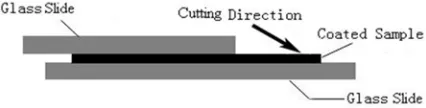
An SEM instrument (S-4800, HITACHI, Japan) operated at 5 kV was used to observe the interfacial bonding microstructure between fiber substrate and TiO2 coating. The influence of fiber surface on the cohesion and adhesion of the brittle oxide coating on the soft manmade fiber substrate was analyzed by SEM. The SEM images of coating interfaces were captured after TiO2 coated fibers were cut in the self-made simple apparatus, as shown in Figure 1, and broke in the single fiber strength tester (YG001N, HONG DA, China) at a constant deformation rate of 20 mm/min with a pre-stress of 0.01N. The microtomed samples were sputter coated with gold-palladium to prevent charge buildup during SEM observations.
FIGURE 1. Cutting view.
RESULTS AND DISCUSSION Comparison in Surface Morphology
FIGURE 2. AFM images of uncoated and coated fiber surface at the scan size of 2000×2000 nm: (a) uncoated PET, (b) uncoated PP, (c) uncoated viscose (d) uncoated PET (c) coated PP (d) coated viscose.
It appears that the morphology of the PET fiber without coating is relatively smooth, but the groove and hill like structures on PP and viscose surface can be clearly observed as presented in Figure 2a-2c, which may be related to the fiber manufacturing process. The AFM images also reveal that the root mean square (RMS) roughness of the sample fibers are 1.53, 7.41, and 16.60 nm respectively, as analyzed by Imager Software. Compared to the original samples, the AFM images clearly show that the sputtered TiO2 nanoclusters cover the fiber surface when the thickness of the deposited film reaches 60 nm, as show in Figure 2d-2f. At this thickness, although AFM images show that the topography of TiO2 deposited films conform to their own substrates as a whole, the RMS roughness of coated fibers increase to 6.03, 8.01, and 19.1 nm respectively. Moreover, the deposited nanoclusters have different shapes and sizes on different manmade fiber substrates. The average diameters of nanoclusters agglomerated by sputtered TiO2 particles on the PET, PP and viscose fibers are 39.1, 37.6, and 49.1 nm, respectively. Compared AFM images of Figure 2d-2f, the columnar structure of TiO2 nanoclusters on the surface of viscose fiber is relatively broad, large, and with domed head, but compact and tapering on the surface of PET fiber and especially on the PP fiber. These differences in shape and size could be accounted for largely by the difference in the
theory. [11] Assuming a TiO2 cluster takes the shape of a spherical cap, as shown in Figure 3, the contact angle θ is determined by the mechanical balance of surface free energies of the TiO2(γTiO2), the substrate(γsub), and the TiO2-substrate interface(γTiO2-sub) as Eq. (1).
sub TiO TiO
sub
2 cos
2
(1)FIGURE 3. Balance of surface free energies for a spherical-cap TiO2 cluster formed on fiber.
Where contact angle θ varies from 0-180°. When
Journal of Engineered Fibers and Fabrics 10 http://www.jeffjournal.org
film-substrate adhesion and surface free energy of the substrate should be among the critical factors which determine the TiO2 nucleation barrier and the shape and size of TiO2 nanoclusters. Among the three manmade fiber substrates, viscose has the higher value of surface energy, because of more hydroxyl groups presented in the structure. So it has the best wetting ability to TiO2 clusters, the lowest nucleation barrier for TiO2 deposition, and the largest critical radius of TiO2 cluster, leading to a rougher morphology of TiO2 clusters. Relatively higher surface energy and better wettability properties of polyester over polypropylene are due to the presence of more polar ester groups in the former. Polypropylene being strictly a hydrocarbon material lacks such polar groups and, therefore, has the highest value of the contact angle (> 90°) and lowest values of the surface energy and the work of adhesion. [12] So TiO2 clusters on the surface of PP fiber exhibit the lowest critical nucleus size and the highest density among the three fibers. In addition, the coating layer shows some obvious crack structures on the viscose fiber surface, as presented in Figure 2f. This may be attributed to the higher surface roughness which leads to a shadowing of the atoms and an open type microstructure. Shadowing effects not only cause the higher portions of the rough surface, but also result in weak bonding between the
over coated particle and the surrounding coating [13]. Therefore they can be easily detached due to the internal or thermal stresses. The coated particles could be also deformed. In this case a gap between the coating and the defect appears which can serve as crack initiators.
Interface Observations
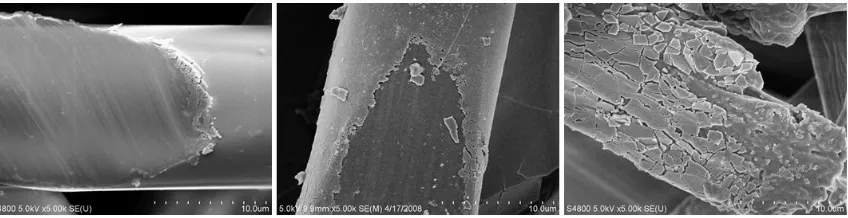
The SEM observations reveal the effects of the interfacial bonding between the coated films and different fibers, as presented in Figure 4. As shown in
Figure 4a, the deposited TiO2 film of 60 nm on PET fiber looks uniform and has no floating layer on the fiber surface, with only a few cracks in the vicinity of the total cutting incision, which may form during cutting of the samples. The film coated on the surface of PP fiber shows a relative integrated structure, but a part of the film on the edge of cutting incision area appears to be cracked and separated from the fiber surface, as shown in Figure 4b. As shown in Figure 4c, the cutting section forms cracks and breaks up into some fragments by the cutting-force for the coated viscose fiber, and the interfacial structure between coating and substrate on the edge of cutting incision is associated with damage in the form of loss of adhesion between the TiO2 coating and viscose fiber.
FIGURE 4. SEM images of interface: between TiO2 films and different fibers (a) PET; (b) PP; (c) viscose.
Similar results are observed by the SEM images of PET, PP and viscose fibers coated with TiO2 film after broken in the single fiber strength tester, as revealed in Figure 5. Comparing these images, TiO2 coatings are damaged to varying degree. The surface morphologies are different in each case. Coating on the surface of PET substrate looks to have relative integrity but with some delaminated and cracked buckles along the axis, as shown in Figure 5a. On the surface of the PP substrate, more cracks appear regularly along the fiber and extend around the whole specimen circumference, as shown in Figure 5b. Most fragments remain attached to the substrate. Whereas on the surface of the viscose substrate, the coating undergoes extensive failure at the interface and sheds off from the substrate completely, as shown in Figure 5c.
The difference in coating mechanical properties of the coating and bonding properties between the TiO2 films and different manmade fibers could be largely attributed to the effect of different fiber substrate natures, as well as the surface roughness and surface energy, on the structure and morphology of the TiO2 thin films. Relatively smoother and higher surface energy properties of PET over PP fiber lead to more uniform film and better adsorption to TiO2 clusters. Viscose fiber has the highest surface energy and the best wetting ability to TiO2 clusters among three manmade fibers, nevertheless its characteristic of crenulated cross-sectional shape and the highest surface roughness reduce the film mechanical strength and the cohesion to the viscose fiber because of more micron cracks building up in the process as discussing in the AFM analysis.
CONCLUSIONS
In this study, the surface of three major manmade fibers (PET, PP and viscose) were functionalized using TiO2 sputter coating. The effect of different substrates on surface morphology, interfacial bonding microstructure, and mechanical properties of TiO2 thin films was studied. The result shows that the surface energy and roughness of different manmade fibers influence many properties of deposited films and film growth kinetics and play a dominant role in determining the microstructure and surface morphology. Higher energy surfaces ultimately contained fewer and larger clusters than the lower energy surfaces. Smooth surfaces lead to a more uniform, fine grain structure while rough surfaces with peaks, valleys and other defects act as preferred
growth sites, leading to a shadowing of the atoms and reduce the film mechanical strength and the cohesion to the manmade fiber substrate.
ACKNOWLEDGEMENTS
This work was supported by the scientific and technological guidance project of China National Textile and Apparel Council (CNTAC) (No.:2011014), and the Open Project Program of Key Laboratory of Eco-Textiles at Jiangnan University (KLET1013).
REFERENCES
[1] Oerlikcon Textile; Global fiber production exceeded 70 million tonnes in 2009; China Textile Leader 2010, 6, 102-104.
[2] Navaneetha Pandiyaraj K.; et al; Adhesive properties of polypropylene(PP) and polyethylene terephthalate(PET) film surfaces treated by DC glow discharge plasma; Vacuum 2009, 83, 332-339.
[3] Wertheimer M.R.; Fozza A.C.; Hollaender A.; Industrial processing of polymers by low-pressure plasmas: the role of VUV radiation; Nuclear Instruments and Methods in Physics Research B 1999, 151, 65-75. [4] Fujishima A.; Rao T.N.; Tryk D.A.; Titanium
Dioxide Photocatalysis Journal of
Photochemistry and Photobiology C: Photochemistry Reviews 2000, 1, 1-21
[5] Szymanowski H.; et al; Plasma enhanced CVD deposition of titanium oxide for biomedical
applications; Surface and Coatings
Technology 2005, 200, 1036-1040.
[6] Wu D.Y.; et al; Synthesis and characterization of self-cleaning cotton fabrics modified by TiO2 through a facile approach; Surface and
Coatings Technology 2009, 203, 3728-3733. [7] Xu Y.; et al; Surface functionalization of
polyester nonwoven fabrics by sputter coating of titanium dioxide; Polymers & Polymer Composite 2009, 17, 347-351. [8] Singh P.; Kaur D.; Room temperature growth
of nanocrystalline anatase TiO2 thin films by dc magnetron sputtering Physica B 2010, 405, 1258-1266.
Journal of Engineered Fibers and Fabrics 12 http://www.jeffjournal.org
[10] Xu Y.; et al; Preparation and the light transmittance of TiO2 deposited fabrics;
Journal of Coatings Technology and Research 2009, 6, 549-555.
[11] Ohring M.; The Materials Science of Thin Films; Academic Press: San Diego, 1992, 195.
[12] Gupta B.S.; Whang H.S.; Surface Wetting and Energy Properties of Cellulose Acetate, Polyester and Polypropylene Fibers;
International Nonwovens Journal 1999, 11, 36-45.
[13] Galdikas A.; Thin film deposition onto the rough surface: phenomenological investigations; Thin Solid Films 2002, 418, 112-118.
AUTHORS’ ADDRESSES Yang Xu, Ph.D.
Wenzheng Xu Fenglin Huang
Key Laboratory of Eco-textiles 1800, Lihu Dadao