©2014 JNAS Journal-2014-3-2/209-214 ISSN 2322-5149 ©2014 JNAS
The Effectiveness of Short-term Solution-focused
Couples Therapy in Increasing Different
Dimensions of Couples’Problem Solving Ability
Zahra Jenaban
*, Zhaleh Refahei
and Zahra Ghaderi
Department of counseling, Marvdasht Branch, Islamic Azad University, Marvdasht, Iran
Corresponding author: Zahra Jenaban
ABSTRACT: The present study was to examine the effectiveness of short-term solution-focused couples therapy in increasing different dimensions of couples’problem solving ability. The method of this quasi-experimental study was pretest and posttest with control group.Samples of16 pairs of couples were purposivelyselected among the couples who referred to eight counseling centers under the supervision of Shiraz’s welfare organization in 2012. And then they were randomly assigned to two experimental group and control group. The experimental group was trained ineight sessions of therapeuticintervention. The instrument of this study was family problem solving scale (D’zurilla & Nezu 1990), which was back translated by Ahmadi (2008) in Iran, carried out in three phases of pre-test, posttest and follow up on both control and experimental group. After the elimination of pre-test effect, the results using analysis of covariance showed that short-term solution-focused therapy leads to an increase ofcouples’ problem solving ability and its components. According to follow up test results, the effects were significant (P=.05). In general, the findings of this study indicated that short-term solution-focused couples therapy as a useful treatment plancan beused to promotecouples’ problem solving ability.
Keywords: Couples; Problem solving ability; Solution-focused couples therapy.
INTRODUCTION
Getting married is one of the most difficult and complex duties of adulthood. This important event is yet described as the most romanticand the simplestphases of lifecycle. Instead of considering marriage as a solution to family’ problemor the ultimate problem of individual, it should be regarded as transition to a new stage of life that requires to forminggoals, rules and different family’s structures (Carter& McGoldric, as cited in Nazari& Navabi Nejad, 2006).
According to Nazari, (2012), “if a marriage is unhappy it canstop personal growth and lead to frustration.Failure in this regard can cause hurt and traumawhichis time-consumingto heal”.Therefor achieving a healthy society obviously depends on family health and the realization of family health is contingent on having good relations and mental health with each other. Accordingly, making a healthy family and their relations will certainly have positive effects on the society. Samani and Ahmadi study, (2011) (as cited in Nasr Esfahani, Etemadi &Shafi-Abadi, 2012).
210
has not actually solved theproblem or has not taken a proper decision, the stress will be dramaticallyincreased and eventuallyit causes to activate his unpleasant emotions (as cited in Shekoohi Yekta & Parand, 2008).
Problem-solving is adynamicprocess which depends on knowledge, and learning process will be made bythe learner himself. So in teaching-learning process trainers will confront people with challenges in problematic situations and give them the opportunity to think about the problem, gather information, make hypothesis and test them (Rastgoo, 2004). Numerous therapies are planned in order to enhance couples’ problem-solving ability. Of
these therapies short-term solution-focused couples therapy can be mentioned. Solution focusedtherapy approach isa kind of postmodern approach which was established by de Shazer and Inso Kim Berg.
According to solution-focused consultative viewpoints, changing is inevitable, especially useful changes are possible, so in this kind of therapy the focus is on the issuesthat are likely to change, but not the unchangeable and difficultissues, for this reason, solution-focused counseling is known as hope counseling. In this approach instead of focusing on the problem itentirely focuses on the solutions.It is different fromtraditional therapy in putting less emphasis on past to gain present and future. (Natalie study, (1993) (as cited in Nazari and Navaee Nezhad, 2006). Solution-focused therapist helps the couples to picture the common hopes and wishes for the future and he joins the couple in mutual relationship and helps them to consider their early success and instead of focusing on the cause and state of a special problem, therapists try to help the couples to find creative solutions. The assumption here is that the clientshave already beenaware of their problem-solving and therapist duty is to help the couples to use their previous knowledge in the present time (Nazari, 2012).
Numerous researches have shown the effectiveness of solution-focused therapy in couples' problems and conflicts. Among them Treyger, Ehlers, Zajicak & Trepper, (2008), made a research entitled “Helping the Couples to Copewith the Consequences of their Partner’s Behavior”: theyrealized thatthecouples who had sexual problems,could help their partners to copewith the consequences of thebehavior by using the concepts of solution-focused approach. Likewise Nazari (2004), Dibaeian (2005), Nazari and Navaei Nezhad (2006), all have done researches about the effectiveness of solution-focused group therapy in marital conflicts and such researches showed the effectiveness of this therapy. Ahralian, Soodan and Hossein Pour (2010) and Davoodi, Etemadi and ShahSia (2012) have done researches about theeffectiveness of solution-focused in marital compatibility, the results of which subsequently showed the effectiveness of solution-focused therapy.
With regard to ever-increasing problems that the couples are facedwith and their weaknessin solving problems ability, which can lead to irreparable psychological and social damages, training the couples and helping them to increase their problem-solving ability has a particular significance. Regarding the above mentioned literature review about the efficiency of solution-focused couple therapy, and the importance of couples’ problem-solving ability, the current research was to examine the effectiveness of short-term solution-focused therapy in couples’ problem-solvingability, and to answer the question whether solution-focused couples therapy can increase couples' problem-solving ability and its different dimensions.
MATERIALS AND METHODS
Method
The present study as a quasi-experimental design was a type of pretest, posttest designs with control group. The researcher used back translated version of family problem solving scale D’zurilla & Nezu (1990) which was done by Ahmadi (2008). It consisted of three phases of pretest, posttest and follow up with control group.
Participants
The population of the study was the couples who referred to 8 counseling centers under the supervision of Shiraz’s welfare organization in 2012. From the given population the samples of 16 couples were purposively selected. To select the samples the following terms were considered:
The duration of the marriage should be between 2 to 15 years (Choosing 2 years is due to the elapsed time of the marriage which is known as a romantic love and the couple is not still encountered with the reality of life).
- Having an educational degree over diploma.
- Being over the age of 25.
- Achieving a minimum score of family problem solving questionnaire.
- Lacking in physical illness and psychological disorders.
211
The method of sampling was available in the current study and the selected samples were 16 couples (8 pairs in control group and 8 pairs in experimental group) among the volunteers to participate in sessions.In this design, solution-focused couple therapy and couples’ problem solving ability were considered as dependent variable and independent variable respectively. To do this, first 16 pairs of coupleswere selected among the population and they completed family problem solving ability questionnaire as a research tool. Then couples were divided into two groups. The experimental group received 8 sessions of solution-focused therapy and the control group received no therapeutic intervention. The sessions were held weekly. A posttest was administered to the couples at the end of therapy sessions and again after 30 days the couples had another test in order to determine the changes that have been taken place.
In order to analyze the data gathered from the completed questionnaire, covariance analysis method was used. The summary sessions based on solution-focused approach are presented as follows:
First session: Getting acquainted and communicating with members, expressing the rules and objectives of group, stating the general principles of focused counseling, training the goals determination based on solution-focused approach.
Second session: Determining the goals positively, objectively and accessibly by the members andtraining themtoreframe the problems.
Third session: Helping the members frame their problems and usefully enabling them to change their understandings of the inconveniences of preceding problems. Training them utilize a 0 to 10 scale.
Fourth session: Helping the members distinguish the positive exceptions with their spouse to increase their hopes and reduce their scope of problems in their life.
Fifth session: Using the miracle question.
Sixth session: Maintaining the irresistible positive expression of the problem. Teaching the members do something different at the outbreak of trouble.
Seventh session: Utilizing a 0 to 10 scale to evaluate the achievement of goals.
Eighth session: Summarizing the topics being taught, administering the posttest.
Follow up session: Administering follow up test to determine the changes that have been made.
Research instrument
The research instrument used in this study was the back translated version of family problem solving scale (D’zurilla & Nezu 1990) to assess the problem solving skill by 30 questions in 5 sub-scales as: orientation towards problems, logical skills of problem solving, being impulsive, carelessness, shunning and avoidance. It was graded in a five-level Likert scale which were arranged on a scale of 1 (never) to 5 (always). Each item is scored from 1 to 5. The items of 9, 10, 12, 17, 18, 21, 25, 26, 30 were reversely scored.
Data Analysis
- Inferential statistics method was analysis of covariance. First, Levene’s test was used to examine the homogeneity of internal group. And then regarding the homogeneity of internal group, analysis of covariance was calculated by means of SPSS software.
212
RESULTS AND DISCUSSION
Table 1. Descriptive statistics of problemsolving abilityscore in pre-test, post-test and follow up
Group Pre test Post test Follow up
Variable Mean Variance Mean Variance Mean Variance
Problem solving ability
Men’s experimental 79.375 9.96 113.875 6.15 113.125 6.62
Men’s control 91 4.63 95.13 5.743 93.375 4.44
Women’s experimental 88.125 5.67 109.5 5.06 106.75 4.19
Women’scontrol 82.125 7.51 88.5 7.91 87.125 7.845
Table 2. Levene’s test to assesshomogeneity of variances oftwo groups in couples’ problem solving ability
Sig Level of significance df2 degrees of freedom df1 degrees of freedom F
0.281 12 3 0.59
Table 3. Analysis of covariance results of couples’ problem solving ability scores
Source of changes Sum of squares SS degrees of freedom df mean squares Ms Test statistic F p-values
Pre-test effect 5.496 1 5.496 3.189 0.071
Group effect 250.147 1 250.147 0.117 0.0279
Error 969.357 13 74.56
Total 1225 15
Table 4. Levene’s test to assess homogeneity of variances of two groups in couples’ orientation towards the problem
Sig
Level of
significance df2 degrees of freedom df1 degrees of freedom F
0.557 13 2 0.231
Table 5. Analysis of covariance results of couples’ problem solving ability scoresin couples orientationtowards the problem
Source of changes
sum of squares SS degrees of freedom df mean squares Ms Test statistic F p-values Pre-test effect
741.3 1 3.741 2.778 0.0358
Group effect
207.636 1 207.636 0.678 0.036
Error 729.98 13 56.152
Total 941.357 15
Table 6. Levene’s test to assess homogeneity of variances of two groups in logical skill of couples’problem solving ability
Sig
Level of significance df2
degrees of freedom df1
degrees of freedom F
0.774 11 4 0.455
Table 7. Analysis of covariance results of couples’ problem solving ability scores in logical skill of couples’ problem solving
Source of changes sum
of squares SS
degrees of freedom df mean squares Ms Test statistic F p- values
Pre-test effect 4.556 1 4.556 4.449 0.009
Group effect 467.643 1 476.643 1.003 0.048
Error 633.801 13 48.753
213
Table 8. Levene’s test to assess homogeneity of variances of two groups in couples’ impulsivity component
Sig
Level of significance df2
degrees of freedom df1
degrees of freedom F
0.297 12 3 0.115
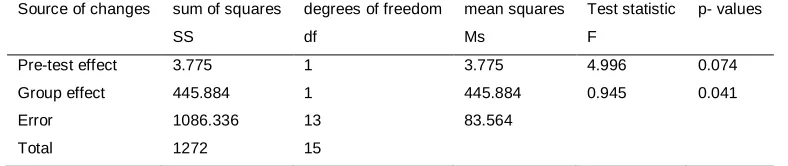
Table 9. Analysis of covariance results of couples’ problem solving ability scores in couples’ impulsivity dimension
Source of changes sum of squares
SS
degrees of freedom
df
mean squares
Ms
Test statistic
F
p- values
Pre-test effect 3.775 1 3.775 4.996 0.074
Group effect 445.884 1 445.884 0.945 0.041
Error 1086.336 13 83.564
Total 1272 15
Table 10. Levene’s test to assess homogeneity of variances of two groups in couples’carelessness
Sig
Level of significance df2
degrees of freedom df1
degrees of freedom F
0.336 10 5 0.23
Table 11. Analysis of covariance results of couples’ problem solving ability scores in couples’ carelessness dimension
Source of changes sum of squares
SS
degrees of freedom df
mean squares Ms
Test statistic F
p-values
Pre-test effect 4.553 1 4.553 3.889 0.009
Group effect 295.846 1 295.846 1.09 0.033
Error 906.338 13 69.72
Total 1207 15
Table 12. Levene’s test to assess homogeneityof variances of two groups in couples’ shunning and avoidance
Sig
Level of significance Df2
Degree of freedom Df1
Degree of freedom F
0.552 13 2 0.288
Table 13. Analysis of covariance results of couples’ problem solving ability scores in couples’ shunning and avoidance dimension
Source of changes sum of squares
SS
degrees of freedom df
mean squares Ms
Test statistic F
p-values
Pre-test effect 3.112 1 3.112 2.776 0.011
Group effect 356.335 1 356.335 0.667 0.028
Error 1022.77 13 78.67
Total 1382 15
DISCUSSION AND CONCLUSION
214
a group or individually. Moreover, they were in accordance with the findings of Davoodi and et al. (2012) who found that solution-focused approach has increased the marital compatibility.
Thus, from the results of the present studyand relevant literature review that were discussed, it can be concluded that solution-focused approach focuses less on problems and more on solutions, so it can help the clients lead to make their relations towards solving problems. In this approach, it is believed that the clients are capable of finding the solutions that can cause their life improvement, but since they don’t know how to use their capabilities, experiences and resources, they will face with difficulties in their life and they need to change their approach to problematic situations. Problem-solving is also a skill that requires training, and it can be said that solution-focused approach is essentiallya training approach.In this study changing attitudes, exception questions, expression changing and miracle questions were taught to the couples. These techniques could help couples to destroy the problems and find possible solutions. As this method does not concern the cause of the problem, and just focuses its attention on innovative solutions to problem-solving, the couples were able to solve the problems and a better relation were made between them. Small changes resulted in bigger changes and could affect the couples’ interaction. In addition, in this research the couples’ problemswere not chronic and deep-seated and also they had an optimum level of education. Finally it can be said that the aforementioned reasons have resulted in the effectiveness of solution-focused approach. According to the findings of the present study, solution-focused couples therapy was effective in couples’problem solving ability and its different dimensions.
This study suggests a range of further research which includes the effect of education and cultural training. To do so, more attention should be paid to these two factors through workshops and doing similar researches with long term follow up periods. In terms of other couples’ education and culture, it is also suggested other studies to be carried out.
REFERENCES
Ahmadi KH. 2008. Family problem solving scale. Institution of Poya Azmonyar.
Ahromian A, Soodani M, and Hosseinpoor M. 2010. The effectiveness of group teaching solution-focused approach in happiness and marital compatability of couple referring to Busher Counseling Centers. Counseling Research and Developments 39:7-29.
Davoodi Z, Etemadi O, Bahrami F, and Shah Siah M. 2012. The effect of short-term solution-focused approach on marital compatibility of men and women who are prone to divorce in Isfahan. Journal of Principles of Mental Health 55:190-203. Dibaeian SH. 2005. The effecttiveness of solution-focuesd therapy in increasing marital satisfaction. Master's thesis, University
of Allameh Tabatabaee,Tehran.
Kurylo MF, Elliot TR, Shewchak RM. 2001. Focus on the family caregiver: A problem solving trainnig intervention. Journal of Counseling and Developments 79:261-275.
Mohammadi N. 2004. The relation of problem solving styles to public health. Journal of Psychology 27, 2-14.
Nasr Esfahani N, Etemadi A, and Shafi Abadi A. 2012. The effectiveness of meaning-focused trainnig in married women's family function. Journal of Counseling and Family Psychotherapy 2:209-221.
Nazari AM. 2004. Investigating and comparing the effect of solution-focused counseling and relationship enrichment program on marital satisfaction of only one spouse working . Doctoral dissertation, University of Teaching Education Tehran.
Nazari AM, and Navabi Nejad Sh. 2006. Investigating the effect of solution-focused counseling on marital satisfaction of dual-career couples. Journal of Counseling Research and Developments 2:57-77.
Nazari AM. 2012.The basis of couples therapy and family therapy. Tehran: Science publishing. Rastgoo MA. 2004. The investigation of problem solving. Tehran: Negah.
Shekohi-Yekta M, and Parand A. 2008. The effect of teaching problem solving techniques to mothers on family relationship. Journal of Family Research 13:5-16.
Soodani M. 2006. Comparing the effectiveness of Ellis cognitive couple therapy and de Shazer solution-focused individual and group therapy in reducing marital conflicts. Doctoral dissertation, University of Allameh Tabatabaee, Tehran.
Soodani M, Shafie-Abadi A, Etemadi A, and Delavar A. 2010. Comparing the effectiveness of de Shazer solution-focused individual and group therapy in reducing marital conflicts. Journal of Educational Psychology Studies 14:39-54.
Treyger S, Ehlers N, Zajicakl and Treppert T. 2008. Helping spouses cope with partners coming out: A solution-focused approach. American Journal of Family Therapy 36:30-47.