A TIBERIAN POTTERY DEPOSIT FROM CORINTH
(PLATES 28-34)
Etl IUrrjqtijv ToV FEwpytov KaXpov
E
XCAVATIONS
in the southwest corner of the Forum at Corinth in the spring of
1976 revealed the northern part of a large Roman building lying just outside the
limits of the Forum, south of the south tower of the West Shops. This building was first
discovered in a test trench in excavations in the spring of 19601 and its late Roman
phases were revealed in 1974 and 1976.2 Excavation of the earlier Roman phases of the
building produced the Tiberian floor deposit discussed here and another large group of
pottery of later date which will be published separately.
The Roman Cellar Building, as this structure is now called, lay immediately to the
west of the north-south road which came from Sikyon and continued towards Acro-
corinth, forming the original western boundary of the Forum. Minor streets bordered
the northern and western sides of the building; it probably continues to the south
beyond the present limits of excavation.
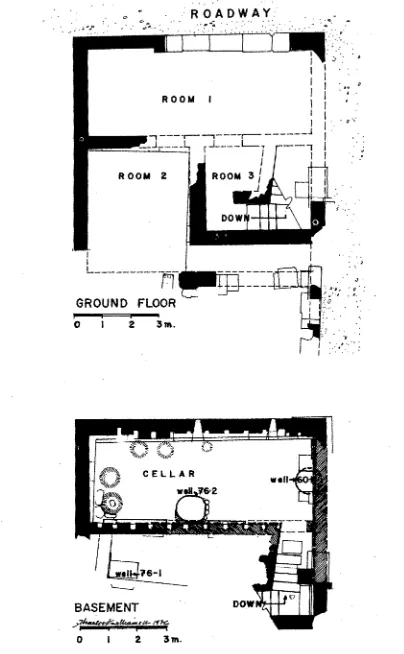
Three rooms of the Roman Cellar Building have been completely excavated (Fig.
1). A deep cellar, which is entered by a stair at. its southeast corner, originally occupied
the northern part of the building for its full east-west width; the ground-floor level of
the room(s) which lay above this can still be established from the cuttings for the
ceiling beams of the cellar and from the preserved threshold by which the building was
originally entered from the north. To the southwest of the cellar lay a smaller, nearly
square room (room 2 in the preliminary report), and here a large group of pottery was
found lying broken on the floor and mixed with the debris of a fallen wall. A threshold
at the southeast corner of the room possibly gave access to the southern part of the
building. The foundation of this threshold is continuous with the wall between rooms 2
1H. S. Robinson, "Excavations at Corinth, 1960," Hesperia 31, 1962, pp. 111-112.
2C. K. Williams, II, and J. E. Fisher, "Corinth 1974: Forum Southwest," Hesperia 44, 1975, pp. 9-10; C. K. Williams, II, "Corinth 1976: Forum Southwest," Hesperia 46, 1977, pp. 41, 58-62.
The sigillata from this deposit formed part of a study of the sigillata and local imitations from the post-War excavations at Corinth submitted to Bryn Mawr College as a doctoral dissertation. I express my gratitude to Charles K. Williams, II, Director of the Corinth Excavations, who offered me the material for publication and did everything possible to facilitate my research, to Nancy Bookidis and Joan Fisher of the Corinth staff who advised me, respectively, on problems of inventory and identified the coins from the deposit, to Richard and Glynnis Jones of the Fitch Laboratory of the British School at Athens who carried out the analyses of the material reported in the Appendix. The final work on the Catalogue was done in Corinth in 1977/1978 while I held the George Kachros Memorial Fellowship from the American School of Classical Studies at Athens. Ioannidou and Bartzioti took the photographs, and the profiles are the work of Diane G. Peck, Marsha Palaima, and Helen H. Townsend.
American School of Classical Studies at Athens is collaborating with JSTOR to digitize, preserve, and extend access to
Hesperia
- * w - ROADWAY:
ROOM I
ROOm 2 ROOM3
---l-- 7r -!
GROUND FLOOR
o 1 2 s3m.
BASEMENT DOW
0 1 2 3mi.
FIG. 1. Plan of the Roman Cellar Building.
and 3 and must belong to the original construction of the building; its condition
suggests that the east-west wall immediately to the south, robbed out in the late Roman
period, was the south wall of room 2. The level of the threshold (+82.536 m.)
establishes the upper limit for the original floor of room 2.
A TIBERIAN
POTTERY
DEPOSIT
137
the room.3 This settling would have been reinforced if, as seems probable, there was
also a doorway in the northeast corner of the room, providing access from the room
over the cellar; traffic through the room would then have compacted the eastern part of
the subfloor layers.
The pottery deposit in room 2 was 0.35/0.40 to 0.57 m. thick (the top had been
unevenly cut away by later Roman construction) and consisted of broken whole pots
and sherds mixed with mud-brick debris; most of the pottery was concentrated in the
lower 0.15 or 0.20 m. of the stratum although joins occurred throughout; some of the
pots were found lying parallel to the floor, others were jumbled at an angle, and the
large Arretine plate (5) lay vertically on edge. Although the mud-brick debris ran
against the west, north and east walls of room 2 and over the southeastern threshold,
few sherds were found in the northern part of the deposit and the concentration of
whole pottery increased toward the south where it terminated at the robbing trench of
the probable south wall of the room. It is therefore probable that the pottery, which had
been stored along the south wall of the room, was thrown to the floor by an earthquake
when the upper, mud-brick wall of the building collapsed on top of it. This interpreta-
tion is supported by evidence for the rebuilding of the west wall of the building at this
time and the partial resetting of the ceiling of the cellar.4
THE FLOOR DEPOSIT
Treatment
of the material
As the pottery deposit was being excavated the excavator noticed that along the
east wall of room 2 one or two sherds of pottery of the 6th century after Christ had
appeared with the pottery-deposit material. An attempt to isolate this late disturbance
was unsuccessful. When the pottery had been mended and was picked up for storage all
baskets which were contaminated with later material were lotted as lot 1976-99 and all
uncontaminated baskets as lot 1976-98. No pottery from this deposit was thrown away
and the contamination appeared only at one point along the east wall of the room.
The criteria for the selection of material to be included in the published catalogue
were the following: 1) All Hellenistic (pre-146
B.C.)pottery was omitted; this consisted
of non-joining single sherds making up one fifth by volume of the material in lots
1976-98 and 1976-99; joins to sherds in the construction fill showed that it derived
from this source (and possibly also from the mud brick). 2) All the complete and nearly
complete pottery was included. 3) Vessels with complete profiles or which were partially
mended from a number of fragments were included unless they duplicated more
3This is clear in the notebook. Because the western floor was thin and discontinuous, and the pottery deposit continued on the eastern side, the excavator continued to excavate the whole room. The western floor and the top of the underlying construction fill were thus removed with the eastern part of the pottery deposit. This explains why no further floor was found in the western part of the room and accounts for fragmentary Hellenistic pottery in the floor deposit lot, a few sherds of which joined to others in the construction fill.
complete material. 4) An attempt was made to include a representative of each ware
present in the deposit. 5) Single sherds were omitted unless called for by 4. 6) Lamps
and glass were selected on the same basis as the pottery, but all the miscellaneous finds
were included except a Classical spindle whorl and a Neolithic celt.5 All of the pieces
presented in the Catalogue come wholly or partly from the uncontaminated lot 1976-98
except 75 and 107. Eleven single sherds which were not inventoried were drawn and
returned to the lot; they are included in the Catalogue. Due to the number of non-
joining fragments it is not possible to state exactly the number of vessels represented; a
sherd count for each ware was made after the major mending had been completed (no
vessel was intentionally counted more than once) and appears after the headings in the
Catalogue.
Coins
The floor deposit produced a number of coins. These were identified and published
by Joan Fisher, Corinth numismatist, in her report on the coins of the 1976 excavation
season.6 A list of these coins is appended here for the reader's convenience.
Lot 1976-98
1976-112 Greek, Boiotian Federal, ca. 244-197
B.C.1976-123 Corinth, Duovir under Augustus, ca. 17
B.C.1976-124 Greek, Sikyon, 4th century
B.C.or later
1976-125 Corinth, Duovir under Augustus, 27
B.C.-A.D.14
1976-127 Greek Imperial, lst-2nd century after Christ
1976-136 Corinth, Duovir under Augustus,
A.D.4/5
1976-137 Greek, Athens, 2nd-Ist century
B.C.1976-138 Corinth, Duovir under Julius Caesar, 49-44
B.C.1976-139 Corinth, Duovir under Augustus, 17
B.C.1976-126 was not a coin; 1976-128 and 1976-129 disintegrated.
Lot 1976-99
1976-99
Greek, Apamea, 133-48
B.C.1976-91 and 1976-100 were not coins.
Catalogue
of Finds: Pottery, Lamps, Glass, and Small Finds
The pottery found in the floor deposit is grouped by wares in the following
Catalogue, with lamps, glass and miscellaneous finds included at the end to give a
complete picture. Substantial quantities of western and eastern sigillata and other wares
are present. The Arretine ware and the lamps provide the best evidence for a date early
in the principate of Tiberius.
5MF-1976-16 and MF-1976-17, respectively.
A TIBERIAN POTTERY DEPOSIT 139
CATALOGUE
In addition to the abbreviations commonly used for Hesperia, the following are employed for the Catalogue and Discussion of the Catalogue:
Agora V H. S. Robinson, The Athenian Agora, V, Pottery of the Roman Period: Chronol- ogy, Princeton 1959.
Antioch IV, i F. 0. Waage, ed., Antioch on-the-Orontes, IV, i, Ceramics and Islamic Coins, Princeton 1948.
Berger L. Berger, Romische Glaser aus Vindonissa, Basel 1960.
Bolsena IV C. Goudineau, Fouilles de l'Ecole franQaise de Rome a Bolsena (Poggio Moscini) 1962-1967, IV, La ceramique aretine lisse (E1cole fran,aise de Rome, Melanges d'archeologie et d'histoire, Suppl. 6), Paris 1968.
Conimbriga IV M. Delgado, F. Mayet, and A. Moutinho de Alar,co, Fouilles de Conimbriga, IV, Les sigillees, Paris 1975.
Corinth IV, ii 0. Broneer, Corinth, IV, ii, Terracotta Lamps, Cambridge, Mass. 1930. Corinth XII G. R. Davidson, Corinth, XII, The Minor Objects, Princeton 1952.
D-W H. Dragendorif and C. Watzinger, Arretinische Reliejkeramik, Reutlingen 1948.
"Haltern" S. Loeschcke, "Keramische Funde in Haltern," Mitteilungen der Altertums- kommission/fir Wes(falen 5, 1909, pp. 101-322.
Hama III, ii A. P. Christensen and C. Friis Johansen, Hama, Fouilles et recherches 1931- 1938, III, ii, Les poteries hellenistiques et les terres sigillees orientales, Copen- hagen 1971.
Hayes, Glass J. W. Hayes, Roman and Pre-Roman Glass in the Royal Ontario Museum, Toronto 1975.
Hayes, Hesperia 42, 1973 J. W. Hayes, "Roman Pottery from the South Stoa at Corinth," Hesperia 42, 1973, pp. 416-470.
Loeschcke, Lampen S. Loeschcke, Lampen aus Vindonissa, Zurich 1919.
Mitsopoulou-Leon V. Mitsopoulou-Leon, "Keramik aus Basilika und Prytaneion-Ein Uber- blick," JOAI 50, 1972-1975, Beiblatt, cols. 495-524.
O-C A. Oxe and H. Comfort, Corpus Vasorum Arretinorum (Antiquitas, 3 ser., 4),
Bonn 1968.
Ostia II F. Berti, A. Carandini, et. al., Ostia II (Studi Miscellanei 16), Rome 1970. Samaria-Sebaste III J. W. Crowfoot, G. M. Crowfoot, and K. M. Kenyon, Samaria-Sebaste, III,
The Objects from Samaria, London 1957.
Tarsus I H. Goldman, ed., Excavations at Gozlu Kule, Tarsus, I, The Hellenistic and Roman Periods, sect. VI: F. F. Jones, "The Pottery," Princeton 1950.
Williams, Hesperia 46, C. K. Williams, II, "Corinth 1976: Forum Southwest," Hesperia 46, 1977, pp.
1977 40-81.
Nota Bene: For Haltern, Goudineau, Samaria, Dragendorff, Broneer, and Isings with type or form numbers see respectively "Haltern", pl. X (= O-C, pl. I); Bolsena IV, Tables recapitulatives des formes, pp. 371-375; Samaria-Sebaste III, figs. 73, 77-82; H. Dragendorif, "Terra Sigillata," BonnJbb 96/97, 1895, pls. I-III; Corinth IV, ii, "Classification," passimn; and C. Isings, Roman Glass from Dated Finds, Groningen 1957.
A TIBERIAN POTTERY DEPOSIT 141
ARRETINE WARE (1-16 plus 60 sherds)7
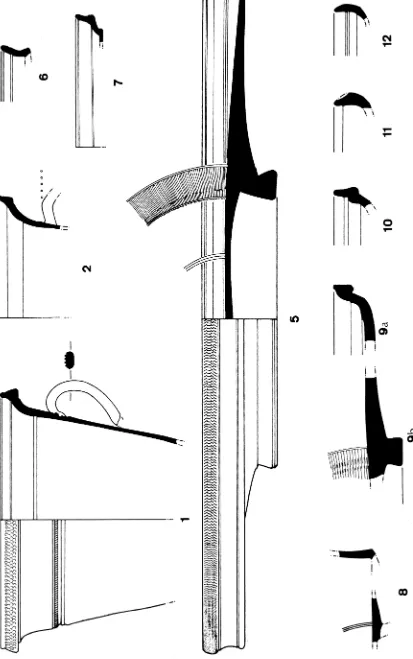
1. Modiolus Fig. 2, P1. 28
C-1976-20 a-e, C-1974-53 (handle). P. H. 0.122, D. rim 0.178. Many fragments of upper wall and rim; non-joining handle fragment found in later stratum.
Modiolus with slightly flaring conical body, overhanging rim and single handle attached to up- per wall. High rim with everted triangular lip has two fascias (the upper one rouletted) separated by a groove; triangular lip rouletted with groove above. Concave molding on interior of lip and groove at mid-point of rim on interior. Grooved vertical strap handle with wavy bifurcating attach- ment above is attached at base of rim, over ovolo. Signature in relief field: :MPEREN: BARGATE, both stamps in a rectangular frame. Relief decora- tion: horizontal wreath of laurel leaves and buds encircles vase; above, horizontal vine stem encir- cles vase with alternating pairs of leaves and bunches of grapes, both with tendrils; at top, double-framed ovolo-and-tongue border below a row of closely spaced bosses. Space for signature was achieved by leaving out one pair from vine group but alternation continues across break. Ten- drils of vine group made by stamping and by manuscript lines. Glaze probably painted onto handle.
Published: Williams, Hesperia 46, 1977, p. 78, no. 34, pl. 12.
For the profile, cf. Bolsena IV, B-2B'-31 and B-2B'-34; for the stamps, O-C 1256; for the ovo- lo, cf. D-W, fig. 1, ovolo 13; for the grapes cf. ibid., pl. 22:277.
2. Modiolus Fig. 2
C-1976-395. Est. D. rim 0.158-0.160 (warped). Six joining fragments of rim and upper handle; non-joining rim fragments in lot; no fragments of relief field.
On exterior two grooves separate relief field from rim; offset below lip, groove near top of lip. Offset concave molding on interior of lip; groove
at mid-point of rim. Grooved vertical strap handle with wavy bifurcating attachment above is at- tached at base of rim. One row of pearl decoration at top of relief field. Warped in firing.
3. Relief fragment P1. 28
C-1976-396. H. 0.047. Single body fragment.
Fragment of upper wall of crater with groove at top of relief field and concave band at same level on interior. Relief decoration: body covered with wide, imbricated leaves. At top of field, row of circular fillers of which a seven-petal rosette with center and two double concentric circles are pre- served adjacent to each other.
Cf. Dragendorif, BonnJbb 96/97, 1895, pls. V:38 and VI:67 by L. Pomponius Pisanus and a Pute- olan potter respectively; D-W, pl. 21:264, assigned to Bargathes also by A. Stenico, Revisione critica delle pubblicazioni sulla ceramica arretina, Milan 1960, no. 1207.
4. Relief fragments P1. 28
C-1976-455 a-c. Three non-joining fragments.
Fragments of relief cup with convex wall sepa- rated by a groove and rouletted half-round mold- ing from plain vertical rim. Relief decoration: low- er zone of vertical nautili placed between lower ends of upper zone of large nautili inclined obliquely to the left. Upper nautili spiral to right at their tops and there is a rosette between each pair of nautili. Schematic leaf band and small narrow ovolo at top of field.
Attributable to Bargathes. Cf. C. Goudineau, "C6ramique ar6tine 'a reliefs de Bolsena," MIl- Rome 80, 1968, p. 179, no. 24, pl. X, which is similar except that the nautili in both registers are spiraling. For the spiraling nautili, cf. D-W, pls. 20:208, 338 (which also has the rosettes) and 21:337; for the straight nautili and possibly the same ovolo, ibid., pl. 21:217.
5. Haltern type 2 Fig. 2, P1. 34
C-1976-22. H. 0.054, D. foot 0.210, D. rim 0.474. Complete profile. About half preserved;
also non-joining fragments in lot. Resting surface and interior of foot not glazed.
Broad trapezoidal foot with recessed interior. Slightly oblique rim with narrow lower and wide upper molding on exterior, defined respectively by a groove above and a groove below; upper mold- ing rouletted. Interior rim has a groove, a narrow fascia, a cyma reversa molding and another groove. Lip flat. Double incised groove and two single grooves on floor, D. 0.086, 0.171 and 0.207 re- spectively; fine linear rouletting between single grooves. Central stamp:
HILARV/SAVFEI
in framed rectangle. Roughened rectangular marks in rouletting on floor indicate where two of the three kiln supports rested.
Published: Williams, Hesperia 46, 1977, p. 78, no. 36, pl. 30.
Cf. Bolsena IV, C-2A-38 which has a simple channel on the interior rather than a cyma reversa.
6. Haltern type 2 Fig. 2
Lot 1976-98:3. Single rim sherd.
7. Haltern type 3 Fig. 2
C-1976-23. P. H. 0.021. Single rim fragment with half of applied spiral handle.
Molding between floor and rim angular on exte- rior. Rim has a constricted band set off by grooves from an upper and a lower molding. Interior quar- ter-round molding offset from the concave rim; groove below lip.
Cf. Conimbriga IV, no. 123 and also the interior profile of no. 99, p. 16, pl. VII.
8. Goudineau form 3 Fig. 2
C-1976-401 a, b. Mended non-joining frag- ments of lower rim and outer floor; non-joining rim fragment in lot. Glaze has an oily luster in indirect light.
From a cup with a ring foot, shallow curving lower wall, vertical concave upper wall, and two vertical handles attached to upper wall. Double groove on floor over (missing) foot, est. D. 0.090. Inside the grooves is a line where another pot rested in firing.
9. Haltern type 1 Fig. 2
C-1976-397 a, b. Est. D. foot 0.220, est. D. rim 0.470-0.480. Fragments of rim, floor and foot; non-joining fragments in lot. Resting surface and interior of foot not glazed. Glaze has oily sheen in indirect light.
Ring foot with wide resting surface, slightly con- tracted above. Rim undercut and with vertical out- er face. Groove at lip. Groove on floor, est. D. 0.210, with fine rouletting towards center of plate. Marks of one curving kiln support over rouletting.
Cf. Bolsena IV, A-2B-8.
10. Haltern type 1 Fig. 2
C-1976-398. Est. D. rim 0.448. Single rim sherd; non-joining floor fragments in both lots.
Rim slightly undercut on exterior with vertical face to lip. On interior, concave band between floor and wall set off by groove from quarter- round molding; above the molding, groove and another concave band below the lip.
Cf. Conimbriga IV, no. 47, pl. IV.
11. Haltern type 4, Goudineau form Fig. 2 19/30
C-1976-399. P. H. 0.028. Single rim sherd, chip missing from exterior.
Rim lunate in section. Shallow offset on interior placed well below lip.
Cf. Bolsena IV, B-2C-85.
12. Haltern type 4 Fig. 2
C-1976-400. Est. D. rim 0.320. Single rim sherd.
Double groove on interior of rim below lip.
13. Haltern type 9 P1. 28
C-1976-402. P. H. 0.032. Single fragment of about one third of cup from foot to lower rim, center of floor missing. Glaze has a pronounced oily luster on both interior and exterior.
A TIBERIAN POTTERY DEPOSIT 143
14. Haltern type 15 Pls. 28, 34
C-1976-25 a, b, C-1976-26. Est. D. foot 0.050, est. D. rim 0.108. Three non-joining fragments of foot and upper wall.
Beveled ring foot. Widely oblique lower wall. Upper wall with convex molding bordered by grooves near mid-point on exterior and concave molding bordered by grooves slightly lower down on interior; exterior molding rouletted. On the interior, floor curves into wall; a groove near base of wall. Groove below lip on exterior. Graffito on interior of foot.
Similar are A. Frova, ed., Scavi di Luni: relazione preliminare di scavo 1970-1971, Rome 1973, CM 2512/3, pl. 63:24; Hayes, Hesperia 42, 1973, p. 431, no. 62, pl. 84 = C-36-1198; and Bolsena IV,
C-2A-60 which lacks the interior molding and the rouletting.
15. Cup base P1. 34
C-1976-403. Est. D. base ring 0.053. Single fragment of one quarter of floor and base ring.
Cup or beaker with low rectangular base ring and horizontal floor. Incised groove on floor, D. 0.040. Central stamp: IEE[ ] in a rectangle.
The stamp is probably one of He(l)enus P. Cor- neli, O-C 509.
16. Stamped fragment P1. 34
C-1976-24. Max. p. dim. 0.056. Two joining floor sherds. Glazed on both sides.
Two incised grooves on floor, D. 0.017 and 0.020. Central stamp; PHILA/AVILL in a rectan- gle.
Published: Williams, Hesperia 46, 1977, p. 78, no. 35.
See O-C 254 a.
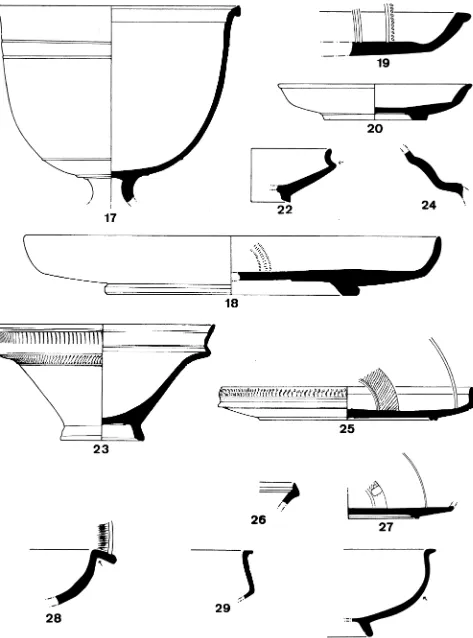
EASTERN SIGILLATA A (17-24 plus 19 sherds) 17. Crater Fig. 3, P1. 28
C-1976-21 a-e. P. H. 0.141, est. D. rim 0.175. Complete profile except pedestal foot; 37 joining and non-joining fragments preserve about one half.
Hollow pedestal foot missing. Rim with everted triangular lip. Interior rim offset from body,
groove below flat, upward inclined surface to lip. Relief decoration: ridge forms a ground line in front of which is a repeated frontal statue of Arte- mis wearing a peplos and her quiver. She stands in a Polykleitan stance, right leg bent, left straight, right arm hanging straight down, left arm bent up close to her side and holding an object; her head is inclined to her left. Between the statues a twisted female figure in a short, frothy chitoniskos dances to the right holding her breasts in both hands. She steps forward with her right foot, her shoulders are twisted to full front and her head is again in profile to the right. Her long hair is tied in a double chignon. Oblique oak(?) leaves be- tween a ridge and a groove form the upper border of the field.
Published: Williams, Hesperia 46, 1977, pp. 77- 78, no. 33, pl. 30.
For the decoration see Antioch IV, i, fig. 22, nos. 10, 16(?), 19, 22, 27-29; for the shape, ibid., no. 485, pl. VI. For other examples of Eastern Sigillata A relief ware in imitation of Arretine cf.
Tarsus I, fig. 156, nos. 693, 694; Hama III, ii, RI, figs. 72, 74-77; and at Corinth, C-36-2301. It is not clear whether the note, A. Stenico, "Ceramica aretina a rilievo della Coll. Pisani-Dossi del Museo de Milano," in Studi in onore di A. Calderini e R. Paribeni III, Milan 1956, pp. 413-414, note 4, refers to another such relief crater or to a Helle- nistic molded relief bowl.
18. Samaria form 1 Fig. 3
C-1976-27. H. 0.043, D. base ring 0.178, D. lip 0.293. Complete profile except center of floor; eleven joining fragments give about five sixths.
Plate with low base ring or foot and oblique convex wall. Interior of base recessed in two de- grees; exterior beveled. Triple circle of rouletting on floor, D. 0.055. Marks of three kiln supports on floor and on resting surface. Wall burned in one place.
For the rim cf. Hama III, ii, no. 1.11, fig. 26; there is no close parallel for the base.
19. Samaria form 5 Fig. 3
20
22
~~~~24
17
18
\~~~~~~~~~~~~~~~ _.
f- 3 28
23
~ ~
~
~
~
~~~3
T--
IN 7- Clw . A - M 1%11 1% 1 1 A T w s - - l I T& % - - - -- -- n %,28
~
~ ~
~
~
~
~~~2
3
~
~ ~
~
~
~~~3
FIG. 3.Estr Sglat A:1-0 22 . Eatr. iilt :2-7 te imote e w re:2-0
A TIBERIAN POTTERY DEPOSIT 145
from lot 1976-110 (fill of stairway to cellar) joined a piece from lot 1976-117 (cellar fill).
Platter or plate with low base ring, convex flar- ing wall and narrow horizontal rim. Band of dot rouletting on floor outside an incised groove, est. D. 0.304. Floor fragment has two double incised grooves, est. D. 0.259 and 0.304 respectively. Sur- face of undersurface of floor cracked in drying. Finger smear of clay on floor on top of glaze.
20. Samaria form 11 Fig. 3
C-1976-28. H. 0.026, D. base 0.075, D. rim 0.138. Complete profile, about three quarters preserved.
Plate or saucer with low beveled base ring, oblique wall, and slightly everted lip. Ridge at edge of interior of base ring. Glaze drips and brush marks near lip.
Cf. Agora V, G9; Samaria-Sebaste III, fig. 79:6; Tarsus I, no. 371, fig. 192.
21. Samaria form 11 P1. 28
C-1976-29. H. 0.024, D. base 0.081, D. rim 0.141. Complete profile, nearly complete.
Same as 20. Step at edge of interior of base. Brush marks visible over entire interior where glaze has worn away: circular on wall and outer part of floor, straight across center.
22. Samaria form 14/23 Fig. 3
C-1976-405 a, b. Est. D. base 0.056, est. D. rim 0.112. Two non-joining fragments allow res- toration of nearly complete profile; center of floor missing; another non-joining rim fragment in lot.
Bowl with ring base, strongly oblique wall, and concave vertical rim. Inward beveled resting sur- face and step at edge of interior of base.
23. Samaria form 23 Fig. 3
C-1976-31. H. 0.081, D. foot 0.061, est. D. rim 0.160. Complete profile, about half preserved.
See Appendix.
Flaring beveled ring foot; interior of foot bev- eled in from resting surface and center of foot in two degrees. Slightly concave wall turning out abruptly to flange at top; everted upper wall rou- letted between grooves. Oblique rim; exterior rou-
letted with groove below lip; two grooves on inte-
rior rim.
Cf. Samaria-Sebaste III, fig. 68:8, but the inte- rior profile of the rim is more rounded and there are single rather than double grooves. For other pieces with the same type of rouletted decoration see Hama III, ii, pp. 168-170, nos. 23.14-23.25, figs. 65, 66.
24. Lid? Fig. 3
C-1976-406. P. H. 0.032. Single fragment, bro- ken all around.
Exterior glazed by dipping; glaze drips on lower interior.
High lid with complex curve. Groove at top of convex member (missing). Offset horizontal flange curving into quarter-round section, fol- lowed by lower edge of concave section.
EASTERN SIGILLATA B (25-27 plus 12 sherds, very fragmentary)
25. Imitation Haltern type 2 Fig. 3, P1. 34
C-1976-32 a, b. H. 0.023, D. base 0.127, D. rim 0.179. Complete profile. Two non-joining frag- ments give half of base to three quarters of rim.
Plate with low base ring with single groove on resting surface. Interior of base has small central depression with nipple. Flat floor curving up at edges to sharp flange and vertical rim, which has a faceted concave band and a rouletted convex band above. Interior rim also concavo-convex, with groove below lip. Triple incised groove at outer edge of undersurface of floor below flange. Dou- ble incised grooves and two single grooves on floor, D. 0.048, 0.075 and 0.156 respectively; rou- letting between inner grooves. Central stamp: HlO/OOY in a rectangle.
Published: Williams, Hesperia 46, 1977, pp. 78- 79, no. 37, pl. 30.
Cf. Hayes, Hesperia 42, 1973, p. 453, no. 135, pl. 86 = C-37-1844; P. Hellstr6m, Labralunda, 11,
gischen Institute I, Vienna 1906, p. 172, no. 39-43; other examples in Corinth: C-35-63, C-36-1185.
26. Plate fragment Fig. 3
Lot 1976-98:10. Single fragment of rim.
Cf. Mitsopoulou-Leon, col. 510, fig. 5:i.
27. Plate fragment Fig. 3, P1. 34
C-1976-33. Est. D. base 0.100. Two joining fragments of base ring and floor, broken all around.
Grooved base ring has heavy step on interior. Undersurface of floor rises slightly, and angle to wall is rather sharp. Double and two single incised grooves on floor, D. 0.042, 0.056 and 0.114 re- spectively; rouletting and radial stamps between double grooves and inner single groove. Central and one (of four) radial stamps preserved:
IATR/OCLI in a rectangle. Partially burned black.
Cf. O-C 1231, 1232 in Greek and Latin. Other examples of this potter in Corinth: C-36-1659 with H and C; C-36-766, C-38-518, and C-75- 153, all Latin. For radial stamping on Eastern Si- gillata B see Mitsopoulou-Leon, col. 510. Possibil- ities for the shape are Heberdey, in Forschungen in Ephesos I, p. 171, no. 28 by the same potter, or Mitsopoulou-Leon, fig. 5:h, or Hayes, Hesperia 42, 1973, p. 453, no. 133, pl. 86 = C-36-2186.
OTHER IMPORTED RED WARES (28-30 plus 1 sherd)
28. Bowl with horizontal rim Fig. 3 C-1976-414 a, b. Est. D. rim 0.29. Two mend- ed non-joining fragments of wall and rim; non- joining body and rim fragments in lot.
Hard, fine, slightly micaceous fabric fired light red (2.5YR 6/8)8 at core, and lighter towards sur- face (7.5YR 7/6). Lustrous red glaze (2.5YR 4/6) varying to dusky red and black (2.5YR 3/2, 2.5YR 2.5/). The wear of the glaze from the outer edge of the rim is characteristic of the fabric.
Open bowl of which the wall curves from nearly horizontal at floor to vertical below rim; upper exterior wall slightly contracted. Broad horizontal
rim rouletted on the inner half; rouletting bor- dered by a broad groove.
For a later version apparently of the same form,
cf. C-74-156 (same fabric) and C-36-1754 (lo- cal) = Hayes, Hesperia 42, 1973, p. 464, no. 212, P1. 91.
29. Bowl with angular carination Fig. 3
C-1976-415. Est. D. rim 0.140. Three joining
fragments preserve profile from below carina- tion to rim and about one quarter of circum- ference; non-joining fragment of same size in lot. Glaze flaking.
Attic? Hard, micaceous, light-red fabric (2.5YR 6/8). Totally glazed; micaceous red glaze (2.5YR 5/6 on exterior, 2.5YR 5/8 on interior).
Bowl with flaring body to angular carination, up- per wall tapering to narrow horizontal rim. Groove at mid-point of upper wall.
30. Bowl with horizontal rim Fig. 3
C-1976-416 a, b. Est. D. foot 0.065, est. D. rim
0.155. Two mended non-joining fragments allow restoration of complete profile except center of floor; non-joining fragments in lot.
Attic? Fabric as 29. Totally glazed; micaceous
red to dark red glaze (2.5YR 4/8 on rim, 2.5YR 3/6 on exterior).
Hemispherical bowl with beveled ring foot. Wall begins to contract below narrow horizontal rim. Burned after breaking.
Cf. Agora V, G65-G67.
GRAY WARES (31-39 plus 2-3 sherds from an- other vessel similar to 31, and about 30 others)
31. Platter with stamped rim P1. 29
C-1976-245 a, b. Est. H. 0.028, est. D. rim
0.640. Two non-joining fragments mended from 10 pieces give nearly complete profile. Twenty- three mended non-joining fragments in lot pre- serve about one quarter.
Light reddish brown fabric (5YR 6/3) with occa-
sional medium-sized lime inclusions and much sil- very mica, lamellar in appearance but with a clean
32
33
35
34
111 (fKWI -- -I (W
41
42
43
/
61
44
46
51
60
67
68
70
72
fracture. Black glaze, dull on exterior, burnished on interior. Cf. 34.
Platter with low, grooved base ring and horizon- tal rim. Rim with half-round molding forming raised lip at top of wall, then two low convex moldings, a faceted band with simplified braid pat- tern, and a widely beveled outer edge with indi- vidually stamped egg-and-dotted-tongue motif.
Cf. Mitsopoulou-Leon, col. 505, fig. 4:d, which is not glazed on the exterior.
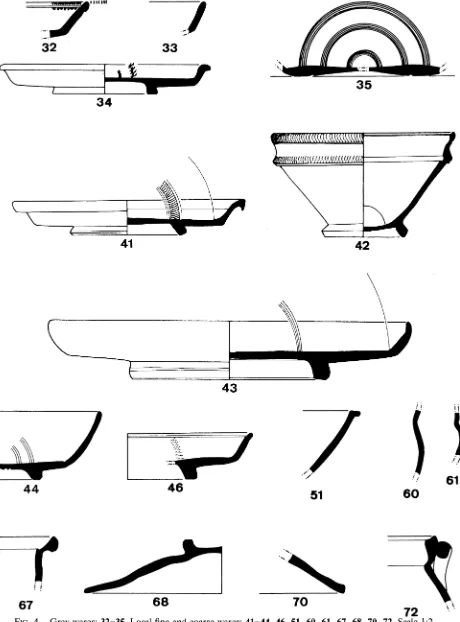
32. Plate Fig. 4
C-1976-417. Est. D. rim 0.29-0.30. Two join- ing fragments of rim to edge of floor. Mended non-joining rim fragment in lot.
Hard and dense but still slightly porous gray fabric (est. IOYR 4.75/1) with a few fine white in- clusions (lime possibly dissolved). Totally glazed; semilustrous gray glaze, slightly streaky and thin- ner on exterior (very dark gray IOYR 3/1 and very dark grayish brown IOYR 3/2).
Plate with oblique wall. Broad groove set well below lip on exterior defines half-round rim. On interior a groove closer to lip. Interior wall flat. Bands of rouletting on outside of lip and above and below interior groove. Interior more carefully smoothed than exterior which shows scratchy fin- ishing marks.
33. Plate Fig. 4
C-1976-418. Est. D. lip 0.236. Single rim frag- ment. Non-joining floor fragment in lot.
Hard, dense, micaceous, light-gray fabric (IOYR 6.5/1) with occasional orange inclusions. Totally glazed(?); semilustrous dark gray glaze (5Y 4/1).
Plate with tapering, horizontal floor and narrow oblique rim with inward rounded lip.
34. Plate Fig. 4
C-1976-42. H. 0.022, D. foot 0.073, D. rim 0.150. Complete profile. Many joining fragments give about one third; one non-joining rim frag- ment in lot.
Slightly splintery, reddish brown fabric (5YR 5/3) with small white inclusions and much silvery mica, fired dark gray at unglazed surfaces (5YR 4/1). Glazed on interior and on exterior rim.
Black glaze (2.5YR N2.5/) lustrous on interior, dull on exterior. Cf. 31.
Small plate with low ring foot and oblique wall to strongly outturned rim. A single and a double row of rouletting on the floor, D. 0.026 and 0.048 respectively. Foot spreading and sharply cut.
35. Plate floor Fig. 4
C-1976-419. D. floor 0.109. Six joining frag- ments give almost complete floor; center of floor and rim missing.
Hard, grayish brown fabric (1OYR 5/2) with mica and a few white inclusions. Interior glazed; lustrous brown to reddish brown glaze (7.5YR 5/2 to 5YR 4/3) with occasional mica.
Concavo-convex base of plate with wide groove just inside resting surface, at point of inflection.
Floor slightly depressed towards rim. Three sets of grooves on floor incised with a multiple point, D. 0.026, 0.061 and 0.093 respectively.
36. Bowl of "Megarian" type P1. 29
C-1976-41 a, b. H. 0.070, est. D. lip 0.160. Complete profile. Two non-joining fragments mended from 11 pieces; two non-joining frag- ments in lot.
Gritty, micaceous, dark gray fabric (5Y 3.5/1) with tiny white inclusions. Totally glazed; flaking, tSin black glaze (2.5Y N2/ to 5Y 2.5/2).
Squat bowl with rounded bottom and lower wall broadly flaring to slightly inturned rim. Exterior rim inset from body by groove. Pointed lip. Relief decoration on exterior: lower wall has three rows of leaves with straight central stalk topped by dot, which spring from the ridge around the plain(?) central medallion. A ridge separates the upper wall decoration, which consists of a row of blob ro- settes between two rows of dots, from the lower body, and another ridge marks this upper border off from the rim. Graffito on exterior rim.
For similar profile and decoration in a related fabric, cf. A. Laumonier, Nlos, XXXI, La cera- mique hellenistique a reliefs, Paris 1977, pls. 131: 9309, 2380 and 134:82.
37. Ovoid pitcher P1. 29
A TIBERIAN POTTERY DEPOSIT 149
just below neck; handle and neck missing. One piece of b added from lot 1976-117.
Soft, gritty, pale brown fabric (IOYR 6/3) with small white and pale orange inclusions. Exterior glazed; micaceous glaze, brown to black (7.5YR 5/4 to 7.5YR N2/).
Ovoid pitcher with low, wide ring foot, maxi- mum diameter just above foot, handle attached to upper shoulder. Double lines of rouletting on shoulder almost form grooves. Lower handle at- tachment just above rouletting.
38. = 59
39. Applique P1. 29
C-1976-422. Single shoulder fragment, broken all around.
Hard, coarse, dark gray fabric (5Y 4/1) with many small white inclusions of two or three kinds and some mica. Exterior glazed, drips on interior; black glaze with slightly metallic luster (7.5YR N2/).
Human figure applique on the tapering shoulder of closed vessel. Male figure moves vigorously to right; flexed left arm extended before him, flexed right arm behind. Shoulders almost frontal. Head in profile shows short hair to eyebrow and ear level, broad diadem or turban. Cursory muscula- ture and features in high relief.
LOCAL FINE AND COARSE WARES (40-72 plus fine:
60 sherds, one third from closed vessels; cooking: at least 27 vessels)
40. Modiolus P1. 29
C-1976-407 a, b. Est. D. lip 0.154. Fourteen joining fragments give about one third of rim and part of upper body; non-joining rim and part of handle (b) added from lot 1976-117; base missing.
Soft, porous orange fabric (5YR 6/6) with mica and fine white inclusions. Thick, non-adherent, micaceous red glaze (between IOR 4/6 and 2.5YR 4/6) with black spots covers interior rim and exte- rior. Cf. 49 and 54.
Vertical upper wall curves into everted triangu- lar rim. Groove on exterior face of rim; shallow
concave band inside lip. Two grooves on exterior wall, 0.070 below lip.
Cf. 1 and C-60-214, a complete example in local fabric published in H. S. Robinson, "A Green-glazed Modiolus from Corinth," in Xaptx- ri7ptoJ E' 'AvaGrTr'atop K. 'OpXa&vov, F', Athens 1965, p. 183 and note 10, pl. LXI:c.
41. Imitation Haltern type 1 Fig. 4, P1. 34
C-1976-35. H. 0.025, D. base 0.076, D. rim 0.168. Complete profile, nineteen joining frag- ments preserve about two thirds.
Totally glazed by dipping from foot. Glaze on floor changes from red through black to yellowish red from stacking in kiln. See Appendix.
Biconically beveled ring base. Angle between undersurface of floor and wall sharp. Groove at lip. Grooves on floor, D. 0.061 and 0.074 respec- tively, with rouletting between them. Central stamp:
CEIEI
in tabella ansata. Graffito on undersurface of floor. Burned after breaking.
For the stamp cf. C-62-6 and CP-2687 = O-C 408 s. For the shape cf. C-62-6 (local) and C-1977-129 (Italian).
42. Imitation Haltern type 8 Fig. 4
C-1976-38. H. 0.075, D. base 0.058, est. D. rim 0.128. Complete profile. Thirteen joining frag- ments give about one third. Non-joining frag- ment in lot.
Spreading beveled ring base. Rim with two rou- letted rounded moldings and a concave band be- tween them; lower molding has deep groove in center; grooves define concave band. Interior pro- file parabolic to groove which sets off rim; rim is convex-concave with groove below the lip. Groove on floor, D. 0.031. Traces of rectangular stamp.
43. Imitation Samaria form 1 Fig. 4, P1. 34
C-1976-34. H. 0.041, D. base ring 0.138, D. lip 0.256. Complete except for small fragment of wall.
floor, D. 0.106. Central stamp: IVLI retrograde in tabella ansata with nails in the four corners. Wedge-shaped double dipping streak. Marks of three, irregularly circular, kiln supports on floor and on resting surface. Burned after breaking.
Duplicate stamp: C-1976-182.
44. Imitation Samaria form 2 Fig. 4 C-1976-30. H. 0.049, D. base 0.065, est. D. lip 0.151. Complete profile. Two joining fragments give complete base and small section of rim. Double-dipping streak; glaze peeled away except from upper wall. Cf. 57. See Appendix.
Double incised groove and inverted cone form center of interior of base. Nearly flat floor articu- lated from curving oblique wall. Two sets of dou- ble grooves on floor, D. 0.038 and 0.056.
45. Imitation Samaria form 10, complete rim in lot 1976-98.
46. Imitation Samaria form 11 Fig. 4 C-1976-408. H. 0.034, D. base 0.088, est. D. rim 0.174. Twelve joining pieces preserve one third to one half; center of floor missing. Glaze badly worn.
Slightly beveled base ring. Groove inside lip. At least three overlapping bands of rouletting on floor over base ring. Finger smears in glaze around base ring and one below rim.
47. Imitation Samaria form 16 P1. 29
C-1976-36. H. 0.074, D. base 0.059, est. D. rim 0.142. Complete profile. Four joining fragments give whole base and about one fifth of rim. Flaring ring base with deep concavity and slight ridge at base of wall; interior of base ring a broad truncated cone. Stacking color change on exterior.
48. Imitation Samaria form 22 P1. 29
C-1976-37. H. 0.055, D. base 0.057, est. D. rim 0.135. Complete profile. Nine joining fragments give whole base and about one quarter of rim. Non-joining fragment in lot.
Totally glazed. See Appendix.
Flaring beveled ring base with step on interior.
49. Imitation Samaria form 22
C-1976-409 a, b. Est. D. rim 0.158. Mended non-joining fragments from outer edge of base
ring to about one quarter of rim. Non-joining frag- ments in lot.
Fabric as 40. Shape as 48.
50. Imitation Samaria form 23 P1. 29
C-1976-39. H. 0.046, D. base 0.037, D. rim 0.085. Complete profile. Single fragment pre- serving about two thirds.
Hard, very pale brown (IOYR 8/3) or white fab- ric (2.5Y 8/2) with abundant tiny voids, small, rounded, dark gray inclusions sparse to moderate in number, and one or two larger white inclu- sions. Very thin glaze, very dark gray (IOYR 3/1) to yellowish red (5YR 4/6), mostly peeled from
interior.
Beveled ring base with wide resting surface; groove marks transition to undersurface of foot which has central nipple. Groove marks junction of base ring and wall. Rim has concave band and groove above.
Cf. Samaria-Sebaste III, fig. 81:6; Antioch IV, i, shape 453m, pl. V; Tarsus I, no. 417, fig. 194.
51. Bowl Fig. 4
C-1976-410. Est. D. rim 0.140-0.150. Two joining fragments from lower wall to rim.
Bowl with ring base formed by pointed bottom of flaring, slightly convex wall and with narrow, flat rim slightly beveled on underside.
For the same shape in Eastern Sigillata B see Hayes, Hesperia 42, 1973, p. 454, no. 154, pl. 87
= C-36-34.
52. Saucer
C-1976-60. H. 0.016, D. rim 0.081. Nearly in- tact.
String-cut base. Curving wall. Rounded lip.
53. Saucer P1. 29
C-1976-61. H 0.016, D. rim 0.088. Complete; rim chipped.
Exterior only partially glazed.
Cf. 52. Wide flaring wall with lip turned slightly
inward.
54. Pitcher or amphora P1. 29
A TIBERIAN POTTERY DEPOSIT 151
shoulder and lower handle attachment. (Two pieces from lot 1976-117.)
Similar to 40. Exterior totally glazed.
Angular pitcher or amphora with ring base, widely oblique lower wall to carination, vertical belly, sloping shoulder above another carination. Shoulder at angle complementary to lower wall. Carination between lower wall and belly sharp- ened by scraping; upper carination more rounded. Lower attachment of vertical strap handle(s) at mid-shoulder.
Cf. CVA, Stuttgart 1 [Germany 261, 71 [12831:6; and see also J. W. Hayes, Roman Pottery
in the Royal Ontario Museum, Toronto 1976, no.
89, p. 20, fig. 5, pi. 11. Both of these are Eastern Sigillata A from which the local example is pre- sumably copied.
55. Pitcher or amphora
C-1976-412. D. base 0.078. Twelve joining fragments preserve about half of base and part of lower body; non-joining wall fragments in lot.
Red glazed to just above base ring; glaze flak-
ing.
Beveled base ring, concave above and with slight offset on interior. Broadly flaring lower wall.
56. Pitcher P1. 30
C-1976-40 a, b. D. base 0.096. Two mended non-joining fragments preserve foot, profile of lower wall and about half of shoulder to edge of neck.
Exterior red glazed except interior of foot; glaze peeling from wall.
Pitcher with flaring ring foot with flat inset inte- rior. Flaring convex wall to angular carination and sloping shoulder, narrow neck. Groove and handle attachment at mid-shoulder. White painted deco- ration on upper half of shoulder: short diagonal lines around neck and below circles alternating with parallel lines in pairs.
57. Pitcher P1. 30
C-1976-454 a, b. Two mended non-joining fragments preserve most of body with profile to upper shoulder and upper neck and lip.
Fabric and glaze as 44; exterior red glazed to just above foot.
Carinated pitcher with ring foot, hemispherical lower body; angular carination marks off concave shoulder curving into neck; neck curves out to thickened rim with horizontal upper surface. Groove above angular carination. Two ribs below
rim.
For the same general shape cf. Agora V, G2, pl. 4.
58. Cylindrical vessel P1. 30
C-1976-413. P. H. 0.086. Two joining frag- ments of wall, broken all around; mended non- joining wall fragment in lot.
Local? Relatively soft, gritty reddish yellow fab- ric (5YR 6/8) with red and dark inclusions. Exte- rior red glazed, smears of glaze on interior.
Cylindrical vessel, probably with open mouth. Wall has pinkish white (7.5YR 8/2 to 7.5YR 8/4) painted decoration of three bands of globular leaves, staggered.
59. (= 38) Pitcher mouth P1. 30
C-1976-420. D. lip 0.085. Nine joining frag- ments give about four fifths of rim, neck and upper wall, handle missing. Glaze worn from exposed edges.
Local. Relatively hard, gritty, light-gray fabric (5Y 7/1) with tiny, white and black inclusions. In- terior of mouth and exterior glazed; glaze crept into edges of handle attachment; very dark gray to black glaze (7.5YR N3/ to 7.5YR N2/).
Pitcher with continuous profile, sloping upper wall, short neck and everted, upward thickened rim, handle attached to underside of rim. Shallow groove on interior emphasizes lip.
Cf. C-65-618, the same form in local red ware.
60. Pink-slipped bowl Fig. 4
C-1976-426 a, b. Two mended non-joining fragments of shoulder and lower rim, broken all around.
Local? Slipped on exterior, glazed on interior. Slip pink (5YR 8/3.5); glaze light red to red de- pending on thickness (2.5YR 6/8 to 2.5YR 5/6).
61. Pink-slipped pitcher Fig. 4
C-1976-427. Single body sherd, broken all around. Slip worn.
Cf. 60. Exterior pink slipped (5YR 8/2 pinkish white).
Belly fragment from a jug with strongly convex, vertical lower wall curving in to a concave band; upper wall only slightly convex, vertical.
62. Pink-slipped pitcher P1. 34
C-1976-428. D. base 0.089. About one half of base, graffito not complete; non-joining frag- ments of body, neck, mouth and handle in lot.
Local? Relatively hard, gritty, reddish yellow fabric (5YR 7/5) with white inclusions, fired much yellower in outer half (nearly lOYR 8/5). Exterior totally slipped except part of interior of base; pink- ish white slip (7.5YR 8/2).
Base of jug with globular body, narrow neck and wide angular mouth. Wide, rounded base ring with narrow groove on resting surface curves in to interior of base. Graffito on interior of base.
For a similar, but smaller, pitcher cf. C. W. Blegen, H. Palmer and R. S. Young, Corinth, XIII, The North Cemetery, Princeton 1964, p. 296, 510-1.
63. Moldmade thymiaterion P1. 30
MF-1976-101 a, b. a: p. H. 0.076, W. at horns 0.086; b: p. H. 0.068. Two mended non-joining fragments preserve part of base edge and back, both ears and horns, lower portion of thymiate- rion bowl.
Local. Hard, reddish yellow fabric (5YR 7/6) fired very pale brown at surface (IOYR 7.5/4) with small dark, white and red inclusions. Traces of pink paint on ears, yellow on horns.
Thymiaterion, of which the body is made in a two-part mold, and the bowl is handmade(?) and added separately. Flat base of thymiaterion open at bottom with a groove around the outside just above the edge. Tufted cow's ears and short curv- ing horns, hair on poll. Plain flaring kalathos be- tween horns. Back plain with round vent-hole and end of signature incised after removal from mold: [ IION. Interior of kalathos discolored by fire.
64. Wheel-thrown thymiaterion P1. 30
C-1976-59. P. H. 0.085, D. rim 0.098. Six join- ing pieces give profile to below flange; foot and part of rim missing.
Local. Fine, relatively soft, reddish yellow fabric (between 5YR 7/6 and 7.5YR 7/6) with few vis- ible inclusions. Traces of white lime slip.
Wheelmade thymiaterion with hollow cylindrical stem foot to heavy horizontal flange; above is the bowl with oblique wall and everted horizontal rim. Cf. Agora V, H15, M74, pls. 8, 21; such vessels are not uncommon in 1st-century contexts at Cor- inth; see also Corinth XII, no. 893, p. 131, pl. 66.
65. Casserole P1. 30
C-1976-67. H. to rim 0.048, est. D. rim 0.220 (slightly warped). Complete profile, one handle missing. Twelve joining fragments preserve al- most one half.
Hard, reddish brown fabric (2.5YR 4/4) fired dark gray near surface and with small white, or- ange and clear inclusions.
Casserole with slightly convex bottom articu- lated from vertical wall, short flanged everted rim with thickened rounded lip, and two horizontal handles. Handles, circular in section, attached to lower wall and pressed lightly against lip. Flange on interior rim relatively high and sharply cut.
66. Casserole P1. 30
C-1976-66. H. to rim 0.060, D. rim 0.237. Complete profile; 17 joining fragments give most of whole, one handle missing.
Local. Hard, loosely compacted, red fabric (2.5YR 5/6) with medium-size oxidized white in- clusions.
Cf. 65. Slightly warped convex bottom. Rim heavy, outward thickened and beveled inward to pointed lip. Interior flange barely articulated. Han- dles, circular in section, attached to underside of rim and pressed against upper rim along most of their length.
67. Casserole rim Fig. 4
Lot 1976-98:1. Single rim fragment.
A TIBERIAN POTTERY DEPOSIT 153
clusions and more angular oxidized white inclu- sions, and a few smaller round gray bits. Exterior surface blackened from rim.
68. Lid Fig. 4
C-1976-65. H. 0.033-0.043, est. D. rim 0.192 (badly warped). Complete profile; about one quarter preserved.
Hard, red to dark gray fabric (2.5YR 5/6, lOYR 4/1) with small to medium-size white and red in- clusions.
Shallow conical lid with slightly everted rim and beveled knob handle deeply hollowed out. Wall has slight compound curve. Interior partly fire blackened.
69. Lid
C-1976-434. H. 0.056, est. D. rim 0.228. Com- plete profile; non-joining rim fragment in lot.
Hard, red fabric (2.5YR 5/6) with many small opaque white inclusions and mica visible on sur- face. Surface fired slightly iridescent reddish brown (2.5YR 5/4) to dull gray.
Cf. 68. Wheel ridges on exterior near knob.
70. Lid Fig. 4
Lot 1976-98:4. Single rim fragment.
Fabric similar to 67, but inclusions larger and more angular.
71. Stew pot P1. 30
C-1976-68. P. H. 0.205, D. rim 0.356. Nearly complete profile; 40 joining fragments preserve about two thirds, part of one handle missing. Restored in plaster.
Local. Hard, loosely compacted, red fabric (2.5YR 5/7) with small to medium-size oxidized white inclusions.
Deep stew pot with curving bottom, bulging body, articulated, slightly convex vertical rim, two horizontal handles attached to upper body and pressed upward against rim. Body slightly sagging. Rim beveled inward from lip. Handles circular in section.
72. Stew-pot rim Fig. 4
Lot 1976-98:7. Single rim fragment.
Cf. 71. Characteristic drying cracks on surface.
IMPORTED COOKING WARES
Pompeian-red Ware (73-75 plus 1 sherd)
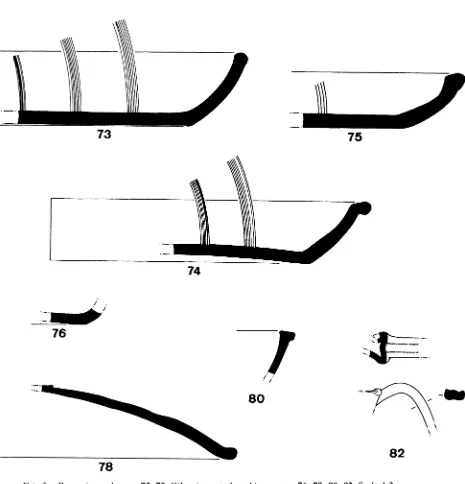
73. Haltern type 75A Fig. 5
C-1976-63. H. T0.053, est. D. base 0.520, est. D. rim 0.590. Outer floor and wall about one quar- ter preserved, center of floor missing; non-join- ing fragments in lot.
Hard, yellowish red fabric (5YR 5/6) with black, dark red and clear sand-size temper and with black and golden mica. Interior and rim slipped and polished; red slip (IOR 4/8) with tiny
silvery mica.
Baking pan with horizontal floor, flaring convex wall and rounded lip. Possibly moldmade. Three sets of grooves incised with a multiple point are preserved on floor; est. D. 0.284, 0.366, 0.445.
74. Haltern type 75B Fig. 5
C-1976-64. H. 0.044, est. D. base 0.370, est. D. rim 0.454. Fourteen joining fragments of rim and floor preserve almost half of circumference; center of floor missing.
Hard, yellowish red fabric (5YR 4/6), finer grained than 73, with opaque white and clear small sand-size temper and white mica. Interior and rim slipped and polished; micaceous red slip (close to lOR 4/8).
Pan with horizontal floor, flaring convex wall and thick, horizontal rim. Possibly moldmade. Two sets of four incised grooves preserved on floor, est. D. 0.226 and 0.294. Two holes drilled for lead repair clamps in rim and wall. Cf. M. Vegas, Ceramica comuin romana del Mediterraneo occidental, Barcelona 1973, p. 49, form 15:7, fig. 16.
75. Pompeian-red-ware plate Fig. 5
C-1976-431 a, b. H. 0.041, est. D. base 0.280, est. D. rim 0.370. Two mended non-joining fragments of outer floor and rim.
73
75
74
._ .
i
~
176 M _
80
/82
78
FIG. 5. Pompeian-red ware: 73-75. Other imported cooking wares: 76, 78, 80, 82. Scale 1:2.
Baking pan similar to 74, but with slightly inward beveled rim. Two sets of grooves incised on floor with a multiple point, est. D. 0.094 and 0.166. Base and lower exterior wall roughly finished.
Other Imported Cooking Wares (76-82)
76. "Orlo bifido" plate fragment Fig. 5
A TIBERIAN POTTERY DEPOSIT 155
Homogeneous light-red fabric (2.5YR 6/8) with abundant, small, rounded black inclusions, a few white and fewer, larger dark red.
77. Frying pan P1. 31
C-1976-433. Est. D. base 0.300, est. D. lip 0.368. Four joining fragments of floor and about one fifth of lip, handle missing.
Hard, coarse, light to dark brownish gray fabric (IOYR 6/2, IOYR 4/2) with mica visible on sur- face. Rounded coarse sand imbedded in base.
Frying pan with horizontal floor, flaring concave wall to rounded lip. Interior wall slightly offset from floor. Burnishing marks on floor cover soot and should be from cleaning.
Cf. S. L. Dyson, Cosa: the Utilitarian Pottery, MAAR XXXIII, Rome 1976, 2211-43, fig. 46; P. Quiri, in NSc 26, 1972, suppl., "Sibari III," no. 309 (PdC 11336), p. 385, figs. 420, 448; Agora V, G113-G115, pls. 7 and 72.
78. Cooking lid Fig. 5
C-1976-432. H. 0.051, est. D. rim 0.345. Near- ly complete profile, 12 joining fragments pre- serve about one fifth.
Hard, light-red fabric (2.5YR 6/8) with mostly small black inclusions, possible golden mica, also lime and quartz or feldspar; same as 76. Exterior surface wet smoothed; weak red (2.5YR 4/2) wash on rim.
Shallow domed lid with outward thickened rim and low ridge near top, est. D. ridge 0.080. Pos- sibly moldmade. Outer 0.041 of interior fire black- ened.
For the general type see Vegas (above, under 74), p. 52, form 16.
79. Olla or jar P1. 31
C-1976-435. Est. D. lip 0.158. Three joining fragments of shoulder and rim preserve about one quarter of rim.
Very hard and dense fabric with small inclusions (mostly white and a few red), fired reddish brown in inner half (2.5YR 5/4), dark gray in outer half (2.5YR N3.5/); color change along sharp line. Lower interior surface almost iridescent.
Globular jar with sloping shoulder and high, in- set neck with sharply everted rim. Neck tapers
slightly. Rim strongly concave on interior to re- ceive lid. Two incised grooves with incised wave pattern between them at top of shoulder. Ridge below rim impressed by hand with piecrust deco- ration.
80. Cooking-pot rim Fig. 5
Lot 1976-98:2. Single rim fragment.
Lamellar red fabric (2.5YR 5/8) with moderate, small, slightly oxidized white inclusions and one or two orange bits.
For the shape cf. Dyson, MAAR XXXIII, PD27-29, fig. 31 and VD-20, fig. 20, identified as skillets.
81. Ovoid pitcher P1. 31
C-1976-436. D. base of neck 0.035, est. max. D. 0.156. Fifteen joining fragments give nearly half of shoulder and part of lower wall, neck broken away at base.
Fine, very hard fabric, light brown (7.5YR 6/4 and yellower and redder) with fine inclusions and a fev coarse black inclusions. Exterior surface covered by a finely micaceous pinkish gray to dark gray wash (7.5YR 6/2 to lOYR 4/1).
Pitcher with ovoid body, maximum diameter at base of broad shoulder, and narrow neck.
82. Pitcher with pinched mouth Fig. 5
Lot 1976-98:11. Mouth and handle mended.
Homogeneous light-red fabric (IOR 6/8) with ti- ny white and dark inclusions, and probable mica; surface fired dark gray.
THIN-WALLED WARES (83-94 plus 62 sherds, 1 with painted decoration)
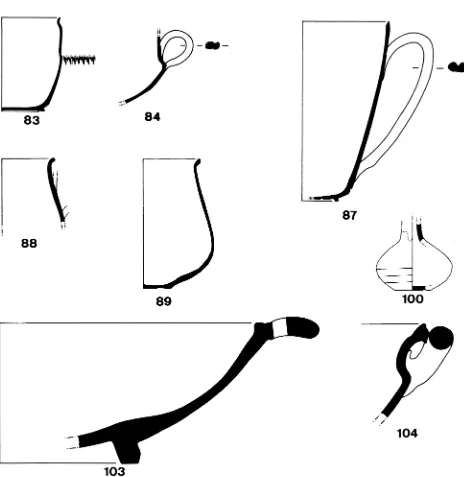
83. Beaker Fig. 6
C-1976-45. H. 0.067, D. base 0.061, est. D. lip 0.078. Complete profile. Fifteen joining frag- ments give most of base, two small sections of rim; non-joining fragments in lot.
3~~~~~~~~h
'
83
84
87
88
89
100
104
103
FIG. 6. Thin-walled wares: 83, 84, 87-89. Miscellaneous wares: 100, 103, 104. Scale 1:2.
Beaker with disk base offset from oblique wall. Tall inset rim with sharp carination between wall and rim on interior. Slightly everted lip defined by broad groove on exterior. Wide band of rouletting at top of exterior wall.