Resource Allocation for Energy E
ffi
ciency in 5G
Wireless Networks
Long D. Nguyen
1 H1Queen’s University Belfast, Belfast BT7 1NN, UK
Abstract
Resource allocation is one important mission in wireless communication systems. In 5G wireless networks, it is essential that the new systems be more dynamic and wiser to simultaneously satisfy various network demands, by using new wireless technologies and approaches. To this end, resource allocation is faced with many significant challenges such as interference alignment, security attacks, or green communication. On the other hand, as one serious problem in 5G networks, the issue of energy is affected directly by the allocated resources in the system, i.e., bandwidth allocation, power control, association allocation, and deployment strategies. Consequently, together with the enhancement of spectral efficiency performance, an emerging trend of 5G wireless networks is to approach green communication via energy efficiency (EE) (bits/Hz/Joule), whose most significant challenge is due to its belonging to the fractional programming in the optimization field, i.e., nonconvex programming. This leaves many difficult tasks for improving network EE performance. In this paper, we will tackle the critical EE in 5G wireless networks.
Keywords: Energy efficiency, nonconvex optimization, resource allocation, 5G networks.
1. Introduction
With the increasing demand for green networking, recently research has been focused on approaches that reduce energy consumption [16, 51, 55]. It is critical to meet the required quality of service (QoS) for all users in the network [53] while managing the amount of utilized energy. In fact, wireless cellular commu-nications may face a significant challenge to satisfy the demand of higher data-rate communications at reduced greenhouse emission [16]. Hence, the energy efficiency (EE) performance is one of the major top-ics and will be attached to green communications in the deployment of 5G technology[16, 32, 51]. Never-theless, the EE maximization problem usually results in a nonconvex program [5]. Specifically, the network energy-efficiency merit is usually defined as the ratio of the total information throughput and the total energy consumption, and thus, the EE maximization problem is introduced under the class of fractional programs [32,49,55] in the field of optimization. To enhance the performance of communication systems, the combina-tion of interference alignment [59], spectrum allocation and energy-efficient management should be necessar-ily considered and implemented simultaneously. This
∗
Long D. Nguyen is with Queen’s University Belfast, Belfast BT7 1NN, UK. Email:[email protected]
leads to the introduction of a hybrid resource manage-ment scheme for the emerging of 5G network archi-tectures, i.e., cognitive relay networks [19, 59], mas-sive multiple-input multiple-output (MIMO), heteroge-neous networks (HetNets), and cell-free. In this paper, we provide and analyse the novel of hybrid resource allocation approaches for improving EE performance in potential 5G network scenarios.
In [39], we study a HetNet which serves multiple user terminals. This work develops a path-following algorithm to handle the computational EE maximiza-tion problem. The proposed algorithm invokes a simply convex quadratic program at each iteration and rapidly converges at least to a locally optimal solution. More-over, the three-objective (EE, QoS and service loading) optimization problem of the joint beamforming design for maximizing EE under QoS requirement and associ-ation SBS service is provided and addressed. In [40], a HetNet scenario with a macro-cell base station (MBS) equipped with a large-scale antenna array (massive MIMO) overlaying a number of small cells maintains high QoS to multiple users under low transmit power budget. The main purpose of this work is to address the downlink beamforming design at the base stations to optimize the network EE under QoS and transmit power budget constraints. Meanwhile, the conventional transmission strategy uses a few hundred antennas for meeting the users’ QoS threshold. More importantly,
Research Article
EAI Endorsed Transactions
on Industrial Networks and Intelligent Systems
Received on 19 February2018, accepted on 03 May 2018, published on 27 June 2018
Copyright © 2018Long D. Nguyen, licensed to EAI. This is an open access article distributed under the terms of the Creative Commons Attribution licence (http://creativecommons.org/licenses/by/3.0/), which permits unlimited use, distribution and reproduction in any medium so long as the original work is properly cited.
we demonstrate that the overall network EE does not increase in the number of BS antennas. In [36, 37], the downlink of a cell-free massive MIMO network has considered for the responsibility of green communica-tions in terms of the total EE. A critical issue, which is proportional to the number of access points (APs), suggest very high power consumption in deploying cell-free networks. To overcome the obstacle, in [37], a path-following power control algorithm using zero-forcing precoding is proposed to maximize the network EE of cell-free massive MIMO under the backhaul power con-sumption and the imperfect channel state information. In [31, 42], we consider the problem of maximizing EE in single-cell and multi-cell massive MIMO under users’ QoS constraints and a limited power budget of transmission. Under such an environment [10,47,54], massive MIMO system provides favorable propagation characteristics and deterministic channels’ eigenvalue distribution behavior. In the earlier work [31], a low-complexity zero-forcing (ZF) beamforming [56,58] is to perform well to serve a smaller number of users with a large array of low-power transmit antennas. In the latter work [42], massive MIMO can schedule its service for serving many users as possible by the fractional time transmission, and thus, a sufficient number of users are served in one of time fractions.
2. Energy efficiency in small cell with user
association
HetNets have recently been considered as a solution for supporting the unprecedented data increase and consistent QoS within the 5G wireless networks [2, 20, 29]. Due to the scarcity of frequency resources and exponential increase of terminal devices in cellular network, the spectrum must be shared between the SBSs and the MBS to serve many users simultaneously [9,46]. As a result, a critical challenge of the alignment intra- and inter-tier interference should be effectively addressed for the successful deployment of HetNets.
On the other hand, due to a serious ecological and economical concern [14], the amount of power con-sumption in hardware and infrastructure significantly increases for operating numerous base stations in Het-nets. As a result, one of most important merit in deploy-ing 5G HetNet systems is the network EE performance in terms of bits per Joule [7,23]. In terms of EE, BSs are the largest energy consumer since they consume not only the power for data transmission, but also the power required to activate radio frequency (RF) circuits of BSs. Therefore, optimizing EE performance for downlink transmission in HetNets has attracted a lot of research interest recently and mixed deployment of HetNets has been shown to have a higher EE. To save the HetNets energy, some actice/sleep regimes for conventional HetNets and massive MIMO HetNets were
1 1.1 1.2 1.3 1.4 1.5 1.6 1.7 1.8 1.9 2
QoS requirement per user, (bps/Hz) 0.5
1 1.5 2 2.5 3 3.5 4 4.5
EE performance, (bps/Hz/W)
Power Minimization Sum-rate Maximization EE-Max with optimal uploading
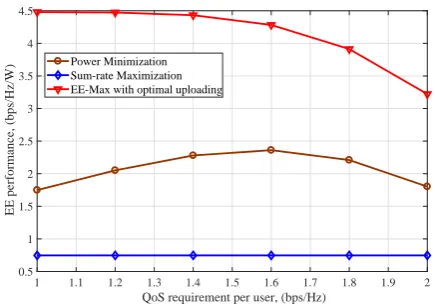
Figure 1. The average EE performance versus per-user QoS threshold. Circle cell structure with radius 250 m is setup
with a MBS equipped with 10 antennas at centrally coverage
network, 4 SBSs equipped with 2 antennas and 14 single-antenna users randomly distributed. Other simulation parameters
are as follows: carrier frequency = 2 GHz, Bandwidth = 10
MHz, transmit power of MBS and SBSs = 43 dBm and 30
dBm, path-loss of MBS and SBS128.1 + 37.6 log10R dB and
140.7 + 36.7 log10R dB (R in km), noise power density−174 dBm/Hz.
proposed in [3,4,28,51]. It is importantly noted that the maximizing EE performance does not try to min-imize the beamformer power since EE merit is a ratio of the network sum-rate and the total power consump-tion. In fact, the beamforming design for the EE must be more complicated than conventional beamforming design with minimizing the beamforming power sub-ject to the users’ QoS throughput (see e.g. [30,57] and references therein).
In our work [38], we use a novel group sparsity of weighted `1-norm corresponding to switching-off SBSs and associated users for joint linear precoder design in EE maximization problem. The Dinkelbach-type algorithms [13] of fractional programming is used as the main approach for obtaining computational solutions of EE maximization [17, 52, 55]. From the considered HetNet scenario in [39], we propose a novel computational algorithm for maximizing EE via a convex quadratic program at each iteration under three-objective (EE, QoS and BS service loading) optimization. Therein, the EE performance is improved, the QoS requirement per user is guaranteed, and service loading refers to the number of served users at BSs is optimized.
In Fig. 1, the EE performance is analysed under the impact of the QoS requirement in a scenario of HetNet with the deployment of one MBS and multiple SBSs. Power minimization, sum-rate maximization and an EE maximization approach with the optimal BS uploading scheme are employed. The EE performance
of the proposed approaches significantly outperforms compared to other schemes. Interestingly, the specific value of Qos requirement of 1.6 bps/Hz is an optimal QoS threshold for power minimization and the EE optimization approach. Also from Fig.1, the sum-rate maximization scheme is not a good approach in terms of EE.
3. Energy Efficiency in small cell and massive
MIMO
Massive MIMO [27, 47] and small cell networks [22] have been visualized as two emerging technologies of 5G communication networks with the promise to provide a 1000-fold increase in network capacity. More importantly, a combination of two technologies, which have attracted considerable research interest [21, 48], will bring enormous benefits by the resonance of the advantages of two systems. In a such scenario, the massive MIMO MBS located at the network center serves macrocell-users (MUEs) while the SBSs serve smallcell-users (SUEs) which are located in the MBS coverage. Normally, the MUEs present users with high mobility and SUEs assign users with static and low mobility. Similar to conventional HetNets, interferences is still a major problem in massive MIMO HetNets which leave many challenges for researchers [12, 15]. However, besides the benefits of massive MIMO, the beamforming design, which involves a large-scale size of beamformer, leads to the dramatically high computational complexity.
On the other hand, EE performance has been designed for 100-fold increase as a requirement in 5G communication systems [8, 25, 60]. However, in massive MIMO HetNets, the use of low power large-scale antennas at MBS and the higher channel gain by SBSs coverage offers better QoS; however, both MBS and SBSs consume a large amount of power including transmission and non-transmission powers, which are proportional to the number of their antennas and the number of SBSs. Unfortunately, the objective EE functions in massive MIMO HetNets [40] may not belong to the classical of fractional programming, i.e., the ratios of concave and convex functions [60]. Therefore, the Dinkelbach’s procedure does not provide an easy way to find its solution for a difficult nonconvex EE optimization problem. To tackle this issue, the separation of beamforming phases for network EE of HetNets were proposed in [18]. In the first phase, the energy-efficient MBS beamforming is implemented with the interference constraint to the SUEs. In the later phase, the energy-efficient SBS beamforming is carried out with ignoring the interference caused by the MBSs. In [45], the nonconvex problem come from each Dinkelbach’s iteration for the SBSs is obtained by D.C. (difference of two convex functions) algorithms
40 50 60 70 80 90 100
Number of MBS antennas 3
3.1 3.2 3.3 3.4 3.5 3.6 3.7 3.8 3.9
EE performance (bits/Joule/Hz)
MZF AZMI+SZF EE-HetNets ZF (Ks=4)
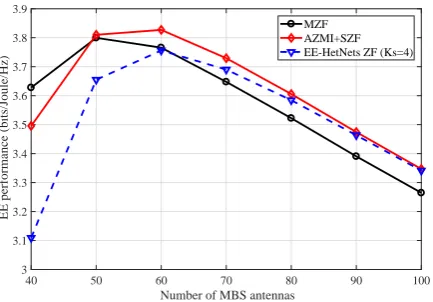
Figure 2. The EE performance versus the number of MBS antennas in a scenario of massive MIMO HetNets. Circle cell structure with radius 1000 m is setup with a centrally located
MBS equipped with large-scale antennas,6SBSs equipped with
4 antennas and>30single-antenna users randomly distributed.
Other simulation parameters are as follows: carrier frequency =
2 GHz, Bandwidth = 10 MHz, MBS and SBSs transmission
power = 46 dBm and 30 dBm, path-loss model of MBS and
SBS 128.1 + 37.6 log10R dB and 140.7 + 36.7 log10R dB
(R in km), noise power density −174 dBm/Hz. The throughput
threshold per user is 4Mbps.
[26] while the interference terms of MUEs must lower than a given threshold. In [40], a massive MIMO HetNet, which provides a large-scale antenna array MBS overlaying multiple small antenna arrays SBSs, serves multiple MUEs and SUEs. The main aim of this work is to design beamformers at both the MBS and SBSs for EE maximization problem under the users’ QoS constraints and power budget. Avoiding the restrict of Dinkelbach’s computationally iterations, we developed some novel path-following computational algorithms which transform the nonconvex problem to a simpler form of convex problem and at least converge to a locally optimal solution. Under different scenarios, simulations in [40] show that the network EE performance significantly enhances by efficient control of the number of the MBS antennas and the deployment of SBSs in massive MIMO HetNets.
60 80 100 120 140 160 180 200 Number of MBS antennas
0.5 1 1.5 2 2.5 3 3.5 4 4.5
EE performance (bits/Joule/Hz)
EE-HetNets with ZF EE-MassiveMIMO with PA EE-MassiveMIMO with EPA
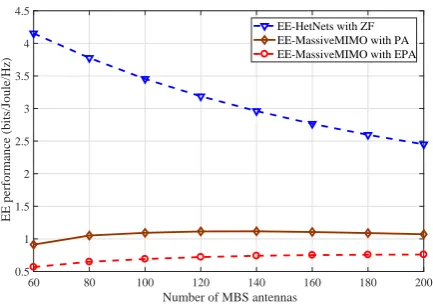
Figure 3. The EE performance versus the total number of antennas in a HetNet scenario. Energy efficiency zero-forcing for HetNets and massive MIMO beamforming are employed. The
throughput threshold per user is4Mbps.
and AZMI+SZF under massive MIMO HetNet scenario is maximum at NM = 50, where their performance gap is clearly visualized. When the number of MBS antennas increases, the performance gap between massive MIMO HetNet beamforming and only HetNet beamforming closes to zero.
Next, instead of only using massive MIMO for maximizing EE performance, using massive MIMO HetNets offers significant benefit for the system EE as shown in Fig. 3. On the other hand, as we can see, the increasing of MBS antennas leads to a degradation of network EE in massive MIMO HetNets. This can be explained as the EE performance of massive MIMO system does not increase in MBS antennas while the power consumption corresponding to antenna number becomes domination, as Fig. 3 shows. In contrast to the conventional spectral efficiency maximization, the overall network EE does not increase when the number of antennas grows up.
4. Energy Efficiency in Cell-free network
Cell-free massive MIMO has been investigated as an emerging 5G technology in the wireless system because of its ability to provide good service to all users [33, 34]. As such system, a numerous low-powered and distributed APs serve a small number of single-antenna users are randomly located in a wide network area [24,34]. In cell-free systems, the inter-cell interference is no longer the main problem that affects the spectral efficiency of wireless networks. Rather, the inter-user interference is a more important role in cell-free [34]. To this end, ZF precoding design is an efficient approach to deal with the term of multiuser interference [37], although the implementation of ZF processing requires a higher complexity than conjugate beamforming [34].
With the existence of massive APs and multiple users in cell-free system, the efficient channel transmission estimation and backhaul control are also necessary for cell-free deployment [24].
When a massive APs number in large-scale networks, EE performance in terms of bits/Joule becomes a major figure-of-merit [36,37] which does not consider in the literature of cell-free networks [24,34]. It is important noted that the strategy of beamforming design is significantly necessary to improve the EE performance because of a huge paramount energy consumption to employ signal processing techniques in cell-free massive MIMO. In fact, the large proportion of used energy is exploited in downlink transmission power at APs, circuits power consumption and the utilized power of backhaul network [11]. In [37], we provide a low-complexity EE maximization procedure using ZF precoding design and MMSE channel estimation under a general scenario of cell-free network. By the benefit of the proposed approach, the EE maximization problem is transformed into a low-complexity power allocation problem under multiple simple constraints. The proposed algorithm only need a few iterations to converge to a locally optimal solution of EE maximization problem.
In Fig.4, we study the impact of the number of access points to the EE performance under imperfect channel estimation (IPCE) in a cell-free system. Maximizing EE approach with and without power control are considered. The power control scheme outperforms the equal power allocation in terms of EE performance for IPCE cases. For the case without power control, the optimal performance can be achieved 20 Mbits/Joule at M= 80 whereas, the optimal performance can be achieved 32 Mbits/Joule at M= 60 for IPCE with the proposed algorithm. As the power consumption critically increases in APs number, although the use of more APs properly enhance spectral efficiency, but does not offer a better EE performance for cell-free network.
5. Energy Efficiency in multi-cell massive MIMO
One of potential 5G communication technology, which can promise high users’ QoS standard, is called massive MIMO [27,47]. With favorable propagation character-istics [47] and deterministic channel behavior [10,54], the low-complexity linear beamforming designs such as conjugate or ZF beamforming are easily performed in massive MIMO [35,56,58]. In our recent work[41], the optimal ZF beamforming for power allocation offers better performance compared to conjugate beamform-ing, meanwhile, these beamformers maintain the users’ QoS under a limited power budget. However, in most of previous works [27, 31, 56, 58], massive MIMO is properly applied to serve smaller numbers of users by a large array of low-power transmit antennas under QoS
4 EAI Endorsed Transactions
on Industrial Networks and Intelligent Systems
40 50 60 70 80 90 100 110 120 Number of access points
12 14 16 18 20 22 24 26 28 30 32
Average EE (Mbits/Joule)
IPCE with power control IPCE without power control
Figure 4. The average EE performance versus the number of
access points. A wrapped around cell structure with1×1 km2
is setup with 16 single-antenna users randomly distributed.
The coefficient models of large-scale fading is as COST Hata
model. The carrier frequency fc= 1.9 GHz, bandwidth B= 20
MHz, τ= 200, maximum transmit power of each AP and user
are 200 and 100 mW. The noise power at the receivers is
N0 = 290×κ×B×N F, where κ and N F are Boltzmann constants and noise figure at 9 dB.
requirement. To support more users, massive MIMO must change its transmission schedule to provide a service-wise for many users. One of the wise strategies is to divide transmission schedule into small fragments within fraction times, and thus, small numbers of users are allocated and arranged to serve in a time fraction [42,43].
On the other hand, the beamforming design for many users usually results in ill-conditioning of the channel matrices in ZF beamforming. To overcome this issue, the regularized zero-forcing (RZF) beamforming is provided [44,56]. The biggest obstacle in employing RZF is that they cannot completely align the inter-user interference and this leads more computational complexity of designing RZF beamforming in massive MIMO. Furthermore, the important issue of massive MIMO is that the closed packed of small space transmit antennas of massive MIMO system creates the antennas’ spatial correlation. As a result, the spatially correlated of large-scale antenna arrays, which causes the lowered rank of the channel matrices, badly affect the spectral efficiency of massive MIMO [1,50].
For discussion of these issues above, in [42], we propose a novel beamforming design for the maximizing EE problem in the multicell massive MIMO. First of all, the network EE performance is defined as the ratio of the total information throughput and the total energy consumption [6, 60]. Secondly, to satisfy users’ QoS requirement and minimize the transmit power, ZF and RZF beamforming design are exploited via new path-following procedures for EE
30 40 50 60 70 80 90
Number of users 1.5
2 2.5 3 3.5 4
EE performance (bits/Joule/Hz)
Conv-ZF (r = 0.4 bps/Hz) Conv-ZF (r = 1 bps/Hz) Beamf with FT (r = 0.4 bps/Hz) Beamf with FT (r = 1 bps/Hz)
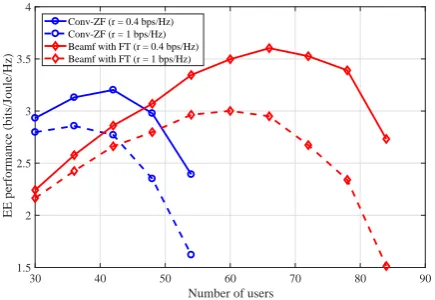
Figure 5. EE performance of a three-cell network versus the number of users per cell. Hexagonal cell structure with radius
1 km is setup with a centrally located BS equipped with
8×8 uniform planar array of antennas. Standard exponential
correlation model is assumed to implement antenna spatial
correlation with correlation factor of 0.9. Other simulation
parameters are as follows: carrier frequency= 2GHz, Bandwidth
= 10 MHz, BS transmission power= 46dBm, path-loss model
128.1 + 37.6 log10R dB (R in km), noise power density -174 dBm/Hz.
maximization problem under practical massive MIMO scenarios. Thirdly, a wise strategy of time-fraction transmission schedule is proposed to serve as many as possible under users’ QoS. This scheme requires the higher complexity of beamforming design which is addressed by a proposed algorithm as shown in [42].
Next, we investigate the EE performance of a multicell massive MIMO system under the impact of the number of users in Fig. 5. ZF beamforming with and without optimal fractional time transmission is employed. As we can see, TF-wise beamforming schemes can serve higher numbers of UEs with higher EE achievement than that for conventional ZF beamforming. In fact, conventional ZF beamformers only can serve up to 54 UEs, meanwhile, TF-wise ZF beamforming is able to serve at least 80 UEs forρ= 0.9 for both QoS standards, i.e., 0.4 and 1 bps/Hz.
6. Conclusions
References
[1] Adhikary, A., Nam, J., Ahn, J. Y. and Caire, G. [2013], ‘Joint spatial division and multiplexing - the large-scale array regime’,IEEE Trans. Inf. Theory59(10), 6441–6463. [2] Andrews, J. [2013], ‘Seven ways that HetNets are a
cellular paradigm shift’,51(3), 136–144.
[3] Bjornson, E., Kountouris, M. and Debbah, M. [2013], Massive MIMO and small cells: improving energy efficiency by optimal soft-cell coordination, in ‘ICT’, pp. 1–5.
[4] Bjornson, E., Sanguinetti, L. and Kountouris, M. [2016], ‘Deploying dense networks for maximal energy efficiency: Small cells meet massive MIMO’,IEEE J. Selec. Areas Commun.34(4), 832–847.
[5] Boyd, S. and Vandenberghe, L. [2004],Convex optimiza-tion, Cambridge university press.
[6] Buzzi, S., I, C.-L., Klein, T. E., Poor, H. V., Yang, C. and Zappone, A. [2016], ‘A survey of energy-efficient techniques for 5G networks and challenges ahead’,IEEE J. Select. Areas Commun.34(4), 697–709.
[7] Cavalcante, R. L. G., Stanczak, S., Schubert, M., Eisenlatter, A. and Turke, U. [2014a], ‘Toward energy-efficienct 5G wireless communications technologies’,
IEEE Signal Process. Magazine13(11), 24–34.
[8] Cavalcante, R., Stanczak, S., Schubert, M., Eisenlatter, A. and Turke, U. [2014b], ‘Toward energy-efficienct 5G wireless communications technologies’,IEEE Signal Process. Mag.13(11), 24–34.
[9] Chandrasekhar, V., Kountouris, M. and Andrews, J. G. [2009], ‘Coverage in multi-antenna two-tier networks’,
IEEE Trans. Wireless Commun.8(10), 5314–5327. [10] Couillet, R. and Debbah, M. [2011], Random Matrix
Methods for Wireless Communications,, Cambridge, U.K.: Cambridge Univ. Press.
[11] Dai, B. and Yu, W. [2016], ‘Energy efficiency of downlink transmission strategies for cloud radio access networks’,
IEEE J. Sel. Areas Commun.34(4), 1037–1050.
[12] Dhillon, H. S., Kountouris, M. and Andrews, J. G. [2013], ‘Downlink MIMO HetNets: modeling, ordering results and performance analysis’,12(10), 5208–5222.
[13] Dinkelbach, W. [1967], ‘On nonlinear fractional pro-gramming’,Management Science13(7), 492–498. [14] Fehske, A., Fettweis, G., Malmodin, J. and Biczok, G.
[2011], ‘The global footprint of mobile communications: The ecological and economic perspective’,IEEE Commun. Mag.49(8), 55–62.
[15] Ghosh et al, A. [2012], ‘Heterogeneous cellular networks: from theory to practice’,IEEE Commun. Mag.50(6), 54– 64.
[16] Hasan, Z., Boostanimehr, H. and Bhargava, V. K. [2011], ‘Green cellular networks: A survey, some research issues and challenges’,IEEE Commun. Surveys Tuts.13(4), 524– 540.
[17] He, S., Huang, Y., Jin, S. and Yang, L. [2013], ‘Coor-dinated beamforming for energy efficient transmission in multicell multiuser systems’, IEEE Trans. Commun. 61(12), 4961–4971.
[18] He, S., Huang, Y., Wang, H., Jin, S. and Yang, L. [2014], ‘Leakage-aware energy-efficient beamforming for heterogeneous multicell multiuser systems’,IEEE J. Sel.
Areas Commun.32(6), 1268–1281.
[19] Hoang, T. M., Duong, T. Q., Suraweera, H. A., Tellambura, C. and Poor, H. V. [2015], ‘Cooperative beamforming and user selection for improving the security of relay-aided systems’, IEEE Transactions on
Communications63(12), 5039–5051.
[20] Hossain, E., Rasti, M., Tabassum, H. and Abdelnasser, A. [2014], ‘Evolution toward 5G multi-tier cellular wireless networks: An interference management perspective’,
21(3), 118–127.
[21] Hoydis, J., Hosseini, K., Brink, S. t. and Debbah, M. [2013], ‘Making smart use of excess antennas: Massive MIMO, small cells, and TDD’, Bell Labs Technical J. 18(2), 5–21.
[22] Hoydis, J., Kobayashi, M. and Debbah, M. [2011], ‘Green small-cell networks’,IEEE Veh. Technol. Mag.6(1), 37–43. [23] I, C., Rowelll, C., Han, S., Xu, Z., Li, G. and Pan, Z. [2014], ‘Toward green and soft: a 5G perspective’,IEEE Commun. Magazine13(2), 66–73.
[24] Interdonato, G., Ngo, H. Q., Larsson, E. G. and Frenger, P. [2016], How much do downlink pilots improve cell-free massive MIMO?,in‘Proc. IEEE GLOBECOM’, pp. 1–7. [25] Isheden, C., Chong, Z., Jorswieck, E. and Fettweis,
G. [2012], ‘Framework for link level energy efficiency optimization with informed transmitter’, IEEE Trans.
Wireless Commun.11(8), 2946–2957.
[26] Kha, H. H., Tuan, H. D. and Nguyen, H. H. [2012], ‘Fast global optimal power allocation in wireless networks by local D.C. programming’,IEEE Trans. Wireless Commun. 11(2), 510–515.
[27] Larsson, E. G., Edfors, O., Tufvesson, F. and Marzetta, T. L. [2014], ‘Massive MIMO for next generation wireless systems’,IEEE Commun. Mag.52(2), 186–195.
[28] Li, J., Bjornson, E., Svensson, T., Eriksson, T. and Debbah, M. [2015], ‘Joint precoding and load balancing optimiza-tion for energy-efficient heterogeneous networks’,IEEE Trans. Wireless Commun.14(10), 5810–5822.
[29] Li, Q., Niu, H., Papathanassiou, A. and Wu, G. [2014], ‘5G network capacity: Key elements and technologies’,
IEEE Veh. Technol. Mag.9(1), 71–78.
[30] Liao, W.-C., Hong, M., Liu, Y.-F. and Luo, Z.-Q. [2014], ‘Base station activation and linear transceiver design for optimal resource management in heterogeneous networks’,62(15), 3939–3952.
[31] Marzetta, T. L. [2010], ‘Noncooperative cellular wireless with unlimited numbers of base station antennas’,IEEE Trans. Wireless Commun.9(11), 3590–3600.
[32] Nasir, A. A., Tuan, H. D., Duong, T. Q. and Poor, H. V. [2017], ‘Secure and energy-efficient beamforming for simultaneous information and energy transfer’, IEEE
Transactions on Wireless Communications 16(11), 7523–
7537.
[33] Nayebi, E., Ashikhmin, A., Marzetta, T. L. and Yang, H. [2015], Cell-free massive MIMO systems, in ‘Proc. 49th Asilomar Conference on Signals, Systems and Computers’, pp. 695–699.
[34] Ngo, H., Ashikhmin, A., Yang, H., Larsson, E. and Marzetta, T. [2015 (in press)], ‘Cell-free massive MIMO versus small cells’, IEEE Trans. on Wireless Commun. PP(99), 1–1.
[35] Ngo, H. Q., Larsson, E. G. and Marzetta, T. L. [2013], ‘Energy and spectral efficiency of very large multiuser MIMO systems’,61(4), 1436–1449.
[36] Ngo, H. Q., Tran, L. N., Duong, T. Q., Matthaiou, M. and Larsson, E. G. [2017], ‘On the total energy efficiency of cell-free massive mimo’,IEEE Trans. on Green Commun. and NetworkingPP(99), 1–1.
[37] Nguyen, L. D., Duong, T. Q., Ngo, H. Q. and Tourki, K. [2017], ‘Energy efficiency in cell-free massive mimo with zero-forcing precoding design’, IEEE Communications Letters21(8), 1871–1874.
[38] Nguyen, L. D., Duong, T. Q., Nguyen, D. N. and Tran, L. N. [2016], Energy efficiency maximization for heterogeneous networks: A joint linear precoder design and small-cell switching-off approach, in ‘Proc. IEEE GlobalSIP 2016’, pp. 718–722.
[39] Nguyen, L. D., Tuan, H. D. and Duong, T. Q. [2016], ‘Energy-efficient signalling in qos constrained heterogeneous networks’,IEEE Access4, 7958–7966. [40] Nguyen, L. D., Tuan, H. D., Duong, T. Q., Dobre, O. A.
and Poor, H. V. [2017], ‘Downlink beamforming for energy-efficient heterogeneous networks with massive mimo and small cells’, IEEE Trans. Wirel. Commun. (under review).
[41] Nguyen, L. D., Tuan, H. D., Duong, T. Q. and Poor, H. V. [2017a], Beamforming and power allocation for energy-efficient massive MIMO, in ‘Proc. 22nd Inter. Conf. Digital Signal Process. (DSP2017)’, p. 105. [42] Nguyen, L. D., Tuan, H. D., Duong, T. Q. and Poor,
H. V. [2017b], ‘Multi-cell massive mimo beamforming in assuring qos for large numbers of users’,arXiv preprint arXiv:1712.03548.
[43] Nguyen, V. D., Tuan, H. D., Duong, T. Q., Shin, O. S. and Poor, H. V. [2017], ‘Joint fractional time allocation and beamforming for downlink multiuser miso systems’,
IEEE Commun. Lett.21(12), 2650–2653.
[44] Peel, C. B., Hochwald, B. M. and Swindlerhurst, A. L. [2005], ‘A vector-perturbation technique for near capacity multiantenna multiuser communication-part i: channel inversion and regularization’, IEEE Trans.
Commun.53(1), 195–202.
[45] Ramamonjison, R. and Bhargava, V. K. [2015], ‘Energy efficiency maximization framework in cognitive down-link two-tier networks’, IEEE Trans. Wireless Commun. 14(3), 1468–1479.
[46] Rihan, M., Elsabrouty, M., Muta, O. and Fumkawa, H. [2014], Iterative interference alignment in macrocell-femtocell networks: A cognitive radio approach,in‘Proc. Int. Symp. on Wireless Commun. System (ISWCS)’, pp. 654–658.
[47] Rusek et al, F. [2013], ‘Scaling up MIMO: opportunities and challenges with very large arrays’, IEEE Signal
Process. Mag.30(1), 40–60.
[48] Sanguinetti, L., Moustakas, A. L. and Debbah, M. [2015], ‘Interference management in 5G reverse TDD HetNets with wireless backhaul: a large system analysis’,IEEE J. Sel. Areas Commun.33(6), 1187–1200.
[49] Sheng, Z., Tuan, H. D., Duong, T. Q. and Poor, H. V. [2017], ‘Joint power allocation and beamform-ing for energy-efficient two-way multi-relay communi-cations’, IEEE Transactions on Wireless Communications 16(10), 6660–6671.
[50] Shiu, D.-S., Foschini, G. J., Gans, M. J. and Kahn, J. M. [2000], ‘Fading correlation and its effect on the capacity of multielement antenna systems’,IEEE Trans. Commun. 48(3), 502–513.
[51] Soh, Y. S., Quek, T. Q., Kountouris, M. and Shin, H. [2013], ‘Energy efficient heterogeneous cellular networks’,31(5), 840–850.
[52] Tervo, O., Tran, L.-N. and Juntti, M. [2015], ‘Opti-mal energy-efficient transmit beamforming for multi-user MISO downlink’, IEEE Trans. Signal Process. 63(20), 5574–5588.
[53] Tran, H., Duong, T. Q. and Zepernick, H. J. [2010], Average waiting time of packets with different priorities in cognitive radio networks,in‘IEEE 5th International Symposium on Wireless Pervasive Computing 2010’, pp. 122–127.
[54] Tulino, A. M. and Verdu, S. [2004], Random Matrix Theory and Wireless Communications., Delft, The Nether-lands: Now Publishers Inc.
[55] Vu, Q.-D., Tran, L.-N., Farrell, R. and Hong, E.-K. [2016], ‘Energy-efficient zero-forcing precoding design for small-cell networks’,64(2), 790–804.
[56] Wagner, S., Couillet, R., Debbah, M. and Slock, D. T. M. [2012], ‘Large system analysis of linear precoding in correlated MISO broadcast channels under limited feedback’,IEEE Trans. Inf. Theory58(7), 4509–4537. [57] Xu, Z., Yang, C., Li, G. Y., Liu, Y. and Xu, S. [2014],
‘Energy-efficient comp precoding in heterogeneous networks’,62(4), 1005–1017.
[58] Yang, H. and Marzetta, T. L. [2013], ‘Performance of conjugate and zero-forcing beamforming in large-scale antenna systems’, IEEE J. Selected Areas in Commun. 31(2), 172–179.
[59] Yeoh, P. L., Elkashlan, M., Duong, T. Q., Yang, N. and da Costa, D. B. [2014], ‘Transmit antenna selection for interference management in cognitive relay networks’,
IEEE Trans. Veh. Technol.63(7), 3250–3262.