Research and trends in the studies of Collective
Intelligence from 2012 to 2015
Francisca Grimon
1, Jaime Meza
2,*, Monica Vaca-Cardenas
3and
Jose M. Monguet
21 University of Carabobo, Valencia-Venezuela 2
Polytechnic University of Catalonia, Barcelona-Spain
3 Kansas State University, Manhattan, Kansas, USA
Abstract
The interaction between groups of people and machines supports the transfer of knowledge and strengthen Collective Intelligence (CI) making it robust. The CI with the support of technology progresses through platforms and computer systems including ontology, clusters, agents, Web intelligence among others. This research consists of a content analysis of recent studies 2012-2015 on CI. After an extensive search of publications on electronic databases, two hundred and fifteen papers were selected and exposed in a document's analysis following the approach of Zott. In this research we identified three categories to consider: Learning, technology and decision-making. The analysis revealed that CI is strongly related with technology, supporting the processes of training people and promoting collaborative learning as a new form of literacy.
Keywords: Collective intelligence, teaching/learning strategies, computing, domain, knowledge, decision-making.
Received on 14 January 2017, accepted on 06 June 2017, published on 26 July 2017
Copyright © 2017 Francisca Grimon et al., licensed to EAI. This is an open access article distributed under the terms of the Creative Commons Attribution licence (http://creativecommons.org/licenses/by/3.0/), which permits unlimited use, distribution and reproduction in any medium so long as the original work is properly cited.
doi: 10.4108/eai.26-7-2017.152905
*Corresponding author. Email:[email protected]
1. Introduction
The scientific communication is the main practice of discussion into the research community. It allows the generation of knowledge and progress of societies. CI has been investigated for several years, is currently taking momentum with the use of technologies that impressively supports collaboration between individuals. Between 2012 and 2015 there have been published in scientific journals several papers related to CI.
CI encompasses a variety of domains, interaction and collaboration within groups in order to perform a variety of works, like sharing knowledge and strengthening decision-making in problem solving [22].
CI has been defined with different approaches. A recent definition understands CI, as “a set of intelligent units like experts, agent systems, or simply set individuals which are autonomous in making decisions” [44]. For [41] CI “is a
group/shared intelligence that emerges from the collaboration and competition of many entities, either human or digital”. According to [77] CI can be considered “a new emerging feature of communities in order to connecting human beings and a new contribution to the acquisition and production of knowledge.” Finally, [52] defines “Collective Intelligence (CI) as “an active field of research, which capitalizes the knowledge of human collectives in order to create, to innovate and to invent.”
Classical definitions of CI include [53], “Collective intelligence (CI) is the capacity of human collectives to engage in intellectual cooperation in order to create, innovate and invent”. According to [78] “defined very broadly as groups of individuals doing things collectively that seem intelligent.”
Other authors agree in indicating that CI is present in various domains. Here we reference some of them: [64] indicated CI will impact the different domains of science, also [25] pointed out that in the scientific literature raised the definition of the CI in several domains. Further, [61] referenced in [17] reported that the CI is a field
multidisciplinary. Researches and studies in several domains as sociology, psychology, analysis of social networks, biology, economy and in general in behaviour of masses have been developed.
1.1. Domain education
CI has an enormous potential in the domain of education [52],[22]. Some authors have investigated CI in the domain of education are presented in Table1:
Table 1. Domain education using CI
Description Author(s)
Materials
Teachers and students creating knowledge, educational materials or curricula and assessment materials among others.
[66]
Improvement of the learning process
Dynamic aspects of the process of teaching and learning using technology.
[23]
Examples
Use of student data to support decision-making and collaboration.
[22]
Use of social media technologies (SMTs) for learning, exploring whether SMTs lead to the production of forms of CI.
[79]
Expressing the interactive nature of m-learning.
[47] referenced by [30] E-learning 4.0 can be supported by the CI. [30] This interaction allows students to create
and share knowledge, Moore called it CI and Kowitz and Smith indicated that shared learning is the most advanced form of instructional process.
[14]
1.2. Domain computing
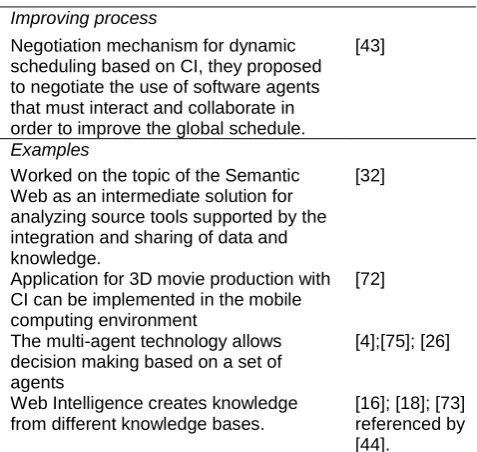
CI impacts on the models in computer science [45], and it emphasizes the areas of computing including data management of heterogeneous groups [49]. Computing services (science and engineering) have grown in the past 10 years thanks to CI since it has improved the quality of these services [38]. Table no. 2 shows some authors that refer to the domain of computing using CI:
Table 2. Domain computing using CI
Description Author(s)
Computational intelligence technologies
Such as consensus theory, fuzzy systems, neural systems, evolutionary computation and others can support CI.
[80]
Improving process
Negotiation mechanism for dynamic scheduling based on CI, they proposed to negotiate the use of software agents that must interact and collaborate in order to improve the global schedule.
[43]
Examples
Worked on the topic of the Semantic Web as an intermediate solution for analyzing source tools supported by the integration and sharing of data and knowledge.
[32]
Application for 3D movie production with CI can be implemented in the mobile computing environment
[72]
The multi-agent technology allows decision making based on a set of agents
[4];[75]; [26]
Web Intelligence creates knowledge from different knowledge bases.
[16]; [18]; [73] referenced by [44].
1.3. Domain social sciences
CI is in the social sciences [65], and it provides tools to support organizations. Commercial enterprises, government, military institutions, and civic organizations use CI processes [21].
Table no. 3 shows some authors that refer to the domain of Social Sciences using CI:
Table 3. Domain Social Sciences using CI
Description Author(s)
Organizations
The interaction among members of an organization moves from one set of people related to a highly cohesive team that the author defines as collective intelligence, seeking to improve all types of
organizations and working environment.
[68]
Improving process
Aims to improve the management process of the quality of IT services, CI has a mechanism for increasing human knowledge with digital knowledge from enterprise data sources, which provides a greater understanding of the company.
[69]
Examples
The Wiki is an instance of online CI. The most widely implemented and largest libraries (Wikipedia) have used Wiki.
[40]
The PolicyGrid project research the role of Grid, Web 2.0 technologies and Semantic Web to support e-Social Science
[13]
The platform, developed in open source, includes conventional and unconventional data to be shared between users of a social network, allows Apps to create
Intelligence
Political participation via social media: A case study of deliberative quality in the public online budgeting process of Frankfurt/Main, Germany 2013.
[81]
The research among several groups: workers, students, friends, etc., outlines collaboration to achieve collective intelligence
[51]
1.4. Others domain
Other domains applying CI are: Tourism and Travel [71], agriculture projects [70], health reported by [8] who
designed a system to take advantage of the CI from students, teachers, professionals, institutions and clients who are interested in this field. Additionally, the research of [25] reports that it can be useful for systems of diagnosis with the aim to create new schemes for the acquisition of knowledge.
Finally, [48] includes other examples of CI in various domains such as: Computer & science, biology, political scientists, economy, history, sociology, organizational theorists, anthropology and psychology.
1.4. Decision-Making
In the domain of education CI can be used to assess student progress and improve making [52]. In the decision-making groups, these are given by the consensus, according [39]; [50]. Also, a research by [25] based on "Knowledge Acquisition for Medical Diagnosis Using Collective Intelligence"; it explains the scheme to collect information for diagnostic methods based on CI and consensus. In the investigation of [82] propose multi-agents for capture of decisions making, exploiting based modelling system and Web-based methodologies in the field of Software. In future works, they will continue investigating on new models of capture of decisions with the blended of the CI and the agents. [46] reported a prototype to supervise students in the process of brainstorming topics and to measure results and interactions in real-time. [55] reported consensus processes in large scale decision making under uncertainty groups, which incorporates the use of aggregation operators.
We hope that the current study contributes to CI and increase understanding about current trends in it; we conducted a content analysis of published papers on the subject.
The rest of this paper is organized as follows: Section 2 contains the methods, referring to the analysis of content in selected research papers; Section 3 contains the results of the selected research papers reviewed and coded according to the method; Section 4 contains some concluding remarks and road map for future research and Section 5 contains some limitations.
2. Methods
Analyses of content published in scientific journals allows to assess the level of development of a particular discipline and to appreciate its research trends [29], [6]. According to [33], content analysis is a method that separate large amounts of information regarding specific purposes. The content analysis involves comparing, contrasting, and categorizing a set of data. [36] used a classification method to analyze collections of papers. According to [62] content analysis has proven to be an effective research method; they also referenced the following authors: [58] in distance education, [59] in educational technology and [67] in science education. Finally, [28] has used the method in the investigation into blended learning in higher education.
Content analysis was selected because its potential to classify text material [5]. The literature exemplifies content analysis as a methodology for analyzing and observing the trends of published articles in journals [54].
2.1. Data collection
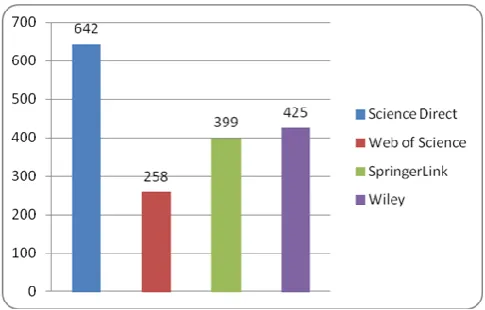
The selection of papers regarding to the literature of CI were done in: Science Direct, Web of Science, SpringerLink and Wiley. The searches for the CI were limited to articles in journals, full-text, all language and all sciences. The term of "collective intelligence" was used in all parts of the article, and it locates a total of 1724 papers published from 2012 to 2015. (Figure1).
Figure 1. . Distribution of papers in Bibliographic Databases. Term: “collective intelligence” in entire
contents. (2012 to 2015)
According to [11] the title of a scientific article describes with few words the content of this article, and the abstract can be considered a miniature version of the article. In addition, the American National Standards Institute
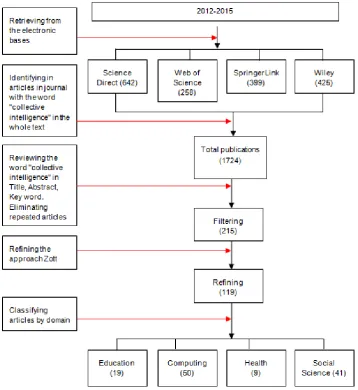
Refining the search with the term "collective intelligence" appearing in keyword, title or abstract the previous 1724 papers were limited to a set of 215.
Next, the set of papers were refined again following the approach of [74] in order to limiting the final list of papers. Over this final list a content analysis was implemented to interpret the contents of the papers classifying and/or encoding the various elements of text in categories [20].
Following [74] the final inclusion criteria of papers are based on the fact that the issue of CI is addressed on a nontrivial manner.
It is the focus of the paper and usually appears in the title.
It appears at least in two of three: title, abstract and key words
It appears in the abstract, in the keywords, and it is clear that the paper is a contribution to IC
At the end, a final list of 119 papers resulted as relevant and was analyzed for this research. Appendix A shows the list of reviewed articles. The Figure 2 shows the scheme followed for the selection of the items.
Figure 2. Scheme followed for the selection of the articles
2.2. Analysis
To perform content analysis, categories must be established according to the focus of each particular research. Categories are intended to group together sets of pieces of
Table 4. Category
Clue Category Words
C1 Learning learning, e-learning, u-learning, b-learning, training, knowledge, teaching, formation, education, pedagogy, pedagogical instruction C2 Technology technology platform, system,
Web, tools, software, ICT, authoring tool, computing C3
Decision-making
decision-making methods, Delphi, consensus, models
3. Results and discussions
The results of the research are presented in different subsections:
3.1. Domains of the research
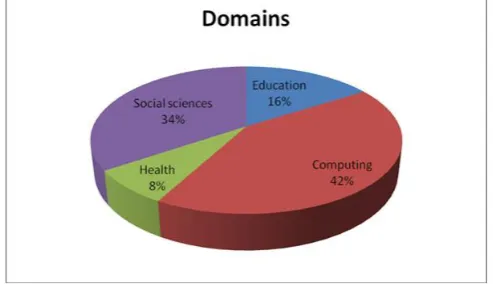
Nowadays, CI is developing in diverse domains, all the 119 papers have been assigned to one of these areas, and when the scope of the paper was more than one, the main was selected. The Figure 3 shows the different domains discussed in the literature in the period 2012-2015.
Figure 3. Different domains (2012-2015)
The computing domain has the highest value. This may be due in part according to [83] symbiosis between computers and humans are the key to a potential of technologies and high impact services designed to enhance the capabilities of human beings to solve problems. Combining ICT knowledge and skills can improve and solve global problems. [53] indicates that the technologies provide powerful tools for increasing cognitive processes of personal and collective way, the processes of CI can be multiplied by digital networks. Additionally, [48] indicates that we must understand that the CI depends on the integration and combination of humans and machines, organizations and networks.
3.2. Category
The frequency of the categories previously defined in table 4 and their associated words are shown in Figure 4
Figure 4. Category and Frequency
3.2.1. Collective Intelligence and learning
Knowledge and CI have been several investigations. [57] applied a CI framework to characterize education in the context of a web based tool for teachers, called Instructional Architect (IA). It allows teachers to find, create and share instructional activities for students using online learning resources. [25] presented a research entitled "Knowledge Acquisition for Medical Diagnosis Using Collective Intelligence", it indicates that using the wisdom of crowds can get new biomedical knowledge. These researchers exhibit a scheme to collect diagnostic information Diagnosis Decision Support Systems; they are based on consensus and CI.
[37] proposed CorpWiki, self-regulation of the wiki system, it allows the acquisition of high-quality knowledge. This will develop CI organizations make efficient use of the intelligence of its employees and the facilities provided by technology, such as Web 2.0. That way you can create and evaluate knowledge that is timely and assured quality.
Regarding to learning, [12] referenced [63] reported online communities that provide a learning space to build CI. They are communities where each member has the potential to contribute and participate in the discussions, which increases the possibility to solve complex problems. Moreover in the field of education and the use of technologies, [66] reported in his article that Web 2.0 provides a framework for education on the Web, allowing students to experience CI and creativity.
displaying other content. Also, the use of software tools enhances the IC, both in the generation of knowledge and the administrative aspect of education.
3.2.2. Collective Intelligence and technology
In research literature linking CI and technology investigations are published in the scientific literature. [84] proposed in their research a framework of CI based narrative reasoning and natural language processing. It exhibits a hybrid model that combines the Narrative Knowledge Representation Language (NKRL) and HARMS (Humans, software Agents, Robots, Machines and Sensors).
Others researches includes the Web.[76] reported a project called "Open Geometry Textbook" whose objective was to develop a web-based platform to gain knowledge on the subject of geometry and create a textbook through CI involving Internet users. According to [28] Semantic Web aims to exchange structured information and formal knowledge to achieve CI on the Web. The Semantic Web enables the distribution of data and interconnection to provide information to users. It also allows the sharing of knowledge, collaboration and cooperation.
Technological systems with Web 2.0 evolve in e-learning and the CI is strengthens. In the investigation of [27] proposed an adaptive learning system centred on the user based on the CI of users and employs item response theory. The results indicate that students are more satisfied and learn efficiently. In the publication of [60] reported the effects of application of information technologies and communication ICT from the perspective of the CI. They refer to the CI, as the exchange of information through specific tools.
Regarding to technological tools several are described in scientific databases, including [8] entitled "Aprendis: a tool for formal learning in Health Informatics", which aims to harness the CI of professionals, students, teachers, clients and institutions interested in the area of Health Informatics, specifically the Portuguese-speaking community.
Finally, [19] indicates that CI arises from the following: 1) data, information, knowledge; 2) software, hardware and; 3) experts and stake-holders which produce knowledge through their input and feedback from them.CI must rely on systems and software tools to develop new collective knowledge. Human and computer tools must be integrated into all domains of knowledge allowing the development of CI.
3.2.3. Collective Intelligence and decision-making
According to several authors, CI appears in a variety of forms of collective knowledge, and it is the result of consensus decision-making in different processes [44]. Investigation of [25] lets you collect diagnostic information
Diagnosis Decision Support Systems methods based on consensus and CI, the objective of the research was to apply the CI to share medical knowledge and build a knowledge base on using consensus methods, achieving results make better medical diagnosis.
[19] created an information system to support the Egyptian Academy of Scientific Research and Technology, in the Millennium Project The system organizes information from experts, scientists, leaders and the general public, aided by the software. It improves decision-making, civic participation and social cohesion.
According to [52] the objective of recommendation systems is to support the decision-making process of the user. They propose in their research use the CI and recommendation systems to improve decision-making.
The objective of recommendation systems is to support the decision-making process of the user. [52] propose in their research to use the CI and recommendation systems to improve decision-making.
Research in the area of CI is opening opportunities for research in the area of decision-making. The literature indicates the need to make quick decisions, to deal with this situation, it is better to use new models and tools incorporating IC.
4. Conclusions
This article provided a diagnosis of CI research in journals during the period 2012-2015. Reviewed the papers and made the analysis from each article, we have the following conclusions:
Researchers can locate a variety of peer reviewed scientific documentation, taking the problem to handle a large wealth of information. To resolve this problem there are methods and techniques, for example the analysis of content [15]. It appears at least in two of three: title, abstract and key words
Our study was conducted in articles published in high impact journals; the focus of our investigation was learning, technology and decision-making. We found that the CI is exhibit in works to enhance learning. The decisions of individuals and groups benefit from the use of technologies to process large amounts of information. We believe that the CI provides an alternative to the creation of knowledge, using technologies and helping decision making.
5. Limitations
The study has some limitations; the sample was obtained from literature search in four databases. This work could be extended by reviewing literature from other sources. Despite of the attempt of scientific rigor, some sources may have been lost during the sample analysis and the identification of
issues and their classification is subjective, we recommend that further similar research on CI are made.
Appendix A. List of Reviewed Articles (2012-2015)
No References
1 Cuevas, E., Oliva, D., Zaldivar, D., Pérez-Cisneros, M., Sossa, H. (2012). Circle detection using electro-magnetism optimization. Information Sciences 182 40–55
2 Vivacqua, A., Borges, M, (2012) Taking advantage of collective knowledge in emergency response systems. Journal of Network and Computer Applications 35 189–198
3 Yoon, M., Kim, B., KimMyuhngJoo (2012) A Discrimination System Model of Harmful Contents using Collective Intelligence and Collective Emotions. The Journal of Korean Association of Computer Education. 15 (2) 37-45
4 Hyeon Jo, Kiho Kwak, Soung Hie Kim and Byung-Chun Kim (2012). A Study about Correlation Between Collective Intelligence On The Internet Stock Message Board And Stock Market. The Journal of Internet Electronic Commerce Research. 12 (2) 149-164
5 Kim, Sung-Yoon; 유병희 (2012) A study on Construct of Collective Intelligence about Unification Education. Journal of Northeast Asian Studies. 17(1) 345-363
6 Kyongjae, S. (2012) A Study on the Dynamics and Political Implications of Collective Intelligence in the Internet. Discourse 201. 15 (3) 127-156
7 박일우; Kim, Woo-Hyung; 박주영. Applying Collective Intelligence to the General Education: a Case Study.Korean Journal of General Education. 6(2) 173-206
8 Bothos, E; Apostolou, D; Mentzas, G (2012) Collective intelligence with web-based information aggregation markets: The role of market facilitation in idea management. Expert Systems with Aplications 39 (1) 1333-1345
9 De Liddo, A; Sandor, A; Shum, SB (2012) Contested Collective Intelligence: Rationale,
Technologies, and a Human-Machine Annotation Study. Computer Supportd Cooperative work-the Journal of Collaborative Computing. 21(4-5) 417-448
10 하진석; Suk, Kim Chang (2012) Design of SERO Note System Model Using Collective Intelligence and Just-In-Time Learning Journal of Korean Institute of Intelligent Systems 22 (5) 590-596 11 Joo, Hyoung il Wonkwang (2012) Digital Media, Collective Intelligence and Intellectual Emancipation
Journal of Humanities 13 (2) 5-34
12 Dos Passos, KG; da Silva, EL (2012) Effect of collective intelligence in organizations. Transinformacao 24(2) 127-136
13 Cyrino, A., Amaral, V., Espósito, A., Garcia, V., Cyrino, E., Zornoff, D.,(2012) Teaching in the community and collective intelligence: sharing knowledge with WIKI. Revista Brasileira de Educação Médica 36(1) 64-70
14 Mikyeong, Y. (2012) Exploring the management principles of academic associations for realization of collective intelligence in academic community. The Journal of Educational Principles 17 (1) 167-203
15 Yi, K. (2012) Harnessing collective intelligence in social tagging using Delicious Journal of the American Society dor Information Science and Technology. 63 (12) 2488-2502
16 Shen, XL; Lee, MKO; Cheung, CMK (2012) Harnessing collective intelligence of Web 2.0: group adoption and use of Internet-based collaboration technologies. Knowledge Management Research & Practice. 10(4) 301-311
17 김태원; 정재림; 김상욱 (2012) Implications of the Dunbar Number in Collective Intelligence based on Social Network Services International Journal of Contents 8 (3) 1-6
18 Alor-Hernandez, G; Perez-Gallardo, Y; Posada-Gomez, R; Cortes-Robles, G; Rodriguez-Gonzalez, A; Aguilar-Laserre, A (2012) iPixel: A visual content-based and semantic search engine for retrieving digitized mammograms by using collective intelligence. Informatics for Health Social Care. 37 (3) 159-176
19 Hernandez-Chan, G; Rodriguez-Gonzalez, A; Alor-Hernandez, G; Gomez-Berbis, JM; Mayer-Pujadas, MA; Posada-Gomez, R. (2012) Knowledge Acquisition for Medical Diagnosis Using Collective Intelligence. Journal of Medical Systems 36 1 S5-S9.
20 Rutkauskiene, D; Karazinas, E. (2012) Methods for Collective Intelligence Utilization in Distributed Knowledge System. Electronika ir Electrotechnika 18 (9) 117-121
22 Franck, G. (2012) Modern Science: A Case of Collective Intelligence? On the Role of Thought Economy and Gratifying Attention in Knowledge Production. Angewandte Chemie-International Edition 51 (29) 7088-7092
23 Joo, Jaehun; 이스마틸라노르마토프. (2012) Relationships between Collective Intelligence Quality, Its Determinants, and Usefulness: A Comparative Study between Wiki Service and Q&A Service in Perspective of Korean Users Asia Pacific Journal of Information Systems. 22 (4) 75-99
24 Han, Jongmin; Yim, Hyun; LeeJaeShin (2012). Scenario Planning based on Collective Intelligence Using Wiki. Journal of Technology Innovation. 20(2) 29-48
25 김우석 (2012) Study on Formation of Collective Intelligence through Varsity Athletes' Collaborative Learning. The Korean Society of Sports Science 21(5) 207-224
26 Silva, HDN; Arboit, AE; Garcia, AK; Rigoni, CF. (2012) The contributions related to the use of conventions/forums in the constitution communities of practice and expression of the collective intelligence: the case of Bibliocontas. Perspetivas em Ciencia Da Informacao. 17 (3) 100-120 27 Shum, SB; Aberer, K; Schmidt, A; Bishop, S; Lukowicz, P; Anderson, S; Charalabidis, Y; Domingue,
J; de Freitas, S; Dunwell, I. Towards a global participatory platform Democratising open data, complexity science and collective intelligence. European Physical Journal_Special Topics. 214(1) 109-152
28 Lung-Hao L; Hsin-Hsi C. (2012) Mining Search Intents for Collaborative Cyberporn Filtering. Journal of the American Society for Informations Science and Technology, 63(2):366–376, 2012
29 Tsung-Ren H. (2012) Boston-NeuroTalks Calendar 3.0: A Talk Database Powered by Collective Intelligence. Neuroinform 10:219–222
30 Grasso, A; Convertino, G. (2012) Collective Intelligence in Organizations: Tools and Studies Introduction Computer Supported Cooperative Work 21:357–369
31 De Liddo, A; Sándor, A; Buckingham, S. (2012) Contested Collective Intelligence: Rationale, Technologies, and a Human-Machine Annotation Study. Computer Supported Cooperative Work 21:417–448
32 Hernández-Chan, G; Rodríguez-González, A; Alor-Hernández, G; Gómez-Berbís JM; Mayer-Pujadas, MA; Posada-Gómez, R. (2012). Knowledge Acquisition for Medical Diagnosis Using Collective Intelligence. J Med Syst 36 (Suppl 1):S5–S9
33 Pérez-Gallardo, Y; Alor-Hernández, G; Cortes-Robles, G; Rodríguez-González, A. (2013).
Collective intelligence as mechanism of medical diagnosis: The iPixel approach Expert Systems with Applications 40, 2726–2737
34 Papadopoulos, T; Stamati, T; Nikolaidou, M; Anagnostopoulos, D. (2013) From Open Source to Open Innovation practices: A case in the Greek context in light of the debt crisis. Technological Forecasting & Social Change 80, 1232–1246
35 Maahsen-Milan, A; Pellegrino, M; Oliva, L; Simonetti, M. (2013).Urban Architecture as Connective-Collective Intelligence. Which Spaces of Interaction? Open Access Sustainability, 5, 2928-2943 36 Viktorsson, C. (2013) Traffic Radio as a Precursor to Smart Travel Planning Systems: The
Challenge of Organizing “Collective Intelligence” Journal of Urban Technology Vol 20, Issue 4, 43-55 37 Kim, Semi; Kim, Eunjin; Kim, Sung-Won (2013). The Formation Process of Scientific Knowledge for
Pre-service Science Teachers through Collective Intelligence. Journal of The Korean Association For Science Education. Vol 33, Issue 5, 963-980.
38 Ji – Min, L. (2013) Study of Collective Intelligence Communities for Translation. Journal of interpretation & translation institute. Vol 17 (1), 177-202
39 Kim Tae-won; Kim, Sang - Wook (2013). Social Media as a Platform of Collective Intelligence :An Exploratory Analysis Based on Communication. Journal of Information Technology Services. Vol 12 (3) 127-149
40 한정필; 문재윤; 최정홍; 최주희, Kim, Jin-Woo; (2013) Open Collaboration Platform Design to Enable Emergent Collective Intelligence: Case Study of Open Source Software Development. Entrue Journal of Information Technology Vol 12 (1), 19-32
41 Kornrumpf, A; Baumoel, U. (2013) From Collective Intelligence to Collective Intelligence Systems: Definitions and a Semi-Structured Model. International Journal of Cooperative Information Systems. Vol 22 (3)
42 김다원 (2013) Exploring the effect of collective intelligence through the ‘World Cafe’ conversations. Journal of The Korean Association of Regional Geographers. Vol 19 (4), 787 - 804
43 Kim, K ; Altmann, J (2013) Evolution of the Software-As-A-Service Innovation System Through Collective Intelligence. Inationational Journal Cooperative Informations Systems. Vol 22 (3). 44 Jundi, S; Vrij, A ; Hope, L ; Mann, S ; Hillman, J. (2013). Establishing Evidence Through Undercover
and Collective Intelligence Interviewing .Psychology public Policy and Law. Vol 19, (3), 297-306 45 LeeSangJun. (2013) Development Scheme of Collective Intelligence based on Mobile Mashup Service. Journal of The Korea Knowledge Information Technology Society. Vol 8, (6),131-141 46 김성호; 김신웅; 최종렬; 김용성 (2013). Design of the MMORPG Item’s Pricing Decision System based
onCollective Intelligence Mode. Journal of The Korean Society for Computer Game. Vol 26, (1) 124-129
48 안효영; 이준기 (2013) Case Study of Collective Intelligence Based Business Model. Entrue Journal of Information Technology. Vol 12,(1) 151-164
49 전종희. (2013)An Exploration of Current State of Collective Intelligence in Engineering Colleges. Korean Journal of Educational Psychology. Vol 27, (1) 1-34
50 전성욱; Kim, Sung-Yoon (2013). A Study on the Social Unity Policy Based on the Collective Intelligence(CI). Journal of Korean Unification Culture and Arts. Vol 13 311-339
51 KangJinsuk; Kim, Ji-Yeon (2013). A Study on the Blog and Twitter Users' Social Media Publication : Focusing on Pierre Levy's Collective Intelligence.Studies of Korean Science. Vol 39, (2) 35-61 52 박근수 (2013). A Study on the Basic Local Governments' Non-recognition Type Collective Intelligence
Case Study : Centered on the Social Media (Facebook, Twitter, Blog) and CNS Operation. Journal of Korean Association for Regional Information Society. Vol 16 (1) 97-123
53 Bok, Ahn hong; 장진영; 이명숙 (2013) A Study of a Dictionary System of Accounting Terms Called FOLDOA, Using Collective Intelligence. Tax Accounting Research. Vol 35, 101-114
54 임선예 (2013). A Case Study on Collective Intelligence of Trainers Delivering Structured On-the-Job Training Process The Journal of Training and Development. Vol 27, 31-48
55 Mergel, I; Desouza, K. (2013). Implementing Open Innovation in the Public Sector: The Case of Challenge.gov. Public Administration Review, Vol. 73, Iss. 6, pp. 882–890.
56 Xiaoling Sun and Hongfei Lin (2013). Topical Community Detection From Mining User Tagging Behavior and Interest . Journal of the Amrican Society for information Science and Techonology. Vol 64(2) 321–333
57 Gurevych I.; T. Zesch (2013). Collective intelligence and language resources: introduction to the special issue on collaboratively constructed language resources. Lang Resources & Evaluation 47,1–7
58 Chorianopoulos, K. (2013) Collective intelligence within web video qHuman-centric Computing and Information Sciences, 3(10), 1-16
59 Joo,J.; Normatov, I. (2013) Determinants of collective intelligence quality: comparison between Wiki and Q&A services in English and Korean users Serv Bus 7:687–711
60 Zhang, W.; Li, Y.;Zhao H.; Jin, Z. (2013) Feature-oriented stigmergy-based collaborative
requirements modeling: an exploratory approach for requirements elicitation and evolution based on web-enabled collective intelligence. Science China Information Sciences. Vol. 56
61 Schoder, D.; Gloor, P; Metaxas, P. (2013). Social Media and Collective Intelligence—Ongoing and Future Research Streams. Künstl Intell 27, 9–15
62 Wong, K; Peng, C;,Li, Y; Chand, T. (2014) Herd Clustering: A synergistic data clustering approach usingcollective intelligence. Applied Soft Computing 23,61–75
63 Thompson, C.; Gray, K.; Kim, H. (2014). How social are socialmedia technologies (SMTs)? A linguistic analysis of university students' experiences of using SMTs for learning. Internet and Higher Education 21, 31–40
64 Sabaa, M.; Bruté D.; Gerbaixc, S. (2014) ICT implementation. Going beyond expectations? An essay of interpretation through competitive intelligence. International Strategic Management Review. Vol 2,46–55
65 Lee, S. (2014). A Web-based Translation Service with Collective Intelligence. Journal of the Korea Institute Of Information and Communication Engineering Vol 18 (12) 2997-3004
66 정호상; 심승배 (2014).Collective Intelligence based Supply Chain Planning Process Considering Supply Chain Uncertainties. Korean Journal of Logistics. Vol 22 (4) 15-26
67 Toyokawa, W.; Kim, HR.; Kameda, T. (2014) Human Collective Intelligence under Dual Exploration-Exploitation Dilemmas PLOS ONE Vol 9 (4)
68 Karydis, I.; Avlonitis, M.; Chorianopoulos, K.; Sioutas, S.(2014) Identifying Important Segments in Videos: A Collective Intelligence Approach. International Journal on Artificial Intelligence Tools. Vol 23 ( 2 )
69 Schoder, D.; Putzke, J; Metaxas, PT.; Gloor, PA; Fischbach, K. (2014) Information Systems for "Wicked Problems" Research at the Intersection of Social Media and Collective Intelligence. Business & Information Systems Engineering Vol 6 (1), 3-10
70 Madureira, A.; Pereira, I. ; Pereira, R; Abraham, A. (2014) Negotiation mechanism for self-organized scheduling system with collective intelligence. Neurocomputing Vol132, 97-110
71 Miorandi, D.; Maggi, L. (2014) "Programming" Social Collective Intelligence. IEEE Technology and society Magazine. Vol 33 (3), 55-61
72 Engel, D.; Woolley, A.; Jing, L.; Chabris, C.; Malone, T. (2014) Reading the Mind in the Eyes or reading between the lines? Theory of Mind predicts collective intelligence equally well online and face-to-face. PloS one Vol 9, (12)
73 김세희; Kim, Min (2014). SNS Characteristics Perceived by Youth and Mediation Effects of the Socio-Psychological Characteristics between Degrees of Participation in Cyber Collective Intelligence Types. Korean Journal of Youth Studies. Vol 21 (10), 363-390
74 Spielman, SE. (2014) Spatial collective intelligence? Credibility, accuracy, and volunteered geographic information. Cartography and Geographic Information science. Vol 41 ( 2), 115-124 75 Ellis, K. (2014) The Voice Australia (2012): disability, social media and collective intelligence.
76 Pór, G. (2014) Augmenting the Collective Intelligence of the Ecosystem of Systems Communities: Introduction to the Design of the CI Enhancement Lab (CIEL). Systems Research and Behavioral Science. Vol 31, 595–605
77 Laszlo, A. (2014) Connecting the DOTS: The Design of Thrivable Systems Through the Power of Collective Intelligence. Systems Research and Behavioral Science. Vol31, 586–594
78 Weninger, T. (2014) An exploration of submissions and discussions in social news: mining collective intelligence of Reddit. Soc. Netw. Anal. Min. Vol 4(173), 1-19
79 Ryang H.; Yun, U.; Pyun, G.; Lee, G.; Kim, J. (2014). Ranking algorithm for book reviews with user tendency and collective intelligence Multimed Tools Appl. Published online: 25 May 2014
80 Awal, G.; Bharadwaj, K. (2014) Team formation in social networks based on collective intelligence – an evolutionary approach. Appl Intell. Vol 41, 627–648
81 Mulgan, G. (2014) True Collective Intelligence? A Sketch of a Possible New Field. Philos. Technol. (2014) 27:133–142
82 Ayar, N.; Chibani, A; Amirat, Y; Matson, E. (2015). A semantic approach for enhancing assistive services in ubiquitous robotics. Robotics and Autonomous Systems.
83 Zhong, R.; Huang, G.; Lan, S.; Dai, Q.; Zhang, T.;Xu, C. (2015) A two-level advanced production planning and scheduling model for RFID-enabled ubiquitous manufacturing. Advanced Engineering Informatics. http://dx.doi.org/10.1016/j.aei.2015.01.002
84 Shen, J.; Deng, C.; Gao, X. (2015) Attraction recommendation: Towards personalized tourism via collective intelligence Neurocomputing. http://dx.doi.org/10.1016/j.neucom.2015.08.030i 85 Mohebbi, S.; Li, X. (2015). Coalitional game theory approach to modeling suppliers 'collaboration
in supply networks. Int. J.ProductionEconomics169, 333–342
86 Trappey, C;, Trappey A. (2015) Collective intelligence applied to legal e-discovery: A ten-year case study of Australia franchise and trademark litigation. Advanced Engineering Informatics (2015) http://dx.doi.org/10.1016/j.aei.2015.04.006
87 Glenn (2015) Collective intelligence systems and an application by The Millennium Project for the Egyptian Academy of Scientific Research and Technology. Technological Forecasting & Social Change 97, 7–14
88 Fister, I.Jr.; Ljubi, K.; Nagaratnam, P.; Suganthan, Perc, M.; Fistera, I. (2015) Computational intelligence in sports: Challenges and opportunities within a new research domain. Applied Mathematics and Computation 262178–186
89 Boula, J. (2015) Déprise de soi et exigence intellectuelle : conditions affectives et cognitives de possibilité de l’interrogation éthique dans la pratique soignante. Médecine des Maladies Métaboliques
Volume 9, Issue 5, 533–537
90 Avlonitis, M,; Karydis I.; Sioutas, S. (2015) Early prediction in collective intelligence on video users’ activity
Information Sciences 298, 315–329
91 Mirza, H. (2015) “Harvesting our collective intelligence”: Black British feminism in post-race times. Women's Studies International Forum 51, 1–9
92 Klein, M.; Bicharra, (2015) A.High-speed idea filtering with the bag of lemons. Decision Support Systems 78, 39–50
93 Maleszka, M.; Nguyen, N. (2015) Integration computing and collective intelligence. Expert Systems with Applications 42, 332–340
94 Lopez, R.; Belaud, J.; Negnya, S.; Le, J. (2015) Open computer aided innovation to promote innovation in process engineering. chemical engineering research and design.
http://dx.doi.org/10.1016/j.cherd.2015.08.015
95 Prieto, A.; Bellas, F.; Trueba, P.; Duro, R. (2015) Towards the standardization of distributed Embodied Evolution. Information Sciences 312, 55–77
96 O'Leary, D. (2015) User participation in a corporate prediction market. Decision Support Systems 78 , 28–38
97 Lopez, R.; Belaud, J.; Le, J.; Negnya, S. (2015) Using the Collective Intelligence for inventive problem solving: A contribution for Open Computer Aided Innovation. xpert
SystemsWithApplications42, 9340–9352
98 Hosseini, M.; ,Moore,J.; Almaliki, M.; ,Shahri,A.; Phalp,K.; Ali, R. (2015). Wisdom of the Crowd within enterprises: Practices and challenges. Computer Networks , 1–12
http://dx.doi.org/10.1016/j.comnet.2015.07.004
99 김지연; KangJinsuk (2015) A Study on Collective Intelligence and Mimesis Practice of SNS Reading Community: Focusing on Mimesis Concept of Benjamin and Collective Intelligence of Levy. Korean Journal of Broadcasting and Telecommunication Studies. Vol 29 (4) 225-259 100 Gonzalez-Pardo, A.; Palero, F. ; Camacho, D. (2015) An Empirical Study on Collective
Intelligence Algorithms for Video Games Problem-Solving Computing and Informatics. Vol 34 (1), 233-253
101 안정국; Hee-Woong, Kim (2015) Building a Korean Sentiment Lexicon Using Collective Intelligence. Journal of Intelligence and Information Systems. Vol 21 ( 2), 49-67
Medical Decision-Making: The Collective Outperforms the Best Radiologist. PLoS ONE 10(8). e0134269. doi:10.1371/journal.pone.0134269
103 LeeHyunju; 최윤희; Ko, Yeonjoo (2015) Effects of Collective Intelligence-Based SSI Instruction on Promoting Middle School Students’ Key Competencies as Citizens. Journal of the Korean Association for in Science Education. Vol 35, (3), 431-442
104 Ryang, H; Yun, U.; Pyun, G.; Lee, G.; Kim, J. (2015) Ranking algorithm for book reviews with user tendency and collective intelligence. Multimed Tools Appl 74, 6209–6227
105 Solesa-Grijak, D ; Solesa, D. (2015) Survey of Collective Intelligence as Interdisciplinary Phenomenon.
Croatian Journal of Education-Hrvatski Casopis Za Odgoj I Obrazovanje. Vol 17 (1) 243-261 106 Hyun-Chul, K.; Oh-Woo, K. (2015) The Effect of Smart Work Quality on Collective Intelligence
and Job Satisfaction. Journal of Distribution Science. Vol 13 (5) 113-120
107 김윤재 (2015) The Philosophical explanation of Cyber Space and Levy’s Collective Intelligence. Studies in Philosophy East-West Vol 76, 301-323
108 Kang, J; Lim, H.; Yun, S. (2015) A study for the mechanism of expression of individual creativity throughout the social learning platform in cluster computing environment (focus on scenario and data collection design) Cluster Comput, 18:619–627
109 Lastovka, M. (2015) Crowdsourcing as new instrument in policy-making: making the democratic process more engaging. European View 14:93–99. DOI 10.1007/s12290-015-0345-7
110 Grüner, S.; · Fietz, A.; Jantsch, A. (2015) Float like a butterfly, decide like a bee. J. Bioecon 17:243–254
DOI 10.1007/s10818-015-9204-5
111 Gimpel, H. (2015) Interview with Thomas W. Malone on ‘‘Collective Intelligence, Climate Change, and the Future of Work’’ Bus Inf Syst Eng 57(4):275–278
112 Chujfi, S.; Meinel, C. (2015) Patterns to explore cognitive preferences and potential collective intelligence empathy for processing knowledge in virtual settings. Journal of Interaction Science 3:5 DOI 10.1186/s40166-015-0006-y
113 Pieper, A.; Pieper, M. (2015) Political participation via social media: a case study of deliberative quality in the public online budgeting process of Frankfurt/Main, Germany 2013. Univ Access Inf Soc 14:487–503 DOI 10.1007/s10209-014-0353-4
114 Woo-Sung , M.; Jin-Won, J.; Han-Sol, K.: Kwang-Ryul, B. (2015) Virtual Pheromone Map Building and a Utilization Method for a Multi-purpose Swarm Robot System. International Journal of Control, Automation, and Systems 13(6), 1-8. DOI 10.1007/s12555-013-0431-z
115 Joutsela, M.; Korhonen, V. (2015) HUMAN-PACKAGING INTERACTION Capturing the User Mindset – Using the Online Research. PACKAGING TECHNOLOGY AND SCIENCE Packag. Technol. Sci. 28, 325–340
116 BO X.; RENJING, L.;ZHENGWEN, H.(2015) Individual Irrationality, Network Structure, and Collective Intelligence: An Agent-based Simulation Approach. Wiley Periodicals, Inc., Vol. 00 No. 00 C O M P L E X I T Y 1 DOI 10.1002/cplx.21709
117 Siroky, D.; Dzutsati, V. (2015) The Empire Strikes Back: Ethnicity, Terrain, and Indiscriminate Violence in Counterinsurgencies (2015) Social Science Quarterly, DOI: 10.1111/ssqu.12192 118 Curseu, P.; Pluut, H.; Boros, S.; Meslec, N. (2015) The magic of collective emotional intelligence
in learning groups: No guys needed for the spell!. British Journal of Psychology 106, 217–234 119 Alevizou, G. (2015) Wikis. DOI: 10.1002/9781118767771.wbiedcs117
http://www.academia.edu/12382556/Wikis
References
[1] Aba, M., Bruté, D. Gerbaix, S. (2014) ICT implementation. Going beyond expectations? An essay of interpretation through competitive intelligence. International Strategic Management Review 2, 46–55 [2] American National Standards Institute, Inc., Nueva York.
American National Standards Institute, Inc. 1979. American national standard for writing abstracts. ANSI Z39.14-1979. American National Standards Institute, Inc., Nueva York.
[3] Besson B.; Possin J. (2004) Eléments fondamentaux d’un système d’intelligence économique. Veille, (79), p.32-35. [4] Bosse, T., Jonker, C. M., Schut, M. C., & Treur, J. (2006).
Collective representational content for shared extended mind. Cognitive Systems Research, 7(23), 151–174. Castelfranchi, C. (1998). Modelling social action for AI agents. Artificial Intelligence, 103(12), 157–182
[5] Burla, L., Knierim, B., Barth, J., Liewald, K., Duetz, M., Abel, T. (2008). From text to codings: intercoder reliability assessment in qualitative content analysis. Nursing Research 57 (2), 113–117.
[6] Capó-Vicedo, J., Martínez-Fernández, M., Vallet-Bellmunt, T.Expósito-Langa, M. (2011). Análisis de contenido de las Publicaciones sobre Clusters y Distritos Industriales en las Revistas Españolas de Económia. Investigaciones Europeas de Dirección y Economía de la Empresa Vol. 17, Nº 2, pp. 119 - 141, ISSN: 1135-2523 [7] Cornu, B. (2005) Collective intelligence and capacity
building in a networked society Education and the Knowledge Society IFIP International Federation for Information Processing Volume 161, pp 27-34
[8] Cruz-Correia, R. (2014) AprendIS: a tool for (in)formal learning in Health Informatics. Procedia Technology 16, 1367 – 1373
[10] Da ConceicÃo, A., Sánchez, J., Mamani-Aliaga, A., Dos Santos, B., MendonÇa, M., Vieira, D., Rocha, V. (2014) Empowering mobile users: Create your own mobile application for data collection in the cloud. Lecture Notes of the Institute for Computer Sciences, Social-Informatics and Telecommunications Engineering, LNICST. Vol 130, 269-272
[11] Day, R. (2005) Cómo escribir y publicar trabajos científicos. Tercera edición en español. Publicación Científica y Técnica No. 598ISBN 92 75 31598 1. [12] Davidson, C.N. (2010) ‘Collective IQ’, HASTAC.
Available at: http://www.hastac.org/blogs/cathy-davidson/collective-iq
[13] Edwards, P.; Farrington, H.; Mellish, C.; Philip, L.; Chorley A.; Hielkema, F.; Pignotti, E., Reid, R.; Polhill, J.; Gotts, N. (2009) e-Social Science and Evidence-Based Policy Assessment. Social Science Computer Review Volume 27 Number 4.
[14] Ekwunife-Orakwue, K.; Tian-Lih, T. (2014) The impact of transactional distance dialogic interactions on student learning outcomes in online and blended environments. Computers & Education 78 (2014) 414-427
[15] Fernández F. (2002) El análisis de contenido como ayuda metodológica para la investigación. Ciencias Sociales 96: 35-53
[16] Fischer, G., Giaccardi, E., & Eden, H. (2005). Beyond binary choices: Integrating individual and social creativity. International Journal of Human–Computer Studies, 63(45), 482–512
[17] Gaganmeet & Bharadwaj (2014). Team formation in social networks based on collective intelligence – an evolutionary approach. Appl Intell 41:627–648
[18] Gan, Y. C., & Zhu, Z. T. (2007). A learning framework for knowledge building and collective wisdom advancement in virtual learning communities. Educational Technology & Society, 10(1), 206–226.
[19] Glenn, J. (2013) Collective Intelligence and an Application by The Millennium Project. Technological Forecasting & Social Change 97 (2015) 7–14
[20] Gómez, M. (2000). Análisis de contenido cualitativo y cuantitativo: Definición, clasificación y metodología. Revista de Ciencias Humanas, 20.
[21] Grasso, A., Convertino, G. (2012) Collective Intelligence in Organizations: Tools and Studies. Computer Supported Cooperative Work 21:357–369
[22] Gregg, F. (2009). Developing a collective intelligence application for special education.Decision Support Systems 47 455–465.
[23] Grimón F., Monguet, JM., Meza, J. (2015). Collective Intelligence in Education a content analysis of Publication in select Journal from 2010-2015. Proceedings of EDULEARN15 Conference, 516-524
[24] Grimón F. (2008). Modelo para la gestión de dominios de contenido en sistemas hipermedia adaptativos aplicados a entornos de educación superior semipresencial. Tesis Doctoral Universidad Politécnica de Cataluña, España. [25] Hernández-Chan G., Rodríguez-González,
A.,Alor-Hernández, G.,Gómez-Berbís, J., Mayer-Pujadas, M.,. Posada-Gómez, R. (2012). Knowledge Acquisition for Medical Diagnosis Using Collective Intelligence. J Med Syst 36 (Suppl 1):S5–S9
[26] Hoen, P. J., & Bohte, S. M. (2003). COllective INtelligence with sequences of actions; coordinating actions in multi-agent systems. Lecture Notes in Artificial Intelligence, 2837, 181–192.
[27] Huang, S., Shiu, J. (2012) A User-Centric Adaptive Learning System for E-Learning 2.0 A User-Centric Adaptive Learning System for E-Learning 2.0. Educational Technology & Society, 15 (3), 214–225.
[28] Janik, M., Scherp, A., Staab, S. (2011) The Semantic Web: Collective Intelligence on the Web. Informatik Spektrum , Springer, 34 (5) 469-483.
[29] Julien, H., Pecoskie, J., Reed, K. (2011) Trends in information behavior research, 1999–2008: A content analysis. Library & Information Science Research 33 19– 24.
[30] JungHwan, L.; Dong Wook, K.; Hangjung, Z. (2015). Conjoint analysis on preferences of HRD managers and employees for effective implementation of m-learning: The case of South Korea. Telematics and Informatics 32, 940– 948
[31] Kamsu-Foguema, B.; Foguem, C. (2014) Telemedicine and mobile health with integrative medicine in developing countries. Health Policy and Technology 3, 264–271 [32] Keivanloo, I.; Rilling, J. (2014) Software trustworthiness
2.0—A semantic web enabled global source code analysis approach. The Journal of Systems and Software 89,33–50 [33] Krippendorff, Klaus (2004). Content Analysis: An
Introduction To Its Methodology. New York: Sage Publication.
[34] Kovacova, L.; Vackova, M. (2015).Implementation of e-learning into the process security education in universities. Procedia - Social and Behavioral Sciences 182 414 – 419 [35] Kowitz, G.; Smith, L. (1987). Three forms of instruction.
Journal of Educational Technology Systems, 15(4), 419-429.
[36] Kucuk, S., Aydemir, M., Yildirim, G.., Arpacik, O., Goktas, Y. (2013) Educational technology research trends in Turkey from 1990 to 2011. Computers & Education 68 42–50
[37] Lykourentzou, I., Papadaki K., Vergados, D., Polemi, D., Loumos, V. (2010) CorpWiki: A self-regulating wiki to promote corporate collective intelligence through expert peer matching. Information Sciences 180, 18–38
[38] Ling, L. (2014) Service Selection and Recommendation through Collective Intelligence. Volume: 47,(4) 6 - 6, DOI: 10.1109/MC.2014.101 IEEE Journals & Magazines [39] Liu, F., & Zhang, W. G. (2013). TOPSIS-based consensus
model for group decisionmaking with incomplete interval fuzzy preference relations. IEEE Transactions on Cybernetics, 99, 1–12.
[40] Livingstone, R. (2015) Models for Understanding Collective Intelligence on Wikipedia. Social Science Computer Review. doi: 10.1177/0894439315591136 [41] Longo, P. Dondio, and S. Barrett. (2010) Enhancing Social
Search: A Computational Collective Intelligence Model of Behavioural Traits, Trust and Time N.T. Nguyen and R. Kowalczyk (Eds.): Transactions on CCI II, LNCS 6450, pp. 46–69,. Springer-Verlag Berlin Heidelberg 2010L. [42] Lopez, R.; Belaud, J.; Le, J.; Negny, S. (2015) Using the
Collective Intelligence for inventive problem solving: Acontribution for Open Computer Aided Innovation.Expert Systems With Applications 42 9340– 9352
[43] Madureira, A., Pereira, I., Pereira, P., Abraham, A. (2014) Negotiation mechanism for self-organized scheduling system with collective intelligence A. Neurocomputing 132 (2014) 97–110.
[45] Maleszka, M.,Nguyen, N., Urbanek, A., Wawrzak-Chodaczek, M. (2014).Building Educational and Marketing Models of Diffusion in Knowledge and Opinion Transmission. ICCCI 2014, LNAI 8733, pp. 164–174. [46] Meza, J., Monguet, JM., Ortiz, O., Grimon, F., Trejo, A.
(2015) An Approach to Prject Management Educational Through Collective Intelligence Internet Tools. Proceedings of EDULEARN15 Conference, pp. 1738-1745 [47] Moore, M. G. (1989). Three types of interaction. American
Journal of Distance Education, 3(2), 1-6
[48] Mulgan, G, (2014). True Collective Intelligence? A Sketch of a Possible New Field. Philos. Technol. 27:133–142 [49] Ning,H.; Liu, H.; Mac, J.; Yang, L.; Huang, R. (2015)
Cybermatics: Cyber–physical–social–thinking hyperspace based science and technology. Future Generation Computer Systems
[50] Palomares, I., Martínez, L., & Herrera, F. (2014). A consensus model to detect and manage non-cooperative behaviors in large scale group decision making. IEEE Transactions on Fuzzy Systems, 22(3), 516–530
[51] Peng, Y., Chang, C., Teng, W., Wu, C. (2013). Document Exploiting collective intelligence for asynchronous collaborative search IEEE 2nd Global Conference on Consumer Electronics, GCCE 2013.6664772, pp. 129-130 [52] Perez-Gallardo, Y., Alor-Hernandez G., Cortes-Robles G.
(2013). Collective intelligence as mechanism of medical diagnosis: The iPixel approach. Expert Systems with Applications 40 (2013) 2726–2737
[53] Pierre Lévy (2010) From social computing to reflexive collective intelligence: The IEML research program. Information Sciences 180, 71–94
[54] Polit, D., Hungler, B., (1999). Nursing Research: Principles and Methods, 6th ed. Lippincott, Philadelphia. [55] Quesada, F.; Palomares, I.; Martínez, L. (2015) Managing
experts behavior in large-scale consensus reaching processes with uninorm aggregation operators. Applied Soft Computing 35, 873–887
[56] Ranking algorithm for book reviews with user tendency and collective intelligence. (2014) Ryang, H., Yun, U.,Pyun, G., Lee, G., Kim, J. Multimed Tools Appl DOI 10.1007/s11042-014-2101-4
[57] Recker M.; Yuan, M.,Ye, L. (2014). Crowdteaching: Supporting Teaching as Designing in Collective I-ntelligence Communities. The International Review of Research in Open and Distance Learning. Vol 15 , No 4, 138-159
[58] Rourke, L., & Szabo, M. (2002). A content analysis of the “journal of distance education” 1986e2001. Journal of Distance Education, 17(1), 63e74.
[59] Shih, M.; Feng, J.; Tsai, C.. (2008). Research and trends in the field of e-learning from 2001 to 2005: a content analysis of cognitive studies in selected journals. Computers & Education, 51(2), 955-967.
[60] Saba, M., De Rémurb, D., Gerbaix, S. (2014) ICT implementation. Going beyond expectations? An essay of interpretation through competitive intelligence. INTERNATIONAL STRATEGIC MANAGEMENT REVIEW 2 46–55
[61] Schut MC (2007) Scientific handbook for simulation of collective intelligence. Available under creative commons license version 2
[62] Sheu, F., Chen, N. (2014). Taking a signal: A review of gesture-based computing research.. Computers & Education 78, 268-277
[63] Singletary, K. (2011) Interdisciplinary intellect HASTAC and the commitment to encourage collective intelligence.
Arts & Humanities in Higher Education. vol 11(1-2) 109– 119
[64] Szuba, T. (2001). A formal definition of the phenomenon of collective intelligence and its IQ measure. Future Generation Computer Systems 17 489–500.
[65] Toca C. (2014) Inteligencia colectiva: enfoque para el análisis de redes. Estudios Gerenciales 30, 259–266 [66] Tsai, W., Li,W., Elston,J., Chen,Y. (2011) Collaborative
Learning Using Wiki Web Sites forComputer Science Undergraduate Education:A Case Study. IEEE TRANSACTIONS ON EDUCATION, Vol. 54(1) 114-124 [67] Tsai, C.; Wen, L. (2005). Research and trends in science education from 1998 to 2002: a content analysis of publication in selected journals. International Journal of Science Education, 27(1), 3-14.
[68] Vergara, S.(2015) Construir inteligencia colectiva en la organización: Una nueva manera de entender y gestionar el clima laboral para alinear el bienestar de las personas con la gestión de la empresa. Ediciones UC - 198 páginas [69] Vukovic, M.; Natarajan, A. (2012) Collective Intelligence
for Enhanced Quality Management of IT Services. ICSOC 2012, LNCS 7636, pp. 703–717
[70] Wise S., Miric, M., Gegenhuber, T. (2011) COINs for Government: Collaborative Innovation Networks used in nascent US Government initiatives.Social and Behavioral Sciences 26,136-146.
[71] Yanga, W., & Hwang, S. (2013). iTravel: A recommender system in mobile peer-topeer environment. The Journal of Systems and Software, 86(1), 12–20. Elsevier Ltd. [72] Yoshida, N (2014) Mutual Resource Exchanging Model in
Mobile Computing and its Application to Collective Intelligence 3D Movies. Information Moddelling and nowlwdge bases XXVI. Vol 272, 429-436
[73] Zettsu, K., & Kiyoki, Y. (2006). Towards knowledge management based on harnessing collective intelligence on the web. Lecture notes in artificial intelligence Vol. 4248, pp. 350–357
[74] Zott, C., Amit, R. and Massa, L. (2011) “The business model: Recent developments and future research,” Journal of Management, 37, 1019-1042.
[75] Castelfranchi, C. (1998). Modelling social action for AI agents. Artificial Intelligence, 103(12), 157–182
[76] Chen, X., Li, W., Luo, J., & Wang, D. (2012). Open Geometry Textbook : A Case Study of Knowledge Acquisition via Collective Intelligence ( Project Description ), 432–437
[77] Burzagli L., Emiliani P.L. (2013) Collective Intelligence for Einclusion. In: Stephanidis C., Antona M. (eds) Universal Access in Human-Computer Interaction. Applications and Services for Quality of Life. UAHCI 2013. Lecture Notes in Computer Science, vol 8011. Springer, Berlin, Heidelberg
[78] Malone, T. W., Laubacher, R., & Dellarocas, C. (2010). The Collective Intelligence Genome THE LEADING. MIT Sloan Management Review, 51(51303), 21–31. http://doi.org/10.1109/EMR.2010.5559142
[79] Thompson, C., Gray, K., & Kim, H. (2014). How social are social media technologies (SMTs)? A linguistic analysis of university students’ experiences of using SMTs for learning. Internet and Higher Education, 21, 31–40. http://doi.org/10.1016/j.iheduc.2013.12.001
[81] Pieper, A. K., & Pieper, M. (2014). Political participation via social media: a case study of deliberative quality in the public online budgeting process of Frankfurt/Main, Germany 2013. Universal Access in the Information Society, 14(4), 487–503. http://doi.org/10.1007/s10209-014-0353-4
[82] Trigo, P., & Coelho, H. (2011). Collective-Intelligence and Decision-Making. In A. Madureira, J. Ferreira, & Z. Vale (Eds.), Computational Intelligence for Engineering Systems: Emergent Applications (pp. 61–76). Dordrecht: Springer Netherlands. http://doi.org/10.1007/978-94-007-0093-2_4
[83] Miorandi, D., & Maggi, L. (2014). “Programming” social collective intelligence. IEEE Technology and Society
Magazine, 33(3), 55–61.
http://doi.org/10.1109/MTS.2014.2345206