Web 2.0 in e-Learning
M. Tariq Banday*
Department of Electronics & Instrumentation Technology, University of Kashmir, Srinagar, India
Abstract
Web 2.0 tools have created fresh opportunities for governments, education, businesses and individuals to enhance efficiency and improve effectiveness while executing respective professional duties. The key features of these tools include online character and access through a web browser, supportive for open content licenses, open sharing and social interaction, and often free to use or support free features. These have created novel prospects for teachers to combine face-to-face teaching and online materials via social media such as discussion forums, blogs and wikis. The web 2.0 educational design is based on socio-cultural learning theories such as interaction, joint creation of content, critical thinking, learning by doing and collaboration. This paper makes an appraisal of ICT adoption in education, emergence of Web, improvements in Web and its effect on the e-Learning. It explains gradual integration of ICT into education through various stages. The paper presents the content and communication dimensions of e-learning for its classification. It discusses various opportunities created by Web 2.0 tools in education for effective teacher-learner, learner-learner and teacher-teacher communication, interaction and collaboration. It presents various cases and projects involving use of some Web 2.0 tools for enhancing learning. Furthermore, it lists some challenges for successful implementation of e-learning through Web 2.0 tools and discusses some possible solutions for its control.
Keywords: E-Learning, Web in Education, Blended Learning, Stages of ICT integration in Education, Web in e-Learning, E-Learning Challenges.
Received on 02 November 2012; accepted on 02 June 2013, published on 16 October 2013
Copyright © 2013 Banday, licensed to ICST. This is an open access article distributed under the terms of the Creative Commons Attribution licence (http://creativecommons.org/licenses/by/3.0/), which permits unlimited use, distribution and reproduction in any medium so long as the original work is properly cited.
doi: 10.4108/ el.1.3.e2
1. Introduction
Effective use of ICT in education can equip learners with multifaceted skills helping them to be active members of knowledge societies. Studies have reported that integration of ICT in education has been successfully transforming education in developing countries. The challenges, however, on account of capacity building, ICT integration plans, curriculum content, etc. remain formidable [1]. ICT has been described as a transformer which has changed roles of both teachers and learners [2]. ICT transforms the teacher’s role from knowledge transmitter and primary source of information to learning facilitator, collaborator, coach, knowledge navigator and a co-learner. Likewise, the role of
* Corresponding author. Email: [email protected]
the learner’s is changed from passive recipient to active participant and collaborative learner.
Figure 1: Stages in adoption and use of ICT
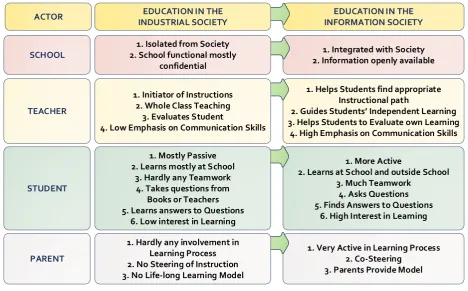
Expectations of educational reforms by the use of ICT have been high, since the days of its introduction. Several policy documents described expected educational transformations in the roles of various actors involved in education. Figure 2 produced here following the work of Pelgrum, et al [6] shows the expected transformations in the roles of actors involved in education from industrial society to information society. The current use of ICT advocates that ICT is not only the backbone of the Information Society, but also an important catalyst and tool for inducing modern educational reforms that transform students into productive knowledge workers.
EDUCATION IN THE INFORMATION SOCIETY
1. Integrated with Society 2. Information openly available
1. Helps Students find appropriate
Instructional path
2. Guides Students’ Independent Learning 3. Helps Students to Evaluate own Learning
4. High Emphasis on Communication Skills
1. More Active
2. Learns at School and outside School 3. Much Teamwork
4. Asks Questions 5. Finds Answers to Questions
6. High Interest in Learning
1. Very Active in Learning Process 2. Co‐Steering
3. Parents Provide Model
ACTOR EDUCATION IN THE
INDUSTRIAL SOCIETY
SCHOOL
1. Isolated from Society 2. School functional mostly
confidential
TEACHER
1. Initiator of Instructions 2. Whole Class Teaching
3. Evaluates Student
4. Low Emphasis on Communication Skills
STUDENT
1. Mostly Passive 2. Learns mostly at School
3. Hardly any Teamwork 4. Takes questions from
Books or Teachers 5. Learns answers to Questions
6. Low interest in Learning
PARENT
1. Hardly any involvement in
Learning Process 2. No Steering of Instruction 3. No Life‐long Learning Model
Figure 2
: Roles Transformation
fromIndustrial Society to Information Society [6]
The key developments [2] that occur during each stage are enumerated below:
A. Emerging Stage
A few computers and peripherals are introduced in the Institution,
Potential of ICT in teaching and management is explored by some teachers,
Teachers use technology for their own ICT literacy, Classroom practice does not change and still remains
teacher-centred, and Teaching is didactic in style.
B. Applying Stage
Institutions acquire additional ICT equipment,
ICT equipment is used in the management of the Institution,
A separate ICT curriculum is adapted and specific software tools are used in teaching,
At this stage learning remains factual knowledge based,
Teachers use ICT equipment for professional
development to improve subject teaching,
Classroom practice does not change and still remains teacher-cantered, and,
Teaching is didactic in style.
C. Infusing Stage
Wide variety of ICT equipment is made available in the Institution,
Technology gets infused in teachers professional activities,
Teachers improve student learning and management of learning,
Teachers start integrating their subject knowledge and skills into project based curriculum which reveal real-world applications,
Teachers use ICT to assist their students in their own learning,
Students have control over their learning and choice of projects,
Teachers collaborate with each other on common interests and to share teaching experiences, and, Classrooms practice starts getting changed to
learner-centric and collaborative approach of learning gets infused.
D. Transforming Stage
Infusing stage leads to transforming stage. ICT becomes regular part of the Institution,
Classrooms become fully learner-centric,
Subjects get integrated into real world applications, Critical and pedagogical thinking in teachers matures,
and,
Collaborative learning leads to collaborative knowledge and Institutes become learning centers for their communities.
Five information literacy competency standards for higher education have been set up by the Association of College and Research Libraries [7]. Similar standards have been advocated by several developing countries, including India. These standards along with brief explanation of each are presented below:
A. Standard 1 – Know
The information literate student determines the nature and extent of the information needed.
B. Standard 2 – Access
The information literate student accesses needed information effectively and efficiently.
C. Standard 3 – Evaluate
The information literate student evaluates information and its sources critically and incorporates selected information into his or her knowledge base and value system.
D. Standard 4 – Use
The information literate student, individually or as a member of a group, uses information effectively to accomplish a specific purpose.
E. Standard 5 – Ethical/Legal
The ethical/legal standards establish that students must be taught the social, economic and political issues surrounding information, specifically the ethical and legal uses of information and its technology.
ICT performance indicators namely Learning and Pedagogy, Facilities and Resources, Curriculum and Student Assessment can be combined with these five standards to evaluate institutions progress in ICT integration.
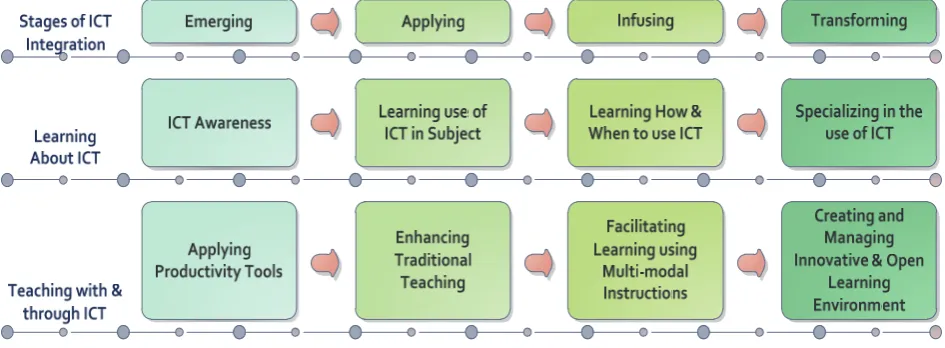
Integration of ICT in education does not happen instantly but instead progresses gradually in stages and the number of stages may vary from case to case. Mostly the integration is a four stage process and the stages are named as Emerging, Applying, Infusing and Transforming. Majumdar [5] has mapped these four stages of ICT integration in education onto ICT learning and ICT teaching practices. This mapping is depicted in figure 3.
There is a one-to-one mapping between individual stages of ICT integration, ICT learning and ICT teaching. Every stage of ICT integration in education maps on to corresponding broader steps for learning and teaching objectives.
2. Web 2.0 in Education
Introduction of ICT is believed to have created third revolution in dissemination of information and knowledge proceeded by inventions of printing press and the written languages. Current era of information and knowledge dissemination based on immense use of Internet, various high tech services on the Internet, e-learning, interactive, mobile and ubiquitous learning is believed to be on the threshold for fourth revolution. This new technology was quickly adapted for learning and the term e-learning with a motto “Anytime, Anywhere and Anybody” sometimes also called as A3 got evolved [8]. Given to the read only nature of the early Web which is sometimes referrers to as Web 1.0 [9], e-learning was called e-learning 1.0 and was mostly focused on creating and administering Web content for online viewing. A basic interaction in the form of asynchronous communication through e-mail and synchronous communication through chat was also supported. A concept of Learning Management System (LMS) was introduced to ensure high quality and usefulness of content.
Web 2.0 referred to as read-write web [9] allowed e-learning to incorporate social aspects of e-learning theories [10]. Web 2.0 tools and technologies allowed integration of features for expressing opinions and socialization into LMS [8]. Using Web 2.0 technologies and tools with sound pedagogy in e-learning has been coined as e-learning 2.0 in literature.
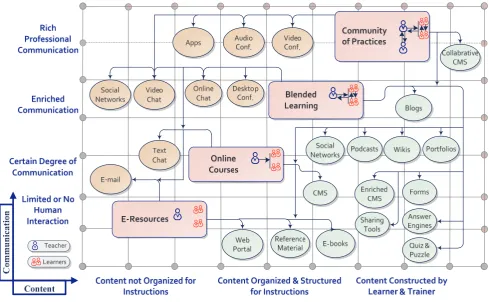
With the development of newer and improved web tools for communication and content manipulation, pedagogy of e-learning also advanced. Though e-learning implies learning through electronic technologies but no universally agreed upon definition of e-learning exists [11]. Resta and Patru [12] recently have explained e-learning as learning by communicating using Internet and interactions with contents accessed on Internet within the context of sound pedagogy. This suggests that e-learning has content and communication dimensions leading to different categories of e-learning. Content on one extreme may be unorganized and on the other extreme it may be co-constructed by students and teachers. Similarly, there may be no human interaction on one extreme in the communication dimension and on the other there may be a rich and profession communication.
Four categories of e-learning namely e-resources, online courses, blended learning and communication of practice have been identifies by Resta and Patru [12] on these two varying dimensions. These are briefly stated below:
A. E-Resources
In this form of e-learning, the content is not organized for instructions and there exists little or no human interaction between teachers and students or teachers and teachers. Internet is searched for information and e-resources. The important web tools used for e-resources include search engines, bookmarks, etc. Internet is used to surf the web to find information which may not be organized for instructions. ICT is not used to enrich communication between students and teachers.
B. Online Courses
In this form of e-learning, the content is organized and constructed by the teacher and there exists a certain degree of communication between the teacher and the student. Online courses are often used in distance education. Internet is used to reach the website(s) offering online course. The important web tool used includes Course Management Systems.
C. Blended Learning
In this form of e-learning the content is not only organized and constructed by the teacher but is also supplemented and complimented easily by the teacher and there exists a highest and enriched level of communication between teachers and students and between students. In this form face to face learning is supported by technology. Besides CMS, the important web tools used include various communication tools that enable students and teachers to collaborate and share resources.
D. Communities of Practice
In this form of e-learning, teacher and students co-construct courses, regularly update, upgrade and share them on the Web and there exists not only communication between teachers and students, and between students but also between teachers to share their experiences and ideas. Relevant Web tools permits this form of e-learning.
Figure 4: Different forms of e-learning
Web 2.0 applications have laid down new ways to create, collaborate, edit and share user content, anytime, anywhere, with anyone they like. The easily adaptive user interface of these applications permit teachers and students to learn these tools easily and to use them without need to download. They enable students to collaborate in creating presentations themselves under the supervision of teachers. Various video integration tools help in classrooms for projects, presentations, parent meetings and more. Mobile phones can be used outside classrooms for texting and sharing images to voicemail, conference calling, podcasting, submitting live surveys, sharing files and collaborating in real-time. Web 2.0 has given innovative technological tools for education to work with profuse and modern teaching pedagogy that promotes project–based learning by encouraging collaboration and participation among students. These tools like Wikis, weblogs, discussion forums, etc. allow users to create and manage their own content and share that content with others to facilitate discussion in an interactive manner. Many Web 2.0 applications have been established for academically-focused interaction between students and teachers where students post on walls and hold discussion with teachers. Certain groups on social networking sites are used by passing out students to post profiles including favourite courses and career goals. Alumnae, who also belongs to the group visit these sites and helps current students find appropriate internships, job placements, and information about postgraduate
social networking not only provides advanced tools for collaborative content development but also provides online and collaborative communication tools and it thus support the development of effective communities of practice.
3. E-Learning Opportunities with Web 2.0
boards, chat rooms, online assessment, whiteboards, and other state of art web tools. Over the years both commercial and free or open source virtual and managed learning environments have emerged. A prominent open-source Virtual Learning Environment having managerial capability called Moodle (http://moodle.org) has been widely accepted by educational institutions. Web facilitates implementation of innovative learning technologies and management facilities thus permitting educational institutions not only to share their teaching expertise but also to share their learning resources globally. This section offers some cases wherein Web 2.0 tools have been successfully implemented for learning.
Paus-Hasebrink et al in a study [15] on learning with Web 2.0 involving students from nine schools worked together on a school-embracing wiki on Austrian national parks found that wikis help youngsters to learn about ownership and authorship, and to understand issues of control and credit within the intellectual world. This study also revealed that students gained experience in both researching and selecting information, as well as in evaluating it.
Web 2.0 tools are self-directed and provide personalized learning environments within collaborative learning contexts. Several examples that achieve balance between self-regulated and personalised learning, while integrating Web 2.0 tools as well as the production, sharing and use of student-generated content have been provided by McLoughlin, and Lee [16].
It has been considered that the use of Web 2.0 for learning purposes transforms the learning context by providing multiple opportunities for shared content and resources, self-directed learning, collaborative learning, ubiquitous and lifelong learning [17], [18].
Weblogs offer an exciting and encouraging learning environment where students have a sense of ownership and readership which can enhance their analytical and critical thinking skills, create social interactions between students and the instructor, students and their peers, and students and a global audience [19]. Blogs not only permit students to show their ability to form complex sentences, ideas and opinion expressions but also use pictures and photos to illustrate their writing. Noytim [19] investigated the potential value of Weblog use on English language learning at university level and examined students’ perceptions towards using Weblogs. The findings show that Weblogs encourage students’ self-expression in English owing to their online nature and user-friendly characteristics. The study further found Weblogs a powerful tool for English language learning particularly for promoting student interest, motivation and confidence in writing and reading skills. An investigation [20] to understand the benefits of using Web 2.0 technologies for English language learning was carried out in a gifted school by Melor, Lisa, and Noriah. The study revealed that gifted learners using Web 2.0 technologies found the technology interesting and very much preferred over the conventional methods of teaching
Makoul et al [21] created a difficult conversations online forum to provide medical students an opportunity to reflect, debrief, and respond to one another about their experiences during the clinical clerkships. The forum used structured templates for student posts and responses and mechanism for faculty feedback thus enables virtual discussion between students regardless of their clerkship schedule or clinical site. After critically analysing the content of the forum for two academic sessions, it was found that the forum proved very effective to students in collaborating on various medical topics.
Roussinos & Jimoyiannis [18] carried an examination of university students’ beliefs and perceptions of a wiki authoring activity, designed to support blended and collaborative learning environment in the context of an authentic coursework project activity. The findings of the study revealed that students were satisfied with the collaborative experience and the learning outcome by the use if wiki. Students considered wiki as an efficient technological tool because of its functionalities and usability.
Angelaina & Jimoyiannis [22] have highlighted as to how pedagogical affordances of blogs offer enhanced opportunities for collaborative creation of content, construction, communication and participation and for blended learning. A group blog was designed to engage students in a cross-thematic large-scale learning activity in different subject areas as an obligatory project according to K-9 computer science curriculum. It used blending learning philosophy and integrated class room sessions and face to face discussions for problem solving. The content generated on the group blog including content posts and commentaries were analysed through a community of inquiry for various indicators in social, cognitive and technical presence dimensions. The results showed successful engagement of students into the blog both in content and commentaries posts and suggest that the students, through their different roles in the blog, achieved higher thinking and cognitive levels.
Cheng et al [23] evaluated the effectiveness of intrinsic discussion forums in higher education by assessing the relation between forum participation and course performance in two introductory psychology courses. In the first experiment, the discussion forum was implemented at the beginning of the course and in the second experiment, the discussion forum was implemented halfway through the course. Results obtained from both experiments showed that students who contributed to the forum particularly post viewing exhibited better performance on the course and in their exam as opposed to students who did not.
podcasts, tools for virtual environments, media sharing and syndication are used to support inclusion and equity. The study identified three types of learning 2.0 for inclusion which are: inclusion of school students using open pedagogy supporting new forms of learning, community of interest supporting digital literacy, collaboration and interaction for adults, and closed settings for institutions to support collaboration, interaction for promoting new forms of learning. It was also found that various examined initiatives supported learners with special needs through a variety of social computing tools.
Liburda and Christensen in their study [25] have provided examples of web 2.0 learning activities from the INNOTOUR platform, meant for students, teachers, businesses and researchers of tourism explaining usefulness of social media for student preparation, support project working methods and activate and challenge students in engaging and motivating teaching and learning activities resulting in comprehensive learning.
A recent study [26] to examine future teachers’ practices with e-portfolios in their learning and to determine effectiveness of these practices to improve teaching competencies was carried out on 55 pre-service teachers from Universiti Sains Malaysia. It was found that e-portfolios helped teachers to recognize their learning and identify their strengths and weaknesses because their performance and achievements are traced over time. It was also found that various competencies including: i) developing understanding of an effective teacher’s role and their teaching approaches, ii) improving linguistic abilities, iv) comprehending content knowledge, v) gaining ICT skills and, vi) the realization of the need to change mind-sets emerge from the teachers’ practices of e-portfolios.
A review [27] evaluating the outcome of e-learning lecture on cancer biology and pharmacology offered for 10 years to students of molecular biotechnology at the University of Heidelberg and to students of Pharmacy at the University of Mainz, Germany found that e-learning especially blended learning interested students and a majority of them sought e-learning to be offered in their present curricula. Further, many students were of the opinion that they would consider e-learning for further and continuing education after graduation.
A study [28] employing data set of 9044 students at two Catalan universities to study the hypothesis that blended learning is more effective than face-to-face learning indicated that the principal cause of the improvement is not due to the increase in time spent just online for educational purposes but by increasing the time devoted to studying online as some form of interactive learning. Another recent survey [29] that examined satisfaction with blended learning in English as a Foreign Language (EFL) course involving 360 undergraduates and postgraduate students in Dalian University of Technology, China found blended learning model highly acceptable and effective. The survey using Statistical Package for
that affect students’ satisfaction with blended learning in EFL. These are learning climate, perceived enjoyment, perceived usefulness, system functionality, social interaction, content feature and performance expectation.
A collective case study [30] of six Web 2.0 implementations in Australian higher education on a range of disciplines, class sizes and year levels across three universities highlighted the potential learning benefits of the effective use of Web 2.0, particularly through student content creation and sharing. The study further validates that the difficulties faced by some students on account of being unfamiliar with the Web 2.0 tools and lack of institutional support can be solved easily.
E-learning has created opportunities for both formal and informal education. In formal learning online resources on web complements traditional modes of learning and in informal learning online resources along with web enabled social interactions and collaborations assist learning. Web based projects like nQuire (http://www.nquire.org.uk/) and LIFE (http://life-slc.org/research/reports.html) initiated to enrich education by supporting complementarity of both formal and informal learnings have created environments for lifelong learning.
Initiatives for Massive Open Online Course aiming to provide global platform for development and deployment of web enabled learning resources include i) EdX (<http://www.edxonline.org), Khan Academy
(http://www.khanacademy. org) and Coursera
(https://www.coursera.org/) initiatives. Under these initiatives various online resources are offered free of charge to learners from any computer with access to the web. According to Khan Academy, Coaches, parents, and teachers have unprecedented visibility into what their students are learning and doing on Academy. Manchester Institute of Technology, a co-initiator of EdX has reported that 120,000 signups were made for the first EdX course named ‘Introduction to Circuits and Electronics” in March 2012 out of which 10,000 students passed the midterm examination.
4. Emerging Developments in e-Learning
RDF query language, e) Notation3 (N3), f) N-Triples, a format for storing and transmitting data, g) Turtle (Terse RDF Triple Language) and, h) Web Ontology Language (OWL). The semantic web will benefit online learners for personalization and knowledge and online instructors for course development, learner support, assessment, and record keeping [32]. E. Wiki [33] considers that Web 3.0 will be “Read-Write-Collaborate” in nature. Neil Rubens et al [34] reports that Web 3.0 shall utilize Artificial Intelligence, make influence on e-learning and shall have four key drivers namely distributed computing, extended smart mobile technology, collaborative intelligent filtering, 3D visualization and interaction. It is suggested that concept of “anytime, anywhere and anybody” as applied to e-learning will be complemented by “anyhow” [35] and as such LMS and VLE systems shall be made capable of representing information through metadata. VLM’s can perform intelligent tasks such as to recommend the most relevant education programme to candidate or inform candidates of the availability of relevant book in their library. 3D visualization and interaction to create 3D multi-user Virtual Environments in education has already been tested by some educators [36], [37] and has been found to be engaging and motivating. These 3D learning environment shall consume more computing and network resources and raise issues that include high cost, difficulty of coursework marking, quality of experience, limited or no facilities for content copying, sharing, etc. [38]. Recently an open source project named OpenSim (http://opensimulator.org) has been initiated to support development of high quality learning environment without incurring any financial costs. Learners and teachers are expected to develop deeper technological connections in future education that shall require significant use of connecting device, media visualization and cloud computing [39].
5. E-learning Implementation Challenges
Use of ICT in general and Web 2.0 in particular for education at a particular institute especially in developing countries face a series of challenges including lack of infrastructure, socio-cultural and religious barriers, lingual issues and security threats. Horton and Mackay [40] argue that economic, cultural, and social factors will pose unlike challenges in developing countries for successful integration of ICT in education. A well discussed challenge for developing countries [41] [42] to successfully integrate ICT in education is the lack of sufficient infrastructure both in terms of physical and human resource. Teachers’ lack ICT competencies, as they take too little time to learn ICT skills and lack creativity and willingness to change the system. In comparison to developed countries, some developing countries do not have a comprehensive ICT policy for education and different bodies take up curriculum,
levels. Socio-cultural challenges are much more pressing in these countries. In countries of diverse cultures like India it is not culturally appropriate for women and girls of remote villages and small towns to visit Internet Cafes at odd times. Using Web 2.0 and social media in education at places where people are emotionally attached to their religion face severe challenge unless guidelines for e-content and privacy are well defined to protect religious sentiments of people. Google and Facebook were forced to remove some contents as Indian courts found it offensive to local aspirations. Various technological issues including challenges on account of speech processing, recognition and synthesis, natural language processing, and localization of fonts for non-English languages have not fully solved. Web when used in education is facing diverse security challenges from cybercrimes like unauthorized access, malicious code, DOS, and infringement of rights. A very recent project study [43] examined implementation of eight online courses at educational institutions in five countries and applied the elements of authentic learning as criteria to evaluate authenticity. It was found that the project study raised teachers’ awareness of cultural background as a factor affecting views on authentic e-learning which varied across countries. Further, developmental challenges like continuous evaluation in authentic assessment surfaced in the study.
Each Web 2.0 application is identified/survives on visual design, interaction and user interface and provides incremental update of pages; however, they may not be always accessible to people using assistive technologies [44]. Some studies [45] [46] show concern that despite the extensive use of new technology in learning, it is not achieving the intended impact on learning in medical education owing to usability challenges of virtual learning environments, online tutorials, blogs, podcasts and websites. The factors determining usability, technology to be used and the content must therefore be considered carefully. The important technological aspects of design are navigation, learnability and visual design and consistency [47].
Liburda and Christensen [25] argue that learning using web 2.0, is a completely different way of understanding and co-creating knowledge which has a range of challenges that include curriculum revisions to create alignment between learning objectives, web 2.0 learning and teaching processes, and student assessment.
reliable and high quality evaluation. The challenges are: i) Absence of standardized evaluation framework, ii) Limited local capacity for evaluation, iii) Limited funding and resource constraints for Monitoring and Evaluation, iv) Lack of Demand and Ownership of evaluation, and v) Confusing updating with upgrading. Further, concerns regarding copyright issues involved in preparation and use of online resources, criticism about outdated learning objects, and technological challenges in realization of 3D Multi-user Virtual Learning Environments [38]
6. Discussion
Integration of ICT in education progresses gradually in stages and the number of stages may vary from case to case. At each stage certain learning and pedagogical objectives are met. The boundaries of e-learning are not now restricted to e-resources and online courses only but they use high tech Web 2.0 tools to support blended learning and communities of practices. Web 2.0 has created opportunities in both primary and higher education offered through formal or informal modes but faces diverse challenges from cyber threats, privacy concerns of individuals and governments, technological overloads for small and medium devices, integration among various tools of its kind, social and religious barriers, infrastructural imbalance, deficiency of motivated and trained staff, less awareness about its benefits, accessibility issues, etc. These challenges can be addressed to a greater extend, if appropriate procedures, steps and guidelines are followed while implementing Web 2.0 in education.
Multilingual technological facilitation may be created to prevent digital divide. Such a facilitation to use a particular regional language in Web has to be taken up at government level and directions for their use need to be provided in e-Learning policies.
Interaction with the learning content needs to be flexible and easy for learners. Content accessibility guidance must be adhered to choose colour, keyboard commands, font sizes and styles, etc. The contents of e-modules offered at a particular institute must be authentic, maintain its integrity and should bind its author with it. The data contained in these modules must be reliable and should be easily traced to its author. The contents of e-modules must remain original and there should be an inbuilt procedure to check their integrity. Various technologies of boundary protection, authentication and authorization can be used to prevent unauthorized parties from accessing, viewing or modifying e-content. System integrity can be maintained by identifying, blocking and eliminating malware. Public Key Infrastructure in its various forms can ensure cryptographic services for e-content and e-modules. Specific guidelines are to be devised for preparation of e-content, authentication; integrity and non-reputation of e-content and liability of authors needs to be defined. Information privacy and
programs to save students and teachers from cyber threats. Very limited empirical studies have been carried out to understand the effects of using ICT in education in developing countries. Therefore, it is imperative to conduct such studies at institutional, local and regional levels. Such studies would not only be helpful in evaluating the success of utilizing ICT in education but will also be beneficial in monitoring ICT integration.
5. CONCLUSION
Information and Communication Technologies particularly Web technologies have extremely transformed teaching and learning by empowering both students and teachers. Increase in learning resources on the Web and improved connectivity to Internet through computers, mobile phones and other hand held devices has significantly helped learning. Technological innovations in the Web have created novel tools for blended learning and community of practices. Several studies have proved effective practise of Web tools in the implementation of modern pedagogy that promote project–based learning and encourage collaboration and participation. The underlying technology of Web is continuously evolving and thus new services and tools for learning are being constantly developed. Use of ICT in education has also created several challenges for students, teachers and educational institutions which substantially vary between developed and developing nations. Therefore, it is imperative for educational institutions to adopt and encourage innovative uses of technology and concurrently monitor and evaluate their effectiveness.
References
[1] DUTTA, S. and MIA,I. (Eds.) (2011) The Global Information Technology Report 2010–2011. World Economic Forum, www3.weforum.org/docs/ WEF_ GITR_Report_ 2011.pdf
[2] ANDERSON, J. ICT Transforming Education-A Regional Guide. UNESCO, ISBN 978-92-9223-325-9. [3] ANDERSON, J. and WEERT, T. (Eds) (2002)
Information and communication technology in education: A curriculum for schools and programme of teacher development. UNESCO, Paris, http://unesdoc.unesco.org/images /0012/001295/ 129538e.pdf
[4] ANDERSON, J. and GLENN, A. (2003) Building capacity of teachers/facilitators in technology-pedagogy integration for improved teaching and learning.
UNESCO, Bangkok, Regional Office for Education in Asia and the Pacific, 2003, http://www.unescobkk. org/fileadmin/userupload/ ict/e-books/ictbuidling_cap acity/buildingcapacity.pdf.
[6] PELGRUM, W.J. BRUMMELHUIS, A.C.A. COLLIS, B.A. PLOMP, T.J. and JANSSEN REINEN, I.A.M. (1997) The Application of Multimedia Technologies in Schools: technology assessment of multimedia systems for pre-primary and pre-primary schools Luxembourg: European Parliament, Directorate General for Research.
[7] ACRL (200) Information literacy competency standards for higher education. The Association of College and Research Libraries, Chicago, Illinois, http://www.ala.org/acrl/sites/ala.org.acrl/files/content/ standards/standards.pdf
[8] EBNER, M. (2007) E-learning 2.0 = e-learning 1.0 + web 2.0?. International Conference on Availability, Reliability and Security, 1235–1239.
[9] RICHARDSON, W. (2005) The educator’s guide to the read/write web. Educational Leadership, 63(4):24. [10]MONDAHL, M. RASMUSSEN, J. and RAZMERITA, L.
Web 2.0 applications, collaboration and cognitive processes in case-based foreign language learning. 2nd World Summit on the Knowledge Society: Visioning and Engineering the Knowledge Society, A Web Science Perspective, WSKS ’09, Berlin, Heidelberg, Springer-Verlag, 98–107.
[11]NICHOLS, M. (2008) E-learning in context. Laidlaw College, Auckland, New Zealand. (E-Primer Series.),
http://akoaotearoa.ac.nz/sites/default/files/ng/group-66 1/n8 77-1---e-learning-in-context.pdf
[12]RESTA, P. and PATRU, M. (Eds) (2010) Teacher Development in an E-learning Age: A Policy and Planning Guide,” UNESCO, Paris.
[13]MICHAELSON, R. HELLIAR, C.V. POWER, D.M. ALLISON. C. (2003) Group Work and the Web: FINESSE and TAGS, in: D. Hawkridge, R. Kaye (Eds.) Learning and Teaching for Business: Case Studies of Successful Innovation, Kogan Page 122– 137.
[14]ALLISON, C. MILLER, A. GETCHELL, K. STURGEON, T. (2008) Exploratory learning for computer networking,
in: H. Leung, F. Li, R. Lau, Q. Li (Eds.), Advances in Web Based Learning ICWL 2007, Springer, Berlin/ Heidelberg, 2008, 331–342.
[15]PAUS-HASEBRINK,I. WIJNEN, C. and JADIN, T. (2010) Opportunities of Web2.0: Potentials of learning.
International Journal of Media and Cultural Politics
6(1).
[16]MCLOUGHLIN, C. and LEE, M. J. W. (2010) Personalized and self-regulated learning in the Web 2.0 era: International exemplars of innovative pedagogy using social software. Australasian Journal of Educational Technology26(1):28-43.
[17]RAVENSCROFT, A. (2009) Social software, Web 2.0 and learning: status and implications of an evolving paradigm. Journal of Computer Assisted Learning25: 1-5.
[18]ROUSSINOS, D. and JIMOYIANNIS, A. (2011) Blended collaborative learning through a wiki-based project: A case study on students’ perceptions. International Journal of Digital Literacy and Digital Competence,
2(3):15-30.
[19]NOYTIM, U. (2010) Weblogs enhancing EFL students’ English language learning. Procedia Social and Behavioral Sciences 2(2):1127-1132, doi:10.1016/ j.edurev.2010.01.001.
[20]MELOR,M.Y.LISA,K.S.L.andNORIAH,M.I.()
Advances in Environment, Computational Chemistry and Bioscience, 385-390.
[21]MAKOUL, G. ZICK, A. B. AAKHUS, M. NEELY, K.J. and ROEMER, P.E. (2010) Using an online forum to encourage reflection about difficult conversations in medicine. Patient Education and Counseling,
79(1):83-86.
[22]ANGELAINA, S. and JIMOYIANNIS, A. (2011) Educational blogging: Developing and investigating a students’ community of inquiry.A. Jimoyiannis (ed.), Research on e-Learning and ICT in Education, (New York: Springer), 167-180.
[23]CHENG, C.K. PARE, D.E. COLLIMORE, L.M. and JOORDENS, S. (2011) Assessing the effectiveness of a voluntary online discussion forum on improving students’ course performance. Computers & Education 56(1):253-261. doi:10.1016/j.compedu. 2010.07.024.
[24]CULLEN ET AL. (2009) Good Practices for Learning 2.0: Promoting Inclusion. An In-depth Study of Eight Learning 2.0 Cases. JRC Technical Note 53578, http://ipts.jrc.ec.europa.eu/publications/pub.cfm?id=26 00.
[25]LIBURD, J. J. and CHRISTENSEN, I. F. (2013) Using web 2.0 in higher tourism education, Journal of Hospitality, Leisure, Sport & Tourism Education,
12(1): 99–108.
[26]KABILAN, M. K. and KHAN, M. A. (2011) Assessing Pre-service English Language Teachers’ Learning Using E-portfolios: Benefits, Challenges and Competencies Gained. Computers & Education,
58(4):1007-1020.
[27]EFFERTH, T. (2013) Ten Years’ Experience with an E-Learning Lecture Series on Cancer Biology and Pharmacology. Education Sciences3(1):1-16.
[28]CASTAÑO-MUÑOZ, J. Duart, J. M. and SANCHO -VINUESA, T. (2013), The Internet in face-to-face higher education: Can interactive learning improve academic achievement? British Journal of Educational Technology. doi: 10.1111/bjet.12007
[29]WU, J., and LIU, W. (2013) An Empirical Investigation of the Critical Factors Affecting Students’ Satisfaction in EFL Blended Learning. Journal of Language Teaching and Research, 4(1), 176-185.
[30]BENNET, S. BISHOP, A. DALGARNO, B. WAYCOTT, J. and KENNEDY, G. (2012) Implementing Web 2.0 technologies in higher education: A collective case study. Computers & Education, 59(2):524–534. [31]RESEARCH, F. (2006) Search engine usage report. [32]MORRIS, R. D. (2011). Web 3.0: Implications for
online learning. TechTrends, 55(1): 42-46.
[33]WIKI,E. (2010) Edutech wiki, a resource kit for educational technology teaching, practice and research.
[34]RUBENS, N. KAPLAN, D. and OKAMOTO, T. (2011) E-Learning 3.0: anyone, anywhere, anytime, and AI.
International Workshop on Social and Personal Computing for Web- Supported Learning Communities
(SPeL 2011).
[36]PERERA, G.I.U.S. ALLISON, C. STURGEON, T. NICOLL, J.R. (2009). Towards successful 3D virtual learning – a case study on teaching human computer interaction.
The 4th International Conference for Internet Technology and Secured Transactions, IEEE Press, London.
[37]KIRRIEMUIR, J. (2012) Virtual World Watch: Who’s Doing What with Virtual Worlds in UK and Ireland Education, Eduserv Foundation, Bath, UK, 2012. url: http://virtualworldwatch.net/.
[38]ALLISON, C., MILLER, A., OLIVER, I., MICHAELSON, R., & TIROPANIS, T. (2012) The web in education.
Computer Networks, 56: 3811-3824.
[39]THOMAS, A.M. SHAH, H. MOORE, P RAYSON, P. WILCOX, A.J. OSMAN, K. EVANS, C. CHAPMAN, C.; ATHWAL, C. WHILE, D. PHAM, H.V. and MOUNT, S. (2012) "E-Education 3.0: Challenges and Opportunities for the Future of iCampuses," Sixth International Conference on Complex, Intelligent and Software Intensive Systems (CISIS), 953-958, 4-6 July 2012.
[40]HORTON, D. and MACKAY, R. (1999) Evaluation in DEVELOPING countries: An introduction. Knowledge.
Technology & Policy, 11(4):5-12.
[41]WORLD-BANK (2003) Lifelong Learning in the Global Knowledge Economy Challenges for Developing Countries. Washington D.C.: The World Bank.
[42]GIBSON, B. (2007) Enabling an Accessible Web 2.0.
W4A2007-Keynote, Co-located with the 16th International World Wide Web Conference, May 7-8. Ban®, Canada.
[43]LEPPISAARI, I. HERRINGTON, J. VAINIO, L. and IM, Y. (2013) Authentic e-Learning in a Multicultural Context: Virtual Benchmarking Cases from Five Countries. Journal of Interactive Learning Research,
24(1), 53-73.
[44]ALVES DA SILVA, N. MORAIS DA COSTA, G. PRIOR, M. and ROGERSON, S. (2011) The Evolution of E-learning Management Systems: An Ethical Approach.
International Journal of Cyber Ethics in Education (IJCEE), 1(3):12–24.
[45]PHILLIPS, R. MCNAUGHT, C. KENNEDY, G. (2011) Evaluating E–Learning: Guiding Research and Practice. Routledge, Taylor & Francis Group. 7625 Empire Drive, Florence, KY 41042.
[46]COOK, D. A. LEVINSON, A. J. GARSIDE, S. DUPRAS, D. M. ERWIN, P. J. and MONTORI, V. M. Internet-Based Learning in the Health Professions: A Meta-Analysis. JAMA: The journal of the American Medical Association, 300(10), 1181-1196.
[47]SANDARS, J. and LAFFERTY, N. (2010). Twelve Tips on Usability Testing to Develop Effective E–Learning in Medical Education. Med Teach, 32:956–960. [48]LUKASIEWICZ, T. and STRACCIA, U. (2008) Managing
uncertainty and vagueness in description logics for the semantic web. Web Semantics: Science, Services and Agents on the World Wide Web6(4):291–308.
[49]GOROSHKO, O. I. and SAMOILENKO, S. A. (2011) Twitter as a Conversation through e-Learning Context.
Revista de Informatica Sociala, 15.
[50]ALKHATEEB, F. ALMAGHAYREH, E. ALJAWARNEH, Z. MUHSIN, S. and NSOUR, (2010) A E-learning Tools and Technologies in Education: A Perspective. E-learning.