GSJ: Volume 6, Issue 9, September 2018, Online: ISSN 2320-9186
www.globalscientificjournal.com
PRIORITY
BUDGET
ALLOCATION
THROUGH
MIXED
INTEGER
PROGRAMMING
Bilkisu Maijama’aa
S. E. Chakua Ismaila Olotu Abdullahib and Babagana ModuC
a
Department of Mathematical Science, Nasarawa State University Keffi, Nigeria Department of Accounting Nasarawa State University Keffi, Nigeria
C
Department of Mathematics and Statistics, Yobe State University Damaturu, Nigeria Email: [email protected]@gmail.com
Abstract
Decision making with priority on allocation and reallocation of university funds is based on the
direction of the university, this is translated in strategic planning executed with transparency and
accountability. It has become very important, particularly in universities, with recent cut for
allocation by the government as a result of global financial crises. This research paper proposes
implementation integer programming for strategic budget planning to be applied on the
university strategic plan as a part of the strategic planning process. Firstly, the marginal cost
consequences was calculated considering the budget allocation from the previous year which was
used for budget allocation for the current year through both existing and new introduced
strategies used for improving the university rating. Secondly the budget allocation is applied to
the university strategies without prioritizing the strategies, thirdly the budget allocation is applied
to the university strategies without prioritizing the strategies. The outcome of this
implementation using mixed integer programming model showed that the targeted achievements
could be realized within the allocated budget that was provided by the university. This mixed
integer programming model will be useful and suitable to be implemented by organizations that
uses strategies for organizational improvement having limited budget allocation issues.
Keywords: Priority, strategies, budget allocation, mixed integer programming model.
1.0Introduction
Decision-making is a very important aspect in most organizations are faced with the problem of
decision making (Smith et al., 2016). The aim of applying mixed integer programming is to
answer the question whether or not to fund a particular strategic activity within the limited
availability of resources through the method of prioritization about cost. Availability of resources
to fund existing strategies with adequate benefit is needed. The decision to forfeit existing
strategies with high funding to new introduced strategies with lower funding and greater benefit
is a great importance. PBMA was first introduced in 1950 (Brambleby & Fordham, 2003b) in the
USA cooperation with much application in defense department. Then the PBMA was used as a
cost accounting tool to display time, deployment of available resources for different military
objectives and also in allocation of missiles for destruction of military targets. Later after a
decade (Brambleby & Fordham, 2003a), a researcher on PBMA bridge the gap between the
military and healthcare application of PBMA procedure. Recently PBMA is an applicable tool
for decision making, guidelines for clinicians as well as decisions by manufacturers and
management of organizations (Polisena, Tran, & Cimon, 2013).
Mitton, Dionne, & Donaldson (2014) outlined seven steps for PBMA:
1. Determining the goal, aim and scope of the program.
2. Identifying the available resources for funding a program, that is the program budget.
3. Conducting marginal analysis
4. Determining the decision making criteria, to maximize benefits or profits as well as
minimization of cost.
5. Evaluating the potential impact of investment and disinvestment in terms of benefit and
cost of the activity.
6. Validating the outcome of the model proposed.
Based on the seven steps outlined above, there is a possibility that PBMA can also be applied in
Other organizations with strategic activities using finances such as the university management to
improve the university ranking with the limited available resources.
2.0Research Problem
Strategic plan is used by different universities as a measure for rating the university. The
strategic plan is used by the university as a guide and key indicator for progress in assessing the
achievement of the university in line with the realities of the educational needs of this
millennium (Hinton, 2012). Unfortunately most of this universities set up their strategies without
due consideration on the availability of limited availability of resources, with less attention given
to the cost of funding each strategy. This will sure lead to mismanagement of resources.
Recently there is a cut in allocation of budget by the government to organizations, with the
university system inclusive. With this there is need to change or introduce new strategies, this
will bring about three basic questions:
1. Which strategic activity need monetary allocation
2. How is the budget allocation on strategies with and without priority settings
2.1 Research Objectives
The objective of this research paper is to apply PBMA procedure with slight adjustment for
budget allocation on university strategies. For illustration purposes, the scope of this research
was confined to the selection and budget allocation on both existing and new introduced
strategies in the university.
The selection of the activities to be funded through PBMA was executed by:
1. Identifying the strategies with monetary allocation for university strategic plan,
2. Comparing planning and budgeting of the strategies/activities in the university with and
without priorities.
3.1Methodology
Proposed Model:
To optimize the budget allocated by the management university on both existing and new
strategies (i.e. assuming that the university management has already decided on the total budget
amount to be allocated. The amount then will be fully-utilized to achieve the intended KPIs as
much as possible)
Decision Variables:
Xi = number of times strategy i to be implemented
Where
i = 1, 2…10.
Objective function:
Two objectives were considered simultaneously. The two objectives, listed according to priority
are:
1. Objective 1: Minimize D
2. Objective 2: Minimize wid1 + w2d2+w3+w3new+w4newT +w4newI +W5 +w6 + …+ w10d10
Where D = total unused budget that is being allocated by the university management
wi= weight of each activity i = 1, 2,…10
di = point not achieved by strategy i (i=1, 2,3(old, new), 4(old,newT,newI), 5, …10)
The preemptive method was used to achieve the two prioritized objectives. To achieve objective
1, the model constraints are as follows.
Constraints:
Constraint 1: Total points to be accumulated for each KPI
Where
Pi = expected points that can be accumulated by each strategy i to achieve KPI i.
Pointi = total points needed for KPI i.
Constraint 2: Total points to be achieved by all the strategies
∑
Where
Pi = expected points that can be accumulated by each strategy i to achieve KPI i.
D = total unused budget that is being allocated
And
Xi ≥ 0 and integer.
di >= 0 and real
D >= 0 and real
Here, the total expected points is by summing the points given for all the 13 strategies including
the new strategies 3 to local universities, 4newT to international universities in Thailand and
4newI to international universities in Indonesia i.e 2.229 and 80% of the total point is therefore
0.8(2.229) = 1.783.
Constraint 3: Total budget allocated by the university management
∑
Where
βi = total budget needed to implement each strategy i.
And
Xi ≥ 0 and integer.
Therefore, the entire constraints are as given below.
Constraint set 1:
0.004X1 + = 0.6
0.00029X2 + =0.2625
0.0007X3 + 0.0007X3new + d3 + d3new = 0.3
0.0007X4 + 0.0007X4newI + 0.0007X 4newT + d4 + d4newI + d4newT = 0.3
0.0784X5 + =0.250
0.00045X6+ = 0.145
0.0003X7 + = 0
0.0006X8 + = 0.252
0.0032X9 + = 0
0.0001X10+ = 0.120
Constraint 2:
0.004X1+ 0.0029X2+ 0.0007(X3old + X3new)+ 0.0007(X4old + X4newI + X4newT)+ 0.0784X5+
0.00045X6+ 0.0003X7+ 0.0006X8+0.0032X9+ 0.0001X10 ≥ 1.783
Constraint 3:
300X1+ 6000X2+500(X3old + X3new)+ 1000(X4old + X4newI + X4newT )+ 20000X5+96000X6+
96000X7+ 125000X8+72000X9+ 500X10 + D total budget allocated.
To achieve Objective 2, the same set of constraints used for Objective 1 were used, except for
constraint 3. In this case, constraint 3 was replaced by constraint 3* as follows.
Constraint 3*:
300X1+ 6000X2+500(X3old + X3new)+ 1000(X4old + X4newI + X4newT )+ 20000X5+96000X6+
96000X7+ 125000X8+72000X9+ 500X10 + D total budget given by the solution for
Objective 1.
4.0 Results Interpretation for Model C Objective 1
Model C is a multi-objective mixed-IP model, involving two objective functions. The model was
solved using the preemptive method. The first objective to be achieved was to optimize the total
budget that is by the university management for the next round of strategic planning year for
both new introduced and existing strategies. Since the budget allocated is not known, we made
an assumption that RM 80,000,000 will be allocated by the university management.
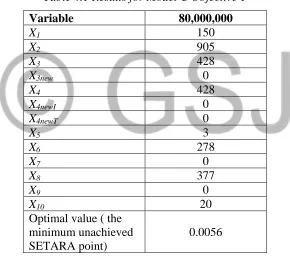
Table 4.1 Results for Model C Objective 1
Variable 80,000,000
X1 150
X2 905
X3 428
X3new 0
X4 428
X4newI 0
X4newT 0
X5 3
X6 278
X7 0
X8 377
X9 0
X10 20
Optimal value ( the minimum unachieved SETARA point)
0.0056
The results in Table 4.1 show than when RM80,000,000 is allocated by the university
management, the entire amount will be utilized to achieve as many point as can be achieved with
an optimal value 0.0056
1. 150 students development programs with an average of 30 students to be engaged
in each program.
2. 905 students being offered scholarship.
3. 428 UUM students to be sent for outbound programs in local universities with
credit transfer.
4. No UUM students to be sent for outbound programs in local universities with
credit transfer (new introduced strategy)
5. 428 UUM students to be sent for outbound in international universities with credit
transfer.
6. No UUM students to be sent for outbound in international universities with credit
transfer (new introduced strategy to Indonesia)
7. No UUM students to be sent for outbound in international universities with credit
transfer (new introduced strategy to Thailand)
8. Three promotional programs to selected foreign countries to increase the
percentage enrollment of international students.
9. 278 staff with industrial experience to be hired.
10.No academic staff with teaching experience abroad will be needed for the
next round of budget allocation. This activity has been fully achieved 100%.
11.377 is the total number of academic staff with PhD
12.X9 No academic staff should be employed or will be needed for the next round of
budget allocation, this activity has been fully achieved.
13.Lastly, 20 staff must be sent for training.
Having achieved objective one, for objective two, is to minimize total budget allocated for the
next round of strategic planning, with the allocation of weight to strategies giving priority to
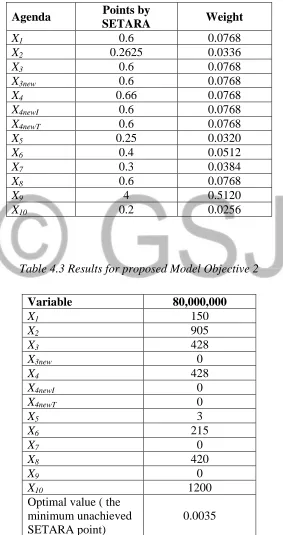
strategies with higher rating, the weight allocated to each strategic plan is presented in Table 3.1.
Prioritization of each strategy answers the research question 4, budget allocation practices with
priority settings with regards to the maximization of benefits and minimization of cost.
Objective 2 is analyzed with the allocation of budget 80,000,000 less than the estimated budget
as presented in model A; the results are presented in table 4.2.
Table 4.2 Agenda with Weights for Existing and New Strategies
Agenda Points by
SETARA Weight
X1 0.6 0.0768
X2 0.2625 0.0336
X3 0.6 0.0768
X3new 0.6 0.0768
X4 0.66 0.0768
X4newI 0.6 0.0768
X4newT 0.6 0.0768
X5 0.25 0.0320
X6 0.4 0.0512
X7 0.3 0.0384
X8 0.6 0.0768
X9 4 0.5120
X10 0.2 0.0256
Table 4.3 Results for proposed Model Objective 2
Variable 80,000,000
X1 150
X2 905
X3 428
X3new 0
X4 428
X4newI 0
X4newT 0
X5 3
X6 215
X7 0
X8 420
X9 0
X10 1200
Optimal value ( the minimum unachieved SETARA point)
0.0035
The results in Table 4.4 show than when RM80,000,000 is allocated by the university
management, the minimum unachieved point (as indicated by optimal or solution value = 0.0037).
1. 150 students development programs with an average of 30 students to be engaged
in each program.
2. 905 students being offered scholarship.
3. 428 UUM students to be sent for outbound programs in local universities with
credit transfer.
4. No UUM students to be sent for outbound programs in local universities with
credit transfer.
5. 428 UUM students to be sent for outbound in international universities with credit
transfer.
6. No UUM students to be sent for outbound in international universities with credit
transfer.
7. No UUM students to be sent for outbound in international universities with credit
transfer.
8. Three promotional programs to selected foreign countries to increase the
percentage enrollment of international students.
9. 215 staff with industrial experience to be hired.
10.No academic staff with teaching experience abroad will be needed for the
next round of budget allocation. This activity has been fully achieved 100%.
11.420 is the total number of academic staff with PhD
12.X9 No academic staff should be employed or will be needed for the next round of
budget allocation, this activity has been fully achieved.
13.Lastly, 1200 staff must be sent for training.
The minimized unachieved point (as indicated by optimal or solution value = 0.0035). The unachieved point for each strategy is less when the each strategy is prioritized.
5.0Discussion and Conclusion
This research on adjusted PBMA is applicable to are problems with strategic activities for
improvement. The Priotization of strategies which are used for ranking the quality of the
university. Mixed Integer programming is used for allocation and reallocation of budget on
selected activities. The result presented in this study showed for next year of budget allocation, It
will be preferable and more beneficial to allocate priorities to every strategy to achieve a higher
benefit with the same budget allocation. Prioritization of activities is based on MCC only, in
reality, selection of determining preferences of activities by the university management to be
founded should be given little consideration, hence preference factor should be included in future
work.
References
Brambleby, P. and Fordham, R. (2003a) Implementing PBMA?, 4(3), http://www.medicine. ox.ac.uk/bandolier/painres/download/whatis/pbmaimp.pdf, accessed on 15 April 2016.
Brambleby, P. and Fordham R. (2003b) What is PBMA?, 4(2), http://www.medicine.ox.ac. uk/bandolier/painres/download/whatis/pbma.pdf, accessed on 17 April 2016.
Drugs, C. A. F., & Health, T. I. (2014). Guidelines for the economic evaluation of health technologies: Canada 2006, Ottawa, http://cadth. ca/media/pdf/186_EconomicGuidelines_e. pdf, accessed on 11 June 2016.
Hinton, K. E. (2012). A Practical Guide to Strategic Planning in Higher Education, Society for
College and University Planning,
http://oira.cortland.edu/webpage/planningandassessmentresources/planningresources/SCPGuideo nPlanning.pdf, accessed on 27 July 2016.
Knoll, M. A. Z. (2010). The role of behavioral economics and behavioral decision making in American’s retirement savings decisions, Society Security Bulletin, 70(4), 1-23.
Mitton, C., Dionne, F., & Donaldson, C. (2014). Managing Healthcare Budgets in Times of Austerity: The Role of Program Budgeting and Marginal Analysis. Applied health economics and health policy, 12(2), 95-102.
Petren, S., Bjerklin, K., Marke, L. A., and Bondemark, L. (2013). Early correction of posterior crossbite - a cost-minimization analysis, European Journal of Orthodontics, 35, 14–21.
Polisena, J., Tran, K., and Cimon, K. (2010). Home telehealth for chronic obstructive pulmonary disease: a systematic review and meta-analysis, Journal of Telemed Telecare, 16(3),120–127.
Smith, K. J., Wateska, A. R., Nowalk, M. P., Raymund, M., Lee, B. Y., and Zimmerman, R. K. (2013). Modeling of cost effectiveness of pneumococcal conjugate vaccination strategies in U.S. older adults, American Journal of Preventive Medicine, 44(4), 373-381.
Smith, N., Mitton, C., Dowling, L., Hiltz, M. A., Campbell, M., and Gujar, S.A. (2016). Introducing new priority setting and resource allocation processes in a Canadian healthcare
organization: A case study analysis informed by multiple streams theory, International Journal of Health Policy Management, 5(1), 23-31. doi:10.15171/ijhpm.2015.169.
Uctug, F.G. and Yukseltan, E. (2012). A linear programming approach to household energy conservation: Efficient allocation of budget, Energy and Buildings, 49, 200–208.