MULTITHREADING ON MULTICORES
IMPACT ON REMOTE SENSING
COMPUTATIONS
NIZAR BEN ACHHAB
Faculty of Sciences, Abdelmalek Essaadi University.
Remote Sensing & Mobile GIS Unit, Innovation & Telecoms Engineering Research Group. Mhannech II, B.P 2121 Tetuan, Morocco
NAOUFAL RAISSOUNI
National Engineering School for Applied Sciences of Tetuan, Abdelmalek Essaadi University. Remote Sensing & Mobile GIS Unit, Innovation & Telecoms Engineering Research Group.
Mhannech II, B.P 2121 Tetuan, Morocco
ABDELILAH AZYAT, ASAAD CHAHBOUN, MOHAMMED LAHRAOUA Faculty of Sciences, Abdelmalek Essaadi University.
Remote Sensing & Mobile GIS Unit, Innovation & Telecoms Engineering Research Group. Mhannech II, B.P 2121 Tetuan, Morocco
ABSTRACT
Multithreading on a multicore approach can potentially increase the multitemporal performance computing of the huge quantity of satellite remotely sensed data. In the present paper, a study of the computation time performance has been carried out. Thus, with two foremost remote sensing algorithms implemented into a self developed Multitemporal Multithreading on Multicore Computations Framework (3MCF). The 3MCF was applied and benchmarked on different hardware architectures: i) two cores (Intel Pentium D, Intel Core 2 Duo, AMD Athlon X2), ii) four cores (Intel Core 2 Quad, Intel i7), and iii) eight cores (Xeon Nehalem). Final adapted benchmark results (with a total number of 414720 benchmarks) show a gain of 8X for the octal core, 4X for the quad core and 2X for the dual core.
Keywords: Huge remote sensing computations, Multicore, Multitemporal, Multithreading, Speedup.
1.Introduction
With the increasing of satellite resolutions during the last three decades and the development of more than 40 biophysical indices, a huge quantity of satellite remotely sensed data has been accumulated. Thus, waiting for software and hardware capability treatments. Each one of these indices (i.e., Land Surface Temperature (LST) [38;53;54;56], thermal inertia [28;43;51], emissivity () [45], Normalized Difference Vegetation Index (NDVI) [39], leaf area index [13;17;18;41;55;57], atmospheric Water vapor (W) [7;24;36;40], global environmental monitoring index [8;15;32], weighted difference vegetation index [5;9;10], soil adjusted vegetation index [12;22;23], etc.) plays a vital role for the study of the environment, global change, geology, biophysics, hydrology, vegetation monitoring, agriculture, etc. Further information could be extracted combining these indices and projecting them in a large temporal scale [44;48]. However, these treatments are both time and memory consuming [37;42]. This is why the remote sensing software designers, together with multimedia, security, web services and games software designers still demanding more computational speed. Conversely, it is a hard task after the cross of the four Ghz barrier. On the other hand, the computer hardware industry has provided more computational power with computer systems containing two or more core processors. These last, connected to a single Central Processing Unit (CPU) are called MultiCores (MC). With the push of the MC systems, software developers are confronted with an increasing complexity: i) cache resources are more pipelined as more cores are implemented, and ii) software developers have to adopt parallel programming instead of serial one. Thus, using techniques such as: multiprocessing (i.e., single instruction single data, single instruction multiple data, multiple instruction single data, multiple instruction multiple data), MultiTHreading (MTH) [4], message passing interface [19], parallel virtual machine [14], component models (i.e., CORBA [34], COM+ [11], Java Beans[31;52]), special libraries (i.e., OpenMP [59], MPI library [19]), etc.
proposes an approach to compute automatically whole RS databases in order to: i) avoid the memory overflow, ii) accelerate the execution with full and/or partial parallelization, iii) maximize the speedup, and iv) exploit the full hardware power. The 3MCF has been benchmarked using the SMT Remote Sensing Benchmark (SMTRSB) on different hardware architectures. This SMTRSB
has been developed integrating most commune remote sensing algorithms [2]. In our case, we have used: i) NDVI and LST split-window as algorithms, and ii) Advanced Very High Resolution Radiometer (AVHRR) short integer raster images with different sizes (20.6 Mb: 5004 columns x 2168 rows), (15 Mb: 4250 columns x 1850 rows), (10 Mb: 4048 columns x 1296 rows), (5 Mb: 2703 columns x 970 rows), (1 Mb: 1010 columns x 520 rows) and (100 Kb: 500 columns x 102 rows).
2. Multithreading on Multicore for Multitemporal Remote Sensing Computations
Since approximately 48 years, computer technology has continuously progressed for better computer architectures [21]. During this time, the CPU frequency was the discern factor in the computer performance. Nowadays, after multiple evolutions (from von Neumann’s model [16] to a network model [50]), further factors must be taken into consideration: family, model, platform, number of physical and logical cores, cache levels, SMT, Symmetric Multiprocessing, etc. These evolutions need software concurrency to benefit from their related powerful capabilities. However, applications’ development is increasingly complicated when thinking parallel [4]; SMT for multitemporal remote sensing computations is extremely difficult due to the algorithms’ complexity and the huge memory data consummation. RS algorithm parallelization entails an important increase in memory reservation. This last is usually confronted with hardware capabilities [3]. 3MCF framework is a RS algorithm parallelization process supporting SMT, MC and Hyper Threading (HT) technologies for temporal RS databases and high resolution images.
2.1. Material: Hyper-Threading and Multicore
The hyper-threaded package (e.g., processor supporting HT) is viewed by the operating system as multiple processors [26]. However, the processor presents duplication in: i) registers (data registers, segment registers, control registers, debug registers, and most of the model specific registers), and ii) Advanced Programmable Interrupt Controller [6]. HT Technology minimizes the memory delay problem with a minimal cost [29] allowing the processor to execute two or more threads near simultaneously. On the other hand, MC technology duplicates the whole CPU providing two or more simultaneous executions in one physical package [25;27].
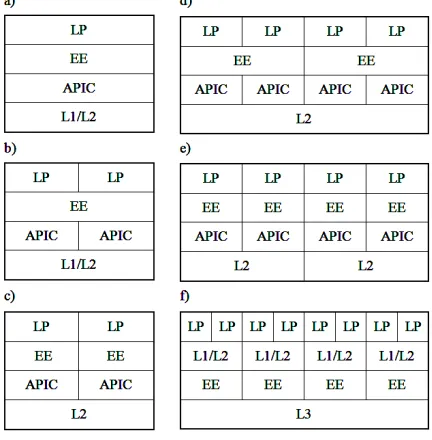
Nowadays, MC and HT technologies combination (i.e., Pentium Extreme edition, core i7) gives more powerful optimization opportunities with different cache levels organization and combinations (e.g., cache shared between execution units and/or cache dedicated for each execution core and/or cache subdivided into layers). Fig. 1 shows some Intel processor architectures integrating diverse combinations of MC, HT and cache level organization: i) Standard Pentium CPU architecture (Fig. 1a), ii) HT technology (Fig. 1b), iii) MC technology in (Fig. 1c) (Fig. 1e), and iv) MC and HT combination in (Fig. 1d) (Fig. 1f).
2.2. Technique: Multithreading
The MTH concept of multiple-threads or multiple-program functionalities running concurrently goes back to the 60’s. However, the MTH hardware support has started with multiprocessing technology on the 80’s and full-fledged with multicore technology on 2001 [33]. Defining a thread as a unit of control within a process [4], program or process functions can be executed enveloped by running threads. This is carried out by associating the main thread to every running program when it starts. Subsequently, in a MTH paradigm, the main thread creates other threads with the possibility of these last to create further threads, and consecutively [29]. MTH model has proven practically it efficiency for both developers and users [4;30;35;49]. In older parallel processing schemes, it was necessary to adapt the program source for the individual hardware configuration. However, with threads, any adjustment is required because the MTH programs work irrespectively of the number of CPUs. Various threads can run on one or diverse cores or processors concurrently without any change on the program source code [47].
2.3. Implementation: Multitemporal Multithreading on Multicore Computations Framework (3MCF)
3MCF [1] has been designed to: a) Automation: automatic computation for a whole temporal database, b) Performance: system performance increases by using MC capabilities, c) Low cost: hardware cost reduction by running on a common personal computer, d) Portability: compatibility with multiple hardware and software platforms, e) Simplicity: minimization of the complexity of remote sensing algorithm parallelization.
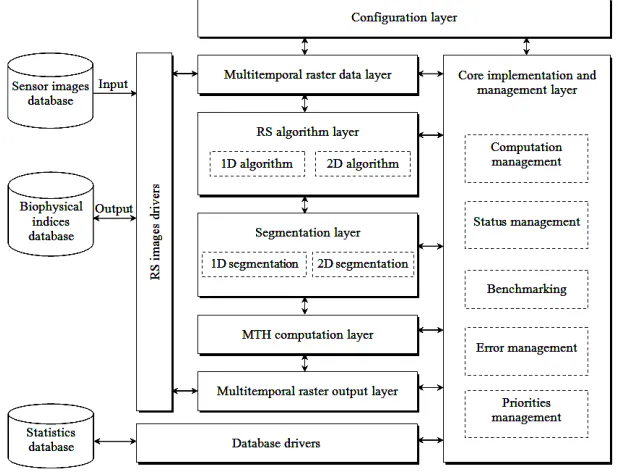
Fig. 2. 3MCF architecture diagram.
built up from a divide-and-conquer approach, by dividing the remote sensing image into regions and the algorithm application into multiples simultaneous threads. Instead of cropping the image into sub images with corresponding reserved memory, the 3MCF segmentation layer has been structured on the basis of executing multiple threads on the original image itself which is already reserved in memory. This is defining high bandwidth parallelism and giving some high level degree of flexibility to RS algorithms needing neighboring pixel information {i.e., Split-Window Covariance-Variance Ratio (SWCVR) algorithms (Eq. (3) & Eq. (4) in §3)}. The segmentation layer has been developed taking in consideration the above mentioned concept with the following procedure for:
i) 1D algorithm: For th=1 to n Begin
Sp = (th-1) * [(r*c)/n]; Ep = th * [(r*c)/n]; For k = Sp to Ep Begin
Calculate the biophysical index End
End
with th the number of the executed threads, Sp and Ep are the start and end thread computing positions, n the total number of threads to be executed, r and c are respectively the total number of rows and columns of the image and k represents the physical memory address of the pixel to be used (in the RS algorithm) to compute a biophysical index.
ii) 2D algorithm: the 2D algorithm segmentation is treated case by case with each own segmentation process. In this paper, we have used LST algorithm that involves W algorithm. This last is a 2D algorithm which segmentation procedure can be given by the following algorithm:
For th=1 to n Begin
Sp = (th-1)*[(r*c)/n]; Ep = th*[(r*c)/n]; For k = Sp to Ep Begin I=k-i
if ( I ≤ r*d ) or ( I ≥ r*(c-d) )
Inexistent value for the biophysical index Else if ( I mod r ≤ d) or ( I mod r ≥ r-d ) Inexistent value for the biophysical index else
Calculate the biophysical index End if
End End
where d the maximum length of neighboring pixel needed in the algorithm and i the physical memory address of the first pixel in the image. The number of SMT, which is equal to n; can be defined by the user, by benchmark test, or by defect to the number of cores. In this paper, n has been set equal to n=(2,3,4,5,6,7,8,9,10,11,12,13,14,15,16) with the maximum value of n, n(max)=16
corresponding to the double of the number of physical CPU used simultaneously (in our case the Xeon with eight cores, see Table 2, §3 for further details) with the aim of getting at least two periodical cycles.
3. Benchmarks
To evaluate the performance of the 3MCF remote sensing software a SMT Remote Sensing Benchmarks (SMTRSB) has been
developed. The SMTRSB is based on a process of running different RS based tests including RS algorithms and images. In this
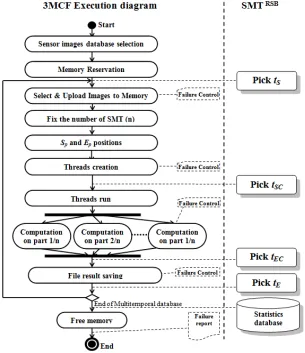
paper, a total number of 414720 tests of micro-benchmarks (e.g., 6 images with different sizes x 20 years x 12 months x 16 thread tests x 9 hardware architectures x 2 algorithms) have been considered. For accuracy commitment, the execution time counting in SMTRSB has been set on milliseconds and microseconds based on two time referential counters. The different picked
directly after file result saving, tSC the start computation pick time indicating the start of running multithreaded RS algorithm and tEC the end pick time computation just after ending of all the algorithms’ parts computation and before file result saving.
Finally, the temporal computations are serial to avoid In/Out bus saturation and memory overflow.
3.1. Remote sensing algorithms and data computation
In order to choose two types of algorithms (1D and 2D), we have opted for the most important AVHRR derived products for ecological applications: The NDVI as a 1D algorithm and the LST as a 2D algorithm.
The NDVI can be defined by the following equation :
NDVI = (1)
Where NIR and Red are images representing the radiances in the near-infrared band (AVHRR Channel 2) and the red band (AVHRR Channel 1), respectively.
In order to have an accurate estimation of LST (with an estimation error of about 1.3 K) we have applied the split-window algorithm [44] given by
LST = T4 + 1.40(T4 –T5) + 0.32(T4 –T5)2 + 0.83 +(57–5W)(1–) - (161–30W) (2)
Where T4 and T5, are images representing the total atmospheric transmittances in Channels 4 and 5 of the AVHRR, and
are the effective emissivity and the difference emissivity images respectively [45] and W (g cm-2) the atmospheric water vapor
image obtained using the SWCVR [46] given by:
Fig. 3. 3MCF execution diagram and SMTRSB picked time positions. tS, pick time for start image computation, tSC, pick time for start core computation, tEC, pick time for end core computation, tE, pick time for end image computation
W = 0.26 – 14.253cosθlnR54 – 11.649 (cosθlnR54)2 (3)
where,
∑K=1 (T4K –T40)(T5K –T50)
where the numerator and denominator in Eq. (4) represent, respectively, the covariance and the variance of the brightness temperatures directly measured by the satellite in AVHRR Channels 4 and 5, with T40 and T50 the mean temperature of the pixels considered in each channel.
Table 1 describes the data set consisting in 20 years (starting from 1981 to 2000) of monthly raster images (IM1, IM2, IM3, IM4, IM5, IM6) with different sizes (100 Kb, 1 Mb, 5 Mb, 10 Mb 15 Mb and 20 Mb, respectively) obtained from the Pathfinder AVHRR Land PAL project database [20].
Table 1
Used Remote Sensing images
Image Size Columns Rows Region
IM1 20,6 Mb 5004 2168 Whole world (PAL data)
IM2 15 Mb 4250 1850 World without Antarctica
IM3 10 Mb 4048 1296 America, Europe, Africa, and Asia
IM4 5 Mb 2703 970 Europe and north Africa
IM5 1 Mb 1010 520 Europe
IM6 100 Kb 500 102 South Spain and Morocco
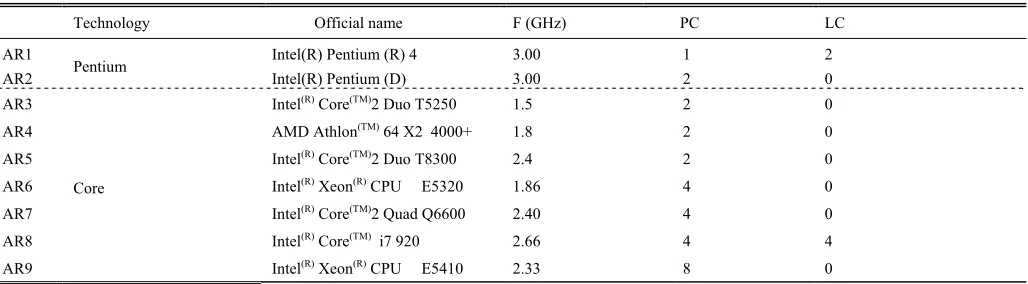
In order to study the performance of the multithreading, the NDVI and LST have been applied to the whole database on nine different hardware architectures (AR1, AR2, AR3, AR4, AR5, AR6, AR7, AR8, AR9) with different CPU configurations, frequencies ranging from 1.5 GHz to 3 GHz and physical cores from 1 to 8 (see Table 2).
Table 2 Processors characteristics
Technology Official name F (GHz) PC LC
AR1
Pentium Intel(R) Pentium (R) 4 3.00 1 2
AR2 Intel(R) Pentium (D) 3.00 2 0
AR3
Core
Intel(R) Core(TM)2 Duo T5250 1.5 2 0 AR4 AMD Athlon(TM) 64 X2 4000+ 1.8 2 0 AR5 Intel(R) Core(TM)2 Duo T8300 2.4 2 0 AR6 Intel(R) Xeon(R) CPU E5320 1.86 4 0 AR7 Intel(R) Core(TM)2 Quad Q6600 2.40 4 0 AR8 Intel(R) Core(TM) i7 920 2.66 4 4 AR9 Intel(R) Xeon(R) CPU E5410 2.33 8 0
F: CPU Frequency, PC: CPU Physical cores, LC: CPU Logical cores.
4. RESULTS
The execution time tC (in seconds, s) for the multithreaded algorithm can be derived from the tSC and tEC pick times using the following equation:
tC = tEC – tSC (5)
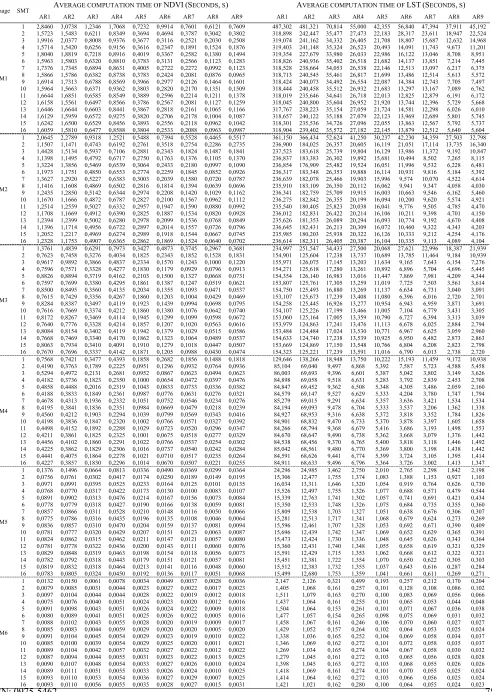
Tables 3 shows the computation time tC (s) in function of the number of SMT for six image sizes (see Table 1, in §3 for more details) and for the nine hardware architectures (see Table 2, in §3 for further details) corresponding to the application of the NDVI “Eq. (1)” and LST “Eq. (2)” algorithms. The average computation time has been carried out by averaging the 240 tC values corresponding to 12 months of 20 years for NDVI and for LST.
Analyzing the computation times, we observe that the tC is being divided by 2 for the dual core (2 cores), by 4 for quad core (4 cores) and by 8 for octal core (8 cores).
∑K=1 (T4K –T40)2
N
N
It is clearly shown, that considering tC the multicore architectures are faster than Pentium ones. This is proving that the CPU Table 3
Indices Average Computation Time
Image SMT AVERAGE COMPUTATION TIME OF NDVI(SECONDS, S) AVERAGE COMPUTATION TIME OF LST(SECONDS, S)
AR1 AR2 AR3 AR4 AR5 AR6 AR7 AR8 AR9 AR1 AR2 AR3 AR4 AR5 AR6 AR7 AR8 AR9
IM1
1 2,8460 3,0738 1,2346 1,7068 0,7232 0,9914 0,7601 0,6121 0,7609 487,302 481,321 70,814 55,000 42,355 56,840 47,394 37,911 45,192 2 1,5723 1,5483 0,6211 0,8349 0,3694 0,4694 0,3787 0,3042 0,3802 318,898 242,447 35,477 27,473 22,183 28,317 23,611 18,947 22,524 3 1,9916 2,0377 0,8008 0,9376 0,3677 0,3116 0,2521 0,2030 0,2508 319,074 241,162 34,332 26,405 21,708 18,807 15,687 12,632 14,968 4 1,5714 1,5420 0,6256 0,9156 0,3616 0,2347 0,1891 0,1524 0,1876 319,403 241,148 35,324 26,523 20,493 14,091 11,743 9,673 11,201 5 1,8040 1,8819 0,7218 0,8916 0,4019 0,3367 0,2582 0,1380 0,1494 319,354 227,679 33,980 26,033 22,986 16,122 13,046 8,708 8,951 6 1,5963 1,5803 0,6320 0,8810 0,3783 0,3131 0,2566 0,1123 0,1283 318,826 240,936 35,402 26,518 21,682 14,137 13,851 7,214 7,445 7 1,7376 1,7345 0,6894 0,8631 0,4005 0,2722 0,2272 0,0992 0,1123 318,528 238,664 34,053 26,538 22,146 12,513 13,097 6,217 6,375 8 1,5866 1,5786 0,6382 0,8738 0,3783 0,2424 0,2081 0,0876 0,0965 318,713 240,545 35,461 26,817 21,699 13,486 12,514 5,613 5,572 9 1,6914 1,7313 0,6788 0,8569 0,3966 0,2977 0,2126 0,1464 0,1601 318,424 240,073 34,492 26,554 22,087 14,384 12,743 7,705 7,497 10 1,5964 1,5663 0,6371 0,9362 0,3803 0,2820 0,2170 0,1351 0,1509 318,444 240,458 35,512 26,932 21,683 13,297 13,167 7,089 6,762 11 1,6644 1,6851 0,6585 0,8549 0,3889 0,2596 0,2214 0,1211 0,1378 318,019 235,646 34,641 26,718 22,013 12,825 12,879 6,191 6,172 12 1,6158 1,5561 0,6497 0,8566 0,3786 0,2567 0,2081 0,1127 0,1259 318,045 240,800 35,604 26,952 21,920 13,744 12,396 5,729 5,668 13 1,6446 1,6644 0,6603 0,8441 0,3867 0,2818 0,2161 0,1065 0,1166 317,767 238,223 35,154 27,059 21,724 14,581 12,298 6,026 6,010 14 1,6129 1,5959 0,6572 0,9275 0,3820 0,2706 0,2178 0,1004 0,1087 318,657 240,122 35,188 27,079 22,123 13,969 12,689 5,801 5,745 15 1,6242 1,6500 0,6529 0,8456 0,3893 0,2556 0,2118 0,0962 0,1042 318,301 235,536 34,726 27,096 22,055 13,863 12,567 5,792 5,737 16 1,6059 1,5810 0,6477 0,8588 0,3804 0,2533 0,2088 0,0963 0,0987 318,904 239,402 35,572 27,182 22,145 13,879 12,512 5,640 5,604
IM2
1 2,0645 2,2789 0,9318 1,2521 0,5488 0,7394 0,5528 0,4465 0,5517 361,150 366,434 52,624 41,250 30,237 42,230 34,359 27,503 32,798 2 1,1507 1,1471 0,4743 0,6192 0,2761 0,3518 0,2754 0,2286 0,2735 236,900 184,025 26,357 20,605 16,119 21,051 17,114 13,735 16,340 3 1,4428 1,5134 0,5937 0,7106 0,2881 0,2343 0,1824 0,1487 0,1841 237,523 183,618 25,739 19,804 16,129 13,986 11,372 9,192 10,847 4 1,1398 1,1495 0,4792 0,6717 0,2750 0,1763 0,1376 0,1105 0,1370 236,837 183,383 26,302 19,892 15,681 10,494 8,502 7,265 8,115 5 1,3224 1,3856 0,5469 0,6539 0,3064 0,2433 0,2180 0,0997 0,1090 236,854 176,909 25,482 19,524 16,051 11,996 9,532 6,228 6,481 6 1,1973 1,1751 0,4850 0,6553 0,2774 0,2259 0,1845 0,0852 0,0926 236,317 183,348 26,353 19,888 16,114 10,931 9,816 5,184 5,392 7 1,3627 1,2920 0,5227 0,6383 0,3003 0,2039 0,1580 0,0720 0,0787 236,639 182,078 25,466 19,903 15,996 9,574 10,070 4,522 4,614 8 1,1416 1,1608 0,4869 0,6502 0,2816 0,1814 0,1394 0,0639 0,0696 235,910 183,109 26,350 20,112 16,062 9,941 9,347 4,058 4,030 9 1,2435 1,2850 0,5142 0,6344 0,2974 0,2208 0,1420 0,1029 0,1162 236,341 182,759 25,709 19,915 16,003 10,663 9,546 6,162 5,460 10 1,1670 1,1666 0,4872 0,6787 0,2827 0,2100 0,1567 0,0962 0,1112 236,275 182,842 26,355 20,199 16,094 10,200 9,620 5,574 4,921 11 1,2514 1,2559 0,5027 0,6332 0,2957 0,1947 0,1590 0,0880 0,0992 235,540 180,405 25,823 20,038 16,041 9,776 9,505 4,785 4,470 12 1,1708 1,1669 0,4912 0,6390 0,2825 0,1887 0,1534 0,0820 0,0928 236,012 182,831 26,422 20,214 16,106 10,211 9,398 4,701 4,150 13 1,2394 1,2399 0,5002 0,6280 0,2978 0,2099 0,1536 0,0768 0,0849 235,626 181,353 26,089 20,294 16,093 10,774 9,192 4,670 4,408 14 1,1396 1,1714 0,4956 0,6722 0,2897 0,2014 0,1557 0,0726 0,0796 236,645 182,431 26,213 20,309 16,072 10,460 9,322 4,343 4,203 15 1,2052 1,2217 0,4969 0,6274 0,2989 0,1918 0,1544 0,0667 0,0745 235,985 180,203 25,938 20,322 16,126 10,333 9,212 4,254 4,176 16 1,2328 1,1753 0,4907 0,6365 0,2862 0,1869 0,1524 0,0640 0,0702 236,614 182,311 26,405 20,387 16,104 10,335 9,113 4,089 4,104
IM3
1 1,3761 1,4839 0,6291 0,7973 0,3427 0,4873 0,3745 0,2967 0,3681 234,997 251,547 34,433 27,500 20,068 27,621 22,996 18,387 21,939 2 0,7623 0,7458 0,3276 0,4034 0,1825 0,2343 0,1852 0,1528 0,1831 154,901 125,604 17,238 13,737 10,689 13,785 11,464 9,184 10,939 3 0,9617 0,9892 0,3866 0,4837 0,2334 0,1570 0,1243 0,1000 0,1220 155,971 126,075 17,145 13,203 11,634 9,165 7,643 6,154 7,276 4 0,7596 0,7571 0,3328 0,4277 0,1830 0,1179 0,0929 0,0796 0,0913 154,271 125,618 17,280 13,261 10,892 6,896 5,704 4,696 5,445 5 0,8826 0,8894 0,3719 0,4162 0,2103 0,1500 0,1327 0,0668 0,0731 154,354 126,140 16,983 13,016 11,447 7,869 7,981 4,209 4,344 6 0,7597 0,7699 0,3380 0,4295 0,1861 0,1387 0,1247 0,0519 0,0621 153,807 125,761 17,305 13,259 11,019 7,725 7,503 3,561 3,614 7 0,8500 0,8495 0,3560 0,4135 0,2034 0,1355 0,1093 0,0471 0,0537 154,750 125,493 16,880 13,269 11,137 6,634 6,731 3,040 3,091 8 0,7615 0,7429 0,3356 0,4267 0,1860 0,1203 0,1004 0,0429 0,0469 153,107 125,673 17,239 13,408 11,080 6,396 6,016 2,720 2,701 9 0,8284 0,8387 0,3497 0,4119 0,1923 0,1439 0,0994 0,0698 0,0795 154,258 125,445 16,926 13,277 10,954 6,943 6,959 3,871 3,691 10 0,7616 0,7669 0,3374 0,4212 0,1860 0,1380 0,1076 0,0642 0,0740 154,107 125,226 17,199 13,466 11,005 7,104 6,779 3,431 3,305 11 0,8172 0,8267 0,3469 0,4114 0,1945 0,1299 0,1099 0,0598 0,0672 153,060 125,164 17,005 13,359 10,790 6,727 6,394 3,313 3,039 12 0,7640 0,7776 0,3328 0,4214 0,1857 0,1207 0,1020 0,0563 0,0616 153,979 124,863 17,241 13,476 11,113 6,678 6,025 2,884 2,794 13 0,8084 0,8154 0,3402 0,4119 0,1942 0,1379 0,1029 0,0515 0,0586 153,484 124,484 17,024 13,530 10,771 6,967 6,625 3,059 2,960 14 0,7668 0,7469 0,3340 0,4170 0,1862 0,1323 0,1064 0,0489 0,0537 154,633 124,740 17,238 13,539 10,925 6,950 6,482 2,873 2,863 15 0,8063 0,7934 0,3410 0,4091 0,1910 0,1279 0,1018 0,0447 0,0507 153,669 124,869 17,150 13,548 10,766 6,804 6,208 2,823 2,798 16 0,7670 0,7696 0,3337 0,4142 0,1871 0,1205 0,0988 0,0430 0,0474 154,323 125,221 17,239 13,591 11,016 6,790 6,013 2,738 2,720
IM4
1 0,7568 0,7421 0,3477 0,4393 0,1858 0,2682 0,1856 0,1488 0,1818 129,646 138,266 18,948 13,750 10,222 15,193 11,459 9,172 10,938 2 0,4190 0,3763 0,1789 0,2225 0,0951 0,1296 0,0932 0,0764 0,0936 85,104 69,040 9,497 6,868 5,392 7,587 5,723 4,588 5,458 3 0,5294 0,4972 0,2131 0,2681 0,0952 0,0867 0,0623 0,0494 0,0623 86,003 69,693 9,396 6,601 5,387 5,042 3,802 3,149 3,626 4 0,4182 0,3736 0,1823 0,2350 0,1000 0,0654 0,0472 0,0397 0,0476 84,898 69,058 9,518 6,631 5,283 3,792 2,839 2,453 2,708 5 0,4858 0,4488 0,2016 0,2319 0,1043 0,0833 0,0733 0,0336 0,0382 84,847 69,452 9,362 6,508 5,348 4,305 3,486 2,059 2,160 6 0,4188 0,3833 0,1849 0,2361 0,0987 0,0776 0,0631 0,0276 0,0321 84,579 69,147 9,527 6,629 5,333 4,204 3,780 1,747 1,794 7 0,4678 0,4313 0,1936 0,2332 0,1051 0,0752 0,0546 0,0234 0,0276 85,279 69,015 9,291 6,634 5,357 3,636 3,421 1,534 1,534 8 0,4195 0,3841 0,1836 0,2351 0,0984 0,0669 0,0479 0,0218 0,0239 84,194 69,093 9,478 6,704 5,333 3,537 3,206 1,362 1,338 9 0,4560 0,4212 0,1903 0,2294 0,1039 0,0799 0,0569 0,0343 0,0416 84,927 68,953 9,316 6,638 5,372 3,818 3,352 1,784 1,826 10 0,4198 0,3836 0,1847 0,2320 0,1002 0,0766 0,0571 0,0327 0,0392 84,901 68,832 9,470 6,733 5,370 3,878 3,397 1,605 1,658 11 0,4498 0,4152 0,1892 0,2288 0,1029 0,0723 0,0520 0,0296 0,0347 84,266 68,794 9,368 6,679 5,416 3,686 3,193 1,498 1,553 12 0,4211 0,3861 0,1825 0,2325 0,1001 0,0675 0,0518 0,0277 0,0329 84,670 68,647 9,490 6,738 5,362 3,668 3,079 1,376 1,442 13 0,4456 0,4102 0,1860 0,2291 0,1022 0,0766 0,0537 0,0254 0,0302 84,538 68,456 9,370 6,765 5,400 3,818 3,118 1,446 1,492 14 0,4225 0,3862 0,1829 0,2306 0,1016 0,0737 0,0540 0,0242 0,0284 85,042 68,561 9,480 6,770 5,369 3,800 3,198 1,438 1,442 15 0,4441 0,4075 0,1864 0,2278 0,1021 0,0710 0,0517 0,0235 0,0264 84,591 68,626 9,441 6,774 5,399 3,724 3,105 1,395 1,414 16 0,4227 0,3857 0,1830 0,2296 0,1014 0,0670 0,0507 0,0221 0,0255 84,911 68,633 9,496 6,796 5,364 3,726 3,002 1,413 1,347
IM5
1 0,1376 0,1496 0,0664 0,0813 0,0336 0,0490 0,0369 0,0299 0,0364 24,296 24,985 3,462 2,750 2,010 2,765 2,298 1,842 2,198 2 0,0756 0,0761 0,0302 0,0417 0,0174 0,0250 0,0189 0,0149 0,0195 15,306 12,477 1,755 1,374 1,083 1,388 1,153 0,927 1,103 3 0,0971 0,0991 0,0395 0,0525 0,0233 0,0164 0,0125 0,0101 0,0135 16,034 13,311 1,646 1,320 1,054 0,919 0,764 0,626 0,730 4 0,0768 0,0770 0,0317 0,0422 0,0173 0,0130 0,0100 0,0083 0,0107 15,526 12,497 1,755 1,326 1,077 0,688 0,571 0,479 0,544 5 0,0891 0,0902 0,0313 0,0476 0,0214 0,0167 0,0156 0,0073 0,0084 15,339 12,763 1,741 1,302 1,057 0,741 0,691 0,421 0,434 6 0,0778 0,0779 0,0318 0,0427 0,0190 0,0166 0,0138 0,0059 0,0081 15,350 12,533 1,748 1,326 1,075 0,684 0,735 0,355 0,360 7 0,0857 0,0866 0,0311 0,0528 0,0210 0,0148 0,0116 0,0050 0,0066 15,809 12,538 1,703 1,327 1,051 0,638 0,676 0,306 0,307 8 0,0775 0,0786 0,0316 0,0435 0,0196 0,0135 0,0108 0,0046 0,0064 15,281 12,513 1,717 1,341 1,068 0,679 0,624 0,273 0,269 9 0,0836 0,0857 0,0310 0,0470 0,0204 0,0159 0,0137 0,0081 0,0094 15,596 12,461 1,707 1,328 1,053 0,692 0,671 0,390 0,409 10 0,0781 0,0777 0,0320 0,0429 0,0207 0,0151 0,0123 0,0063 0,0087 15,696 12,439 1,742 1,347 1,069 0,652 0,629 0,365 0,391 11 0,0824 0,0862 0,0315 0,0462 0,0211 0,0147 0,0121 0,0057 0,0080 15,473 12,424 1,730 1,336 1,048 0,645 0,626 0,343 0,364 12 0,0781 0,0778 0,0322 0,0436 0,0200 0,0143 0,0111 0,0060 0,0076 15,360 12,431 1,740 1,348 1,055 0,658 0,619 0,321 0,329 13 0,0829 0,0848 0,0319 0,0463 0,0198 0,0154 0,0118 0,0056 0,0073 15,591 12,429 1,715 1,353 1,062 0,668 0,612 0,322 0,321 14 0,0782 0,0792 0,0318 0,0443 0,0179 0,0151 0,0121 0,0057 0,0081 15,451 12,381 1,722 1,354 1,070 0,650 0,622 0,305 0,303 15 0,0819 0,0832 0,0318 0,0464 0,0213 0,0141 0,0116 0,0048 0,0060 15,512 12,383 1,732 1,355 1,037 0,643 0,616 0,287 0,284 16 0,0783 0,0805 0,0324 0,0450 0,0192 0,0136 0,0117 0,0051 0,0068 15,499 12,680 1,753 1,359 1,041 0,661 0,611 0,269 0,271
IM6
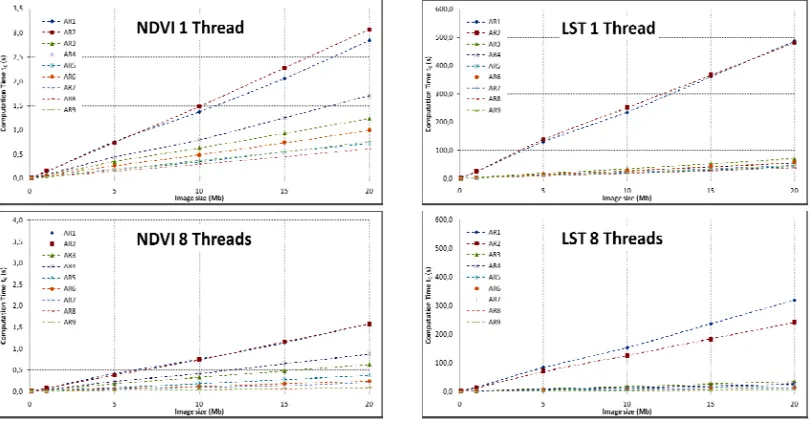
In order to show the linear tendency of tC with the image size increasing, Fig. 4 has been constructed for all the images (see Table 1, in §3) and hardware architectures (see Table 2, in §3). We have chosen n=1 (1 SMT) and n=8 (8 SMT) with the aim of comparing serial and parallel computing. We have taken in mind that the maximum number of cores in our case is corresponding to eight physical cores (see Table 2, in §3).
The SpeedUp, as non unit index, is defined as a ratio of execution times with the aim of quantifying the gain in time comparing the serialized and parallelized programs. It is given by the following equation:
SpeedUp(n) = (6)
where n is the number of SMT, tC(1) is the iterative algorithm time or the running time corresponding to a unique thread and tC(n)
is the time corresponding to the running time of a number of n simultaneous threads.
Fig. 5. Speedup in function of the number of SMT for six image sizes (IM1 with 20 Mb, IM2 with 15 Mb, IM3 with 10 Mb, IM4 with 5 Mb, IM5 with 1 Mb, IM6 with 100 Kb) and for the nine hardware architectures corresponding to the application of the NDVI and LST algorithms.
tC(1)
tC(n)
In order to quantify the potential of the developed 3MCF framework, the SpeedUp(n) with (n=1 to n=16) corresponding to a total number of 414720 tests of micro-benchmarks (see paragraph §3) applying Eq. (1) and Eq. (2). Fig. 5 shows the SpeedUp results in function of the number of SMT (from 1 to 16) computed for the six images (in Table 1, in §3) and the nine hardware architectures (in Table 2, in §3). The SpeedUp has been obtained by averaging the 240 SpeedUp values corresponding to 12 months of 20 years.
For the whole sizes (except NDVI 100Kb) it has been verified for standard and common computer running operating system windows without special configurations that the gain on remote sensing computations can attain Eq. (7) and Eq. (8):
SpeedUp(n) = n ; n ≤ PC (7)
SpeedUp(n) = n - (LC/k) ; PC < n ≤ PC+LC (8)
with k[1,[ depending on the hardware technology and the algorithm complexity. PC and LC are the number of the physical and logical cores respectively.
For the NDVI 100 Kb the behavior shown in Eq. (7) and Eq. (8) is not respected in comparison to LST 100 Kb. This is due to the fact that the complexity of the algorithm influences tC when applying the multithreading technique on multicore architectures.
5. Conclusion
The potential of the developed Multitemporal Multithreading on Multicore Computations Framework (3MCF) applied to Remote Sensing (RS) algorithm computation has been shown (in our case NDVI and LST algorithms). The Multithreading on a multicore approach has potentially increased the multitemporal performance computing of the huge quantity of satellite remotely sensed data (in our case PAL data, with about 1744 Gbyte).
The 3MCF was applied for a total number of 414720 benchmarks on different hardware architectures: i) 2 cores (Intel Pentium D, Intel Core 2 Duo, AMD Athlon X2), ii) 4 cores (Intel Core 2 Quad, Intel i7, AMD Operton X4), iii) 8cores (Xeon Nehalem). Final results show a gain of 8X for the octal core, 4X for the quad core and 2X for the dual core.
Acknowledgment
This work was supported in part by the Ministry for Higher Education, Management Training and Scientific Research under CSPT Grants for “Integration and application of GIS and GPS on mobile systems” and “Ad-hoc wireless sensor networks for remote sensing algorithm validation” projects.
The authors would like to express gratitude to external anonymous referees whose comments and suggestions improved this manuscript. The authors would also like to thank the Open Source communities maintaining the GDAL library and the NASA’s Goddard Space Flight Center for providing satellite data.
References
[1] N. Ben Achhab, N. Raissouni, A. Azyat, a. Chahboun, and M. Lahraoua, "High performance computing software package for multitemporal Remote-Sensing computations," International Journal of Engineering and Technology, vol. 2, no. 5, pp. 360-365, Oct.2010.
[2] N. Ben Achhab, N. Raissouni, J. A. Sobrino, A. Azyat, M. Lahraoua, a. Chahboun, and M. Atitar, "Automatic temporal analysis software package for satellite remote sensing ATA-SRS," in Second Recent Advances in Quantitative Remote Sensing 2006, pp. 210-215.
[3] R. L. Carlson, A Study of hardware/software multithreading 1998.
[4] R. H. Carver and K. C. Tai, Modern multithreading implementing, testing, and debugging multithreaded Java and C++/Pthreads/Win32 programs. Hoboken, NJ: Wiley, 2006.
[5] D. Casanova, G. F. Epema, and J. Goudriaan, "Monitoring rice reflectance at field level for estimating biomass and LAI," Field Crops Research, vol. 55, no. 1-2, pp. 83-92, Jan.1998.
[6] L. Chao, "Intel® Hyper-Threading Technology," in Technical User's Guide, 6 ed. Intel Corporation, Ed. 2003.
[7] L. Chen, Y. Gao, L. Yang, Q. Liu, X. Gu, and G. Tian, "MODIS-derived daily PAR simulation from cloud-free images and its validation," Solar Energy, vol. 82, no. 6, pp. 528-534, June2008.
[8] E. Chuvieco, P. Englefield, A. P. Trishchenko, and Y. Luo, "Generation of long time series of burn area maps of the boreal forest from NOAA-AVHRR composite data," Remote Sensing of Environment, vol. 112, no. 5, pp. 2381-2396, May2008.
[9] J. G. P. W. Clevers, "Application of a weighted infrared-red vegetation index for estimating leaf Area Index by Correcting for Soil Moisture," Remote Sensing of Environment, vol. 29, no. 1, pp. 25-37, July1989.
[10] J. G. P. W. Clevers, "Application of the WDVI in estimating LAI at the generative stage of barley," ISPRS Journal of Photogrammetry and Remote Sensing, vol. 46, no. 1, pp. 37-47, Feb.1991.
[11] G. Eddon, "COM+: the evolution of component services," IEEE Computer, vol. 32, no. 7, pp. 104-106, July1999.
[12] J. C. Epiphanio and A. R. Huete, "Dependence of NDVI and SAVI on sun/sensor geometry and its effect on fAPAR relationships in Alfalfa," Remote Sensing of Environment, vol. 51, no. 3, pp. 351-360, Mar.1995.
[14] G. A. Geist, J. A. Kohl, and P. M. Papadopoulos, "PVM and MPI: A Comparison of Features," Calculateurs Paralleles, vol. 8, no. 2 May1996. [15] F. Gemmell and A. J. McDonald, "View Zenith Angle Effects on the Forest Information Content of Three Spectral Indices," Remote Sensing of
Environment, vol. 72, no. 2, pp. 139-158, May2000.
[16] H. H. Goldstine, The computer from Pascal to Von Neumann Princeton University Press, 1972.
[17] L. M. Gonzales, J. W. Williams, and J. O. Kaplan, "Variations in leaf area index in northern and eastern North America over the past 21,000 years: a data-model comparison," Quaternary Science Reviews, vol. 27, no. 13-14, pp. 1453-1466, July2008.
[18] M. C. Gonzblez-Sanpedro, T. Le Toan, J. Moreno, L. Kergoat, and E. Rubio, "Seasonal variations of leaf area index of agricultural fields retrieved from Landsat data," Remote Sensing of Environment, vol. 112, no. 3, pp. 810-824, Mar.2008.
[19] W. Gropp, E. Lusk, and A. Skjellum, Using MPI: Portable Parallel Programming with the Message-Passing Interface 1994.
[20] G. Gutman and A. Ignatov, "The relative merit of cloud/clear identification in the NOAA/NASA Pathfinder AVHRR Land 10-day composites," International Journal of Remote Sensing, vol. 17, no. 16, pp. 3295-3304, 1996.
[21] J. L. Hennesy and D. A. Patterson, Computer architecture A Quantitative Approach, 4 ed Morgan Kaufmann, 2006.
[22] A. R. Huete, "A soil-adjusted vegetation index (SAVI)," Remote Sensing of Environment, vol. 25, no. 3, pp. 295-309, Aug.1988.
[23] A. R. Huete, G. Hua, J. Qi, A. Chehbouni, and W. J. D. van Leeuwen, "Normalization of multidirectional red and NIR reflectances with the SAVI," Remote Sensing of Environment, vol. 41, no. 2-3, pp. 143-154, 1992.
[24] P. Ineichen, "Conversion function between the Linke turbidity and the atmospheric water vapor and aerosol content," Solar Energy, vol. 82, no. 11, pp. 1095-1097, Nov.2008.
[25] Intel Corporation, "Intel® 64 and IA-32 Architectures Software Developer's Manual," 2009. [26] Intel Corporation, "IA-32 Intel® Architecture Software Developer's Manual,", Volume 1 ed 2006. [27] Intel Corporation, "Inside Intel® Core Microarchitecture and Smart Memory Access," 2006.
[28] A. B. Kahle, J. P. Schieldge, and R. E. Alley, "Sensitivity of thermal inertia calculations to variations in environmental factors," Remote Sensing of Environment, vol. 16, no. 3, pp. 211-232, Dec.1984.
[29] W. Kai-feng, J. Zhen-zhou, and H. Ming-zeng, "Simultaneous multithreading trace processors Improving trace processor performance,", 30 ed 2006, pp. 102-116.
[30] H. Kwak, A performance study of multithreading 1998.
[31] C. Laurence, Extensible Runtime Containment and Services Protocol for JavaBeans Version 1.0 1998.
[32] D. Lo Seen, E. Mougin, S. Rambal, A. Gaston, and P. Hiernaux, "A regional Sahelian grassland model to be coupled with multispectral satellite data. II: Toward the control of its simulations by remotely sensed indices," Remote Sensing of Environment, vol. 52, no. 3, pp. 194-206, June1995. [33] D. T. Marr, F. Binns, D. L. Hill, D. A. Koufaty, J. A. Miller, and M. Upton, "Hyper-Threading Technology Architecture and Microarchitecture," Intel
Technology Journal, vol. 6, no. 1, pp. 4-15, Feb.2002.
[34] OMG, Common Object Request Broker Architecture: Core Specification, 3.0.3 ed 2004.
[35] V. J. Pattery, B. Lee, C. Won, H. Lee, and H.-C. Oh, "Analysis of the effectiveness of multithreading for interrupts on communication processors," in Communications and Computer Networks. M.H.Hamza, Ed. 2002, pp. 145-154.
[36] N. Raissouni and J. A. Sobrino, "Application of the SWCVR algorithm to Asia PAL data for the retrieval of the atmospheric water vapor," in Information and Communication Technologies International Symposium's 05 Sofitel Hotel, Marina Smir Tetuan, Morocco: 2005, pp. 498-503. [37] U. Rajasekar and Q. Weng, "Urban heat island monitoring and analysis using a non-parametric model: A case study of Indianapolis," ISPRS Journal
of Photogrammetry and Remote Sensing, vol. 64, pp. 86-96, 2009.
[38] M. K. Raynolds, J. C. Comiso, D. A. Walker, and D. Verbyla, "Relationship between satellite-derived land surface temperatures, arctic vegetation types, and NDVI," Remote Sensing of Environment, vol. 112, no. 4, pp. 1884-1894, Apr.2008.
[39] J. W. Rouse, R. H. Haas, J. A. Schell, and D. W. Deering, "Monitoring vegetation systems in the Great Plains with ERTS," NASA. Goddard Space Flight Center 3d ERTS-1 Symp., vol. 1, pp. 309-317, Jan.1974.
[40] A. Scrivani and U. Bardi, "A study of the use of solar concentrating plants for the atmospheric water vapour extraction from ambient air in the Middle East and Northern Africa region," Desalination, vol. 220, no. 1-3, pp. 592-599, Mar.2008.
[41] T. D. Setiyono, A. Weiss, J. E. Specht, K. G. Cassman, and A. Dobermann, "Leaf area index simulation in soybean grown under near-optimal conditions," Field Crops Research, vol. 108, no. 1, pp. 82-92, July2008.
[42] J. Shalf, L. Oliker, M. Lijewski, S. Kamil, J. Carter, and A. Canning, "Performance Characteristics of Potential Petascale Scientific Applications," in Petascale computing algorithms and applications. d. a. Bader, Ed. Taylor & Francis, 2008, pp. 1-28.
[43] J. A. Sobrino, M. H. El Kharraz, J. Cuenca, and N. Raissouni, "Thermal inertia mapping from NOAA-AVHRR data," Advances in Space Research, vol. 22, no. 5, pp. 655-667, Oct.1998.
[44] J. A. Sobrino and N. Raissouni, "Toward remote sensing methods for land cover dynamic monitoring. Application to Morocco," International Journal of Remote Sensing, vol. 21, no. 2, pp. 353-366, 2000.
[45] J. A. Sobrino, N. Raissouni, and Z. L. Li, "A comparative study of land surface emissivity retrieval from NOAA data," Remote Sensing of Environment, vol. 75, no. 2, pp. 256-266, Feb.2001.
[46] J. A. Sobrino, N. Raissouni, J. Simarro, F. Nerry, and P. François, "Atmospheric water vapor content over land surfaces derived from the AVHRR Data. Application to the Iberian Peninsula," Transactions on Geoscience and Remote Sensing, no. 37, pp. 1425-1434, May1999.
[47] Sun Microsystems, Multithreaded Programming Guide Sun Microsystems, 2002.
[48] X. Tang, Y. Liu, J. Zhang, and W. Kainz, Advances in spatio-temporal analysis Taylor & Francis, 2008. [49] L. Tarricone and A. Esposito, Grid Computing for Electromagnetics Artech House, 2004.
[50] S. Vangal, J. Howard, G. Ruhl, S. Dighe, H. Wilson, J. Tschanz, D. Finan, P. Iyer, A. Singh, T. Jacob, S. Jain, S. Venkataraman, Y. Hoskote, and N. Borkar, "An 80-Tile 1.28TFLOPS Network-on-Chip in 65nm CMOS," San Francisco, CA: 2007.
[51] W. W. Verstraeten, F. Veroustraete, C. J. van der Sande, I. Grootaers, and J. Feyen, "Soil moisture retrieval using thermal inertia, determined with visible and thermal spaceborne data, validated for European forests," Remote Sensing of Environment, vol. 101, no. 3, pp. 299-314, Apr.2006. [52] G. Voss, Introducing Java Beans Sun Microsystems, 1996.
[53] Z. Wan, "New refinements and validation of the MODIS Land-Surface Temperature/Emissivity products," Remote Sensing of Environment, vol. 112, no. 1, pp. 59-74, Jan.2008.
[54] W. Wang, S. Liang, and T. Meyers, "Validating MODIS land surface temperature products using long-term night time ground measurements," Remote Sensing of Environment, vol. 112, no. 3, pp. 623-635, Mar.2008.
[55] C. Wu, Z. Niu, Q. Tang, and W. Huang, "Estimating chlorophyll content from hyperspectral vegetation indices: Modeling and validation," Agricultural and Forest Meteorology, vol. 148, no. 8-9, pp. 1230-1241, July2008.
[56] H. Xiao and Q. Weng, "The impact of land use and land cover changes on land surface temperature in a karst area of China," Journal of Environmental Management, vol. 85, no. 1, pp. 245-257, Oct.2007.
[57] Y. Yi, D. Yang, J. Huang, and D. Chen, "Evaluation of MODIS surface reflectance products for wheat leaf area index (LAI) retrieval," ISPRS Journal of Photogrammetry and Remote Sensing, vol. 63, no. 6, pp. 661-667, Nov.2008.
[58] Geospatial Data Abstraction Library, http://www.gdal.org/
N. BEN ACHHAB received the degree in Informatics, Electronics, Electrotechnics, and Automatics (IEEA) and M.S. degree in Bioinformatics from University Abdelmalek Essaadi (UAE), Tetuan, Morocco, in 1995 and 2004 respectively. Currently, he is a member of Remote-Sensing & Mobile-GIS Unit/Telecoms Innovation & Engineering Research group. His present research include remote sensing multitemporal and spatiotemporal studies of thermal infrared satellite imagery of the earth’s surface, the in-situ LST measurements and the development of remote sensing methods for land cove dynamic monitoring. It includes also, Grid computing, Multithreading, GPGPU, hardware and software methods for time computing optimizations.
N. Raissouni received the M.S., and Ph.D. degrees in physics from the University of Valencia, Spain, in 1997, and 1999, respectively. He has been a Professor of physics and remote sensing at the National Engineering School for Applied Sciences of the University Abdelmalek Essaadi (UAE) of Tetuan, since 2003. He is also heading the Innovation & Telecoms Engineering research group at the UAE, responsible of the Remote Sensing & Mobile GIS unit. His research interests include atmospheric correction in visible and infrared domains, the retrieval of emissivity and surface temperature from satellite image, huge remote sensing computations, Mobile GIS, Adhoc networks and the development of remote sensing methods for land cover dynamic monitoring.
A. Chahboun obtained his degree from Central School of Arts and Businesses in Brussels Belgium, M.S. in Telecommunication Systems from University Abdelmalek Essaadi in 2006. He was Maintenance responsible engineer of radiology and medical imaging materials, at FREELANCE SERVICE enterprise Rabat-Morocco, from 1995 to 2003. Currently, he is a member of Remote-Sensing & Mobile-GIS Unit/Telecoms Innovation & Engineering Research group. His current areas of research are Wireless Sensor Networks, Routing in Ad hoc Network, Network Security, remote sensing, the development of remote sensing methods for land cove dynamic monitoring and Grid computing.
A. Azyat received the degree in Informatics, Electronics, Electrotechnics, and Automatics (IEEA) and M.S. degree in Bioinformatics from University Abdelmalek Essaadi (UAE), Tetuan, Morocco, in 1995 and 2004 respectively. Currently, he is a member of Remote-Sensing & Mobile-GIS Unit/Telecoms Innovation & Engineering Research group. His research interests include remote sensing, spatiotemporal studies of thermal infrared satellite imagery of the earth’s surface and the development of remote sensing methods for land cove dynamic monitoring, GIS and Mobile GIS.