*Corresponding author, E-mail:[email protected]
SHORT COMMUNICATION
GERMINATION BEHAVIOUR AND PHYSIOLOGICAL RESPONSE OF RICE TO PAPER
MILL EFFLUENT APPLICATION
MADHUMITA PAUL1*, H.C. JOSHI1 AND R.K. SAIRAM2
1Division of Enviornmental Sciences, 2Division of Plant Physiology, Indian Agricultural Research Institute, New Delhi-110 012 Received on 27 Sept., 2007, Revised on 30 Dec., 2007
A study was conducted to examine the effect of different levels of paper mill effluent on rice var. Pusa Basmati-1 (PB-l) at the germination stage. The effluent at higher concentration showed limited inhibitory effect on the germination percentage. The shoot and root length increased on application of effluent at 25 and 50 % concentration but higher concentrations of effluent, i.e. 75 and 100 % effluent, retarded the root and shoot length of the seedlings. RWC and MSI decreased with increase in the effluent concentration but the total sugar content increased significantly with the increase in effluent concentration. Hydrogen peroxide content increased in the seedlings under higher concentration of effluent with a corresponding increase in lipid peroxidation. At higher concentration of paper mill effluents, activity of antioxidant enzyme system, viz. superoxide dismutase (SOD), catalase and peroxidase increased significantly over the control. Thus salinity stress created by the paper mill effluent was found to be significantly higher at 75 and 100% paper mill effluent concentration.
Key words: Antioxidant activity, MSI, paper mill effluent, rice, RWC
Intensification of agriculture has lead to an increase in the water needs of this sector. At the same time expansion of economy has created competing inter-sectoral and intra-inter-sectoral demands for the water use. But temporal and spatial scarcity of water resources has made it difficult to meet these demands. Therefore, it has become imperative to explore alternative sources of irrigation to meet the water demands. With the environment norms becoming stringent, industries are also looking for suitable means for disposal of the wastewater generated by them. The option of land application of the waste waster has been suggested as one of the method of disposal as well as meeting the water demands.
Paper industry, one of the largest consumers of
water, utilizes about 250-350 m3 of water per ton of
paper produced (Gove 1982). 75 to 95 % of the fresh
water used in the paper and pulp mills is discharged as effluent. The wastewater emanating from the pulp and paper mills is rich in lignin, cellulose, organic carbon, calcium, magnesium, sodium, chloride, sulphite and bicarbonate (Rajannan and Oblisami 1979). These effluents are being used for irrigating various crops. The present investigation was therefore, carried out to study the effect of application of different levels of treated paper mill effluent on rice variety PB-1. The treated pulp and paper mill effluent has been classified in the irrigation water class of ‘increasing problem’ to ‘severe problem’ with respect to salinity and specific ion toxicity by
Thawale et al. (1999). The effect was studied in terms
of germination behavior and physiological response of rice var. PB-1.
Seeds of rice (Oryza sativa L. ) variety PB-l were
Indian J. Plant Physiol., Vol. 12, No. 4, (N.S.) pp. 388-392 (Oct.-Dec., 2007)
solution for two minutes and then washed thoroughly with distilled water (5-6 times). The seeds were germinated on soaked filterpaper in petriplates and kept in incubator at 25°C.Four different levels of paper mill effluents (25, 50, 75 and 100 %) in equal amounts were applied to the seeds in replication of three. The germination percentage, root length and shoot length were recorded on the 5th day of germination. Vigour index was calculated as per the equation by Anderson and Abdul-baki (1973):
Vigour index = (Root length + Shoot length) x Germination percentage
The shoot samples were collected on the fifth day and following parameters were studied. Membrane stability was determined according to the method of
Premchandra et al. (1990) as modified by Sairam et al.
(1994), Relative water content (RWC) of fresh plant samples was determined according to the method of Weatherley (1950). Total sugars were estimated by Nelson arsenomolybdate method. Hydrogen peroxide
(H2O2) was estimated by recording the absorbance of
titanium-hydrogen peroxide complex (Taranishi et al.
1974). The level of lipid peroxidation was measured in terms of thiobarbituric acid reactive substances (TBARS) content (Heath and Packer 1968).
Enzyme assay for superoxide dismutase (SOD), catalase and peroxidase was done by freezing the samples (1 g) in liquid nitrogen. The samples were then homogenized in pre-chilled pestle and mortar with ice cold 0.1 M phosphate buffer (pH 7.5) containing 0.5 mM EDTA and filtered. The homogenate was centrifuged at 4°C for 15 minutes at 15000 x g and the supernatant was used as enzyme extract.
SOD activity was estimated by recording the decrease in absorbance of superoxide-nitro blue
tetrazolium complex by the enzyme (Dhindsa et al.
1981). Absorbance was recorded at 560 nm and one unit of enzyme activity was taken as the quantity which reduced the absorbance reading of samples to 50 % in comparison with tubes lacking the enzymes. Catalase
was assayed by measuring the disappearance of H2O2
according to Aebi (1984). The decrease in absorbance at 240 nm was observed for 1 minute in a UV-visible spectrophotometer. Enzyme activity was computed by
calculating the amount of H2O2 decomposed. Peroxidase
assay was done according to the method of Castillo et
al. (1984). After initiating the reaction by addition of
H2O2, increase in absorbance due to formation of
tetra-guaiacol was recorded at 470 nm spectro-photometrically over a period of 1 minute. Data was statistically analyzed at 5% level of significance.
Pulp and paper mills release effluents having a mixture of chemicals used in digestion of raw wood chips, cellulose fibres and dissolved lignin and also wood extractives (Patel and Gadhia 2000). These dissolved chemicals can have significant effect on the germination stage, which is a crucial phase in the establishment of natural population of plants. Physiochemical characteristics of the paper mill effluent used in the study are presented in the Table 1. The change in germination
Table 1. Average physico-chemical characteristics of the effluents from Shreyans Paper Mill
Characteristics Values
Colour Brown
pH 7.93
EC (dS m-1) 3.25
BOD (mg 1-1) 65
COD (mg l-1) 260
Sodium (ppm) 300
Potassium (ppm) 160 Calcium (meq/l) 8.75 Magnesium (meq/l) 3.75
SAR 5.20
ZinC (ppm) 0.26
Manganese (ppm) 0.23
Copper (ppm) 0.22
Iron (ppm) 1.17
Total Dissolved solids (ppm) 1820
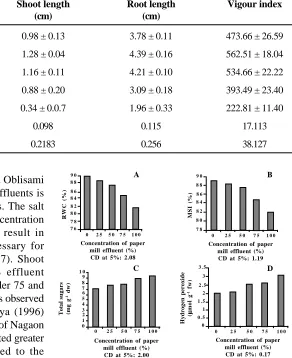
by Misra and Behra (1991) and Rajannan and Oblisami (1979). This inhibitory effect of paper mill effluents is due to dissolved salts present in the effluents. The salt concentration of the effluent alter the salt concentration of soil and build up salinity in soils and result in disturbance of seed water interaction necessary for triggering the enzyme system (Baruah 1997). Shoot length was increased under 25 and 50 % effluent concentration while there was a decrease under 75 and 100 % effluent concentration. Similar trend was observed in the root length of PB-l. Dutta and Boissya (1996) have also reported that at lower concentration of Nagaon paper mill effluents, the seedling of rice exhibited greater shoot and root length which was attributed to the presence of nutrients like nitrogen, potassium, calcium and magnesium in the diluted effluents in optimum concentration promoting the growth of both root and shoot. In the undiluted effluent, concentration of these nutrients was too high to become toxic, resulting in restricted root and shoot growth. Vigor index of PB-l was found to have a similar trend of increase under 25 and 50% effluent and decreased under 75 and 100 % effluent. This stimulatory effect of effluents under dilution has been attributed by Dhevagi and Oblisami (2000) to the reduction in level of toxic metabolites by dilution and better utilization of nutrients present in the effluent at reduced level of toxicity.
The relative water content (RWC) of the crops showed a decline trend with increase in effluent concentration (Fig. lA). The decline in RWC in the rice
Table 2. Effect of paper mill effluent on germination percentage, shoot length, root length and vigour index of rice var. PB-l
Paper mill effluent Germination Shoot length Root length Vigour index
concentration (%) percentage (cm) (cm)
0 99.56 ± 0.77 0.98 ± 0.13 3.78 ± 0.11 473.66 ± 26.59 25 99.33 ± 0.67 1.28 ± 0.04 4.39 ± 0.16 562.51 ± 18.04 50 99.56 ± 0.38 1.16 ± 0.11 4.21 ± 0.10 534.66 ± 22.22 75 99.11 ± 0.38 0.88 ± 0.20 3.09 ± 0.18 393.49 ± 23.40 100 96.89 ± 0.38 0.34 ± 0.0.7 1.96 ± 0.33 222.81 ± 11.40
SEm ± 0.423 0.098 0.115 17.113
CD at 5% 0.942 0.2183 0.256 38.127
seedlings was found to be significantly greater under 75 and 100% effluent concentration over the control. The paper mill effluents have slightly alkaline pH and high dissolved salts. Due to high dissolved salts, paper mill effluents belong to the irrigation water class of ‘increasing problem’ to ‘severe problem’ with respect to salinity and specific ion toxicity. Therefore, irrigation with paper mill effluent creates salinity stress in the crop plants. Various workers have reported a salinity induced decline in RWC in crop plants. Decrease in RWC under salinity stress has been reported by Gadallah (1999) in
Vicia faba and by Sharma et al. (1983) and Sairam et
al. (2002) in wheat.
Fig. 1. Effect of different concentration of paper mill effluent on (A) RWC, (B) MSI, (C) total sugars and (D) hydrogen peroxide in seedlings of rice var. PB-1
9 0 8 8
8 6 8 4 8 2 8 0
7 8 7 6
0 2 5 5 0 7 5 1 0 0
Concentration of paper mill effluent (%)
CD at 5%: 2.08
RWC (%)
9 0
8 8
8 6 8 4
8 2
8 0
7 8
0 2 5 5 0 7 5 1 0 0
Concentration of paper mill effluent (%) CD at 5%: 1.19
MSI (%)
3 . 5
3
2 . 5 2 1 . 5 1 0 . 5
0 2 5 5 0 7 5 1 0 0
Concentration of paper mill effluent (%) CD at 5%: 0.17
Hydrogen peroxide
(
µµµµµ
mol g
-1 fw)
0 0 2 5 5 0 7 5 1 0 0
Concentration of paper mill effluent (%) CD at 5%: 2.00
Total sugars (mg g
-1 dw)
1 0 9 8 7 6 5 4 3 2 1 0
A B
Indian J. Plant Physiol., Vol. 12, No. 4, (N.S.) pp. 388-392 (Oct.-Dec., 2007)
Application of paper mill effluent resulted in a decline in membrane stability index (MSI) of the crop plants (Fig. 1B). In the rice seedlings, the decline in MSI corresponded with the increase in the concentration of paper mill effluent. The germination stage of the crops is most sensitive to salinity stress. Therefore, MSI was found to decline significantly under all the effluent treatments. Salinity stress causes an increase in generation of active oxygen species and resultant decrease in the membrane stability is due the lipid
peroxidation by these active oxygen species (Dhindsa et
al. 1981). This could be the possible reason for the
decline in MSI with increase in effluent concentration. Similar decline in MSI has been reported in wheat by
Sairam et al. (2002) under salinity stress.
Under abiotic stress plants accumulate soluble carbohydrates. These soluble sugars play an important role in protecting the cells under stress by maintaining the osmotic strength of the cytosol and balancing it with that of vacuole and external environment. The soluble sugars content was found to increase under all the effluent treatments in rice seedlings over the control (Fig. 1C). This indicates osmotic adjustments in the seedlings on application of paper mill effluents. Similar results of increase in soluble sugars under salinity stress
have been reported by Sairam et al. (2002) and Rhodes
(1987).
Production of active oxygen species like superoxide
(02-), hydrogen peroxide (H
2O2) and hydroxyl radical
significantly increase during abiotic stress in the crop plants. Under normal condition, these reactive oxygen species are well regulated by cell metabolism but under abiotic stress they may exceed the scavenging capacity of antioxidant system. Significant increase in hydrogen peroxide content with increase in effluent concentration was observed in the rice seedlings (Fig. 1D). Higher
levels of H2O2 can also accelerate the processes like
Haber-Weiss reaction, resulting in formation of hydroxyl
radicals that can cause lipid peroxidation (Loggini et al.
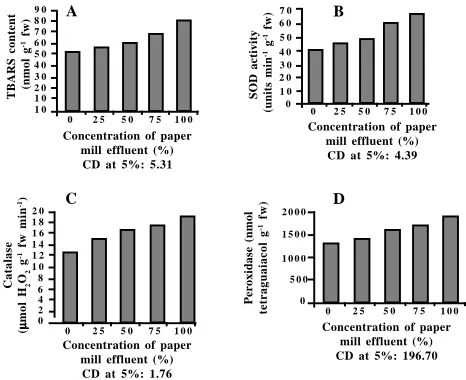
1999). This is reflected in the significantly higher extent of lipid peroxidation observed in PB-l seedlings under 50, 75 and 100% effluent concentrations (Fig. 2A). Similar increase in lipid peroxidation under salinity stress has been reported by Dionisio-Sese and Tobita (1980) in rice under salinity stress.
Plants possess antioxidant system to endure the oxidative damage caused by reactive oxygen species under oxidative stress such as high temperatures, drought, salinity etc. Antioxidant system in plants consists of enzymes such as superoxide dismutase, ascorbate peroxidase, glutathione peroxidase, catalase etc. (Smirnoff 1995). Activity of these antioxidant enzymes increases under stress. Superoxide dismutase activity was found to increase significantly under the effluent irrigation in the rice seedlings indicating osmotic stress with increase in effluent concentration (Fig. 2B). Catalase activity was also found to increase significantly in rice under 50, 75 and 100% effluent concentrations (Fig. 2C). Peroxidase activity also showed a trend similar to catalase with increase in activity with increase in effluent concentration at germinating stage (Fig. 2D).
Results obtained in this study indicate variation in response of PB-1 to different levels of paper mill effluent applied. Effluents at lower concentration have favorable effect on the shoot and root length of rice seedlings while shoot and root length declines with increase in effluent concentration. Germination percentage also declined with application of effluent without dilution. As the concentration of effluent increases the seedlings showed signs of osmotic stress. The RWC and MSI of PB-1 declined, while total sugars increased as plant cells undergo osmotic adjustments. Increase in the hydrogen
Fig. 2. Effect of different concentration of paper mill effluent on (A) lipid peroxidation (TBARS content), (B) SOD, (C) catalase and (D) peroxidase in rice var. PB-1
2 0 1 8 1 6 1 4 1 2 1 0 8 6
0 2 5 5 0 7 5 1 0 0
Concentration of paper mill effluent (%) CD at 5%: 1.76
Catalase
(µµµµµ
mol H
2
O2
g
-1 fw min -1)
4
0 2
2 0 0 0
1 5 0 0
1 0 0 0
5 0 0
0 2 5 5 0 7 5 1 0 0
Concentration of paper mill effluent (%) CD at 5%: 196.70
Peroxidase (nmol
tetraguaiacol g
-1 fw)
0 9 0
8 0 7 0 6 0 5 0 4 0 3 0 2 0
0 2 5 5 0 7 5 1 0 0
Concentration of paper mill effluent (%) CD at 5%: 5.31
TBARS content (nmol g
-1 fw)
1 0 1 0
7 0 6 0 5 0 4 0 3 0 2 0
0 2 5 5 0 7 5 1 0 0
Concentration of paper mill effluent (%) CD at 5%: 4.39
SOD activity
(units min
-1 g -1 fw)
1 0 0
A B
peroxide content in the seedlings resulted in lipid peroxidation with increased effluent concentration. There was a corresponding increase in antioxidant enzyme system too.
REFERENCES
Abdul-baki, A.S. and Anderson, J.O. (1973). Vigour determination in soybean seeds by multiple criteria.
Crop Sci. 3: 630-633.
Aebi, H. (1984). Catalase in vitro. Methods Enzymol.105: 121-126.
Baruah, B.K. and Das, M. (1998). Study on the effect of paper mill effluent on physiochemical characteristics of soil.
J.Natcon. 10: 101-106.
Dhevagi, P. and Oblisami, G. (2000). Effect of paper mill effluent on germination of agricultural crops. J. Ecobiol. 12:243-249.
Dhindsa, R.S., Plumb-Dhindsa, P. and Throne, T.A. (1981). Leaf senescense: correlated with increased levels of membrane permeability and lipid peroxidation and decreased levels of superoxide dismutase and catalse.
J. Expt. Bot. 32:93-1 01.
Dionisio-Sese, M.L. and Tobita, S. (1998). Antioxidant responses of rice seedling to salinity stress. Plant Sci.
Limerick. 135: 1-9.
Dutta, S.K. and Boissya, C.L. (1999). Effect of paper mill effluent on the growth, yield and N, P, K contents of transplanted rice (Oryza sativa L. var. Mahsuri). J.
Environ. Biol. 20:29-32.
Gadallah, M.A.A. (1999). Effect of protein and glycine betaine
on Vicia faba response to salt stress. Biol. Plant 42:
247-249.
Gove, G.W. (1982). Pulp and paper industry waste water management. J. Water Pollution Con. Fed. 53: 701-719.
Heath, R.L. and Packer, L. (1968). Photoperoxidation in isolated chloroplast. I. Kinetics and Stoichiometry of fatty acid peroxidation. Arch. Biochem. Biophy. 125:
189-198.
Loggini, B., Scartazza, A., Brugnoli, E. and Navmi-Izzo, F. (1999). Antioxidation defense system, pigment composition and photosynthetic efficiency in two wheat cultivars subjected to drought. Plant Physiol. 119:
1091-1100.
Mishra, R.N. and Behera, P.K. (1991). The effect of paper industry effluent on growth, pigment, carbohydrates and proteins of rice seedlings. Environ. Pollut. 72: 159- 168.
Nelson, N. (1944). A photometric adoptation of the Somogyi's method for determination of glucose. J. Biol. Chem. 153:
375-380.
Patel, P. and Gadhia, M. (2000). Effectiveness of effluent treatment plant of pulp and paper mill effluent. J.
Ecotoxicol. Environ. Monit. 10: 43-46.
Premchand, G.S., Sangroka, T. and Ogatta, S. (1990). Cell membrane stability as indicators of drought tolerance as affected by applied nitrogen in soyabean. J. Agric. Sci.115: 63-66.
Rajannan, G. and Oblisami, G. (1979). Effect of paper factory effluents on the soil and crop plants. Indian J. Environ.
Hlth. 21:120-130.
Rhodes, D. (1987). Metabolic response to stress, In: P.K. Stumpf, J. Priess (Eds.), The Biochemistry of Plants, Vol. 12, pp. 201-241. Academic Press, San Diego, CA.
Sairam, R.K. (1994). Effect of moisture stress on physiological activities of two contrasting wheat genotypes. Indian
J. Exp. Biol. 32: 584-593.
Sairam, R.K., Veerbhadra, K.R. and Srivastava, G.C. (2002). Differential response of wheat genotypes to long-term salinity stress in relation to oxidative stress, antioxidant activity and osmolyte concentration. Plant Sci. 163:
1037-1046.
Sharma, S.K. and Garg, O.P. (1983). Comparative study of osmotic and salt stress effects on nitrate assimilation in wheat. Curr. Agric.7: 36-40.
Smirnoff, N. (1995). Antioxidant system and plant responses In: N. Smirnoff (Ed.), Enviornment and Plant Metabolism: Flexibility and Acclimation, pp. 217-243. Bios Scientific Publishers Oxford.
Taranishi, Y., Tanaka, A., Osumi, N. and Fukui, S. (1974). Catalase activity of hydrocarbon utilizing Candida
yeast. Agric. Biol. Chem. 38: 1213-1216.
Thawale, P.R., Juwarkar, A.S., Kulkami, A.B. and Juwarkar, A.A. (1999). Lysimeter studies for evaluation of changes in soil properties and crop yield using wastewater.
Intern. J. Trop. Agric. 41: 231-244.