Atmos. Meas. Tech., 11, 4239–4260, 2018 https://doi.org/10.5194/amt-11-4239-2018 © Author(s) 2018. This work is distributed under the Creative Commons Attribution 4.0 License.
Estimating observation and model error variances
using multiple data sets
Richard Anthes1and Therese Rieckh1,2
1COSMIC Program Office, University Corporation for Atmospheric Research, Boulder, Colorado, USA 2Wegener Center for Climate and Global Change, University of Graz, Graz, Austria
Correspondence:Richard Anthes ([email protected])
Received: 29 December 2017 – Discussion started: 18 January 2018 Revised: 21 June 2018 – Accepted: 22 June 2018 – Published: 19 July 2018
Abstract.In this paper we show how multiple data sets, in-cluding observations and models, can be combined using the “three-cornered hat” (3CH) method to estimate vertical pro-files of the errors of each system. Using data from 2007, we estimate the error variances of radio occultation (RO), ra-diosondes, ERA-Interim, and Global Forecast System (GFS) model data sets at four radiosonde locations in the tropics and subtropics. A key assumption is the neglect of error covari-ances among the different data sets, and we examine the con-sequences of this assumption on the resulting error estimates. Our results show that different combinations of the four data sets yield similar relative and specific humidity, temperature, and refractivity error variance profiles at the four stations, and these estimates are consistent with previous estimates where available. These results thus indicate that the correla-tions of the errors among all data sets are small and the 3CH method yields realistic error variance profiles. The estimated error variances of the ERA-Interim data set are smallest, a reasonable result considering the excellent model and data assimilation system and assimilation of high-quality obsvations. For the four locations studied, RO has smaller er-ror variances than radiosondes, in agreement with previous studies. Part of the larger error variance of the radiosondes is associated with representativeness differences because ra-diosondes are point measurements, while the other data sets represent horizontal averages over scales of ∼100 km.
1 Introduction
Estimating the error characteristics of any observational sys-tem or model is important for many reasons. Not only are
these errors of scientific interest; they are also important for data assimilation systems and numerical weather prediction. In many modern data assimilation schemes, observations of a given type are weighted proportionally to the inverse of their error variance (e.g., Desroziers and Ivanov, 2001).
Kuo et al. (2004) and Chen et al. (2011) used the difference between radio occultation (RO) observations and short-range model forecasts to estimate the error of the RO observations, using the concept of apparent or perceived errors, defined by
XAE=XRO−Xfcst, (1)
whereXAE is the apparent error of the RO observation and
XRO andXfcst are the RO observations and model forecast values, respectively.
The error varianceσa2of the apparent error is given by
σa2=1 n
X
X2AE, (2)
wherenis the number of samples of observed and modeled RO at the same location and time.
The relationship between the apparent error varianceσa2, the observational error variance σo2, and the forecast error varianceσf2is given by
COVerrterm in Eq. 3 is zero).
σa2=σo2+σf2 (4)
We note that the apparent errors are the same as the O−B (observation minus background) or innovations as used in data assimilation methods and studies (Chen et al., 2011).
As discussed by Kuo et al. (2004) and Chen et al. (2011), the forecast error variance can be estimated by two alter-native methods, the National Meteorological Center (NMC) method (Parrish and Derber, 1992) or the Hollingsworth and Lönnberg (1986) method. Kuo et al. (2004) used both methods to estimate the observational errors of RO refractiv-ity using the National Centers for Environmental Prediction (NCEP) Aviation Model (AVN). They found that the esti-mated radiosonde (RS) observations had larger errors than the RO observations, due in part to representativeness er-rors of the RS, which provide in situ point measurements, whereas the model data were larger-scale horizontal aver-ages similar to those of the RO data. Chen et al. (2011) used the NMC method and Weather and Research Forecast Model (WRF) to estimate the forecast error variance and then the RO refractivity error variance.
In this paper, we estimate the error variances of multiple data sets using the “three-cornered hat” (3CH) method (Gray and Allan, 1974). Unlike the apparent-error method, this method does not require independent estimates of the error variance of a forecast; it uses the differences between com-binations of three data sets. The 3CH method is described in Appendix A along with the closely related “triple-collocation method” (TC; Stoffelen, 1998). The data sets may be either different model or observational data, and estimates of the er-ror variances of all the data sets are computed by the method. We compare three observational data sets (two versions of RO retrievals and radiosondes) and two model data sets at four locations in the tropics and subtropics to estimate the er-ror variances of all five data sets. We find that the results are consistent with each other and with previous error estimates, where available.
2 Discussion of data sets
We use five data sets from an entire year (2007) in this study. Rieckh et al. (2018) extensively studied the properties of these data sets and their daily variability over 2007 in the tropical and subtropical western Pacific. They are described in more detail there but are summarized briefly here for con-venience.
We chose 2007 for the year of our study because the num-ber of COSMIC (Constellation Observing System for Me-teorology, Ionosphere, and Climate) RO observations was near a maximum at this time. Because the primary interest in Rieckh et al. (2018) was the evaluation of water vapor obser-vations and model analyses in challenging tropical and sub-tropical environments, we chose one RS station in the deep
tropics and three Japanese stations in the subtropics. Because of our focus on water vapor, we carry out the analysis from 1000 to 200 hPa.
2.1 ERA-Interim
The ERA-Interim (hereafter ERA) reanalysis is a global model reanalysis produced by the European Centre for Medium-Range Weather Forecasts (ECMWF) (Dee et al., 2011). Information about the current status of ERA-Interim production, availability of data online, and near-real-time updates of various climate indicators derived from ERA-Interim data can be found at https://www.ecmwf.int/en/ research/climate-reanalysis/reanalysis-datasets/era-interim.
We use the ERA analysis product, which assimilates both RS and RO data for the entire year of 2007; hence some cor-relation of model, RS, and RO errors is likely. However, there are many other observations going into the ERA reanalysis, and model correlations with any one observational data set are likely to be small.
2.2 NCEP Global Forecast System (GFS)
The Global Forecast System (GFS) is a forecast model pro-duced by the National Centers for Environmental Prediction (NCEP). Data are available for download through the NOAA National Operational Model Archive and Distribution Sys-tem (NOMADS). Forecast products and more information on GFS are available at https://www.ncdc.noaa.gov/data-access/ model-data/model-datasets/global-forcast-system-gfs.
The GFS assimilated RS observations for the entire year 2007 but began assimilating RO data on 1 May 2007, along with many other changes to the model and analysis system (Cucurull and Derber, 2008; Kleist et al., 2009). Thus the GFS and RS and RO errors are also likely correlated to some degree. However, we computed vertical profiles of the corre-lation coefficients for RO and GFS refractivity, temperature, specific humidity, and relative humidity in the 2 months be-fore and after 1 May 2007, when the GFS started assimilating RO data, and found little differences, so the error correlations between RO and GFS are likely small.
2.3 Radio occultation observations
The RO observations used in this study are re-processed data obtained from the UCAR COSMIC Data Analysis and Archive Center (CDAAC). Two methods for estimating the temperature and water vapor from the RO refractivity are used. In the direct method, the GFS temperature is used in the Smith and Weintraub (1953) equation
N=77.6p
T +3.73×10
5 e
T2 (5)
R. Anthes and T. Rieckh: Evaluating observation and model error variances 4241
Figure 1.Number of co-located measurements for(a)Mina and(b)Guam. These are also the sample numbers in the calculations of the estimated error variances for the data sets. When using the RO 1D-VAR, the number of co-locations is slightly higher than for the RO-direct throughout the profile due to the way the 1D-VAR is computed.
A one-dimensional variational (1D-VAR) method is also used to estimateT andefromN. The 1D-VAR method uses an a priori state of the atmosphere (background profile) and an observed RON profile to minimize a quadratic cost func-tion. At CDAAC, an ERA-Interim profile is used as a back-ground, which is interpolated to the time and location of the RO observation (accounting for tangent point drift during the occultation). The humidity retrieval allows an error for both T ande but only a very small error for bending an-gle/refractivity. Specific humidityq is then computed from the derivede.
2.4 Radiosonde observations
RS data from Guam and three Japanese stations are used in this comparison. The RS data are given on nine main pres-sure levels between 1000 and 200 hPa, plus additional lev-els if atmospheric conditions are variable. The four stations use the following sensors: Guam: VIZ/Sippican B2; Ishigak-ijima: Meisei; Minamidait¯ojima: Vaisala RS92; and Naze: Meisei. They are launched twice daily in the hour before noon and midnight, UTC.
Guam is located in the deep tropics at 13.7◦N, 144.8◦E. Ishigakijima (hereafter called Ishi), Minamidait¯ojima (here-after called Mina), and Naze are located relatively close to-gether in the western Pacific subtropics south of Japan and northeast of Taiwan:
– Naze (Kagoshima Prefecture): 28.4◦N, 129.4◦E – Mina (Okinawa Prefecture): 25.6◦N, 131.5◦E – Ishi (Okinawa Prefecture): 24.2◦N, 124.5◦E 2.5 Co-location of the data sets
The locations of the four radiosonde stations are chosen for the comparisons. We use RO observations that are located within 600 km and 3 h of the radiosonde launches. CDAAC
provides GFS and ERA profiles that are already linearly in-terpolated in space and time to the RO location and time. These interpolated profiles, along with the RO observations, were corrected for their time and spatial differences from the radiosonde data using a model correction algorithm (de-scribed in Gilpin et al., 2018). Thus the effect of spatial and temporal differences among the data sets is expected to be minor.
The refractivity for the radiosonde and model data is com-puted from Eq. (5) using the pressure, temperature, and water vapor from these data. Normalized differences are computed for all combinations of the data sets (RO–ERA, RO–GFS, GFS–ERA, RS–ERA, RS–GFS, RS–RO), where RO is ei-ther the RO-direct or the RO 1D-VAR data. The ERA annual mean for 2007 at each RS station is used to normalize the dif-ferences in the data sets associated with that station. We con-sider the differences among all data sets for four variables: refractivity (N), temperature (T), specific humidity (q), and relative humidity (RH).
2.6 Number of samples
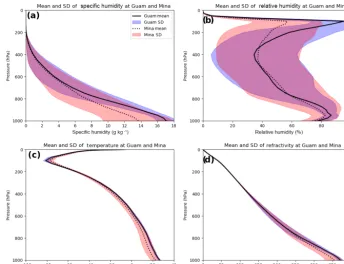
Figure 2.The mean ERA profiles over 2007 at Guam and Mina of specific humidityq(a), relative humidity RH(b), temperatureT (c), and refractivityN(d). The standard deviations about the mean profiles are indicated by the shading.
all four stations below 900 hPa, where the sample size is less than 500.
2.7 Mean ERA profiles for 2007 and example of profiles and normalized-difference profiles
Before showing the statistical comparisons of the normalized differences between the data sets and their estimated errors, we present the mean ERA profiles of q, RH, T, and N at Mina and Guam for the year 2007 (Fig. 2). The standard de-viations are shown by the shading around each mean pro-file. As shown by Fig. 2, the water vapor (especially relative humidity) shows the greatest variability over the year. The variability in specific humidity, temperature, and refractivity is greater at Mina, which is located in the subtropics, than Guam, which is located in the deep tropics.
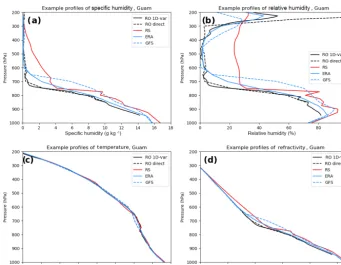
We next present a single example of soundings from the five data sets, to illustrate how the profiles of the normalized differences of the variables (which we use in all the follow-ing calculations) compare to the actual profiles. Figure 3 il-lustrates theq, RH,T, andNprofiles from 13 January 2007 at approximately 00:00 GMT, and Fig. 4 illustrates the cor-responding profiles of the normalized differences of the vari-ables from ERA, for example (q−qERA)/q, whereq is the 2007 mean ERA value ofq.
A comparison of Figs. 3 and 4 shows that the normalized-difference profiles highlight the similarities and normalized-differences of the five data sets better than the actual profiles, especially
in the upper troposphere. The magnitudes of the normalized differences are the same order of magnitude at all levels, whereas the differences in the actual profiles can vary by more than an order of magnitude from the lower to the upper troposphere. Figure 4 shows that typical percentage differ-ences between data sets are∼50 % forqand RH, 0.5 % for
T, and 5 % forN.
2.8 Representativeness errors
As in the apparent-error method, the 3CH error estimates include representatives errors. Since four of the five data sets considered here are representative of horizontal averages with a length scale of∼100 km, while the RS data are point measurements, the differences between the RS and other data sets include a significant “representativeness” compo-nent (Kitchen, 1989). O’Carroll et al. (2008) discuss the im-portance of representativeness errors and how they relate to the concept of “truth” that is used in the 3CH method.
3 Derivation of error variances
R. Anthes and T. Rieckh: Evaluating observation and model error variances 4243
Figure 3.Profiles of specific humidity(a), relative humidity(b), temperature(c), and refractivity(d)for the five data sets for 13 January 2007 at 00:23 UTC.
The error variance of a variableX(e.g.,q, RH,T, orN) is defined as
VARerr(X)= 1
n
X
(X−true)2= 1 n
X
X2err, (6)
where true is the true (but unknown) value ofXand the sum-mation is overnsamples.
As shown in Appendix A, we can derive three different lin-early independent equations for estimating the error variance of any data set, assuming that the error covariances among all the data sets are negligible compared to the differences in the observed mean square (MS) differences between the data sets. The three complete (and exact) linearly independent so-lutions for estimating the error variance of RO are
VARerr(RO)= 1
2MS(RO–ERA)+ 1
2MS(RO–GFS)
−1
2MS(GFS–ERA)+COVerr(RO,ERA)
+COVerr(RO,GFS)−COVerr(GFS,ERA) , (7) VARerr(RO)=
1
2MS(RO–ERA)+ 1
2MS(RO–RS) −1
2MS(RS–ERA)+COVerr(RO,ERA)
+COVerr(RO,RS)−COVerr(RS,ERA) , (8) VARerr(RO)=
1
2MS(RO–GFS)+ 1
2MS(RO–RS) −1
2MS(RS–GFS)+COVerr(RO,GFS)
+COVerr(RO,RS)−COVerr(RS,GFS) , (9) where RO (or ERA, GFS, RS) corresponds to the value of
X as estimated by RO (or ERA, GFS, RS) and MS denotes the mean square difference between the values from two data sets (e.g., RO–ERA).
We use Eqs. (7)–(9) to provide three independent estimates of VARerr(RO) by neglecting the COVerrterms in each equa-tion. The assumption that the error covariances are small compared to the difference in variances between the data sets is similar to the assumption used in the apparent-error method that the errors of the observations and model fore-casts are uncorrelated. In general the COVerrterms are not zero; thus we will examine the validity of this assumption by checking whether the various estimates of the error variances from the three equations are consistent with each other and reasonable compared to other independent studies that esti-mate error variances in other ways. In a related paper (Rieckh and Anthes, 2018) we examine the effect of various degrees of error correlations between two of the three data sets using simulated data sets with known errors.
The same procedure can be used to derive three equations for estimating the error variances for the other three data sets, RS, ERA, and GFS (equations not shown here).
So for each of the five data sets – RO-direct and RO 1D-VAR, RS, ERA, and GFS – there are three independent ways
to estimate their respective error variances. This is the three-cornered hat method described in Appendix A. We note that it is possible that the estimated error variances from any of the three equations are negative because of the neglect of the COVerr terms and the small sample size, especially above 300 hPa for the Japanese stations and below 800 hPa for all four stations (Fig. 1).
4 Comparison with previous studies for RO refractivity We first compute the estimated error variance for RO refrac-tivity using GFS and ERA data for comparison with the Kuo et al. (2004) and Chen et al. (2011) estimates of RO error variance to illustrate the 3CH method. In an analogy to the apparent-error equation (Eq. 4), with RO being the observa-tion and ERA being the forecast,
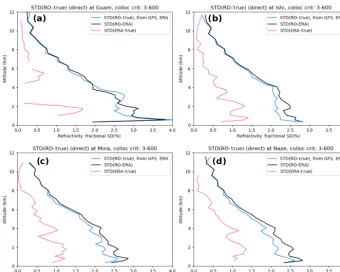
MS(RO–ERA)=VARerr(RO)+VARerr(ERA) , (10) which is Eq. (A2) in Appendix A with neglect of the COVerr terms. We compute MS(RO–ERA) from the RO and ERA data sets (analogous to the apparent error variance σa2 in Eq. 4) and plot its square root as the black line in Fig. 5. Then we estimate VARerr(RO) using Eq. (7) and the data sets (RO–GFS) and (GFS–ERA), neglecting the COVerrterms.
The square root of VARerr(RO) gives the standard devia-tion (SD) (Fig. 5, blue curve). Finally, the ERA error variance (analogous to the forecast error) is obtained by subtracting VARerr(RO) from MS(RO–ERA) using Eq. (10) above (pink line in Fig. 5). The gap in the computed ERA error SD in Fig. 5a occurs due to negative estimated error variance val-ues, which can result from having a limited sample size, ne-glecting the error covariance terms, and having an error vari-ance that is already close to zero (as is the case for ERA).
The results shown in Fig. 5 are quite similar to those from Kuo et al. (2004, Fig. 13) and Chen et al. (2011, Fig. 3d), who used different models and different data sets. The SD of normalized RO refractivity errors is a maximum of between 2.0 and 2.5 % near the surface, decreasing to about 0.5 % at 10 km. These similarities give credibility to both methods.
5 Calculation of the error variance terms using multiple data sets
This section shows the estimated error variances forN,q,T, and RH at one of the four stations (Mina) for the five data sets and summarizes the results for the other three stations (Naze, Ishi, and Guam).
5.1 Results for Mina
R. Anthes and T. Rieckh: Evaluating observation and model error variances 4245
Figure 5.Standard deviations of the apparent-error SD(RO–ERA) (black line), estimated RO error SD(RO–true) computed from Eq. (7) (blue line) and ERA error SD(ERA–true) (pink line) for refractivity at(a)Guam,(b)Ishi,(c)Mina, and(d)Naze.
data set: one using the RO-direct with RS, ERA, and GFS, and one using the RO 1D-VAR with RS, ERA, and GFS. In the following plots, darker colors correspond to the three re-sults using the RO 1D-VAR, and lighter colors correspond to the three results using the RO-direct.
Figure 6 shows the results for specific humidity. Error vari-ances are shown rather than SDs because they are easier to interpret using the three equations used to derive them and because the SD are undefined for the occasional negative estimated error variance. Figure 6a shows the q error vari-ance profiles for the two RO data sets (direct and 1D-VAR). The direct method (use of GFS temperature in Eq. 5) shows a steady increase of error variance with height, from about 100 %2 (SD∼10 %) at 950 hPa to 800 %2 (SD∼28 %) at 500 hPa and 2000 %2 (SD∼45 %) at 300 hPa. This is ex-pected since the refractivity contains little information on water vapor above about 400 hPa and we are using an inde-pendent estimate of temperature, with no constraints on the water vapor retrieval. Theqerror variance profile for RO us-ing the 1D-VAR method is similar to that of the direct method below 500 hPa but reaches a maximum at about 500 hPa of about 500 %2(SD∼22 %) and then decreases toward zero at 200 hPa. The 1D-VAR method uses the ERA-Interim fields as a background and thus constrains the water vapor profile retrieval at high altitudes. It is notable that the three equa-tions used to estimate the error variance profiles agree closely and the difference among the three estimates is much smaller
than the differences in the mean profiles using the two RO retrieval methods.
The RS specific humidity error variance profiles at Mina (Fig. 6b) show a similar behavior to the RO-direct, with a steady increase with height, exceeding 2000 %2 (SD of ∼45 %) at 400 hPa. The SDs of the RS are slightly larger than the two RO estimates below 600 hPa. The larger error variance of RS compared to RO is consistent with the results from Kuo et al. (2004) and is due in part to the RS represen-tativeness differences. The error variance estimates using the RO-direct (orange) and RO 1D-VAR (red) are similar.
The error variance profiles from the two model sets (Fig. 6c, d) are quite different. The GFS error variance is less than the RO-direct and RS error variances at all levels, and also less than the RO 1D-VAR error variance except above 300 hPa. Although there is more scatter, especially in the up-per troposphere, the ERA profiles are different from all the other data sets in that they show only a small increase of er-ror variance with height, from near zero at the surface to up to a mean of about 100 %2(SD∼10 %) at 200 hPa.
Figure 6.Estimated error variances (percent squared) of specific humidity at Mina:(a)RO,(b)RS,(c)GFS, and(d)ERA.
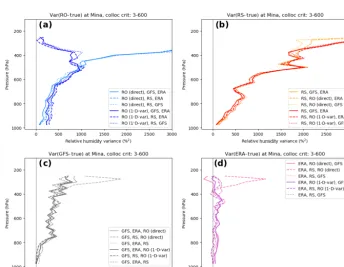
Figure 7.Estimated error variances (percent squared) of relative humidity at Mina:(a)RO,(b)RS,(c)GFS, and(d)ERA.
RO-derived RH are less than those of the RS in the lower tro-posphere. The GFS error variances are smaller than the RO and RS variances, except for the RO 1D-VAR profile above 300 hPa, which is constrained by the ERA observations in
R. Anthes and T. Rieckh: Evaluating observation and model error variances 4247
Figure 8.Estimated error variances (percent squared) of temperature at Mina:(a)RO,(b)RS,(c)GFS, and(d)ERA.
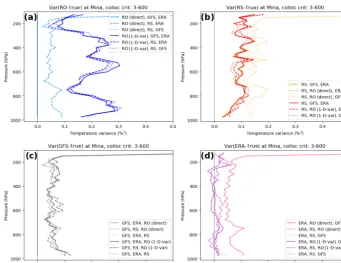
Figure 8 shows the estimated error variances of tempera-ture. Because the RO-direct retrieval uses the exact GFS tem-perature, the results for the direct retrieval (light blue) using (RO, GFS, and ERA) and (RO, RS, and GFS) are not mean-ingful in Fig. 8a (they are identically zero). The result from Eq. (8) (RO, ERA, and RS), given by the dashed light blue line in Fig. 8a is valid, but in reality this is an estimate of the GFST error variance, and it is in fact very similar to the profiles in Fig. 8c.
The RO 1D-VAR results for temperature from all three equations give somewhat larger results (Fig. 8, dark blue profiles). The estimated error variance profiles oscillate be-tween 0.1 and 0.3 %2(SD 0.3 to 0.55 %). For a temperature of 300 K, these correspond to 0.9 to 1.65 K.
The RS temperature error variances (Fig. 8b) vary be-tween 0.05 and 0.15 %2(SD 0.2 to 0.4 % or 0.6 to 1.2 K for
T =300 K). The GFS temperature error variances are a little lower, averaging around 0.05 to 0.10 %2(SD 0.2 to 0.3 %), while the ERA-estimated temperature error variances aver-age close to zero (Fig. 8d).
Figure 9 shows the estimates of the normalized refractivity errors for the five data sets. There is more spread in the re-fractivity estimates compared to those of the other variables, especially in the lower troposphere, where the estimates vary between about 4 and 9 %2(SD 2 to 3 %) for the two RO vari-ances. Recall that the RO-direct N are the observed RON
as provided by CDAAC, while the RO 1D-VARNare mod-ified based on the background (ERA)N. The average of the
N error variances for the radiosondes (Fig. 9b) shows a
max-imum of ∼10 %2 (SD∼3.2 %) around 900 hPa. The GFS error variance profiles show a maximum around 750 hPa of ∼8 %2 (SD∼2.8 %). The ERA profiles show the smallest errors, with a maximum in the lower troposphere of an aver-age of∼2 %2(SD∼1.4 %). All data sets show a decrease of error variance to less than 0.5 %2 (SD<0.7 %) at 400 hPa. The reason for the large scatter in estimates of N below about 800 hPa may be related to errors inNcaused by super-refraction in the lower troposphere, which occurs often in the tropics and subtropics. Super-refraction causes a negativeN
bias, which may lead to larger error covariances in this layer. The smaller number of RO samples below 800 hPa (Fig. 1) may also be a factor.
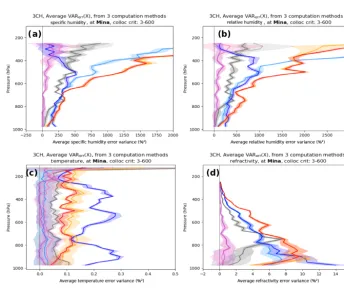
Figure 10 shows the mean of the three estimates of the error variances of the five data sets forq, RH,T, andN at Mina. The standard deviation1about these means is shown by the shaded areas. These figures show clearly the signif-icant differences among the error variance estimates of the five data sets. In Fig. 10a, the error variance for specific hu-midity is greatest for the radiosonde (red and orange pro-files) and least for the ERA profiles. As discussed earlier, the mean of the RO 1D-VAR retrieval reaches a maximum at about 550 hPa and then decreases back toward zero as it becomes constrained by the background profile at high lev-els. Figure 10b–d show the mean profiles of error variance for relative humidity, temperature, and refractivity. The
rela-1σ=1 2
Pn=3
n=1(xn−x)2
1/2
, wherexndenote the three error
Figure 9.Estimated error variances (percent squared) of refractivity at Mina:(a)RO,(b)RS,(c)GFS, and(d)ERA.
Figure 10.Mean of the three estimates of error variance plots forq, RH,T, andNusing RO-direct and RO 1D-VAR for each data set at Mina. The standard deviation about the mean is indicated by shaded areas.(a)specific humidity,(b)relative humidity,(c)temperature, and
R. Anthes and T. Rieckh: Evaluating observation and model error variances 4249
tive humidity profiles are similar to the specific humidity pro-files. The ERA errors are the smallest, followed by GFS, the RO, and finally the radiosondes. The temperature error vari-ance profiles show that the ERA errors are very close to zero throughout the entire troposphere. The GFS profiles (gray) and the RS profiles (red and orange) show relatively con-stant values with height of approximately 0.05 and 0.1 %2, respectively (corresponding to temperature errors of 0.7 and 0.9 K at 300 K, respectively). The RO shows an oscillating error variance profile ranging between 0.1 and 0.3 %2 (0.9 and 1.6 K at 300 K). Finally, the refractivity profiles show the greatest variability, but the mean profiles are still quite dis-tinct. ERA again shows the lowest errors, followed by GFS, RO, and RS.
It is difficult to find previous results for RS temperature and specific humidity error variances. However, previous studies comparing RO with RS and models indicate that our estimates are reasonable and consistent with these studies. Ho et al. (2017) found SD between RO and RS pairs for many RS types of about 1.5 K in the 200–20 hPa layer, where RO temperatures are most accurate (Table 2 in Ho et al., 2017). This value corresponds to the apparent error between RS and RO, which is larger than the RS error. The estimated RS tem-perature error variances from 200 to 100 hPa in Fig. 10c is about 0.15 %2, which corresponds to a SD of 0.39 % or 0.9 K for a mean temperature of 230 K. Ladstädter et al. (2015) compared high-quality GCOS (Global Climate Observing System) Reference Upper-Air Network (GRUAN) RS to RO globally and for a tropical station (Nauru) and subtropical station (Tateno, Japan) from 2002 to 2013. They found tem-perature SD of about 0.5 K for Nauru and 0.5 to 0.8 K at Tateno averaged over the layer 800 to 300 hPa. For specific humidity, they found SD between RO and RS of about 10 %, increasing to about 40 % in the upper troposphere. In our cal-culations for Guam and the three subtropical Japanese sta-tions our estimates for SD ofqare similar (Fig. 10a; Fig. B1 in Appendix B), ranging from about 10 % at 900 hPa to 45 % at 300 hPa.
Ho et al. (2010) compared COSMIC RO observations to ECMWF analyses and several types of radiosondes for the period August–November 2006. They found mean specific humidity SD of RO–ECMWF of ∼0.5 g kg−1 and RO–RS (Meisei) of ∼0.9 g kg−1. From their plots of the vertical profiles of the SD, these numbers are typical for the layer 800–500 hPa, which, given the normalization values from the four RS stations in our study (Fig. 3) of about 9 g kg−1 at 800 hPa and 2 g kg−1 at 500 hPa, correspond to SD (VAR) values of ∼6 % (36 %2) at 800 hPa and 25 % (625 %2) at 500 hPa for ECMWF and ∼10 % (100 %2) at 800 hPa and 45 % (2025 %2) at 500 hPa for Meisei RS. These values are similar to the estimates of the RS analysis for the Japanese stations shown in Fig. B1 of Appendix B.
Vergados et al. (2014) compared RO-derived observations of specific humidity with radiosondes and ERA-Interim un-der cloudy conditions in the tropics for August–October
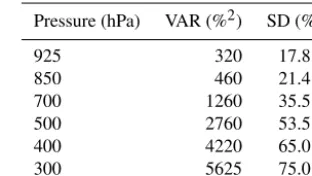
Table 1.Normalized differences of zonal mean RO and ERA spe-cific humidity in the tropics for cloudy conditions (computed from data in Vergados et al., 2014).
Pressure (hPa) VAR (%2) SD (%) 925 320 17.8 850 460 21.4 700 1260 35.5 500 2760 53.5 400 4220 65.0 300 5625 75.0
2006. They used the direct method for computing specific hu-midity from the RO refractivity using the ERA-Interim tem-peratures. Their differences between zonal means of normal-ized RO and ERA-Interim observations ofqare presented in Table 1 (we computed the normalized differences from their data in Table 3 for the tropics).
The VAR values in Table 1 correspond to apparent errors, where RO and ERA correspond to the observation and fore-cast variables, respectively (Eq. 10). As expected, they are larger than the estimated error variances for RO-direct shown in Fig. 6a because the apparent errors are always larger than the observation errors as shown in Eq. (4). This comparison indicates that the estimates of true errors in Fig. 6a are rea-sonable.
5.2 Summary of results at Naze, Ishi, and Guam The mean and SD error profiles for Naze, Ishi, and Guam corresponding to the above results for Mina are presented in Appendix B. Here we summarize the main similarities and differences between the error variance estimates for these sta-tions compared to those for Mina. In general, we find similar magnitudes and shapes of the profiles of the estimated error variances of the five data sets for all four variables (q, RH,
T, andN).
The estimated error profiles are especially similar for the three Japanese stations. This close similarity may be due pri-marily to the fact that the three locations are relatively close together and two of the three use the same type of radiosonde (Meisei).
The results from Guam are also similar in general mag-nitudes and shapes of the profiles to those from the three Japanese stations, but there are somewhat greater differences in some of the profiles (e.g., GFS q, RH, and N; and RS
sys-tem in the former than in the latter, where single observations may affect the models more significantly.
6 Summary and discussion
We used the three-cornered hat (3CH) method to estimate vertical profiles of error variances of different observation and model data sets by computing the differences among the data sets. We computed estimated error variances of four variables (specific humidity q, relative humidity RH, tem-peratureT, and refractivityN) for five data sets (ERA, GFS, radiosondes (RS), and radio occultation (RO) 1D-VAR and RO-direct) at four different locations in the tropics and sub-tropics for the year 2007. The stations are Guam, Ishigaki-jima, Minamidait¯oIshigaki-jima, and Naze. The latter three stations are on Japanese islands and are located quite close together (a few hundred kilometers apart). We computed vertical pro-files of estimated error variances for normalized differences from the 2007 ERA mean values of q, RH,T, and N at the four stations using three linearly independent equations (Eqs. 7–9) neglecting all error covariance terms. Ideally, with a very large sample of data pairs and zero correlation of er-rors among the different data sets, all three equations would produce identical results. However, a finite data set and non-zero error correlations among the data sets lead to three dif-ferent estimates, as shown by Rieckh and Anthes (2018). The differences among the three estimates is a measure of these effects.
Although the neglect of the covariance terms affects the results to a noticeable degree in some of the estimated pro-files, there is strong evidence that there is valid information in the estimated error profiles that rises above the noise caused by the neglect of the covariance terms and the limited data sample. This evidence is summarized as follows:
1. There is generally good agreement in the three esti-mated error profiles of the four variables for each of the five data sets at all four locations. It is unlikely that this agreement would occur by chance if the neglected error covariance terms were large enough to invalidate the results, because they would have to somehow com-bine or cancel in each of the three equations to give the observed similar results.
2. There are large differences in the overall structure (shape and magnitude) of the average vertical profiles of estimated error variances for the five data sets (Fig. 10). These differences are significantly larger than the stan-dard deviation from the three independent equations used to compute the error variances.
3. The variability, or spread among the error estimates, is similar at most height levels for specific humidity, rel-ative humidity, and temperature. If the error covariance terms were significant, they would almost certainly vary
with height, giving different agreement in estimated er-ror profiles with height. For example, we know that RO temperature and refractivity are most accurate in the upper troposphere and least accurate in the lower tro-posphere and that the weight given to RO in the mod-els’ data assimilation varies significantly with height, being largest in the upper troposphere and smallest in the lower troposphere. Thus one would expect the RO– ERA and RO–GFS error covariance terms to vary sig-nificantly with height. Also, the RS errors as well as the ERA and GFS model errors vary with height. It is there-fore unlikely that all of the neglected error covariance terms are the same at all heights.
4. The general structure and magnitudes of the estimated error variance profiles are similar at the four locations. However, there are some small differences among the profiles at the four locations. In general, the differences among the three estimates (indicated by the SD about the mean), which are a measure of the effect of the ne-glected covariance terms as well as limited sample size, are smallest for Ishi, Naze, and Mina and largest for Guam. Since the three Japanese stations are close to-gether, this suggests that there is a difference in the error variance of the Japanese RS observations compared to the Guam RS observations. There may also be small dif-ferences in the model errors over the Japanese stations, which are located in a data-rich area compared to Guam, which is located in a data-sparse region. The largest variability and largest error estimates occur at Guam, which uses a radiosonde that is thought to have large water vapor biases due to sensor malfunctions (Hol-ger Vömel, personal communication, 2017).
5. The magnitudes of the estimated RO refractivity error variances are supported by previously published studies, including Kuo et al. (2004) and Chen et al. (2011). 6. The estimated errors are smallest for the ERA-Interim
model data set, which is a reasonable result since ERA uses an excellent model and data assimilation system that assimilates many independent, quality-checked ob-servations. In fact, Vergados et al. (2015) state that “ERA-Interim is one of the most advanced global atmo-spheric models simulating the state of the atmosphere with accuracy similar to what is theoretically possible (Simmons and Hollingsworth, 2002) using a 4D-VAR method (Simmons et al., 2005)”.
R. Anthes and T. Rieckh: Evaluating observation and model error variances 4251
Code availability. Code will be made available by the author upon request.
Appendix A: Derivation of estimates of error variances using four data sets and the three-cornered hat method A1 Description of three-cornered hat method
In this appendix we summarize the 3CH method (Gray and Allan, 1974) for estimating error variances from three data sets. Gray and Allan (1974) developed the method to esti-mate the absolute frequency stability of an ensemble of N clocks by forming all(N−1)(N−2)/2 triads under the as-sumption that the clock errors are uncorrelated. Each of the triads are three-cornered hat (3CH) estimates. Riley (2003) provides a summary of the 3CH method.
Variations and enhancements of the 3CH method have been applied to many diverse geophysical data sets. The 3CH method has been used to estimate the stability of GNSS clocks using the measured frequencies from multiple clocks (Ekstrom and Koppang, 2006; Griggs et al., 2014, 2015; Luna et al., 2017). Valty et al. (2013) used the 3CH method to estimate the geophysical load deformation computed from GRACE satellites, GPS vertical displacement measurements, and global general circulation models. O’Carroll et al. (2008) compared three types of systems to measure sea surface tem-peratures: two different radiometers and in situ observations from buoys. They discuss the assumption of the neglect of error correlations among the three data sets; the effect of rep-resentativeness errors; and the interpretation of “truth”, the true value of the variable being measured.
Closely related to the 3CH method is the triple-collocation (TC) method, which was introduced by Stoffelen (1998) and has been widely used since in oceanography and hydromete-orology (e.g., Su et al., 2014; Gruber et al., 2016). It has been used to estimate the error variances of triplets of observa-tion types to measure a diverse set of geophysical properties, including wave heights, sea surface temperatures, precipi-tation, surface winds over the ocean, leaf area index (LAI) products, and soil moisture. Stoffelen (1998) estimated the error variances of in situ measurements, ERS scatterome-ter winds, and NCEP forecast model wind speeds. Lascatterome-ter, Vogelzang et al. (2011) compared four sets of scatterome-ter winds from ASCAT and SeaWinds with buoy measure-ments and ECMWF model forecasts of surface winds over the oceans to estimate the error variances and standard de-viations of the different data sets and their combinations. Stoffelen (1998) and Vogelzang et al. (2011) calibrate their data sets using an error model and show how the error es-timates may account for a partial correlation of representa-tiveness errors between two data sets if independent infor-mation about this correlation is known. Fang et al. (2012) es-timated the uncertainties in three different estimates of LAI products. McColl et al. (2014) extended the method by de-riving a performance metric of the measurement system to the unknown truth and applied the extended method to wind estimates from numerical weather prediction, scatterometer, and buoy wind estimates. Roebeling et al. (2012) used the
triple-collocation method to estimate the errors associated with three ways of estimating precipitation: the Spinning Enhanced Visible and Infrared Imager (SEVERI), weather radars, and ground-based precipitation rain gauges. They concluded that the method provides useful error estimates of these systems.
The major assumption in the 3CH and TC methods is that the unknown errors of the three systems are uncorrelated. Correlations between any or all of the three measurement systems will reduce the accuracy of the error estimates. Other factors that can reduce the accuracy of the error estimates in-clude widely different errors associated with the three sys-tems or a small sample size. These factors can lead to neg-ative estimates of error variances, especially when the esti-mates are close to zero (Gray and Allan, 1974; Riley, 2003). All three of these factors potentially affect the 3CH estimates in this paper, but the general agreement of the three linearly independent equations for estimating the error variances of each variable suggests that the estimates are still reasonably valid and contain useful information.
A2 Derivation of 3CH equations
In this section we summarize the derivation of the 3CH method as applied to four meteorological data sets, RO, RS, GFS, and ERA. The error variance of a variableX(e.g., tem-perature, specific humidity, relative humidity, refractivity) is defined as
VARerr(X)= 1
n
X
(X−true)2=1 n
X
X2err, (A1)
where true is the true but unknown value ofXand the sum-mation is overnsamples. This definition of error variance in-cludes bias as well as random errors inX. Let RO correspond to the value ofXas estimated by RO, ERA correspond to the value ofXas estimated by ERA, and similarly for GFS and RS. We then have
MS(RO–ERA)=VARerr(RO)+VARerr(ERA)
−2COVerr(RO,ERA) , (A2) where MS(RO–ERA) is the mean square difference between RO and ERA and the last term is the error covariance be-tween RO and ERA.
R. Anthes and T. Rieckh: Evaluating observation and model error variances 4253
MS(GFS–ERA)=VARerr(GFS)+VARerr(ERA) (A3) −2COVerr(GFS,ERA) ,
MS(RS–ERA)=VARerr(RS)+VARerr(ERA)
−2COVerr(RS,ERA) , (A4) MS(RO–GFS)=VARerr(RO)+VARerr(GFS)
−2COVerr(RO,GFS) , (A5) MS(RS–GFS)=VARerr(RS)+VARerr(GFS)
−2COVerr(RS,GFS) , (A6) MS(RO–RS)=VARerr(RO)+VARerr(RS)
−2COVerr(RO,RS) . (A7) It is possible to use these six equations to get three different, linearly independent estimates of the four unknowns error variances for RO, RS, ERA, and GFS. For RO, these three equations are
VARerr(RO)= 1
2MS(RO−ERA)+ 1
2MS(RO−GFS) −1
2MS(GFS−ERA)+COVerr(RO,ERA) +COVerr(RO,GFS)−COVerr(GFS,ERA) (A8)
VARerr(RO)= 1
2MS(RO−ERA)+ 1
2MS(RO−RS) −1
2MS(RS−ERA)+COVerr(RO,ERA) + COVerr(RO,RS)−COVerr(RS,ERA) (A9) VARerr(RO)=
1
2MS(RO−GFS)+ 1
2MS(RO−RS) −1
2MS(RS−GFS)+COVerr(RO,GFS) +COVerr(RO,RS)−COVerr(RS,GFS). (A10)
O’Carroll et al. (2008) present these equations for a system of three observation types (their Eq. 1). However, they re-move the mean biases from each data set in their definition of error variance, whereas we do not in our definition (Eq. A1). Our expressions for estimated error variances are identical to those of O’Carroll et al. (2008) with the removal of the effect of these biases; e.g., replace MS(X−Y) in Eqs. (A8)–(A10) with MS(X−Y)−[M(X−Y )]2, whereXandY are any of the data sets. Removing these biases will generally result in smaller estimated error variances than the results presented in this paper.
As noted by an anonymous reviewer, it is pos-sible to derive infinitely many linearly dependent equations by combining Eqs. (A8)–(A10) in dif-ferent ways by forming combinations of the form
M1×Eq. (A8)+M2×Eq. (A9)+M3×Eq. (A10), where
M1, M2, and M3 are any numbers except those for which
M1+M2+M3=0. We did not pursue this possibility in this paper but instead used the three linearly independent equations only in our estimates of error variances.
If all the neglected COVerrterms were in fact identically zero and the sample size was very large (much larger than our sample size), all three estimates of the error variances would be the same. The fact that they give different solutions is be-cause the neglected COVerrterms are in reality not zero, and hence their neglect affects the three approximate equations in different ways to give three different solutions. The relatively small sample sizenalso contributes to the differences in the three solutions, which are a measure of these effects.
We also note that the error estimates contain any represen-tativeness errors caused by the different data sets represent-ing different scales of atmospheric structure (O’Carroll et al., 2008). Representativeness errors can occur because of differ-ent horizontal or vertical resolutions or footprints of the data sets.
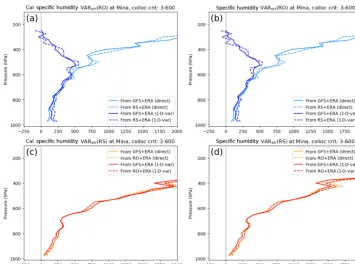
A3 Brief comparison of 3CH method and TC method While it is not the intent of this paper to do a thorough com-parison of the 3CH and TC methods, which are introduced above, in response to a reviewer’s comment we compared the two methods on a subset of our data sets. A difference between the 3CH and TC method is that the TC method cor-rects for additive and multiplicative biases among the three data sets, as discussed by Stoffelen (1998), Vogelzang et al. (2011), and others. The TC method calibrates two of the data sets against the third, eliminating biases among the three data sets. This calibration uses an error model of the form
Xi=a·true+b+ei, whereaandbstand for the “trend” and “bias” calibration coefficients andei are random errors (Vo-gelzang et al., 2011). As shown below, calibrating our data sets according to this model gave results very similar to re-sults using our uncalibrated data sets.
In our application of the TC method we use the follow-ing combinations of data sets: (ERA, RO, RS), (ERA, RO, GFS), and (ERA, GFS, RS). For the RO we use two RO re-trievals, the direct and 1D-VAR (see Sect. 2.3). The RO, RS, and GFS data sets are all calibrated using ERA as the cali-bration reference, using the following calicali-bration factors. For example, the calibrated RO and RS (designated by ROcaland RScal, respectively) using ERA as the reference are (follow-ing Stoffelen, 1998; Vogelzang et al., 2011; and Roebel(follow-ing et al., 2012)
ROcal=
RO−bRO
aRO
,
RScal=
RS−bRS
aRS
,
where the additive bias terms are
bRO=M (RO–ERA) ,
bRS=M (RS–ERA) ,
the multiplicative bias terms are
aRO=
aRS=
M (RO·RS) M (RO·ERA),
andMdenotes the mean value over the data sets.
R. Anthes and T. Rieckh: Evaluating observation and model error variances 4255
Figure A1.Estimated RO and RS error variances for specific humidity at Minamidait¯ojima (Japan) using calibrated data as in the TC method(a, c)and the uncalibrated data as in the 3CH method(b, d). For the TC method, the RO, RS, and GFS data sets are calibrated with respect to ERA as the reference data set. The following combinations of the four data sets are used: (ERA, RO, RS), (ERA, RO, GFS), and (ERA, GFS, RS).
Appendix B: Mean and standard deviations of three independent error estimates ofq, RH,T, andNusing RO-direct and RO 1D-VAR at Guam, Ishi, Mina and Naze
R. Anthes and T. Rieckh: Evaluating observation and model error variances 4257
Figure B2.Mean and standard deviations (shading) of the three estimates of normalized relative humidity using RO-direct and RO 1D-VAR at(a)Guam,(b)Ishi,(c)Mina, and(d)Naze.
Figure B3.Mean and standard deviations (shading) of the three estimates of normalized temperature using RO-direct and RO 1D-VAR at
Figure B4.Mean and standard deviations (shading) of the three estimates of normalized refractivity using RO-direct and RO 1D-VAR at
R. Anthes and T. Rieckh: Evaluating observation and model error variances 4259
Author contributions. RA formulated the overall idea of this work, and TR performed all the calculations and contributed significantly to the discussion of the results.
Competing interests. The authors declare that they have no conflict of interest.
Acknowledgements. We acknowledge with thanks the insightful comments and advice on this study from Ian Culverwell and John Eyre (Met Office), Shay Gilpin (UCAR COSMIC), Sean Healy (ECMWF), Adrian Simmons (ECMWF), and Sergey Sokolovskiy (UCAR COSMIC). We thank the three anonymous reviewers for their constructive comments. Anthes and Rieckh were supported by NSF-NASA grant AGS-1522830. We thank Eric DeWeaver (NSF) and Jack Kaye (NASA) for their long-term support of COSMIC. Edited by: Ad Stoffelen
Reviewed by: three anonymous referees
References
Chen, S.-Y., Huang, C.-Y., Kuo, Y.-H., and Sokolovskiy, S.: Ob-servational Error Estimation of FORMOSAT-3/COSMIC GPS Radio Occultation Data, Mon. Weather Rev., 139, 853–865, https://doi.org/10.1175/2010MWR3260.1, 2011.
Cucurull, L. and Derber, J. C.: Operational Implementa-tion of COSMIC ObservaImplementa-tions into NCEP’s Global Data Assimilation System, Weather Forecast., 23, 702–711, https://doi.org/10.1175/2008WAF2007070.1, 2008.
Dee, D. P., Uppala, S. M., Simmons, A. J., Berrisford, P., Poli, P., Kobayashi, S., Andrae, U., Balmaseda, M. A., Balsamo, G., Bauer, P., Bechtold, P., Beljaars, A. C. M., van de Berg, L., Bid-lot, J., Bormann, N., Delsol, C., Dragani, R., Fuentes, M., Geer, A. J., Haimberger, L., Healy, S. B., Hersbach, H., Hólm, E. V., Isaksen, L., Kållberg, P., Köhler, M., Matricardi, M., McNally, A. P., Monge-Sanz, B. M., Morcrette, J.-J., Park, B.-K., Peubey, C., de Rosnay, P., Tavolato, C., Thépaut, J.-N., and Vitart, F.: The ERA-Interim reanalysis: configuration and performance of the data assimilation system, Q. J. Roy. Meteor. Soc., 137, 553–597, https://doi.org/10.1002/qj.828, 2011.
Desroziers, G. and Ivanov, S.: Diagnosing and adaptive tuning of observation-error parameters in a variational assimilation, Q. J. Roy. Meteor. Soc., 127, 1433–1452, https://doi.org/10.1002/qj.49712757417, 2001.
Ekstrom, C. R. and Koppang, P. A.: Error Bars for Three-Cornered Hats, IEEE T. Ultrason. Ferr., 53, 876–879, https://doi.org/10.1109/TUFFC.2006.1632679, 2006.
ERA-Interim, available at: https://www.ecmwf.int/en/research/ climate-reanalysis/reanalysis-datasets/era-interim, last access: 1 July 2018.
Fang, H., Wei, S., Jiang, C., and Scipal, K.: Theoreti-cal uncertainty analysis of global MODIS, CYCLOPES, and GLOBCARBON LAI products using a triple col-location method, Remote Sens. Environ., 124, 610–621, https://doi.org/10.1016/j.rse.2012.06.013, 2012.
Gilpin, S., Rieckh, T., and Anthes, R.: Reducing repre-sentativeness and sampling errors in radio occultation– radiosonde comparisons, Atmos. Meas. Tech., 11, 2567–2582, https://doi.org/10.5194/amt-11-2567-2018, 2018.
Gray, J. E. and Allan, D. W.: A method for estimating the frequency stability of an individual oscillator, in: 28th Annual Symposium on Frequency Control, Atlantic City, New Jersey, 29–31 May 1974, IEEE, 243–246, https://doi.org/10.1109/FREQ.1974.200027, 1974.
Griggs, E., Kursinski, E., and Akos, D.: An investigation of GNSS atomic clock behaviour at short time intervals, GPS Solut., 18, 443–452, https://doi.org/10.1007/s10291-013-0343-7, 2014. Griggs, E., Kursinski, E., and Akos, D.: Short-term
GNSS satellite clock stability, Radio Sci., 50, 813–826, https://doi.org/10.1002/2015RS005667, 2015.
Gruber, A., Su, C.-H., Zwieback, S., Crow, W., Dorigo, W., and Wagner, W.: Recent advances in (soil moisture) triple collocation analysis, Int. J. Appl. Earth Obs., 45, 200–211, https://doi.org/10.1016/j.jag.2015.09.002, 2016.
Ho, S.-P., Zhou, X., Kuo, Y.-H., Hunt, D., and Wang, J.-H.: Global evaluation of radiosonde water vapor systematic biases using GPS radio occultation from COSMIC and ECMWF analysis, Re-mote Sens., 2, 1320–1330, https://doi.org/10.3390/RS2051320, 2010.
Ho, S.-P., Peng, L., and Vömel, H.: Characterization of the long-term radiosonde temperature biases in the upper troposphere and lower stratosphere using COSMIC and Metop-A/GRAS data from 2006 to 2014, Atmos. Chem. Phys., 17, 4493-4511, https://doi.org/10.5194/acp-17-4493-2017, 2017.
Hollingsworth, A. and Lönnberg, P.: The statistical struc-ture of short-range forecast errors as determined from ra-diosonde data. Part I: The wind field, Tellus A, 38, 111–136, https://doi.org/10.3402/tellusa.v38i2.11707, 1986.
Kitchen, M.: Representativeness errors for radiosonde ob-servations, Q. J. Roy. Meteor. Soc., 115, 673–700, https://doi.org/10.1002/qj.49711548713, 1989.
Kleist, D. T., Parrish, D. F., Derber, J. C., Treadon, R., Wu, W.-S., and Lord, S.: Introduction of the GSI into the NCEP Global Data Assimilation System, Weather Forecast., 24, 1691–1705, https://doi.org/10.1175/2009WAF2222201.1, 2009.
Kuo, Y.-H., Wee, T.-K., Sokolovskiy, S., Rocken, C., Schreiner, W., Hunt, D., and Anthes, R. A.: Inversion and error estimation of GPS radio occultation data, J. Meteorol. Soc. Jpn., 82, 507–531, 2004.
Ladstädter, F., Steiner, A. K., Schwärz, M., and Kirchengast, G.: Climate intercomparison of GPS radio occultation, RS90/92 ra-diosondes and GRUAN from 2002 to 2013, Atmos. Meas. Tech., 8, 1819–1834, https://doi.org/10.5194/amt-8-1819-2015, 2015. Luna, D., Pérez, D., Cifuentes, A., and Gómez, D.:
Three-Cornered Hat Method via GPS Common-View Com-parisons, IEEE T. Instrum. Meas., 66, 2143–2147, https://doi.org/10.1109/TIM.2017.2684918, 2017.
McColl, K., Vogelzang, J., Konings, A., Entekhabi, D., Piles, M., and Stoffelen, A.: Extended triple collocation: Esti-mating errors and correlation coefficients with respect to an unknown target, Geophys. Res. Lett., 41, 6229–6236, https://doi.org/10.1002/2014GL061322, 2014.
tem-perature observations, J. Atmos. Ocean. Tech., 25, 1197–1207, https://doi.org/10.1175/2007JTECHO542.1, 2008.
Parrish, D. F. and Derber, J. C.: The National Meteorological Center’s Spectral Statistical-Interpolation analysis system, Mon. Weather Rev., 120, 1747–1763, https://doi.org/10.1175/1520-0493(1992)120<1747:TNMCSS>2.0.CO;2, 1992.
Rieckh, T. and Anthes, R.: Evaluating two methods of estimating error variances using simulated data sets with known errors, At-mos. Meas. Tech. Discuss., https://doi.org/10.5194/amt-2018-75, in review, 2018.
Rieckh, T., Anthes, R., Randel, W., Ho, S.-P., and Foelsche, U.: Evaluating tropospheric humidity from GPS radio occultation, radiosonde, and AIRS from high-resolution time series, At-mos. Meas. Tech., 11, 3091–3109, https://doi.org/10.5194/amt-11-3091-2018, 2018.
Riley, W. J.: Application of the 3-cornered hat method to the analy-sis of frequency stability, Hamilton Technical Services, available at: http://www.wriley.com/3-CornHat.htm (last access: 1 July 2018), 2003.
Roebeling, R. A., Wolters, E. L. A., Meirink, J. F., and Leijnse, H.: Triple collocation of summer precipitation re-trievals from SEVIRI over Europe with gridded rain gauge and weather radar data, J. Hydrometeorol., 13, 1552–1566, https://doi.org/10.1175/JHM-D-11-089.1, 2012.
Simmons, A. J. and Hollingsworth, A.: Some as-pects of the improvement in skill of numerical pre-diction, Q. J. Roy. Meteor. Soc., 128, 647–677, https://doi.org/10.1256/003590002321042135, 2002.
Simmons, A. J., Hortal, M., Kelly, G., McNally, A., Untch, A., and Uppala, S.: ECMWF Analyses and Forecasts of Stratospheric Winter Polar Vortex Breakup: September 2002 in the Southern Hemisphere and Related Events, J. Atmos. Sci., 62, 668–689, https://doi.org/10.1175/JAS-3322.1, 2005.
Smith, E. and Weintraub, S.: The constants in the equation for at-mospheric refractive index at radio frequencies, Proc. IRE, 41, 1035–1037, 1953.
Stoffelen, A.: Toward the true near-surface wind speed: Error mod-eling and calibration using triple collocation, J. Geophys. Res., 103, 7755–7766, https://doi.org/10.1029/97JC03180, 1998. Su, C.-H., Ryu, D., Crow, W. T., and Western, A. W.:
Beyond triple collocation: Applications to soil mois-ture monitoring, J. Geophys. Res., 119, 6419–6439, https://doi.org/10.1002/2013JD021043, 2014.
Valty, P., de Viron, O., Panet, I., Camp, M. V., and Legrand, J.: Assessing the precision in loading estimates by geodetic tech-niques in Southern Europe, Geophys. J. Int., 194, 1441–1454, https://doi.org/10.1093/gji/ggt173, 2013.
Vergados, P., Mannucci, A. J., and Ao, C. O.: Assess-ing the performance of GPS radio occultation measure-ments in retrieving tropospheric humidity in cloudiness: A comparison study with radiosondes, ERA-Interim, and AIRS data sets, J. Geophys. Res.-Atmos., 119, 7718–7731, https://doi.org/10.1002/2013JD021398, 2014.
Vergados, P., Mannucci, A. J., Ao, C. O., Jiang, J. H., and Su, H.: On the comparisons of tropical relative humidity in the lower and middle troposphere among COSMIC radio occultations and MERRA and ECMWF data sets, Atmos. Meas. Tech., 8, 1789– 1797, https://doi.org/10.5194/amt-8-1789-2015, 2015.