Evolution Unit Practice Test
Modified True/False
Indicate whether the statement is true or false. If false, change the identified word or phrase to make the statement true.
____ 1. After his voyage on the Beagle,Charles Darwin wondered whether similar species from the Galápagos Islands could once have been members of the same species. _________________________
____ 2. Charles Darwin noted that members of a population are identical. _________________________
____ 3. According to Lamarck, geological forces acting today are the same ones that have been acting in the past. _________________________
____ 4. In Charles Darwin’s time, many people thought that Earth and its living things were formed about a few thousand years ago. _________________________
____ 5. Evidence that the surface of a mountain was once under the sea includes the presence of marine fossils on the mountain. _________________________
____ 6. According to Lamarck’s hypothesis, an organism could change parts of its genotype and pass those changes to its offspring. _________________________
____ 7. Lyell hypothesized that human populations are kept in check by war, famine or starvation, and disease. _________________________
____ 8. Artificial selection as practiced by farmers is also called selective breeding. _________________________
____ 9. In natural selection, humans, rather than the environment, select the variations of traits to be passed to offspring. ______________________________
____ 10. According to the concept of natural variation, living and extinct species evolved from the same ancestors. ______________________________
____ 11. The way that living and fossil species are distributed form patterns of geography that help explain the relationships among species. _________________________
____ 12. The discovery of a dinosaur fossil with wings and feathers connects birds to their ancient ancestors. _________________________
____ 13. The wings of birds and the flippers of dolphins are vestigial structures. ______________________________
____ 14. When comparing the genomes of two species, the number of differences in their genetic codes can be used to estimate the time since their lineages split. _________________________
____ 15. In their studies of Galápagos finches, the Grants studied the molecular characteristics of finches from different islands. _________________________
____ 17. Because all members of a population can interbreed, biologists often study their genes as a single group. __________________
____ 18. Most differences which can passed to offspring are due to genetic recombination that occurs during asexual reproduction. ______________________
____ 19. Mutations do not always affect an organism’s phenotype—its physical, behavioral, and biochemical characteristics. _________________
____ 20. A polygenic trait is controlled by one gene.______________________
____ 21. On a graph, the distribution of phenotypes for a single-gene trait tends to form a bell-shaped curve. _____________________
____ 22. Natural selection acting on single-gene traits can lead to changes in allele frequencies. _________________________
____ 23. In a population of snakes with a range of body lengths, if the longest individuals have the highest fitness, disruptive selection is likely to occur. _________________________
____ 24. In small populations, an allele can become more or less common simply by chance. _________________________
____ 25. Genetic drift may occur when a small group of individuals colonize a new habitat. _________________________
____ 26. A lack of mutations that introduce new alleles into a population is one condition of genetic variation. _________________________
____ 27. In a population of birds, if females prefer males with long tails, the population violates the condition of directional selection described by the Hardy-Weinberg principle. _________________________
____ 28. In the type of reproductive isolation called behavioral isolation, two populations are separated by barriers such as rivers or mountains. _________________________
____ 29. Two populations that have overlapping ranges can remain reproductively isolated through behavioral isolation or temporal isolation. _________________________
____ 30. The first step towards speciation of the Galápagos finches was the arrival of founders from South America. _________________________
____ 31. The fossil record, although incomplete, provides evidence about the history of life and illustrates that most species have remained unchanged over time. _________________________
____ 34. The vast majority of Earth’s history—about 90 percent—is taken up by the Cenozoic Era. _________________________
____ 35. The Cenozoic Era includes the Cretaceous, Jurassic, and Triassic Periods. _________________________
____ 36. Impacts from comets and large meteors contributed to mass extinctions by kicking massive amounts of dust and debris into the atmosphere._________________________
____ 37. Background extinction is the normal extinction that occurs as part of natural selection.
____ 38. Scientists study radioactive elements to learn about patterns of macroevolution.
____ 39. In the punctuated equilibrium model, most new species would likely evolve during periods of rapid change. _______________________________
____ 40. Two important patterns of macroevolution are speciation and adaptation.
____ 41. The Galápagos finches underwent adaptive radiation, a process in which a small group evolves into several different forms that live in different ways. _________________________
____ 42. Under certain conditions, very small bubbles called proteinoid microspheres can form large organic molecules. _________________________
____ 43. The earliest sedimentary rocks were formed about the time that liquid water formed on Earth’s surface. _________________________
____ 44. Mitochondria and chloroplasts divide the same way free-living bacteria do—by mitosis. ________________________________
____ 45. Asexual reproduction increases genetic variation—the raw material on which natural selection operates. _________________________
Completion
Complete each statement.
46. ____________________’s contribution to science was the theory of evolution by natural selection.
47. The absence of rabbits and other species commonly found in Europe from South American and Australia is an example of Darwin’s observation that species vary ____________________.
48. James Hutton and Charles Lyell held similar views about Earth’s age. Both thought that Earth was ____________________ of years old.
49. The geologist ____________________ proposed that past changes in Earth must be explained in terms of events and processes observable today.
51. Although his idea was incorrect, Jean-Baptiste Lamarck was one of the first people to propose a scientific explanation for ____________________.
52. When a population’s birthrate exceeds its death rate, the size of the population ____________________.
53. Charles Darwin applied Thomas Malthus’s thoughts about human population growth to all ____________________.
54. Natural selection occurs when organisms survive in their local environment and produce ____________________.
55. Homologous structures are evidence for Darwin’s idea that all life on Earth is connected through _________________________.
56. Charles Darwin concluded that the distribution of living and extinct ____________________ around the world could provide evidence of evolution.
57. Geologists use ____________________ to determine a rock layer’s absolute age.
58. Structures that have different functions in different species but develop from the same embryonic tissues are called ____________________ structures.
59. ____________________ proteins, such as cytochrome c, are found in all types of cells from one-celled yeasts to multicellular kangaroos.
60. In studying Galápagos finches, the Grants found that ____________________ can take place frequently and over relatively short periods of time.
61. A(an) ____________________ is all of the genes that are present in a particular population.
62. The passing of genes from one organism to another organism that is not its offspring is called ____________________.
63. The number of possible phenotypes for a given trait depends on how many ____________________ control the trait.
64. A polygenic trait can have many possible genotypes and ____________________.
65. The pattern of natural selection that acts most strongly against gray individuals in a population that ranges from black through gray to white is ____________________ selection.
66. When the phenotypes of polygenic traits are represented by a bell curve, the ____________________ of individuals close together on the curve is not very different.
67. In genetic drift, ____________________, not natural selection, plays an important part in determining how many descendants an organism has.
69. When a population is NOT evolving, it is in a situation called _________________________.
70. For speciation to occur, populations must be ____________________ isolated from each other.
71. If two populations have been reproductively isolated and can no longer breed and produce fertile offspring, the process of _________________________ has occurred.
72. In the Galápagos finches that the Grants studied, a pattern of natural selection called ____________________ selection favored individuals with larger, heavier beaks during a drought.
73. In a particular environment, populations that are very different from each other are less likely to ____________________ with each other for resources.
74. When researchers use a molecular clock, they can estimate the time since two organisms shared a _________________.
75. A(an) ____________________ uses mutation rates in DNA to estimate the time that two species have been evolving independently.
76. In a species that has become ____________________, all members have died, and the species has ceased to exist.
77. The ____________________ record provides evidence about the history of life on Earth.
78. A researcher could quickly compare the ages of two rock samples if they both contained a(an) ____________________ fossil.
Figure 19–3
80. After Precambrian Time, the main divisions of the geologic time scale are eons, eras, and ____________________.
81. The process that causes some fossils to appear on more than one continent is called ____________________.
82. An event during which many types of living things suddenly die out is called a(an) ____________________.
83. A fossil species that shows a steady pattern of changes over consecutive rock layers most likely evolves through ____________________.
84. The similar body structure but different ancestry of sharks and dolphins indicates that these groups have undergone ____________________, a process in which unrelated organisms come to resemble each other.
85. ____________________ is the process by which two species evolve in response to changes in each other over time.
86. In Stanley Miller and Harold Urey’s experiment, several ____________________, which are the building blocks of proteins, began to accumulate.
87. Earth’s first atmosphere was composed primarily of carbon dioxide, ____________________, and water vapor.
88. ____________________ may have evolved from photosynthetic prokaryotes that moved into ancient eukaryotic cells.
89. The ____________________ theory proposes that eukaryotic cells arose from living communities of several prokaryotic organisms.
90. Most grass plants in the schoolyard have very little genetic diversity within a species. This suggests that regular mowing forces lawn grasses to reproduce ____________________.
Short Answer
91. What was the scientific value of the specimens that Charles Darwin brought back to England?
92. Summarize Charles Darwin’s contribution to science.
93. What did Charles Darwin notice about some of the fossils he collected during his voyage on the Beagle?
94. What did Charles Darwin learn about how the land tortoises of the Galápagos Islands varied from island to island?
95. Summarize the contribution to science made by Hutton and Lyell.
96. Summarize Jean-Baptiste Lamarck’s ideas about how organisms changed over time.
98. How did the farmers observed by Charles Darwin take advantage of natural variation to improve their livestock?
99. How does artificial selection differ from natural selection?
100. What are three conditions necessary for natural selection to occur?
101. What is the principle of common descent?
Figure 16–1
102. Many modern whales have a vestigial pelvis and femur, such as is shown in Figure 16–1. What does this evidence suggest about ancestors of modern whales?
103. What does the continued presence of vestigial structures like the whale pelvis and femur shown in Figure 16–1 suggest about the impact vestigial structures have on fitness?
104. What can be concluded from the similarity in the Hox genes that control limb development in many types of organisms?
105. What did the Grants discover about Galápagos finches?
106. Are the members of a population necessarily the same species? Explain.
107. Explain how you could calculate the allele frequency of an allele in a gene pool.
108. What are the three main sources of genetic variation? Which is most common among eukaryotes?
109. Would a trait that has only two distinct phenotypes more likely be a single-gene trait or a polygenic trait? How do you know?
110. Is an allele for a trait that has no effect on a species’ fitness affected by natural selection? Explain.
113. Why might a geographic barrier such as a large river cause the formation of a new species of small rodents but not a new species of birds?
114. What are three mechanisms for reproductive isolation? Which mechanism isolates two populations of similar frogs with different mating calls?
115. What are the major steps that were likely involved in the speciation of the Galápagos finches?
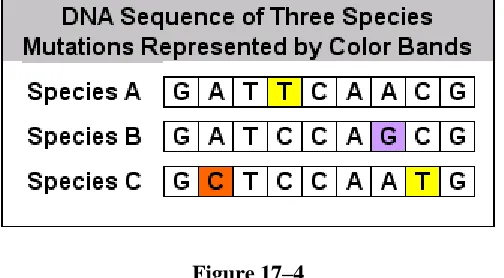
Figure 17–4
116. How many differences are there in the DNA of the three species in Figure 17–4? What could be learned by comparing those differences?
117. What might explain the differences in the mutations of the species in Figure 17–4?
118. How can gene duplication affect evolution?
119. How can small changes in Hox genes can cause large changes in organisms?
120. What might happen when a Hox gene turns other genes on or off?
121. Why is the fossil record an incomplete history of life?
122. What are two kinds of information that scientists attempt to infer from the study of fossils?
123. What information does relative dating provide?
124. What can you infer about the relative ages of two fairly young fossils if fossil A has a greater amount of carbon-12 compared to carbon-14 than does fossil B?
125. Why are the divisions of geologic time NOT standard lengths, such as 100 million years?
126. Within the clade Reptilia, whole clades have become extinct. Do you think Reptilia itself will eventually become extinct? Explain your answer.
129. What are two important macroevolutionary patterns?
130. A pollinator species for a particular flowering plant undergoes a mutation that prevents it from seeing the plant’s dominant flower color. How might the plant evolve in response to the pollinator’s loss of color sight?
131. Why did oceans not exist on Earth 4 billion years ago?
132. When they conducted their famous experiments, Stanley Miller and Harold Urey made certain that no microorganisms contaminated their lab equipment. Why might microorganisms have harmed the accuracy of their result?
133. What role did microscopes play in the origin of the endosymbiotic theory more than 100 years ago?
134. Explain how living organisms changed the environment during Earth’s early years.
135. Gardeners often reproduce favorite plants by planting cuttings from the plant instead of seeds. Is this sexual or asexual reproduction? How would this process affect the genetic diversity of the garden population?
Other
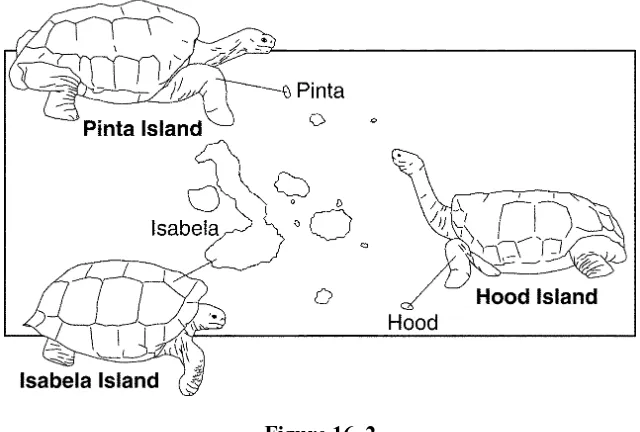
Figure 16–2
136. Interpret Visuals What adaptation is apparent in the bodies of the three tortoise species shown in Figure 16–2?
137. Interpret Visuals Which of the tortoises shown in Figure 16–2 has the longest neck?
139. Form a Hypothesis Considering the body structure of the tortoises shown in Figure 16–2, which tortoises—a population from Pinta Island or a population from Isabela Island—might survive more successfully on Hood Island? Why?
140. Apply Concepts Can you tell from Figure 16–2 how closely the three tortoise species resemble the ancestral species? Why or why not?
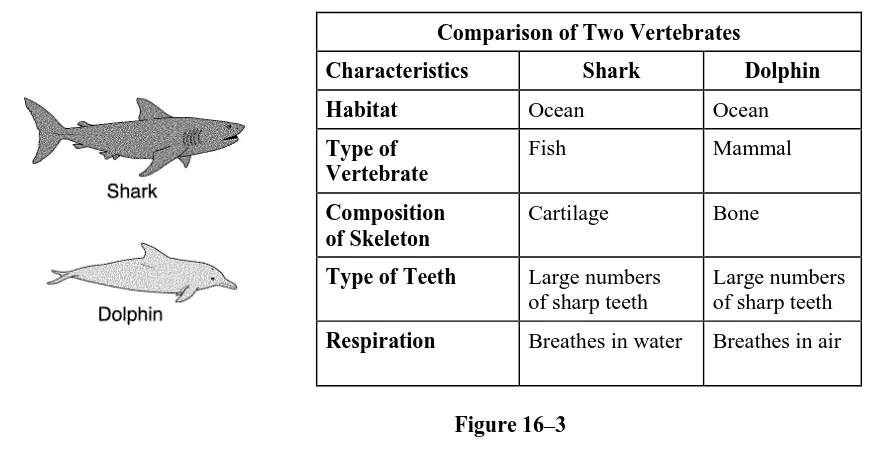
Comparison of Two Vertebrates
Characteristics Shark Dolphin
Habitat Ocean Ocean
Type of Vertebrate
Fish Mammal
Composition ofSkeleton
Cartilage Bone
Type of Teeth Large numbers of sharp teeth
Large numbers of sharp teeth
Respiration Breathes in water Breathes in air
Figure 16–3
141. Compare and Contrast In Figure 16–3, sharks and dolphins belong to different vertebrate groups and are not closely related. How can Darwin’s ideas about evolution help explain their similar appearance?
142. Apply Concepts Charles Darwin would say that sharks like the one in Figure 16–3 exhibit fitness. Explain what that means, and discuss two specific adaptations as part of your explanation.
143. Apply Concepts Fossil evidence indicates that dolphins evolved from ancestors that walked on land. How can the concept of natural selection be used to explain the evolution of the present-day dolphin body, as seen in Figure 16–3?
144. Predict Suppose a dolphin population, like those in Figure 16–3, becomes trapped in a harbor that is growing smaller and more shallow because of climate changes. Is it likely that the dolphins would evolve into a land-dwelling species in a few thousand years? Explain your answer.
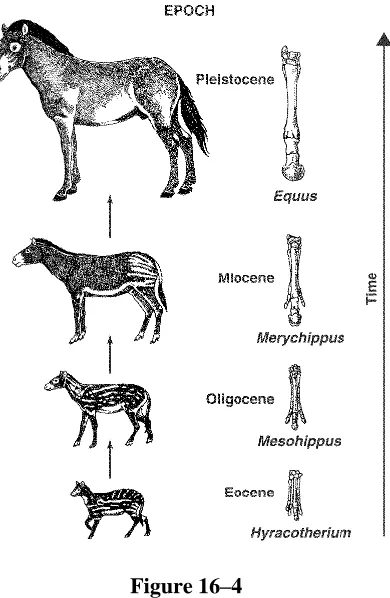
Figure 16–4
146. Infer Scientists have never seen the ancient horses shown in Figure 16–4. What do you think was the main type of evidence scientists used to prepare these diagrams?
147. Interpret Visuals According to Figure 16–4, how did overall body size of the horse change during its evolution?
148. Observe In Figure 16–4, how does the size of the head change as the horse evolves?
149. Compare and Contrast According to Figure 16–4, how did the number of toes of Mesohippus compare with that of Equus, the modern horse?
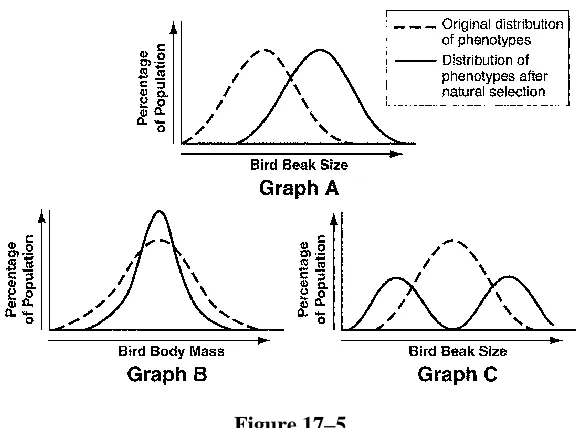
Figure 17–5
151. Interpret Graphs According to Graph A in Figure 17–5, what has occurred?
152. Interpret Graphs According to Graph B in Figure 17–5, what has occurred?
153. Interpret Graphs According to Graph C in Figure 17–5, what has occurred?
154. Infer Which of the three graphs shown in Figure 17–5 might show a population of birds with members that specialize in different types of food? Explain.
155. Infer What factors or conditions might have led to the change shown in Graph A of Figure 17–5?
Figure 17–6
156. Interpret Graphs Describe the information about frog species that is shown in Figure 17–6.
158. Infer Based on Figure 17–6, what mechanism appears to keep bullfrogs reproductively isolated? Would that mechanism necessarily be the only isolating mechanism? Explain.
159. Infer Peeper frogs and leopard frogs do not interbreed even when they share a habitat. Use the information in Figure 17–6 to determine what mechanism probably keeps the two species reproductively isolated.
160. Predict Frog mating does not occur in cold weather. Assume that the mating times shown in Figure 17–6 are for frogs in the northern part of the United States. How might these curves change for frogs in the southern part of the United States? Explain.
Figure 17–7
161. Apply Concepts Explain what speciation means using examples from Figure 17–7.
162. Design an Experiment Suppose that researchers suspected that two groups shown in Figure 17–7 were actually a single species. How might the researchers test that hypothesis?
163. Apply Concepts Darwin’s finches in Figure 17–7 were found on one or more of the Galápagos Islands. How might the island geography have affected the evolution of these species?
164. Form a Hypothesis Examine Figure 17–7 and observe the large ground finch and medium ground finch. Assume that the diagram shows the average type of beak for each group. If these species were formed from a single type of natural selection, which type is it most likely to be? Explain.
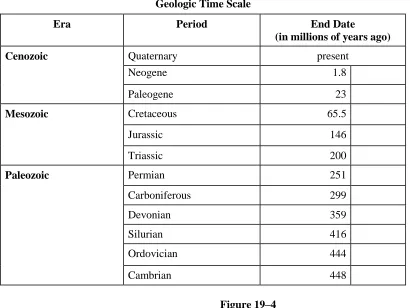
Geologic Time Scale
Era Period End Date
(in millions of years ago)
Cenozoic Quaternary present
Neogene 1.8
Paleogene 23
Mesozoic Cretaceous 65.5
Jurassic 146
Triassic 200
Paleozoic Permian 251
Carboniferous 299
Devonian 359
Silurian 416
Ordovician 444
Cambrian 448
Figure 19–4
166. Interpret Tables How many geologic periods are shown in Figure 19–4, and which one is the earliest?
167. Apply Concepts The Paleozoic Era ended with the disappearance of many land and aquatic species. What is that type of event called? Use Figure 19–4 to name the period in which that event took place.
168. Interpret Tables The end of the Mesozoic Era marks the extinction of dinosaurs. Based on Figure 19–4, how long ago did the dinosaurs become extinct?
169. Calculate Use Figure 19–4 to determine how many years the Silurian Period lasted.
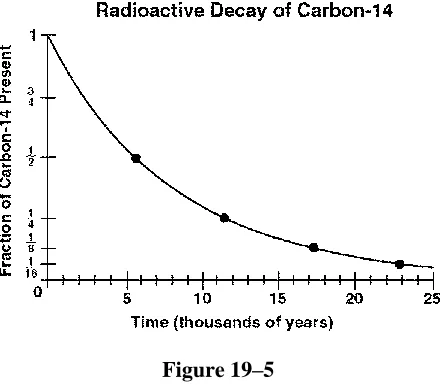
Figure 19–5
171. Interpret Graphs Use Figure 19–5 to determine the approximate half-life of carbon-14.
172. Interpret Graphs A fossil bone was found to contain about one sixteenth of the amount of carbon-14 that was originally present. Use Figure 19–5 to determine the approximate age of the bone.
173. Infer According to Figure 19–5, in which case would carbon-14 be more useful for radioactive dating: for wooden beams in native American cave dwellings, which are probably less than 7000 years old, or for the fossil of an early mammal that is probably 100,000 years old? Explain your answer.
174. Interpret Graphs According to Figure 19–5, how many half-lives have passed if a fossil has one eighth of its original amount of carbon-14?
175. Predict As carbon-14 decays, it changes to nitrogen-14, which is released as a gas. Refer to Figure 19–5 to predict how the amount of nitrogen gas produced would change over the period of radioactive decay. Why does that change take place?
Figure 19–6
176. Interpret Visuals The evolutionary tree in Figure 19–6 shows relationships among several mammal species. Which group of modern mammals is the most closely related to elephants (Proboscideans)?
177. Interpret Visuals Which group of animals has existed the longest in Figure 19–6? How do you know?
178. Apply Concepts In Figure 19–6, are the different groups the result of convergent evolution or adaptive radiation? How do you know?
179. Predict Study Figure 19–6. How would you expect this evolutionary tree to look thousands of years from now? Why?
180. Infer What do you think was most responsible for the amount of diversity in the groups shown in Figure 19–3? Explain your answer.
Essay
181. What was Charles Darwin’s contribution to science, and how did he develop it?
182. What sources of evidence contributed to Charles Darwin’s presentation of his concept of evolution by natural selection?
183. Explain how Darwin noticed that different animals that lived in similar habitats existed around the world.
184. Discuss Jean-Baptiste Lamarck’s contribution to the overall theory of evolution.
185. How did Thomas Malthus’s ideas about human population growth inspire Darwin’s thinking about evolution?
186. Explain how the finches and tortoises that Charles Darwin observed on the Galápagos Islands influenced his thinking.
187. How was Darwin’s concept of natural selection influenced by the practices of English farmers?
188. Suppose a plant breeder selectively breeds a plant for its bright red flower and creates a new population with little variation. Would the new population survive if it were released into the wild? Explain.
Figure 16–5
190. How is the idea of common descent supported by examples of homologous structures as shown in Figure 16–5?
191. For a trait that has many different alleles, would an individual in the population be more likely to have that allele if it has a low allele frequency or a high allele frequency? Why?
192. Define mutation and describe one situation in which a mutation changes an organism’s phenotype in a way that affects fitness and another situation in which a mutation would not affect an organism’s fitness.
193. For a population, are the frequencies of phenotypes for a single-gene trait best expressed by a bar graph or a curve? Are the frequencies of phenotypes for a polygenic trait best expressed by a bar graph or a curve? Explain.
194. Describe the founder effect, and describe the conditions in which it arises.
Figure 17–8
196. Assume that a single population becomes split by migration across a geographic barrier that divides two very different ecosystems, as is shown in Figure 17–8. What would likely happen to the two separated
populations? Would this process occur more quickly, less quickly, or at the same rate as it would if the two populations lived in similar ecosystems?
197. If each of the Galápagos Islands had contained an identical assortment and abundance of vegetation, would the impact of natural selection have been as pronounced as it was? Explain.
198. Why are neutral mutations useful for molecular clocks?
199. Describe one way that new genes can evolve.
200. Assume that a species needs a fairly long neck to reach its food. How might Hox genes contribute to the evolution of this species?
201. Suppose that a scientist found a fossilized fish on the surface of the ground. Describe a possible set of events that could have taken place, first to form the fossil and then to situate it on the ground surface.
202. Explain the principle behind radioactive dating.
203. What is the geologic time scale and how does it relate to the fossil record?
204. Explain how physical and biological processes have shaped life on Earth.
205. Explain the processes that determine whether a clade survives or becomes extinct.
206. Darwin proposed that evolution proceeded at a slow and steady pace, a model known as gradualism. But his Galápagos finches did not follow this model. What model of evolution did they follow? Explain how the two models differ.
207. Explain the proposed relationship between an asteroid impact and the Cretaceous mass extinction.
208. Explain the hypothesis that describes Earth’s formation.
209. Define and explain the endosymbiotic theory.
Evolution Unit Practice Test
Answer Section
MODIFIED TRUE/FALSE
1. ANS: T PTS: 1 DIF: L1
REF: p. 451 OBJ: 16.1.1 State Charles Darwin's contribution to science. STA: UT.BIO.5.2.c TOP: Foundation Edition
BLM: knowledge 2. ANS: F
differ are different
have natural variations
PTS: 1 DIF: L2 REF: p. 452
OBJ: 16.1.2 Describe the three patterns of biodiversity noted by Darwin. STA: UT.BIO.5.2.c | UT.BIO.5.2.d BLM: comprehension 3. ANS: F, Lyell
PTS: 1 DIF: L2 REF: p. 455
OBJ: 16.2.1 Identify the conclusions drawn by Hutton and Lyell about Earth's history. STA: UT.BIO.5.2.c TOP: Foundation Edition
BLM: comprehension
4. ANS: T PTS: 1 DIF: L2
REF: p. 454 OBJ: 16.2.1 Identify the conclusions drawn by Hutton and Lyell about Earth's history. STA: UT.BIO.5.2.c TOP: Foundation Edition
BLM: comprehension
5. ANS: T PTS: 1 DIF: L2
REF: p. 455 OBJ: 16.2.1 Identify the conclusions drawn by Hutton and Lyell about Earth's history. STA: UT.BIO.5.2.c BLM: application
6. ANS: F phenotype body
PTS: 1 DIF: L2 REF: p. 456
OBJ: 16.2.2 Describe Lamarck's hypothesis of evolution. STA: UT.BIO.5.2.c TOP: Foundation Edition BLM: comprehension
7. ANS: F, Malthus
PTS: 1 DIF: L1 REF: p. 457
OBJ: 16.2.3 Describe Malthus's view of population growth. STA: UT.BIO.5.2.c TOP: Foundation Edition BLM: knowledge
8. ANS: T PTS: 1 DIF: L1
REF: p. 457 | p. 458
PTS: 1 DIF: L2 REF: p. 458
OBJ: 16.3.1 Describe the conditions under which natural selection occurs.
STA: UT.BIO.5.1.a | UT.BIO.5.1.b | UT.BIO.5.2.d TOP: Foundation Edition BLM: knowledge
10. ANS: F, common descent
PTS: 1 DIF: L1 REF: p. 464
OBJ: 16.3.2 Explain the principle of common descent. STA: UT.BIO.5.2.c TOP: Foundation Edition BLM: knowledge
11. ANS: F, biogeography
PTS: 1 DIF: L2 REF: p. 465
OBJ: 16.4.1 Explain how geologic distribution of species relates to their evolutionary history. STA: UT.BIO.5.1.a | UT.BIO.5.1.c TOP: Foundation Edition
BLM: comprehension
12. ANS: T PTS: 1 DIF: L2
REF: p. 467
OBJ: 16.4.2 Explain how fossils and the fossil record document the descent of modern species from ancient ancestors. STA: UT.BIO.5.2.a TOP: Foundation Edition
BLM: analysis 13. ANS: F, homologous
PTS: 1 DIF: L1 REF: p. 468
OBJ: 16.4.3 Describe what homologous structures and embryology suggest about the process of evolutionary change. STA: UT.BIO.5.2.a
TOP: Foundation Edition BLM: knowledge
14. ANS: T PTS: 1 DIF: L2
REF: p. 470
OBJ: 16.4.4 Explain how molecular evidence can be used to trace the process of evolution. STA: UT.BIO.5.2.a BLM: comprehension
15. ANS: F
physical characteristics phenotype
PTS: 1 DIF: L2 REF: p. 472
OBJ: 16.4.5 Explain the results of the Grants' investigation of adaptation in Galapagos finches. STA: UT.BIO.5.1.b | UT.BIO.5.2.c | UT.BIO.5.2.d TOP: Foundation Edition BLM: comprehension
16. ANS: T PTS: 1 DIF: L2
REF: p. 483 OBJ: 17.1.1 Define evolution in genetic terms. STA: UT.BIO.5.2.b BLM: application
17. ANS: T PTS: 1 DIF: L2
REF: p. 483 OBJ: 17.1.1 Define evolution in genetic terms. STA: UT.BIO.5.2.b BLM: comprehension 18. ANS: F, sexual
PTS: 1 DIF: L1 REF: p. 484
BLM: knowledge
19. ANS: T PTS: 1 DIF: L2
REF: p. 484 OBJ: 17.1.2 Identify the main sources of genetic variation in a population.
STA: UT.BIO.5.2.b BLM: analysis
20. ANS: F, single-gene
PTS: 1 DIF: L1 REF: p. 485
OBJ: 17.1.3 State what determines the number of phenotypes for a trait. STA: UT.BIO.4.2.b TOP: Foundation Edition BLM: knowledge
21. ANS: F, polygenic
PTS: 1 DIF: L2 REF: p. 486
OBJ: 17.1.3 State what determines the number of phenotypes for a trait. STA: UT.BIO.4.2.b TOP: Foundation Edition BLM: application
22. ANS: T PTS: 1 DIF: L1
REF: p. 488 OBJ: 17.2.1 Explain how natural selection affects single-gene and polygenic traits. STA: UT.BIO.5.1.b TOP: Foundation Edition
BLM: knowledge 23. ANS: F, directional
PTS: 1 DIF: L3 REF: p. 489
OBJ: 17.2.1 Explain how natural selection affects single-gene and polygenic traits. STA: UT.BIO.5.1.b TOP: Foundation Edition
BLM: evaluation
24. ANS: T PTS: 1 DIF: L1
REF: p. 490 OBJ: 17.2.2 Describe genetic drift. STA: UT.BIO.5.1.c TOP: Foundation Edition BLM: knowledge
25. ANS: T PTS: 1 DIF: L2
REF: p. 490 OBJ: 17.2.2 Describe genetic drift. STA: UT.BIO.5.1.c TOP: Foundation Edition BLM: application
26. ANS: F, equilibrium
PTS: 1 DIF: L2 REF: p. 491
OBJ: 17.2.3 Explain how different factors affect genetic equilibrium. STA: UT.BIO.4.1.b TOP: Foundation Edition BLM: comprehension
27. ANS: F, non-random mating
PTS: 1 DIF: L3 REF: p. 492
OBJ: 17.2.3 Explain how different factors affect genetic equilibrium. STA: UT.BIO.4.1.b TOP: Foundation Edition BLM: evaluation
28. ANS: F, geographic
PTS: 1 DIF: L2 REF: p. 495
OBJ: 17.3.1 Identify the types of isolation that can lead to the formation of new species. STA: UT.BIO.5.1.c TOP: Foundation Edition
29. ANS: T PTS: 1 DIF: L2 REF: p. 495
OBJ: 17.3.1 Identify the types of isolation that can lead to the formation of new species. STA: UT.BIO.5.1.c TOP: Foundation Edition
BLM: analysis
30. ANS: T PTS: 1 DIF: L1
REF: p. 496 OBJ: 17.3.2 Describe the current hypothesis about Galapagos finch speciation. STA: UT.BIO.5.1.c | UT.BIO.5.2.d TOP: Foundation Edition
BLM: knowledge 31. ANS: F
changed evolved
PTS: 1 DIF: L2 REF: p. 539
OBJ: 19.1.1 Explain what information fossils can reveal about ancient life. STA: UT.BIO.5.2.a BLM: comprehension
32. ANS: F, carbon-14
PTS: 1 DIF: L2 REF: p. 541
OBJ: 19.1.2 Differentiate between relative dating and radiometric dating. STA: UT.BIO.5.2.a TOP: Foundation Edition BLM: application
33. ANS: F, radioactive
PTS: 1 DIF: L2 REF: p. 541
OBJ: 19.1.2 Differentiate between relative dating and radiometric dating. STA: UT.BIO.5.2.a TOP: Foundation Edition BLM: comprehension
34. ANS: F, Precambrian Time
PTS: 1 DIF: L1 REF: p. 543
OBJ: 19.1.3 Identify the divisions of the geologic time scale. STA: UT.BIO.5.2.a TOP: Foundation Edition BLM: knowledge
35. ANS: F, Mesozoic
PTS: 1 DIF: L2 REF: p. 421
OBJ: 19.1.3 Identify the divisions of the geologic time scale. STA: UT.BIO.5.2.a BLM: knowledge
36. ANS: T PTS: 1 DIF: L1
REF: p. 544
OBJ: 19.1.4 Describe how environmental processes and living things have shaped life on Earth. STA: UT.BIO.5.1.a TOP: Foundation Edition
BLM: knowledge
37. ANS: T PTS: 1 DIF: L1
REF: p. 548
OBJ: 19.2.1 Identify the processes that influence survival or extinction of a species or clade. STA: UT.BIO.5.1.a | UT.BIO.5.2.a TOP: Foundation Edition
PTS: 1 DIF: L3 REF: p. 546
OBJ: 19.2.1 Identify the processes that influence survival or extinction of a species or clade. STA: UT.BIO.5.1.a | UT.BIO.5.2.a TOP: Foundation Edition
BLM: application
39. ANS: T PTS: 1 DIF: L3
REF: p. 549 OBJ: 19.2.2 Contrast gradualism and punctuated equilibrium. STA: UT.BIO.5.2.a TOP: Foundation Edition
BLM: application 40. ANS: F, extinction
PTS: 1 DIF: L1 REF: p. 546
OBJ: 19.2.3 Name two important patterns in macroevolution. STA: UT.BIO.5.1.b | UT.BIO.5.2.a TOP: Foundation Edition BLM: knowledge
41. ANS: T PTS: 1 DIF: L2
REF: p. 550 | p. 551 OBJ: 19.2.3 Name two important patterns in macroevolution. STA: UT.BIO.5.1.b | UT.BIO.5.2.a TOP: Foundation Edition
BLM: application
42. ANS: T PTS: 1 DIF: L2
REF: p. 554 OBJ: 19.3.1 Identify some of the hypotheses about early Earth and the origin of life. STA: UT.BIO.2.1.a TOP: Foundation Edition
BLM: comprehension
43. ANS: T PTS: 1 DIF: L3
REF: p. 553 OBJ: 19.3.1 Identify some of the hypotheses about early Earth and the origin of life.
STA: UT.BIO.2.1.a BLM: synthesis
44. ANS: F binary fission fission
PTS: 1 DIF: L3 REF: p. 557
OBJ: 19.3.2 Explain the endosymbiotic theory. STA: UT.BIO.1.3.a | UT.BIO.5.2.a TOP: Foundation Edition BLM: comprehension
45. ANS: F, Sexual
PTS: 1 DIF: L2 REF: p. 558
OBJ: 19.3.3 Explain the significance of sexual reproduction in evolution. STA: UT.BIO.4.1.b TOP: Foundation Edition BLM: analysis
COMPLETION
46. ANS: Darwin Charles Darwin
PTS: 1 DIF: L1 REF: p. 450
OBJ: 16.1.1 State Charles Darwin's contribution to science. STA: UT.BIO.5.2.c TOP: Foundation Edition BLM: knowledge
all over the world
PTS: 1 DIF: L1 REF: p. 451
OBJ: 16.1.2 Describe the three patterns of biodiversity noted by Darwin. STA: UT.BIO.5.2.c | UT.BIO.5.2.d TOP: Foundation Edition BLM: knowledge
48. ANS: many millions millions
PTS: 1 DIF: L2 REF: p. 455
OBJ: 16.2.1 Identify the conclusions drawn by Hutton and Lyell about Earth's history. STA: UT.BIO.5.2.c TOP: Foundation Edition
BLM: comprehension 49. ANS:
Lyell James Lyell
PTS: 1 DIF: L1 REF: p. 455
OBJ: 16.2.1 Identify the conclusions drawn by Hutton and Lyell about Earth's history. STA: UT.BIO.5.2.c TOP: Foundation Edition
BLM: knowledge 50. ANS: acquired
PTS: 1 DIF: L1 REF: p. 456
OBJ: 16.2.2 Describe Lamarck's hypothesis of evolution. STA: UT.BIO.5.2.c TOP: Foundation Edition BLM: knowledge
51. ANS: evolution
PTS: 1 DIF: L2 REF: p. 456
OBJ: 16.2.2 Describe Lamarck's hypothesis of evolution. STA: UT.BIO.5.2.c TOP: Foundation Edition BLM: comprehension
52. ANS: grows increases
PTS: 1 DIF: L2 REF: p. 457
OBJ: 16.2.3 Describe Malthus's view of population growth. STA: UT.BIO.5.2.c TOP: Foundation Edition BLM: comprehension
53. ANS: organisms living things
PTS: 1 DIF: L2 REF: p. 457
OBJ: 16.2.3 Describe Malthus's view of population growth. STA: UT.BIO.5.2.c TOP: Foundation Edition BLM: comprehension
PTS: 1 DIF: L2 REF: p. 463
OBJ: 16.3.1 Describe the conditions under which natural selection occurs.
STA: UT.BIO.5.1.a | UT.BIO.5.1.b | UT.BIO.5.2.d TOP: Foundation Edition BLM: comprehension
55. ANS:
common descent common ancestors
PTS: 1 DIF: L2 REF: p. 464
OBJ: 16.3.2 Explain the principle of common descent. STA: UT.BIO.5.2.c TOP: Foundation Edition BLM: application
56. ANS: species organisms
PTS: 1 DIF: L2 REF: p. 465
OBJ: 16.4.1 Explain how geologic distribution of species relates to their evolutionary history. STA: UT.BIO.5.1.a | UT.BIO.5.1.c TOP: Foundation Edition
BLM: comprehension 57. ANS:
radioactivity radioactive dating
PTS: 1 DIF: L1 REF: p. 466
OBJ: 16.4.2 Explain how fossils and the fossil record document the descent of modern species from ancient ancestors. STA: UT.BIO.5.2.a TOP: Foundation Edition
BLM: knowledge 58. ANS: homologous
PTS: 1 DIF: L2 REF: p. 468
OBJ: 16.4.3 Describe what homologous structures and embryology suggest about the process of evolutionary change. STA: UT.BIO.5.2.a
TOP: Foundation Edition BLM: comprehension 59. ANS: Homologous
PTS: 1 DIF: L2 REF: p. 471
OBJ: 16.4.4 Explain how molecular evidence can be used to trace the process of evolution. STA: UT.BIO.5.2.a BLM: comprehension
60. ANS:
natural selection adaptation
PTS: 1 DIF: L2 REF: p. 472
OBJ: 16.4.5 Explain the results of the Grants' investigation of adaptation in Galapagos finches. STA: UT.BIO.5.1.b | UT.BIO.5.2.c | UT.BIO.5.2.d TOP: Foundation Edition BLM: application
OBJ: 17.1.1 Define evolution in genetic terms. STA: UT.BIO.5.2.b TOP: Foundation Edition BLM: knowledge
62. ANS: lateral gene transfer.
PTS: 1 DIF: L2 REF: p. 485
OBJ: 17.1.2 Identify the main sources of genetic variation in a population. STA: UT.BIO.5.2.b TOP: Foundation Edition BLM: comprehension
63. ANS: genes
PTS: 1 DIF: L1 REF: p. 485
OBJ: 17.1.3 State what determines the number of phenotypes for a trait. STA: UT.BIO.4.2.b TOP: Foundation Edition BLM: knowledge
64. ANS: phenotypes
PTS: 1 DIF: L2 REF: p. 486
OBJ: 17.1.3 State what determines the number of phenotypes for a trait. STA: UT.BIO.4.2.b TOP: Foundation Edition BLM: comprehension
65. ANS: disruptive
PTS: 1 DIF: L3 REF: p. 489
OBJ: 17.2.1 Explain how natural selection affects single-gene and polygenic traits. STA: UT.BIO.5.1.b BLM: evaluation
66. ANS: fitness appearance phenotype
PTS: 1 DIF: L3 REF: p. 488
OBJ: 17.2.1 Explain how natural selection affects single-gene and polygenic traits. STA: UT.BIO.5.1.b TOP: Foundation Edition
BLM: application 67. ANS: chance
PTS: 1 DIF: L2 REF: p. 490 OBJ: 17.2.2 Describe genetic drift. STA: UT.BIO.5.1.c TOP: Foundation Edition
BLM: analysis
68. ANS: Hardy-Weinberg
PTS: 1 DIF: L1 REF: p. 491
OBJ: 17.2.3 Explain how different factors affect genetic equilibrium. STA: UT.BIO.4.1.b TOP: Foundation Edition BLM: knowledge
69. ANS: genetic equilibrium
PTS: 1 DIF: L2 REF: p. 491
BLM: comprehension 70. ANS: reproductively
PTS: 1 DIF: L1 REF: p. 494
OBJ: 17.3.1 Identify the types of isolation that can lead to the formation of new species. STA: UT.BIO.5.1.c TOP: Foundation Edition
BLM: knowledge 71. ANS:
speciation species formation
PTS: 1 DIF: L3 REF: p. 494
OBJ: 17.3.1 Identify the types of isolation that can lead to the formation of new species. STA: UT.BIO.5.1.c TOP: Foundation Edition
BLM: synthesis 72. ANS: directional
PTS: 1 DIF: L2 REF: p. 496
OBJ: 17.3.2 Describe the current hypothesis about Galapagos finch speciation. STA: UT.BIO.5.1.c | UT.BIO.5.2.d TOP: Foundation Edition
BLM: application 73. ANS: compete
PTS: 1 DIF: L2 REF: p. 497
OBJ: 17.3.2 Describe the current hypothesis about Galapagos finch speciation. STA: UT.BIO.5.1.c | UT.BIO.5.2.d BLM: analysis
74. ANS: common ancestor
PTS: 1 DIF: L1 REF: p. 499
OBJ: 17.4.1 Explain how molecular clocks are used. STA: UT.BIO.4.3.d TOP: Foundation Edition BLM: comprehension
75. ANS: molecular clock
PTS: 1 DIF: L1 REF: p. 498
OBJ: 17.4.1 Explain how molecular clocks are used. STA: UT.BIO.4.3.d TOP: Foundation Edition BLM: comprehension
76. ANS: extinct
PTS: 1 DIF: L1 REF: p. 538
OBJ: 19.1.1 Explain what information fossils can reveal about ancient life. STA: UT.BIO.5.2.a TOP: Foundation Edition BLM: knowledge
77. ANS: fossil
PTS: 1 DIF: L1 REF: p. 539
OBJ: 19.1.1 Explain what information fossils can reveal about ancient life. STA: UT.BIO.5.2.a TOP: Foundation Edition BLM: knowledge
PTS: 1 DIF: L2 REF: p. 540
OBJ: 19.1.2 Differentiate between relative dating and radiometric dating. STA: UT.BIO.5.2.a TOP: Foundation Edition BLM: application
79. ANS: half-life
PTS: 1 DIF: L3 REF: p. 541
OBJ: 19.1.2 Differentiate between relative dating and radiometric dating. STA: UT.BIO.5.2.a TOP: Foundation Edition BLM: evaluation
80. ANS: periods
PTS: 1 DIF: L1 REF: p. 542
OBJ: 19.1.3 Identify the divisions of the geologic time scale. STA: UT.BIO.5.2.a TOP: Foundation Edition BLM: knowledge
81. ANS: plate tectonics continental drift
PTS: 1 DIF: L2 REF: p. 551
OBJ: 19.1.4 Describe how environmental processes and living things have shaped life on Earth. STA: UT.BIO.5.1.a TOP: Foundation Edition
BLM: comprehension 82. ANS: mass extinction
PTS: 1 DIF: L2 REF: p. 549
OBJ: 19.2.1 Identify the processes that influence survival or extinction of a species or clade. STA: UT.BIO.5.1.a | UT.BIO.5.2.a TOP: Foundation Edition
BLM: comprehension 83. ANS: gradualism
PTS: 1 DIF: L3 REF: p. 549
OBJ: 19.2.2 Contrast gradualism and punctuated equilibrium. STA: UT.BIO.5.2.a TOP: Foundation Edition BLM: evaluation
84. ANS: convergent evolution
PTS: 1 DIF: L3 REF: p. 550
OBJ: 19.2.3 Name two important patterns in macroevolution. STA: UT.BIO.5.1.b | UT.BIO.5.2.a TOP: Foundation Edition BLM: evaluation
85. ANS: Coevolution
PTS: 1 DIF: L2 REF: p. 551
OBJ: 19.2.4 Explain the evolutionary characteristics of coevolving organisms. STA: UT.BIO.5.2.a TOP: Foundation Edition
BLM: application 86. ANS: amino acids
PTS: 1 DIF: L1 REF: p. 554
BLM: analysis 87. ANS: nitrogen
PTS: 1 DIF: L2 REF: p. 553
OBJ: 19.3.1 Identify some of the hypotheses about early Earth and the origin of life. STA: UT.BIO.2.1.a TOP: Foundation Edition
BLM: analysis 88. ANS: Chloroplasts
PTS: 1 DIF: L1 REF: p. 556
OBJ: 19.3.2 Explain the endosymbiotic theory. STA: UT.BIO.1.3.a | UT.BIO.5.2.a TOP: Foundation Edition BLM: comprehension
89. ANS: endosymbiotic
PTS: 1 DIF: L2 REF: p. 557
OBJ: 19.3.2 Explain the endosymbiotic theory. STA: UT.BIO.1.3.a | UT.BIO.5.2.a TOP: Foundation Edition BLM: knowledge
90. ANS: asexually
PTS: 1 DIF: L3 REF: p. 558
OBJ: 19.3.3 Explain the significance of sexual reproduction in evolution. STA: UT.BIO.4.1.b BLM: evaluation
SHORT ANSWER
91. ANS:
Darwin collected many examples of similar, but not identical, modern organisms as well as fossils that were previously unknown.These specimens helped him form his theory of evolution by natural selection.
PTS: 1 DIF: L3 REF: p. 452 | p. 453
OBJ: 16.1.1 State Charles Darwin's contribution to science. STA: UT.BIO.5.2.c BLM: synthesis
92. ANS:
Darwin proposed a scientific theory of biological evolution to explain how organisms evolved over long periods of time through descent from common ancestors.
PTS: 1 DIF: L2 REF: p. 450
OBJ: 16.1.1 State Charles Darwin's contribution to science. STA: UT.BIO.5.2.c TOP: Foundation Edition BLM: comprehension
93. ANS:
Darwin noticed that some of the fossils were similar to living species.
PTS: 1 DIF: L1 REF: p. 453
OBJ: 16.1.2 Describe the three patterns of biodiversity noted by Darwin. STA: UT.BIO.5.2.c | UT.BIO.5.2.d TOP: Foundation Edition BLM: comprehension
94. ANS:
PTS: 1 DIF: L2 REF: p. 452
OBJ: 16.1.2 Describe the three patterns of biodiversity noted by Darwin. STA: UT.BIO.5.2.c | UT.BIO.5.2.d TOP: Foundation Edition BLM: application
95. ANS:
Hutton and Lyell recognized that geologic process take place over much longer periods of time than was commonly thought. Further, these processes are the same that have been acting on Earth since its formation. Hutton and Lyell’s ideas led them to conclude that Earth is millions, not thousands, of years old.
PTS: 1 DIF: L2 REF: p. 455
OBJ: 16.2.1 Identify the conclusions drawn by Hutton and Lyell about Earth's history. STA: UT.BIO.5.2.c TOP: Foundation Edition
BLM: comprehension 96. ANS:
Lamarck thought that organisms tended toward complexity and perfection. He thought they could change their structures during their lifetimes through selective use and disuse. These acquired characteristics could then be inherited.
PTS: 1 DIF: L2 REF: p. 456
OBJ: 16.2.2 Describe Lamarck's hypothesis of evolution. STA: UT.BIO.5.2.c TOP: Foundation Edition BLM: comprehension
97. ANS:
Malthus concluded that if human population growth was not “checked” by factors like disease, there would not be enough resources to sustain it.
PTS: 1 DIF: L2 REF: p. 457
OBJ: 16.2.3 Describe Malthus's view of population growth. STA: UT.BIO.5.2.c TOP: Foundation Edition BLM: comprehension
98. ANS:
Farmers bred only animals with desirable traits, which resulted in improved offspring.
PTS: 1 DIF: L1 REF: p. 458
OBJ: 16.2.4 Explain the role of inherited variation in artificial selection. STA: UT.BIO.5.1.a | UT.BIO.5.1.b TOP: Foundation Edition BLM: knowledge
99. ANS:
In artificial selection, humans do the “selecting”—that is, they choose which traits they want to appear in future generations. In natural selection, the environment does the “selecting.”
PTS: 1 DIF: L2 REF: p. 458
OBJ: 16.2.4 Explain the role of inherited variation in artificial selection. STA: UT.BIO.5.1.a | UT.BIO.5.1.b TOP: Foundation Edition BLM: analysis
100. ANS:
Natural selection occurs when 1) more individuals are born than can survive, 2) natural, heritable variations among organisms are present, and 3) organisms vary in their fitness.
STA: UT.BIO.5.1.a | UT.BIO.5.1.b | UT.BIO.5.2.d TOP: Foundation Edition BLM: comprehension
101. ANS:
All living and extinct species are descended from a common ancestor.
PTS: 1 DIF: L2 REF: p. 464
OBJ: 16.3.2 Explain the principle of common descent. STA: UT.BIO.5.2.c TOP: Foundation Edition BLM: comprehension
102. ANS:
Ancestors of modern whales probably had functional legs and lived on land.
PTS: 1 DIF: L2 REF: p. 467
OBJ: 16.4.2 Explain how fossils and the fossil record document the descent of modern species from ancient ancestors. STA: UT.BIO.5.2.a TOP: Foundation Edition
BLM: application 103. ANS:
It suggests that there is no disadvantage to fitness associated with the vestigial structures. If there were a disadvantage, then the structures would be selected against and you’d expect them to no longer be present.
PTS: 1 DIF: L2 REF: p. 469
OBJ: 16.4.3 Describe what homologous structures and embryology suggest about the process of evolutionary change. STA: UT.BIO.5.2.a
BLM: application 104. ANS:
The similarity of Hox genes in many types of organisms is evidence that the organisms all evolved from a common ancestor.
PTS: 1 DIF: L2 REF: p. 471
OBJ: 16.4.4 Explain how molecular evidence can be used to trace the process of evolution.
STA: UT.BIO.5.2.a BLM: analysis
105. ANS:
The Grants documented changes in the finch population consistent with Darwin’s ideas of natural selection. Through their work, they discovered that natural selection can occur often and frequently.
PTS: 1 DIF: L2 REF: p. 472
OBJ: 16.4.5 Explain the results of the Grants' investigation of adaptation in Galapagos finches. STA: UT.BIO.5.1.b | UT.BIO.5.2.c | UT.BIO.5.2.d TOP: Foundation Edition BLM: comprehension
106. ANS:
Yes, the term population is defined in terms of a species. A population is a group of individuals of the same species that interbreed.
PTS: 1 DIF: L2 REF: p. 483
OBJ: 17.1.1 Define evolution in genetic terms. STA: UT.BIO.5.2.b BLM: comprehension
107. ANS:
OBJ: 17.1.1 Define evolution in genetic terms. STA: UT.BIO.5.2.b TOP: Foundation Edition BLM: application
108. ANS:
The three main sources of genetic variation are mutations, genetic recombination in sexual reproduction, and lateral gene transfer. Genetic recombination is most common in eukaryotes.
PTS: 1 DIF: L2 REF: p. 484 | p. 485
OBJ: 17.1.2 Identify the main sources of genetic variation in a population. STA: UT.BIO.5.2.b TOP: Foundation Edition BLM: comprehension
109. ANS:
A trait with two distinct phenotypes likely would be a single-gene trait. Because each gene of a polygenic trait often has two or more alleles, a polygenic trait can have many possible genotypes and phenotypes.
PTS: 1 DIF: L2 REF: p. 485 | p. 486 OBJ: 17.1.3 State what determines the number of phenotypes for a trait. STA: UT.BIO.4.2.b TOP: Foundation Edition BLM: application
110. ANS:
No. An allele for a trait that has no effect on fitness will not be affected by natural selection because it does not affect the survival and reproduction of individuals in a population.
PTS: 1 DIF: L3 REF: p. 488
OBJ: 17.2.1 Explain how natural selection affects single-gene and polygenic traits.
STA: UT.BIO.5.1.b BLM: synthesis
111. ANS:
Generally, the smaller a population is, the easier it is for allele frequencies to change. Genetic drift occurs when the allele frequencies in small populations change by chance.
PTS: 1 DIF: L3 REF: p. 490 OBJ: 17.2.2 Describe genetic drift. STA: UT.BIO.5.1.c TOP: Foundation Edition
BLM: synthesis 112. ANS:
The five conditions are non-random mating, small population size, immigration or emigration, mutations, and natural selection.
PTS: 1 DIF: L2 REF: p. 492
OBJ: 17.2.3 Explain how different factors affect genetic equilibrium. STA: UT.BIO.4.1.b TOP: Foundation Edition BLM: knowledge
113. ANS:
A large river would likely keep populations of small rodents apart, but it would not necessarily isolate birds and other populations that can fly.
PTS: 1 DIF: L2 REF: p. 495
OBJ: 17.3.1 Identify the types of isolation that can lead to the formation of new species. STA: UT.BIO.5.1.c TOP: Foundation Edition
The three mechanisms for reproductive isolation are behavioral isolation, geographic isolation, and temporal isolation. Two populations of frogs that are isolated due to different mating calls is an example of behavioral isolation.
PTS: 1 DIF: L2 REF: p. 495
OBJ: 17.3.1 Identify the types of isolation that can lead to the formation of new species. STA: UT.BIO.5.1.c TOP: Foundation Edition
BLM: application 115. ANS:
Speciation in the Galápagos finches occurred by the founding of a new population, the geographical isolation of a portion of that population, changes in the new population’s gene pool, reproductive isolation, and ecological competition.
PTS: 1 DIF: L2 REF: p. 496 | p. 497
OBJ: 17.3.2 Describe the current hypothesis about Galapagos finch speciation. STA: UT.BIO.5.1.c | UT.BIO.5.2.d TOP: Foundation Edition
BLM: application 116. ANS:
There are two differences in DNA between A and B, and three differences in DNA between A and C or B and C. You can infer that A and B share a more recent common ancestor than A and C or B and C.
PTS: 1 DIF: L3 REF: p. 499
OBJ: 17.4.1 Explain how molecular clocks are used. STA: UT.BIO.4.3.d TOP: Foundation Edition BLM: synthesis
117. ANS:
Species C may share an older common ancestor with both Species A and B. The longer a species has been evolving independently, the more differences there are likely to be in the gene pool of those species.
PTS: 1 DIF: L3 REF: p. 499
OBJ: 17.4.1 Explain how molecular clocks are used. STA: UT.BIO.4.3.d TOP: Foundation Edition BLM: synthesis
118. ANS:
Gene duplication can affect evolution because the duplicate might acquire a mutation. If that mutation is positive, it will be will be selected for by natural selection to become more frequent in the population.
PTS: 1 DIF: L2 REF: p. 500
OBJ: 17.4.2 Explain how new genes evolve. STA: UT.BIO.4.3.d TOP: Foundation Edition BLM: analysis
119. ANS:
Hox genes can turn other genes on or off during embryological development. A change in the activity of one Hox gene can affect how an entire segment of an organism is patterned. For example, whether the segment has legs or wings, and how big or small those legs or wings will be.
PTS: 1 DIF: L2 REF: p. 501
OBJ: 17.4.3 Describe how Hox genes may be involved in evolutionary change. STA: UT.BIO.5.2.a TOP: Foundation Edition
BLM: synthesis 120. ANS:
PTS: 1 DIF: L2 REF: p. 501
OBJ: 17.4.3 Describe how Hox genes may be involved in evolutionary change. STA: UT.BIO.5.2.a TOP: Foundation Edition
BLM: application 121. ANS:
The formation of a fossil depends on a precise combination of conditions; therefore, many ancient organisms died without leaving a trace.
PTS: 1 DIF: L2 REF: p. 538
OBJ: 19.1.1 Explain what information fossils can reveal about ancient life. STA: UT.BIO.5.2.a TOP: Foundation Edition BLM: analysis
122. ANS:
Answers may include two of the following: the organisms’ structures, what they ate, what ate them, the environment in which they lived, how long ago they lived, the order in which they lived, what other organisms were similar to them, and how they changed over time.
PTS: 1 DIF: L2 REF: p. 539
OBJ: 19.1.1 Explain what information fossils can reveal about ancient life. STA: UT.BIO.5.2.a TOP: Foundation Edition BLM: application
123. ANS:
Relative dating allows paleontologists to estimate a rock layer or fossil’s age compared with that of other rock layers or fossils.
PTS: 1 DIF: L2 REF: p. 538
OBJ: 19.1.2 Differentiate between relative dating and radiometric dating. STA: UT.BIO.5.2.a TOP: Foundation Edition BLM: application
124. ANS:
Fossil A is older than fossil B. A fossil with a smaller proportion of carbon-14 than another fossil has been in existence longer.
PTS: 1 DIF: L3 REF: p. 541
OBJ: 19.1.2 Differentiate between relative dating and radiometric dating.
STA: UT.BIO.5.2.a BLM: synthesis
125. ANS:
The divisions of geologic time are based on evidence from rock layers that reveal major changes in fossil animals and plants. These divisions vary in length.
PTS: 1 DIF: L2 REF: p. 542
OBJ: 19.1.3 Identify the divisions of the geologic time scale. STA: UT.BIO.5.2.a BLM: analysis
126. ANS:
PTS: 1 DIF: L2 REF: p. 547
OBJ: 19.2.1 Identify the processes that influence survival or extinction of a species or clade. STA: UT.BIO.5.1.a | UT.BIO.5.2.a TOP: Foundation Edition
BLM: evaluation 127. ANS:
Background extinction is the extinction of a single species as the result of the normal process of natural selection. It takes place over a long period of time. Mass extinction is the rapid extinction of many species over a short period of time as the result of a catastrophic environmental event.
PTS: 1 DIF: L2 REF: p. 548
OBJ: 19.2.1 Identify the processes that influence survival or extinction of a species or clade. STA: UT.BIO.5.1.a | UT.BIO.5.2.a TOP: Foundation Edition
BLM: comprehension 128. ANS:
The Galápagos finches evolved very rapidly from single mainland species. Each finch species occupies a distinct niche meaning they each live in slightly different ways.
PTS: 1 DIF: L3 REF: p. 549
OBJ: 19.2.2 Contrast gradualism and punctuated equilibrium. STA: UT.BIO.5.2.a BLM: synthesis
129. ANS:
speciation and extinction
PTS: 1 DIF: L1 REF: p. 546
OBJ: 19.2.3 Name two important patterns in macroevolution. STA: UT.BIO.5.1.b | UT.BIO.5.2.a TOP: Foundation Edition BLM: knowledge
130. ANS:
The plant would evolve by producing greater numbers of flowers in a color or colors that the pollinator can easily see.
PTS: 1 DIF: L2 REF: p. 552
OBJ: 19.2.4 Explain the evolutionary characteristics of coevolving organisms.
STA: UT.BIO.5.2.a BLM: synthesis
131. ANS:
Oceans did not exist because the surface of Earth was too hot for the presence of liquid water.
PTS: 1 DIF: L1 REF: p. 553
OBJ: 19.3.1 Identify some of the hypotheses about early Earth and the origin of life.
STA: UT.BIO.2.1.a BLM: knowledge
132. ANS:
Microorganisms are composed of the very molecules Miller and Urey were trying to produce, so their presence or their waste products might have falsely indicated that organic molecules were produced from the simpler molecules.
PTS: 1 DIF: L3 REF: p. 554
OBJ: 19.3.1 Identify some of the hypotheses about early Earth and the origin of life. STA: UT.BIO.2.1.a BLM: evaluation
133. ANS:
PTS: 1 DIF: L3 REF: p. 556
OBJ: 19.3.2 Explain the endosymbiotic theory. STA: UT.BIO.1.3.a | UT.BIO.5.2.a BLM: synthesis
134. ANS:
As photosynthetic organisms increased in number, the massive amounts of oxygen these organisms generated caused the dissolved iron in ocean water to settle out. They also pulled large quantities of carbon dioxide out of the atmosphere and replaced it with oxygen. This reduction in carbon dioxide caused Earth to cool.
PTS: 1 DIF: L2 REF: p. 544
OBJ: 19.1.4 Describe how environmental processes and living things have shaped life on Earth. STA: UT.BIO.5.1.a TOP: Foundation Edition
BLM: synthesis 135. ANS:
This is asexual reproduction because there is a single parent. Using cuttings from a single plant would reduce the genetic diversity of the population.
PTS: 1 DIF: L2 REF: p. 558
OBJ: 19.3.3 Explain the significance of sexual reproduction in evolution. STA: UT.BIO.4.1.b BLM: evaluation
OTHER
136. ANS:
The tortoises have necks of different lengths and shells that differ in overall shape and in the size of the opening for the neck.
PTS: 1 DIF: L2 REF: p. 452
OBJ: 16.1.2 Describe the three patterns of biodiversity noted by Darwin. STA: UT.BIO.5.2.c | UT.BIO.5.2.d TOP: Foundation Edition BLM: analysis
137. ANS:
The Hood Island tortoise has the longest neck.
PTS: 1 DIF: L2 REF: p. 452
OBJ: 16.1.2 Describe the three patterns of biodiversity noted by Darwin. STA: UT.BIO.5.2.c | UT.BIO.5.2.d TOP: Foundation Edition BLM: application
138. ANS:
Ancestral tortoises with long necks and shells that permitted greater neck movement obtained food more easily, survived longer, and produced more offspring than other tortoises.
PTS: 1 DIF: L3 REF: p. 452
OBJ: 16.3.1 Describe the conditions under which natural selection occurs. STA: UT.BIO.5.1.a | UT.BIO.5.1.b | UT.BIO.5.2.d BLM: synthesis 139. ANS:
OBJ: 16.3.1 Describe the conditions under which natural selection occurs.
STA: UT.BIO.5.1.a | UT.BIO.5.1.b | UT.BIO.5.2.d TOP: Foundation Edition BLM: evaluation
140. ANS:
No. The diagram does not provide information on the ancestral species.
PTS: 1 DIF: L2 REF: p. 452
OBJ: 16.4.2 Explain how fossils and the fossil record document the descent of modern species from ancient
ancestors. STA: UT.BIO.5.2.a BLM: analysis
141. ANS:
Darwin proposed that over time, natural selection made a population more fit for its environment. Sharks and dolphins both live in the ocean, where natural selection favors organisms that move efficiently through water.
PTS: 1 DIF: L3 REF: p. 452 | p. 453 OBJ: 16.1.2 Describe the three patterns of biodiversity noted by Darwin. STA: UT.BIO.5.2.c | UT.BIO.5.2.d TOP: Foundation Edition BLM: synthesis
142. ANS:
Sharks show fitness because they are able to survive and reproduce successfully in their ocean environment. Students should give two of the following examples: (1) Sharks have an overall body shape that enables them to move rapidly through water. (2) Sharks have a large tail and fins that provide balance and enable them to steer. (3) Sharks have teeth that make them successful predators.
PTS: 1 DIF: L3 REF: p. 461
OBJ: 16.3.1 Describe the conditions under which natural selection occurs.
STA: UT.BIO.5.1.a | UT.BIO.5.1.b | UT.BIO.5.2.d TOP: Foundation Edition BLM: synthesis
143. ANS:
Student answer may include that the dolphin’s land-dwelling ancestors were probably made up of populations with different body shapes and limbs. Those land-dwellers began to spend more time in the ocean, perhaps because food was easier to find. In each generation, those with bodies that moved efficiently in water survived longer and produced more offspring than others. Eventually, the whole population came to resemble today’s dolphins.
PTS: 1 DIF: L3 REF: p. 463
OBJ: 16.3.1 Describe the conditions under which natural selection occurs.
STA: UT.BIO.5.1.a | UT.BIO.5.1.b | UT.BIO.5.2.d TOP: Foundation Edition BLM: synthesis
144. ANS:
It is not likely. Possible arguments: (1) Darwin emphasized that evolution usually requires millions, not thousands, of years. (2) The bodies of dolphins are well adapted to life in water, with little observable variation; it’s unlikely that the population’s relevant characteristics could change in just thousands of years.
PTS: 1 DIF: L3 REF: p. 450 | p. 460
OBJ: 16.3.1 Describe the conditions under which natural selection occurs. STA: UT.BIO.5.1.a | UT.BIO.5.1.b | UT.BIO.5.2.d BLM: synthesis 145. ANS:
PTS: 1 DIF: L3 REF: p. 468
OBJ: 16.4.3 Describe what homologous structures and embryology suggest about the process of evolutionary change. STA: UT.BIO.5.2.a
TOP: Foundation Edition BLM: synthesis 146. ANS:
Scientists probably used the fossil bones of ancient horses from several sites and compared them with the bodies of modern horses.
PTS: 1 DIF: L3 REF: p. 468
OBJ: 16.4.1 Explain how geologic distribution of species relates to their evolutionary history. STA: UT.BIO.5.1.a | UT.BIO.5.1.c TOP: Foundation Edition
BLM: synthesis 147. ANS:
Body size increased in mass and volume. (The horse became taller and heavier.)
PTS: 1 DIF: L2 REF: p. 466 | p. 467
OBJ: 16.4.2 Explain how fossils and the fossil record document the descent of modern species from ancient ancestors. STA: UT.BIO.5.2.a TOP: Foundation Edition
BLM: analysis 148. ANS:
The head becomes larger.
PTS: 1 DIF: L2 REF: p. 466 | p. 467
OBJ: 16.4.2 Explain how fossils and the fossil record document the descent of modern species from ancient ancestors. STA: UT.BIO.5.2.a TOP: Foundation Edition
BLM: analysis 149. ANS:
The number of toes decreased from three to one.
PTS: 1 DIF: L2 REF: p. 468
OBJ: 16.4.2 Explain how fossils and the fossil record document the descent of modern species from ancient ancestors. STA: UT.BIO.5.2.a TOP: Foundation Edition
BLM: analysis 150. ANS:
No, this diagram shows a pattern only in horse evolution. Many other species have remained small.
PTS: 1 DIF: L3 REF: p. 468
OBJ: 16.4.2 Explain how fossils and the fossil record document the descent of modern species from ancient ancestors. STA: UT.BIO.5.2.a TOP: Foundation Edition
BLM: evaluation 151. ANS:
The average beak size of the birds represented in Graph A has increased through directional selection. There are now no birds with the smallest beaks, and some birds with very large beaks have evolved.
PTS: 1 DIF: L2 REF: p. 489
OBJ: 17.2.1 Explain how natural selection affects single-gene and polygenic traits. STA: UT.BIO.5.1.b TOP: Foundation Edition
Stabilizing selection has occurred. There are more birds with a body mass of average size and no birds with extremely large or small body mass.
PTS: 1 DIF: L2 REF: p. 489
OBJ: 17.2.1 Explain how natural selection affects single-gene and polygenic traits. STA: UT.BIO.5.1.b TOP: Foundation Edition
BLM: application 153. ANS:
Disruptive selection has occurred. There are more birds with smaller or larger beak sizes and few or no birds having the average beak size.
PTS: 1 DIF: L2 REF: p. 489
OBJ: 17.2.1 Explain how natural selection affects single-gene and polygenic traits. STA: UT.BIO.5.1.b TOP: Foundation Edition
BLM: application 154. ANS:
Graph C in Figure 17–5 shows a population with two very different beak sizes, which indicates that the birds could be eating different foods.
PTS: 1 DIF: L2 REF: p. 489
OBJ: 17.2.1 Explain how natural selection affects single-gene and polygenic traits. STA: UT.BIO.5.1.b TOP: Foundation Edition
BLM: analysis 155. ANS:
Student answers might include that a change in the birds’ environment, such as the introduction of a larger kind of food, could have caused the directional selection in favor of larger beaks.
PTS: 1 DIF: L3 REF: p. 489
OBJ: 17.2.1 Explain how natural selection affects single-gene and polygenic traits. STA: UT.BIO.5.1.b TOP: Foundation Edition
BLM: synthesis 156. ANS:
Figure 17–6 shows the times of mating activity for seven species of frogs. Four of the species mate in the spring. The other three species mate in the summer.
PTS: 1 DIF: L2 REF: p. 495
OBJ: 17.3.1 Identify the types of isolation that can lead to the formation of new species. STA: UT.BIO.5.1.c TOP: Foundation Edition
BLM: application 157. ANS:
Frog mating nearly stops in early to mid-May.
PTS: 1 DIF: L2 REF: p. 495
OBJ: 17.3.1 Identify the types of isolation that can lead to the formation of new species. STA: UT.BIO.5.1.c TOP: Foundation Edition
BLM: application 158. ANS: