SECTION 2. RESEARCH PERSPECTIVES
Language Development and Emotional Expression
Lois Bloom, PhD
ABSTRACT. The relation of language and emotion in development is most often thought about in terms of how language describes emotional experiences with words that name different feelings. However, children typically do not begin to use these words until language development is well underway, at approximately 2 years of age. Given the relatively small number of words for naming feelings and emotions, and the redundancy be-tween emotion words and the expressions they name, understanding how emotion and language are related in early development requires looking beyond just acquisi-tion of specific emoacquisi-tion words. Pediatrics 1998;102:1272– 1277;first words, vocabulary spurt, language development, emotional development, engagement, effort.
ABBREVIATIONS. FW, First Words; VS, Vocabulary Spurt; SD, standard deviation.
T
he relation of language and emotion in devel-opment is most often thought about in terms of how language describes emotional experiences with words that name different feelings. Not surpris-ingly, therefore, developmental studies of emotion and language typically have described how children acquire emotion labels, such as “mad,” “happy,” “scared.”1–3However, children typically do not beginto use these words until language development is well underway, at approximately 2 years of age. Other studies have described how caregivers use emotion words when talking to their infants in the first year. Caregivers are very good, almost from the beginning, at attributing particular emotions to a young infant’s cries, whines, whimpers, smiles, and laughs, for example, “what ahappybaby,” “don’t be so sad,” “are you angry?”4,5 However, once infants
begin to learn language, mothers are far less likely to name a child’s emotion than to talk about the situa-tions and reasons for the child’s feelings and what might be done about them.6,7
This research emphasis on the words that name emotions has at least these two limitations. First, the number of emotion words in the dictionary is small —at most, a few dozen terms for emotions and feel-ing states— compared with the enormous number of names in a dictionary for objects and actions. Second, the emotional expressions of infants and young
chil-dren generally are transparent in their emotional meaning. Thus, the label for an emotion is very often redundant with its expression and adds no new in-formation. Given the relatively small number of words for naming feelings and emotions, and the redundancy between emotion words and the expres-sions they name, understanding how emotion and language are related in early development requires looking beyond just acquisition of specific emotion words.
STUDYING LANGUAGE ACQUISITION IN ITS DEVELOPMENTAL CONTEXT
The core of development that brings an infant to the threshold of language in the second year of life is the convergence of emotion, cognition, and social connectedness to other persons.8,9Children learn
lan-guage initially because they strive to connect with other persons to share what they are feeling and thinking. When language begins toward the end of the first year, infants have had a year of learning about the world. The results of their cognitive devel-opments have given children contents of mind— beliefs, desires, and feelings—that have to be ex-pressed because they are increasingly elaborated and discrepant from what other persons can see and hear in the context. Language expresses and articulates the elements, roles, and relationships in mental meanings in a way that a child’s smiles, cries, frowns, and whines cannot. Language, then, emerges in the second year out of a nexus of developments in emo-tion, social connectedness, and cognition.
For the past 10 years, I have been studying how language comes together with the cognitive, emo-tional, and social developments of the first 3 years of life,8with the basic assumption that language
acqui-sition is tied to other developments in a child’s life. The knowledge we set out to explain was language: how children learn words in the second year and then learn to combine words for phrases and simple sentences in the beginning of the third year. Early words are fragile, imprecise, and emerge tentatively at the same time that emotional expressions are ro-bust, frequent, and fully functional. We asked, there-fore, how these two systems of expression— emotion and language— come together in the second year of a child’s development. We looked at both the content of developments in emotional expression and lan-guage as well as at the process of their interaction.
The model of development that guided our re-search (Fig 1) built on the link between two well-known concepts in psychology: engagement and ef-Received for publication Aug 2, 1998; accepted Sep 29, 1998.
Address correspondence to John G. Warhol, PhD, The Warhol Institute, 225 First Ave, Atlantic Highlands, NJ 07716.
fort. Knowledge of language is represented here by the tripartite model of language that Peg Lahey and I introduced 20 years ago. Linguistic form—sounds, words, and syntax—is only part of language, albeit the part that attracts the most attention. Form neces-sarily interacts with content, or meaning, because language is always about something. And form and content interact with the pragmatics of language use: language is used in different situations, for different purposes and functions. Only one or the other of these components, notably form alone, cannot by itself be a language. Rather, language is, necessarily, the convergence of content, form, and use.10
Engagement embraces the child’s emotional and social directedness for learning a language in the first place, whereas effort captures the work it takes to learn a language and the cognitive processes that are required. Language, I have proposed, is acquired in a dialectic tension between engagement and effort that is governed by principles of relevance, discrep-ancy, and elaboration.9,11These principles are
respon-sive to different aspects of a child’s development.
Emotion and the Principle of Relevance
Language is learned when the words a child hears are about what the child has in mind—the objects of engagement, interest, and feelings. Word learning is intimately connected to a child’s emotional life, be-cause infants learn language to talk about and thereby to share those things that they are thinking and feeling: the persons, objects, and events that make up the goals and situations in everyday events that are the causes and circumstances of emotion. The principle of relevance is responsive, in particu-lar, to a child’s emotional life and engagement in an interpersonal and physical world.
Social Development and the Principle of Discrepancy
Language has to be learned when what the child has in mind differs from what someone else has in mind and must be expressed to be shared. As infants remember past events and anticipate new events, they have beliefs, desires, and feelings about things that other persons cannot yet know. Children will have to acquire a language when caregivers cannot exploit clues from the context for understanding— when the objects of a child’s belief, desire, and feel-ing are not already evident. Thus, the principle of discrepancy is responsive, in particular, to a child’s social development and need to sustain social con-nectedness to other persons.
Cognition and the Principle of Elaboration
The principle of elaboration is responsive to a child’s cognitive development. Developments in the symbolic capacity, concepts, and conceptual struc-ture make possible the representations in conscious-ness that are expressed by language and that are set up by interpreting what other persons say. Children will have to learn more words and, eventually, pro-cedures for sentences, if they are to express and articulate the increasingly elaborated contents of mind made possible by developments in cognition as well as in social and emotional understanding.
In this view of language acquisition, therefore, language is acquired by a child with feelings and thoughts about other persons; a child engaged in dynamic real-life events; a child learning to think about a world of changing physical and psycholog-ical relationships; and, most importantly, a child poised to act, to influence, to gain control—in short, a child reaching out and embracing the learning of language for the power of expression it provides.
DEVELOPMENTS IN EMOTION AND LANGUAGE: FROM FIRST WORDS TO SENTENCES
We have studied 12 children from mixed racial, ethnic, and religious backgrounds, from 9 months to 21⁄2 years of age. All were first-born, growing up in
different neighborhoods in the greater New York metropolitan area, and their mothers were their pri-mary caregivers throughout the study. We saw the children and their mothers every month in our lab-oratory playroom and also in their homes (see Bloom for the full description of the study).8
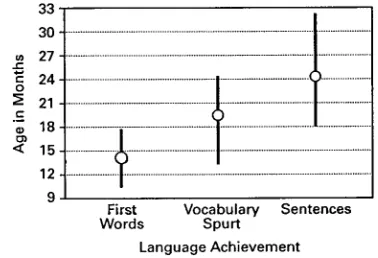
Children vary greatly in age of onset and rate of progress in their language learning. The children we studied did, indeed, differ in when they began to say words and in the length of time between their first words and the beginning of sentences. Figure 2 shows the average age and range in their ages at the time of three language achievements. First Words (FW) began to occur at the beginning of the second year. A Vocabulary Spurt (VS) was a sharp increase in the number of new words in a child’s vocabulary and occurred toward the end of the second year. With the achievement of Simple Sentences, at ap-proximately 2 years of age, the children were putting words together with an average utterance length of
Fig 1. Model of the interaction between engagement and effort for language development.11
least 1.5 words.8 However, the children differed in
their ages of achievement, as can be seen.
The children also differed in their emotionality— how frequently they expressed emotion (nonneutral expression with positive, negative, or mixed affective tone)—in the period from 9 to 21 months of age. Moreover, the differences among them in emotional expression were related to the differences in their ages at the times of the three language achievements. When measured across time, from 9 to 21 months of age, the children who were earlier word learners spent more time in neutral affect expression and did not increase in their frequency of emotional expres-sion. However, the children who were later word learners increased in frequency of emotional expres-sion between 9 and 17 months of age instead of learning words early.12 Moreover, age of language
achievement was correlated with the children’s ex-pression of emotion and neutral (nonemotional) af-fect: more time in neutral affect expression predicted earlier age, and more frequent emotional expression predicted later age of language achievement.13
We concluded that learning words and expressing emotion compete for the limited cognitive resources of the young language-learning child and neutral affect promoted earlier language learning. The two groups of earlier and later word learners did not differ in emotionality at 9 months of age, but the children who began to acquire words somewhat later in the second year increased in their frequency of emotional expression from 9 to 17 months, instead of acquiring words early.
However, development is more than change in relation to chronologic age, because age is only an index of the passing of time and reveals nothing about the transformations in structure or function that characterize the process of development. Look-ing at change at times of developmental transition, such as each of the language achievements, was more informative than looking at change only in relation to age alone.14 –16 Therefore, we equated the
children for language achievement and looked more closely at developments in emotional expression in relation to language learning.
First, we looked simply at how often the children said words and how often they expressed emotion (all nonneutral affect expressions) at the two achieve-ments, FW and VS. The frequency of speech in-creased from FW to VS, but this was not surprising because the VS was defined as an increase in new words learned from one month to the next. However, in this same period, the children did not express emotion more or less frequently.17 We have since
confirmed this result in a finer analysis, looking at the actual amount of time the children spent talking, expressing emotion, or both talking and expressing emotion at FW, the VS, and the beginning of Sen-tences.11A computer program tallied whether a
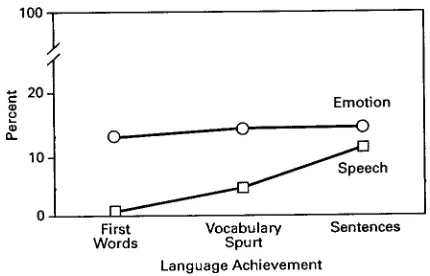
par-ticular kind of expression (emotion or speech) oc-curred in any of the 54 000 video frames that made up the first half-hour of each playroom session (1 second of video tape equal to 30 frames). The result is shown in Fig 3 as the percentage of all the frames in a half-hour that contained speech and/or
emo-tional expression, at each of the language achieve-ments.
Again, as with frequency of speech, the amount of time spent talking increased from FW to VS to Sen-tences, as expected, given how the achievements in language were defined. However, although speech increased, the percentage of time in emotional ex-pression did not change between the language achievements. This result meant two things. First, that development in the second year is not simply an increase in overall expressivity (because speech in-creased but emotional expression did not increase when children were equated for language achieve-ment rather than for age). Second, that children do not express emotion less often as words are acquired (which means that they are not learning to say words instead of expressing emotion). Children continue to express their feelings through displays of affect, as they learn to say more words in the single-word period and as length of utterance increases with the occurrence of simple sentences.
The children said a total of 11 404 words (tokens), consisting of 326 different words (types) in the play-room sessions, from FW to 1 month after the VS.18
Except for 1 child who said the words “scared” and “sorry,” none of the children’s words were names of emotions or feeling states, and the mothers did not report emotion words in the diaries they kept. Re-ports in the literature of the “early” use of emotion words by English-speaking children have relied on mothers’ reporting whether such words ever occur at all, through the use of diaries and checklists, and the youngest children in these studies typically have been older than 2 years.1–3The children in our study
might have said such words on occasion as well and, if we had explicitly asked their mothers, perhaps they would have reported such words at home. But names for the emotions were not among the words they used in their everyday activities.
Names for the emotions were even rare in the mothers’ own speech when they were responding to their children’s emotional expressions, and the verb “like” was the most frequent emotion word they used.6,7Nevertheless, the children were quite adept
at letting others know when they were pleased or distressed. Their mothers, in turn, knew easily enough when their infants were happy, angry, frus-trated, or frightened. Thus, consistent with the
ciple of Discrepancy, the children did not have to say what their emotions were; they did not need to say they were “happy” or “mad,” because their feelings were already evident to other persons. But words were needed to do something about their distress or to achieve and extend their happiness. Consistent with the Principle of Relevance, they were, indeed, learning to talk about those things that were relevant to the objects, causes, and circumstances of feelings, even though they were not learning emotion labels. The children were learning words to express what their feelings were about while they continued to express how they were feeling through displays of positive and negative affect.
EFFORT AND ENGAGEMENT IN THE DEVELOPMENT OF EXPRESSION
Saying words and expressing emotion put de-mands on a young child’s limited cognitive re-sources. At a minimum, expressing emotion requires a representation of goals and plans in consciousness, as well as an evaluation of the circumstances in the situation in relation to the representation the child has in mind. Again, at a minimum, saying words requires a mental representation and recall of the words to express and articulate the elements, roles, and relationships in that representation. Evidence of the effort that requirements for the two forms of expression entailed came from looking at both the words the children said and the kind of emotion expressed when both words and emotional expres-sion occurred at the same time.
First, the words the children said with emotional expression were either among their most frequent words or were “old” words that were easiest for them to recall and say. The words children said with neutral expression were relatively newer words, which were presumably less well-known and harder to recall and/or say. Thus, the effort of saying new words interfered with the cognitive and affective requirements for emotional expression. In addition, when the children expressed emotion at the same time that they said words, the emotion was signifi-cantly more often positive and of low intensity.19
Less cognitive “work” is required for positive emo-tion because a goal has been achieved, and there is no need to construct a plan for removing an obstacle to a goal (as in the case of anger) or for creating a new goal (as in the case of sadness, in which the goal is lost).20
In addition to developments across time in the second year, we also looked at the actual moments that speech occurred and measured the second-to-second timing relationship between emotional ex-pression and speech in the stream of the children’s activity in the playroom. In an earlier analysis,19 we
had assumed that if the effort required for speech and emotional expression competed for a young child’s cognitive resources, then we should see the effects of effort in the actual moments in which speech and emotion occurred. Also, it should be easier for children to express emotion and say words at VS, when they knew more words and words came more easily to them, with less effort. In fact, both of
these assumptions were confirmed, and the results are shown in Fig 4.
The horizontal line in Fig 4 represents the baseline rate of the behavior that was tracked over time, emotional expression in this case, in relation to a target event, in this case speech. A child’s baseline was the likelihood that the child would be expressing emotion at any point in the course of an observation, given how often the child expressed emotion overall (Fig 3). The vertical line in the figure represents the time interval of the speech target event, from the start of a word to the end of the word (words lasted about 1 second, on average). The 10 other data points in the Fig 4 each represent a 1-second interval, 5 before the speech event, and 5 after it. The result is the extent to which emotional expression was differ-ent from the baseline rate during speech (the vertical line) and in the 1-second intervals before and after speech. The children were less likely to be expressing emotion around their FW, when they were just be-ginning to learn words, than they were to be express-ing emotion around words at the VS, when speech presumably required less effort. The dip below base-line before speech at FW was an indication of the cognitive effort required for speech at the time that words first began. The patterns (shape of the curves around speech) were the same at both FW and VS, but emotional expression was greater than baseline at VS, increasing at the time of speech and then decreasing. This result indicated to us that the chil-dren were able to integrate the two kinds of expres-sion at VS because by that time, saying words re-quired less effort.
These results provided evidence of both engage-ment and effort. The increased likelihood of emo-tional expression relative to baseline at VS was inter-preted as evidence of engagement. The children were learning to talk, in general, about those things that were relevant to them, those things they cared about. However, the words they said with emotion were the children’s easiest words, and emotional expression was most likely to be positive and at low levels of intensity, therefore requiring less effort. Thus, there was in effect an accommodation between effort and engagement in the timing of speech and emotional expression in the single-word period. Given that most of the emotion the children expressed was
itive, the peak in emotional expression immediately after a word recalls the smiles of recognition that have been described in younger infants,16,21 and
smiles after mastery22 or assimilation after
concen-trated attention.23
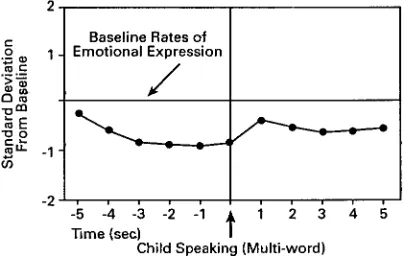
Evidence of effort was even more apparent when the children began to say sentences, and this result is shown in Fig 5. At the time the children were work-ing at learnwork-ing the syntax of language, they were far less likely to express emotion around speech than could be expected from their baseline levels of emo-tional expression,11indicating the effort that the two
kinds of expression required. The children were most likely to be expressing neutral affect in the moments around and during their efforts at talking.
However, the results were different for children who were earlier and later syntax learners. The dif-ferences between the earlier and later word learners were echoed in these microanalyses of the timing between the two kinds of expression at each of the language achievements. The differences between the groups at the time of the transition to sentences is shown in Fig 6. The patterns of emotional expression around speech were essentially the same for both groups of children relative to their respective base-line rates of emotional expression, but the children who were older when they began to say sentences expressed substantially less emotion around speech than did the children who were younger. The emo-tional expression of the later syntax learners was substantially below baseline and differed signifi-cantly from the emotional expression of the earlier, younger learners, who did not differ from baseline. Children who were learning to say sentences some-what later, and evidently working harder at lan-guage learning, were using their lanlan-guage with more effort than were the children who were earlier lan-guage learners.
CONCLUSIONS
Many questions about the complex developmental relationship between language and emotion remain for additional research, but our findings provide some insight into the effort and engagement required by both language learning and emotional expression. We propose that the heart of language acquisition is
in the dialectic tension between the two psychologi-cal components of effort and engagement (Fig 1).
To begin with, a language will never be acquired without engagement in a world of persons, objects, and events—the world that language is about and in which language is used. The concept of engagement embraces the social, affective, and emotional factors that figure into language learning. Other persons and the social context are required, because the motiva-tion for learning a language is to express and inter-pret contents of mind so that child and others can share what each is thinking and feeling (the principle of discrepancy).
Affect and emotional expression are required for establishing intersubjectivity and sharing between child and caregiver before language and also for motivating a child’s attention and involvement with people, objects, and events for learning language. The relevance of adult behavior is ensured when adults tune into what a child is feeling and thinking. Language is learned when the words a child hears are about the objects of engagement, interest, and feelings—about what the child has in mind (the prin-ciple of relevance). In turn, children use the language they are learning for talking about the things they care about—the objects of their engagement.
Acquiring language requires effort, first, for set-ting up the meanings consciousness that language expresses or that results from interpreting the ex-pressions of others. Second, additional effort is re-quired for learning the increasingly complex lan-guage needed to express and articulate the increasingly elaborated mental meanings that are made possible by developments in cognition (the principle of elaboration). And third, effort also is required for coordinating different kinds of behav-iors—such as talking, expressing emotion, and play-ing with objects (as described by Bloom and associ-ates11)—that make up the ordinary activities of a
young child’s life. Neither speech nor emotional ex-pression occurs in isolation; they are always and necessarily embedded in complex events.
In summary, language and emotion are related in complex ways in the process of development. Lan-guage is created by a child in the dynamic contexts and circumstances that make up the child’s world,
Fig 5. Average difference from baseline rates of emotional ex-pression during speech and in the five 1-second intervals before and after (in SD units) at the time of the transition to multiword speech.11
and acquiring a language requires both engagement and effort. A child’s feelings and emotions are cen-tral to engagement with the personal and physical world and determine the relevance of language for learning. And the effect of the effort needed to coor-dinate cognitive, emotional, and linguistic resources for learning language is to recruit states of neutral affect for attention and processing. Children who began to learn words early spent more time in neu-tral affect, whereas children who learned words somewhat later expressed more emotion instead. Ef-fort also was apparent in the timing relation of speech and emotional expression at the transition to sentences, especially for the later language learners. By the time language begins, toward the end of the first year, emotional expression already is well-estab-lished and children do not need to learn the names of the emotions to tell other people what they are feel-ing. But they do need to learn the language to tell other people what their feelings are. Language does not replace emotional expression. Rather, children learn language for expressing and articulating the objects and circumstances of their emotional experi-ences while they continue to express emotion with displays of positive and negative affective tone.
REFERENCES
1. Bretherton I, Fritz J, Zahn-Wexler C, Ridgeway C. Learning to talk about emotions: a functionalist perspective.Child Dev.1986;57:529 –548 2. Cervantes C, Callanan M. Labels and explanations in mother– child
emotion talk: age and gender differentiation.Dev Psychol.1998;34:88 –98 3. Ridgeway D, Waters E, Kuczaj S. Acquisition of emotion-descriptive language: receptive and productive vocabulary norms for ages 18 months to 6 years.Dev Psychol.1985;21:901–908
4. Klinnert M, Sorce J, Emde R, Stenberg C, Gaensbauer T. Continuities and change in early emotional life: maternal perceptions of surprise, fear, and anger. In: Emde R, Harmon R, eds.Continuities and Disconti-nuities in Development.New York, NY: Plenum; 1984:339 –354 5. Johnson W, Emde R, Pannabecker B, Stenberg C, Davis M. Maternal
perception of infant emotion from birth through 18 months.Infant Behav Dev.1982;5:313–322
6. Data on file, Lois Bloom
7. Capatides (Bitetti) J. Mothers’ Socialization of Their Children’s Experi-ence and Expression of Emotion. New York, NY: Columbia University; 1990. Dissertation
8. Bloom L.The Transition From Infancy to Language. Acquiring the Power of Expression.Cambridge, MA: Cambridge University Press; 1993 9. Bloom L. Language acquisition in its developmental context. In: Kuhn
D, Siegler R, eds. Cognition, perception, and language. Vol II. In: Damon W, series ed.Handbook of Child Psychology. New York, NY: John Wiley & Sons; 1997
10. Bloom L, Lahey M.Language Development and Language Disorders.New York, NY: John Wiley & Sons; 1978
11. Data on file, Lois Bloom
12. Bloom L, Beckwith R, Capatides (Bitetti) J. Developments in the expres-sion of affect.Infant Behav Dev.1988;11:169 –186
13. Bloom L, Capatides (Bitetti) J. Expression of affect and the emergence of language.Child Dev.1987;58:1513–1522
14. Connell J, Furman W. The study of transitions: conceptual and meth-odological issues. In: Emde R, Harmon R, eds.Continuities and Discon-tinuities in Development.New York, NY: Plenum; 1984:153–173 15. Emde R, Harmon R. Entering a new era in the search for developmental
continuities. In: Emde R, Harmon R, eds.Continuities and Discontinuities in Development.New York, NY: Plenum; 1984:1–11
16. McCall R. Smiling and vocalization in infants as indices of perceptual-cognitive processes.Merrill-Palmer Q.1972;18:341–347
17. Bloom L, Beckwith R, Capatides (Bitetti) J, Hafitz J. Expression through affect and words in the transition from infancy to language. In: Baltes P, Featherman D, Lerner R, eds.Life-span Development and Behavior.Vol IX. Hillsdale, NJ: Erlbaum; 1988:99 –127
18. Bloom L, Tinker E, Margulis C. The words children learn: evidence against a noun bias in children’s vocabularies.Cognit Dev. 1994;8: 431– 450
19. Bloom L, Beckwith R. Talking with feeling: integrating affective and linguistic expression in early language development. In: Izard C, ed. Development of Emotion-cognition Relation.Hillsdale, NJ: Erlbaum:1989;3: 313–342
20. Stein N, Jewett J. A conceptual analysis of the meaning of basic negative emotions: implications for a theory of development. In: Izard C, Read P, eds.Measurement of Emotion in Infants and Children. Vol II. New York, NY: Cambridge University Press; 1987:238 –267
21. Zelazo P. Smiling and vocalizing: a cognitive emphasis.Merrill-Palmer Q.1972;18:349 –365
22. Sroufe A, Waters E. The ontogenesis of smiling and laughter: a perspec-tive on the organization of development in infancy.Psychol Rev.1976; 83:173–189
1998;102;1272
Pediatrics
Lois Bloom
Language Development and Emotional Expression
Services
Updated Information &
2
http://pediatrics.aappublications.org/content/102/Supplement_E1/127
including high resolution figures, can be found at:
References
2#BIBL
http://pediatrics.aappublications.org/content/102/Supplement_E1/127
This article cites 11 articles, 0 of which you can access for free at:
Subspecialty Collections
_sub
http://www.aappublications.org/cgi/collection/psychiatry_psychology Psychiatry/Psychology
sub
http://www.aappublications.org/cgi/collection/fetus:newborn_infant_ Fetus/Newborn Infant
milestones_sub
http://www.aappublications.org/cgi/collection/growth:development_ Growth/Development Milestones
l_issues_sub
http://www.aappublications.org/cgi/collection/development:behaviora Developmental/Behavioral Pediatrics
following collection(s):
This article, along with others on similar topics, appears in the
Permissions & Licensing
http://www.aappublications.org/site/misc/Permissions.xhtml
in its entirety can be found online at:
Information about reproducing this article in parts (figures, tables) or
Reprints
http://www.aappublications.org/site/misc/reprints.xhtml
1998;102;1272
Pediatrics
Lois Bloom
Language Development and Emotional Expression
http://pediatrics.aappublications.org/content/102/Supplement_E1/1272
located on the World Wide Web at:
The online version of this article, along with updated information and services, is
by the American Academy of Pediatrics. All rights reserved. Print ISSN: 1073-0397.
![Fig 4. Average difference from baseline rates of emotional ex-pression during speech and in the five 1-second intervals beforeand after (in standard deviation [SD] units) at FW and VS.19](https://thumb-us.123doks.com/thumbv2/123dok_us/9551672.1484062/4.587.317.521.569.696/average-difference-baseline-emotional-pression-intervals-beforeand-deviation.webp)