COMPLETE CATALYTIC
CONVERSION OF HIGH DENSITY
POLYETHYLENE INTO
HYDROCARBONS WITHOUT WAX
FORMATION USING FLY ASH AS
CATALYST
P. Prem Kumar1, C.G. Saravanan1*, M. Gopalakrishnan2
1&1*
Department of Mechanical Engineering. Annamalai University Annamalainagar, India. 2
Department of Chemistry. Annamalai University Annamalainagar, India. Email: [email protected]; [email protected]
Abstract
Hydrocarbons have been obtained from waste plastic syringes, made of high density polyethylene (HDPE), by degradation using fly ash as catalyst. Complete degradation was observed with cat/pol ratio of 0.2 oil was obtained when the temperature inside the reactor was in the range 188-377C. This range is lower than those reported in other studies. The oil yield was 65.3%. No wax formation occurred suggesting that the yield of gaseous hydrocarbons was 34.7%. The oil obtained was fractionated into the following four fractions viz., fraction boiling below 100C fraction boiling in the range 100 - 150C fractions boiling in the range 150 - 200C and fraction boiling above 200 C. The physico-chemical properties of the fraction boiling in the range 100 - 150C and 150 - 200C can be used as a substance for diesel. Since fly ash is very cheaper hence fly ash seems to be better catalyst then those used previously for the degradation of HDPE.
Key words: catalytic conversion, catalyst, waste plastic, fly ash, plastic oil, hydrocarbons.
1. Introduction
Nowadays, management of waste plastic is a serious problem. Degradation of polymer waste into hydrocarbons has received greater attention [1-29]. Catalytic degradation has been found to be better than thermal degradation [4, 18, 1, 20, 22, 24, 27]. Polyethylene, a widely used thermoplastic, is a polymer of ethylene and is represented as PE. The chemical formula of PE is [CH2-CH2]n. The molecular weight and the physical properties of PE depend on the value of ‘n’. Based on the value of ‘n’, polyethylene is classified into two types viz., low density polyethylene (LDPE) and high density polyethylene (HDPE). LDPE is generally used for making flexible materials like bags and geo-membranes. HDPE is generally used for making containers including bottles. Plastic syringes made of HDPE are used for injections.
Since HDPE is widely used as a plastic material, several attempts have been made to degrade HDPE into hydrocarbons of low molecular weight. Acid zeolites have been widely used as catalyst [5-8, 9, 23, 25]. Basic catalysts MgCO3 [14], BaCO3 [19] and CaCO3 [22] also have been used. Metal supported activate carbon also has been used as catalyst [23].
Catalyst degradation has been carried out by heating at atmospheric pressure in suitable reactors or in autoclaves under hydrogen pressure. A temperature of 350-450 C has been used for the degradation. The cat/pol ratio has also been varied from 0 to 0.2. The reaction has been carried out for a period of about 2 h. In many cases more than 90% conversion has been reported. The products have been classified into waxy materials, oil and uncondensed gases.
Fly ash, obtained by burning coal, is a waste product of thermal power plants. Fly ash contains silica, alumina, iron and alkali metals [30]. Fly ash has been used as a catalyst in chemical reactions [31, 32]. In this study, we report the cracking of HDPE using fly ash as catalyst.
2. Exp
2.1 Mate
syringes with app moisture power pl
(
stainless using a th using AV
2.2 Physi
erimental
rials and meth
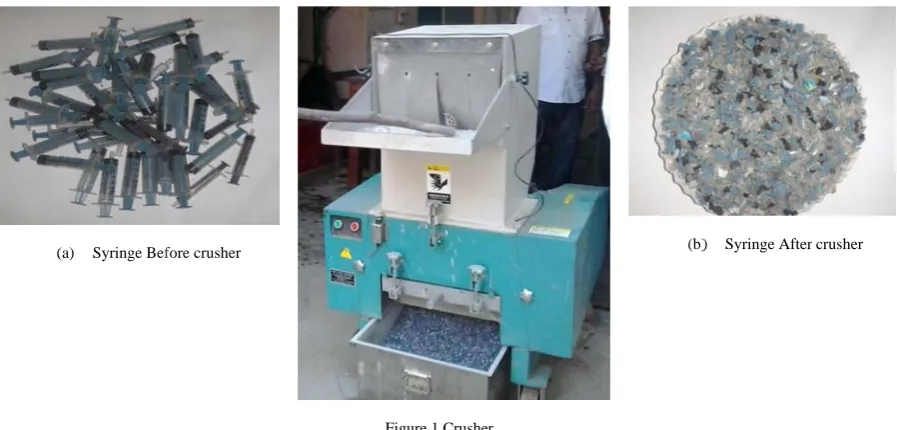
Plastic syring were crushed propriate amou
content. The ant at Neyveli
(a) Syringe Bef
The sketch o steel. Heatin hermocouple. VL Di gas 444
ical paramete hods
ges were obta d in to small p
unt of catalys e results and m i, which is 30
fore crusher
of the plant u ng was done The oil obta 4 analyzer.
ers study
ained from Ra pieces using c st wetted with material was su km away from
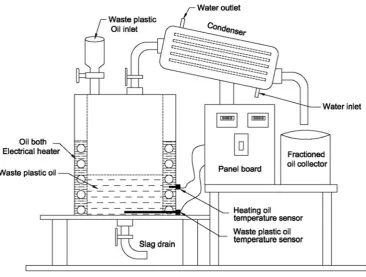
sed for cataly electrically an ained was col
Figure 2 Wa
aja Muthiah M crusher as sho
h water. The ubjected to de m our univers
Figure 1 Crusher
ytic conversio nd the temper llected in a m
aste plastic oil ex
Medical Colle own in figure
e blend obtain egradation. Fl sity.
r
on is shown i rature inside easuring jar.
traction plant
ge Hospital o 1. The crush ned was dried ly ash was obt
(b)
in Fig.2. The the reaction c The unconde
of our Univer hed material w
d in air to re tained from th
) Syringe After
e reactor was chamber was ensed gas was
rsity. The was blend emove the he thermal
r crusher
sulphur c determin
3. Resu
3.1 Effec
catalyst, collection ceased w in the rea given in t
reaction. of the pro
content, IP-13 ed as per
ults and discu
ct of catalyst
Degradation using 100gm n started and was also noted
actor after the table 1.
For the cataly These results oduct obtained
3&14 for carb IS-1448.
ussion
was carried o m catalyst and temperature . In each case e reaction. T
ytic processes s are shown in d are compare
bon residue an
out with 1 kg d 200 gm cat
at which the e the percent c The density of
the quantity o n fig. 3, 4 and ed with that of
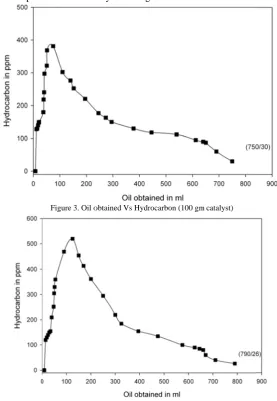
Figure 3. Oil o
Figure 4 Oil o
and IS-1448-P
g of the polym talyst. In ea
oil ceased w conversion wa f the oil was
of hydrocarbo 5. The quanti f fly ash in fig
obtained Vs Hydr
obtained Vs Hydr
P40 for water
mer metal. T ach experimen were noted. T as calculated b
also determin
ons evolved w ities of oil for g. 7.
rocarbon (100 gm
rocarbon (150 gm
content. Gro
he degradatio nt the temper The time at w
by weighing t ned in each c
as measured d rmed are show
m catalyst)
m catalyst)
oss calorific v
on was studie rature at whic which the oil
the materials r case. All the r
during the cou wn in fig. 6. T
value was
ed without ch the oil formation remaining results are
A
c
a
The low temperatu b
obtained Amount
of catalyst
(gm) Nil 100 150 200 wer temperatu
ure at which o d by balance.
Reaction Temperaturea
(C)
250 – 420 250 – 402 227 – 392 188 – 377 ure is the temp
oil formation i
Figure 5. Oil o
Figure
Ta
Reaction time (min
180 150 130 100 perature at wh
is ceased
obtained Vs Hydr
re 6. Oil obtained
able 1. Results tab
n n)
Conver (%
51. 85. 94. 100 hich oil format
rocarbon (200 gm
Vs catalyst adde
bles
rsion )
O (%
6 42
2 60
4 62
0 65
tion commenc m catalyst)
d
Oil %)
Gasb (%)
2.7 8.9 0.1 25.1 2.3 32.1 5.3 34.7
ced and the hi
Density o the oil (kg/m3)
865 807 793 777 igher tempera
of
)
conversio degradati
3.2 Phys obtained and petro
Since the and petro 3.3 Frac The The The The The
on has been o ion of HDPE.
sico-chemical
Since comple in this case w ol in table 2.
Properti Specific g Kinemati Flash poi Fire poin Gross cal Pour poin Smoke po Sulphur % Carbon re Moisture Density @
e properties of ol.
ctional distilla
oil was fractio
fraction boilin
fraction boilin
fraction boilin
e fraction boili
observed) diff
F
l properties of
ete conversion were determin
es
gravity @ 15/ ic viscosity @ int C nt C
lorific value in nt C
oint C % esidue %
content @ 15 C
f the oil obtain
ation of oil
onated using f
ng within 100
ng between 10
ng between 15
ing above 200
ffers from that
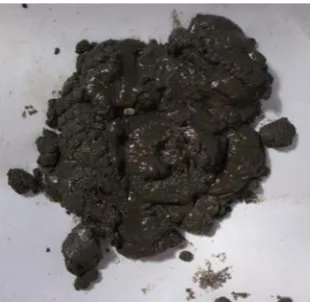
Figure 7. Photogr
f the oil
n was observed ned by standar
Table 2 Properti
/15 C @ 40 C
n kJ/kg
ned are in betw
fractionating c
o
C was 23%
00 oC and 150
50 oC and 200
0 oC was 8%
at of fly ash.
raphic view of 10
d using 200 g rd methods. T
ties of plastic oil,
Plastic oil 0.776 1.63 68 74 44,122 10 Below 10 0.023 0.013 Nil 0.7769
ween those of
column shown
0 C was 33%
0 C was 36%
This shows
0 gm fly ash afte
catalyst the p These propertie
diesel and petrol
Diese 0.828 3.822 69 (5 86 44,78 15 B/W 0.035 0.01 Nil 0.825
f diesel and pe
n in fig. 7
that the cata
r degradation
hysico-chemi es are compar
el Pet 84 0.7 2 0.6
2-95) > 4 - 86 47, 3-15 100 5 0.0 Nil 5 0.7
etrol, it should
alyst is involv
ical properties red with those
trol 73722 6 Cp 45
,999
0 – 185 05
l 73722
d be a mixture
ved in the
s of the oil e of diesel
3.4 Use
The to 200 0C From tab
can be us
3.5 Com
Though observed and a rea obtained conversio formation is a very the most
4. Con
degradati occurs. T catalysts. potentiali
Referenc
of products as
physic-chemi C were evaluat ble 3 it is seen
Also the gas o sed as a dome
mparison with p
several works d so far. M R
action temper 97.8% conve on of 98.6% w n. We have us
cheap catalys suitable cataly
nclusion
This study sh ion of HDPE The degradati . Oil obtained ity of being us
ces
s fuel
ical properties ted using stan that both thes
obtained in th stic fuel.
previous study
s have been Jan et al [22] rature 385 to ersion with 6 with 54.5% oi sed a tempera st. Indeed it i yst for the deg
hows that fly a E. Complete d ion takes pla d has potential sed as a dome
s of the fractio dard methods se fractions ca
e process usin
dy
reported on t have reporte 468 0C. The 60.5% oil form
il formation a ature (188 – 37
s a waste pro gradation of H
ash, a waste p degradation o ace at a cons
lity of being u estic fuel.
Figure 8. Fractio
on boiling in th s. These prope an be used as a
ng 200 g catal
the degradatio ed a conversio
e yield of oil mation at 435 at 440 C. We 77 C) lower duct of therm HDPE.
product of ther ccurs when t siderably low used as an alte
oned column
he range 100 o erties are comp alternating fue
yst burnt with
on of HDPE, on of 97.2% u was 52.33% 5 C. Jerzy e have observ than that used mal power plan
rmal power pl the cat/pol rat wer temperatu
ernative fuel f o
C to 150 0C a pared with tho els for diesel.
h the blue flam
complete co using calcium . Selahan Ka Walendziewsk ed 100% conv d earlier [22-2 nt. All these a
lant, can be us tio is 0.2. A re than those for diesel. Als
and in the rang ose of diesel in
me suggesting
onversion has carbonate as Karagoz et al ski [24] has o nversion with
24]. Moreov aspects make
sed as a cataly Also no wax
e reported us so the gas obt
ge 150 oC n table 3.
that it not been a catalyst [23] have obtained a 65.3% oil er, fly ash fly ash as
yst for the formation sing other
and Stability, 86 (2004), pp. 225-231
[4] N. Miskolczi, L. Bartha, G. Deak, B. Jover, D. Kallo, “Thermal and thermo-catalytic degradation of highe-density polyethylene waste” Journal of Analytical and Applied Pyrolysis, 72 (2004), pp. 235-242.
[5] J.F. Mastral, C. Berrueco, M. Gea, J. Ceamanos, “Catalytic degradation of high density polyethylene over nano crystalline HZSM-5 Zeolite” Polymer Degradation and Stability, 91 (2006), pp. 3330-3338.
[6] G. Manos, I.Y. Yusof, N. Papayannakos, N.H. Gangas, “Catalytic cracking of polyethylene over clay catalysts. Comparison with an ultrastable Y zeolite” Industrial & Engineering Chemistry Research, 40 (2001), pp. 2220-2225.
[7] J. Mosio-Mosiewski, M. Warzala, I. Morawski, T. Dobrzanski, “High pressure catalytic and thermal cracking of polyethylene fuel process” Journal of Technology, 88 (2007), pp. 359-364.
[8] I.C. Neves, G. Botelho, A.V. Machodo, P. Rebelo, “Catalytic degradation of polyethylene; An evaluation of the effect of dealuminated Y Zeolites using thermal analysis” Materials Chemistry and Physics, 104 (20070, pp. 5-9.
[9] G. Manos, A. Garforth, J. Dwyer, “Catalytic degradation of high-density polyethylene on an ultrastable-Y zeolite. Nature of initial polymer reactions, pattern of formation of gas and liquid products, and temperature effects” Industrial & Engineering Chemistry Research, 39 (2000), pp. 1203 -1208.
[10] K.H. Lee, D.H. Shin, “Catalystic degradation of waste polyolefinic polymers using spent FCC catalyst with various experimental variables” Korean Journal of Chemical Engineering, 20 (2003), pp. 89-92.
[11] G. Elordi, M. Olazar, G. Lopez, M. Amutio, M. Artetxe, R. Aguado, “Catalytic pyrolysis of HDPE in continuous mode over zeloite catalysts in a conical spouted bed reactor” Journal of Analytical and Applied Pyrolysis, 85 (2009), pp. 345-351.
[12] G. Elordi, M. Olazar, R. Aguado, G. Lopez, M. Arabiourrutia, J. Bilbao, “Catalytic pyrolysis of high density polyethylene in a conical spouted bed reactor” Journal of Analytical and Applied Pyrolysis, 79 (2007), pp. 450-455.
[13] F.J. Mastral, E. Esperanza, C. Berrueco, M. Juste, J. Ceamanos, “Fluyidized bed thermal degradation products of HDPE in an inert atmosphere and in air/nitrogen mixtures” Journal of Analytical and Applied Pyrolysis, 70 (2003), pp. 1-17.
[14] M.R. Jan, J. Shah, H. Gulab, “Degradation of waste high-density polyethylene into fuel oil using basic catalyst” Journal of Fuel, 89 (2010), pp. 474-480.
[15] M.R. Jan, J. Shah, H. Gulab, “Catalytic degradation of waste high-density polyethylene into fuel products using BaCO3 as a catalyst”
Fuel processing Technology, 91 (2010), pp. 1428-1437.
[16] R.A. Garcia, D.P. Serrano, D. Otero, “Catalytic cracking of HDPE over hybride zeolitic-mesoporous materials” Journal of Analytical and Applied Pyrolysis, 74 (2005), pp. 1-17.
[17] G. Manos, A. Garforth, J. Dwyer, “Catalytic degradation of high-density polyethylene over different zeolitic structures” Industrial & Engineering Chemistry Research, 39 (2000), pp. 1198-1202.
[18] G. Luo, T. Suto, S. Yasu, K. Kato, “Catalytic degradation of high density polyethylene and polypropylene into liquid fuel in a powder-particle fluidized bed” Polymer Degradation and Stability, 70 (2000), pp. 97-102.
[19] Y. Sakata, M. Azhar-Uddin, A.Muto, Y. Kanada, K. Koizumi, K. Murata, “Catalytic degradation of polyethylene into fuel oil over mesoporous silica (KFS-16) catalyst” Journal of Analytical and Applied Pyrolysis, 43 (1997), pp. 15-25.
[20] G.J.T. Fernandes, V.J. Fernandes J.R, A.S. Araujo, “Catalytic degradation of polyethylene over SAPO-37 molecular sieve” Catalysis Today, 75 (2002), pp. 233-238.
[21] W. Ding, J. Liang, L. Anderson, “Thermal and catalytic degradation of high density polyethylene and commingled post-consumer plastic waste” Fuel Processing Technology, 51 (1997), pp. 47-62.
[22] M. R. Jan, J. Shah, H. Gulab, “Catalytic conversion of waste high density polyethylene into useful hydrocarbons” Journal of Fuel, 105, (2013), pp 595-602.
[23] Selahan Karagoz, JaleYanik, Suat Ucar, Mehmet Saglam, Chunshan Song, “Catalytic and thermal degradation of high-density polyethylene in vacuum gas oil over non-acidic and acidic catalysts” Journal of Applied catalysis 245 (2003) pp. 51-62.
[24] Jerzy Walendziewski, “Engine fuel derived from waste plastics by thermal treatment” Journal of Fuels, 81 (2002) pp. 473-481. [25] J. Aguado, D.P. Serrano, J.M. Escola, E. Garagorri, J.A. Fernandez, “Catalytic conversion of polyolefin’s into fuels over zeolite beta”
Journal of Polymer Degradation and stability 69(2000) pp. 11-16.
[26] Ikusei Nakamura, Kaoru Fujimoto, “Development of new disposale catalyst for waste plastics treatment for high quality transportation fuel” Journal of Catalysis Today, 27 (1996) pp. 174-179.
[27] Jerzy Walendziewski, Mieczyslaw Steininger, “Thermal and catalytic conversion of waste polyolefines” Journal of Catalysis Today, 65 (2001)pp. 323-330.
[28] N. Miskolczi, L. Bartha, G. Deak, B. Jover, “Thermal degradation of municipal plastic waste for production of fuel-like hydrocarbons” Journal of Polymer degradation and stability 86 (2004) pp. 357-366.
[29] Mohammad Farhat Ali, Mohammad Nahid Siddiqui, “Thermal and catalytic decomposition dehavior of PVC mixed plastic waste with petroleum residue” journal of Annalytical and Applied Pyrolyysis, 74 (2005) pp. 282-289.
[30] D. Khale and R. Chaudhary, “Mechanism of geopolymerization and factors influencing its development”, a review, J Mater Sci., 10 (2007) pp. 729-746.
[31] M.M.A. Abdullah, K. Hussin, M. Bnhussain, K. N. Ismail and W. M. W. Ibrahim, “ Mechanism and chemical reaction of fly ash Geopolymer cement – A review”, Int. J. Pure Appl. Sci. Technol., 6(1) (2011) pp. 35-44.
[32] Anita Sharma, Stuti Katara, Sakshi Kabra and Ashu Rani, “Acid activated fly ash as a novel solid acid catalyst for Esterification of Acetic Acid”, Indian Journal of Applied Research, 3(4) (2013) pp. 37-39.