United Kingdom Vol. IV, Issue 11, November 2016
Licensed under Creative Common Page 219
http://ijecm.co.uk/
ISSN 2348 0386
“HIGH TECHNOLOGY EXPORT AND R&D EXPENDITURES”
A STUDY FOR E7 COUNTRIES
Mehmet Alagöz
Karamanoglu Mehmetbey University, Faculty of Economics and Administrative Sciences, Department of Economics, Karaman, Turkey
Gökhan Akar
Selçuk University, Hadim Vocational High School, Department of Foreign Trade, Konya, Turkey
Tuba Akar
Karamanoglu Mehmetbey University, Faculty of Economics and Administrative Sciences, Department of Economics, Karaman, Turkey
Abstract
The aim of this study is to evaluate the relationship between R&D expenditures and advanced
technology export for E7 countries (Brazil, China, Indonesia, India, Mexico, Russia, and
Turkey). Providing economic development of a country depends on many factors. Ability to
have high technology sectors and export high added value are considered to be one of the
most important factors in providing the advantage of sustainable economic development and
global competitive advantage. In the study, examining R&D expenditures and advanced
technology indicators of the country deal with, it is attempted to be observed the relationship
between both of them. As a result of evaluation made, it was identified that both the share
China allocates for R&D expenditures and its high technology product export are more,
compared to the other countries.
Keywords: Human Capital, R&D expenditures, High Technology Exports, Innovation, E7
Licensed under Creative Common Page 220 INTRODUCTION
Liberalization of trade has contributed to globalization of world economy. Together with facilitation of goods and services flow among countries, some changes have been also experienced in production structures of countries as well (Gani, 2009: 34). Today, competitive advantage in international trade does not only depend on the natural resources of a country, it is based on innovative products and services. In the recent times, technology and innovation have become a driving force in positioning long term competition related to global markets (Sara et al. 2012: 86-88). At this point, the criteria such as the qualified labor force, technological infrastructure countries have, success and intensity in the activities of research and development (R&D) activities, and effective and extensive use of information and communication use become important. Developed countries reached these levels, increasing R&D expenditures, working on information production and commercializing this product, and giving importance to the activities improving the quality of labor force (Göçer, 2013a: 118). Technological developments, as a result of R&D activities carried out by the firms, emerge as the inventions and innovations. While technological development and innovation give rise to economic growth at the macro level, it results in increase of the profits and market shares of the firms at the micro level. Technological innovation i.e. product and process innovation has become an obligation in the world, in which the continuous developments and changes are experienced, in terms of keeping competitive power and becoming successful. In this context, it is impossible for the firms and countries, which do not showing necessary attention to R&D activities, to catch a sustainable growth trend. Since R&D activities are an important resource of economic growth, in today’s world, it is unavoidable that there is a strong relationship between R&D expenditures and growth (Altın and Kaya, 2009: 252).
Providing economic development of a country depends on many factors. Ability to have high technology sectors and export high technology and high technology products is considered to be one of the most important factors of an economy.
Licensed under Creative Common Page 221 The aim of this study is to reveal the relationship between R&D expenditures and export of advanced technology product. In the study, this relationship was considered in terms of the developing E7 countries (Brazil, China, Indonesia, India, Mexico, Russia, and Turkey). In the study, the period of 1996-2014 is dealt with. The reason for choosing this period is to reach some data more healthily after this period. The study consists of three parts. Firstly, theoretical frame is given place. In the second part, literature review takes place. In the third part, the relationship between R&D expenditures and advanced technology export is examined with the necessary indicators for E7 countries. The study ends with the part of Conclusion, in which there are evaluations.
THEORETICAL FRAME
Today, the contribution technology makes to economic growth and its important is a generally acceptable reality. Technological advance is locomotive of economic growth. While the contribution of technology to economic growth is examined, economic analysis are basically divided into two. The theory, divided as external and internal, agrees with that technology is one of the most important resources of long term growth but differs about modeling the technology process and technologic advance (Alan, 2008:14).The approach accepting the technology as external is neoclassic theories and, one these approach is Solow growth model putting forward that the growth rates of countries will approach to each other in time. In 1980s, internal growth theories emerged and internality of technology has begun to be used in accounting for the developedness differences between countries. According to this growth theory, technology is accepted as an internal variable and the effect of R&D activities on economic growth is studied. Romer (1990), Grossman and Helpman (1991), and Aghion and Howitt (1992) are the studies bringing R&D based growth internal growth models, which pay attention to innovation in long term growth, in the literature. Internal growth theories are based on the technologies and innovations, created by R&D activities (Yıldırım and Kesikoğlu, 2012:166).. According to
Licensed under Creative Common Page 222 intermediate goods sector. The firm, acquiring patent right, which becomes a monopolist power in this sector; later, sells final product sector. Thus, R&D sector becomes forms the dynamic of a sustainable growth (Yıldırım and Kesikoğlu, 2012:167). R&D expenditures
have a great importance in the processes such as developing new product and/or production method, effectively using, adapting, and changing the existent or imported technology. Thus, not only the firms or countries but also firms and countries importing technology from the other countries are in the position to make largely R&D expenditure to obtain the highest productivity from the imported technology. In this scope, R&D expenditure is one of the main aims of gaining knowledge and experience, which have a great importance in the process of gaining technology ability (Saygılı, 2003: 70).
That technology internally comes into growth theory also created change in foreign trade theories. In describing the relationship between technology and foreign trade, two main schools stand out. The first of these is the one based on perfect competition markets, with which classic and neoclassic trade theories deal, and the other is the school based on imperfect competition market, which considers closer to the reality in contrast to classic and neoclassic theories. While classic and neoclassic trade theories deal with technology as an external factor, alternative trade theories regard to technology as an internal factor. Although classic and neoclassic schools consider technology as an external factor, they are aware of that technological innovation leads to saving in labor and capital. In contrast to the school based on perfect competition market, the school based on imperfect competition market, which accepts the technology as internal, includes “innovation model”, developed by Schumpeter, (1947) and “technologic deficit hypothesis”, developed by Posner (1961), and “product periods model” developed by
Vernon (1966). Even though addition of innovation to the theoretical models begins with Schumpeter (1947), “technologic deficit hypothesis”, developed by Posner (1961) has
Licensed under Creative Common Page 223 When developing countries and especially developed countries create innovation as a result of their R&D activities, they do not generate these innovations for presenting them to only domestic market and they also export them. Addressing to larger market than domestic market via export reduces the unit costs of R&D investments and this carries an encouraging quality interms of activities. Also, since these innovations, at least for certain times bring a monopolist power in the firms creating it, small number of worldwide firms makes a production on many products based on high technology (Özer and Çiftçi, 2009: 44).
That export structure shifts from low technology products to high technology products is an indicator of sustainability of competitive power and, of that national welfare will increase in time (Bayraktutan and Bıdırdı, 2015: 23). In today’s world, in
which global competition is intensive; countries can export only when they can produce the high quality products in a suitable price (Özer and Çiftçi, 2009: 42 ) At this point, the importance of the products produced with high technology and qualified labor that is necessary for this and R&D expenditures emerges(Göçer, 2013b:218).Advanced technology products are generally defined as R&D volunteered products. R&D and innovation intensity are the main factors of advanced technology export. Nowadays, every country, for being able to provide sustainable growth, should reserve time for the production of high technology product. R&D intensity can affect the export of high technology product, depending on that the firms produce high technology products, that national and intellectual capital increases and develops, and that patent appeals of innovative firms increase. In view of this, these can be considered as the most important determinants of the export level of advanced technology (Sandu, 2014: 82). For creating technology, the increase in technological competency enables for many country to improve and develop from many aspects. This increasing importance of technology and its role in affecting technological welfare and global economic growth carried it to another place. It directs investments allocated for research and development in large production sectors, because these investments lead advanced technology products to form. High technology export includes the products such as computers, drugs, scientific instruments, electronic products, software, transportation electronics, and military and civil aeration products. It is likely that the countries producing such electronic products have an important effect on economic welfare (Gani, 2009: 31-32).
Licensed under Creative Common Page 224 performance, an increase is observed. The reason for the increase of this interest is that international trade of high technology products provides information about competitiveness and position of an economy in the technological global markets. In addition, another reason is it makes a contribution to accounting for how innovation affects the competitive advantage in a dynamic environment and the relative importance of high technology in international markets (Tebaldi, 2011: 343).
LITERATURE
As in a country, the investments on high technology sectors and emerging products increase, product innovation and R&D activities gain more importance. The exporting firms are obliged to be innovative for maintaining their competitive power and being able to obtain profit. In the recent years, a number of studies testing the relationship of technological development – export have been carried out. There are two kinds of
approach examining the relationship between technological innovation and export . First of these is patent model examining the relationship between patent data, accepted the output of R&D activities, and export. The second approach is the relationship between the variables such as R&D expenditures and R&D staff, accepted as the R&D activities; and export (Uzay et al., 2012: 151). While reviewing literature, the studies researching the relationship of R& D expenditures and export of high technology product were given weight.
high-Licensed under Creative Common Page 225 tech components, which varies among countries. Braunerhjelm and Thulin (2008), using panel data analysis, 19 OECD countries, examined how R&D expenditures and market size affected the distribution of comparative advantage in the period of 1981-1999. As a result of the study, they identified that an increase of 1% in R&D expenditures led an increase of 3% in the export of high technology product. Özer and Çiftçi (2009) , using panel data analysis, examined the relationship between R&D expenditures and general export, export of information -communication technologies, and advanced technology in 19 OECD countries for the period of 1993-2005. As a result of the study, they reached the conclusion that R&D expenditures had a positive effect on general export and advanced technology export. Sara et al. (2012), as a result of regression analysis they carried out on 120 countries, reached the conclusion that high technology export significantly affected innovation capacity of a country.
Tebaldi (2011), in the stud he carried out, analyzed the determinants of export of high technology. In the study, in which the period of 1980-2008 was analyzed by the Panel data method, it was found that human capital, direct foreign capital inflows, and trade openness were the most important determinants of high technology industry of a country. It was found that the institutes affected high technology export through human capital and foreign direct investments not directly. Gokmen and Turen (2013), using the model of Tebaldi (2011), in the study they carried out on 15 European countries for the period of 1995-2001, found that in long term, human capital played an important role in the export of high technology product.
Licensed under Creative Common Page 226 countries (Japan, China, Hong Kong, South Korea, India, Singapore, Malaysia, Indonesia, Philippines and Thailand ), examined the effect of innovation on high technology product. As a result of the study, he identified that innovation activities were important factors of export of high technology product. Kılıç et al. (2014), using panel data
analysis, in the period of 1996-2011, for G8 countries, analyzed the relationship between R&D expenditures and export of advanced technology product. As a result of the study, it was identified R&D expenditures and real effective exchange rate had a positive effect on export of high technology product. In addition, it was identified that there were two directional causality between R&D expenditures and real effective exchange rate and one directional causality from the high technology product to real effective exchange rate.
Sandu and Ciocanel (2014),as a result of the econometric studies they carried out on 26 European countries for the period of 2006- 2010, they found that there was a positive directional relationship between R&D expenditures and advanced technology export and, in addition, that the effect of R&D expenditures made by private sector, was stronger than that of expenditures, made by public sector. Karahan (2015) examined the panel causality relationship applied by GMM method and, for the period of 2000-2013, the relationship between private sector R&D expenditures and the production of high technology product . In the analysis, carried out for Europe, it was introduced that private sector R&D expenditures increased the production of high technology products and that there was a strong correlation between these two data. Kızılkaya et
al. (2016) examined the determinants of export of advanced technology product by FMOLS method for BRICS, (Brazil, Russia, India, China, South Africa,) countries, using the data of 2000-2011. In the study, it was concluded that R&D expenditures significantly affected the patent appeals, trade openness, and export of high technology product.
DISCUSSION
In the presentation of the congress, titled The World in 2050: Risk and Challenge’s” hold in
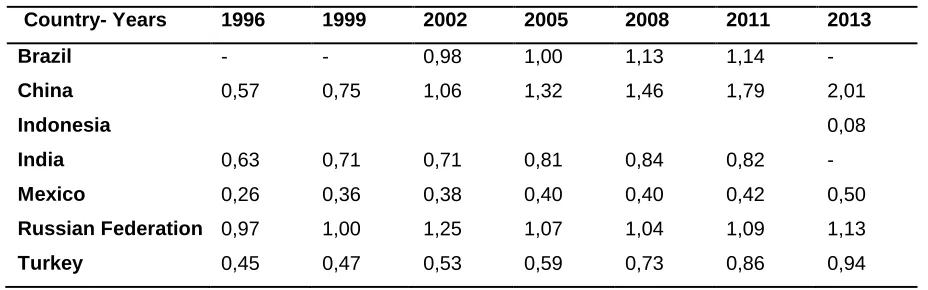
Licensed under Creative Common Page 227 Table 1: Research and development expenditure (% of GDP)
Country- Years 1996 1999 2002 2005 2008 2011 2013
Brazil - - 0,98 1,00 1,13 1,14 -
China 0,57 0,75 1,06 1,32 1,46 1,79 2,01
Indonesia 0,08
India 0,63 0,71 0,71 0,81 0,84 0,82 -
Mexico 0,26 0,36 0,38 0,40 0,40 0,42 0,50
Russian Federation 0,97 1,00 1,25 1,07 1,04 1,09 1,13
Turkey 0,45 0,47 0,53 0,59 0,73 0,86 0,94
Source: Compiled from World Bank data
In Table 1, the share of R&D expenditures in GDP in Brazil, Indonesia, India, Russia, and Turkey is seen. According to this table, it is seen that the fastest increase is experienced in China. The data in this table has also a quality confirming these findings.
Table 2: High-Technology Export (current US 1000$)
Country- Years 1990 1995 2000 2005 2010 2014
Brazil 1.053.130 1.207.552 5.990.406 8.031.342 8.121.872 8.228.775
China - 13.057.348 41.735.539 215.928.412 406.089.687 558.605.991
Indonesia 144.306 1.685.982 5.774.419 6.671.058 5.742.569 4.980.582
India 497.829 1.351.219 2.062.488 4.139.238 10.086.626 17.315.676
Mexico 962.212 9.352.136 31.174.465 32.400.251 37.657.285 49.402.709
Russian Federation - - 3.907.958 3.820.368 5.075.117 9.842.669
Turkey 106.787 193.654 1.077.574 881.846 1.713.837 2.348.380
Source: Compiled from World Bank data
Licensed under Creative Common Page 228 Table 3: High-Technology Exports (% of manufactured exports)
Country- Years 1990 1995 2000 2005 2010 2014
Brazil 6,5 4,9 18,7 12,8 11,2 10,6
China - 10,4 19,0 30,8 27,5 25,4
Indonesia 1,6 7,3 16,4 16,5 9,8 7,0
India 3,9 5,8 6,3 5,8 7,2 8,6
Mexico 8,4 15,2 22,5 19,6 16,9 16,0
Russian Federation - - 16,1 8,4 9,1 11,5
Turkey 1,2 1,2 4,8 1,5 1,9 1,9
Source: Compiled from World Bank data
In the export in manufacturing sector, the data containing the information belonging to the share of technology export are given in Table 3. China is in a position of country having the highest share. However, there is no tendency increasing in respect with years. It reached the highest value in 2005 with 30.8%. In the continuing years, there is a decreasing tendency in this rate. In Table 2, in the existing data in terms of all countries, it can be mentioned that a fluctuation was experienced in respect with years. For Turkey, this rate actualized as 4.8% in 2000. However, for the other years, this rate can be accepted as the range of 1.2-1.9%. Together with this level, Turkey takes place in the last rank.
If an evaluation is made for all tables, it is seen that China, Mexico, and India, and India take place in the first ranks in export of high technology product. Especially, China has an important difference between it itself and the other countries. In terms of R&D expenditures, since China is seen at the front compared to the other countries, it can be said that there is a positive relationship between R&D expenditures and export of high technology product. However, it reveals that it is necessary to empirically test the study. This study has prepared a ground for the further studies.
CONCLUSION
Licensed under Creative Common Page 229 in R&D expenditures and export of high technology product. Setting out from these evaluations, when considered that the firms and countries do not pay necessary attention to R&D expenditures, it reveals that the countries should gain competitive advantage, spending the necessary time and effort to R&D and innovation. For the countries to be able to close the gap between them and developed countries and to have voice in the same global arena, it can be said that they should export the products with high value added . This depends on R&D expenditures of countries, their allocating more share from the national income, their paying attention to human capital, and their increasing national innovation capacity. Innovation has become the key determining factor in economic development. For example Ismail (2013), using pull model, in the period of 2004-2009 (except for the years 2007 and 2008), on 10 Asian countries (Japan, China, Hong Kong, South Korea, India, Singapore, Malaysia, Indonesia, Philippines and Thailand), examined the effect of innovation on high technology product. As a result of the study, he identified that innovation activities were important factors of export of high technology product. Also Tebaldi (2011), in the study he carried out, analyzed the determinants of export of high technology. In the study, in which the period of 1980-2008 was analyzed by the Panel data method, it was found that human capital, direct foreign capital inflows, and trade openness were the most important determinants of high technology industry of a country. It was found that the institutes affected high technology export through human capital and foreign direct investments not directly. Gokmen and Turen (2013), using the model of Tebaldi (2011), in the study they carried out on 15 European countries for the period of 1995-2001, found that in long term, human capital played an important role in the export of high technology product. Innovation and human capital has become the key determining factor in high technology product and economic development. We can say that the general determinants of high technology product and export include human capital, innovation, and R&D.
REFERENCES
Alan, Ş. (2008).Sinai Mülkiyet Haklarının Ekonomik Büyümeye Etkisi, Türk Patent Enstitüsü, Uzmanlık Tezi.
Altın, O., Kaya, A. Ayşen, (2009). “Türkiye’de Ar-Ge Harcamaları Ve Ekonomik Büyüme Arasındaki Nedensel İlişkinin Analizi”. Ege Akademik Bakış, 9(1) pp 251-259.
Bayraktutan, Y. Bıdırdı H.(2015). Teknoloji Politikaları : Temel Göstergeler ve İhracata Yansımaları (Seçilmiş Ülke Örnekleri) , KOSDEB, 30, 1-30.
Licensed under Creative Common Page 230 Gani, A. (2009).“Technological Achievement, High Technology Exports and Growth”, Journal of Comparative International Management, Vol 12 (2), 31-47.
Göçer, İ. (2013a).Teknolojik İlerlemenin Belirleyicileri: NIC ülkeleri için Panel Eşbütünleşme ve Panel Nedensellik Analizleri”. Maliye Finans Yazıları. Yıl 27. Sayı 100. 116-141, 2013a
Göçer, İ. (2013b). “Ar-Ge Harcamalarının Yüksek Teknolojili Ürün İhracatı, Dış Ticaret Dengesi ve Ekonomik Büyüme Üzerindeki Etkileri”Maliye Dergisi, Sayı: 165.pp 215-240.
Gökmen,Y. Turen, U.(2013). “The Determinants of High Technology Exports Volume: A Panel Data Analysis of EU-15 Countries”. Vol 2(3). Pp 217-232.
ISMAIL, NormazWana, (2013). “Innovation and High-TechTrade in Asian Countries”, International Conference on Recent Developments in Asian Trade Policy and Integration, 20-21February,KualaLumpur,Malezya;https://www.nottingham.ac.uk/gep/documents/conferences/2013/mala ysiaconference/normaz-wana-ismail.pdfDate of Access: 08.05.2016
Karahan, O.(2015).Intensity of Business Enterprise R&D Expenditure and High-Tech Specification In European Manufacturing Sector. World Conference on Technology, Innovation and Entrepreneurship, 195(3), 806–813.
Karahan, O.(2015).Intensity of Business Enterprise R&D Expenditure and High-Tech Specification in European Manufacturing Sector. World Conference on Technology, Innovation & Entrepreneurship, 195(3), 806–813.
Kılıç, C., Bayar Y., Özekicioğlu H.(2014). “Araştırma Geliştirme Harcamalarının Yüksek Teknoloji Ürün İhracatı Üzerindeki Etkisi: G–8 Ülkeleri İçin Bir Panel Veri Analizi”, Erciyes Üniversitesi İktisadi ve İdari Bilimler Fakültesi Dergisi, Sayı: 44, Temmuz-Aralık 2014 ss. 115-130.
Kizilkaya, O., Ay, A. & Sofuoğlu, E.(2016).The determinants of hightechnology product export in brict countries: An econometric approach, Global Journal on Humanites&Social Sciences. , pp 112-117. Larosiere de J. (2013). “The World in 2050: Risk and Challenges” https://www.genevaassociation.org/media/853749/ga_9th_cro_assembly_de-larosiere.pdf, Date of Access: 08.05.2016
MONTOBBIO, FabioandFrancesco RAMPA (2005).“The Impact of Technology and Structural Change on Export Performance in Nine Developing Countries”, World Development, 33(4), pp.527–547.
Ozer, M.,& Çiftçi, N.(2009). “Ar-Ge Harcamaları ve İhracat İliskisi: OECD Ülkeleri Panel Veri Analizi. Dumlupınar University Journal of SocialScience, (23), 39-49.
Sandu, S. andCiocanel, B.(2014). “Impact of R&D and Innovation on high – techexport” Procedia Economics and Finance 15,80 – 90.
Sara, T.S., Jackson F.H.,Upchurch, L.T., 2012. “Role of Innovation in Hi-Tech-Exports of a Nation” International Journal of Business and Management Vol. 7, No. 7;,pp 85-93.
Saygılı, Ş.(2003). “Bilgi Ekonomisine Geçiş Sürecinde Türkiye Ekonomisinin Dünyadaki Konumu” DPT, Yayın No. DPT: 2675.
Srholec, M. (2007). “High-Tech Exports from Developing Countries: A Symptom of Technology Spurtsor Statistical Illusion?”Review of World Economics, Vol. 143 (2).
Tebaldi, E.(2011). “The Determinants of High-Technology Exports: A Panel Data Analysis”, AtlEcon J (2011) 39:343–353.
Uzay N., Demir, M.,Yıldırım E. (2012). “İhracat Performansı Açısından Teknolojik Yeniliğin Önemi: Türkiye İmalat Sanayi Örneği”Doğuş Üniversitesi Dergisi, 13 (1), 147-160.
Yıldırım E. , Kesikoğlu F.(2012). “Ar-Ge Harcamaları ve İhracat Arasındaki Nedensellik İlişkileri Marmara Üniversitesi İ.İ.B.F. DergisiCilt XXXII, SAYI I, S. 165-180.