United Kingdom Vol. V, Issue 11, November 2017
Licensed under Creative Common Page 547
http://ijecm.co.uk/
ISSN 2348 0386
PUBLIC PARTICIPATION PROCESS IN THE DEVOLVED
SYSTEM OF GOVERNANCE IN KENYA
Geoffrey Ronoh
PhD student, Department of Development studies, Moi University, Eldoret, Kenya [email protected]
Abstract
This study evaluates public participation process in the devolved system of governance in
Kenya and the extent to which it has taken place for sustainable development. The study was
carried out in South Rift counties (Kericho, Bomet and Narok County). The respondents to the
questionnaires and interview questions were delimited to members of the public, county
executive and county assembly. The study was conducted through analytical survey approach.
The target population was 1,051,077; and using simple random sampling, a sample size of 384
was determined and using purposive sampling techniques, six people were interviewed. Data
collection instruments used was: questionnaires, interview schedules and document analysis.
The data collected was analyzed using descriptive statistics and the results presented in tables.
Arising from the study findings it emerged clearly that; lower level public participation process
such as information dissemination and public consultation has been adopted by county
governments but they have failed to adopt higher levels of public participation processes such
as public involvement, collaboration and empowerment.
Keywords: Public Participation, Participation Process, Sustainable Development, Devolution,
Devolved Government, Development Activities
INTRODUCTION
Participation has captured the imagination and hopes of politicians, policy makers and practitioners alike (Jochum, Pratten and Wilding, 2005; Cornwall, 2008). Across the globe –from Brazil to India to the United States - we have witnessed „an explosion‟ of interest in participation
Licensed under Creative Common Page 548 with efforts to promote good governance, many African countries have also identified public participation as a key principle to promote and uphold good governance. For example, in adopting the African charter on democracy, elections and governance in 2007, the 53 member states of the African Union committed themselves to, amongst others; promote the conditions that are necessary to foster citizen participation and transparency (African Union‟s Commitment
to Human Rights, 2007). Public participation is a useful tool to promote the involvement of the public in governance. The World Development Report (2000), states that governments at all levels have begun to understand the importance of inclusive, participatory and consensual models of public participation. As a result, various strategies are applied to consult and engage with members of the public in progressive nations across the globe.
In Brazil, the most common stated example of effective public participation is the municipal participatory budgeting initiative, Sprague (2000). This participatory process is one of the creative programmes developed by the city of Porto Alegre in Brazil. The aim of the participatory budgeting process is to address severe disparities in the living standard of the city residents, by bringing these residents on board during participatory processes. In India, a common stated example of effective public participation is the community and sustainable forest management. Sustainability of forest management comes through community participation at all levels from planning, intervention and monitoring, Kotwal (2008). In this regard a bottom-up approach is applied wherein communities are mobilised to participate in all forestry interventions.
In Uganda, efforts to promote public participation have taken the form of both policy frameworks and the development of implementation modalities. The government took appropriate steps to put in place supporting legislative framework to promote public participation. In this regard, the enactment of the 1993 Local Councils Statute was a way of broadening the space for citizen participation, Kakumba and Nsingo (2008). The legislation was designed in such a way that it facilitates effective involvement of communities in articulating their needs and influencing programme planning and implementation. The main aim was to foster citizen participation in the processes of rural development. In addition, according to the United Nations Development Report (2006), Uganda has been able, through public participation to significantly reduce the levels of HIV/AIDS. In South Africa, since 1994 the government has applied several initiatives to effect public participation. These include methodologies such as
izimbizo, Exco-meets the people, public hearings, ward committees, community development
Licensed under Creative Common Page 549 At independence in 1963, Kenya was a constitutionally devolved state with various regions
(majimbo in Kiswahili) vested with responsibilities of collection of taxes and provision and
maintenance of basic social services (health and education) and minor roads. But by December 1964, the country had reverted to a centralized system of government with the regions becoming provinces as had been the case earlier. In the subsequent year, the government formulated a premier policy paper, Sessional Paper No. 10 of 1965 on African Socialism and its
Application to Planning in Kenya, (Republic of Kenya, 1965) in which it was stated that the
power to control resource use resided with the state but planning was to be extended to the provinces and local authorities. The 1971 report on public service structure recommended that the planning process be extended to the district and divisional levels.
Over the years, Kenya has progressively shifted from a centralized to a decentralized form of governance. This paradigm shift was due to the shortfalls that are often characteristic of highly centralized government systems. The shortfalls include administrative bureaucracies and inefficiencies, misappropriation of public resources, lack of public participation and the marginalization of local communities in development processes (The Institute for Social Accountability - TISA, 2010). Therefore, there was a need to make devolution a permanent feature in Kenya by anchoring it in the constitution. According to International Commission of Jurists, ICJ (2013) devolution is simply defined as the process of transferring decision-making and implementation powers, functions, responsibilities and resources to legally constituted, and popularly elected local governments. Devolution in Kenya is based on the supremacy of the Constitution, sovereignty of the people and the principle of public participation.
The adoption of the new constitution in 2010, in Kenya, marked the beginning of a new dispensation where there are two levels of government: central government and county governments. Article 176 (1) of the Constitution of Kenya, state that there shall be a county government for each county, consisting of a county assembly and a county executive and article 174 states that the objects of the devolution of government is (a) to promote democratic and accountable exercise of power; (b) to foster national unity by recognizing diversity; (c) to give powers of self-governance to the people and enhance the participation of the people in the exercise of the powers of the State and in making decisions affecting them; (d) to recognize the right of communities to manage their own affairs and to further their development, (Republic of Kenya, 2010).
Licensed under Creative Common Page 550 development. Other constitutional provisions that provide for public participation in the Constitution of Kenya 2010,include: Article 69(1) d which provides for public participation in the management, protection and conservation of the environment, Article 118 which mandates parliament to facilitate public participation in the legislative and other business of parliament, Article 174 (c) which provides for public participation as an object of devolution, Article 201(a) which provides for openness and accountability including public participation in financial matters as a principle of public finance and others related to the right of recall and in constitutional amendment processes, (Republic of Kenya, 2010).
Research Objective
To evaluate public participation process in the devolved system of governance in Kenya.
LITERATURE REVIEW
The Concept of Sustainable Development
Licensed under Creative Common Page 551 be achieved. Agyeman and Angus (2003) are of the opinion that a sustainable community is one “where wider questions of social needs, welfare and economic opportunities are integrally
related to environmental limits”. To this effect, Melnick, Mcneely, Navarro, Schmidt-Traub & Sears (2005) suggest that if the governments are more transparent and sensitive to needs of the public, participation can improve the quality of economic, social and environmental decisions, therefore increasing long-term sustainability. Doelle and Sinclair (2006), has also argued that it is the consensus of the interested and affected parties that provides the best indicator to measure the development and project sustainability rather than the use of predetermined rules or goals.
The Concept of Devolution
Devolution is considered a form of political decentralization, involving a full transfer of responsibility, decision-making, resources and revenue generation to a local level of public authority that is autonomous and fully independent from the devolving authority. Decentralization is often linked to concepts of participation in decision-making, democracy, equality and liberty from higher authority (Dutta, 2009). According to Ndege and Brooks (2013) the writers of Kenya‟s constitution were bold in their quest to devolve public governance and resources to the grassroots. Previously, the “national cake” was exclusively shared from
Nairobi, with the presidency having an inordinate say in who got what. More often than not, these decisions were premised neither on national good, nor on strategic considerations. According to ICJ (2013) devolution in Kenya is based on the supremacy of the Constitution, sovereignty of the people and the principle of public participation. Devolution is one of the concepts in the Constitution that has brought about a complete overhaul in Kenya‟s system of
governance. This is because it is a new aspect in the Kenyan governance. The need for Devolution has been seen in many countries and it is informed by the need to have power sharing, checks and balances in governance and the decentralization of resources.
Public Participation
A great deal of scholarly work has been conducted to define the concept and practice of public participation in general. The International Finance Corporation (IFC) (2007) has recognized that the terms “public participation,” “citizen participation,” or “stakeholder participation” continue to
be used interchangeably. They noted that while different organizations sometimes use different terminologies to explain the phenomena of engagement, be it “consultation,” “public consultation,” “public participation,” or “stakeholder involvement”, they most often express
Licensed under Creative Common Page 552 potentially have an interest in a development or project, or be affected by it. It entails a wide range of activities that can range from providing information, through consultation to direct involvement of the public in aspects of the decision-making process.
Participation is the highest order of public engagement. The term participation conceptually refers to „being part of‟ and „taking part in‟ and carries an active component within it
(Mdunyelwa, 2008). According to International Association of Public Participation (IAP2) (2007), Public participation implies that the public's contribution will influence the decision. Public participation is viewed as a tool, intended to inform planning, organizing or funding of activities. The objective behind public participation is to facilitate the involvement of those potentially affected by or interested in a decision made by government. Participation is the process through which stakeholders‟ input and share control over development initiatives, decisions and
resources which affect them, (Odhiambo and Taifa, 2009). Okello, Oenga and Chege (2008) further define it as a process whereby stakeholders influence policy formulation, alternative designs, investment choices and management decisions affecting their communities. Public participation is seen as a form of empowerment and is a vital part of democratic governance. Participation has greatly contributed to the sustainability of development initiatives, strengthened local capacity, given a voice to the poor and marginalized and linked development to the people‟s needs (Odhiambo and Taifa, 2009).
According to Report of the Task Force on Devolved Government, TFDG (2011), the constitution is providing a major paradigm shift from a system of extreme exclusion and marginalisation to a system that puts emphasis on inclusion and participation of all sectors of the society in the affairs and benefits of governance. Participation enhances transparency of interaction in the public domain through such facilities as notice board announcements of job opportunities , recruitments information; social/participatory budgeting; opening the budget process to citizen participation; procurement transparency and oversight committees; monthly revenue and expenditure Report; quarterly development status reports; bi-annual monitoring report prepared through the Sub-County Citizen Forums; County and Sub-County Assemblies ; monthly public revenue and expenditure forums; and quarterly face-to-face question and answer sessions with the governor and senator of each County. The legislative elements of each of these instruments and platforms for citizen participation may vary from sector to sector and from County to County.
Licensed under Creative Common Page 553 responsibility is on the speaker of the County Assembly and Chairpersons of various Committees of the House.
The County Government Act, 2013, provides further guidelines for the realisation of the goal of the Constitution of ensuring the participation of the people in governance. According to section 87 of the Act, Citizen participation in county governments shall be based upon the following principles: a) Timely access to information, data, documents, and other information relevant or related to policy formulation and implementation; b) Reasonable access to the process of formulating and implementing policies, laws, and regulations, including the approval of development proposals, projects and budgets, the granting of permits and the establishment of specific performance standards; c) Protection and promotion of the interest and rights of minorities, marginalized groups and communities and their access to relevant information.
According to ICJ (2013), in line with these principles, several provisions have been highlighted below as key to public participation at the county level. Firstly, the Constitution in Article 118 and 196 requires Parliament and county assemblies respectively to conduct their business in an open manner, and hold their sittings and those of their committees, in public; and facilitate public participation and involvement in the legislative and other business of the assembly and its committees, (Republic of Kenya, 2010). More importantly, the Constitution prohibits both houses from excluding the public, or any media, from any sitting unless in exceptional circumstances where the speaker has determined that there are justifiable reasons for doing so. The County Government Act also provides for citizen participation in a number of areas. Under section 15, it grants any person power to petition the county assembly to consider any matter within its authority, including enacting, amending or repealing any of its legislation. Secondly, under section 27 of the Act, it empowers the electorate in a county ward to recall their member of the county assembly before the end of the term of the member. Last but not least, the Act specifies the structure that the county government should put in place to facilitate citizen participation.
METHODOLOGY
Licensed under Creative Common Page 554 The target population for this study was 1,051,077; derived from Kenya Population and Housing Census of 2009 of adults who are 18 years old and above residents of the three counties.This study employed simple random sampling technique for members of the public who responded to questionnaire and purposive sampling for the representatives of county executive and county assembly who were interviewed. Therefore six people were interviewed from the three counties. The sample size was determined by the formula suggested by Fisher, et al (1983) for estimating sample sizes in social surveys as shown below;
n = Z2pq = (1.96)2 x 0.5 x 0.5 = 384 d2 (0.05)2
The total population of persons who are 18 years and above in the three counties are 1,051, 077 (KPHC, 2009); this are more than 10,000, therefore according to Fisher, et al (1983) the sample size will be 384. A sample size of 128 was picked from Kericho County, 121 from Bomet County and 135 from Narok County for purposes of answering questionnaires.
Questionnaires, interview schedule and document analysis were used as the main tools for collecting data. The research collected both primary and secondary data. Primary data was obtained by administering questionnaires and using interview schedules, while the secondary information was collected through document analysis which was review of the relevant literature.
Data analysis for this study was done using the SPSS. Qualitative data analysis involved such processes as coding, categorizing and making sense of the essential meanings of the phenomenon. Quantitative data was analyzed through descriptive statistics and presented in tables and pie charts, as per the objective: data was analyzed in terms of counts/frequencies, percentages and descriptive statistics (mean and standard deviation).
Participation in the study was voluntary. The research objectives were explained to the participants verbally and in writing. The following logistical and ethical issues were considered: informed consent, privacy and confidentiality, anonymity and researcher‟s responsibility.
ANALYSIS, FINDINGS AND DISCUSSION
Public Participation Process
Licensed under Creative Common Page 555
Frequency of involvement in the development activities in the county
The respondents to the questionnaire were asked to respond to the question, “How often have
you been involved by the county government and/ or county assembly in the following development activities in the county?
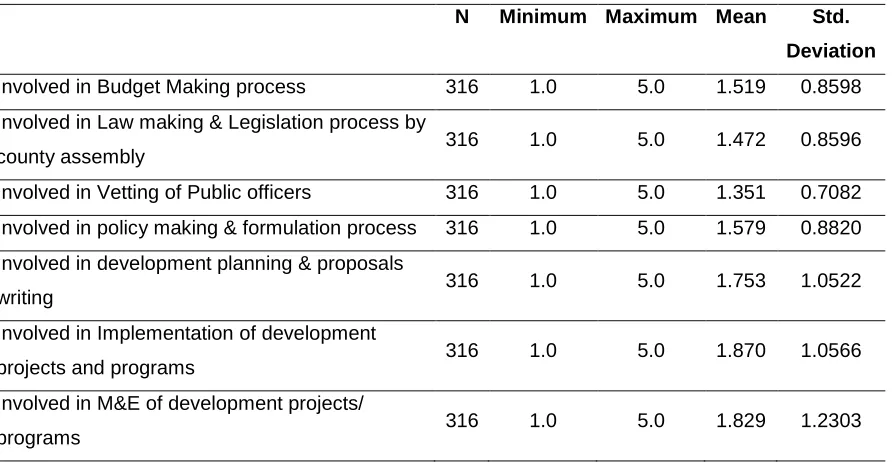
The respondents were given choices to tick; Never- 1, Rarely- 2, Sometimes- 3, Frequently- 4 or Always- 5. The findings are as shown in the table 1 below.
Table 1: Involvement in development activities in the county
N Minimum Maximum Mean Std. Deviation
Involved in Budget Making process 316 1.0 5.0 1.519 0.8598
Involved in Law making & Legislation process by
county assembly 316 1.0 5.0 1.472 0.8596
Involved in Vetting of Public officers 316 1.0 5.0 1.351 0.7082
Involved in policy making & formulation process 316 1.0 5.0 1.579 0.8820
Involved in development planning & proposals
writing 316 1.0 5.0 1.753 1.0522
Involved in Implementation of development
projects and programs 316 1.0 5.0 1.870 1.0566
Involved in M&E of development projects/
programs 316 1.0 5.0 1.829 1.2303
Licensed under Creative Common Page 556 mean. Sixth; Involvement in implementation of development projects and programs has a mean of 1.870 and standard deviation of 1.0566; which means majority of the respondents rarely participate and their responses are not so dispersed from the mean. Last but not least; Involved in monitoring and evaluation of development projects/ programs has a mean of 1.829 and standard deviation of 1.2303; which means majority of the respondents rarely participate and their responses are not so dispersed from the mean.
The above findings shows that majority of the people have not been involved by the county governments or assemblies. This could be because county governments have not taken public participation seriously or they are not willing to involve the public fully by providing information and facilitating public participation. It means; most of development activities and other process have been undertaken with little or no input from the public. According to Cashmore (2007), for the development project to be sustainable, the community needs to be involved early on in terms of planning, designing, implementing and evaluating (monitoring). Public participation is viewed as a tool, intended to inform planning, organizing or funding of activities.
According to county officers interviewed public participation process is as follows: public participation on budget is normally done once a year before the end of the financial year. It is taken to the public after compilation; both proposals from the executive arm and the assembly arm are compiled to come up with a single budget. Members of the public are normally called upon to provide information on suitability of the officers nominated to hold a public office. On development plans, they originate from the executive. On implementation of development projects, there is a county assembly‟s committee on implementation whose work is to inspect
various projects. A report is normally written with recommendations handed to sectoral committees for further actions.
Public participation process facilitated by county government in the county
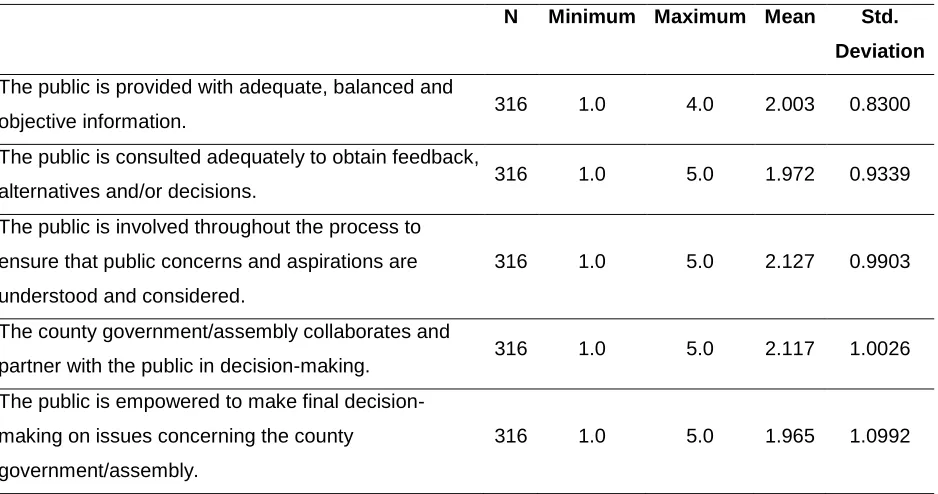
The respondents to the questionnaire were asked to respond to the question, “To what extent
Licensed under Creative Common Page 557 Table 2: Public participation process in the county
N Minimum Maximum Mean Std. Deviation
The public is provided with adequate, balanced and
objective information. 316 1.0 4.0 2.003 0.8300
The public is consulted adequately to obtain feedback,
alternatives and/or decisions. 316 1.0 5.0 1.972 0.9339
The public is involved throughout the process to
ensure that public concerns and aspirations are
understood and considered.
316 1.0 5.0 2.127 0.9903
The county government/assembly collaborates and
partner with the public in decision-making. 316 1.0 5.0 2.117 1.0026
The public is empowered to make final
decision-making on issues concerning the county
government/assembly.
316 1.0 5.0 1.965 1.0992
The table 2 above shows responses to the five statements on public participation process. First; the public is provided with adequate, balanced and objective information; has a mean of 2.003 and standard deviation of 0.8300; which means majority of the respondents disagree with the statement and their responses are not so dispersed from the mean. Secondly; the public is consulted adequately to obtain feedback, alternatives and/ or decisions; has a mean of 1.972 and standard deviation of 0.9339; which means majority of the respondents disagree with the statement and their responses are not so dispersed from the mean. Thirdly; the public is involved throughout the process to ensure that public concerns and aspirations are understood and considered; has a mean of 2.127 and standard deviation of 0.9903; which means majority of the respondents disagree with the statement and their responses are not so dispersed from the mean. Fourth; the county government/ assembly collaborate and partner with the public in decision-making; has a mean of 2.117 and standard deviation of 1.0026; which means majority of the respondents disagree with the statement and their responses are not so dispersed from the mean. Last but not the least; the public is empowered to make final decision-making on issues concerning the county government/ assembly; has a mean of 1.965 and standard deviation of 1.0992; which means majority of the respondents disagrees with the statement and their responses are not so dispersed from the mean.
Licensed under Creative Common Page 558 governments have done very little to ensure that the members of the public participate in all or most of the processes of public participation as envisioned in the constitution. Most counties have taken long to allocate money to finance or employ personnel to facilitate public participation and some are still lacking laws and regulations to guide public participation. Public participation in most counties did not start immediately after 2013 because there were no funds allocated in the budget to facilitate public participation and up to now most counties have not passed laws and policies to guide public participation.
Public participation entails a wide range of activities that can range from providing information, through consultation to direct involvement of the public in aspects of the decision-making process. It is an empowering process which enables local people to do their own analysis, take command and gain confidence (Nsibambi, 1998; Chambers, 2002). Participation is the process by which stakeholders exert influence and share control over priority setting, policy making, resource allocation, and/or programme implementation. Participation is the process through which stakeholders‟ input and share control over development initiatives,
decisions and resources which affect them, (Odhiambo and Taifa, 2009). Okello, Oenga and Chege (2008) further define it as a process whereby stakeholders influence policy formulation, alternative designs, investment choices and management decisions affecting their communities. The county officers interviewed gave the following information and compiled as follows: County assemblies have been undertaking public participation guided by article 196 of the constitution. The process of public participation is such that the assemblies advertise for a public forum and inform the public about the venue. They also upload the information and other documents concerning the pieces of legislation in their websites. Then the officers of the assembly together with the Members of the committee of the assembly (who are MCAs) guide the public through the pieces of legislation/development plans word by word as the public discusses and give their contributions/comments/opinions. The committee takes notes then later on compile and sieve through to make sense out of it. The compiled report is then taken to the committee of the whole house of the county assembly for debate, further deliberations and voting to pass it into law. Communication to the public is normally done through daily newspapers adverts, local radio stations and posters which are claimed to be more effective. Initially money was not allocated to facilitated public participation process in the counties.
The public is given information through the elected MCAs, county assembly website on the upcoming events, through Facebook page, radio, newspapers and posters. The public is normally consulted on the best venues for public participation acceptable to the majority. Involvement of the staff attached to the MCA‟s office in public participation by collecting
Licensed under Creative Common Page 559 may collaborate with institutions, multinational companies, NGOs, civil societies and other stakeholders. Rarely do they collaborate with the public. Training of the public on how to manage and sustain a development project, capacity building is normally organized but on a smaller scale. Civic education has never been done in the three counties.
CONCLUSION
The study concludes that county governments and assemblies tend to involve the public in lower level of public participation process such as provision of information and public consultation, but they have failed to involve the public in higher level of public participation process such as public involvement, public collaboration and public empowerment; which is the highest level/ process of public engagement.
The study also concludes that county governments or assemblies have failed to involve the public fully in development activities. This could be because county governments have not taken public participation seriously or they are not willing to involve the public fully by providing information and facilitating public participation. The study also concludes that most of development activities have been undertaken with little or no input from the public. The county governments have done very little to ensure that the members of the public participate in all or most of the processes of public participation as envisioned in the constitution. Most counties have taken long to allocate money to finance or employ personnel to facilitate public participation and some are still lacking laws and regulations to guide public participation. The study therefore concludes that; there has been no political goodwill from the political leadership of both arms of county government; executive and assembly, towards involving the public fully in development activities.
RECOMMENDATIONS
Licensed under Creative Common Page 560 formulation; development planning and proposals writing; implementation of development projects/programs; and monitoring & evaluation of development projects/ programs.
WAY FORWARD
The study basically evaluated public participation process for sustainable development in devolved system of governance in Kenya. Public participation is a very broad area and therefore further research could be conducted on the following areas:
(i) Public perceptions and attitudes towards Public participation in the devolved system of governance.
(ii) Role of politics on effectiveness of public participation in the devolved system of governance.
REFERENCES
Afgan, N. H., Bogdan, Z. & Duić, N. (Eds) (2004). Sustainable Development of Energy, Water and Environment Systems. The Netherlands: A.A. Balkema.
African Union‟s Commitment to Human Rights. 2007.
Agyeman, J. &Angus, B. (2003). The Role of Civic Environmentalism in the Pursuit of Sustainable Communities. Journal of Environmental Planning and Management 46 (3): 345-363.
Aregbeshola, M. T. (2009). Public Participation in Environmental Impact Assessment: An Effective Tool for Sustainable Development-A South African Perspective. Gautrain.
Cashmore, M. (2007). The Contribution of Environmental Assessment to Sustainable Development: Toward a Richer Conceptual Understanding. In C. George, and C. Kirkpatrick, (Eds). Impact Assessment and Sustainable Development. United Kingdom: Edward Elgar Publishing Ltd.
Chambers. R. (2002) Relaxed and Participatory Appraisals: Notes on Practical Approaches and Methods for Participants in PRA/PLA-related Familiarization. IDS: University of Sussex.
Cornwall, A. (2008) „Unpacking „Participation‟: models, meanings and practices‟, Community Development Journal, 43(3): 269-283.
Dalal-Clayton, B. (2000). Sustainable Development: Concepts and Approaches. Available at http://www.nssd.net/references/sustdev.htm [Accessed 21/10/2014].
Doelle, M. &Sinclair, A. J. (2006). Time for New Approach to Public Participation in EA: Promoting Cooperation and Consensus for Sustainability. Environmental Impact Assessment Review 26(2): 185-205.
Dunn, A. (2007) Champions of Participation: Engaging citizens in local governance [online] Available at: www.ids.ac.uk/logolink [Accessed 03 September 2014].
Dutta, S. (2009). Democratic decentralization and grassroot leadership in India, Mittal Publications, 2009, p. 5-8, ISBN 9788183242738
ICJ (2013). Handbook on Devolution: The Kenyan section of the International commission of jurists.
IFC (2007). Stakeholder Engagement: A Good Practice Handbook for Companies doing Business in Emerging Markets. World Bank.
Licensed under Creative Common Page 561 Iyer-Raniga, U. & Treloar, G. (2000). A Context for Participation in Sustainable Development. Environmental Management. 26(4): 349-361.
Jochum, V., Pratten, B. and Wilding, K. (2005) Civil renewal and active citizenship: A guide to the debate, London: NCVO.
Kakumba, U. and Nsingo, S. (2008) Journal of Public Administration. Volume 43, Number 2, June. 2008.
Kenya, Republic of (1965) Sessional Paper No. 10 on African Socialism and its Application to Planning in Kenya. Nairobi: Government Printers.
Kenya, Republic of (2010). Laws of Kenya: The Constitution of Kenya. Nairobi: National Council of Law Reporting.
Kotwal, (2008). Sustainable Forest Management through Community Participation. Vol. 95,no 8.
Mdunyelwa L. (2008). Public Participation in Local Government: It‟s Impact on Service Delivery: Conference Proceedings -International Research Group Programme (GDRI), South Africa.
Melnick, D., Mcneely, J., Navarro, Y. K., Schmidt-Traub, G. &Sears, R. R. (2005). UN Millenium Project. Environment and Human Well-Being: A Practical Strategy. Report of the Task Force on Environmental Sustainability.
Ndege, R. & Brooks, K. (2013). Devolution in Kenya: Early days yet. Africa in Depth: Africa Practice
Nsibambi, A. (1998) „Introduction‟. In A. Nsibambi (ed.) Decentralization and Civil Society in Uganda: The Quest for Good Governance. Kampala: Fountain Publishers.
Odhiambo, M. & Taifa, A. (2009). Devolved Funds Development: A Handbook on Participation. Nairobi: Claripress.
Okello, M., Oenga, I. & Chege, P. (2008). Participatory Urban Planning Toolkit Based on the Kitale Experience: A Guide to Community Based Action Planning for Effective Infrastructure and Services Delivery. Nairobi: Practical Action.
Report of the Task Force on Devolved Government (TFDG) (2011). A Report on The Implementation of Devolved Government in Kenya, 2011.
Sprague, A. (2000) LBJ Journal of Public Affairs. 2000.
Sustainable Development: From Brundtland to Rio 2012 (2010)
TISA, Shelter Forum & Ufadhili Trust (2010). The Nairobi Social Audit Report.
The World Bank Report. 1999/2000.