EFFECT OF CHAIN LENGTH AND ALDEHYDIC FUNCTION ON SOME BIOLOGICAL PROPERTIES OF PARROPOLYENES
Davide Tagliazucchi1, Elena Verzelloni2, Elena Pini3, Giovanni Ronca2*, Angela Conte1
1Department of Agricultural Sciences, University of Modena and Reggio Emilia,
Reggio Emilia, Italy. 2Unit of Medical Chemistry and Biochemistry, Department of Human and Environmental Sciences, University of Pisa, Pisa, Italy. 3Alessandro Marchesini Institute of Organic Chemistry, University of Milan, Milan, Italy. [email protected]
Summary
Parropolyenes, also called parroenes, parrodienes and psittacofulvines, are aldehydes costituted of an unsaturated chain ranging from 8 to 18 carbon atoms. These compounds have been isolated from the plumage of parrots and are also synthesized in the laboratory. Parropolyenes have antiproliferative and antioxidant activities. We investigated the effect of chain length and the role of aldehydic function of some parropolyenes by comparing their biological activities with those of their corresponding alcohols. Trans, trans-∆2,4-hexadienal at a concentration of 100 µM significantly inhibited the growth of SH-SY5Y cells after 72 h of incubation. The corresponding alcohol was less effective. All-trans-∆2,4,6-octatrienal and all-trans-∆2,4,6,8,10-dodecapentaenal were more effective since significant inhibition of growth was observed at a concentration of 10 µM. Again, the corresponding alcohols were less effective. All-trans-∆2,4,6-octatrienal and all-trans-∆2,4,6,8,10-dodecapentaenal at 1 µM concentration protected 2-deoxyribose from degradation by ferrous ions. Trans, trans-∆2,4-hexadienal at the same concentration does not show this protective effect. The protection increased with increasing parropolyene chain length. No significant difference was observed between aldehydes and their corresponding alcohols. Parropolyenes increased the rate of lysis of erythrocyte membrane in a lactoperoxidase-potassium iodide-hydrogen peroxide assay. The cytolytic effect increased with increasing parropolyene chain length. In this assay no difference was observed between aldehydes and alcohols. In all assays the effects were concentration dependent.
Introduction
Carotenoids that birds introduce with foods contribute to a great extent to the color of the plumage of these animals. In parrots carotenoids are metabolized to differently colored compounds that determine the colors of the plumage of these birds. A series of colored compounds derived from carotenoid metabolism have been isolated from the plumage of parrots and have been synthesized in the laboratory. These compounds are aldehydes composed of an unsaturated chain of carbon atoms ranging from 8 to 18 carbon atoms calied parropolyenes, parroenes, parrodienes or psittacofulvines (1).
Few studies have been performed on the biological activity of parropolyenes. The antioxidant and antiproliferative activities of these compounds have already been published (1,2).
The aims of the present study were to investigate the effect of chain length and the role of aldehydic function on the antiproliferative and antioxidant effects of parropolyenes by comparing their activities with their corresponding alcohols.
Methods
Trans,trans-∆2,4-hexadienal (abbreviated name in this paper C6-dienal), all-trans ∆2,4,6-octatrienal (abbreviated name C8-trienal) and the corresponding alcohol-1-ol (C8-trienol), all-trans ∆2,4,6,8,10-dodecapentaenal (C12-pentaenal) and the corresponding alcohol-1-ol (C12-pentaenol) were a gift from Prof. Aldo Bertelli, Department of Pharmacology, University of Milan, Italy. Trans,trans- ∆2,4-hexadien-1-ol (C6-dienol) was from Aldrich (Milan, Italy). The compounds obtained from Prof. Bertelli were prepared as previously described (1). The alcohols were obtained by reduction of the corresponding aldehyde. The other chemicals were from Carlo Erba (Milan, Italy) or from Sigma (Milan, Italy) and were of analytical grade.
The cells used in this study were neuroblastoma SH-SY5Y. The cells, which were mycoplasma-free, were routinely maintained at 37 °C and 5% CO2 in RPMI medium containing 1% L-glutamine, 1% penicillin-streptomycin and 10% heat-inactivated fetal calf serum. Cell viability and growth rate were determined by the Trypan Blue dye-exclusion assay and by the 3-(4,5-dimethylthiazol-2-yl)-2,5-diphenyl tetrazolium bromide (MTT) based colorimetric assay (3).
cells were incubated for 72 h after parropolyene addition and were harvested, washed and evaluated for cell number, growth and viability.
The antioxidant activity was evaluated with the deoxyribose degradation assay. The reaction mixture contained the following final concentrations: 2.5 mM 2-deoxyribose, 1.2 mM hydrogen peroxide, 0.22 mM ferrous ion, 1% ethanol (v/v), 20 mM potassium phosphate (pH 7.4) and variable amounts of the tested compounds. After 60 min of incubation at 37 °C to 1 ml of the above reported reaction mixture, 1 ml of 1% (w/v) solution of thiobarbituric acid in 50 mM sodium hydroxide was added, followed by 1 ml of 2.8% (w/v) aqueous trichloroacetic acid. After the mixture had been mixed well, the tubes were heated at 100 °C for 20 min. The absorbance of the thiobarbituric acid adduct was measured at 532 nm (4). The antioxidant activity was evaluated with another technique in according to McFaul and Everse (5-6). Briefly, freshly heparinized human blood was centrifuged at 2,000 g for 3 min and the isolated erythrocytes were washed twice with phosphate-buffered saline (PBS: 10 mM sodium phosphate, 140 mM NaCl, pH 7.2). The erythrocytes were suspended in PBS at a concentration of 2 x 10⁷ cell/ml; 100 µl of this suspension was incubated in a final volume of 1 ml PBS with 1 µg/ml lactoperoxidase, 25 µM potassium iodide, 1% ethanol (v/v) in the absence or in the presence of the tested compounds, in a cuvette placed in the spectrophotometer, the cell housing of which was maintained at 37 °C. After a few minutes hydrogen peroxide was added to make a concentration of 40 µM. The change in absorbance was monitored at 600 nm. The erythrocytes were maintained in suspension by gentle movement of the cuvettes.
Results
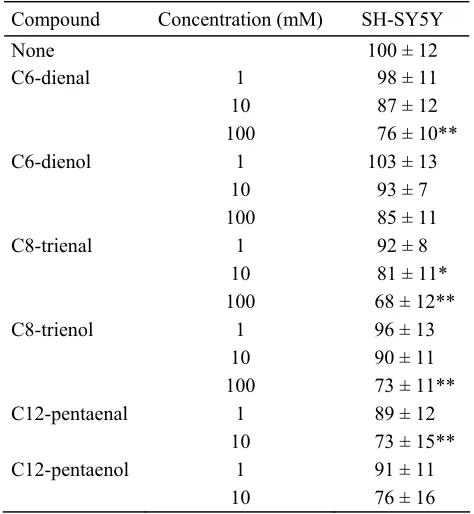
Table 1 shows the effect of parropolyenes on SH-SY5Y cell line as a function of concentration. Depending on the chain length, a significant inhibitory effect on growth was observed after 72 h of incubation as measured by the methyl-thiazol-diphenyl-tetrazolium (MTT) test (Table 1) and by cell number (data not shown).
The inhibitory effect on SH-SY5Y cell line was statistically significant at 100 µM C6-dienal while C8-trienal and C12-pentaenal were effective at 10 µM. The alcohols were less effective than the corresponding aldehydes. Owing to the low solubility of C12 derivatives in ethanol, the higher concentration tested was 10 µM. Ethanol at 1% concentration (v/v) did not affect cell growth.
Parropolyenes showed protection at 1 µM concentration (Table 2). C12 derivatives were more effective than C8 derivatives. C6 derivatives does not show protection at 1
µM concentration. No significant differences were observed between aldehydes and alcohols in this assay.
Table 1. Effect of some parropolyenes on cell growth
Compound Concentration (mM) SH-SY5Y
None 100 ± 12
C6-dienal 1 98 ± 11
10 87 ± 12 100 76 ± 10**
C6-dienol 1 103 ± 13
10 93 ± 7
100 85 ± 11
C8-trienal 1 92 ± 8
10 81 ± 11* 100 68 ± 12**
C8-trienol 1 96 ± 13
10 90 ± 11 100 73 ± 11** C12-pentaenal 1 89 ± 12
10 73 ± 15** C12-pentaenol 1 91 ± 11
10 76 ± 16
Time of incubation 72 h; n = 8; *p < 0.05; **p < 0.01.
We evaluated the antioxidant activity with another technique using erythrocyte cell membrane as a target of oxidation by lactoperoxidase-potassium iodide-hydrogen peroxide cytolytic system. With this assay resveratrol and catechin were highly effective protective compounds (6).
Table 2. Effect of some parropolyenes
and other antioxidant on deoxyribose degradation by hydroxyl radicals
% of inhibition+
concentration of added compound Added compound 1 µM
None 100 ± 12
C6-dienal 83 ± 9 C6-dienol 83 ± 11 C8-trienal 74 ± 12* C12-pentaenal 62 ± 14* C12-pentaenol 60 ± 12* Resveratrol 74 ± 17* Catechin 53 ± 15* n = 6; **p < 0.01; + % of inhibition respect
to the deoxyribose degradation in the absence of added compounds
Table 3. Effect of some arropolyenes on
erythrocyte lysis by lactoperoxidase-potassium iodide and hydrogen peroxide
Added compound
(10 µM)
Lag time (min)
Time of 50% lysis (min)
None 7 ± 4 22 ± 7
C6-dienal 5 ± 4 19 ± 8 C6-dienol 6 ± 5 18 ± 9 C8-trienal 4 ± 3 16 ± 5 C8-trienol 4 ± 3 15 ± 6 C12-pentaenal 3 ± 2 11 ± 5* C12-pentaenol 4 ± 2 13 ± 7 Resveratrol 29 ± 8** 63 ± 11** Catechin 55 ± 10** 116 ± 19** n = 6; *p < 0.05; **p < 0.01.
Discussion
The chemical structure of parropolyenes is similar to the polyene chain of carotenoids, and some chemical and biological properties may be similar. For example, the ability of carotenoid to scavenge oxygen reactive species may be present in parropolyenes (7-8). Using electron paramagnetic resonance, Morelli et al. (1) showed that C8-trienal solubilized in β-cyclodextrin containing medium, at a final concentration of 1.61 mg/ml corresponding to 13.2 mM, determines 34% quencing of hydroxyl radicals generated by the Fenton reaction. In our experimental conditions C8-trienal, at a much lower concentration (1 µM), determined 26% of inhibition of deoxyribose degradation by hydroxyl radicals. The high efficiency in scavenging hydroxyl radicals observed in our experimental conditions may be due not only to the different assay used but also to the different method of parropolyene solubilization. In our experimental condition 1% ethanol (v/v) was used.
The presence of contaminants or products of polyene oxidation may also determine differences in cell growth inhibition. Indeed, β-carotene and lycopene become toxic to cells when they are oxidized (9). Oxidative damage to both purified and cellular DNA by oxidized β-carotene and lycopene have been demonstrated (9). Cell membranes are other possible targets of the oxidative products of carotenoids.
We observed that polyenes at micromolar concentrations increase the rate of damage due to oxygen reactive species and to hypoiodous and hypochlorous acids produced by lactoperoxidase-potassium iodide-hydrogen peroxide in PBS. The explanation for the lack of protection and the increasing rate of damage may lie in the ability of parropolyenes to dissolve and orient themselves in cell membranes similarly to zeaxanthin. Indeed, the polar groups of this carotenoid maintain the molecule dissolved in cell membrane near the surface while β-carotene occupies a deep position within the hydrophobic core of membrane (7). A position near the surface will increase the number of cell membrane targets most easily accessible to oxygen reactive species and hypoalogenous acids. This is a possible explanation for the different behavior of parropolyenes in the two experimental assays (deoxyribose degradation and erythrocyte lysis by lactoperoxidase-potassium iodide-hydrogen peroxide) reported in this study in which oxygen reactive species were produced. Parropolyenes share some biological activities with other polyenes such as falconensones (10-11) and fecapentaenes (12-14). Falconensones are yellow pigments, such as parropolyenes, isolated from the mycelial extract of ascomycetous fungi Emericella falconensis. These compounds have a polyene chain and induce differentiation and apoptosis in HL60 cells. Fecapentaenes are glycerol ether compounds containing a pentaene moiety with a chain length of 12 or 14 carbon atoms. These compounds are potent and direct acting mutagens. The enzymatic oxidation of fecapentaene-12 increases the formation of reactive oxygen species which are, however, not related to their genotoxic effects (13).
To conclude, parropolyenes have some interesting biological properties as shown by four different assays performed in this study. All these properties increase with increasing carbon chain length. The presence of more reactive aldehydic function increases the biological effect in some assays, if compared to corresponding compounds with an alcoholic function. However, the differences are small and in most cases are not significant.
References
1) Morelli R, Loscalzo R, Stradi R, Bertelli A, Falchi M. Evaluation ot the antioxìdant activity of new carotenoid-like compounds by electron paramagnetic resonance. Drugs Exp Clin Res 2003; 29: 95-100.
3) Mosmann T. Rapid colorimetric assay for cellular growth and survival: Application to proliferation and cytotoxicity assays. J Immunol Methods 1983; 66: 55-63.
4) Halliwell B, Grootveld M, Gutteridge JM. Methods for the measurement ol hydroxyl radicals in biomedical systems: Deoxyribose degradation and aromatic hydroxylation. Methods Biochem Anal 1988; 33: 59-90.
5) McFaul SJ, Everse J. Continuous assay for cytolytic activity. Methods Enzymol 1986; 132: 491-498.
6) Palmieri L, Mameli M, Ronca G. Effect of resveratrol and some other natural compounds on tyrosine kinase activity and on cytolysis. Drugs Exp Clin Res 1999; 25: 79-85.
7) Young AJ, Lowe GM. Antioxidant and prooxidant properties of carotenoids. Arch Biochem Biophys 2001; 385: 20-27.
8) Lavelli V, Peri C, Rizzolo A. Antioxidant activity of tomato products as studied by model reactions using xanthine oxidase, myeloperoxidase, and copper-induced lipid peroxidation. J Agric Food Chem 2000; 48: 1442-1448.
9) Yeh SL, Hu ML. Induction of oxidative DNA damage in human foreskin fibroblast Hs68 cells by oxidized beta-carotene and lycopene. Free Radic Res 2001; 35: 203-213.
10)Takahashi N, Fukui T, Iwahori A, Kubo Y, Hosoe T, Kawai K. Induction of differentiation and apoptosis in human promyelocytic leukemia HL60 cell line by a new type of steroids. Exp Cell Res 1998; 245: 313-320.
11)Takahashi N, Kubo Y, Iwahori A, Kawai KI, Fukui T. Induction of apoptosis in the human promyelocytic leukemia cell line HL60 by falconensone A and its derivatives, new polyenes. Biol Pharm Bull 2000; 23: 748-754.
12)de Kok TM, van Maanen JM, Lankelma J, Ten Hoor F, Kleinjans JC. Electron spin resonance spectroscopy of oxygen radicals generated by synthetic fecapentaene-12 and reduction of fecapentaene mutagenicity to Salmonella typhimurium by hydroxyl radical scavenging. Carcinogenesis 1992; 13: 1249-1255.
13)de Kok TM, Pachen DM, van Maanen JM, et al. Role of oxidative DNA damage in the mechanism of fecapentaene-12 genotoxicity. Carcinogenesis 1994; 15: 2559-2565.