
Newsletter • 2019 • vol.1 • 34-39
ASSESSMENT OF DEPRESSION AMONG SCIENCE STUDENTS AT A PRIVATE UNIVERSITY: A
QUESTIONNAIRE SURVEY
*Mizanur Rahman; Rabbil Hossain Roman
Department of Pharmacy, Daffodil International University, Dhaka, Bangladesh.
Email address: [email protected]*
Abstract
Background: Depression (major depressive disorder) is a common and serious medical illness that negatively affects how you feel the way you think and how you act. Fortunately, it is also treatable. Depression causes feelings of sadness and/or a loss of interest in activities once enjoyed.
Objective: The study investigated the prevalence of depression, anxiety and stress among 120 undergraduate students attending the following programs, Pharmacy, Computer Sciences, Software Engineering & Electrical Engineering of Daffodils International University, Dhaka, Bangladesh.
Methods: The presence and severity of depression was measured by using the patient heath questionnaire (PHQ-9) scoring & also assessed their stressors inducing factors.
Result: A total of 120 students participated in this study among male 75 students & female 45 students. The overall prevalence of depression among the students was 56.7 percent. The prevalence of depression was 60.1 percent among female students and 28.07 percent in male students. It shows that highest percentage of depression belonged to female students then male students. Both male and female students gave high ratings to Future concern and academic stress as the main stress inducing factors.
Conclusions: Depression, anxiety and stress have a high detrimental effect to individual and society, which can lead to negative outcomes including medical dropouts, increased suicidal tendency, relationship and marital problems, impaired ability to work effectively, burnout and also existing problems of health care provision. With that, there is a need for greater attention to the psychological wellbeing of undergraduate students to improve their quality of life.
Introduction
Depression is an illness that affects both the mind and the body and is a leading cause, most of people have felt sad or depressed at times. Feeling depressed can be a normal reaction to loss, life’s struggles or an injured self-esteem. But when feeling of intense sadness including feeling helpless, hopeless and worthless last for many days to weeks and keep you from functioning normally, depression may be something more than sadness. It may very well be clinical depressing a treatable medical condition [1]. According to the World Health Organization (WHO), a person could be termed depressed if he/she shows a variable combination of loss of interest or pleasure, feeling of guilt, feeling hopeless, feeling restless, low mood, low self-esteem, disturbed sleep, disturbed concentration or disturbed appetite[2].
A number of several studies have documented stress among medical students ranging from 12% to 73% [3-6] In 2015, Kulsoom and Afsar showed that the smoking and female sex were associated with higher levels of depression, anxiety or stress compared to other medical students amongst college of medicine at Al-Faisal University, Riyadh, Saudi Arabia [7]. Another more recent study performed at medical school in Bursa, Turkey has found that 30.5% of the participants have mild and moderate degree of depression while 8.5% have severe and extremely severe levels of depression [8]. However, a study done on medical students and residents in the USA showed that 12.0% of the respondents had major and 9.2% had mild/ moderate depression [9].
The causes of depression, anxiety and stress among university students are numerous and varied. For example, some researchers found that increased academic workload, assignment papers, mid-term tests, projects and final examinations caused depression [10-12]. A study also found that these daily hassles of attending university were quite problematic in the first year of study [13]. In a study by Leary [14] shyness was found to be one of the causes of social anxiety. Loneliness, culture shock, and homesickness during the first few month of the first year were also found to have connections with anxiety in foreign students [11]. In addition, several other factors such as financial
problems, unrealistic expectations of students and their parents, poor time management, repeated failure and lack of experience of success, and public speaking or giving a speech were linked to anxiety. [15]
The aim of the study was to determine the prevalence of anxiety and depression among undergraduate students attending the following programs, Pharmacy, Computer Sciences, Software Engineering & Electrical Engineering of Daffodils International University, Dhaka, Bangladesh.
Methods
Study DesignThis was a cross-sectional study conducted at Science Students, Daffodil International University , using paper-based patient health questionnaire (PHQ), developed by Kroenke et al. [16]. The study was conducted between Octobers to November 2017. Male and female students attending the following programs, Pharmacy, CSE, SWE & EEE Participated in this study. Completed questionnaires were collected at least one month before the examination period in order to avoid the effect of exam-related stress and psychological changes that would otherwise affect their response. All students showing willingness to participate were included in the study. The students with any major diagnosed illness were excluded from the study. Also, responses with missing values or incomplete questionnaire were excluded.
Personal Data: This included age, sex, batch, ID no. & Subject.
Depression Scale: The presence of depression and its severity was based on PHQ-9 scoring, which consists of nine questions for screening, diagnosing, monitoring and measuring the severity of depression level. When the PHQ-9 scoring is between 5 to 9 minimal symptoms of stress is presented. When the PHQ-9 scoring is between 10 to 14 minor depressions, dysthymia or mild major depression is indicated. Major depression, moderately severe and major depression, severe are indicated when PHQ-9 scoring is between 15 to 19 or higher than 20 respectively. [16]
stress inducing factors were selected. The students were asked to strike the factors they thought to be important from the following [17].
a) Academic stress b) Home sickness c) Relationships d) Hectic lifestyle e) Future concerns
Data Analysis:
Data were entered into Microsoft excel and analyzed using SPSS 12.0 statistical software.
Results
A total of 120 participants enrolled in the study. Participants were male and female students at different academic level in pharmacy (30 students), computer sciences (30 students), electrical engineering (30 students) and software engineering (30 students). The mean age of the male and female participants was 21 (± 2) years. Out of 120 students 45 (37.5%) were females and 75 (62.5%) were males.
Table 1 shows the prevalence of minimal depression was about 34.1% whereas the prevalence of minor and major depression was about 19.9%% and 2.4%%. The percentage of students without any depression symptoms were 43.3%% and percentage of students with depression were 56.7%.
Table 2 shows gender based distribution of depression among science students at the university. Considering male and female students separately, we found differences in depression score among the two genders. It shows that highest percentage of depression belonged to female students then male students. On the contrary, maximum number of students having normal level was belonging to male students (45.3%). In this result, we saw that minimal and minor depression symptoms were found in female student’s more than male students. On the other hand, major depression was found in male students (2.6%).
Table 3 shows percentage of students showing all levels of depression taken together, were between 46.6% to 63.3%, in each course [59.9%, 56.8%, 46.6% and 63.3% in pharmacy, computer science, software engineering and electrical engineering department, respectively]. In this case, we saw that maximum number of students with
depression belonged to EEE (63.3%), then Pharmacy (59.9%), then CSE (56.8%) & then SWE (46.6%) in respectively. Highest percentage of students with major depression belonged to pharmacy department (6.6%), then EEE (3.3%) department. Lowest percentage of students with major depression was in CSE & SWE department (0.1%). On the contrary, maximum number of students having depression with minimal symptoms was found to belong to the department of CSE (46.7%). This was followed by departments of EEE (40%), SWE (26.7%), and Pharmacy (23.3%). On the other hand, maximum students with normal level were belonging to SWE department (53.4%), then CSE (43.2%), then Pharmacy (40.1%), then EEE department (36.6%) in respectively.
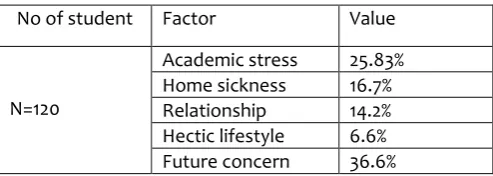
Table 4 shows the different stress level such as academic stress, home sickness, relationship, hectic life style and future concern among science students at undergraduate level. A total 120 students at different academic level were enrolled in the study.
In this case, highest percentage of students having stressed belonged to Future concern (36.6%). This was followed by Academic stress (25.83%), Home sickness (16.7%), Relationship (14.2%) then, Hectic lifestyle (6.6%) in respectively.
Discussion
Similar to our results, some previous studies showed higher levels of depression among female students [19, 20]. Some western studies have also shown female gender to be significantly correlated with anxiety, depression and psychological distress [21]. Both male and female students gave high ratings to Future concern and academic stress as the main stress inducing factors.
There were several limitations to the study. Our study only included only 120 students in the sample. Also, only the well-studied principal stressors were assessed. The students were not questioned about their coping strategies and possible measures like, student counsellors, to alleviate the situation. However, the study has been able to throw some light about the mental health and their stress inducing factors. Medical schools in the United States and Canada have started health promotion.programmes and have reported positive results in reducing the negative effects of stress upon medical student’s health and academic performance [22, 23]. Others methods suggested for reducing stress are use of small groups for teaching and support, provision of recreation and sports and more participation in social activities. Even, Leisure activities can reduce stress in medical schools [24]. Studies done in the US regarding the residents’ working hours and the stress and the work performance is quite significant and has helped change policies[25].
Conclusions
Implication of anxiety and depression are of serious concern that could result in loss of potential to handle various stressors encountered at college, impairment of functioning in classroom performance and later in service life. So, steps should be taken to reduce depression, anxiety and stress among undergraduate students. Adequate service should be provided to manage psychological problem by college authority. Further research should be carried out on large sample in different colleges which should include both public and private colleges.
Acknowledgments
Authors are thankful to Daffodil International University, Bangladesh for providing the necessary facility for this research work.
References
1. Dr.G.M.Nagaraja1, Dr. Mohan Reddy2, Mr. S Ravishankar3, Dr. Jagadisha4, Dr. Muninarayana (2015) Study the Prevalence of Depression among Nursing College Students of Kolar District. Volume 20, Issue 5, Ver. II (May. 2015), PP 135-139.
2. Rana Zaini*, Farah Anjum and Haytham Dahlawi (2017) Assessment of Depression among Applied Medical Science College Students at Taif University. J Psychiatry, an open access journal ISSN: 2378-5756.
3. Cuttilan AN, Sayampanathan AA, Ho RCM (2016) Mental health issues amongst medical students in Asia: a systematic review. Ann Transl Med 4: 72.
4. Saipanish R (2003) Stress among medical students in a Thai medical school. Med Teach 25: 502–506.
5. Carter AO, Elzubeir M, Abdulrazzaq YM, Revel AD, Townsend A (2003) Health and lifestyle needs assessment of medical students in the United Arab Emirates. Med Teach 25: 492–496
6. Inam SN, Saquib A, Alam E (2003) Prevalence of anxiety and depression among medical students of a private university. J Pak Med Assoc 53: 44–47. 7. Kulsoom B, Afsar NA (2015) Stress, Anxiety,
and Depression among medical students in a multi ethnic setting. Neuropsychiatric Dis Treat 11: 1713-1722.
8. Head LG, Lindsey JD. Anxiety and the university student: a brief review of the professional literature. Coll Stud J. 1983; 17(2):176-182.
9. Cuttilan AN, Sayampanathan AA, Ho RCM (2016) Mental health issues amongst medical students in Asia: a systematic review. Ann Transl Med 4: 72.
10. Saipanish R (2003) Stress among medical students in a Thai medical school. Med Teach 25: 502–506.
11. Capeding LJ. Counselling U. P. Manila freshman students: issues, concerns, expectations, outcomes and program. PGCA
12. Pabiton CP. Concerns, issues and coping strategies of international students in selected private universities in the Philippines. Philippines J Counseling Centres. 2004;6:22-31
13. Pabiton CP. Problems and coping strategies of university students: implication for counseling centres. Philippines J Couns Centres. 2007; 6:78-95.
14. Bouteyre E, Maurel M, Bernand J-L. Daily hassles and depressive symptoms among first year psychology students in France: the role of coping and social support. Stress Health. 2007;23:93-99.
15. Leary MR. Social anxiety, shyness and related constructs. In J. P. Robinson, P. R. Shaver, & L. S. Wrightsman (Eds.), Measures of personality and social psychological attitudes. (pp. 161-194). San Diego, CA: Academic Press, 1991.
16. Head LG, Lindsey JD. Anxiety and the university student: a brief review of the professional literature. Coll Stud J. 1983;17(2):176-182.
17. Kroenke K, Spitzer RL, Williams JB (2001) The PHQ-9: Validity of a brief depression severity measure. J Gen Intern Med 16: 606– 613.
18. Vaidya PM, Mulgaonkar KP. Prevalence of depression, anxiety and stress in undergraduate medical students and its correlation with their academic performance. Indian J occup ther 2007;39(1):7-10.
19. Khan MS, Mahmood S, Badshah A, Ali SU, Jamal Y (2006) Prevalence of depression, anxiety and their associated factors among medical students in Karachi, Pakistan. J Pak Med Assoc 56: 583-586.
20. Inam SB (2007) Anxiety and depression among students of a medical college in Saudi Arabia. Int J Health Sci 1: 295.
21. Steptoe A, Tsuda A, Tanaka Y, Wardle J (2007) Depressive symptoms, socioeconomic background, sense of control, and cultural factors in university students from 23 countries. Int J Behav Med 14: 97-107.
22. . Lee J, Graham A. Students’ perception of medical stress and their evaluation of a wellness elective. Med Ed 2001;35(7):658-9 23. Wolf TM, Randall HM, Faucett JM.A survey
of health promotion programs in U.S and Canadian Medical Schools. Am J Health Promot 1988; 3(1):33-6.
24. Shaikh B, Kahloon A, Kazmi M, Khalid H, Nawaz K,Khan N, et al. Students, stress and coping strategies: a case of Pakistani medical school. Educ Health 2004;17(3):346-53.
Table 1: show the numbers and percentage of depression among science students
No of student Normal
(0-4)%
Minimal Depression (5-9) %
Minor Depression (10-14) %
Major Depression (15-20) %
Total Depression %
120 43.3% 34.4% 19.9% 2.4% 56.7%
Table 2: Show the number and percentage of depression among male and female students
Gender Students Normal
(0-4)%
Minimal Depression (5-9) %
Minor Depression (10-14) %
Major Depression (15-20) %
Total Depression %
Male 75 45.3% 33.4% 18.7% 2.6% 54.7%
Female 45 39.9% 35.7% 22.2% 2.2% 60.1%
Table 3: Shows the percentage of different grades of depression in each department, according to PHQ-9 scores
Department Normal
(0-4)%
Minimal Depression (5-9) %
Minor Depression (10-14) %
Major Depression (15-20) %
Total Depression %
Pharmacy 40.1% 23.3% 30% 6.6% 59.9%
CSE 43.2% 46.7% 10% 0.1% 56.8%
Software Engineering 58.4% 26.7% 14.8% 0.1% 41.6%%
EEE 36.6% 40% 20% 3.3% 63.3%
Table 4: shows the different stress level
No of student Factor Value
N=120
Academic stress 25.83%
Home sickness 16.7%
Relationship 14.2%
Hectic lifestyle 6.6%
![1 [4 (4 Methylpyrimidin 2 yl)piperazin 1 ylmethyl] 1H benzotriazole](data:image/gif;base64,R0lGODlhAQABAIAAAP///wAAACH5BAEAAAAALAAAAAABAAEAAAICRAEAOw==)