111
Performance Analysis Of Interior Gateway
Routing Protocol (Eigrp) Over Open Shortest
Path First (Ospf) Protocol
Degadzor F. Asigbe, Adamu M. Mustapha, Collinson C. M. Agbesi, Botchey F. Ephraim , Anibrika S.K. Bright Prof. Somuah Clement
Abstract: Due to the increase in the easy accessibility of computers and mobile phones alike, routing has become indispensable in deciding how computes communicate especially modern computer communication networks. This paper presents performance analysis between EIGRP and OSPFP for real time applications using Optimized Network Engineering Tool (OPNET). In order to evaluate OSPF and EIGRP’s performance, three network models were designed where 1st, 2nd and 3rd network models are configured respectively with OSPF, EIGRP and a combination of EIGRP and OSPF. Evaluation of the proposed routing protocols was performed based on quantitative metrics such as Convergence Time, Jitter, End-to-End delay, Throughput and Packet Loss through the simulated network models. The evaluation results showed that EIGRP protocol provides a better performance than OSPF routing protocol for real time applications. By examining the results (convergence times in particular), the results of simulating the various scenarios identified the routing protocol with the best performance for a large, realistic and scalable network.
Keywords: Enhanced Interior Gateway Routing Protocol (EIGRP), (Open Shortest Path First Protocol (OSPF), Link State Algorithm (LSA), Opnet, Convergence Time, Jitter, End-to-End delay, Throughput
————————————————————
1.
INTRODUCTION
The advancement in data communication technology facilitates users have easy access to services that enable users to use computers and mobile phones. Some of these services include file sharing through Bluetooth, print sharing, video streaming and voice conferencing services. The internet has created interconnected computer networks called the virtual underpinned by routing protocols. Currently the internet is playing a vital role in the life of communication networks. Data communication networks are solely based on technologies that provide the technical infrastructure base, where routing protocols transmit packets across the Internet. These routing protocols specify how routers communicate with each other by broadcasting messages. Also these routers update their routing tables based on prior knowledge of the adjacent networks that normally helps them in selecting the best routes possible between nodes that available on the network. These routing protocol differ in various like convergence, throughput, jitter delay and rout establishment. Performance were based on two parameters: Convergence duration and Jitter were also measured. Estimation of the protocol performance could be done by using real time traffic such as video and voice conferencing. (OPNET) was used to analyze and measure the comparative performance of these routing protocols. Routing protocols specify how routers communicate with each other by disseminating information. The router has prior knowledge about the adjacent networks which can assist in selecting the routes between two nodes. There are different types of routing protocols in the IP networks and three classes are common on IP networks as follows:
1) Interior gateway routing over link state routing
protocols, such as IS-IS and OSPF.
2) Interior gateway routing over distance vector protocols,
such as RIP, IGRP and EIGRP.
3) Exterior gateway routing, such as BGP v4 routing
protocol.
The performance of each routing protocol is different from each other. Among all routing protocols, EIGRP and OSPF
routing protocols were chosen for doing performance evaluation in a simulation based network model for real time application such as video streaming and voice conferencing. Enhanced Interior Gateway Routing Protocol (EIGRP) is an interior gateway protocol, which is mainly based on DUAL (Diffusing Update Algorithm) to calculate the best route without creating routing table loops based on bandwidth and delay. On the other hand, OSPF is a robust link state interior gateway protocol, which is used to allot routing information within an autonomous system based on cost. This paper provides a simulation based study on EIGRP over OSPF routing protocols.
2.
CONCEPTUAL
FRAMEWORK
important ones are fast convergence, short end to end delay and the ability to recover from emergencies quickly. The motivation behind the thesis is to get better performance in the case of selecting routing protocols among EIGRP and OSPF on the same network configuration for real time applications, such as video streaming and voice conferencing. I tried to imploy ideas that may outperform the various limitations of routing protocols. In terms of performance measurement of routing protocols, convergence times is concerned and as a performance metrics for real time applications are delay variation, end to end delay, jitter and throughput. Simulation and validation are carried out by using OPNET.A routing protocol is considered to be operated at layer three of the Open System Interconnection model. There are several types of routing protocols being widely used in the network. EIGRP is a Cisco proprietary distance-vector protocol based on Diffusing Update Algorithm (DUAL). EIGRP only supports Cisco products. However, the convergence time of EIGRP is faster than other protocols and easy to configure. In contrast, OSPF is a link-state interior gateway protocol based on Dijkstra algorithm (Shortest Path First Algorithm). OSPF routing protocol has difficulty to configure network and high memory requirements. The main objective is to simulate Open Shortest Path First protocol using OPNET (Optimised Network Engineering Tool), the analyzed results obtained using OPNET is interpreted in order to determine a suitable protocol for a scalable network.
“In this paper, two major quantitative metrics were employed for the analysis and they are:
CONVERGENCE TIME AND JITTER”
2.1 Theoretical Background Of OSPF
Open Shortest Path First is a routing protocol that was developed by Interior Gateway Protocol (IGP) working group of the Internet Engineering Task Force for Internet Protocol (IP) networks. OSPF is a link state routing protocol that is used to distribute information within a single Autonomous System. In 1989, first version of OSPF (Open Shortest Path First) was defined as OSPFv1 was published in RFC (Request For Comments) 1131. The second version of OSPFv2 (Open Shortest Path First version 2) was introduced in 1998 which was defined in RFC 2328. In 1999, the third version of OSPFv3 (Open Shortest Path First version 3) for IPv6 (Internet Protocol version 6) was released in RFC (Request For Comments) 2740 (Lammle et al, 2005).
2.2 OSPF Message Encapsulation
OSPF message is encapsulated in a packet. Figure 3. 0 and Table 3.1 lists the encapsulated OSPF message:
Figure 2.1: OSPF Message encapsulation. (Cisco Press “OSPF Message Encapsulation”, 1999)
Bandwith Example Hello Interval Hold Interval Default Link Default Value Value
1.544Mbps Multipoint 60Sce 180Secs Or Frame
Slower Rellay
1.544Mbps T1 ,Ethernet 5secs 15Secs
Table 2.7: EIGRP interval time for Hello and Hold (Shamim and Liu, 2002)
Table 3.1: Encapsulated OSPF Message (malhotra et al , 2002)
2.4 OSPF Packet Header
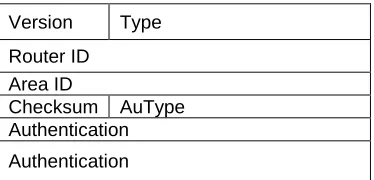
OSPF packets composed of nine fields. As demonstrated in table 3.2.
Table 2. Packet Format ( Javvin et al ,2002) Data Link
Frame Header
I P Packet Header
OSPF
Pac ket
Header
OSPF packet Type
1.
Mac Source Address2.
Mac Destination Address1.IP Sourc e Addres s 2.IP Destination Address
Type Code
1.Router ID
2.Area ID 1 .Hello
2.DBD 3.LSR 4.LSU
5. L
SAck
Version Type
Router ID Area ID
Checksum AuType Authentication
113 2.5 Theoretical And Technical Background Of EIGRP
Enhanced Interior Gateway Routing Protocol
Enhanced Interior Gateway Routing Protocol (EIGRP) is a CISCO proprietary protocol, which is an improved version of the interior gateway routing protocol (IGRP). EIGRP is being considered as the more scalable protocol in both medium and large scale networks. EIGRP is said to be an extensively used IGRP where route computation is done through Diffusion Update Algorithm (DUAL). However, EIGRP can also be considered as hybrid protocol because of having link state protocol properties (Lammle et al, 2005).
2.6 Protocol Structure of EIRGP
Table3. Protocol structure of EIGRP (Lammle et al, 2005)
EIGRP Convergence
It was assumed in figure 2.2 below that the link from R3 and R5 goes down and at the same time R3 identifies the failure of the link. There is no FS (Feasible Successor) present in the topology database and hence the role of R3 is to be entered into the active convergence. R4 and R2, on the other hand, are the only neighbors to R3. Given that, there is no availability of route with lower FD (Feasible Distance), R3 sends a message to both R4 and R2 for gaining a logical successor. R2, for acknowledgement, replies to R3 and indicates that there is no availability of a successor. On the other hand, R3 gets positive acknowledgement from R4 and the FS (Feasible Successor) with higher FD becomes available to R3. The distance and new path is allowed by R3 and then added to the routing table. R2 and R4 are sent an update about the higher metric. In the network, all the routes converge when the updates reached the various nodes (Comer et al., 2006).
Figure 2.2: Network topology of EIGRP (Lemma ,Hussain and Anjelo, 2010).
3.
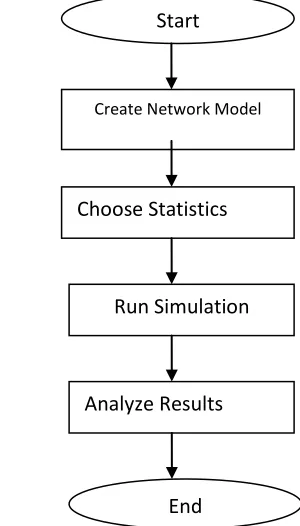
METHODOLOGY Simulation in OPNETDuring the implementation of a real model of the system in OPNET, an algorithm was used for the implementation of the design on the simulator. Figure 3.1 shows a flow chart of the steps
.
Figure 3.1: Designing Steps
3.1 Introduction
Simulation can be defined to show the eventual real behavior of the selected system model. It is used for performance optimization on the basis of creating a model of the system in order to gain insight into their functioning. We can predict the estimation and assumption of the real system by using simulation results.
3.2 OPNET Simulator
In this thesis, network simulator, Optimized Network Engineering Tools (OPNET) modeler 14.0 has been used as a simulation environment. OPNET is a simulator built on top of Discrete Event System (DES) and it simulates the system behavior by modeling each event in the system and processes it through user defined processes. OPNET is very powerful software to simulate heterogeneous network with various protocols.
3.3 Simulation Study
The protocols used in this thesis are OSPF and EIGRP routing protocol. The proposed routing protocols are compared and evaluated based on some quantitative metrics such as convergence duration, packet delay variation, end to end delay, jitter and throughput. These protocols are intended to be used to get better performance of one over the other for real time traffic such as video streaming and voice conferencing in the entire network.
Version Opcode Checksum
Flags
Sequence Number
Acknowledge Number
Autonomous System Number
Type Lenght Length
Start
Create Network Model
Choose Statistics
Run Simulation
Analyze Results
End
Network Topology under simulation
Figure3: Network Topology for simulation
In this thesis, three scenarios EIGRP, OSPF and
EIGRP_OSPF were created that consists of six
interconnected subnets where routers within each subnet are configured by using EIGRP and OSPF routing protocols. The network topology composed of the following network devices and configuration utilities:
CS_7200 Cisco Routers
Ethernet Server
Switch
PPP_DS3 Duplex Link
PPP_DS1 Duplex Link
Ethernet 10 BaseT Duplex Link
Ethernet Workstation
Six Subnets
Application Configuration
Profile Configuration
Failure Recovery Configuration
QoS (Quality of Service) Attribute Configuration
An Application Definition Object and a Profile Definition Object named correspondingly Application Config and Profile Config in the figure 3.6 are added from the object palette into the workspace. The Application Config allows generating different types of application traffic. As far as real time applications are concerned in this thesis, the Application Definition Object is set to support Video Streaming (Light) and Voice Conferencing. A Profile Definition Object defines the profiles within the defined application traffic of the Application Definition Objects. In the Profile Config, two profiles are created. One of the Profiles has the application support of Video Streaming (Light) and another one has Voice Conferencing support. Failure link has been configured in the scenarios. Failure events introduce disturbances in the routing topology, leading to additional intervals of convergence activity. The link connected between Sub-E Router 1 and Sub-D Router 1 is set to fail at 300 seconds and recovered after 500 seconds. One Video Server is connected to Sub-C Router 1 that is set to the Video Streaming under the supported services of the Video Server. Quality of Service (QoS) plays an important role to achieve the guaranteed data rate and latency over the network. In order to implement QoS
(Quality of Service), Internet Protocol QoS Object called QoS Parameters in the figure 3. 6 is taken into the workspace where it has been used to enable and deploy
Weighted Fair Queuing (WFQ). WFQ is a scheduling
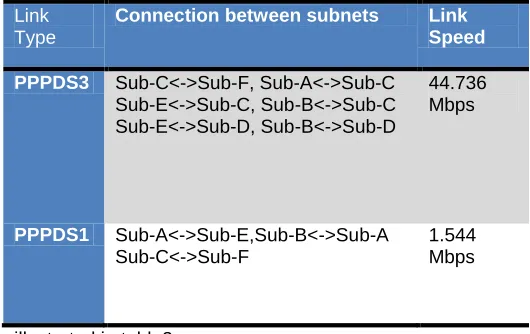
technique that allows different scheduling priorities on the basis of Type of Service (ToS) and Differentiated Service Code Point (DSCP).The routers are connected using PPP_DS3 duplex link with each other. The switches are connected to routers using same duplex link. Ethernet workstations are connected to switch using 10 Base T duplex links and also links speeds of 44.76Mbps for the first set of subnet connection with link type of PPP_DS3 and 1.544 Mbps for the second set of subnet connection with a link type of PPP_DS1 deployment to ensure standard data transmission across the links. The same number of bits were sent simulated for the various scenarios (EIGRP, OSPF, EIGRP_OSPF).
3.4 Simulation Results
In this section, a comparative analysis of EIGRP over OSPF is presented. There are three network models, which are configured and run as 1st scenario with OSPF alone, 2nd one with EIGRP alone and 3rd one with both EIGRP and OSPF concurrently. One failure link between Sub-E and Sub-D has been configured to occur at 300 seconds and to recover at 500 seconds. The links that have been used in these scenarios are
illustrated in table3.
Table 4: Link connection
Convergence Duration simulation for EIGRP scenario
Table 5: Convergence Duration
Link Type
Connection between subnets Link
Speed
PPPDS3 Sub-C<->Sub-F, Sub-A<->Sub-C
Sub-E<->Sub-C, Sub-B<->Sub-C Sub-E<->Sub-D, Sub-B<->Sub-D
44.736 Mbps
PPPDS1 Sub-A<->Sub-E,Sub-B<->Sub-A
Sub-C<->Sub-F
1.544 Mbps
No. of bits sent
Scenario Name
Routing Protocol
Convergence Time(sec)
5 EIGRP EIGRP 1.6597
10 EIGRP EIGRP 1.6666
15 EIGRP EIGRP 1.6667
20 EIGRP EIGRP 1.6668
Sub-A
Sub-A Sub-A
115 3.5 Convergence time simulation graph for EIGRP
protocol
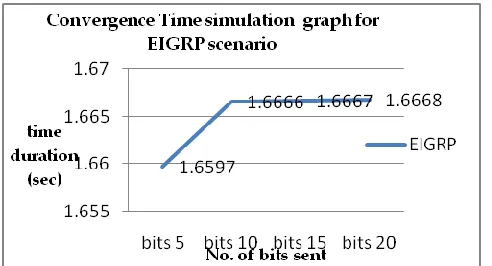
From the figure 4, it can be seen that the convergence time for bits 5 is faster than bits 10, bits 15 and bits 20 respectively. Because when changes occur through the network, it detects the change in the routing path source to the destination and sends query to the immediate neighbours to have a successor and propagated this update to all routers. In all, the convergence time for all the number of bits sent is relatively faster and so EIGRP convergence time is fast. Convergence time is a measure of how fast a group of routers reach the state of convergence and whereby routers acquire the same routing path update about the network in which they are and this also reduces extensive use of Central Processing Unit (CPU) time.
Convergence time simulation graph for EIGRP
Figure4: Convergence time simulation graph for EIGRP protocol
3.6 Convergence time simulation graph for OSPF From the above figure 5, it can be seen that the convergence time for bits 5 is lower than, bits 10, bits 15 and bits 20 respectively. Because when changes occurs through the network, it detects the topology change and sends query to the immediate neighbours to have a successor and propagated this update to all routers. As the change occurred in the OSPF network, all routers within an area updated the topology database by flooding LSA (Link State Advertisement) to the neighbours and routing table is recalculated. As a consequence, network convergence time of OSPF is getting slower than EIGRP. Convergence time is a measure of how fast a group of routers reach the state of convergence and how routers acquire the same topological information about the network in which they are.
Figure5: Convergence time simulation graph for OSPF (above)
Table 6: Convergence time simulation for EIGRP_OSPF scenario
3.7 Convergence time simulation graph for EIGRP_OSPF
From the figure 6 , it can be seen that the convergence time for bits 5 is faster than bits 10, bits 15 and bits 20, while bits 10 and 15 have slightly different time interval respectively. Because when changes occur through the network, it detects the topology change and sends query to the immediate neighbours to have a successor and propagated this update to all routers. The overall effect is that, the convergence time for all the number of bits sent is relatively faster for OSPF and so EIGRP_OSPF convergence time is slower than OSPF but faster than EIGRP and makes it
No. of bits sent
Scenario Name
Routing Protocol
Convergence (sec)
5 OSPF OSPF 7.585
10 OSPF OSPF 7.588
15 OSPF OSPF 7.590
20 OSPF OSPF 7.593
Table 5: Convergence time simulation for OSPF
No. of
bits sent
Scenario Name
Routing Protocol
Jitter (sec)
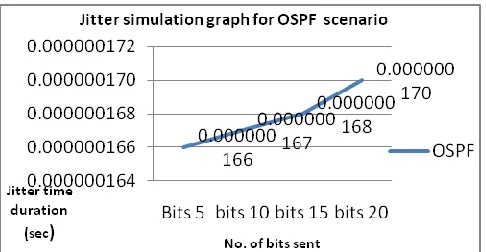
5 OSPF OSPF 0.000000166
10 OSPF OSPF 0.000000167
15 OSPF OSPF 0.000000168
20 OSPF OSPF 0.000000170
No. of
bits sent
Scenario Name
Routing Protocol
Convergence Time
(sec)
5 EIGRP_OSPF EIGRP and
OSPF
1.6597
10 EIGRP_OSPF EIGRP and
OSPF
1.6666
15 EIGRP_OSPF EIGRP and
OSPF
1.6668
20 EIGRP_OSPF EIGRP and
OSPF
suitable for scalable networks.
`
Figure 6: Convergence time simulation graph for EIGRP_OSPF protocol.
Table 3.6 Jitter simulation for OSPF (below)
3.8 Jitter simulation graph
Jitter is the variation in the time between packets arriving, caused by network congestion, timing drift or route changes. A jitter buffer can be used to handle jitter. From the figure 7, below it can be seen that, jitter values increased when bits 5, bits 10 are simulated through network but increased significantly when bits 10 were sent. This shows that network congestion caused by noise has a significant impact on the network and this also leads to attenuation in packet transmission. Possible causes of Jitter could also linked to differences in transmission media, differences in hardware and software configuration on routers and nodes. The smaller the Jitter values, the more
efficient
packets arriving at the destination intact without any inference resulting from network congestion.
Figure 7: Jitter simulation graph for OSPF
Table 3.6 Jitter for EIGRP simulation(below)
Figure8: Jitter simulation graph
Figure 8 illustrates that packet delay variation is decreasing faster while packets are being transmitted from source to destination. Interactive voice (PCM Quality) is considered to interact with each node in the OSPF network. As shown in
figure 8, it can be seen that at the beginning, bits 20 sent in the OSPF network has slightly higher jitter values and this is caused by different data transmission rates, differences in router
configuration and nodes from source to destination, poor cabling as well as faulty routers and nodes. Below is figure 8.
Table 3.7 Jitter simulation for EIGRP_OSPF protocol
Figure 9 bellow illustrates that packet delay variation is decreasing faster while packets are being transmitted from source to destination. Interactive voice (PCM Quality) is considered to interact with each node in the OSPF network. As shown in figure 4.9, it can be seen that at the beginning, bits 20 sent in the OSPF network has slightly higher jitter values and this is caused by different data transmission rates, differences in router configuration and nodes from source to destination , poor cabling as well as faulty routers and nodes. Below is figure 9.
No. of bits sent
Scenario Name
Routing Protocol
Jitter (sec)
5 EIGRP EIGRP 0.000000165
10 EIGRP EIGRP 0.000000167
15 EIGRP EIGRP 0.000000169
20 EIGRP EIGRP 0.000000173
No. of
bits sent
Scenario Name
Routing Protocol
Jitter (sec)
5 EIGRP_OSPF EIGRP and
OSPF
0.000000165
10 EIGRP_OSPF EIGRP and
OSPF
0.000000167
15 EIGRP_OSPF EIGRP and
OSPF
0.000000168
20 EIGRP_OSPF EIGRP and
OSPF
117 Figure9: Jitter simulation graph
4.
CONCLUSION
AND
DISCUSSION
In this paper, I have presented a comparative analysis of selected routing protocols such as EIGRP, OSPF and the combination of EIGRP and OSPF. Network scalability can be enhanced by reducing network convergence time of the routing protocol. In this thesis work, implementation of EIGRP shows that network convergence time is much faster than EIGRP_OSPF and OSPF networks because EIGRP network learns the topology information and updates faster than EIGRP_OSPF and OSPF. The simulation result has shown that end to end delay of EIGRP_OSPF network is relatively less than EIGRP and OSPF networks. The performance of packet delay variation for EIGRP_OSPF is better than OSPF and EIGRP. Also the packet delay variation of EIGRP and OSPF networks is high while EIGRP_OSPF network is low. In the context of packet loss, it was found that packet loss in the EIGRP_OSPF network is less than OSPF and EIGRP networks.In this thesis work, the comparative performance among EIGRP, OSPF and combination of EIGRP and OSPF routing protocols for real time application has been analyzed. By comparing these protocols’ performances, it is observed that the combined implementation of EIGRP and OSPF routing protocols in the network performs better than OSPF and EIGRP. In the case of individual routing protocol performance, overall performance of EIGRP is better than OSPF. In future, a research work can be done on the explicit features of both OSPFv3 and EIGRP protocols in the IPv4/IPv6 environment. Security analysis for both OSPF and EIGRP can be done.
REFERENCES
[1] Christian Huitema, “Routing in the in ernet” 2. Ed.
Prentice Hall PTR, cop. 2000.
[2] Cisco “OSPF Design Guide”
http://www.cisco.com/en/US/tech/tk365/technologies_w hite_paper09186a0080094e9e.shtml,2001.
[3] Cisco, "Internet Technology Handbook"http://www
.cisco.com/en/U S/docs/internetworking/technology/
handbook/Enhanced_l GRP. html, .
[4] Cisco, “IP Routing, Introduction to EIGRP” Document l
D: 13669.http://www .cisco.com/en/U S/tec
h/tk365/technologies_tec h_note091 86a0080093f07.s
html# hw.
[5] Douglas E. Comer, “Internetworking with TCP/IP,
Principles, Protocols and Architecture” 5th ed. Vol.1,
Pearson Prentice Hall, 2006.
[6] David Billings, ”A collection of materials for the study of
intranet and internet networking” GTCC.
http://www.gtcc-it.net/bill i ngs/eigrp.html.
[7] Esuendale Lemma; Syed Hussain;
WendwossenAnjelo; “Performance Comparison of
EIGRP/ IS-IS and OSPF/ IS-IS”
BlekingeTekniskaHogskolan.Sweden, 2010.
http://www.essays.se/essay/cc996c98ff/.
[8] FarazShamim, Zaheer Aziz, Johnson Liu, Abe Martey,
“Troubleshooting IP Routing Protocols” Cisco Press,
Pages: 912, May 07, 2002.
[9] Ravi Mal hotra, “IP Routing" 0-596-00275-0” January
2002. http://oreilly.com/catalog/iprouting/c hapter/c
h04.ht ml#45434.
[10]Shen Yang (Inst. of Command Autom, PLA Univ. of
Sci. & Tech., Nanjing, China); Dai Hao; Qi Qang-dong “Performance comparisons between OSPF and EIGRP
in tactical IP networks” Source: Journal of PLA
University of Science and Technology (Natural Science Edition), v 6, n 3, p2 41-5, June 2000.
[11]“Simulations and Tools for Telecommunications”
http://www.telecomlab.oulu.fi/kurssit/521365Atietoliiken netekni ikansimuloinnitjatyokalut/OPNETesittely07.pdf.
[12]Talal Mohamed Jaffar, “Simulation-Based Routing
Protocols Analysis (Thesis)” Ph.D., Dept. Elect. Eng., Georgia Institute of Technology, 2007.
[13]Tony Larsson and NicklasHedman, “Routing Protocols
in Wireless Ad-hoc Networks-A simulation Study (Master’s thesis)” Dept. Com. & Eng., Luleå Univ., Stockholm, 1998.
[14]Todd Lammle, “Cisco Certified Network Associate” 5th