IJSRR, 8(1) Jan. – March., 2019 Page 166
Research article
Available online www.ijsrr.org
ISSN: 2279–0543
International Journal of Scientific Research and Reviews
Firefly Algorithm with Improved Sorting Mechanism of Blocks in
Fractal Image Compression
S.keerthika
11
Department of Information Technology, KG College of Arts and Science, Coimbatore, Tamil Nadu 641035, India Email: [email protected]
ABSTRACT
The researchers are extremely developed in doing lots of work in the part of image compression. The cause of image compression is to reduce in significance and redundancy of the image data in order to be able to store or transmit data in a capable form. Image compression is reducing the quantity in bytes of a file without modifying the feature of the image to an undesirable level. Study advances in Firefly algorithm which focuses on computationally efficient and effective algorithm. It is a lossy compression method with asymmetric method in which it takes additional time in compression of an image than decompression. In this paper new technique is implemented to increase the speed of fractal image compression. The method using quick search strategies using proposed Firefly with sorting mechanism of blocks for fractal image compression is implemented. The purpose of the work is to overcome the drawback of fractal image compression which is the improved encoding time, the various speed up terms like compression ratio (CR), peak signal to noise ratio (PSNR), and encoding time. The test outcome on color and RGB images indicates a definite decrease in computational time and also achieving a faster encoding process. The investigational work done in this effort proves that the proposed improved algorithm gives approximating solutions to all types of problems.
KEYWORDS:
Encoding, Firefly, Fractal image compression, Compression ratio, PSNR.*
Corresponding author
Ms. S. Keerthika,
Assistant professor,
Department of Information Technology,
KG College of Arts and Science, Cbe,
IJSRR, 8(1) Jan. – March., 2019 Page 167
information controlled in the original image. If all pixel value represents a preferred and imperative
part of information, it would be composite to compress an image. The data compressing a digital
image or series of images are commonly redundant and irrelevant.1 Redundancy relates to the
geometric properties of images, while irrelevancy relates to an image.
Digital images are very large in size and hence engage larger storage space. Due to their
larger size, they take better bandwidth and more time for upload or download throughout the
Internet. This makes it complex for storage as well as file sharing. To challenge with this problem,
the images are compressed in size with special techniques. This compression not only helps in
reduction storage space but also enables easy sharing of files. Image compression applications lessen
the size of an image file without causing major degradation to the quality of the image.
Redundancy can be divided into three types-Spatial redundancy is appropriate to the correlation
between adjacent pixels in an image. Spectral redundancy is due to the correlation between planes or
spectral bands. Temporal redundancy is due to the correlation linking neighboring frames in a
sequence of images1 2.
II.
FRACTAL IMAGE COMPRESSION
Fractal image compression is a lossy compression process for images in digital form, based
on fractals. The development is best corresponding for textures and natural images, relying on the
information that parts of an image often be associated to other parts of the similar image. Fractal
algorithms change these parts into arithmetic data called "fractal codes" which are used to restructure
the encoded image.3
The word fractal was first used by Benoit B. Manderlbrot to allocate objects that are
self-similar at different scales as shown in Figure1 Fractals. Such objects have in order at every scale.
Unfortunately, a good definition of the term fractal is indefinable. It is the maximum to examine a
fractal as a set that has a property such as those listed below, rather than to look for an correct
IJSRR, 8(1) Jan. – March., 2019 Page 168
Figure1. Fractals
If we consider a set F to be fractal, it will have a quantity of the following properties: F has
aspect at every scale. F is (exactly, roughly, or statistically) self-similar. The 'fractal dimension' of F
is better than its topological dimension. There is a simple algorithmic clarification of F. The most
significant advantages of fractal image compression are: High reconstruction quality at low coding
rates, fast decoding, Resolution independence i.e.; an encoded image may be decoded at a higher
resolution than the original.
III.
FIREFLY ALGORITHM WITH SORTING MECHANISM OF BLOCKS
The firefly algorithm (FA) is a met heuristic algorithm, inspired by the alternating behaviour of
fireflies. The main idea for a firefly's flash is to act as a signal classification to attract other fireflies.
All fireflies are unisexual, so that one firefly will be concerned to all other fireflies, Attractiveness is
comparative to their brightness, and for any two fireflies, the less clear one will be attracted by the
brighter one; however, the clarity can decrease as their distance increases. If there are no fireflies
brighter than a given firefly, it will move accidentally. The brightness should be connected with the
objective function. Firefly algorithm is a nature-inspired meta-heuristic optimization algorithm.
Figure2. Flow chart for firefly algorithm with sorting mechanism of blocks
IV.
PERFORMANCE METRICS
Compression ratio
Data compression ratio is defined as the ratio fixed involving the uncompressed size and
compressed size. The data compression ratio can serve as a compute of the complexity of a records
IJSRR, 8(1) Jan. – March., 2019 Page 169
The Mean Square Error (MSE) and the Peak Signal to Noise Ratio (PSNR) are the two error
metrics used to compare image compression quality. The MSE represents the rising squared error
between the compressed and the exclusive image, whereas PSNR represents a measure of the peak
error. Lower the value of MSE, the lesser the error.8
V.
RESULTS AND DISCUSSION
In this section, the encoding time, PSNR value, Compression ratio in terms for the existing and
planned situation by using MATLAB R2013a is calculated. The results are described that the
planned scenario yields superior result for programming of images. The investigational results
executed in MATLAB R2013a on Intel (R) Core (TM) 2Duo CPU @ 2.00 GHZ with 3.00 GB RAM
along with 32 bit Windows 10 Pro Operating System. The experiment images used in the
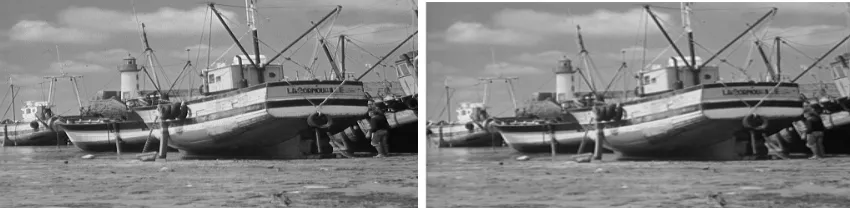
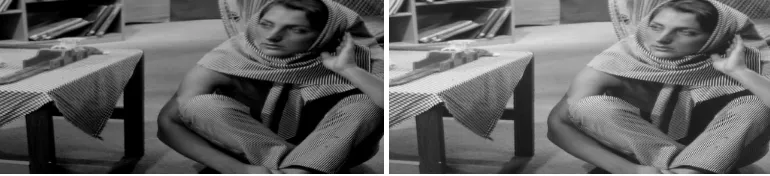
experiments is Boat image, Barbara image and Mandrill Image. 11
Figure 3. Boat imageFigure 4. Outcome of Boat Image
IJSRR, 8(1) Jan. – March., 2019 Page 170
Figure 5. Barbara image Figure 6. Outcome of Barbara Image
Graph 2. Performance of Barbara Image
Figure 7.Mandrill Image Figure 8. Outcome of Mandrill Image
Graph 3. Performance of Mandrill Image
VI.
CONCLUSION
Fractal image compression is an asymmetric lossy compression method which includes
combination of computations in it. The proposed Firefly algorithm with sorting mechanism
algorithm on images indicates a definite drop in computational time and also achieving a faster
encoding process. The investigational work done in this work proves that the proposed better
IJSRR, 8(1) Jan. – March., 2019 Page 171
2. Chong Fu, Zhi-liang Zhu, A DCT-based Fractal Image Compression Method, International
Workshop on Chaos-Fractals Theories and Applications, 2015 .
3. Preedhi Garg, Richa Gupta and Rajesh K. Tyagi, Adaptive Fractal Image Compression Based
on Adaptive Thresholding in DCT Domain, Information Systems Design and Intelligent
Applications, Advances in Intelligent Systems and Computing 433, Springer India 2016.
4. Edward R. Dougherty (Editor), Digital Image Processing Methods, Marcel Dekker, Inc., New
York, 1994.
5. Anil K. Jain, Fundamentals of Digital Image Processing, PHI, New Delhi, 1995
6. Yuval Fisher (Ed.), Fractal image Compression Theory and Applications, Springer-Verlag,
New york, 1995.
7. M.F. Barnsley, Fractals Every Where , Academic Press, San Diego, California, 1988.
8. Mohammed Omari, Nasreddine Karour, and Souleymane Ouled Jaafri, Fractal Image
Compression based on Polynomial Interpolation , IEEE 2016.
9. Utpal Nandi, Jyotsna Kumar Mandal, Sahadeb Santra, Suman Nandi, Fractal Image
Compression with Quadtree Partitioning and a new Fast Classification Strategy, IEEE 2016.
10. A.E. Jacquin, Image Coding Based On A Fractal Theory of Iterated Contractive Image
Transformations, IEEE Transactions on Image Processing, 1992; IP- 1(1):18- 30.
11. Lester Thomas and Farzin Deravi, "Region Based Fractal Image Compression using Heuristic
Search", IEEE Transactions on Image Processing, 1995;4(6): 832-838.
12. Yang, X. S. Nature-Inspired Metaheuristic Algorithms. Luniver Press, 2005; ISBN