IJSRR, 8(2) April. – June., 2019 Page 4851
Research article Available online www.ijsrr.org
ISSN: 2279–0543
International Journal of Scientific Research and Reviews
Offline Messaging Application using LAN
Verma Yashasviny
1and Jagtap Pankaj
2*1
M.Tech (NM & IS), Devi Ahilya Vishwavidyalaya Takshashila Campus, Khandwa Road, Indore, Madhya Pradesh 452001
2
*Assistant Professor, Devi Ahilya Vishwavidyalaya Takshashila Campus, Khandwa Road, Indore, Madhya Pradesh 452001
Email: [email protected], [email protected]
ABSTRACT
This paper aims to build an offline messaging network site which is implemented for a local area network. The objective of the system is to focus on data. In the initials of technology, only important data transfer took place. But, with the evolution of the technology, the process of exchanging data increased which also contains waste and non-useful data and consumes time which ultimately over-utilizing resources. Hence our system can be a way to save resources from overutilization. This system can be an effective way for communication where better performance, low overhead, and security is needed. To achieve these aspects, the system is connected through the RJ45 connector instead of using internet connection. RJ45 (Ethernet) transfer data with the speed of 1000 Mbps which provides reliable and faster data transfer through which high performance can be achieved. This system will not be depended upon any another middleware which will reduce the overhead of the systems as no communication process through middleware can be done. Also, the system contains a time slot duration and text limit. In the system, the participants i.e., the client and server are connected through wire. Due to this physical connection, accessing each other devices will also become physical. Hence, the security of the systems can be maintained. For creating a client-server environment sockets are used. The system also has features of message transmission modes: Uncast, Broadcast, and Multicast which seems similar to a social networking application.
KEYWORDS:
Local Area Network, Client-Server, Sockets, TCP, Message Transmission mode.*
Corresponding author
Mr. Pankaj Jagtap,
Devi Ahilya Vishwavidyalaya Takshashila Campus,
Khandwa Road, Indore, Madhya Pradesh 452001
Email: [email protected]
IJSRR, 8(2) April. – June., 2019 Page 4852
INTRODUCTION
Technology is evolving with very fast speed which causes increasing the data. To store or
process this bulk data is also becoming complex day by day. If there will be a way for not depending
on these complexities for general purpose communication for an enterprise or a small area which
may need security also, will be a good option. Our objectives are to focus on these types of issues.
A large number of separate but interconnected computer systems are called computer
networks1. LAN's are usually confined to a limited geographic area such as a building or a campus2.
LAN's can be small, sharing two systems or can link a hundred computers over a limited range.
Ethernet is a protocol that controls the data which is transmitted over a Local Area Network.
Wi-Fi replaces many features of Ethernet cables as the need for enhancement in data
transmission rate over a wide range. But still, the use of LAN cable will not vanish because of some
of its basic and important feature like speed (100 Mbps to 1000 Mbps), fast and stable reliability and
most important security without any kind of external technique.
Hence, it will be a way better to use Ethernet cable at a small distance so that overhead of
connection can be reduced. Also, Socket Programming3 is now playing a transparent and major role
in a client-server environment3As it provides two-way communication facilities.
So, we are going to build an official messaging application in a LAN with the help of the
above-mentioned techniques so that we can take advantage of their importance.
LITERATURE REVIEW
Our proposed system will work on a client-server system. In distributed computing, basically,
the client sends the request to the server. The server will process and respond according to the client.
A server can only serve to the clients. There is no way for a server to communicate with the client.
The server will always respond to the client whenever the client sends for a request. If there
will be a situation when a server will have to communicate with the client, it will be a difficult
IJSRR, 8(2) April. – June., 2019 Page 4853
Sockets facilitate us with the advantage where client-server can communicate independently. The
client can send a request to the server and vice versa. So, a single system can play the role of both
clients as well as the server.
In 3, Maata, cordova, sudramurthy and halibas, discussed the details of developing a
client-server based application using socket programming in a distributed computing environment. They
build an application called OpTel billing System based on socket programming through which they
can conclude that socket programming is one of the best methods which can improve system
performance.
In 4, Shin, yoon, song, kim and Han, they propose a method for multi-Hop Communication in
segmented robots. To operate the robot, they build a method to construct a GUI by using ROS
(Robot Operating System). This segmented robot capable of multi-hop communication can be used
at disaster site where maintaining a constant communication is a challenge.
In 5, Jitbanyud and Toadithep develop the system of powerful computer laboratory class via
socket programming. They try to enhance the learning of computer laboratory in three aspects:
Controlling, teaching and evaluating on computer network technology with client/server using
TCP/IP protocol. This system contains two-way communication and can immediately access the
internet.
In 6, Ming Xue and Changjun Zhuintroduce the application of the client/server through which
we can understand the concept and the programming principle of socket based on client-server in an
explanatory manner. They also explain how communication can take place through sockets and
about TCP and UDP protocols.
In 7, Zhu, Wu, and Li propose a new model for client assignment problem on the basis of
server loads and design algorithms based on semi definite programming (SDP).
MATERIALS AND METHOD:
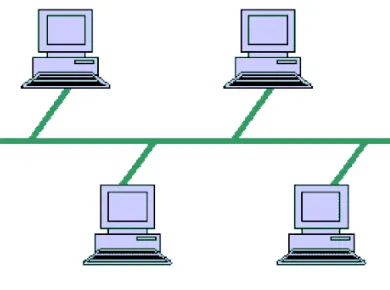
The basic requirements of the system consist of a minimum of two PC's or laptops connected
through RJ45 cable. The front-end of the application builds through java, java swing and socket
IJSRR, 8(2) April. – June., 2019 Page 4854 Figure 1. System Setup
SYSTEM MODULES:
1. Register: If the user is new, it has to register to get access to the application. This data entered by the user is stored in the Database.
2. System Log-In: The user has to log-in in the application with the registered credentials. 3. Profile: After Logged-In, the user can see its profile, where details of the user provided at the
registration time can be seen.
4. Colleague: On this page, the list of another user's will display. It contains three important links:
i. View: Where the details of other users can be displayed and personal or unicast message transmission can take place. When a user is selected and view button is clicked, it
displays the details of another user. It also contains a button named send a message
through which the client user sends a message to a server.
ii. Send a message to many: when a user has to send a message to many multiple users, he can select those users and send a message through this link.
iii. Send to all: When the user has to send message to all the users, it can be linked through this link.
5. Log-out: When a user wants to come out through all the process, it can click the log-out button which is located on a profile page. It redirects the user to a log-in page.
INTERNAL WORKING:
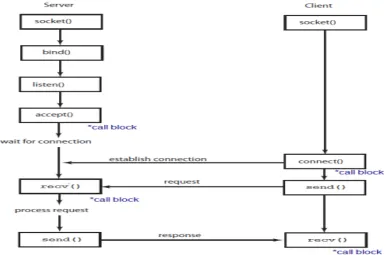
Each system can appear as a client & server. To be the client, the user needs to run the client
program of the application and to be the server; it needs to run the server program to connect and
accepts the client request. Both the programs have a socket in it. A socket is binding the IP address
with port no. An IP address is a 32-bit address and port allows a client to get access to a system or a
server via specific locations, opens for a specific service. It can be any numbers greater than 1024, as
IJSRR, 8(2) April. – June., 2019 Page 4855
In other social networking applications, which are mostly being used nowadays, the systems
can not directly communicate with each other. Each system is connected through a gateway (cloud)
which stores the data provided by the user in user-box format. Then, the gateway of another system
interacts with a database to provide the service. The copy of the actual data is sent to all other users.
To use this method we have to use external protocol for communication but it may possible that
systems have different language platform, so there occurs the cost of compatibility and maintaining a
TCP connection needs some memory which is also expensive. To reduce this problem, TCP
connection should be dumb and session micro service of the data should be maintained.
In the proposed system, no such gateways are used. The person who needs to communicate
can directly link with another system and can interact with the help of NIC. The server will accept
the connection, data gets exchanged and the connection closed. The Sockets are used in the system
for communication. The difference between HTTP and sockets is HTTP is a client to server protocol.
That means the client can only request and the server can only respond. Sockets provide the facility
for two-way communication over TCP and UDP.
Figure 2. Communication of client-server through sockets.
DISCUSSION:
The above processes help to build an offline messaging application using a LAN with better
performance, low overhead, and security implementation. All the processes used in this paper helps
us to build the application in a simplified way.
IJSRR, 8(2) April. – June., 2019 Page 4856
This paper presents the details of official messaging network application using a LAN. The
structure of the application is simple to use and can easily be used for a small enterprise. The
application purposefully made for any kind of text message transmission mode;hence it is a message
based application. It serves better performance because of low overhead with maintaining security of
the enterprise. Also, it contains message limit and session factors which make the communication
official. No use of the internet in the application reduces the overhead and use of sockets give
advantage of making an effective client-server environment. Some function can also be added in the
application which enhances its use in future.
REFERENCES:
1. Tanenbaum. Computer Networks. Fifth Edition. Pearson Publications: USA; 2011;
2. Ullah Zobair. Use of Ethernet technology in computer network. Global Journal of Computer
Science and Technology Network, Web and Security, Volume 12 issue 14 Version 1.0;2012.
3. Maata Rolou Lyn R., Cordova Ronald, Sudramurthy Balaji, Halibas Alrence. Design and
Implementation of client-server Based Application using socket programming in a
distributed computing environment. IEEE, 2017; 3: 978-1-5090-6621-6/17.
4. Shin Seona, Yoon Dongkuk, Song Hyunjong, Kim Baekseok, Han Jeakweon.
Communication System of a Segmented Rescue Robot Utilizing Socket Programming and
ROS. International Conference on URAI IEEE, 978-1-5090-3056-9/17; 2017.
5. Jitbanyud A., Toadithep N. The System Of Powerful Computer Laboratory class via Socket
Program. Third IEEE international Conference on Computer Science and Information
Technology, China; July 2010; 638641.
6. Xue Ming, Zhu Changjun. The Socket Programming and Software Design For
Communication Based on Client/Server. Pacific-Asia Conference on Circuits,
Communication and Systems. IEEE 978-0-76953614-9/09; 2009.
7. Zhu Yuqing,Li Deying, Wu Weili. Efficient Client Assignment for Client/Server Systems.
IEEE Transactions on Network Service and Management, August 2016; 13(4): 835-847.
8. www.lantronix.com
9. Herbert Shieldt. Java: The Complete Reference. Seventh Edition.Tata Macgraw hills
publications:New York;2007.