STAD Type Cooperative Learning Model: An
Action In Learning Mathematics
Cecep Maman Hermawan, Okta Rosfiani,Suheti, Sisca Febry Susanti
Abstract— One type of cooperative learning is Student Team Achievement Divisions (STAD) is a collaborative learning strategy in which small groups of
students with various levels of ability work together to achieve shared learning goals, to encourage students to improve their achievements and promote more positive attitudes to work together using critical thinking skills. There is a notable paucity of empirical research in the field of application of the STAD type cooperative learning model to the mathematics subjects of third-grade elementary school students. This class action research uses the R&H class action research model. Participants in this study were third-grade students in one of the Public Elementary Schools in South Tangerang, Banten, Indonesia. Data has been collected through tests, observations, and documents. Data were analyzed using text analysis and descriptive statistics. This research has shown that the STAD type cooperative learning model is proven to be able to improve student mathematics learning outcomes, helps students acquire academic content and skills to discuss the goals and objectives of important social and human relations. Research data shows that the use of STAD can significantly improve students' learning outcomes of mathematics. In the pre-cycle, students who received the Minimum Mastery Criteria (MMC) were 14 students or 43.75%. In cycle 1 there were 24 students or 70% who got MMC. In cycle 2 there were 29 students or 90.32% who got MMC.
Index Terms— Mathematics, learning outcomes, STAD, academic content, human relations.
—————————— ——————————
1
I
NTRODUCTIONCoperative learning is very focused on students by using group processes to enable students to have the opportunity to work together and as a result get mutual benefits and achievements for groups [1]. Cooperative Learning is a learning approach that provides opportunities for students to work together in structured assignments, in situations of cooperative learning also students must coordinate their efforts to complete tasks. One type of cooperative learning is STAD (Student Team Achievement Divisions) is a collaborative learning strategy in which small groups of students with various levels of ability work together to achieve shared learning goals [2]. Most studies in this field have shown that the STAD method helps improve students [3]. In the STAD method, students work in small groups and help each other to learn together. They also work collaboratively to complete assignments given by the teacher in class [4]. STAD has five main components, namely class presentations, team studies, quizzes, individual improvement scores, and team recognition [5]. In team studies, each team consists of four to five students of various levels of performance, gender, and ethnicity. Mathematics is about solving problems. Mathematics talks about how to find the best answers to mathematical questions into mathematical statements. Doing mathematics means producing strategies to solve problems, applying the approach, checking whether the approach leads to a solution, and checking whether the answer makes sense [6]. One of the subjects with low absorption is Mathematics. Many studies state that the STAD model simplifies the process of learning mathematics. The STAD method known as the Student Team Achievement Division is one of the most prominent among other cooperative learning methods [7]. Most studies in this
field indicate that the STAD method helps improve student learning outcomes because this method is student-centered and encourages students to learn collaboratively [8]. In the research of [9], states that STAD can help improve student learning outcomes in mathematics. However, there is a notable paucity of empirical research in the field of application of the STAD type cooperative learning model to the mathematics subjects of third-grade elementary school students.Thus, researchers use this gap as a moment to conduct further research. The objective of the present work paper is to investigate the improvement in mathematics learning outcomes through the STAD learning model in third-grade elementary schools. The findings of this study will help existing theories to explain the empirical evidence of STAD learning models on mathematics learning outcomes.
2
L
ITERATURER
EVIEW2.1 Student Team Achievment Divisions (STAD)
STAD is a cooperative learning way in which the students help themselves and also their group friends learn in small heterogeneous groups [10]. To encourage students to improve their achievements and promote more positive attitudes, the Student Team Achievement Division (STAD), a type of cooperative learning, can be adopte [11]. In this learning model students are required to work together using critical thinking skills. Everyone on the team must have a group discussion, examine partners, and work together until each member is sure that everyone on the team can achieve high scores for the quiz. When they have questions, they should ask each other their friends in a team-first before asking the teacher, this process further advances responsibility in teamwork [12]. The teacher presents the lesson, and then students work together in their team through conducting investigations and ensuring that all team members have mastered the lesson. Finally, all students take individual quizzes on the material, where they may not help each other in the work, student quiz scores are compared with their past averages, and points are awarded based on the level at which students meet or exceed previous performance [2]. To develop student achievement in teacher mathematics applying the STAD structured form of cooperative learning, they developed this model in learning based on five basic principles such as
————————————————
Department of Teacher Education Madrasah Ibtidaiyah, Faculty of
Character, Universitas Muhammadiyah Jakarta, Indonesia. E-mail: [email protected]
Department of Teacher Education Madrasah Ibtidaiyah, Faculty of
Character, Universitas Muhammadiyah Jakarta, Indonesia.
Bachelor of education, an elementary school teacher in South Jakarta,
Indonesia.
Currently pursuing a bachelor's degree program in Madrasah Ibtidaiyah
positive interdependence, individual accountability, face-to-face interaction, interpersonal and small group skills, and broad group processing can be applied to the successful application of cooperative learning in mathematics classes [13]. Arends [14] explains that there are six phases of cooperative learning in the STAD model, including:
Phase 1: Clarify goals and establish a set Phase 2: Present information
Phase 3: Organize students into learning Phase 4: Assist teamwork and study Phase 5: Test on the materials Phase 6: Provide recognition
The conclusion is the STAD model is very easy to use by teachers to help the learning process in the field of mathematics, this model is also very easily understood by students to make learning mathematics fun. If the learning process has been going on fun then it creates good results.
2.2 Learning Outcome in Mathematics
Learning outcomes are very important in the learning process which is a measure of the success of a learning process. Types of affective learning outcomes arise in students in a variety of behaviors such as attention to learning, discipline, learning motivation, respect for teachers and classmates, study habits, and social relations [15]. Interest in learning is a source of intrinsic motivation that encourages students to do what they want so that it impacts learning achievement [16]. With this learning model, researchers also enhance students' curiosity about what is happening and how they solve problems in the form of collaboration, this skill is also included in critical thinking. In general, the assessment aims to help students improve their own learning. In practice, assessment is a process of self-reflection that aims to improve student achievement. Formative tests are measurement tools to determine the quality of learning and encourage student learning activities [17].Research conducted by [4], states that the use of the STAD method which involves a lot of group discussion allows each student to have the same opportunity to find their individual weaknesses after receiving constructive guidance and feedback from their teachers and peers.Additional information provided by the teacher enhances their new findings together in the group. The teacher is also assigned to continue to guide students throughout the learning process, this is done so that there are no misinterpretations and learning out of context.In conclusion, learning outcomes are abilities and skills that are obtained by individuals after experiencing the learning process that can provide behavior change both knowledge, understanding and individual skills so that it becomes better than before.
3 M
ETHODSThis study uses a mixed action research plan in which data collection is based on quantitative or qualitative methods or both [18]. This study adopts the R&H Classroom Action Research Model [19], which consists of 4 stages, namely the exploration, planning, action and observation, and discussion stages.
Fig. 1. The R&H Classroom Action Research Model©
This action research was conducted in a class at one of the elementary schools in South Tangerang. Thirty-two students were made as study participants. This research was conducted in the first semester of the 2018/2019 school year with mathematics subject matter.
3.1 Participants
There were thirty-two participants in the study, including fourteen men and eighteen women. [20] mentioned that participants were measured to experimental procedures before and after the testing procedure. So the thirty-two participants were tested with several tests, and the test results were the result of the final implementation of the STAD type cooperative learning model in mathematics subject which was carried out in one of the elementary schools in South Jakarta, Indonesia.
3.2 Data Collection Tools Observation
The use of standard observation instruments is a common practice in the study of teacher effectiveness and classroom practice [21]. Direct observations made by researchers in the learning process in class. Observations on teacher performance are captured in a detailed observation sheet showing aspects of the observed process. Observation is the best way to describe the classroom atmosphere and produce a better understanding of the teaching of a teacher in class.
Test
This test is used to measure students 'abilities, both initial abilities, development and improvement of students' abilities during the study, as well as abilities at the end of the research cycle. The test is done in writing and is based on student performance. Researchers then gave tests to all students, gave their average scores, and looked at their score differences, then compared the scores obtained by students against the students' mathematical criteria (Minimum Criteria of Completion / MCC), MCC scores of 65.
3.3 Data Analysis
25%
75%
100%
0% 20% 40% 60% 80% 100%
P
e
rc
e
n
tag
e
Criteria
Cycle 1
Incomplete Complete Observation of Teacher Performance
9.38%
90.32% 100%
0.00% 20.00% 40.00% 60.00% 80.00% 100.00%
Pe
rc
en
ta
ge
Criteria
Cycle 2
Incomplete Complete Observation of Teacher Performance
analysis of research text data to analyze the results of students' mathematics learning tests in each research cycle, and the results of observations on the teaching behavior of teachers from the cooperative learning model type STAD that he adopted.
3.4 Triangulation
Triangulation is the process of corroborating evidence from different individuals (for example, teachers and students), types of data (for example, observation of field notes and tests), or methods of collecting data (for example, documents and interviews) in descriptions and themes in qualitative research [18]. Triangulation in this study involved teachers and students, with the type of teacher observation data, and the results of students' mathematics tests. Tests are given to students to see the percentage of learning outcomes (Pre-cycle and Post-(Pre-cycle) and make field notes to complete which are not recorded.
3.5 Limitation and Scope of Study
This study uses a classroom action research method and has several limitations, firstly, this study was only conducted in one elementary school on the edge of South Jakarta. Second, the study only used one class that involved thirty participants in the class. Third, this research is limited to using the STAD model as a learning model, and the subjects studied are only mathematics. So, this research only focuses on improving the learning outcomes of third-grade elementary school students in mathematics through the STAD learning model.
4 R
ESULTS ANDD
ISCUSSION4.1 Pre-Cycle
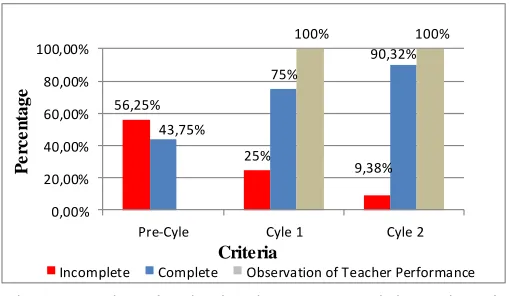
The pre-test results show that the number of students who have reached the Minimum Completion Criteria score (MCC score) is fourteen students from a total of thirty-two students, or by 43.75%. While students who have not yet achieved an MCC score of 56.25%. The fourteen students received an average test score of 74, while eighteen students who had not yet achieved an MCC score obtained an average test score of 52. Figure 1 shows the percentage of students' mathematical achievement and inadequacy in the pre-cycle.
Fig. 2. Percentage data of student learning outcomes in the pre-cycle
4.2 Cycle 1
Student learning outcomes data in cycle 1 shows 75% or twenty-four people out of thirty-two students scored above the Minimum completeness Criteria score (MCC = 65), with an average value of 70.16. While the rest, eight students scored below MCC, with an average score of 59. However, learning
outcomes of cycle 1 have not been considered complete, because they did not meet the expected learning outcomes of ≥ 85% of students in the class achieved an MCC score of 65. Therefore it is necessary to improve learning that will be done by the teacher in the second cycle.
Fig. 3. Data percentage of student learning outcomes and observations of teacher performance in cycle 1
4.3 CYCLE 2
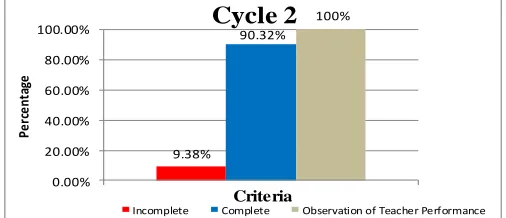
Student learning outcomes data in cycle 2 shows 90.63% or twenty-nine students out of thirty-two students have obtained MCC scores, with an average value of 85.78. There are three students who have not yet reached the MCC score, with an average score of 53. Although the learning outcomes of the three students have not yet reached the MCC score, the student scores continue to increase from the pre-cycle with a value of 20 to the first cycle with a value of 50.
Fig. 4. Data percentage of student learning outcomes and observations of teacher performance in cycle 2
Comparison of student mathematics learning outcomes data in pre-cycle, cycle 1, and cycle 2 is presented in table 1.
TABLE 1
STUDENT MATHEMATICS LEARNING OUTCOMES IN PRE-CYCLE, CYCLE
1, AND CYCLE 2
Category Pre-Cycle Cycle I Cycle II Quanti
ty
% Quanti ty
% Quanti ty
%
Complete 14 43,75 24 75 29 90,63
Incomplete 18 56,25 8 25 3 9,38
56,25%
25%
9,38% 43,75%
75%
90,32%
100% 100%
0,00% 20,00% 40,00% 60,00% 80,00% 100,00%
Pre-Cyle Cyle 1 Cyle 2
P
e
rc
e
n
tag
e
Criteria
Incomplete Complete Observation of Teacher Performance
Fig. 5. Comparison of student learning outcomes and observations of teachers from various cycles
Figure 5 shows the percentage of mastery learning in pre-cycle mathematics of 43.75%, incompleteness of 56.25%. The percentage of mastery learning cycle 1 mathematics is 75%, incompleteness is 25%, and the observations on teacher performance are 100%. The percentage of mathematical learning completeness in cycle 2 is 90.32%, incompleteness is 9.38%, and the observations on teacher performance are 100%, or as many as twenty-nine students out of thirty-two students have achieved an MMC math score of 60. Research is considered successful in cycle 2.This paper has argued that the STAD type cooperative learning model is proven to be able to improve mathematics learning outcomes of third-grade elementary school students.The results of this study are supported by the research of [9] which shows that the learning outcomes of students who use STAD learning models are better than those using TPS learning models. And also research by [1] which explains that groups of students taught using the STAD cooperative learning model have higher abilities than groups of students taught using the PBL model. Following the results of research by [13] who found that the effects of cooperative learning techniques on students' reading comprehension increased by using the STAD cooperative learning model.But the evidence on the results of the study is different from the results of research conducted by [22] which shows that effective learning processes in workgroups and teams use the Group Investigation (GI) learning model in this learning model, the division of tasks between members of the same group flat.Finally, the results of [23] state that the STAD learning model is effective in learning mathematics. Also, [24] which states that the average score of the STAD learning model can exceed the average score of the control group with other cooperative learning models.
5 C
ONCLUSIONThis research has shown that the STAD type cooperative learning model is proven to be able to improve student mathematics learning outcomes. The evidence from this research has answered that the STAD type cooperative learning model helps students acquire academic content and skills to discuss the goals and objectives of important social and human relations. Further research might investigate three instructional objectives of cooperative learning at once such as academic achievement, tolerance, and acceptance of diversity, and the development of social skills simultaneously.
A
CKNOWLEDGMENTWe would like to thank the Universitas Muhammadiyah Jakarta for providing support for our research.
R
EFERENCES[1] T. Rattanatumma, ―Assessing the effectiveness of STAD model and problem based learning in mathematics learning achievement and problem solving ability.,‖ J.
Educ. Prat., vol. 7, no. 12, pp. 194–199., 2016.
[2] S. Tiantong, M., & Teemuangsai, ― Student team achievement divisions (STAD) technique through the moodle to enhance learning achievement,‖ Int. Educ.
Stud., vol. 6, no. 4, pp. 85–92., 2013.
[3] A. Tella, ―Teacher variables as predictors of academic achievement of primary school pupils mathematics.,‖ Int.
Electron. J. Elem. Educ., vol. 1, no. 1, pp. 1–17, 2008.
[4] S. M. Nair, ―Effects of utilizing the stad method (cooperative learning approach) in enhancing students descriptive writing skills.,‖ Int. J. Educ. Prat., vol. 6, no. 4, pp. 239–252., 2018.
[5] R. E. Slavin, ―Cooperative learning in elementary schools.,‖ Int. J. Primary, vol. 43, no. 1, pp. 5-14., 2014. [6] J. M. Walle, J. A. Van De., Karp, K. S., & Bay-Williams,
Elementary and Middle Szhool Mathematics Teaching
Development. United States: Pearson Education Inc.,
2010.
[7] M. O. Gambarı, A. I., & Yusuf, ―Effectiveness of computer-assisted STAD cooperative learning strategy on physics problem solving achievement and retention.,‖ J. Educ.
Technol., vol. 3, no. 3, 2015.
[8] F. Tarim, K., & Akdeniz, ―The effects of cooperative learning on Turkish elementary students‘ mathematics achievement and attitude towards mathematics using TAI and STAD methods.,‖ Educ Stud Math, vol. 67, pp. 77–
91., 2007.
[9] R. Ardiyani, & S. M., Gunarhadi., ―Realistic mathematics education in cooperative learning viewed from learning activity.,‖ J. Math. Educ., vol. 9, no. 2, pp. 301–310., 2018. [10] A. Karacop, ―Effects of student teams-achievement divisions cooperative learning with models on students understanding of electrochemical cells.,‖ Int. Educ. Stud., vol. 9, no. 11, pp. 104–120., 2016.
[11] Y. Aldila, M., Tapilouw, F. S., & Sanjaya, ―Students‘ cognitive and attitude of secondary school in learning global warming using student team achievement division (STAD) based on gender.,‖ J. Sci. Learn., vol. 1, no. 13, pp. 104-109., 2018.
[12] L. Yusuf, Y. Q., Natsir, Y., & Hanum, ―A Teacher‘s experience in teaching with student teams-achievement.,‖
Int. J. Intruction, vol. 8, no. 2, pp. 99-112., 2015.
[13] A. F. M. Hossain, M.A., Tarmizi, R.A., & Ayub, ―Collaborative and cooperative learning in malaysian mathematics education.,‖ J. Math. Educ., vol. 3, no. 2, pp. 103-114., 2012.
[14] R. I. Arends, Learning to teach, ninth edition. New York: McGraw-Hill., 2012.
[15] E. T. Wibowo, ―Improving the motivation and learning outcomes students with applying ‗everyone is teacher here‘ learning method.,‖ J. Pendidik. Bisnis dan
Manajemen, vol. 3, no. 2, pp. 122–130., 2012.
inquiry, and student learning interest.,‖ TARBIYA J. Educ.
Muslim Soc., vol. 6, no. 1, pp. 45–56., 2019.
[17] R. Sumantri, M. S., & Satriani, ―The effect of formative testing and self- directed learning on mathematics learning outcomes.,‖ Int. Electron. J. Elem. Educ., vol. 8, no. 3, pp. 507–524., 2016.
[18] J. W. Creswell, Educational Research : Planing, Conducting, and Evaluating Quantitave and Qualitative
Research (5th ed). Upper Saddle River, NJ: Pearson,
2015.
[19] O. Rosfiani & C.M. Hermawan, ―R&H Classroom Action Research Model,‖ 000130825, 2018.
[20] H. Karali, Y., & Aydemir, ―The effect of cooperative learning on the academic achievement and attitude of students in mathematics class.,‖ Educ. Res. Rev., vol. 13, no. 21, pp. 712–722., 2918.
[21] P. Lindorff, A., & Sammons, ―Going beyond structured observations: looking at classroom practice through a mixed method lens.,‖ Int. J. Math., vol. 50, no. 3, pp. 521–
534., 2018.
[22] S. J. Priola, V., Smith, J. L., & Armstrong, ―Group work and cognitive style a discursive investigation. Small Group Research,‖ 565–596., vol. 35, no. 5, 2004.
[23] Suripah., ―Komparasi keefektifan model pembelajaran kooperatif tipe student teams achievement divisions (STAD) dan tipe think-pair-share (TPS) pada siswa sekolah menengah pertama (SMP).,‖ J. Pengajaran MIPA,
vol. 20, no. 2, pp. 125-132., 2015.