Measuring The Performance Of Multi-Core
Architecture Using Openmp
S. Sarmah, M.P. Bhuyan, V. Deka, M. Rahman, P. Sarma, S.K. Sarma
Abstract: Scientific and Engineering problems demand massive computation power and computer resources. To fulfill such demands multi-core architecture is a very useful and efficient design of the computer system. In this research work, multi-core architecture is utilized by using the programming technique Open Multi-Processing (OpenMP). OpenMP is a technique which helps us to execute the different sections of the code in the multi-core processor. Different types of parallel algorithms like matrix multiplication, merge sort, linear search these three algorithms are implemented in this work and the time required to perform the operations are recorded. Finally, it is found that parallel programming on multi-core architecture showing good performance than the sequential execution and also in the experiment it is found that excessive increase of the number of threads will not increase the performance of the system, on the other hand, it will degrade the performance of the system.
Index Terms: Threads, OpenMP, gprof, profiling, parallel matrix multiplication
—————————— ——————————
1.
INTRODUCTION
Nowadays, because of the huge amount of data, there is a need for a very fast computer to perform tasks in less amount of time. In serial processing, one work will be done after another i.e. one by one which takes more time. This serial execution or processing can be optimized by executing or processing more than one task at a time which will reduce the overall execution time. Parallel processing is a method which deals with many sub-problems of a large problem. In parallel processing, a computational problem is divided into several independent sub-problems which can be solved separately or independently. OpenMP (Open Multi-Processing) is an API (Application Program Interface) used in C or C++ to support multi-processing platform with shared memory parallelism. OpenMP gives programmers a very simple scalable and portable platform for implementing parallel applications. OpenMP is an implementation of multithreading. In OpenMP, a master thread manages all the other threads and all the threads are run in different processors to accomplish a task. OpenMP was first introduced in October 1997. It has been extensively used since then in parallelizing computer programs. In OpenMP, the programmer can specify which portion of the code need to be parallelized. The programmer also sets necessary synchronization parameters like locks, barriers, etc. to make sure proper execution of the parallel code-section. At runtime, threads are forked by a master thread for the parallel code-section and are normally executed in different processors in the same shared memory module by sharing the same memory and address space [1]. Multi-core systems are found in everywhere so it is very much important to utilize the hardware using some software techniques [2]. OpenMP is a very powerful technique in parallel computing.
The major center of concentration for the research was the performance obtainable and attempt required implementing a program with OpenMP. OpenMP requires that a library is linked during the compilation and also requires that the compiler has built-in support for it.
The benefit of having several cores is that we might take the benefit of these cores by using thread-level parallelism in a particular program and consequently boost the performance of the program. Numerous research has been carried out in this filed. So, we observe that we have a system with multiple-core which can be used as a traditional multiprocessor system with minimum communication cost and also it can be used to improve single thread programs. OpenMP so far has been used only in traditional multiprocessor environments and we saw that the multi-core processors are very similar to a traditional multiprocessor. So it is expected to think of OpenMP in multi-core processors. It is seen that many techniques depend on hardware-based mechanisms and a little rely on the compiler to extract the threads. Thread is a light-weight process which can be managed independently by the process scheduler of the operating system. The thread is a part of a process. Multiple threads can exist within one process and one process control block, executing concurrently and sharing resources such as memory. On the other hand, if threads exist in different processes they do not share their resources. In general, the threads of a process can share its executable code and the values of its variables at any instance time during their execution. The pragma omp parallel is used to fork additional threads to perform the work within the code-section marked as parallel. The original thread will be specified as master thread. OpenMP is designed with several compiler directives which can be used in the source code, these directives need functions to run and those functions are mentioned in a library that has to be included at compile time [3]. The core elements of OpenMP are the constructs for thread creation, workload sharing or load distribution, data-environment management, thread synchronization, user-level runtime routines, and environment variables. In C/C++, OpenMP uses #pragma, pragma is a directive to the preprocessor. It is usually used to provide some additional control during the compilation.
Example:
#include <omp.h> main()
{
#pragma omp parallel ————————————————
S. Sarmah is currently working as an Assistant Professor in Information Technology department in Gauhati University, India. Email: [email protected]
M. P. Bhuyan is currently pursuing PhD degree in Information Technology in Gauhati University, India, E-mail: [email protected]
V. Deka is currently working as an Assistant Professor in Information Technology department in Gauhati University, India.
M. Rahman is currently working as an Assistant Professor in Information Technology department in Gauhati University, India. P. Sarma is currently working as an Assistant Professor in
Information Technology department in Gauhati University, India. S. K. Sarma is currently working as a Professor in Information
{
int id = 0;
printf(― parallel(%d)\n‖, id); printf(― threads(%d) \n\n‖,id); }
}
An OpenMP program executes with a ―master‖ thread executing ―main‖ as a sequential program. ―#pragma omp parallel‖ indicates the beginning of a parallel code-section [4].
– Parallel threads are created and join the master thread. – All threads execute the code within the parallel region. – At the end of the parallel region, only the master thread executes. Serial programming involves a successive and prearranged execution of processes one by one. In other words, with serial programming, codes or processes are successively run one after another. Parallel processing uses the concurrent execution or real-time execution of processes or threads at the same time. Parallel processing, we have multiple processes execute at the same time. In software engineering, ―profiling‖ or "program profiling" or "software profiling" is a type of dynamic program investigation on the various parameters of a program. For example, the memory space or time complexity, execution time of each section of the code of a program, the usage of particular instructions, or the frequency and time of function calls. Most commonly, profiling information serves to aid program optimization. Profiling is achieved by using a tool called profiler. Profilers can employ numerous different methods, such as event-based, statistical, instrumented, and simulation methods. Profilers apply a wide range of techniques to gather data, including hardware interrupts, code instrumentation, instruction set simulation, operating system hooks, and performance counters. Profilers are applied in measuring the performance of engineering applications. Gprof is a performance investigation tool used to profile applications to verify where time is spent throughout program execution. Gprof is incorporated with most Unix/Linux implementations, is simple to utilize, and can quickly show which parts of an application take the majority of the time. Gprof works by automatically with the code during compilation and then sampling the application's program counter in execution. Sampling data is saved in a file, usually named as gmon.out, which can then be understood by the gprof command. Gprof was designed as an addition of the prof command, by providing a call graph of the program's execution [5]. The rest of the paper is organized as follows: Section 2 describes the related works in this field, Section 3 has its focused on the methods, Section 4 depicts the implementation approaches, Section 5 discusses and analyzes the experimental results and finally, section 6 concludes the present work and proposes the future work. 2 Related WorksIn [3], authors have analyzed the bottleneck performance of parallel computing using OpenMP. In their research, they have mentioned that the use of multithreading in OpenMP will increase the execution speed but the excessive number of threads will degrade the performance of the system. They have focused on the synchronization of the threads, synchronization is necessary for the threads which co-ordinates their actions. Critical section execution of threads, as we know in the critical section only one thread can execute. They mentioned about the barrier if one thread reaches the barrier that thread must wait until all the threads reach the barrier. They have explained good memory access
processing or parallel programming is an emerging field and researchers are working in this field. Measuring and evaluating the performance of the parallel algorithms by converting the serial code of the traditional problems. In the next section, the methods are presented and they are evaluated using OpenMP.
3 METHODS
3.1 Matrix Multiplication
Matrix Multiplication is the process of multiplying a scalar with a matrix or multiplying two matrices together, the focus will be on the second one. It works by multiplying the rows of matrix X with the column of matrix Y. X11 will be multiplied with Y11, and then X12 with Y21, the sum of these multiplications will end up in Z11. The next step we multiply X11 with Y12, then X12 with Y12. The sum of these multiplications will end up in Z12. This will continue for all rows and columns in the matrices.
3.2 Merge Sort
Merge sort is one of the stable sorting algorithms. In merge sort, before sorting, data is divided, each partial component is sorted (conquer), then all sorted components are pasted together in a cycle to sort entire data, which is one of the divide and conquer method. During a cyclical call, it goes through three steps; divide, conquer, and place. The divide is a step where given data is divided into many small sub-problems. Conquer is a step where divided data is sorted in an orderly manner and another step Place where data is placed and completely sorted. During merge sort process, depending on how the unit is divided and goes through those three steps are called k-way merge sort. In this research, merge sort is parallelized by using OpenMP and also, the performance of the parallel region and the performance of the serial region are evaluated.
3.2 Linear Search
Linear search or sequential search is a technique to find target data within a set of data or from a list. The searching algorithm sequentially examines each element of the list to get the target value. The process continues until a match is found or until all the elements have been searched. Linear search is one of the simplest searching algorithms to implement and has the worst-case complexity of O(n), i.e. the algorithm has to scan through the entire list to find the element this happens when the required element is not in the list or is present extreme right of the list. By parallelizing the implementation, we make the multiple threads split the data amongst themselves and then search for the element independently on their part of the list the searching process can be optimized.
4 IMPLEMENTATION
APPROACHES
4.1 Matrix Multiplication
Step 1: First we take a 2-dimensional matrix. Step 2: Data input set as 1.
Step 3: For Parallel Matrix Multiplication, 3.1 We use thread 8.
3.2 Now, randomly given the size 500-8000.
3.3 Using gprof, we got different time for different matrix size.
3.4 We take different matrix size.
3.5 Using gprof, we got different time for different
matrix size.
Step 5: Now, we create a chart for Serial and Parallel Matrix Multiplication.
4.2 Merge Sort
Step 1: We take a const size=2000000.
Step 2: Randomly generate ‗n‘ numbers to be sorted. Step 3: For Parallel Merge Sort,
3.1 Values are sorted by using threads.
3.2 Using gprof, we got different running time accordingly the number of threads.
3.3 Values are sorted.
3.4 Using gprof, we got running time.
Step 5: Now, we create a chart for Serial and Parallel Merge Sort.
5
RESULT
AND
DISCUSSIONS
Different types of experiments are performed and the experimental results are analyzed in this section.
5.1 Parallel Matrix Multiplication taking number of threads 8 and Serial Matrix Multiplication:
TABLE1
COMPARISON OF PARALLEL AND SERIAL MATRIX MULTIPLICATION
:
FROM TABLE 1 FOR THE DIFFERENT SIZE OF THE MATRICES, THE
EXECUTION TIME OF THE PARALLEL ALGORITHM IS FAR BETTER THAN
THE SERIAL ONE.
5.2 Matrix Multiplication table for matrix size 2000x2000 using different threads
Sl. No.
Matrix Size Parallel Execution Time (sec)
Serial
Execution Time (sec)
1 500x500 0.63 0.77
2 1000x1000 6.84 10.76
3 1500x1500 24.57 34.76
4 2000x2000 62.57 94.98
5 2500x2500 127.74 274.98 6 3000x3000 222.74 556.34 7 3500x3500 346.04 1021.94
8 4000x4000 561.9 2881.6
TABLE 2
COMPARISON OF PARALLEL AND SERIAL MATRIX MULTIPLICATION
WITH DIFFERENT NO. OF THREADS
From Table 2 it is cleared that for the matrix dimension 2000 x 2000 the increasing number of threads showing better performance in the parallel execution. On the other hand, from no. of threads 5000 to 8000 there is no improvement in the system. This is because an excessive increase in the number of threads in the parallel execution will not result in better performance.
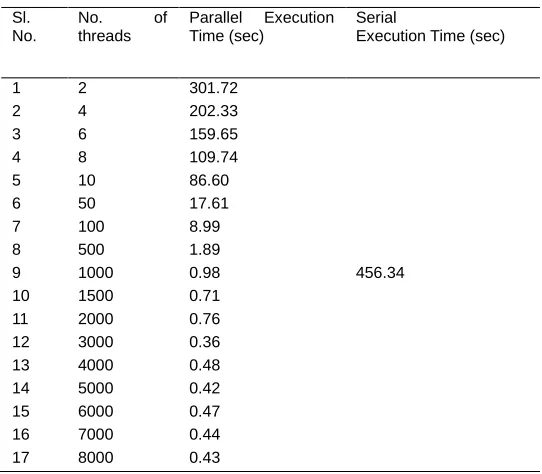
5.3 Matrix Multiplication table for matrix size 3000x3000 using different threads:
TABLE 3
Comparison of Parallel and Serial Matrix Multiplication with different number of threads
Sl. No.
No. of threads
Parallel Execution Time (sec)
Serial
Execution Time (sec)
1 2 301.72
2 4 202.33
3 6 159.65
4 8 109.74
5 10 86.60
6 50 17.61
7 100 8.99
8 500 1.89
9 1000 0.98 456.34
10 1500 0.71
11 2000 0.76
12 3000 0.36
13 4000 0.48
14 5000 0.42
15 6000 0.47
16 7000 0.44
17 8000 0.43
From Table 3 for the matrix dimension 3000x3000, it is seen that on increasing the number of threads the execution time is also decreasing. But from the number of threads 4000 to 8000 there is no improvement or very little improvement in the execution time. Highest level of improvement is found if the number of threads is 3000 which 0.36 sec. In Table 1 for the matrix size 6500x6500, the execution time is reduced to more than the 5 times of the sequential execution. In matrix dimension 7000x7000 the execution time is reduced to almost 5 times of its serial execution. In Table 2 the maximum level of improvement is found if the number of threads is 6000 which is 0.38 sec. When the number of threads is 2 then the execution time is almost half of the serial execution time of the algorithm.
5.4 Merge sort for Thread 2, Thread 8, Thread 100, Thread 1000 and Thread 100000:
No. of Threads=2
TABLE 4
No. of Threads=8 Sl.
No.
No. of threads
Parallel Execution Time (sec)
Serial
Execution Time (sec)
1 2 96.81
2 4 54.63
3 6 42.00
4 8 25.47
5 10 22.62
6 50 9.97
7 100 4.91
8 500 1.15
9 1000 0.62 196.98
10 1500 0.64
11 2000 0.46
12 3000 0.51
13 4000 0.34
14 5000 0.43
15 6000 0.38
16 7000 0.39
17 8000 0.42
Sl. No.
Data size Parallel Execution Time (sec)
Serial
Execution Time (sec)
1 100000 43.3 51.88
2 300000 93.3 150.55
3 500000 143.5 252.94
4 800000 158.0 450.16
5 1000000 245.3 749.20
6 1300000 344.3 852.80
7 1500000 541.1 1053.24
8 1800000 589.3 1252.50
TABLE
No. of Threads=100
TABLE 6
No. of Threads=1000
TABLE 7
No. of Threads=100000
TABLE 8
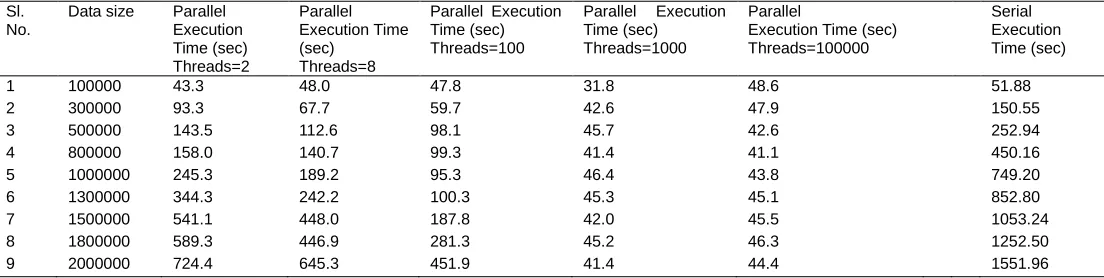
From Table 4, 5, 6, 7 and 8 it is seen that the increasing the threads with the increasing number of data size showing less execution. But from Table 7 and Table 8 it can be found that the performance is not changing very much or improving at a significant level. In Table 7 and Table 8 the number of threads is changed from 1000 to 100000. But there was no improvement in the execution time. From this experiment, it cleared that the huge increase in the number of threads will not result in better performance. In Table 9 the results of Table 4, 5, 6, 7, and 8 are merged to visualize the execution time with a different number of threads. From Table 9 it is cleared that the optimum no. of threads in this merge sort algorithm is 1000. Because after that the improvement is not significant and also, the execution time obtained by using 1000 threads is relatively very small or a fraction of a second.
TABLE 10
TABLE 9
Sl. No.
Data size Parallel Execution Time (sec)
Serial Execution Time (sec)
1 100000 47.8 51.88
2 300000 59.7 150.55
3 500000 98.1 252.94
4 800000 99.3 450.16
5 1000000 95.3 749.20
6 1300000 100.3 852.80
7 1500000 187.8 1053.24
8 1800000 281.3 1252.50
9 2000000 451.9 1551.96
Sl. No.
Data size Parallel Execution Time (sec)
Serial Execution Time (sec)
1 100000 31.8 51.88
2 300000 42.6 150.55
3 500000 45.7 252.94
4 800000 41.4 450.16
5 1000000 46.4 749.20
6 1300000 45.3 852.80
7 1500000 42.0 1053.24
8 1800000 45.2 1252.50
9 2000000 41.4 1551.96
Sl. No.
Data size Parallel Execution Time (sec)
Serial Execution Time (sec)
1 100000 48.6 51.88
2 300000 47.9 50.55
3 500000 42.6 52.94
4 800000 41.1 50.16
5 1000000 43.8 49.20
6 1300000 45.1 52.80
7 1500000 45.5 53.24
8 1800000 46.3 52.50
9 2000000 44.4 51.96
Sl. No.
Data size Parallel Execution Time (sec) Threads=2
Parallel Execution Time (sec)
Threads=8
Parallel Execution Time (sec) Threads=100
Parallel Execution Time (sec) Threads=1000
Parallel
Execution Time (sec) Threads=100000
Serial Execution Time (sec)
1 100000 43.3 48.0 47.8 31.8 48.6 51.88
2 300000 93.3 67.7 59.7 42.6 47.9 150.55
3 500000 143.5 112.6 98.1 45.7 42.6 252.94
4 800000 158.0 140.7 99.3 41.4 41.1 450.16
5 1000000 245.3 189.2 95.3 46.4 43.8 749.20
6 1300000 344.3 242.2 100.3 45.3 45.1 852.80
7 1500000 541.1 448.0 187.8 42.0 45.5 1053.24
8 1800000 589.3 446.9 281.3 45.2 46.3 1252.50
9 2000000 724.4 645.3 451.9 41.4 44.4 1551.96
Sl. No.
Data size Parallel Execution Time (sec)
Serial Execution Time (sec)
1 10000 0.000 0.000
2 100000 0.000 0.000
3 1000000 0.000 0.000
4 2000000 0.000 11.10
5 3000000 0.001 12.50
6 5000000 0.004 18.20
7 8000000 0.006 22.20
5.4 Linear search for Thread 2:
From the above Table 10, it is seen that the linear search algorithm is taking almost zero time to search a given data from a list. This is a significant level of improvement of the parallel algorithm over the sequential algorithm.
6 CONCLUSION
AND
FUTURE
WORK
After doing a detail experimental analysis we have seen that parallel execution on various problems shows relatively good results in comparison with the serial one. From our experiment, we have found that if we increase the number of threads gradually after a certain point of time the computer is unable to work properly. So, we have to use a moderate number of threads in our programs, which will smaller than the threshold value. In the future to compare this OpenMP parallel execution it is possible to implement the Message Passing Interface (MPI) which is a distributed memory parallel computing model.
REFERENCES
[1] OpenMP, https://en.wikipedia.org/wiki/OpenMP accessed on 26th August 2019.
[2] Ashwini M. Bhugul, ―Parrallel Computing using OPenMP,‖ International Journal of Computer Science and Mobile Computing, Vol. 6, Issue. 2, Febraury 2017, pp: 90-94 [3] Vibha Rajput, Alok Katiyar, ―Proactive Bottleneck
Performance analysis in parallel computing using OpenMP,‖ International Journal of Advanced Studies in Computer Science and Engineering, Vol. 2, Issue 5, 2013, pp: 46-53.
[4] Parallel Programming with OpenMP, http://www.cse.iitm.ac.in/~rupesh/teaching/hpc/jun16/4-openmp.pdf accessed on 26th August 2019.
[5] Himanshu Arora, ―GPROF Tutorial- How to use in Linux GNU GCC Profiling Tool,‖ August 2012, accessed on 29th August 2019.
[6] Sheela Kathavate and N.K. Srinath,‖Efficiency of Parallel Algorithms on Multi Core Systems Using OpenMP,‖ International Journal of Advanced Research in Computer and Communication Engineering, Vol. 3, Issue 10, October 2014, pp: 8237-8241.
[7] E. Ayguade, N. Copty, A. Duran, and J. Hoeflinger, ―The Design of OpenMP tasks,‖ IEEE Transaction on Parallel and Distributed systems, Vol. 20, Issue 3, June 2008, pp 404-418.
[8] Myeonggyn Han, Jinsu Park, and Woongki Baek, ―CHRT: a critically- and heterogeneity-aware runtime system for task-parallel applications,‖ In DATE‘17 Proceedings of the Conference on Design, Automated & Test in Europ, March 2017, pp: 942-945.
[9] Pranab Kulkarni, and Sumit Pathare, ―Performance Analysis of Parallel Algorithm over Sequential using OpenMP,‖ IOSR Journal of Computer Engineering (IOSR-JCE) Vol. 16, Issue 2, March 2014, pp 58-62.
[10] Sinan Sameer Mahmood Al-Dabbagh, Nawaf Hazim Barnouti, ―Parallel Quicksort,‖ International Journal of Computer Science and Mobile Computing, Vol. 5, Issue 6, June 20016, pp: 372-382.
[11] Taniya AshrafDar, Salma Fayaz, and Afaq Alam Khan, ―Performance Evaluation on Multi-core system uing OPenMP,‖ International Journal of Advance Research in Science and Engineering, Vol. 07, Special Issue 04,