'a•3
APPENDIX I
TRE CERAMIC DESCRIPTION
The Sample
The ceramic sample comprises a total of
56,438
potsherda collected from the surface in1966, 1968,
and1978,
and from excavations in1966
and1968.
The original survey team took surface collections from nearly all the350
sites they found.103
of these sites fall within my study area and all of them,with the exception of three: 100,
77,
and124,
yielded some potsherds and/or other artefacts, the collections ranging from8
to478
sherds 1 . The reasons for this disparity will be suggested later. All these collections, together with sherds from the team's small test pit at Pachacamac, are now stored in the Department of Anthropology at Temple University,Philadelphia.
During the next two years preliminary hypotheses were formulated with regard to the dating of the sites, and in
1968
I made further surface collections from the sitesconsidered to be LIP and LH. Timothy Earle also made further collections from EIP sites. Some of his data have been used by me. Our object at that time was to obtain as much variety as possible in vessel form and decoration. The
1968
sample was further enlarged by the sherds from excavations atPanquilma and Avillay, which have helped me to work out the
a few small collections were made at sites whose dating was uncertain. In addition, a method of collecting that would give reasonably representative sherd samples was devised. For convenience, these samples have been termed
"random" in order to distinguish them from the "grab" samples made previously. This method of sampling was used at a few
sites at the two extremes of the study area; 28 at the west end, and
164, 109, 136
and135
at the east end. Its purposewas to discover whether there were differences in the
proportions of Orange Ware and Brown Ware at different sites. The method and its results will be discussed later. All my
1968
and most of the1978
collections are stored in theCasa de la Guardianfa de las Ruinas de Pachacamac in Puente de Lurfn, Peru. A few of the
1978
collections are stored at site57.
Further comparative material was found in the sample of plain and decorated fragments available for study from Strong and Corbett's excavations near the Temple of the Sun at Pachacamac (Strong and Corbett1943).
These sherds are now stored at the American Museum of Natural History, New York City.excavations, now stored at the Museum of the University of Pennsylvania in Philadelphia. Very few of these vessels, especially the plain ones, were published in his report of 1 903. Further remarks on Bandelier's and Uhie's excavations
will be found in Appendix 11. Piri11y, there are a few vessels on exhibition at the Museo Nacional de Antropologfa in Lima and at the Iuseo de Sitio in Puruchuco, which can be related to ones from the Lur^n valley. These have been used where necessary.
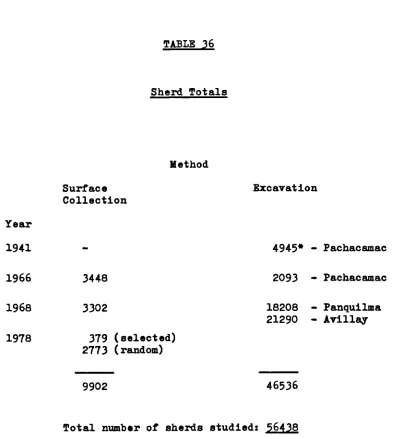
Table 36 gives sherd totals according to the year
andTABLE 36
Sherd Totals
Method
Surface Collection
Year
1941
-1966 3448
1968 3302
1978 379 (selected)
2773 (random)
9902
Excavation
4945* - Pachacamac
2093 - Pachacamac
18208 - Panquilma
21290 - Avillay
46536
Total number of sherds studied: 56438
All the surface collections, except the'trandom'saniples, were made according to the same principle, that is the
potential of the sherds for a similarity seriation by features and themes, (see Rowe 1961). The rationale of this method
has best been expressed by Lirniing (1963 pp.149-151). So called "diagnostic" fragments are selected, these being rims, bases, handles, other appendages and decorated sherds. They are gathered in an unsystematic fashion, the amount depending on the whim of the collector, although if the site is small, then everything that appears diagnostic is taken and only the plain body sherds left behind. The inferred shapes and associated decoration are then arranged in a sequential order according to their similarity to one another and the presence or absence of certain features, the assumption being that those vessels similar to one another will be closer in age than those less similar. Such a sequence is usually dated by relating it to known ceramic sequences elsewhere. The length of occupation of each site is then inferred from the phases in the sequence that are manifest from the aherds. Such studies have been carried out by Linn1ng 1961, Proulx 1968 and Browman 1970.
Questions, however, may be justifiably raised as to whether such sampling methods yield a representative enough collection for analysis. The reasons are as
follows:-1. They are usually biased against plainware forms, which may be collected in so small a number that
inferences about the nature and function of the site may be inaccurate. Por example, in at least two instances of his 1966 study Patterson selected about 200 sherds from the several thousand available for collection in the field, rejecting the rest
presumably because they were plainware (Patterson 1966 Pp. 12 and 16).
2. Such methods of sampling assume that variation is due to chronological differences rather than distance from other sites, site function, or cultural differences between inhabitants of each site. This can lead to a situation where each phase is represented by only one site, whose sherds vary in few ways from those of a neighbouring site. Patterson's 1966 work is an example of this, since each of his phases is built up from one site only.
3. The method assumes that the amount of variation in the collection will enable the i1yst to distinguish between long and short occupation sites. Yet, owing to environmental and depositional factors, certain occupations may not be represented on the surface, leading to inaccurate inferences about the occupation span. Por example, Pachacamac has a substantia]. EIP occupation discovered through excavation, but to the best of my knowledge there are no ElF sherd.s on the
4. The eherds are collected in an unsystematic fashion
and cannot be used for inter-site statistical comparisons. The amount obtained often merely reflects the time
available for collecting. For example, in 1966 220 sherds were collected at olle, a far smaller site than Panquilina which yielded only 134.
Notwithstanding such strictures which may well be
applicable to the Lurin samples, it is my belief that the total surface collections are reasonably representative of what is on the surface of each site and, also, of what was in use at each site during its occupation span. There are three reasons: the unique environmental conditions of the central coast mid-valley zones; the general lack of decorated ware in the Lurin valley; and the results of my own survey work and excavations.
The environment of the middle zones of central coast valleys has already been discussed in Chapter Two. The features of concern here are the general lack of rainfall and strong winds, and the dearth of natural vegetation away from the river and agricultural areas, so that there is little erosion and even less natural deposition. Indeed, the landscape has remained almost static since at least conquest times. It is therefore unlikely that the material remains of any cultural period lie buried beneath recently deposited soil. It is true that the occasional huayco can deposit silt, sand and rocks of various sizes on quebrada floors, but these have never completely covered structures, as may the wind-blown
revealed unsuspected ceramic or architectural styles3.
One only finds what may be reasonably inferred from the nature of ceramic material close to the excavation. The same huaycos may also erode part of the house platforms and hillside
structures, but I am convinced that this damage is small compared with that caused by human agents, namely the early Spanish and later armies that looted and destroyed so many sites 4 , Purthermore, an examination of those structures, mostly tombs, that were built on house platforms and are still intact, reveals no accumulation at the base of the wall, which merely rests on the platform surface without a foundation trench.
At the same time, there is no cultural superposition which would prevent sherds of earlier occupations from being
represented on the surface. Excavations at three different points in the study area, Panquilma, Chontay and Avillay, in house platforms and ceremonial structures,that date from the MH to the LH,have failed to reveal superposition of living floors or any other kind of activity area that can be assigned to different time periods 5 . The same can be said of excavations in refuse heaps 6 . This suggests that the occupation extends horizontally rather than vertically. In fact,there is
interpretations lies buried beneath the surface.
The second reason for believing the surface collections
to be representative of their sites is the small amount of
decorated wares found in the study area, a phenomenon which
occurs particularly in the MR and LIP. This meant that the
original survey team and the members of subsequent ones were
obliged to gather what was there and there was less bias
towards collecting decorated shards. It might be objected
that looting, both ancient and modern, could have affected
the proportions of decorated to plain wares, because attractive
whole vessels and potsherds would be removed. My own view is
that little has been removed by pothunters, chiefly because
the greater part of the looting took place in the years
directly after the conquest, when the looters' object was to
find gold not pottery. This accounts for ransacked tombs and
large fragments of smashed vessels around them. If this
looting had been carried out recently, one would not expect
to see some large fragments in the Cuzco style on the surface,
as one does at Avillay, because the intact vessels would have
been sought after by the pothunters. Moreover, it is Unlikely
that pothunters, even if attracted to sherds, could or would
remove every single piece of evidence for a LIP decorated
style such as the Red, Black and White Geometric, and yet
leave behind the equally attractive Cuzcostyle sherde. One
must therefore conclude that there is a genuine lack of
decorated wares for the periods in question, and that this
has led to plazinwares being strongly represented in the surface
Pinally there are my own observations on the surface distribution of ceramic material. After three field seasons, the surface of all late sites has been scrutinised thoroughly in order not to misinterpret patterns of sherd distribution. The excavations and collections of 1968 and 1978 extended the range of variation for various forms and their decoration, but no new ceramic styles were found 7 . In 1978 an intensive survey was made of between 75% and 100% of the area that had been mapped, in which the kinds of potaherds found in each structure
and between structures were noted down. In addition other
possible late sites were surveyed, plus the hillsides, irrigation ditches and some of the land under cultivation. The information has been sufficient to work out the succession of late forms without lacunae and to date sites and their sectors. The only difficulty has arisen in dating those sites with small collections, a point to be discussed below. Consequently, it has been concluded that the collections do represent what was in use at these sites during their occupation span.
It remains to comment on the disparity in the size of collections from different sites. The reason lies in the inconsistent definition of "site" made by the original survey team, for any small sherd scatter could be designated a site and, as such, comparable with clusters of buildings spread over many hectares, which naturally yielded larger collections8. There is also a functional distinction between these two
Several pots per grave can yield hundreds of surface sherds. On the other hand those sites, or sectors of sites, which consist of no more than house platforms, are where the bulk of the population lived. These yield very little pottery, which can be inferred to have been broken in the course of domestic use, because it is usually trampled down into small fragments with worn edges, especially if it belongs to pre-LH periods. Indeed, any large sherd was probably refashioned into some other artefact. (See fig.XIX f-j and XVI f, g, i,
j ). About one third of the sites fall into this category of a few house platforms with some undiagriostic sherds.
Since it is impossible to improve upon the surface samples, the sites will only be satisfactorily dated by radiocarbon or
maybe thermoluminescence.
The Method of Analysis
the valley during the LH and is used only for the Cuzco Polychrome style, although the paste bears a relation to that used for Black Ware 9 . The paste of the 0rnge Ware is also used for the Cuzco Polychrome style, particularly at Pachacamac and sites nearer the coast. However, the surface treatment for Cuzco Polychrome is different from that given to standard Orange Ware.
The second step in the classification was to work out the various forms within each ware group. This has been possible for the Orange Ware, Black Ware and the Cuzco Polychrome style, because of the number of complete vessels. It has been less easy for the Brown Ware, since few complete vessels have been found.
Finally the decoration has been analysed by an examination of the occurrence of the various design features over the range of forms. It should be noted that, with the exception of the snake motif, these do not occur across ware groups. It must also be said that, with the exception of Cuzco Polychrome, the range of decorative features is limited to crude white designs on a matte red background with the occasional addition of black outlines or fillers. There is also a small amount of plastic decoration.
The purpose of the analysis has been to distinguish LIP ceramics from LH ones in order that this information may be used to date sites and discuss cultural change. The analysis of dates has been carried out by working backwards from the LH, that is, by examining what is commonly associated with known
end I have used the sequence at Pachacaznao as a base for inferences because, through the work of Uhle, Strong and Menzel, it is the best documented for the central coast area,
despite lack of radiocarbon dates'°. Because of the
associations of plain and fancy wares at Pachacamac, it has been possible to relate the Pachacamac plainware to the plainware found in the Lurin valley collections and thus date them. However, no attempt has been made to divide any of the accepted Peruvian time periods into phases. Until some absolute dates can be obtained, it is unlikely that any refinement can be made.
The Pachacamac Sequence
The following remarks summarise the evidence for ceramic associations at Pachacamac. This evidence is discussed in greater detail in Appendix II. Firstly, it is assumed that
any plainware vessels found associated with Cuzco Polychrome or Pachacamac Black Ware may be reasonably said to date to the LH. Uhie's report on his excavations in front of the Temple of Pachacamac and the Temple of the Sun gives no indication as to plainware associations, but his excavations in the northwest part of the town revealed several forms associated with Pachacamac Black Ware. These are Orange Ware VA, VIIA,
VIII and I. Strong and Corbett's excavations give further evidence of associations with Cuzco Polychrome, particularly with regard to Brown Ware I and Orange Ware IV, VA, VIIA, IX, I, XI and XVI. Patterson's excavations confirm the association
Orange Ware IV and IX. Bandelier's excavations, although completely undocumented, uncovered vessels that are mostly plainware but different from those associated with Cuzoo Polychrome. These are Orange Ware Vb, Vc, VI and VIIb. The few decorated vessels from his excavations are clearly related to published and unpublished specimens from the Black, Red and White Geometric graves of Uhie, and may be assigned a late MR to LIP date. All these plainware forms differ from the bowls and jars associated with the EIP Lima style found in the lower blocks of Strong and Corbett's
Temple of the Sun excavation. In this way, many forms in the valley can be related to the Pachacainac sequence, the chief exceptions being three forms in Dark Brown Ware: nos. I, II and IV, which have never been found at Pachacamac itself. believe this to be due to their highland origins.
The Place of Manufacture
Some comments are in order on the place of manufacture. As will be seen later, the brown paste is similar to that used at present in the manufacture of domestic pottery by the
to fertilise the fields, but there remains a visible oval, approximately one to one and a half metres in diameter, with some charcoal scattered over it. This patch could be seen in the courtyards of houses that had been abandoned for some time. However, no such patches are visible in any of the Lurin valley sites, nor does one find small stone troughs for soaking the clay, as are currently used in Santo Domingo and can also be seen in abandoned houses there. Given the conditions of preservation in the study area, and that LH house platforms show less disturbance than those of other
periods, one would expect to find traces of pottery manufacture at one site, even if this were the only one involved in the manufacture, in which case the amount of firing carried out would be so great that the evidence would be incontrovertible. Since this is not the case, it is concluded that the Brown Ware pottery was not manufactured at any site, but away from the habitation area, either near the river or close to the source of the clay. The latter would imply highland manufacture, since there are no pottery clays in the Lurin valley.
The same is true of the Orange Ware, for which the firing processes were different. It must have been heated to higher temperatures than the Brown, because it sometimes shows traces of vitrification11 . This has been noted on some vessels in the Bandelier collection, on Cuzco Polychrome sherds from Pachacaniac made from the orange paste, and on various surface
the LH. This leads one to think in terms of a coastal origin for the Orange Ware, since vitrification also occurs on Chancay style pottery 12 and South Coast pottery (Menzel 1976 p.30).
In 1978 it was assumed that sites in the study area that were
closer to the highlands would exhibit greater quantities of Brown Ware, whereas those closer to the coast would exhibit greater quantities of Orange Ware. To test this assumption samples were taken from sites at both ends of the study area by a specially devised method. A student walked for about 200 metres along the long axis of these sites, all of similar area and time span, and gathered every sherd within a metre on either side of his path, Sherds less than 1 cm x 1 cm were not collected. The sherda were classified into their wares and the results are shown in Table 37, where the hypothesis can be seen to be confirmed despite certain disadvantages to the
method, such as the fact that the sites had been collected before, the fact that different students were involved, and that the
Brown Ware crumbles into small pieces more easily than does the Orange. Por the purposes of comparison with a site on the coast,I have also inserted the percentages from Patterson's Pachacainac excavation and from a block (no. 134) taken at random from Strong and Corbett's excavation. These samples from the actual coast should also be compared with the small numbers of Orange Ware sherds from excavations at Avillay,
given in Chart III. Moreover, I have examined collections
409
4)• o
01 0
Eli H
4I
s,I I I - I I I I
vi I S • I S I I
01 I S S I I
*1
HI
0 CM H o I I S I
HI • • I I S I
o s i
S
H
01 H J .
o - - i I 0 N
G) NI • • • i u • •
4.) ¼0 I I
-r to
'.0 V a, H • I I S I I N
I I I I I •
14 aS I I I I I •i-I
4)
r4 C
riii 14 •• LS• U' CO 0. 0 * U) H V 0 L1\ N 0 CM * '.0
I
d oEl i-I 0 H H H ir * '.0 U)
0 4) U)
41 0
H4 a,
V
'.0 H a'. H O ir H U)
I '. C'. CM 0'. CM * U) U)
•I 05 S S 0 0
i 0 0 ir. a'. a'. N a) V I CO a) Cl) r H CM
. a,
p4 0140
CM H
* 0 0
S • •
H LC '*
H U)
a,1 MOO
0101
U) U) a a, . u .0 . .
a, to
i-Il I H N '.0 '..0 IA H H cr\I
I 411 * C c'. CM I
vI H 0 H ,Di 1I
aS 0 to
a, \,-i aS*4-i aS
aS 0i
]C) 0 0
E-aS 0 0 ok
a, * aSMH aSo) 0)
.4)1 VI 0 0 0'. * . C) N H H 0 0 0 LA 0 .L1+ .4)1V ,-Il .1I \ r1 (c'. aS 0 i1 * 0 Cl) aS H a, r aS aS 0 01 • .
The Method of Description
The discussion of the Vessel forms for each ware group is preceded by a short description of the paste characteristics, the kind of surface treatment and type of decoration found, if any. Then follows a more detailed analysis for each vessel form. This is divided into three parts. Part A gives the actual description of the vessel and its range of variation. Part B discusses its relationships with forms from neighbouring valleys and highland zones. Part C assesses the evidence for dating the form to a particular time period. For present purposes it is the LIP and the LH that are of most concern. It is not assumed, however, that each form falls neatly into one period or another, although some, such as Cuzco forms will do so. Often a particular form, such as face neck jars, will belong in both periods. In such cases,
it is possible to suggest changes in the placement of handles, lip treatment or decorative motifs, which will distinguish one period from the other. Where possible, such differences are signalled by using A, B, C, etc. after the Roman numeral that designates the form. These letters are also used to distinguish similar vessels with slightly different rims.
Part A comprises 12 items.
whether or not these may be from the same vessel. A number from 1 - 30 is considered very rare; from 30 - 60 as rare; from 60 - 100 as less common; from 100 - 500 as common; and over 500 is considered very common.
Item 2 discusses the general distribution of the rim sherds in the study area; whether they are absent from any sector; and whether they are found at Pachacamac.
Item 3 classifies the rim sherds according to the kind of
collection in which they occur. The total number from the surface surveys is given, together with the total number from excavations.
Item 4 describes the complete vessel, if there is one in existence, giving its measurements and particular decoration. If there is no complete vessel, the hypothesised shape is given with reasons for the hypothesis.
Item 5 describes the shape of the rim. For jars the word "rim" refers to the portion between the uppermost constriction of the vessel and the lip. For bowls the reference is to the upper portion of the vessel, that ends at the lip. The range in the orientation of the wall angle can be seen from the accompanying drawings for each form.
Items 7a and 7b give the rim diameter and the rim height. The former is always measured from its exterior edges and the upper and lower ends of the range are given. If there are sufficient specimens the mode is also given. The rim height is measured from the interior and along the vertical that intersects two horizontal planes, that of the lip and that of the iniier juncture between rim and shoulder.
Item 8 discusses the form and placement of the handles,if known. It also gives their width, which is measured across the handle at the centre point of its span.
Item 9 describes the form of the base, if known, and also its diameter, if it is a ring or a pedestal base.
Item 10 gives the slip colours and the order in which they are painted on the vessel.
Item 11 gives the range of decorative techniques and motifs to be found on each vessel. These can be incised, impressed, appliqu, modelled, moulded or a combination of these.
Item 12 gives any other point of importance and comments on the vessel's function.
Part B comprises 8 items. All concern different neighbouring zones with which the study area pottery may be properly compared.
of the area between Cruz de Laya and San Damin along one tributary and between Cruz de Laya and Langa or Chorrillos along the other tributary.
Item 2 concerns the lower Lurin valley as far as the shore. Again the 1966 survey is the only source of information on
ceramic material. Bonavla's 1965 study dealt chiefly with architecture and did not describe or illustrate any vessels
or eherds.
Item 3 concerns the lower Rimac valley around Lima. There
are several large sites occupied during the late periods and these are listed by Stunier (1954), who gives some information on ceramic material, but this is mainly through reference to the publications of others. For the area around Maranga and Huaca Pando, Jij6n y Caaniao (1949) gives the most data with descriptions, drawings and photographs. Unfortunately the latter are of poor quality and the detail has to be inferred from the accompanying description, but despite this drawback, it is possible to make comparisons based on vessel shape at least. It is unfortunate that Kroeber, who worked at the same site in the same year, 1925, was only able to publish the
results of his EIP excavations in 1954. He makes a brief mention of later graves but gives no ceramic description
(Kroeber 1954 pp. 10-11). For the huacas to the north of Maranga at Pundo Pando a brief description and illustration
third of them belong to the post-MI! era. Upvalley, at the Nieverla cemetery, Gayton
(1927)
has discussed some of the pottery from Uhie's excavations but this dates to the early ME. At Cajarmarquilla Sestieri refers to LIP burials but doesnot illustrate or describe the pottery he found in them,
(Seetierl.
1972 p.324).
On the south side of the valley I myself have observed, sketched and photographed late vessels found in the vicinity of Puruchuco and on exhibit there. There are also brief notices on LIP Huancho vessels inIriarte
(1960),
Villa Cordoba(1935),
Stumer(1954)
and the Instituto Riva Agiero (1960)13. Only the last two published a few photographs with their articles.Item
4
concerns the upper Rimac around 1000 metres, which is approximately the same height as the Sisicaya sector of the study area. Unfortunately there Is less published material for this zone than for any other. Milla Villena(1975)
has given a brief summary of the pottery found around the confluence of the Rimac and the Santa Eulalia, but he has dealt with the right bank rather than the left.Item
5
concerns the ChIll6n valley and the bay of Ancon. Por the latter there is a good deal of published material, although It deals mostly with decorated vessels. It begins with Reiss and Stilbel's illustration of vessels from theirexcavations at Anc6n
(1880-87).
There is Strong's1925
work on the post MI! vessels found by Uhle at the Anc6nthe Teatino style, that are mainly from Anc6n. Going up the Chiil6n valley, Guffroy (1977) has surveyed the sites in an area equivalent to the Lurin valley study area, up to 1000 metres above sea level. The sherds that he illustrates from the late sites are mostly plainware and can be compared with sherds from Lurmn valley vessels.
Item 6 refers to the dry Chilca quebrada. Engel (1966) has made a study of sites from different periods, but only one face neck jar is illustrated and the pottery description is
almost non-existent. Bonavla (1959) gives a detailed description of a few hundred sherds collected from a late site on the coast at Puerto Viejo. These sherds are both drawn and photographed and comparable with those from the Lurin.
Item 7 refers to the Huarochirl area. This was surveyed in 1968 by two graduate students, John Thatcher and Nicholas
Helimuth. I have examined their collections, now stored at Puente de Lurmn,and have had access to their notes, descriptions
and drawings of sherds. Some of these are reproduced in figure XCVIII.
Item 8 concerns other areas which might shed light on the relationships of the Lurin ceramic material. One of these is the central highlands for which Lava1le (1967) provides some infoxnation with accompanying illustrations of late vessels. Browman (1970) also furnishes comparable material. On the coast , beyond the areas already mentioned, ICroeber
provides comparable material in his study of vessels from
1925 respectively). To the south Kroeber has also reported on late ceramic material from Caete (1937) and Kroeber and Strong (1924) on late burials excavated by Uhie at Chincha. Beyond these areas relationships are tenuous.
For the Cuzco style and Black Ware items 1 - 8 are
discarded as inappropriate. Instead comparisons are made with any relevant published material. It would appear that more analysis has been made of the Coastal Cuzco than the Highland Cuzco style. The publications that are most helpful are those by Ienzel (1966) on, among other items, LH burials from Chincha. There are also her publications on burials from a similar
period, excavated by Uhie at Ica (1976) and her general evaluation of Uhie's finds in 1977. For the highlands, Rowe's 1944
description is too bare to be of more than limited value. Pardo's 1957 work is more detailed, but there are not enough illustrations. Fernandez Baca's 1972 work is only of limited utility since it does not correlate designs with shapes.
There are also illustrations in various site reports, which have been used where required.
1. For the LH these are as
follows:-a. The form is LH if it is found at Pachacamac, either in Strong and Corbett's, Patterson's, or Uhie's excavations in the northwest part of the town.
b. The form is LII if it is found at Avillay, either in the house platform excavations (test pits 1 - 3) or
in test pits 8 and 9 in the gabled structure. c. The form is LII if its shape or some feature of its
decoration can be related to known LII material from elsewhere.
d. The form is LII if it is consistently absent from sites that do not contain Cuzco-style pottery.
2. For the LIP there are the
following:-a. The form is LIP if it is found in the Bandelier collections from Pachacamac, the vessels from which are dated to this period.
b. The form is LIP If it is found at sites or sectors of sites that have no Cuzco-style pottery.
c. The form is LIP if It is related by shape or decorative feature to known LIP vessels from elsewhere.
d. The form is LIP if it is not found in Strong and Corbett's excavation at the Temple of the Sun, - or in Patterson's excavation to the northeast of the town,
or in Uhie's excavations to the northwest.
periods and, if found in isolation, can give no dating infoxnation whatsoever. I have indicated in my discussion which are likely to fall into this category.
Finally, there is no indication that the Cuzco style arrived in the Lurin valley before the Incas. It is
considered as purely LII on the coast. In the same vein the glazed ware can only be Colonial. At the time of writing there is no pure Colonial site in the valley, and some LII plainware must have continued to be manufactured in the Colonial period, i.e. after 1532. Those indigenous fonna that can be associated with the glazed ware have been indicated in the discussion.
NOTES
1. This number,
103,
includes all sites on G.M.3
with the exception of353
and354,
located by me in1968,
and the Chuchsurco sites of175, 177
and343,
which are outside the study area. Collections from175
and177
have been used in the ceramic analysis because they provide useful information.2.
In this thesis plainware is used to mean matte, undecorated, (or at the most slightly decorated) vessels that were used for storage and cooking. Decorated or fancy ware refers to highly burnished vessels with elaborate ornamentation that were used in ceremonies and/or burials.3.
At Avillay pits8, 9
and 10 were excavated through huayco deposit and did not yield pre-LH material.4. For the wars and rebellions of early Colonial Peru, which would have resulted in soldiers' going up and down the Lurin, see Hemming
1970 pp. 137-235.
He does not include the rebellion of Hernández Gir6n, whose followers had several skirmishes in the lower Lurin (Pedro Pizarro1917
p. 179).
During the wars of liberation General Canterac marched down the Lurin to Lima, via a quebrada at Antioqula (Stiglich1922).
During the War of the Pacific there were many skirmishes between the valley inhabitants and the Chileans, who reached Huarochir( from the coast (Sobrevilla1963 pp. 122-123).
5.
See Appendix II for a discussion of my own excavations.For those at site
105,
Chontay, see Earle1969 Pp. 69
and84.
6.
The only exception to this is the possible earlier hearth at the bottom of pit5
at Avillay.7.
The only exception is the finding of a few sherds in the Nieverla style at site58.
There are only three, and it is unlikely that they would have been found if a different method of collecting had been used.8.
For an example of this inconsistency one should note the two quebradas of Chaimayanca and Antivales on G.M.3.
Both have structures on the floor, the hill slopes and the ridge top. The larger, Chaimayanca, has been given one site number,164,
whereas Antivales is divided into six sites:82, 84, 86, 88, 90
and106.
Furthermore, on the north side of the valley near the San Francisco quebrada, house platforms around three adjacent water channels on the hill slope have been given three site numbers:70, 72
and74.
A much longer stretch of slope on the south side of the9. The paste of the Black Ware has been fired to a grey colour, although the surface is black. The term Black Ware has been used because many of the forms are part of the Pachacamac Black Ware style, as defined by Ienzel (Menzel 1966 and 1976).
10. The relevant publications are Uhie 1903; Strong and Corbett
1943; and Menzel 1964 and 1977. Of these authors only Strong discusses the whole Pachacainac sequence, and then only on the basis of his own excavated materials.
11. This is accidental vitrification and/or bloat from over-firing according to Bob Sonin in a personal communication. 12. Bob Sonin, personal communication.
BROWN WARE
In spite of inadequate sherd samples for some forms, all
vessels,with the exception of form IX,were manufactured by
coiling, since the joints of coils are often visible on the
interior of body sherds and breakage sometimes occurred along
these joints. The lower half of the vessel, however, may-have
been modelled from a single lump of clay, much as a whole pot
is made today at Santo Domingo de los 011eros 1 . The strap
handles (fig. XIX d) were modelled separately and then attached
to the vessel. Bases were usually rounded, the few flat
specimens (fig. XIX e) being earlier in time. The only
exception to the coiling method is found with form IX, which
was probably moulded In two horizontal halves over the base of
finished vessels or a gourd. Generally pots were thickest at
the juncture of neck and rim, with the walls thinning out towards
the point of maximum diameter and then thickening again towards
the base. Body sherds from all forms range betweenO.45 and
0.85 cms thick,with rim sherds betweenO.40 and 1.10 cms.
The paste is similar to one used for bowls and jars in the
EIP, but in the later periods it is used almost exclusively for
jars, bowls being exceedingly rare except for the odd specimen
which is probably LH. Its texture is grainy and sherds are found
with jagged edges because the paste crumbles easily. White quartz
and other inclusions are visible in the core and sometimes on the
surface, but it is not certain whether these were deliberately
added or occur naturally in the clays 2 . At any rate, microscopic
it is inferred that they were not deliberately crushed.
Inclusions range in size froniO.20 mm to 2 mm with occasional larger ones.
Surface treatment is similar for &1l vessels manufactured from this paste. Interiors were partially scraped while leather hard and exhibit a rough, uneven surface with scoring and pitting. Sometimes finger prints can be seen, and there is usually a visible interior juncture where the rim was pressed down into the neck. The vessel exteriors were scraped and shaved with a hard instrument 3 which sometimes left marks in the form of
diagonal grooves. They weresmoothed in horizontal strokes with another hard instrument, probably a pebble (fig. C I c). This smoothing left tracks and occasional striations all over the vessel, so that the surface is relatively uneven and matte, for the instrument did not impart much lustre. Only forms III, V and II possess a slight burnish. The rims show the faintest of striations around the lip, which suggests that a damp cloth was used in the finishing, as it is nowadays in 011eros (Tello 1924 p.426 fig. 9d). In forms such as I and III, where the rim interior is more visible than the exterior, this latter is often very uneven and pitted, as if the finishing procedures did not matter. Some forms such as I, III and V were given a red slip before the smoothing process. This is possibly a late
phenomenon since sherds that are not associated with LH occupation do not exhibit this4.
only during the LH, such as 104 and 136, are usually completely
oxidised, which may be due to improved techniques of pottery
manufacture learned from the Incas. The grey to black streak
is Iunsell 5YR 4/1 to 3/1. The core colour is 2.5YR 4/2 4/4
-4/6, a red to reddish-brown colour. The surface is a darker red%
if slipped, lOR 5/3 - 5/4 aM 4/4 - 4/6. If unalipped it tends
towards a reddish-brown 2.5YR 4/4 - 5/4.
NOTES
1. The inhabitants assured me that nowadays no vessel was made there by coiling, but instead a lump of clay in a "bun" shape was placed on a "molde", which is a large ceramic plate, which in turn was placed on a grinding stone. The pot is drawn out and shaped by the hands as the "molde" is slowly revolved. Tello (1924 p.425), speaking about pottery-making in the same region, gives similar information but adds that further coils were placed on the vessel as it was built up.
2. The inhabitants of 011eros distinguish two kinds of clay a "paisha", which is fine and compact and a "caica", which is sandy and coarse. They informed me that the best paste was made from a mixture of these from at least five different sources.
3. In 011eros they used an old iron knife-blade or a piece of bone.
Brown Ware - form I Sample - 1100 rims figures I and II
A. Description
1. Very common. The moat frequent form at late sites.
2. It is found in all sectors of the study area and at Pachacamac, both on the surface and in excavations. 3. Of the total sample 579 rims were collected in surface
surveys, three from Patterson's excavatiàn at Pachacamac,
and 75 from Strong and Corbett's excavation there. There are 81 rime from the excavation at Panquilma and 362 from the excavations at Avillay.
4. There is a complete specimen found by Alberto Bueno in
his excavations of the central complex at site 57 (fig. Ia), and other almost whole specimens from the surface, in
particular from site 164. The 57 vessel stands 43 cms high with a rim diameter of 29 cms and an exterior neck diameter of 16 cms. The 164 vessel is 23 cms high with a rim diameter of 14 cms. The body of these vessels is globular to oval, with only a slightly flattened base. The rim diameter may equal the neck dimmeter (fig. Ig), though in most examples the rim curves outwards so that it is several centimetres wider at the lip. Handles
are mostly placed on the body of the vessel, although a few extend from rim to shoulder. It is likely that the majority of unassociated Brown Ware handles found at late sites come from form I.
bowl and ends in a thickened, flattened lip.
6. In some examples the lip is rounded and only slightly flattened (figs. Ic, m, lie); in others it is
thickened and flattened in an exaggerated fashion
(figs. Ij, 1, lIb, j). Such variations occur within
sites, for example, Pachacainac has both (figs. ho, j).
7a. The rim diameter varies from 10 to 40 cms. Many
examples from Pachacamac are of particularly large, thick
rims.
7b. The rim height varies from 2 to over 10 cms.
8. The two strap handles from the site 57 vessel (fig. Ia) are placed vertically half way down the body, at the
point of maximum diameter. This is the usual position of the handles for this form. Some rims from sites 164, 137 and 110 exhibit similar handles placed on the
rim itself, extending from the lip to the shoulder (fig. Ib).
9. There is sometimes a slight shoulder or ridge on the exterior to indicate the start of the base, which is curved.
10. A few specimens show traces of a red slip. This is most apparent on fragments from upvalley sites of 136, 137 and
164.
11. There is no decoration on this vessel.
12. The lower two thirds of the vessel from site 57 show heavy charring, which suggests that the vessel was
used over a fire. Yet large fragments from form I
vessels from Nieve Nieve show no evidence of charring,
and it is therefore concluded that it was a multi-purpose
suggested by its size range.
B. Relationships
1. It is common on certain sites upvalley. At some of these sites there are Cuzco-style aherds.
2. It is also common on many downvalley sites.
3. At Pundo Pando near Liina the drawing of "tipo 21" (Ramos de Cox et .
1974/1975 pp. 7-12,
plate 2) bears some resemblance to form I, but it is not clear whether this type is a bowl or a Jar rim and there is no indication of the paste.4. There is nothing similar from the upper Rimac valley. 5. There is nothing similar in the Chill6n or Ancn region. 6. There is nothing similar from Chilca.
7. There are some similar fragments from the HuarochirC region (Thatcher
1969
sites19
and 39) but surprisingly not the abundance one might expect, given the tiesbetween Huarochiri: and the coast during the late periods, (Rostworowski
1979 pp. 109-117).
8. As yet, there is nothing similar from elsewhere, which may be a reflection of the lack of interest in plainware. Purthennore, the rapidly growing population in the Rimac valley at a similar altitude to the study area has
Since the archaeology of this area is unknown,
it is probably there that vessels related to toxin I should be sought.
C. Dating
The form is dated as LH on grounds a, b, and d of section 1. It is found in association with the Cuzco style in most of the Inca blocks of Strong and Corbett's excavations near the Temple of the Sun. It is also found in Patterson's excavations on the outskirts of the site (see Appendix II and Chart II). It is found in excavations in late structures at Avillay and is rare or non-existent at sites without Cuzco pottery. It seems to be the major domestic ware of the study area during this period, particularly from Chontay upwards. Because it is domestic ware, it is, I feel, unlikely to belong only to the L}! and must logically have had its roots in the LIP. It is found in ones and twos at the Chuchsurco sites and at Chontay (site 105), where there is no Cuzoo-style pottery or other
LH features and which can, on other grounds, be dated to the LIP.
Brown Ware - form II Sample - 86 rims Pigure III
A. Description
2. It is found in all sectors of the study area and at Pachacamac.
3. By far the majority of rims come from surface collections, 84 in all, whereas only two come from excavations. Of these one is from Strong and Corbett's Pachacamac excavation (fig. III 1) and one from the excavation at Panquilma.
4. There are no complete specimens and a hypothetical reconstruction is given in figure III a. Differences between this and form I lie in the rim shape and lip treatment. Otherwise the contours of the vessel body follow those of form I, with vertical handles and a rounded base. Its height is unknown.
5. The rim interior is slightly concave and the exterior rounded and convex. Prom figure III it will be seen that the rim does not curve out in quite the bowl-like shape of form I but verges on a straight flare.
6. The lip is usually rounded (figs. III d-h, 1-rn, p-r,
and t), occasionally thinned (figs. III a, c, h, k, and n), and in two specimens it is a little everted
(figs. III i and o).
7a. Rim diameters vary from 12 to 28 cms.
7b. The rim height varies from 2.90 to 5.50 cms.
8. One sherd shows the traces of a vertically-placed handle. 9. There are very few bases in Brown Ware in the collections
and none that can be associated with this form. It is likely to have been rounded.
10. There is no slip.
11. There is no decoration.
B. Relationships
1. There are a few similar rims from upvalley. 2. There are a few similar rims from downvalley. 3. There is nothing similar from the lower Rimac. 4. There is nothing similar from the upper Rimac.
5. There is nothing similar from the Chill6n/Ancin region. 6. There is nothing similar from Chilca.
7. There are some similar forms in a brown paste from
Huarochirl (fig. XCVIII a and b). Thatcher (1963 p. 11) describes a similar form for some late sites, particularly site 23, so that the relationships seem to lie upvalley. 8. There is, in our present state of knowledge, nothing
similar from elsewhere.
C. Dating
The form is dated as LIP but lasting into the LH. It belongs in the former period because the bulk of the rims come from sites without Cuzco-style sherds, that can. be dated
as LIP on stronger grounds. Such sites are 109, 177 and 31. In this connection it is interesting that Thatcher gives an LIP date for site 23. On the other hand, on ground la, it
Brown Ware - form III Sample - 452 rims Figures IV and V
A. Description
1. This is a common form found at every late site with the exception of six.
2. It is found in all sectors of the study area and in particular association with Dark Brown Ware forms I, 11 and IV on the surface of certain sectors of sites. It is not found at Pachacamac.
. There are 397 sherds front surface collections, sixteen from the Panquilma excavation and 39 from the Avillay excavation.
4. At present there are no complete vessels, but a very
large sherd from site 28,with a rim diameter of 15.50 cms, came from a vessel with a probable height of 12 to 13 cnis
(fig. IV a). Since the upper end of the range for rim diameters is 40 cms, there is probably as much height and size variation for form III as for form I. The body of
the vessel was globular or ova]. with vertical handles. Its rim took the form of a large pronounced flare.
5. The rim meets the neck interior at an acute angle and flares sharply outwards for a span between 3.50 and 9.50 cms. The interior varies from the straight to the slightly convex in profile and the rim exterior from straight to slightly concave. There is often a slight burnish on the interior and this is most apparent around the lip.
In one example from Vichuya (fig. XII a) there are
small slashes along the lip ,which are perpendicular to the edge.
7a. The rim diameter varies from 14 to 40 cms. 7b. The rim height varies from
2.6
to5.5
cms.8. Traces of handles show that these were vertical and placed at the maximum vessel diameter. These were of the strap kind. The ones associated with the rims-of this form vary between
2.05
and2.70
cms in width.9. The base was probably rounded. 10. There is no slip.
11. The only decoration known for this form is found in the slashes on the lip described under
6.
12. Some sherds are fired to a darker brown colour and resemble the Dark Brown Ware. Since its size range is similar to that of form I, it probably had both cooking and storage functions.
B. Relationships
1. The form occurs sporadically at upva.11ey sites.
2. It is also found in the downvalley sites as far as Manchay.
3. There is nothing similar in the lower Rimac valley.
4. As yet there is nothing similar from the upper Rimac valley. 5. There is nothing similar from the Chilln or from Anc6n. 6. There is nothing similar from Chilca.
are fragmentary and none shows the angle at the neck. Moreover the lip is rounded rather than square.
8. There is nothing similar elsewhere.
C. Dating
This form is considered to belong to the LIP on grounds 2 a and b. It is noteworthy that no specimens come from Uhie's excavations and, what is more important, none comesfrom Strong and Corbett's excavations near the Temple of the Sun. It does occur in the Panquilma excavation and in some of the pits from Avillay, all of which are disturbed refuse. What is most revealing is that in the one obviously LE structure at Avillay where pits 8 and 9 were excavated, there is no trace of this form. It is also prevalent at the Chuchaurco sites, 109, and 105 - all sites without Cuzco pottery. For these reasons the dating is LIP. The section on relationships suggests that the ties were upvalley rather than downval1y.
Brown Ware - form IV Sample - 71 rims Figures VI and VII a - h
A. Description
1. This is a less common form, despite the fact that its rim is distinctive.
3. There are 68 rims from surface collections, two from the Panqui].nia excavations and one from the Avillay
excavations. There are none from Patterson' a Pachacamac excavation nor from Strong and Corbett's.
4. There are no complete vessels and the fact that no rim
bears traces of a handle and that flat bases are rare in Brown Ware leads me to hypothesise the form drawn
in fig. VII h. As in the case of form III, some examples are made from the dark brown paste, e.g. fig. VI 1, although the majority are from the lighter one under discussion
here. The form is one of a globular body with a composite rim and vertically-placed strap handles on or just above maximum diameter.
5. The rim is that of a bowl whose upper constriction is the same diameter as that of the neck of the vessel, or else slightly wider. A small flare springs frpm the
upper constriction. The rim interior is well
smoothed along the flare, whose angle at the neck interior resembles that of form III. It is less well smoothed on the interior of the bowl ,which can be quite uneven.
6. The lip is usually flattened (fig. VI a-c, e-h, j-1 and o). Some examples, however, show a lip thickened on the exterior and similar to that of Dark Brown Ware form II (fig. XVI), and two show a lip treatment similar to that of form I (figs. VI m and VII i).
7a. The rim diameters vary from 10 to 34 cms. lb. The rim, height varies between 3.3 and 10 ems.
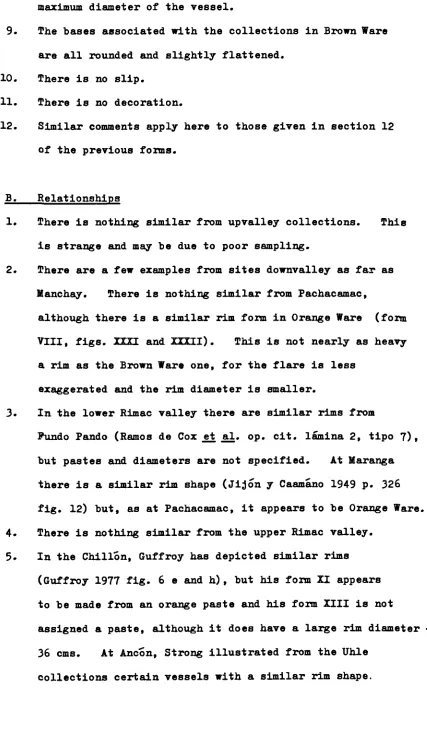
maximum diameter of the vessel.
9. The bases associated with the collections in Brown Ware are all rounded and slightly flattened.
10. There is no slip.
11. There is no decoration.
12. Similar comments apply here to those given in section 12 of the previous forms.
B. Relationships
1. There is nothing similar from upvalley collections. Thia is strange and may be due to poor sampling.
2. There are a few examples from sites downvalley as far as !anchay. There is nothing similar from Pachacsmac,
although there is a similar rim form in Orange Ware (form VIII, figs. !IIi and 1-1111). This is not nearly as heavy a rim as the Brown Ware one, for the flare is less
exaggerated and the rim diameter is smaller.
3. In the lower Rimac valley there are similar rims from
Pundo Pando (Ramos de Cox et al. op. cit. lznina 2, tipo 7), but pastes and diameters are not specified. At Maranga there is a similar rim shape (Jij6n y Caazn.no 1949 p. 326 fig. 12) but, as at Pachacamac, it appears to be Orange Ware.
4. There is nothing similar from the upper Riniac valley. 5. In the Chil1n, Guffroy has depicted similar rims
(Gu.tfroy 1977 fig. 6 e and h), but his form XI appears to be made from an orange paste and his form XIII is not
assigned a paste, although it does have a large rim diameter -36 cms. At Ancn, Strong illustrated from the Uhle
(Strong 1925 plate 44 a, d, h, m). These resemble the ones mentioned by Jij6n for Maranga, but they are not plainware and the vessel shape is not the one that I have hypothesised for form IV. They are placed in Middle Anc6n II.
6. There is nothing similar from Chilca.
7. There
iB
nothing similar from Huarochiri.8. The general rim profile is similar to that of certain rims in the Chancay Black on White style, although these are usually much smaller in diameter and made in a different paste.
C. Dating
The form is dated as LIP and as just lasting into the LII on grounds 2 a, b and c. Although it is found on the surface mingled with LII sherds, it is also found at several sites that have no Cuzco-style pottery or form I, such as 160, 166, 90,
71 and 87. The fact that there is only one specimen from the
this period. At both these sites the lip treatment resembles that of form I (fig. VII 1).
Brown Ware - form V Sample - 39 rims Figure VII j -and Fi gure VIII
A. Description
1. This is a rare form with a restricted distribution.
2. It is not found in the Huaycn or Piedra liza sectors
of the study area, but only from Chontay upwards.
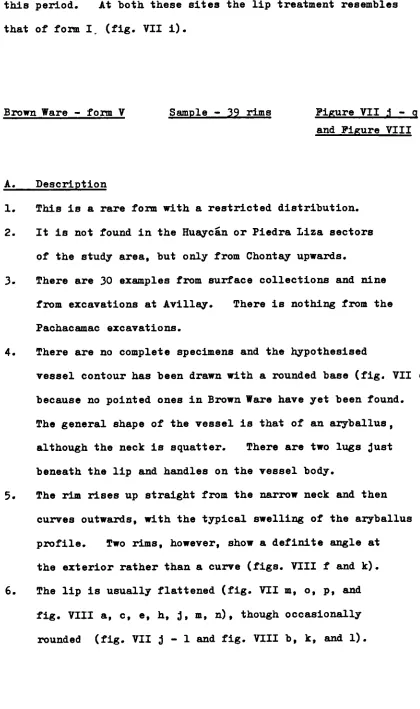
3. There are 30 examples from surface collections and nine
from excavations at Avillay. There is nothing from the Pachacamac excavations.
4. There are no complete specimens and the bypothesised
vessel contour has been drawn with a rounded base (fig. VII q)
because no pointed ones in Brown Ware have yet been found. The general shape of the vessel is that of an aryballus, although the neck is squatter. There are two lugs just beneath the lip and handles on the vessel body.
5. The rim rises up straight from the narrow neck and then curves outwards, with the typical swelling of the aryballus profile. Two rims, however, show a definite angle at the exterior rather than a curve (figs. VIII f and k). 6. The lip is usually flattened (fig. VII a, o, p, and
7a. The rim diameter varies between 5 and 20 cma, the average being 11 cms. This is vexy much within the range for aryballi.
7b. Because of the incompleteness of so many rims it is harder to be accurate about rim height, but the measurable samples give a range from 4.5 to -8.5 cbs.
The upper limit is probably too low.
8. Handles were probably of the strap variety and vertically placed, because no other kind has yet been found. One or two specimens still show small pierced lugs just below the lip (fig. VII n).
9. There is no information about the base, which is most likely to have been rounded.
10. There is no slip.
11. There is no decoration.
12. Its function is not certain, but it is likely to have been used for the storage of liquids and maize in grain form. Such a form in plainware, although with a pointed base, is associated with storehouses at Hua'nuco Pampa (Morris 1971 p. 139).
B. Relationships
1. The form is found sporadically upvalley.
2. It has not been noted in the collections downvafley, nor yet at Pachacaznac.
3. There is nothing similar from the lower Rimac.
6.
At Chilca Bonav^a depicts a
formsomewhat
similar,made
from
a coarse red-brown paste (Bonavla 1958,
].ninaVII-29),
but the rim does not curve outwards as much as the Lurin
examples do.
7.
There is nothing similar
fromHuarochirl.
8.
It is worth nothing that in other parts of Peru Cuzco forms
are copied in local pastes and left undecorated. For
example, as stated previously, most
of the aryba].li foundin the storage houses at Hu gnuco Pampa were
plainand,
nearer Cuzoo, Rivera describes a type called "Chinchero
Llano", which includes forms such as the one
shown here(Rivera 1976 pp. 35-39).
C. Dating
This
form
is dated as LH on grounds 1 b, c, and d.It is true that it is not found in any LH context at
Pachacamac,
but it is found at Avillay in pits 1 to 3, and in pit 8, allBrown Ware - form VIA Sample - 17 rims Figure IX a - m
A. Description
1. This is a very rare form.
2. With the exception of two examples from site 164
(fig. IX a and j), all rims are found in the downvalley Huayc.n sector of the study area.
3. All the rims come from surface collections.
4. There is no complete vessel, though it was probably never a very large one, because the maximum rim diameter is 16 cms. The vessel has been hypothesised as globular
(fig. IX n), because of the similarities between its rim and that of Orange Ware form VI (fig. XXIX b).
The handles are vertical and placed on the upper shoulder. 5. The rim rises either straight from the neck (fig. IX a, c,
d, f - h, i and k), or with a very slight outward flare (fig. IX b, e, j, 1 and in). At the neck the interior angle formed by the juncture of rim and shoulder is obtuse, or, in two cases, a right angle (fig. IX f and i).
6. The lip is rounded and sometimes thinned (fig. IX f and g). Some specimens have a slight exterior bevel (fig. IX j and k) and one is slightly evened (fig. IX in).
7. Rim diameters vary between 8 and 16 cina. 8. The rim height varies between 1.65 and 5 cma.
9. Two sherds show traces of handles. In one specimen these were placed at the juncture of neck and shoulder (fig. IX g), and in the other they are 3 cms lower
round, as with other Brown Ware forms. 10. There is no slip.
11. There is no decoration.
12. Its function could be either for storage or for cooking.
B. Relationships
1. There is nothing similar from upvalley. 2. There is nothing similar from downvalley.
3. n the lower Rimac valley its nearest equivalent in plainware is type 5 at Pundo Pando (Ramos de Cox
. 1znina 2, lowest drawing under tipo 5), but no information is given on the paste for this type. 4. There is nothing similar from the upper Rimac.
5. In the Chill6n, Guffroy illustrates similar rims from Checta, although these have a flatter lip (Guffroy 1977 lamina 6g). Their rim diameters are from 12.50 to 15 cms, which is within the range of the Lurin specimens. However, it is not made clear in the text from which of Guffroy's six pastes these rims are made.
6. There is nothing similar from Chilca. 7. There is nothing similar from Huarochirl.
8. There is nothing similar from elsewhere.
C. Dating
This form is assigned an LIP date on ground 2 a. Its complete absence from all excavations, both mine at Panquilnia
were being manufactured during the LH it ought to have occurred in one of the pits. In the Huaycn sector it occurs at sites with no Cuzco or form I sherds (31 and 33 for example), which is the main reason for assigning it to an earlier period.
Brown Ware - form VIB Sample - 45 rims Figure IX o - bb Figure 1 a - k
A. Description
1. This is a rare form.
2. It is evenly distributed among all sectors of the study
area. It is not found at Pachacamac.
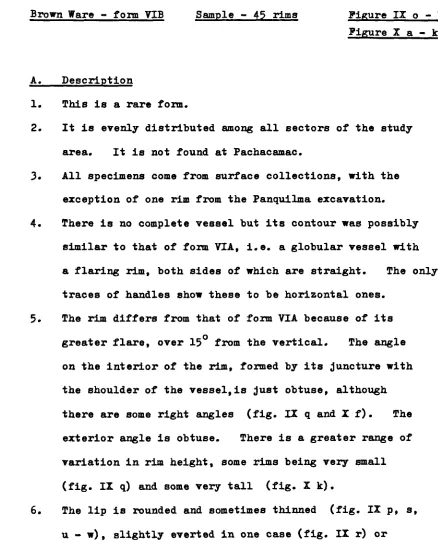
3. All specimens come from surface collections, with the exception of one rim from the Panqui].ma excavation. 4. There is no complete vessel but its contour was possibly
similar to that of form VIA, i.e. a globular vessel with a flaring rim, both sides of which are straight. The only traces of handles show these to be horizontal ones.
5. The rim differs from that of form VIA because of its greater flare, over 150 from the vertical. The angle on the interior of the rim, formed by its juncture with the shoulder of the vessel,ia just obtuse, although there are some right angles (fig. IX q and I f). The exterior angle is obtuse. There is a greater range of variation in rim height, some rims being very small (fig. IX q) and some very tall (fig. I k).
6. The lip is rounded and sometimes thinned (fig. IX p, 8,
given a slight exterior bevel (fig. I b, g and j).
7a. Rim diameters vary between 8 to 24 cms, with the majority clustering between 10 and 18 cms.
7b. The rim height varies between 1.5 and 6.5 ems, both these being extreme cases, for the majority fall between 2 and 4 cms.
8. The only handles, found on a specimen from site 164
(fig. IX v), are set horizontally and are about 2 cms wide. They are 1 cm from the neck.
9. As with other Brown Ware bases, it is likely to have been round.
10. There is no slip.
11. There is no decoration.
12. It was probably a multi-purpose vessel.
B. Relationships
1. There are a few examples from upvalley.
2. There are at present no examples from downvalley. 3. There is nothing similar from the lower Rimac. 4. There is nothing similar from the upper Rimac.
5. In the Ch.tlln Guffroy illustrates a foxn from Pucara,
which is also made from a brown paste (Guffroy 1977 fig. 6d). The rim diameters, however, are larger than those of the Lurin, being from 25 to 35 cms.
6. There is nothing similar from Chilca.
7. There are possible examples from Huarochirl (cf. fig. XCVIII h), but the collections there have few complete
8. There Is nothing similar from elsewhere. It may be worth noting that this form shows some similarities with form YB in Orange Ware (cf, fig. XXVI).
C. Dating
It is assigned an LIP date on ground 2 a and for similar reason8 to those given for the previous form. It comes from layer 10 of the Panquilma excavation, a layer associated with a small structure possibly antedating the LH. Its absence from any of the well-documented U! excavations at Avillay and Pachacamac and its appearance at such sites as 177 and 160, which have no Cuzco-. style sherds, are also significant in its dating.
4.
Brown Ware - form VII Sample - 23 rims Figure X 1 - bb
A. Description
1. This is a very rare form.
2. It is found in the upvalley portion of the study area from Chontay to Sisicaya, except for one occurrence at site 51 in Huaycn.
3. All rims come from surface collections.
4. There are no complete vessels and since existing rims do not extend more than a couple of centimetres below the neck, no complete form has been hypothesised.
straight contours, the interior profile being convex and the exterior concave.
6. The lip is rounded (fig. I 1 - m, aa, bb) and sometimes thickened (fig. I o - or occasionally flattened (fig. I r, s, w - y).
7a. The rim diameter varies from 9 to 18 cms. 7b. The rim height varies from 2.80 to 5.50 ems. 8. There is no evidence for any handles.
9. There is no evidence for the base. 10. There is no slip.
11. There is no decoration.
12. Its function was probably multiple, as with other Brown Ware vessels.
B. Relationships
1. There is nothing similar from upvalley. 2. There is nothing similar from dowzivalley. 3. There is nothing similar from the lower Rimac. 4. There is nothing similar from the upper Rimac.
5. In the ChilThn Gulfroy's form IV from Santa Rosa de Quives II shows a certain similarity to this one (Guffroy 1977 fig. 5 f.), although the flare is less pronounced. Unfortunately he does not give a paste description for this form.
6. There is nothing similar from Chilca.
7. Prom Iuarochir1 there are some similar forms (fig. XCVIII 1) that Thatcher dates as LIP. These are also in a brown
paste.
height is less (2.5 to 3.5 cuts), (Earle 1969 p.18 table 3; p.47 fig. 4). Earle thought the form was prevalent
upval].ey although it is also found at Pachacamac (fig. XCVII 1).
C. Dating
It is dated as early LIP going back into the MH on the ground 2 c. It is not found in any LH excavation at Avillay or Pachacamac. On the other hand it is not found at those
sites with a fair amount of sherd material, but that lack Cuzco-style pottery. Given its general similarities to the EIP form and that the sites where it does occur, such as 137, 164 and 113, all have occupations of this earlier period, it seems likely that its date is closer to the ML It is interesting that the forms described by Guffroy come from a site dated EIP to MH (Gu.ffroy 1977 p.49).
Brown Ware - form VillA Samp le - 15 rims Figure XI
A. Descrj.ption
1. This is avery rare form.
2. It is found only in the upvalley portion of the study area around Sisicaya.
3. There are eleven rims from surface collections and four from excavations at Avillay.
4. There are no complete vessels, but because of the
or globular with vertical strap handles and a rounded base. 5. The rim is a tall straightish collar that in most cases
expands slightly outwards in its upper third. Its
interior varies from an almost straight line (fig. XI j) to a concave curve. The exterior has a convex profile, though in one case it has become an inverted "S" shape (fig. XI f).
6. The lip is flattened and thickened to overhang the interior as with fonu I (fig. XI a - d, f, i, j and in). In some cases it is merely rounded and/or thinned (fig. XI e, g, h and o).
7a. The rim diameter varies between 8 and 25 cms.
7b. The rim height varies between 7 and 10+ cms. Its height distinguishes it from form I vessels.
8. Because of its similarities to form I the handles were probably strap and vertically placed at the maximum diameter of the vessel body.
9. The base was probably rounded.
10. Most specimens have no slip, but some from Nieve Nieve (site 136) have a red slip.
11. There is no decoration.
12. Large sherds found scattered over the site of Nieve Nieve are from almost complete vessels. There is no evidence of carbonisation on the exterior, so the vessel is likely to have had a storage function.
B. Relationships