R E S E A R C H A R T I C L E
Open Access
Impact evaluation of a school-based oral
health program: Kuwait National Program
Aishah Alsumait
1*, Mohamed ElSalhy
2, Sahar Behzadi
1, Kim D. Raine
3, Rebecca Gokiert
4, Ken Cor
5,
Sabiha Almutawa
1and Maryam Amin
6Abstract
Background:This study evaluated the relationship between enrolment in a school-based oral health prevention
program (SOHP) and: 1) children’s dental health status and oral health-related quality of life (OHRQoL), and 2) mothers’ oral health (OH) knowledge, attitude, practice, and OHRQoL.
Methods:This cross-sectional study, in the Kuwait Capital, included 440 primary school children aged 11 to 12 years and their mothers. Participants were classified into two groups: SOHP and non-SOHP. The SOHP group had been enrolled in the prevention program for at least 3 years: children had twice-a-year applications of fluoride varnish and fissure sealants if needed; mothers had, at least, one oral health education session. The non-SOHP group had negative consents and had not been exposed to the prevention program activities. Dental examinations were performed at schools using portable dental units. Caries experience was determined using the decayed (D/d), missing (M/m), and filled (F/f) teeth (T/t)/surface (S/s) indices. Children’s OHRQoL was assessed using a self-administered validated Child Perceptions Questionnaire 11–14 (CPQ11–14). Mothers’OH knowledge, attitude, practice, and OHRQoL were also assessed. After Bonferroni correction, ap-value of less than 0.05 was considered statistically significant for caries experience measures while a p-value of less than 0.013 was considered statistically significant for OHRQoL subscales and mothers’OH knowledge, attitude, practice, and OHRQoL.
Results:Mean (SD) DT/dt, DMFT/dmft and DMFS/dmfs were 1.41 (1.66), 2.35 (2.33), and 4.41 (5.86) for SOHP children, respectively. For non-SOHP children, the means were 2.61 (2.63), 3.56 (3.05), and 7.24 (7.78), respectively. The difference between the SOHP and non-SOHP was statistically significant (p< 0.001). Children enrolled in the program had a higher number of sealed and restored teeth. No significant differences were found in CPQ11–14 scores or subscale scores between the two groups. No significant difference in mothers’OH knowledge, attitude, practices or OHRQoL was found between SOHP and non-SOHP groups (P> 0.013).
Conclusion:Enrolment in the SOHP prevention services was associated with a positive impact on children’s caries level with no significant impact on mothers’knowledge, attitude, practice, or OHRQoL.
Keywords:Children, Caries, Mothers, Knowledge, Oral health quality of life
Background
Worldwide, dental professionals struggle to improve public oral health. School-based programs have been established to provide prevention services, including oral health, for school-aged children [1, 2]. These programs can benefit a wide group of children at minimum cost, especially those who are less likely to receive dental care due to economic
limitations and limited exposure to fluoride [2]. In fact, using the school as a setting for oral health promotion in-terventions was recommended in 2002 by the World Health Organization (WHO). Activities in school programs have included oral health education/promotion, supervised tooth brushing, fluoride and fissure sealant application, and/or various treatments. These activities can shape chil-dren’s health-related beliefs, attitudes, values and behaviors. In addition, evidence suggests that oral health services in childhood can influence a healthy lifestyle into adulthood [3, 4]. Although school-based oral health education has
© The Author(s). 2019Open AccessThis article is distributed under the terms of the Creative Commons Attribution 4.0 International License (http://creativecommons.org/licenses/by/4.0/), which permits unrestricted use, distribution, and reproduction in any medium, provided you give appropriate credit to the original author(s) and the source, provide a link to the Creative Commons license, and indicate if changes were made. The Creative Commons Public Domain Dedication waiver (http://creativecommons.org/publicdomain/zero/1.0/) applies to the data made available in this article, unless otherwise stated.
* Correspondence:[email protected]
1National School Oral Health Program, Ministry of Health, PO Box No 5338,
22064 Salmiya, Kuwait
been found to be effective in promoting oral hygiene and improving oral health knowledge and practices [5,6], there is a research gap in the literature on the impact of multi-ap-proach preventive programs [1].
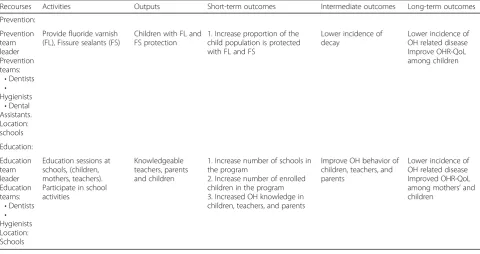
In 1983, the Kuwaiti government established the School Oral Health Program (SOHP) in the capital re-gion. The program is a partnership between the Kuwaiti Ministry of Health and the Forsyth Institute, Cambridge, U.S.A., in reaction to the 80% caries rate found in the 1982 national oral health survey [7]. The SOHP was established to provide dental education, prevention, and treatment for children between the ages of 6 and 14 years. These prevention services are offered through mo-bile clinics at the schools, preventive services, and cen-ter-based clinics (See Table 1 for the logic model associated with SOHP). The program provided dental care for approximately 300,000 school children, with 60–70% of these children receiving preventive (general oral health education, tooth-brushing education services, fluoride varnish, fissure sealants) or therapeutic dental care-treatment in 2004 [7].
The Kuwaiti School Oral Health Program has the fol-lowing broad goals: (1) reduce the prevalence of dental caries among school children by increasing the propor-tion of caries-free children; (2) reduce the severity of dental caries; and (3) improve the oral health status among this population through oral health education in-volving parents, teachers and children [7]. Most of the children enrolled in the program receive fluoride varnish
applications, and about half of them have at least one sealed tooth. Around 4000 h are spent annually on edu-cation, including special sessions conducted for children, parents, and teachers in the schools [7].
Oral health-related quality of life (OHRQoL) reflect sub-jective indicators of oral health status and its impact on various aspects of life [8]. It is based on information pro-vided by individuals. OHRQoL measures provide essential information when assessing the treatment needs of individ-uals and populations. They are also important for making clinical decisions and evaluating interventions, services, and public health programs [9,10]. OHRQoL can be measured using four domains: oral symptoms, functional limitations, social well-being, and emotional well-being. OHRQoL do-mains are interconnected and affect one another. Dental health status was shown to have a direct impact on chil-dren’s overall OHRQoL [11].
Four national oral health surveys were conducted by SOHP in 1982, 1985, 1993, and 2001 to determine the dental health status of children aged 5–15 years. The sur-veys showed no improvement in dental caries incidence in the population [12,13]. As these surveys do not differenti-ate between SOHP enrolled and non-enrolled children, they cannot reflect the effectiveness of the program. The impacts of the SOHP components had not been fully eval-uated. Therefore, this study aimed to examine the rela-tionship between enrolment in a school-based oral health program (SOHP) and (1) children’s dental health status and Oral Health-Related Quality of Life, and (2) mothers’
Table 1School prevention and education logic model
Recourses Activities Outputs Short-term outcomes Intermediate outcomes Long-term outcomes Prevention:
Prevention team leader Prevention teams:
•Dentists
•
Hygienists
•Dental Assistants. Location: schools
Provide fluoride varnish (FL), Fissure sealants (FS)
Children with FL and FS protection
1. Increase proportion of the child population is protected with FL and FS
Lower incidence of decay
Lower incidence of OH related disease Improve OHR-QoL among children
Education: Education team leader Education teams:
•Dentists
•
Hygienists Location: Schools
Education sessions at schools, (children, mothers, teachers). Participate in school activities
Knowledgeable teachers, parents and children
1. Increase number of schools in the program
2. Increase number of enrolled children in the program 3. Increased OH knowledge in children, teachers, and parents
Improve OH behavior of children, teachers, and parents
oral health knowledge, attitude, and practice, and OHRQoL.
Methods
Study design
This is a cross-sectional study of mother-child dyads from randomly selected public schools at Kuwait Capital School District. The University of Alberta Research Eth-ics Board (Protocol #0037434), together with the Joint Committee for the Protection of Human Subjects in Re-search of Kuwait, approved the study protocol. Further-more, the research was conducted in adherence with the Helsinki Declaration and the STrengthening the Report-ing of OBservational studies in Epidemiology (STROBE) guidelines, and the parents/guardians of each participat-ing child granted their written informed consent.
Participants and setting
The research was conducted for 6 months during the 2013–2014 academic year in the Capital Education/ Health Region in Kuwait. Approximately 85% of children residing in Kuwait attend the public schools. Seven schools were randomly selected from a school list pro-vided by the Ministry of Education Research Depart-ment. Within these seven schools, children aged 11–12 and their mothers were selected to participate. Partici-pants were classified into two groups; SOHP and non-SOHP. The SOHP participants had been enrolled in the prevention program of the SOHP for at least 3 years. These children received, at least, one oral health educa-tion session, two applicaeduca-tions of fluoride varnish, and (if eligible) fissure sealants. Non-SOHP participants had negative consents and had not been exposed to the pro-gram preventive activities.
A required sample size of 370 participants was calcu-lated based on the number of children in the capital re-gion (16,361 children) using type I error of 0.05, sampling error of 0.05, with a goal to achieve an esti-mated proportion of children enrolled in the SOHP of 0.5. A 75% positive response rate was expected, so a total of 500 consent forms were distributed.
Procedure
Trained field assistants gave a 5-min presentation to the children about the study and sent an information letter and consent form home with them for their parents to sign. Once the children’s consent was obtained, field as-sistants administered structured questionnaires. Clinical examinations were performed at school clinics using fully equipped mobile dental chairs and sterile WHO probes and mirrors.
Outcome measures
Children’s dental examinations
Clinical examinations were conducted at the school clinics to assess the normative needs of the children. The exami-nations, which were carried out by one calibrated exam-iner, were carried out in adherence to the oral health criteria recommended by the WHO. The examiner had already used the WHO criteria during the Kuwait Na-tional School Oral Health Survey (2013–2014). The exam-iner was blinded for the SOHP status.
The primary equipment comprised a mobile dental chair, artificial LED light, and a dental unit. High intra-examination and inter-intra-examination consistency (kappa = 0.91 and 0.83, respectively) were shown by the examiner. Evaluations of differences between cavitated and non-cavi-tated lesions followed criteria outlined in the guidelines of the International Caries Detection and Assessment System (ICDAS) (https://www.icdas.org). Additionally, the Sil-ness-Löe plaque index [14] was used to evaluate the oral hygiene of participating children, while the PUFA index [15] measured the clinical consequences of the partici-pants’untreated dental caries.
Decayed teeth (DT/dt), missing teeth due to caries (MT/mt), filled/restored teeth (FT/ft), DMF teeth (DMFT/dmft), and DMF surfaces (DMFS/dmfs) indices were used during the examination. Additional indices ap-plied during the examinations included the number of sealed teeth, the number of non-cavitated teeth, the re-storative care index (RI) [16] and the plaque index (PI). The PUFA index (for comprehensive oral health examin-ation purposes) was also used.
Children’s OHRQoL
In the questionnaire, children were asked to give their oral health a global rating and to describe the impact of their oral health status on their general well-being. The following information was used as a dependent variable in the analysis as a further indicator of OHRQoL. Across the two questions, the response options are: “Excellent”= 0,
“Very good”= 1, “Good”= 2, “Acceptable”= 3 and
“Poor”= 4 for the global rating; and“Not at all”= 0,“Very little”= 1,“Somewhat”= 2,“A lot”= 3 and“Very much”= 4 for impact on general well-being.
Questions related to perceptions around the impacts of oral health were grouped into the following four domains: oral symptoms (6 questions), functional limitations (9 questions), emotional well-being (9 questions), and social well-being (12 questions). Participants were given five pos-sible response options. The options were Never (0), Once or twice”(1), Sometimes (2), Often (3), and Everyday or Almost Everyday (4) to be applied within a recall period of 3 months. From these responses, domains and overall OHRQoL scores on the questionnaire were calculated by adding up the responses of the items in the domains or the whole questionnaire. Low scores indicated a better OHRQoL.
Prior to administering the questionnaire for research purposes, the Arabic-version questionnaire was given to a small group of participants as a‘pre-test’. Based on partici-pants’ responses, terms and phrases that were unclear were reworded to make them easier for the children to understand. A total of 118 questionnaires were adminis-tered twice (for a grand total of 236), with a 14-day gap between the administration of the initial pre-test and the repeat of the modified pre-test. The kappa scores for the pre-test/pre-retest questionnaires were 0.87–1.0. The reli-ability results were done with children from two of the se-lected schools.
For the CPQ11–14 questionnaire and each subscale, Cronbach’s alpha was used to quantify internal consistency, while the agreement was measured using the intra-class correlation coefficient of the repeated question-naires. The item response rate was 100%, with the results suggesting high levels of internal consistency for the ques-tionnaire. As tested by Cronbach’s alpha for the overall CPQ11–14 in the sample, reliability was 0.91. Internal consistency coefficients for emotional and social well-be-ing subscales were excellent, measurwell-be-ing 0.83 and 0.81, re-spectively. However, the alpha coefficient for the functional limitation subscale was acceptable (0.7), but only moderate (0.58) for the oral symptoms subscale. The intra-class correlation coefficient for repeated applications of the measure was excellent at 0.89 (95% CI = 0.76–0.97).
Mothers’knowledge, attitude, practice, and OHRQoL Mothers were the second target population for the SOHP. According to a previously published report among the
Kuwaiti population, mothers were the main caregiver and had a high influence on children’s oral health status [18]. A questionnaire on the mothers’oral health knowledge, atti-tude, practice and OHRQoL was used in this study. It was initially prepared in English and translated into Arabic. Then two independent translators, to check for the cor-rectness of the messages conveyed, translated it back into English. Questions included in the questionnaire have been used in previously published studies [19,20].
In addition to a section on demographics (i.e., age, educational attainment, and number of children), the questionnaire consisted of four sections. The first sec-tion included 14 quessec-tions that assessed the participants’ oral hygiene knowledge. Questions were about the asso-ciation between oral bacteria and systemic diseases, transmission of bacteria from parent to child, soft drinks and tooth wear, sugar intake and caries, the frequency of brushing and flossing, type of toothbrush and replace-ment frequency, dental check-up frequency, and use of fluoridated toothpaste. The second section consisted of six questions about attitudes toward OH including the importance of OH for overall health, the relationship be-tween healthy diet and healthy teeth, the exclusion of unhealthy foods from school premises, the inclusion of oral health topics in the school curriculum, and mothers as oral health educators and role models for their chil-dren and students in general. The participants’ oral health-related behaviors (e.g., last dental visit, brushing and flossing frequency, use of fluoridated toothpaste, etc.) were explored in the third section.
The final section asked about the participants’ OHR-QoL in three domains: physical, social, and psychological (self-esteem) impairments. The questions asked partici-pants how often oral health problems affected their daily/social activities, and whether the appearance of their teeth caused them to avoid conversation.
Data analysis
considered statistically significant for oral health indica-tors while p-value of less than 0.013 was considered sta-tistically significant for OHRQoL subscales and Mothers’ knowledge, attitude, practice, and OHRQoL.
Results
Characteristics of the studied population
Signed consent forms with respective parent authoriza-tions were returned by 449 participating children, giving a response rate of 88%. Of these 449, nine participants were excluded due to the presence of a systemic disorder which may affect oral health status (as reported by the parents), or due to the child’s uncooperative behavior ei-ther during the clinical examination or the administra-tion of the quesadministra-tionnaire.
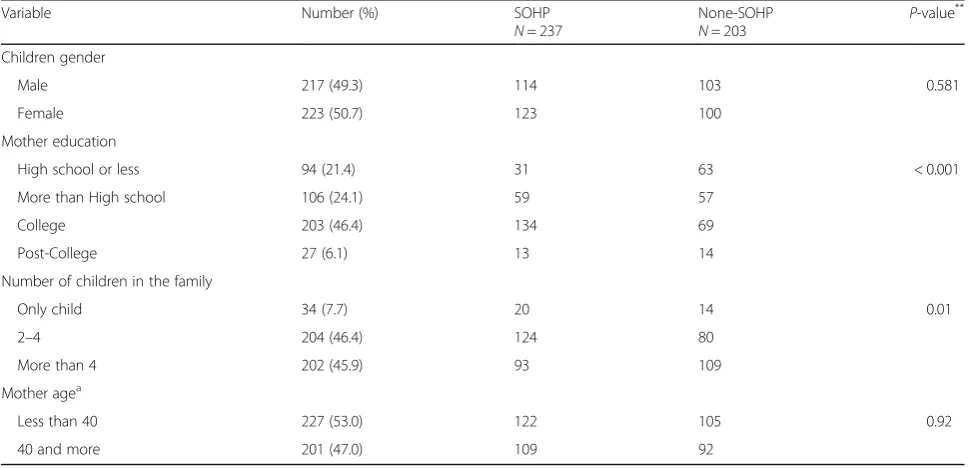
Four hundred and forty children were included in the final sample, of which 49.3% were male. Approximately half (46.4%) of the children were from families with 2–4 offspring while less than a tenth (7.7%) of the partici-pants had no siblings. Nearly half of the mothers had earned a post-secondary degree and were 39 years of age or younger. Table 2 presents participants’ demographic summary.
Participants’OH indicators
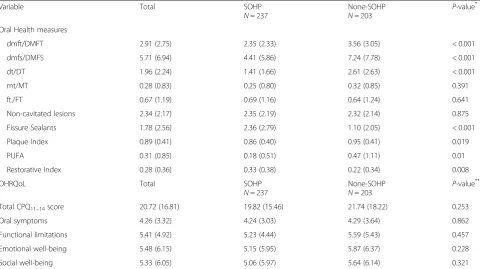
Mean (SD) DT/dt was 1.96 (2.24) while the mean DMFT/dmft and DMFS/dmfs were, 2.91(2.75), and 5.71 (6.94), respectively. About 23.9% of the children had a DMFT/dmft of zero. The mean number of non-cavitated carious teeth per child was 2.34 (2.17) while the mean
sealed teeth was 1.78 (2.56). The mean restorative index was 0.21 (0.34), the plaque index was 3.59 (1.63), and the PUFA index was 0.31 (0.85). Children’s dental health status according to the demographics was reported in a previous paper [21].
The children enrolled in the SOHP had significantly lower DMFT/dmft (P< 0.001), DMFS/dmfs (P< 0.001), dt/Dt (P< 0.001) scores than non-enrolled children. In addition, they had a higher number of teeth with fissure sealants. The children’s dental health status according to their SOHP enrollment is summarized in Table3.
Having adjusted for potential confounding factors (i.e., gender, number of children, mother’s age, and mothers’ OH knowledge) in the Poisson regression analysis, we have found that enrolment in the SOHP was the only predictors for DMFT/dmft, DMFS/dmfs, DT/dt, and number of sealants (Table 4). The prevalence rate for caries/caries experience was about 50% less in children enrolled in the SOHP while the prevalence rate of seal-ants was 2.8 times those not enrolled in the SOHP.
Children’s oral health-related quality of life
The average (SD) total CPQ11–14score was 20.72 (16.81). The oral symptoms subscale score was 4.26 (3.32); func-tional limitations score was 5.40 (4.92), emofunc-tional well-being score was 5.48 (6.15), and social well-being score was 5.33 (6.05). Nearly 78% of the participating children evaluated their oral health as being excellent or very good, and 5% evaluated it as being fair or poor. The mean overall self-evaluation of the effect of OH on their life was 0.69 (0.95).
Table 2Basic Demographics of participants according to SOHP enrolment
Variable Number (%) SOHP
N= 237
None-SOHP
N= 203
P-value** Children gender
Male 217 (49.3) 114 103 0.581
Female 223 (50.7) 123 100 Mother education
High school or less 94 (21.4) 31 63 < 0.001 More than High school 106 (24.1) 59 57
College 203 (46.4) 134 69 Post-College 27 (6.1) 13 14 Number of children in the family
Only child 34 (7.7) 20 14 0.01 2–4 204 (46.4) 124 80
More than 4 202 (45.9) 93 109 Mother agea
Less than 40 227 (53.0) 122 105 0.92 40 and more 201 (47.0) 109 92
SOHPSchool Oral Health Program
**
Chi-Square test. Significant at the levelp< 0.05
a
Table 3Children’s mean (SD) OH measures and OHRQoL scores according to SOHP enrolment
Variable Total SOHP
N= 237
None-SOHP
N= 203 P -value* Oral Health measures
dmft/DMFT 2.91 (2.75) 2.35 (2.33) 3.56 (3.05) < 0.001 dmfs/DMFS 5.71 (6.94) 4.41 (5.86) 7.24 (7.78) < 0.001 dt/DT 1.96 (2.24) 1.41 (1.66) 2.61 (2.63) < 0.001 mt/MT 0.28 (0.83) 0.25 (0.80) 0.32 (0.85) 0.391 ft./FT 0.67 (1.19) 0.69 (1.16) 0.64 (1.24) 0.641 Non-cavitated lesions 2.34 (2.17) 2.35 (2.19) 2.32 (2.14) 0.875 Fissure Sealants 1.78 (2.56) 2.36 (2.79) 1.10 (2.05) < 0.001 Plaque Index 0.89 (0.41) 0.86 (0.40) 0.95 (0.41) 0.019 PUFA 0.31 (0.85) 0.18 (0.51) 0.47 (1.11) 0.01 Restorative Index 0.28 (0.36) 0.33 (0.38) 0.22 (0.34) 0.008 OHRQoL Total SOHP
N= 237
None-SOHP
N= 203
P-value**
Total CPQ11–14score 20.72 (16.81) 19.82 (15.46) 21.74 (18.22) 0.253
Oral symptoms 4.26 (3.32) 4.24 (3.03) 4.29 (3.64) 0.862 Functional limitations 5.41 (4.92) 5.23 (4.44) 5.59 (5.43) 0.457 Emotional well-being 5.48 (6.15) 5.15 (5.95) 5.87 (6.37) 0.228 Social well-being 5.33 (6.05) 5.06 (5.97) 5.64 (6.14) 0.321
SOHPSchool Oral Health Program,D/ddecayed,F/ffilled,M/mmissing,S/ssurface,Tpermanent teeth,tprimary teeth,PUFAPulp, Ulcer, Fistula, Abscess,CPQ11–14 Child Perception Questionnaire among 11- to 14 year-old children
*
t-test with Bonferroni correction. Significant at the levelP< 0.005
**
t-test with Bonferroni correction. Significant at the levelP< 0.001
Table 4Poisson regression analysis final models predicting children OH indicators significantly associated with SOHP enrolments
Variables PRa P-value 95% CI
Lower limit Upper limit DMFT
Constant 3.613 < 0.001 2.449 5.330 Enrolment in the SOHP (No/Yes) 0.582 < 0.001 0.510 0.664 DMFS
Constant 8.120 < 0.001 6.161 10.702 Enrolment in the SOHP (No/Yes) 0.512 < 0.001 0.466 0.561 DT/dt
Constant 2.728 < 0.001 1.704 4.366 Enrolment in the SOHP (No/Yes) 0.450 < 0.001 0.385 0.526 Number of sealants
Constant 0.713 0.226 0.412 1.233 Enrolment in the SOHP (No/Yes) 2.825 < 0.001 2.157 3.700
SOHPSchool Oral Health Program,D/ddecayed,F/ffilled,M/mmissing,S/ssurface,Tpermanent teeth,tprimary teeth
a
More than 80% of children reported that their OHRQoL were “not at all or very little” affected, and 5% reported that it affected their life“a lot or very much.” Children’s OHRQoL according to demographics was previously re-ported [21].
There was no significant difference between SOHP-en-rolled and -non-enSOHP-en-rolled children in their total CPQ11–14 score or subscales (P> 0.013) (Table3).
Mothers’knowledge, attitude, practice and OHRQoL
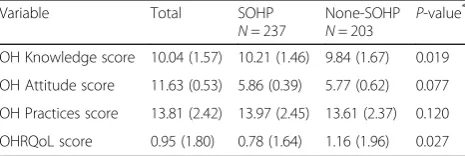
No significant difference in mothers’OH knowledge, at-titude, practices or OHRQoL was found between SOHP and non-SOHP groups (P > 0.013). The mothers’ mean knowledge, attitude, practice, and OHRQoL scores, ac-cording to SOHP, are summarized in Table5.
Discussion
School oral health programs were recommended by the WHO to be a cost-effective approach to reach and pro-mote oral health in school-aged children and to elimin-ate inequalities in oral health. In the present research, we investigated the effects of oral health education and preventive interventions on the dental health of school-aged children. To assess the effectiveness (impact evalu-ation), we chose common variables to measure dental caries, oral hygiene, and quality of life. Overall, children enrolled in the program had better dental health (fewer caries lesion) and enrollment in the program was the main predictor of children’s caries level.
The preventive interventions provided by the SOHP were evidenced-based and recommended by WHO [22]. The effectiveness of fluoride has been acknowledged in caries prevention over the past 40 years, and fluoride var-nish has been the core of numerous oral health interven-tions in school children [23,24]. Fissure sealant has also been recognized as an effective method for prevention of caries on occlusal surfaces in some studies [25]. Our re-sults showed that twice a year fluoride varnish and fissure sealant as part of the school-based prevention activities were effective in reducing dental caries in children.
In Kuwait, all children in the public schools are en-couraged to enroll in the SOHP. Our data indicate that
enrollment in school-based prevention activities was as-sociated with better dental health. Being enrolled in the SOHP influenced children’s level of dental caries, the se-verity of the disease, and oral hygiene status. However, the program had no impact on children’s OHRQoL. We previously reported that the level of dental caries had no impact on children’s OHRQoL [21], a result that was in-consistent with Castro Rde et al. [26]. This inconsistency could be explained by participants’ underreporting due to a lack of oral health literacy among Kuwaiti children, an area which needs more research exploration. Further investigation is required regarding the psycho-social im-pact of dental diseases among the Kuwaiti population.
The second target of the SOHP was the mothers. An ap-propriate level of oral hygiene practices is often the ultim-ate outcome of any oral health education/promotion program [27]. Therefore, the intention of Kuwait SOHP for mothers was also improving their oral health practices through enhancing their knowledge and attitude using the Knowledge-Attitude-Practice (KAP) model. Although mothers of children enrolled in the program had better, but not significantly, oral health knowledge, this was not reflected in their practices. SOHP policy-makers may con-sider adopting different educational and behavior-change models if a change is a target.
The SOHP group had better oral health status than the reported caries prevalence for all schoolchildren in various Kuwaiti governorates [12,13]. The overall mean of the chil-dren’s CPQ11–14 was generally better than that in a study undertaken previously in the region [17] and very similar to studies undertaken in other countries [28]. Published reports have shown that the outcome of preventive care provided through different programs varied based on the local con-text, and more complex interventions tend to have a lower implementation rate [29]. Many countries provide an exten-sive preventive regimen, including fluoride varnish, fissure sealant, and oral health education [7,30] that targets only high-risk populations, and thus evaluating a public health program is a context-sensitive process. It is a challenge to capture such a program’s outcomes in a quantitative study [31], because beyond quantitative measure, the context of the program goals, objectives and resources should also be considered. This could be complemented by a process evaluation (i.e., document review) and qualitative data.
The limitations of this study were twofold: the study de-sign and the evaluation variables. Because this was a cross-sectional study, the causal link between intervention activities and dental health indicators cannot be assessed. For instance, we cannot offer conclusive evidence that fissure sealants reduced the incidence of dental caries. Moreover, the SOHP is the main proxy for free-of-charge dental services in Kuwait, and 90% of children receive mainly therapeutic services in the program’s dental center. Due to many factors confounding the relationship between Table 5Mothers’mean (SD) OH knowledge, attitude, practices,
OHRQoL scores according to SOHP enrolment
Variable Total SOHP
N= 237
None-SOHP
N= 203 P -value*
OH Knowledge score 10.04 (1.57) 10.21 (1.46) 9.84 (1.67) 0.019 OH Attitude score 11.63 (0.53) 5.86 (0.39) 5.77 (0.62) 0.077 OH Practices score 13.81 (2.42) 13.97 (2.45) 13.61 (2.37) 0.120 OHRQoL score 0.95 (1.80) 0.78 (1.64) 1.16 (1.96) 0.027
OHOral Health,OHRQoLOral Health Related Quality of Life,SOHPSchool Oral Health Program
*
the program activities and the dental health status, this study cannot conclude that the SOHP is an effective pro-gram in preventing dental diseases. However, a significant association was detected between enrollment in the school-based prevention intervention and dental health status. Such results could be introduced by selection bias given the assumption that SOPH children being essentially non-responders/decliners.
Conclusions
In conclusion, the Kuwait school oral health program is a comprehensive multicomponent program that had a posi-tive impact on children’s dental health. Children enrolled in the program had lower caries levels. However, no asso-ciation was detected between the program enrollment and children’s OHRQoL or mothers’ oral health knowledge, attitude, practice, and OHRQoL. Quality assurance and improvement approaches have to be implemented for the program to achieve better outcomes. A mixed-method ap-proach can be used to understand the program’s internal-and external-context internal-and how improvement can be accomplished.
Abbreviations
CPQ11–14:Child Perception Questionnaire among 11- to 14-year-old children;
dmfs/DMFS: Decayed, missing, or filled teeth; dmft/DMFT: Decayed, missing, or filled teeth; dt/DT: Decayed teeth; ft/FT: Filled teeth; mt/MT: Missing teeth; OH: Oral Health; OHRQoL: Oral Health-Related Quality of Life; PI: Plaque index; PUFA: Pulp, Ulcer, Fistula, Abscess index; SOHP: School-based Oral Health Program; STROBE guidelines: STrengthening the Reporting of OBservational studies in Epidemiology; WHO: World Health Organization
Acknowledgments
Authors gratefully thank the Ministry of Education Research Department for facilitating the data collection. This paper was part of the Ph.D. dissertation
titled“Evaluation of a Long-Standing School-based Oral Health Program: A
Sequential-explanatory Mixed-method Approach.”
Authors’contributions
AA designed and carried out the study, analyzed the data and drafted the manuscript. SB contributed to the data collection procedure. ME contributed to study design, data analysis, and drafting the manuscript. KR, KC and RG contributed to study design and revising the manuscript. SA contributed to study design, study conduction, and reviewed the manuscript. MA contributed to study design, study conduction, data analysis and manuscript revision. All authors reviewed and approved the final version of the paper.
Funding
This study was supported by the School Oral Health Program. The program only provided logistics and manpower with no role in study design, data collection, data analysis, interpretation of the results or writing the manuscript.
Availability of data and materials
The patients’data will not be shared. However, the datasets used and
analyzed during the current study are available from the corresponding author on reasonable request.
Ethics approval and consent to participate
The University of Alberta Research Ethics Board (Protocol # 0037434), together with the Joint Committee for the Protection of Human Subjects in Research of Kuwait, approved the study protocol. The research was conducted in adherence to the Helsinki Declaration and the STROBE
guidelines, and the parents/guardians of each participating child granted a written informed consent.
Consent for publication
Not applicable.
Competing interests
The authors declare that they have no competing interests.
Author details
1National School Oral Health Program, Ministry of Health, PO Box No 5338,
22064 Salmiya, Kuwait.2College of Dental Medicine, University of New
England, Portland, ME, USA.3School of Public Health, University of Alberta,
Edmonton, Alberta, Canada.4Faculty of Extension, University of Alberta, Edmonton, Alberta, Canada.5Faculty of Pharmacy and Pharmaceutical
Sciences, University of Alberta, Edmonton, Alberta, Canada.6School of
Dentistry, Faculty of Medicine and Dentistry, University of Alberta, Edmonton, Alberta, Canada.
Received: 11 July 2018 Accepted: 21 August 2019
References
1. Cooper AM, O'Malley LA, Elison SN, Armstrong R, Burnside G, Adair P,
Dugdill L, Pine C. Primary school-based behavioural interventions for preventing caries. Cochrane Database Syst Rev. 2013;5:CD009378.
2. Centers for Disease C, Prevention. Promoting oral health: interventions for
preventing dental caries, oral and pharyngeal cancers, and sports-related craniofacial injuries. A report on recommendations of the task force on
community preventive services. MMWR Recomm Rep. 2001;50(RR-21):1–13.
3. Alsumait A, ElSalhy M, Amin M. Long-term effects of school-based oral
health program on oral health knowledge and practices and oral
health-related quality of life. Med Princ Pract. 2015;24(4):362–8.
4. Brownson RC, Haire-Joshu D, Luke DA. Shaping the context of health: a
review of environmental and policy approaches in the prevention of
chronic diseases. Annu Rev Public Health. 2006;27:341–70.
5. Worthington HV, Hill KB, Mooney J, Hamilton FA, Blinkhorn AS. A cluster
randomized controlled trial of a dental health education program for
10-year-old children. J Public Health Dent. 2001;61(1):22–7.
6. Tai B, Du M, Peng B, Fan M, Bian Z. Experiences from a school-based oral
health promotion programme in Wuhan City, PR China. Int J Paediatr Dent.
2001;11(4):286–91.
7. Ariga J, Al-Mutawa S, Nazar H. School oral health program in Kuwait. Med
Princ Pract. 2014;23(Suppl 1):43–6.
8. Gherunpong S, Sheiham A, Tsakos G. A sociodental approach to assessing
children's oral health needs: integrating an oral health-related quality of life (OHRQoL) measure into oral health service planning. Bull World Health
Organ. 2006;84(1):36–42.
9. Jokovic A, Locker D, Stephens M, Kenny D, Tompson B, Guyatt G. Validity
and reliability of a questionnaire for measuring child oral-health-related
quality of life. J Dent Res. 2002;81(7):459–63.
10. Krisdapong S, Sheiham A. Which aspects of an oral health-related quality of
life measure are mainly associated with global ratings of oral health in
children? Community Dent Oral Epidemiol. 2014;42(2):129–38.
11. Barbosa TS, Gaviao MB. Oral health-related quality of life in children: part II.
Effects of clinical oral health status. A systematic review. Int J Dent Hyg.
2008;6(2):100–7.
12. Al-Mutawa SA, Shyama M, Al-Duwairi Y, Soparkar P. Dental caries experience of
Kuwaiti kindergarten schoolchildren. Community Dent Health. 2010;27(4):213–7.
13. Al-Mutawa SA, Shyama M, Al-Duwairi Y, Soparkar P. Dental caries experience
of Kuwaiti schoolchildren. Community Dent Health. 2006;23(1):31–6.
14. Silness J, Loe H. Periodontal disease in pregnancy. II: correlation between oral
hygiene and periodontal condtion. Acta Odontol Scand. 1964;22:121–35.
15. Monse B, Heinrich-Weltzien R, Benzian H, Holmgren C, van Palenstein HW.
PUFA--an index of clinical consequences of untreated dental caries.
Community Dent Oral Epidemiol. 2010;38(1):77–82.
16. Jackson D. Measuring restorative dental care in communities. Br Dent J.
1973;134(9):385–8.
17. Brown A, Al-Khayal Z. Validity and reliability of the Arabic translation of the
child oral-health-related quality of life questionnaire (CPQ11-14) in Saudi
18. Ashkanani F, Al-Sane M. Knowledge, attitudes and practices of caregivers in
relation to oral health of preschool children. Med Princ Pract. 2013;22(2):167–72.
19. Al-Ansari J, Honkala E, Honkala S. Oral health knowledge and behavior
among male health sciences college students in Kuwait. BMC Oral Health. 2003;3(1):2.
20. Kressin NR, Reisine S, Spiro A 3rd, Jones JA. Is negative affectivity associated
with oral quality of life? Community Dent Oral Epidemiol. 2001;29(6):412–23.
21. Alsumait A, ElSalhy M, Raine K, Cor K, Gokiert R, Al-Mutawa S, Amin M.
Impact of dental health on children's oral health-related quality of life: a cross-sectional study. Health Qual Life Outcomes. 2015;13:98.
22. Petersen PE, Kwan S. Evaluation of community-based oral health promotion
and oral disease prevention--WHO recommendations for improved evidence in public health practice. Community Dent Health. 2004;21(4
Suppl):319–29.
23. Paige CJ, Shahid SK. Developing and implementing a fluoride varnish
programme for young children in Bradford, UK. Community Dental Health.
2014;31(1):5–8.
24. Rolnick SJ, Jackson JM, DeFor TA, Flottemesch TJ. Fluoride varnish
application in the primary care setting. A clinical study. J Clin Pediatr Dent.
2015;39(4):311–4.
25. Griffin SO, Oong E, Kohn W, Vidakovic B, Gooch BF, Group CDCDSSRW,
Bader J, Clarkson J, Fontana MR, Meyer DM, et al. The effectiveness of
sealants in managing caries lesions. J Dent Res. 2008;87(2):169–74.
26. Castro Rde A, Portela MC, Leao AT, de Vasconcellos MT. Oral health-related
quality of life of 11- and 12-year-old public school children in Rio de
Janeiro. Community Dent Oral Epidemiol. 2011;39(4):336–44.
27. Morris RE, Gillespie GM, Al Za'abi F, Al Rashed B, Al Mahmeed BE. Aggressive
strategic planning for oral health in Kuwait: a decade of post-war successes. East Mediterr Health J = La revue de sante de la Mediterranee orientale =
al-Majallah al-sihhiyah li-sharq al-mutawassit. 2008;14(1):216–27.
28. Foster Page LA, Thomson WM, Jokovic A, Locker D. Validation of the child
perceptions questionnaire (CPQ 11-14). J Dent Res. 2005;84(7):649–52.
29. Glasgow RE, McKay HG, Piette JD, Reynolds KD. The RE-AIM framework for
evaluating interventions: what can it tell us about approaches to chronic
illness management? Patient Educ Couns. 2001;44(2):119–27.
30. Sagheri D, Hahn P, Hellwig E. Assessing the oral health of school-age
children and the current school-based dental screening programme in
Freiburg (Germany). Int J Dent Hyg. 2007;5(4):236–41.
31. Protheroe J. Communicating risk: but does it work, doctor? BMJ. 2003;
327(7428):1404.
Publisher’s Note