Open Access
Software article
A basic analysis toolkit for biological sequences
Raffaele Giancarlo*, Alessandro Siragusa, Enrico Siragusa and Filippo Utro
Address: Dipartimento di Matematica Applicazioni, Università di Palermo, Italy
Email: Raffaele Giancarlo* - [email protected]; Alessandro Siragusa - [email protected]; Enrico Siragusa - [email protected]; Filippo Utro - [email protected]
* Corresponding author
Abstract
This paper presents a software library, nicknamed BATS, for some basic sequence analysis tasks. Namely, local alignments, via approximate string matching, and global alignments, via longest common subsequence and alignments with affine and concave gap cost functions. Moreover, it also supports filtering operations to select strings from a set and establish their statistical significance, via z-score computation. None of the algorithms is new, but although they are generally regarded as fundamental for sequence analysis, they have not been implemented in a single and consistent software package, as we do here. Therefore, our main contribution is to fill this gap between algorithmic theory and practice by providing an extensible and easy to use software library that includes algorithms for the mentioned string matching and alignment problems. The library consists of C/C++ library functions as well as Perl library functions. It can be interfaced with Bioperl and can also be used as a stand-alone system with a GUI. The software is available at http:// www.math.unipa.it/~raffaele/BATS/ under the GNU GPL.
1 Introduction
Computational analysis of biological sequences has became an extremely rich field of modern science and a highly interdisciplinary area, where statistical and algo-rithmic methods play a key role [1,2]. In particular, sequence alignment tools have been at the hearth of this field for nearly 50 years and it is commonly accepted that the initial investigation of the mathematical notion of alignment and distance is one of the major contributions of S. Ulam to sequence analysis in molecular biology [3]. Moreover, alignment techniques have a wealth of applica-tions in other domains, as pointed out for the first time in [4].
Here we concentrate on alignment problems involving only two sequences. In general, they can be divided in two areas: local and global alignments [1]. Local alignment
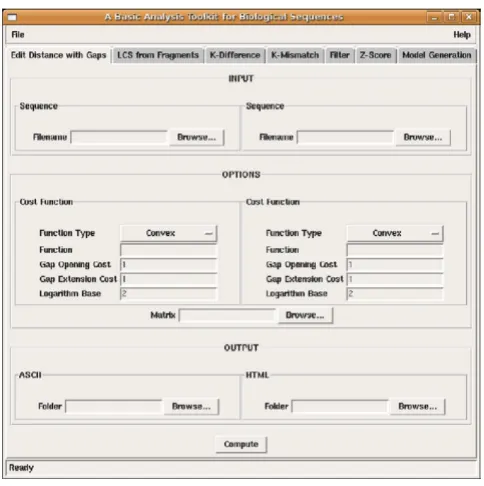
methods try to find regions of high similarity between two strings, e.g. BLAST [5], as opposed to global alignment methods that assess an overall structural similarity between the two strings, e.g. the Gotoh alignment algo-rithm [6]. However, at the algoalgo-rithmic level, both classes often share the same ideas and techniques, being in most cases all based on dynamic programming algorithms and related speed-ups [7]. More in detail, we have implemen-tations for (see also Fig. 1 for the corresponding function in the GUI):
(a) Approximate string matching with k mismatches. That is, given a pattern and text string and an integer k, we are interested in finding all occurrences of the pattern in the
text with at most k mismatching characters per occurrence.
We provide an implementation of an algorithm given in [8]. It is a simplification of the first efficient algorithm Published: 18 September 2007
Algorithms for Molecular Biology 2007, 2:10 doi:10.1186/1748-7188-2-10
Received: 7 May 2007 Accepted: 18 September 2007
This article is available from: http://www.almob.org/content/2/1/10
© 2007 Giancarlo et al; licensee BioMed Central Ltd.
obtained for this problem, due to Landau and Vishkin [9]. The asymptotically fastest known algorithm to date is due to Amir, Lewenstein and Porat [10]. Formalization of the problem, as well as description of the algorithm and library functions, both in C/C++ and Perl, is given in sec-tion 2.
(b) Approximate string matching with k differences. That is, given a pattern and text string and an integer k, we are interested in finding all occurrences of the pattern in the text with at most k differences where, for each occurrence a "difference" is a character to be inserted, deleted or sub-stituted in the pattern. We provide an implementation of the algorithm by Landau and Vishkin [11], although the asymptotically most efficient one, to date, has been recently obtained by Cole and Hariharan [12]. Formaliza-tion of the problem, as well as descripFormaliza-tion of the algo-rithm and library functions, both in C/C++ and Perl, is given in section 3.
(c) The longest common subsequence from fragments, a generalization of the well known longest common subse-quence problem [1], considered by Baker and Giancarlo [13]. Formalization of the problem, as well as description of the algorithm and library functions, both in C/C++ and Perl, is given in section 4.
(d) Edit distance with concave and affine gap penalties. It is the well known generalization of the edit distance between two strings introduced by M.S. Waterman [14], i.e., with the use of concave gap costs. We provide an implementation of the algorithm obtained by Galil and
Giancarlo [15] (GG algorithm for short). An analogous
algorithm was obtained independently by Miller and Myers [16]. We also point out that the asymptotically most efficient algorithm, to date, is still the one given by Klawe and Kleitman [17], although it seems to be mainly of theoretic interest. It is also worth mentioning that the
GG algorithm naturally specializes to deal with affine gap
costs. Formalization of the problem, as well as description of the algorithm and library functions, both in C/C++ and Perl, is given in section 5.
(e) Filtering, statistical significance computation and organism model generation. The first two functions allow to select a subset of strings from a given set and to assess its statistical significance via z-score computation [18]. The third function is required in order to give to the first two, a probabilistic model of the input data. While the fil-tering techniques are quite standard, the implementation of the z-score computation is a specialization of a non-trivial implementation by Sinha and Tompa, used for motif discovery [19]. Our code, as the one by Sinha and Tompa, works only for DNA sequences. The function allowing for the generation of a user-specified model organism gives, in a suitable format, all probabilistic information needed by the z-score function. Description of this part of the system, as well as presentation of the corresponding library functions, both in C/C++ and Perl, is given in section 6.
As it is self-evident from the description just given, this software library is not intended as a generic programming environment, like Leda for combinatorial and geometric computing [20]. An initial attempt, in that direction, for string algorithms is described in [21]. The software pre-sented here is more tailored at specific alignment prob-lems. We also point out that most of the algorithms implemented in BATS are based on suffix trees [22]. Here we use the algorithm by Ukkonen [23] in the Strmat library [24]. It is not particularly memory-efficient (17 bytes/character) and that may be problematic for genome-wide applications of the corresponding algorithms. We finally point out that the entire library can be used as a stand-alone system with a GUI and it can be interfaced with Bioperl. A detailed user manual, together with instal-lation procedures, file formats etc., is given at the supple-mentary web site [25].
a snapshot of the GUI Figure 1
2 Approximate string matching with
k
mismatches
Given a text string text = t[1, n], a pattern string pattern = p[1, m] and an integer k, k ≤ m ≤ n, we are interested in finding all occurrences of the pattern in the text with at most k mismatches, i.e. with at most k locations in which the pattern and a text substring have different symbols.
Let Prefix(i, j) be a function that returns the length of the longest common prefix between p[i, m] and t[j, n]. It can be computed in O(1) time, after the following preprocess-ing step: (A) build the suffix tree T [22] of the strpreprocess-ings p[1, m]$t[1, n], where $ is a delimiter not appearing anywhere
else in the two strings; (B) preprocess T so that Lowest
Common Ancestor (LCA for short) queries can be answered in constant time [26]. The preprocessing step takes O(n + m) time and it is well known that the
compu-tation of Prefix(i, j) reduces to the computation of one
LCA query on the leaves of T [8].
Once that the preprocessing step is completed, we can find the first (leftmost) mismatch between p[1, m] and t[j, j + m - 1] in O(1) time by use of Prefix(1, j). If we keep track of where this mismatch occurs, say
1: Algorithm SM
2: for j = 1 to n do
3: pt ← j; v ← 1; num_mismatch ← 0;
4: **t[j, j + m - 1] is aligned with p[1, m] and no
mis-match has been found**
5: while v ≤ m - 1 and num_mismatch ≤ k do
6:
7: **find leftmost mismatch between t[pt, pt + m - 1]
and p[v, m]**
8: ᐍ← Prefix(v, pt)
9: if v + ᐍ≤ m then
10: num_mismatch ← num_mismatch + 1
11: end if
12: pt ← pt + ᐍ + 1; v ← v + ᐍ + 1;
13: end while
14: if num_mismatch ≤ k then
15: found match
16: end if
17: end for
at position l of pattern, we can locate the second
mis-match, in O(1) time, by finding the leftmost mismatch between p[l + 1, m] and t[j + l - 1, j + m - 1]. In general, the q-th mismatch between p[1, m] and t[j, j + m - 1] can be found in O(1) time by knowing the location of the (q -
1)-th mismatch. Algori1)-thm SM gives the needed
pseudo-code. We have:
Theorem 2.1 [8,9]Given a pattern p and a text t of length m and n respectively, Algorithm SM finds all occurrences of p in t with at most k mismatches in O(m + n + nk) time, including the preprocessing step.
2.1 The C/C++ library functions
The function below returns all occurrences, with at most k mismatches, of a pattern within a text.
Synopsis
#include "k_mismatch.h"
OCCURRENCES
k_mismatch(char*text, char*pattern, int k);
Arguments:
• text: points to a text string;
• pattern: points to a pattern string;
• k: is an integer giving the maximum number of allowed mismatches.
Return Values: k_mismatch returns a pointer to OCCURRENCES_STRUCT, defined as:
typedef struct occurrences
{
int start, end;
int errors;
char*text;
struct occurrences*next;
} OCCURRENCES_STRUCT, *OCCURRENCES;
where:
• start: is the start position of this occurrence in the text string;
• end: is the end position of this occurrence in the text string;
• errors: the number of mismatches of this occurrence;
• text: is a pointer to the aligned substring corresponding to the occurrence found;
• pattern: is a pointer to the aligned pattern string.
2.2 The PERL library functions
The function below returns all occurrences, with at most k mismatches, of a pattern within a text.
Synopsis
use BSAT::K_Mismatch;
K_Mismatch Text Pattern K
Arguments:
• Text: is a scalar containing the text string;
• Pattern: is a scalar containing the pattern string;
• K: is a scalar giving the maximum number of allowed mismatches.
Return values: The function returns an array of occur-rences. Each occurrence consists of a hash:
my %occurrence = (
errors => 0,
start => 0,
end => 0,
text => "",
pattern => "");
where the above fields are as in the OCCURRENCES_STRUCT defined earlier.
3 Approximate string matching with
k
differences
In this section we consider a more general problem of approximate string matching by extending the set of
allowed differences between strings. Letting text, pattern
and k be as in section 2, we are interested in finding all
occurrences of pattern in text with at most k differences.
The allowed differences are:
(a) A symbol of the pattern corresponds to a different symbol of the text, i.e., a mismatch.
(b) A symbol of the pattern corresponds to no symbol in the text.
(c) A symbol of the text corresponds to no symbol in the pattern.
Let A be an (m + 1) × (n + 1) dynamic programming
matrix and consider the following recurrence:
A[0, j] = 0, 0 ≤ j <n. (1)
A[i, 0] = i, 0 ≤ i <m. (2)
A[i, j] = min(A[i - 1, j] + 1, A[i, j - 1] + 1, if p[i] = t[j] then A[i - 1, j - 1] else A[i - 1, j - 1] + 1). (3)
Matrix A can be computed row by row, or column by col-umn, in O(nm) time. Moreover, it can be easily shown that A[i, j] is the minimal edit distance between p[1, i] and a substring of text ending at position j. Thus, it follows that there is an occurrence of the pattern in the text ending at position j of the text if and only if A[m, j] ≤ k. The compu-tation of A can be substantially sped-up by observing that, for any i and j, either A[i + 1, j + 1] = A[i, j] or A[i + 1, j + 1] = A[i, j] + 1. That is, the elements along any diagonal of A form a non-decreasing sequence of integers. Thus, the
computation of A can be performed by finding, for all
diagonals, the rows in which A[i + 1, j + 1] = A[i, j] + 1 ≤
k. Such an observation was exploited by Ukkonen [27] in order to obtain a space efficient algorithm for the compu-tation of the edit distance between two strings. Landau and Vishkin [11] cleverly extended the method by Ukko-nen to obtain an efficient algorithm that handles the more general problem of string matching with k differences. We present their algorithm here, although the asymptotically most efficient one, to date, has been recently obtained by Cole and Hariharan [12].
Let Ld,e denote the largest row i such that A[i, j] = e and j -i = d. The def-in-it-ion of Ld, e implies that e is the minimal
number of differences between p[1, Ld,e] and the
we need to compute the values of Ld,e that satisfy e ≤ k. Assuming that Ld+1,e-1, Ld-1,e-1 and Ld,e-1 have been correctly
computed, Ld,e is computed as follows. Let row =
max(Ld+1,e-1 + 1, Ld-1,e-1, Ld,e-1 + 1) and let ᐍ be the largest integer such that p[row + 1, row + ᐍ] = t[d + row + 1, d + row + ᐍ]. Then, Ld,e = row + ᐍ. The proof of correctness of such a computation is a simple exercise, left to the reader. Moreover, if one makes use of the preprocessing
algo-rithms presented in section 2, Ld,e can be computed in
O(1) time as follows:
Ld,e = row + Prefix(row + 1, row + d + 1). Algorithm SD gives the needed pseudo-code. We have:
Theorem 3.1 [11]Given a pattern p and a text t, of length m and n, respectively, Algorithm SD finds all occurrences of p in t with at most k differences in O(m + n + nk) time, including the preprocessing step.
3.1 The C/C++ library functions
The function below returns all occurrences of a pattern within a text with at most k differences.
Synopsis
#include " k_difference.h"
OCCURRENCES
k_difference (char*text, char*pattern, intk);
Arguments: As in function k_mismatch
Return Values: As in function k_mismatch
1: Algorithm SD
2: **Initial Conditions Start Here**
3: for d := 0 to n do
4: L[d, -1] ← -1
5: end for
6: for d := -(k + 1) to -1 do
7: L[d, |d| - 1] ← |d| - 1
8: L[d, |d| - 2] ← |d| - 2
9: end for
10: for e := -1 to k do
11: L[n + 1, e] ← -1
12: end for
13: **Initial Conditions End Here**
14: for e := 0 to k do
15: for d := -e to n do
16: row ← max(L[d, e - 1] + 1, L[d - 1, e - 1], L[d + 1, e
- 1] + 1
17: row ← min(row, m)
18: if row <m and row + d <n then
19: row ← row + Prefix(row + 1, row + d + 1)
20: end if
21: L[d, e] ← row
22: if L[d, e] = m and d + m ≤ n then
23: **Occurrence Found**
24: end if
25: end for
26: end for
3.2 The PERL library functions
The function below returns all occurrences of a pattern within a text with at most k differences.
Synopsis
use BSAT::K_Difference;
K_Difference Text Pattern K
Arguments: As in function K_Mismatch
Return values: As in function K_Mismatch
4 Longest common subsequence from
fragments
discussed in sections 2 and 3. Then, we outline the algo-rithm presented in [13].
4.1 LCS from fragments and edit graphs
It is well known that finding the LCS of X and Y is equiv-alent to finding the Levenshtein edit distance between the two strings [4], where the "edit operations" are insertion and deletion of a single character. Those edit operations naturally correspond to the differences of type (b) and (c) introduced in section 3 for approximate string matching. Although there is analogy between approximate string matching and LCS computation, the former can be regarded as a local alignment method as opposed to the latter, that is a global alignment method [1]. Following Myers [28], we phrase the LCS problem as the
computa-tion of a shortest path in the edit graph for X and Y,
defined as follows. It is a directed grid graph (see Fig. 2) with vertices (i, j), where 0 ≤ i ≤ n and 0 ≤ j ≤ m, |X| = n and |Y| = m. We refer to the vertices also as points. There is a ver-tical edge from each non-bottom point to its neighbor below. There is a horizontal edge from each non-right-most point to its right neighbor. Finally, if X[i] = Y[j], there is a diagonal edge from (i - 1, j - 1) to (i, j). Assume that each non-diagonal edge has weight 1 and the remaining edges weight 0. Then, the Levenshtein edit distance is given by the minimum cost of any path from (0, 0) to (n, m). We assume the reader to be familiar with the notion of edit script corresponding to the min-cost path and how to recover an LCS from an edit script [28-30]. Our LCS from Fragments problem also corresponds naturally to an edit graph. The vertices and the horizontal and vertical edges are as before, but the diagonal edges correspond to a given set of fragments. Each fragment, formally described as a triple (i, j, k), represents a sequence of diag-onal edges from (i - j - 1) (the start point) to (i + k - 1, j + k - 1) (the end point). For a fragment f, the start and end points of f are denoted by start(f) and end(f), respectively. In the example of Figure 3, the fragments are the sequences of at least 2 diagonal edges of Fig. 2. The LCS from Fragments problem is equivalent to finding a mini-mum-cost path in the edit graph from (0, 0) to (n, m), where each diagonal edge has weight 0 and each non-diagonal edge has weight 1. The problem has an obvious dynamic programming solution since the graph naturally
corresponds to an nxm dynamic programming matrix.
However, it also falls into the more efficient algorithmic paradigm of Sparse Dynamic Programming [31,32], as discussed in [13] and outlined next.
For a point p, define x(p) and y(p) to be the x- and y- coor-dinates of p, respectively. We also refer to x(p) as the row of p and y(p) as the column of p. Define the diagonal number of f to be d(f) = y(start(f)) - x(start(f)).
an edit graph with fragments Figure 3
an edit graph with fragments. An LCS from Fragments edit graph for the same strings as in Figure 2, where the frag-ments are the sequences of at least two diagonal edges of Figure 2. The bold path from (0, 0) to (6, 7) corresponds to a minimum-cost path under the Levenshtein edit distance.
B C B
1
A 1 C
A
4
5
2
B
C 6
0
0
3
3 6 7
D 2
5
A A B A
4
an edit graph Figure 2
an edit graph. An edit graph for the strings X = CDABAC
and Y = ABCABBA. It naturally corresponds to a DP matrix. The bold path from (0, 0) to (6, 7) gives an edit script from which we can recover the LCS between X and Y.
A
B C B
1
5
5
1 C
A
4
2
B
C 6 0
0
3
3 6 7
D 2
4
We say a fragment f' is left of start(f) if some point of f' besides start(f') is to the left of start(f) on a horizontal line
through start(f), or start(f) lies on f' and x(start(f'))
<x(start(f)). (In the latter case, f and f' are in the same diag-onal and overlap.) A fragment f' is above start(f) if some point of f' besides start(f') is strictly above start(f) on a ver-tical line through start(f).
Define visl(f) to be the first fragment to the left of start(f) if such exists, and undefined otherwise. Define visa(f) to be the first fragment above start(f) if such exists, and unde-fined otherwise.
We say that fragment f precedes fragment f' if x(end(f))
<x(start(f')) and y(end(f)) <y(start(f')), i.e. if the end point of f is strictly inside the rectangle with opposite corners (0, 0) and start(f').
Suppose that fragment f precedes fragment f'. The shortest path from end(f) to start(f') with no diagonal edges has cost x(start(f')) - x(end(f)) + y(start(f')) - y(end(f)), and the minimum cost of any path from (0, 0) to start(f') through f is that value plus mincost0(f). It will be helpful to separate
out the part of this cost that depends on f by the definition Z(f) = mincost0(f) - x(end(f)) - y(end(f)). Note that Z(f) ≤ 0 since mincost0(f) ≤ x(start(f)) + y(start(f)). The following lemma states that we can compute LCS from fragments by considering only end-points of some fragments rather than all points in the dynamic programming matrix. Moreover, it also gives the appropriate recurrence rela-tions that we need to compute.
Lemma 4.1 [13]For any fragment f and any point p on f, mincost0(p) = mincost0(start(f)).
Moreover, mincost0(f) is the minimum of x(start(f)) + y(start(f)) and any of cp, cl, and ca that are defined according to the following:
1. If at least one fragment precedes f, cp = x(start(f)) + y(start(f)) + min{Z(f'): f' precedes f}.
2. If visl(f) is defined, cl = mincost0(visl(f))+d(f) - d(visl(f));
3. If visa(f) is defined, ca = mincost0(visa(f)) + d(visa(f)) -d(f);
4.2 Outline of the algorithm
Based on Lemma 4.1, we now present the main steps of the algorithm in [13] computing the required optimal path, given a list M of fragments (represented as triples of integers). It uses a sweepline approach where successive rows are processed, and within rows, points are processed from left to right. Lexicographic sorting of (x, y)-values is needed. The algorithm consists of two main phases, one
in which it computes visibility information, i.e., visl(f) and visa(f) for each fragment f, and the other in which it computes Recurrences (1)–(3) in Lemma 4.1.
Not all the rows and columns need contain a start point or end point, and we generally wish to skip empty rows and columns for efficiency. For any x (y, resp.), let C(x) (R(y), resp.) be the i for which x is in the i-th non-empty column (row, resp.). These values can be calculated in the same time bounds as the lexicographic sorting. From now on, we assume that the algorithm processes only non-empty rows and columns.
For the lexicographic sorting and both phases, we assume the existence of a data structure of type D that stores
inte-gers j in some range [0, u] and supports the following
operations: (1) insert, (2) delete, (3) member, (4) min, (5) successor: given j, the next larger value than j in D, (6) max: given j, find the max value less than j in D. In our toolkit, D is implemented via balanced trees [33].
There-fore, if d elements are stored in it, each operation takes
O(log d) time. More complex schemes are proposed and analyzed in [13], yielding better asymptotic performance. With the mentioned data structures, lexicographic sorting of (x, y)-values can be done in O(d log d) time. In our case u ≤ n + m and d ≤ |M|.
• Visibility Computation. We now briefly outline how to
compute visl(f) and visa(f) for each fragment f via a
sweepline algorithm. We describe the computation of visl(f); that for visa(f) is similar. For visl(f), the sweepline algorithm sweeps along successive rows. Assume that we have reached row i. We keep all fragments crossing row i sorted by diagonal number in a data structure V. For each fragment f such that x(start(f)) = i, we record the fragment f' to the left of start(f) in the sorted list of fragments; in this case, visl(f) = f'. Then, for each fragment f with x(start(f)) =
i, we insert f into V. Finally, we remove fragments such
that y(end( )) = i. If the data structure V is implemented as a balanced search tree, the total time for this computa-tion is O(M log M).
• The Main Algorithm. Again, we use a sweepline approach of processing successive rows. It follows the same paradigm as the Hunt-Szymanski LCS algorithm [34] and the computation of the RNA secondary structure (with linear cost functions) [31].
We use another data structure B of type D, but this time B stores column numbers (and a fragment associated with each one). The values stored in B will represent the col-umns at which the minimum value of Z(f) decreases
com-ˆ f ˆ
pared to any columns to the left, i.e. the columns containing an end point of a fragment f for which Z(f) is smaller than Z(f') for any f' whose end point has already been processed and which is in a column to the left. Notice that, once we fix a row, D gives a partition of that row in terms of columns. Within a row, first process any start points in the row from left to right. For each start
point of a fragment, compute mincost0 using Lemma 4.1.
Note that when the start point of a fragment f is
com-puted, mincost0 has already been computed for each
frag-ment that precedes f and each fragment that is visa(f) or
visl(f). To find the minimum value of Z(f') over all prede-cessors f' of f, the data structure B is used. The minimum
relevant value for Z(f') is obtained from B by using the
max operation to find the max j <y(start(f)) in B; the frag-ment f' associated with that j is one for which Z(f') is the minimum (based on endpoints processed so far) over all columns to the left of the column containing start(f), and in fact this value of Z(f') is the
1: Algorithm FLCS
2: For each fragment f, compute visl(f) and visa(f)
3: for i = R(0) to R(n) do
4: for each fragment f s.t. x(start(f)) = i do
5: f' ← max on B with key y(start(f))
6: if f' is defined then
7: compute cp
8: end if
9: if visl(f) is defined then
10: compute cl
11: end if
12: if visa(f) is defined then
13: compute ca
14: end if
15: compute mincost(f)
16: end for
17: for each fragment f s.t. x(start(f)) = i do
18: f' ← max on B with key y(end(f)) + 1
19: if f' is not defined or Z(f) <Z(f') then
20: INSERT f into B with key y(end(f))
21: end if
22: for each fragment f' := SUCCESSOR(f) in B such
that Z(f') ≤ Z(f) do
23: DELETE(f') from B
24: end for
25: end for
26: end for
minimum value over all predecessors of f.
After any start points for a row have been processed, proc-ess the end points. When an end point of a fragment f is
processed, B is updated as necessary if Z(f) represents a
new minimum value at the column y(end(f)); successor and deletion operations may be needed to find and remove any values that have been superseded by the new
minimum value. Algorithm FLCS gives the pseudo-code
of the method just outlined, with the visibility computa-tion omitted for conciseness. In conclusion, we have:
Theorem 4.2 [13]Suppose X [1 : n] and Y [1 : m] are strings, and a set M of fragments relating substrings of X and Y is given. One can compute the LCS from Fragments in O(|M|log|M|) time and O(|M|) space using standard balanced search tree schemes.
4.3 The C/C++ library functions
The function below computes the longest common subse-quence from fragments and returns the corresponding alignment.
Synopsis
#include "flcs.h"
ALIGNMENTS
flcs (char*X, char*Y, FRAGSETM);
Arguments:
• X: points to a string;
• M: point to a FRAGSET_STRUCT, that represents a set of fragments.
Return Values: A pointer to ALIGNMENTS_STRUCT, which is defined as:
typedef struct alignments
{
double distance;
char*X;
char*Y;
struct alignments*next;
} ALIGNMENTS_STRUCT, *ALIGNMENTS;
where:
• distance: is the Levenshtein Distance between strings Xand Y, computed using only fragments;
• X: is a pointer to the aligned string X, i.e., the string with appropriate spacers inserted;
• Y: is a pointer to the aligned string Ywith appropriate spacers inserted.
One can create a set of fragments from all the matching k-tuples between Xand Y, using the function:
FRAGSET
fragset_create_ktuples (char*X, char*Y, intk);
where:
• X: points to string;
• Y: points to a string;
• k: is the fragment length.
Auxiliary functions destroying, creating or incrementally updating a set of fragments are the following:
void
fragset_destroy(FRAGSET fragset);
FRAGSET
fragset_create(int*max_cardinality);
int
fragset_frag_add(FRAGSET fragset, int i, int j, int length);
where
• fragset:points to FRAGSET_STRUCT;
• i: fragment starting position in the first string X;
• j: fragment starting position in the second string Y;
• length: fragment length.
4.4 The PERL library functions
The function FLCS computes the longest common subse-quence from fragments. It returns the corresponding alignment.
Synopsis
use BSAT::FLCS;
FLCS X Y Frags
Arguments:
• X: is a scalar containing string X.
• Y: is a scalar containing string Y.
• Frags: is a hash reference (see below).
Return values: FLCS returns a hash corresponding to the alignment between X and Y:
my %alignment = (
distance => 0,
X => "",
Y => "");
where:
• distance: is a scalar containing the Levenshtein Distance between strings Xand Y, computed using only fragments;
• X: is a scalar containing the alignment string X;
The hash reference Frags is defined as:
my %Frags = (
K => 0,
Set => ());
where:
• K: is a scalar giving the fragment length;
• Set: is an array of three elements (i, j, length) specifying a fragment.
5 Edit distance with gaps
5.1 The dynamic programming recurrences
We refer to the edit operations of substitution of one sym-bol for another (point mutation), deletion of a single symbol, and insertion of a single symbol as basic opera-tions. They are related in a natural way to the differences introduced in section 3. Let a gap be a consecutive set of deleted symbols in one string or inserted symbols in the other string. With the basic set of operations, the cost of a gap is the sum of the costs of the individual insertions or deletions which compose it. Therefore, a gap is considered as a sequence of homogeneous elementary events (inser-tion or dele(inser-tion) rather than as an elementary event itself. But, both theoretic and experimental considerations [1,14,35], suggest that the cost w(i, j) of a generic gap X[i, j] must be of the form
w(i, j) = f1(X[i]) + f2(X[j]) + g(j - i) (4)
where f1 and f2 are the costs of breaking the string at the
endpoints of the gap and g is a function that increases with the gap length.
In molecular biology, the most likely choices for g are aff-ine or concave functions of the gap lengths, e.g., g(ᐍ) = c1 + c2ᐍ or g(ᐍ) = c1 + c2 log ᐍ, where c1 and c2 are constants.
With such a choice of g, the cost of a long gap is less than or equal to the sums of the costs of any partition of the gap into smaller gaps. That is, each gap is treated as a unit. Such constraint on g induces a constraint on the function w. Indeed, w must satisfy the following inequality, known as concave Monge condition [7]:
w(a, c) + w(b, d) ≥ w(b, c) + w(a, d) for all a <b and c <d. (5)
an extremely useful inequality that yields speed-ups in Dynamic Programming [7].
The gap sequence alignment problem can be solved by computing the following dynamic programming equa-tion (w' is a cost funcequa-tion analogous to w):
D[i, j] = min{D[i - 1, j - 1] + sub(X[i], Y[j]), E[i, j], F[i, j]} (6)
where
sub is a symbol substitution cost matrix and the initial
conditions of recurrence (6) are D[i, 0] = w'(0, i), 1 ≤ i ≤ m and D[0, j] = w(0, j), 1 ≤ j ≤ n.
We observe that the computation of recurrence (6)
con-sists of n + m interleaved subproblems that have the
fol-lowing general form: Compute
D[0] is given and for every k = 1,..., n, D [k] is easily com-puted from E[k]. We now concentrate on a general algo-rithm computing (9).
5.2 The GG algorithm
From now on, unless otherwise specified, we assume that w satisfies the concave Monge condition (5). An impor-tant notion related to concave Monge condition is con-cave total monotonicity of an s × p matrix A. A is concon-cave totally monotone if and only if
A[a, c] ≤ A[b, c] ⇒ A[a, d] ≤ A[b, d]. (10)
for all a <b and c <d.
It is easy to check that if w is seen as a two-dimensional matrix, the concave Monge condition implies concave total monotonicity of w. Notice that the converse is not true. Total monotonicity and Monge condition of a matrix A are relevant to the design of algorithms because of the
following observations. Let rj denote the row index such
that A[rj, j] is the minimum value in column j. Concave
total monotonicity implies that the minimum row indices are nonincreasing, i.e., r1 ≥ r2 ≥ ... ≥ rm. We say that an ele-ment A[i, j] is dead if i ≠ = rj (i.e., A[i, j] is not the minimum of column j). A submatrix of A is dead if all of its elements are dead.
Let B[i, j] = D[i] + w(i, j), for 0 ≤ i ≤ j ≤ n. We say that B[i, j] is available if D[i] is known and therefore B[i, j] can be
E i j D i k w k j
k j
, min , , ,
[ ]
={
[ ]
+( )
}
≤ ≤ −0 1 (7)
F i j D i j w l i
l i
, min , , ,
[ ]
={
[ ]
+ ′( )
}
≤ ≤ −0 1 (8)
E j D k w k j j n
k j
[ ]
={
[ ]
+( )
}
=≤ ≤ −min , , , , ,
0 1 1
computed in constant time. That is, B[i, j] is available only when the column minima for columns 1, 2,..., i have been
found. We say that B is on-line, since its entries become
available as the computation proceeds.
The computation of recurrence (9) reduces to the identifi-cation of the column minima in an on-line upper triangu-lar matrix B. One can easily show that when w satisfies the
concave Monge condition, B is totally monotone. We
make use of this fact to obtain an efficient algorithm.
The algorithm outlined here finds column minima one at a time and processes available entries so that it keeps only possible candidates for future column minima. In the concave case, we use a stack to maintain the candidates. The algorithm can be sketched as follows (proof of cor-rectness can be found in [15])
For each j, 2 ≤ j ≤ n, we find the minimum at column j as
follows. Assume that (i1, h1),..., (ik, hk) are on the stack ((i1, h1) is at the top of the stack). Initially, (0, n) is on the stack. The invariant on the stack elements is that in sub-matrix B[0 : j - 2, j : n] row ir, for 1 ≤ r ≤ k, is the best (gives the minimum) in the column interval [hr-1 + 1, hr]
(assum-ingh h0 + 1 = j). By the concave total monotonicity of B,
i1,..., ik are nonincreasing. Thus the minimum at column j is the minimum of B[i1, j] and B[j - 1, j].
Now we update the stack with row j - 1 as follows.
(GG1) If B[i1, j] ≤ B[j - 1, j], row j - 1 is dead by concave
total monotonicity. If h1 = j, we pop the top element
because it will not be useful.
(GG2) If B[i1, j] > B[j - 1, j], we compare row j - 1 with row ir at hr (i.e., B[ir, hr] vs. B[j - 1, hr]), for r = 1, 2,..., until row ir is better than row j - 1 at hr. If row j - 1 is better than row ir at hr, row ir cannot give the minimum for any column because row j - 1 is better than row ir for column l ≤ hr and row ir+1 is better than row ir for column l > hr. We pop the
element (ir, hr) from the stack and continue to compare
row j - 1 with row ir+1. If row ir is better than row j - 1 at hr,
we need to find the border of the two rows j - 1 and ir,
which is the largest h <hr such that row j - 1 is better than row ir for column l ≤ h; i.e., finding the zero z of f(x) = B[j - 1, x] - B[ir, x] = w(j - 1, x) - w(ir, x) + (D[j - 1] - D[ir]), then h = NzQ. If h ≥ j +1, we push (j - 1, h) into the stack.
In the pseudo-code of Algorithm GG, let I(top) and H(top)
denote (i1, h1). Moreover, let CLOSEST(j - 1, I(top)) be a function that returns the zero of f(x) (defined in step
GG2) closest to j - 1. Notice that, using the monotonicity
conditions on w, CLOSEST(j - 1, I(top)) can be computed in O(log n) time. Moreover, we say that f satisfies the clos-est zero property if such a zero can be computed in constant
time. We also notice that when w is a linear function, f obviously satisfies the closet zero property. Moreover, for
linear functions, lines 9–20 of Algorithm GG become
use-less since only one element can be on the stack: the win-ner (the minimum) of the comparison on line 5 of the algorithm. We have:
Theorem 5.1 Recurrence (9) can be computed in O(n log n) time when w satisfies the concave Monge conditions. The time reduces to O(n) when the closet zero property is satisfied or w is linear. Therefore, given two strings X and Y, their edit dis-tance with gaps can be computed in time O(nm log max(n, m)) time, when both w and w' satisfy the concave Monge con-ditions and O(nm) time when both functions satisfy the closest zero property or are affine gap costs.
Two remarks are in order regarding the implementation of
the GG algorithm provided here:
1: Algorithm GG
2: push (0, n) on S
3: for j := 2 to n do
4: ᐍ← I(top)
5: if B[j - 1, j] ≥ B[ᐍ, j] then
6: min is B[ᐍ, j]
7: else
8: min is B[j - 1, j]
9: while S ≠∅and B[j - 1, j] ≤ B[I(top); H(top)] do
10: pop
11: end while
12: if S = ∅then
13: push (j - 1, n)
14: else
15: h ← CLOSEST(j - 1, I(top))
16: push (j - 1, h)
17: end if
19: if H(top) = j then
20: pop
21: end if
22: end for
(a) It takes in input a character substitution matrix. Such a matrix could be one of the well known PAM [36] or BLOSUM [37,38] matrices. However, those matrices have been designed for maximization problems, while we have stated our alignment problem as a minimization prob-lem. Therefore, in order to use those matrices, we need to change the sign of each entry, i.e., take its dual.
(b) It takes in input two default gap cost functions, one affine and the other concave: g(ᐍ) = c1 + c2ᐍ and g(ᐍ) = c1 + c2 log ᐍ, where c1 and c2 are constants. In this case, the closet zero property holds and the program uses this con-dition to avoid the binary search. However, the user can also specify a concave cost function by simply providing a pointer to the excutable computing it. In this case, the binary search is used.
5.3 The C/C++ library functions
The function below computes the edit distance between two strings, using convex or affine gap costs. It returns the corresponding alignment.
Synopsis
#include "edit_distance_gaps.h"
ALIGNMENTS
edit_distance_gaps(char*X, char*Y, WEIGHT Xw, WEIGHT Yw,, MATRIX substitution);
Arguments:
• X: points to a string;
• Y: points to a string;
• Xw: is a pointer to a WEIGHT_STRUCT;
• Yw: is a pointer to a WEIGHT_STRUCT;
• substitution: is a pointer to MATRIX_STRUCT, a data structure (detailed below) defining an upper triangular substitution cost matrix.
WEIGHT_STRUCT defines a generic cost function for gaps, as follows:
typedef struct weight
{
int type;
double Wa, Wg, base;
double (*w)(int l, int k);
} WEIGHT_STRUCT, *WEIGHT;
The type is a mendatory field that takes two
val-ues:F_AFFINE and F_CONCAVE. In both cases, the total of gap opening and closing costs, i.e., Wg, and the gap extension cost, i.e., Wa, need also be specified. Then, the affine function is Wa + Wgᐍ, for a gap of length ᐍ. For the concave cost function, we can use the default Wa + Wglog
-base(ᐍ), where the base of the logarithm must also be spec-ified. One can also use a user-defined concave cost function w by specifying a pointer to a function defined as:
double
weight_function(int l, int k);
MATRIX_STRUCT defines a generic cost substitution matrix, as follows:
typedef struct matrix
{
char*alphabet;
int size
double**matrix
} MATRIX_STRUCT, *MATRIX;
where alphabet is a pointer to the alphabet array (case
insensitive) of cardinality size. The last field matrixis a pointer an upper triangular symbol substitution cost matrix. In case one wants to use the default matrix, i.e., match values 0 and mismatch 1, it suffices to set filed size equal to zero.
5.4 The Perl library functions
The Edit_Distance_Gap computes the edit distance with gaps between two strings.
Synopsis
use BSAT::Edit_Distance_Gaps;
Edit_Distance_Gaps X Y Xw Yw Substitution
Arguments:
• X: is a scalar containing string X;
• Y: is a scalar containing string Y;
• Xw: is a hash reference defined below;
• Yw: is a hash reference defined below;
• Yw: is a list reference containing the
• Substitution: is a list reference containing an upper trian-gular symbol substitution cost matrix. If undefined, the default values are used, as in section 5.3;
• Alphabet: is a list reference containing the characters of alphabet (case insensitive). If undefined, the default val-ues are used, as in section 5.3.
Xw is defined as (Yw is analogous):
my %Xw = (
Type => "",
Wa => 0,
Wg => 0,
Base => 0,
w => \&custom_fuction);
where the fields are as in the specification of the cost func-tion in secfunc-tion 5.3.
Return values: Edit_Distance_Gaps returns an hash cor-responding to the computed alignment and it is defined as in section 4.4, except the distance is now the value of the edit distance with gaps:
my %alignment = (
distance => 0,
X => "",
Y => "");
6 Filtering, statistical scores and model organism
generation
In this section we outline the filtering and statistical func-tions present in the system, starting with the filter. Let
O1,...,Os be the output of algorithm SM on the pattern
strings p1,...,ps and text strings t1,...,ts, respectively. We assume that the algorithm has been used with the same value of k in all s instances. The procedure takes in input the sets Oi and ti, 1 ≤ i ≤ s, and a threshold parameter th. It returns a set W consisting of all strings in Oi that appear in at least th of the text strings. Since each Oi consists of the occurrences of a pattern pi in ti, with mismatches, W corre-sponds to a set of strings representing common occur-rences of all patterns in the text strings, i.e., it is a consensus set. The algorithmic details yielding an efficient implementation of the filtering operation are straightfor-ward and therefore omitted.
We now turn to the z-score. The assessment of the statisti-cal significance of the occurrences of a set of strings W in a set of text strings t1,...,ts is a well established procedure for analysis of biological sequences, in particular via z-score functions [18]. Intuitively, the value of the z-z-score for a set of strings W gives an indication of how relevant are the occurrences of the strings in W in the text strings t1,...,ts, with respect to "a random event" as characterized by a background model. We limit ourselves to give formal definitions and for the case in which W contains only one string and s = 1. For the generalization to the case in which W contains more than one string and the rather involved algorithmic details, the reader is referred to [19].
Let p be a string and let X be a set of random strings, gen-erated according to some " background probabilistic
model", usually a Markov Source. Let Xp be the random
variable indicating the number of occurrences of p in X
and let E(Xp) and σ(Xp) be the mean and standard
devia-tion, respectively. Then, the z-score associated with p is
where Np is the number of occurrences of p in the strings
in X. Notice that zp gives the number of standard
devia-tions by which the observed value Np exceeds its expected
value. It is normalized so that it has mean zero and stand-ard deviation one, so that it can be used to compare the z-score of different strings.
z N E X
X
p
p p
p
= −
( )
( )
The module that computes the z-score in our system takes in input the set W output by the filtering function, the text strings t1,...,ts and a model, i.e., a table encoding a Markov source of order 3, together with additional information needed for the computation of the variance (see Appendix A in [39]). The software computing the z-score is a special-ization of the software of Sinha and Tompa for the com-putation of the z-score in YMF, that is designed to work for motifs (a concise and general encoding of a set of strings). As in their case, the code is designed to work only for DNA sequences. Therefore, care must be taken in computing the number of occurrences of a string p in a string t. In fact, one must count occurrences on both DNA strands. That is done by including, for each string in the input set W, its reverse complement.
Two model organisms are available, Human and Yeast, as they are given by the YMF software distribution of Sinha and Tompa [39]. Moreover, via the function that gener-ates a model organism, the user can specify a new model for her/his sequences. Details on input formats for the model are given in the User Guide.
6.1 The C/C++ library functions
The function below computes the z-score value of a set of patterns (all of the same length) with respect to a set of sequences (all of the same length). It works for DNA only.
Synopsis
#include "z_score.h"
double
z score (char**patterns, char**texts, char*organismpath);
Arguments:
• patterns: is a column vector, each item points to a pattern string. The last item point to NULL;
• texts: is a column vector, each item points to a text string. The last item point to NULL;
• organismpath: it is the path to the file containing all prob-abilistic information for an organism.
Return Values
Upon successful completion z_scorereturn a double
value, corresponding to z-score.
The function below generates a Markov model of order 3, from a set of strings. It works for DNA only.
Synopsis
#include " model_generatation.h"
int
model_generatation (char**strings, char*path, char*organism);
Arguments:
• strings: is a column vector, each item points to a string. The last item point to NULL;
• path: is a output path;
• organism: is the organism name;
Return Values
model_generation returns zero if the computation is completed successfully and 1 otherwise.
6.2 The Perl library functions
The function below performs a filtering operation on a set of sequences.
use BATS::Filter;
Filter files hits score Hitsthreshold Filesthreshold
Arguments:
• files: is an array of strings containing the filenames.
• hits: is a hash reference containing number of hits for each occurrence per file.
• score: is a hash reference containing number of errors for each occurrence.
• Filesthreshold: is a scalar containing the minimum number of hits on which occurrences need to be present.
• Filesthreshold: is a scalar containing the minimum per-centage of files on which occurrences need to be present.
Return values Filter returns an array containing indices of hits that satisfy the threshold.
The function below computes the z-score value of a set of patterns (all of the same length) with respect to a set of sequences (all of the same length). It works for DNA only.
use BATS::Z_Score;
Z_Score patters texts organismpath
Arguments:
• patterns: is an array of strings containing the set of pat-terns;
• sequences: is an array of strings containing the text strings;
• organismpath: it is the path to the file containing all prob-abilistic information for an organism.
Return values:
Z_Score returns a scalar containing the z-score value of the pattern set.
The function below generates a Markov model of order 3, from a set of strings. It works for DNA only.
Synopsis
use BATS::Model_Generation;
Model_Generatation strings path organism
Arguments:
• strings: is an array of strings;
• path: is a scalar containing the string of the output path;
• organism: points to the string containing the name of the organism;
Return values: Model_Generation returns a scalar con-taining 0 if the computation is completed successfully and 1 otherwise.
7 Conclusion
We have presented a software library for some basic global and local sequence alignment tasks. Moreover, procedures to assess the statistical significance of the occurrence of a set of DNA pattern strings in a set of DNA text strings has also been provided. Although none of the presented algo-rithms is new, this the first software library that provides their implementation in one consistent and ready to use package.
Acknowledgements
The authors are deeply endebted to S. Sinha and M. Tompa for allowing to modify their software in order to be included in BATS. RG is partially sup-ported by the Italian MIUR FIRB project " Bioinformatica per la Genomica
e la Proteomica" and by MIUR FIRB Italy-Israel project " Pattern Matching and Discovery in Discrete Structures, with applications to Bioinformatics".
References
1. Gusfield D: Algorithms on Strings, Trees, and Sequences: Computer Sci-ence and Computational Biology Cambridge University Press; 1997. 2. Waterman M: Introduction to Computational Biology. Maps, Sequences
and Genomes Chapman Hall; 1995.
3. Goad W: Sequence analysis- contributions by Ulam to molec-ular genetics. In From Cardinals to Chaos. Reflections on the life and legacy of Stanislaw Ulam Edited by: Cooper N. Cambridge University Press; 1989:288-291.
4. Kruskal J, Sankoff D, Eds: Time Wraps, String Edits, and Macromolecules: The Theory and Practice of Sequence Comparison Addison-Wesley; 1983. 5. Altshul S, Gish W, Miller W, Myers E, Lipman D: Basic Local
Align-ment Search Tool. J of Molecular Bioilogy 1990, 215:403-410. 6. Gotoh O: An Improved Algorithm for Matching of Biological
Sequences. Journal of Molecular Biology 1982, 162:705-708. 7. Giancarlo R: Dynamic Programming: Special Cases. In Pattern
Matching Algorithms Edited by: Apostolico A, Galil Z. Oxford Univer-sity Press; 1997.
8. Galil Z, Giancarlo R: Data Structures and Algorithms for Approximate String Matching. J of Complexity 1988, 4:32-72. 9. Landau G, Vishkin U: Efficient String Matching with k
Mis-matches. Theoretical Computer Science 1986, 43:239-249.
10. Amir A, Lewenstein M, Porat E: Faster algorithms for string matching with k mismatches. J of Algorithms 2004, 50:257-275. 11. Landau G, Vishkin U: Introducing Efficient Parallelism into
Approximate String Matching and a New Serial Algorithm.
Proc. 18th Symposium on Theory of Computing, ACM 1986:220-230. 12. Cole R, Hariharan R: Approximate String Matching: A Simpler
Faster Algorithm. SIAM J Comput 2002, 31:1761-1782.
13. Baker BS, Giancarlo R: Sparse Dynamic Programming for Long-est Common Subsequence from Fragments. J Algorithms 2002,
42(2):231-254.
14. Waterman M: Efficient Sequence Alignment Algorithms. Jour-nal of Theoretical Biology 1984, 108:333-337.
15. Galil Z, Giancarlo R: Speeding Up Dynamic Programming with Applications to Molecular Biology. Theor Comput Sci 1989,
64:107-118.
16. Miller W, Myers EW: Sequence Comparison with Concave Weighting Functions. Bull Math Biol 1988, 50:97-120.
17. Klawe MM, Kleitman D: An Almost Linear Algorithm for Gen-eralized Matrix Searching. SIAM J on Desc Math 1990, 3:. 18. Leung M, Marsh G, Speed T: Over- and underrepresentation of
short DNA words in herpesvirus genomes. J Comput Biol 1996,
3:345-360.
19. Sinha S, Tompa M: A Statistical Method for Finding Transcrip-tion Factors Binding Sites. 8-th ISMB Conference, AAAI
2000:344-354.
20. Mehlhorn K, Näher S: The LEDA Platform of Combinatorial and Geomet-ric Computing Cambridge, UK: Cambridge University Press; 1999. 21. Czumaj A, Ferragina P, Gasieniec L, Muthukrishnan S, Traeff J: The
Archtecture of a Software Library for String Processing. In
Workshop on Algorithm Engineering University of Venice; 1997:166-176. 22. McCreight EM: A space-economical suffix tree construction
algorithm. Journal of the ACM 1976, 23(2):262-272.
23. Ukkonen E: On-Line Construction of Suffix Trees. Algorithmica
1995, 14:.
24. Strmat [http://www.cs.ucdavis.edu/~gusfield/strmat.html] 25. BATS Supplementary Material Web Page [http://
www.math.unipa.it/~raffaele/BATS]
26. Schieber B, Vishkin U: On Finding Lowest Common Ancestors: Simplification and Parallelization. Siam J on Computing 1988,
17:1253-1262.
27. Ukkonen E: Algorithms for Approximate String Matching.
Information and Control 1985, 64:100-118.
28. Myers EW: An O(ND) Difference Algorithm and Its Varia-tions. Algorithmica 1986, 1:251-266.
29. Apostolico A: String Editing and Longest Common Subse-quence. In Handbook of Formal Languages Volume 2. Edited by: Rozenberg G, Salomaa A. Berlin: Springer Verlag; 1997:361-398. 30. Hirschberg D: Serial Computations of Levenshtein Distances.
Publish with BioMed Central and every scientist can read your work free of charge
"BioMed Central will be the most significant development for disseminating the results of biomedical researc h in our lifetime."
Sir Paul Nurse, Cancer Research UK
Your research papers will be:
available free of charge to the entire biomedical community
peer reviewed and published immediately upon acceptance
cited in PubMed and archived on PubMed Central
yours — you keep the copyright
Submit your manuscript here:
http://www.biomedcentral.com/info/publishing_adv.asp
BioMedcentral
31. Eppstein D, Galil Z, Giancarlo R, Italiano G: Sparse Dynamic Pro-gramming I: Linear Cost Functions. J of ACM 1992, 39:519-545. 32. Eppstein D, Galil Z, Giancarlo R, Italiano G: Sparse Dynamic Pro-gramming II: Convex and Concave Cost Functions. J of ACM
1992, 39:546-567.
33. Aho A, Hopcroft J, Ullman J: Data Structures and Algorithms Reading, MA.: Addison-Wesley; 1983.
34. Hunt J, Szymanski T: A Fast Algorithm for Computing Longest Common Subsequences. Comm of the ACM 1977, 20:350-353. 35. Fitch W, Smith T: Optimal Sequence Alignment. National
Acad-emy of Sciences USA 1983, 80:1382-1385.
36. Dayhoff M, Schwartz R, Orcutt B: A model of evolutionary change in proteins. Atlas of Protein Sequence and Structure
1978:345-352.
37. Henikoff S, Henikoff J: Amino acid substitution matrices from protein blocks. Proc Nat Acad of Sci USA 1992, 89:10915-10919. 38. Henikoff S, Henikoff J: Performance evaluation of amino acid
substitution matrices. Proteins: Structure, function and genetics
1993, 17:49-61.