Open Access
Research article
Effects of a refugee elective on medical student perceptions
Kathleen Bronson Dussán*
1, Erin M Galbraith
2, Mary Grzybowski
3,
Bonnie Motyka Vautaw
4, Linda Murray
1and Kim A Eagle
5Address: 1Michigan State College of Human Medicine, East Lansing, MI, USA, 2Emory University Hospitals, Department of Cardiology, Atlanta,
GA, USA, 3Wayne State University School of Medicine, Department of Emergency Medicine, Detroit, MI, USA, 4Ford Motor Credit Company,
Dearborn, MI, USA and 5University of Michigan, Department of Cardiology, Ann Arbor, MI, USA
Email: Kathleen Bronson Dussán* - [email protected]; Erin M Galbraith - [email protected];
Mary Grzybowski - [email protected]; Bonnie Motyka Vautaw - [email protected]; Linda Murray - [email protected]; Kim A Eagle - [email protected]
* Corresponding author
Abstract
Background: There are growing numbers of refugees throughout the world. Refugee health is a relatively unstudied and rarely taught component of medical education. In response to this need, a Refugee Health Elective was begun. Medical student perceptions toward cultural aspects of medicine and refugee health before and after participation in the elective were measured.
Methods: Preliminary questionnaires were given to all preclinical students at the academic year commencement with follow-up questionnaires at the refugee elective's conclusion. Both questionnaires examined students' comfort in interacting with patients and familiarity with refugee medical issues, alternative medical practices, and social hindrances to medical care. The preliminary answers served as a control and follow-up questionnaire data were separated into participant/non-participant categories. All preclinical medical students at two Midwestern medical schools were provided the opportunity to participate in the Refugee Health Elective and surveys. The 3 data groups were compared using unadjusted and adjusted analysis techniques with the Kruskall-Wallis, Bonferroni and ANCOVA adjustment. P-values < 0.05 were considered significant.
Results: 408 and 403 students filled out the preliminary and follow-up questionnaires, respectfully, 42 of whom participated in the elective. Students considering themselves minorities or multilingual were more likely to participate. Elective participants were more likely to be able to recognize the medical/mental health issues common to refugees, to feel comfortable interacting with foreign-born patients, and to identify cultural differences in understanding medical/mental health conditions, after adjusting for minority or multilingual status.
Conclusion: As medical schools integrate a more multicultural curriculum, a Refugee Health Elective for preclinical students can enhance awareness and promote change in attitude toward medical/mental health issues common to refugees. This elective format offers tangible and effective avenues for these topics to be addressed.
Published: 9 April 2009
BMC Medical Education 2009, 9:15 doi:10.1186/1472-6920-9-15
Received: 4 August 2008 Accepted: 9 April 2009
This article is available from: http://www.biomedcentral.com/1472-6920/9/15
© 2009 Dussán et al; licensee BioMed Central Ltd.
Background
The Geneva Convention defines refugees as "those per-sons who are forced to leave their countries of origin due to well-founded racial, religious, social, political persecu-tion or of its possible persecutory threat [1-3]." Even with 3.2 million refugees and asylees resettling in the United States since 1975 [4], researchers are only beginning to investigate the effect refugees on have health care institu-tions, urgent care facilities and emergency departments. Refugees present with a higher frequency of challenging diseases, such as tuberculosis, hepatitis B, lead poisoning, parasitic infections, trauma, and mental illnesses [3]. Simultaneously, physicians are faced with the secondary challenge of the diverse health beliefs of refugees that don't always conform to Western norms. If physicians do not appreciate these socio-cultural differences, refugees seeking care are at risk of sub-optimal care, adverse health outcomes, and poor medical adherence [5-7].
Because of the proximity of our medical allopathic and osteopathic schools to over 11,000 refugees in our imme-diate community and 3,100 more residing in the outlying Mid-state area [8], our medical students identified a need for increased physician awareness of this growing popula-tion. In response to this need, an elective was developed and the overall objectives were to (1) develop a medical school course to address the medical needs of refugees by (a) educating medical students about refugee medical and mental health issues and cross-cultural care issues and (b) providing students with an opportunity to interact with refugees, and (2) measure their beliefs/attitudes about ref-ugee medical care before and after the implementation of the elective. The discussion was done in the context of the global refugee phenomenon and its effects on both the developed and developing countries, not just the Western world, but with a focus on local refugee care. It was hoped that an increased knowledge base would provide a foun-dation for clinical interaction after the pre-clinical years. We studied medical student knowledge and attitudes toward refugee health care prior to and after implement-ing a newly-developed medical school elective directed at refugee health. To our knowledge, there have not been any studies investigating the change in medical student overall knowledge and attitudes pre- and post-elective toward refugees and their health compared to their non-participant peers' knowledge and attitudes.
Methods
Refugee Elective: Curriculum and Format
The Refugee Health Elective curriculum consisted of a course elective administered by both the College of Human Medicine and College of Osteopathic Medicine at Michigan State University. The elective was developed by a panel of faculty and students interested in the subject matter. Extensive research regarding the background and evolution of refugee awareness was conducted and
reviewed for content relevant to optimizing the interper-sonal communication and health care priorities set by
Physicians for Human Rights, which addresses human rights, ethics, and advocacy issues addressing the health of refugee patients. Various professors, community physi-cians, and social agency workers, who serve as local experts in the field of refugee advocacy and care delivered lectures for the medical students. Students also had con-tact with refugees in the classroom setting.
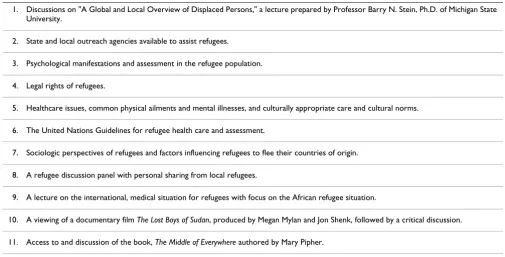
All preclinical medical students enrolled in both colleges during the academic year 2005–2006 were eligible to par-ticipate in the elective. The course elective was conducted on one afternoon a week during the fall and early winter semesters of the study period. The course was an hour in length and included didactic and discussion sessions. Each class addressed specific topics relevant to refugee health, which are listed in table 1.
Survey Data Collection
Data to evaluate the course were obtained from a baseline questionnaire administered to all first and second year students during mandatory medical school lectures or after scheduled examinations prior to the commencement of the course. Post-course questionnaires were available and administered to the same students regardless of course enrollment following the elective's conclusion. Non-participants were asked to complete the post-elective questionnaire to serve as a control group. Neither ques-tionnaire was mandatory.
This study was approved by the Human Investigative Committees (HIC) at Michigan State University. How-ever, the HIC prohibited collection of demographic varia-bles such as, student identification number or study number linking student participation in the pre- and post-elective questionnaires, as well other demographic varia-bles.
Data Collection Instrument
men-tal health issues relevant to refugees; the ability to identify cultural differences in traditional and alternative medical care practices; self-perceived understanding of logistical and cultural/social obstacles of medical compliance rela-tive to refugees; and lastly, the degree to which one's own race, gender, and religion would impact his/her ability to practice medicine. The follow-up questionnaire contained four additional questions (yes|no) regarding if and how the elective benefited the students.
Statistical Analyses
Questionnaire data were classified into three groups: stu-dents completing the questionnaire prior to the elective (the baseline or control group), students who enrolled in the elective, and students who did not enroll in the elec-tive. Because we could not assign study identification numbers to the questionnaires, we were unable to directly compare individual pre- and post-questionnaires. The three data groups were therefore treated as independent entities.
Odds ratios and 95% confidence intervals were calculated to determine the degree to each variable was associated with participation status. For dichotomous responses, chi-square tests were used to determine frequency differences between the groups. Likert scale responses were scored as follows: 5 = strongly agree, 4 = agree, 3 = neutral, 2 = dis-agree, and 1 = strongly disdis-agree, and these data were treated as continuous variables. Means and standard devi-ations were calculated for each item. The Shapiro-Wilks test was used to determine if the Lickert scale responses
were normality distributed, and the responses were not normally distributed. The Wilcoxon Rank Sum test was used to determine which treatment group means differed when the Kruskall-Wallis test was significant. In order to correct for the multiple comparisons between treatment groups, Bonferroni correction was applied. An analysis of covariance (ANCOVA) was used to adjust for demo-graphic variables that had significant associations with the treatment groups. All reported p-values are two-tailed. A p -value less than or equal to 0.05 was considered a statisti-cally significant. All analyses were performed using SAS version 9.1.3 [9].
Results
Subjects
The first and second year medical school classes of both College of Human Medicine (CHM) and College of Osteo-pathic Medicine (COM) consisted of a total of 556 stu-dents. Of these, 408 (73.4%) responded to the baseline questionnaire and 403 (72.5%) to the follow-up question-naire. A total of 43 (7.7%) students enrolled in the elective with 42 of the 403 respondents (10.4%) to the follow-up questionnaire having participated in the elective.
Minority students were more likely to enroll in the Refu-gee Health Elective as seen in the follow-up questionnaire that showed 46.3% of participants versus 25.6% of non-participants considered themselves minorities, (p = 0.02). Similarly, elective participants were more frequently mul-tilingual (69.1% of participants versus 43.0% of non-par-ticipants; p < 0.01). See Table 2.
Table 1: Topics addressed in refugee health elective.
1. Discussions on "A Global and Local Overview of Displaced Persons," a lecture prepared by Professor Barry N. Stein, Ph.D. of Michigan State University.
2. State and local outreach agencies available to assist refugees.
3. Psychological manifestations and assessment in the refugee population.
4. Legal rights of refugees.
5. Healthcare issues, common physical ailments and mental illnesses, and culturally appropriate care and cultural norms.
6. The United Nations Guidelines for refugee health care and assessment.
7. Sociologic perspectives of refugees and factors influencing refugees to flee their countries of origin.
8. A refugee discussion panel with personal sharing from local refugees.
9. A lecture on the international, medical situation for refugees with focus on the African refugee situation.
10. A viewing of a documentary film The Lost Boys of Sudan, produced by Megan Mylan and Jon Shenk, followed by a critical discussion.
Perceptions
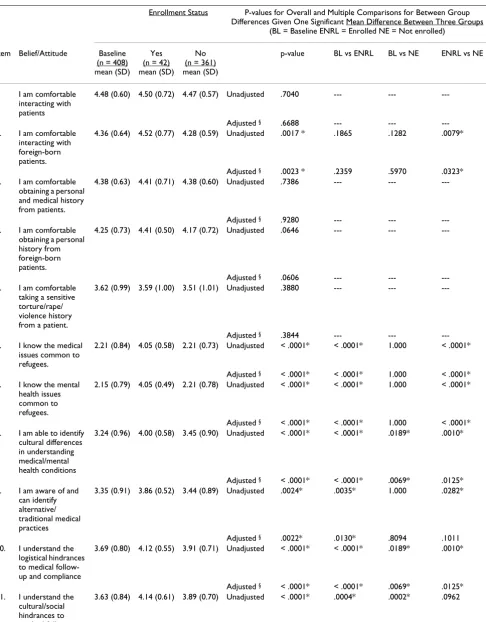
Students who participated in the elective expressed a deeper understanding of the various cultural influences on patient care when compared to the baseline group and those not completing the elective (Table 3).
Those who enrolled in the elective demonstrated more comfort interacting with foreign-born patients (unad-justed (U) p =< 0.01; ad(unad-justed (A) p = 0.03). There was also a trend toward significance with students who partic-ipated in the elective feeling more at ease taking a per-sonal and medical history from foreign-born patients than elective non-participants (U, A p = 0.06). Compared to baseline and to the non-elective students, elective par-ticipants showed significant change in their overall knowledge of refugee medical and mental health issues (U, A p =< 0.01) and in their ability to identify cultural dif-ferences in understanding medical/mental health condi-tions (U, A p = 0.01). Elective participants also gained the ability to understand logistical and cultural/social hin-drances to medical follow-up/compliance. The difference between the means was significant for both the prelimi-nary and the elective participant groups and for the pre-liminary and non-participant groups (U, A p < 0.01 for both). There was no statistically significant difference between the means for the participant and non-partici-pant groups, however.
When asked to respond to three statements pertaining to the effect of their own personal identity of background (i.e. race/ethnicity, religion, and gender) on patient inter-actions, the means for the preliminary responses ranged from 3.24 to 3.51, indicating that at baseline the group tended to agree that their race, religion, and gender would not affect their interactions with patients. Data from the follow-up questionnaires revealed that elective partici-pant mean answers ranged from 2.57 to 2.90, indicating that they as a group tended to disagree with the premise that their personal identifiers would not affect their inter-actions with patients, i.e. they felt that it would have an effect. For all three groups of responses, there was a per-ception that gender, followed closely by race, would have the most affect, i.e. the lowest means, indicating more dis-agreement with the statements, and that religion would have the least impact. When mean responses were com-pared, there were significant differences, (p < 0.05),
between the preliminary and participant means as well as between the preliminary and the non-participant means, (Table 3).
Among elective participants, 41 of 42 (97.6%) indicated that they anticipated working with refugees in the future and 37 of 42 (88%) elective participants felt that partici-pation in the elective prepared them clinically for the 3rd
and 4th years of medical school. Of note, 5 of the 42
par-ticipant responders did not answer to this question. See Table 4 for results. Students were also given a venue on the survey to share their comments and feedback of the elec-tive. Their feedback is listed in Additional file 1.
Discussion
The expanding international refugee phenomenon is pro-ducing a growing need for physicians well-versed in the health problems of refugees. Various initiatives have been implemented throughout the world, including the coun-tries of Great Britain, Canada, Australia, New Zealand [10,11] and the United States, to raise awareness of the culturally diverse societies in these countries [12]. Some medical schools have addressed multicultural issues with cultural immersion programs [13-16], international elec-tives, discussions, and formal pre-clinical cultural compe-tence seminars in which students discuss racial, religious, and sexual diversity in society [11,17-22]. But unlike cul-tural diversity discussions, refugee health has been much less studied and is a rarely taught component of medical education. Few medical students and physicians know how to appropriately treat refugees [4] or identify those who have undergone torture or related trauma [1,23-25]. Physicians untrained in issues sensitive to refugees and cultural diversity can have a deleterious effect on refugees. Prior research found that ineffective interactions with ref-ugees resulted in longer office visits, delays in obtaining consent, unnecessary testing, and patient non-adherence. Medical residents also found it difficult to assess the degree of patient understanding of their illnesses and felt less prepared to care for those who hold different beliefs. Conversely, other reports have shown that many immi-grants and refugees reported feeling misunderstood by their physicians [26]. Poor communication often exists between physicians and refugees, and patient satisfaction, adherence, and health outcomes have been tied to com-munication [6].
Table 2: Demographic characteristics of first and second year medical school students eligible to enroll in the refugee elective
Participation in Refugee Elective
Baseline (n = 408) Yes (n = 42) No (n = 361)
Characteristic N (%) N (%) N (%) p-value
Considers oneself a Minority 107/408 (26.3) 19/41 (46.3) 92/359 (25.6) 0.0161
Table 3: Belief/attitude responses: differences among three groups: baseline, participants, and nonparticipants
Enrollment Status P-values for Overall and Multiple Comparisons for Between Group Differences Given One Significant Mean Difference Between Three Groups
(BL = Baseline ENRL = Enrolled NE = Not enrolled)
Item Belief/Attitude Baseline (n = 408) mean (SD)
Yes (n = 42) mean (SD)
No (n = 361) mean (SD)
p-value BL vs ENRL BL vs NE ENRL vs NE
1 I am comfortable interacting with patients
4.48 (0.60) 4.50 (0.72) 4.47 (0.57) Unadjusted .7040 --- ---
---Adjusted § .6688 --- ---
---2. I am comfortable interacting with foreign-born patients.
4.36 (0.64) 4.52 (0.77) 4.28 (0.59) Unadjusted .0017 * .1865 .1282 .0079*
Adjusted § .0023 * .2359 .5970 .0323*
3. I am comfortable obtaining a personal and medical history from patients.
4.38 (0.63) 4.41 (0.71) 4.38 (0.60) Unadjusted .7386 --- ---
---Adjusted § .9280 --- ---
---4. I am comfortable obtaining a personal history from foreign-born patients.
4.25 (0.73) 4.41 (0.50) 4.17 (0.72) Unadjusted .0646 --- ---
---Adjusted § .0606 --- ---
---5. I am comfortable taking a sensitive torture/rape/ violence history from a patient.
3.62 (0.99) 3.59 (1.00) 3.51 (1.01) Unadjusted .3880 --- ---
---Adjusted § .3844 --- ---
---6. I know the medical issues common to refugees.
2.21 (0.84) 4.05 (0.58) 2.21 (0.73) Unadjusted < .0001* < .0001* 1.000 < .0001*
Adjusted § < .0001* < .0001* 1.000 < .0001* 7. I know the mental
health issues common to refugees.
2.15 (0.79) 4.05 (0.49) 2.21 (0.78) Unadjusted < .0001* < .0001* 1.000 < .0001*
Adjusted § < .0001* < .0001* 1.000 < .0001* 8. I am able to identify
cultural differences in understanding medical/mental health conditions
3.24 (0.96) 4.00 (0.58) 3.45 (0.90) Unadjusted < .0001* < .0001* .0189* .0010*
Adjusted § < .0001* < .0001* .0069* .0125* 9. I am aware of and
can identify alternative/ traditional medical practices
3.35 (0.91) 3.86 (0.52) 3.44 (0.89) Unadjusted .0024* .0035* 1.000 .0282*
Adjusted § .0022* .0130* .8094 .1011
10. I understand the logistical hindrances to medical follow-up and compliance
3.69 (0.80) 4.12 (0.55) 3.91 (0.71) Unadjusted < .0001* < .0001* .0189* .0010*
Adjusted § < .0001* < .0001* .0069* .0125* 11. I understand the
cultural/social hindrances to medical follow-up and compliance.
In a similar elective, Griswold described a unique 'Refugee Health Night' applying both academic seminars and clini-cal encounters for mediclini-cal students at the State University of New York, Buffalo in 2003 [2]. Based on self-reported feedback, these students had an overall positive impression of their experience [2]. Griswold found a change in medical student attitudes towards cultural awareness, increased communication, and increased sensitivity to religious val-ues, family patterns, and gender roles both before and after their interactions with the refugees [27,28].
We successfully developed and implemented a medical school elective course to expose the medical needs of ref-ugees by 1) educating medical students about refugee medical and mental health issues, as well as cultural diver-sity issues and 2) providing students with an opportunity to interact with refugees. Through our questionnaires, we showed that the elective increased student comfort inter-acting with foreign-born patients and their knowledge of refugee medical and mental health issues. It also improved understanding of cultural differences in medi-cine and alternative/traditional medical practices, and increased awareness of the logistical, cultural, and social hindrances to medical care and compliance. Lastly, we showed that medical students acknowledged that their race, religious background, and gender may have an effect
on their interaction with patients after learning about ref-ugees' perceptions of medical care personnel.
Participating students were more likely to feel that their personal religion, ethnicity/race, and gender would affect their interactions with patients. This suggests that learning about refugees and cultural diversity led to an increased recognition of these personal factors. Previous research has shown that gender concordance results in more effec-tive communication, respect, and trust [27,29,30]. Simi-larly, racial concordance can improve satisfaction with the delivery of health care services and shared-decision mak-ing [29]. While one cannot change their gender or race for each given patient interaction, recognition of the impact of these identifiers on the doctor-patient relationship is essential.
Our results are congruent with other projects aimed at multi-cultural medical education [13-16,18,27,31-33], and more specifically, health care for refugees [27,28]. These studies support the proposition that student atti-tudes about refugees change following coursework or clin-ical encounters with refugees.
The overwhelming majority of students reported that this elective helped prepare them for their last two years of
Adjusted § < .0001* .0016* .0001* .5888 12. My race/ethnic
background will not/does not affect my interactions with patients.
3.27 (1.24) 2.57 (1.15) 2.96 (1.20) Unadjusted < .0001* .0028* .0027* .2088
Adjusted § < .0001* .0100* .0012* .8173 13. My religious
background will not/does not affect my interactions with patients.
3.51 (1.20) 2.90 (1.23) 3.26 (1.20) Unadjusted .0008* .0164* .0267* .4297
Adjusted § .0007* .0213* .0299* .5719
14. My gender will not affect my interactions with patients.
3.24 (1.21) 2.57 (1.15) 2.94 (1.14) Unadjusted < .0001* .0041* .0031* .1984
Adjusted § < .0001* .0126* .0025* .7839
Abbreviations: SD, standard deviation; BL, baseline; PRT, participants; NP, nonparticipants; Vs, versus. § Adjusted for self-reported minority status and multi-lingual status.
* Statistically significant
Table 3: Belief/attitude responses: differences among three groups: baseline, participants, and nonparticipants (Continued)
Table 4: Follow-up questionnaire responses to questions relative to the refugee elective among students who completed the elective (n = 42)
Question N (%)
Was this your first interaction with non-simulated patients? 2/42 (4.8)
Was this your first clinical interaction with resident or attending physicians? 2/41 (4.9) Do you feel that your experiences helped prepare you for 3rd and 4th year clinically? 37/42 (88.1)
medical school and that they anticipated working with refugees in the future. This reflects other studies which have found that long-term medical education programs can have a positive effect on student motivation to work with the underserved [34].
The primary advantage of our intervention study is that we assessed the same cohort of students prior to and fol-lowing the course elective. To thoroughly consider what may have affected our findings, the role of self-selection bias must be addressed because this course was not man-datory. Those who enrolled in the elective may have been initially more interested in refugee health issues or have had prior experiences with refugees thereby making them more inclined to enroll in the elective. We also adjusted for student race and multilingual abilities. For example, those who enrolled in the elective felt more able to iden-tify alternative and traditional medical practices. Follow-ing adjustment for race and multilFollow-ingual status, this difference was no longer significant. The lack of signifi-cance following adjustment, despite that medical prac-tices were addressed in the course, suggests that these particular student-held-attitudes may have been inherent among students with multi-racial backgrounds and those who were multilingual.
It is also plausible that the experience of being a medical student, regardless of enrollment status, during the study period accounts for some of the non-significant findings between those who did and did not enroll in the elective. For example, there was no statistical significance found between those who did and did not enroll in the elective regarding understanding cultural and social hindrances to medical follow-up and compliance. This finding suggests that knowledge was likely acquired through either other medical school courses or experiences resulting in an overall greater awareness of these factors over time.
Although this was a preliminary investigation as to how an elective focused on refugees would influence medical students' knowledge and perceptions, there are several disadvantages inherent in this study. The primary disad-vantage is that we were unable to assign study identifica-tion numbers to link pre- and post-study quesidentifica-tionnaires. Secondly, we did not obtain other demographic variables (age, gender, year of medical schooling, religion, future medical specialty interest). In our future investigations, we will incorporate more demographic variables so that we can determine which potentially confounding per-sonal factors are associated with enrolling in a Refugee Health Elective. As this was the first time the Refugee Health elective was offered, our sample size (42 students) was limited; therefore, we were at a disadvantage to meas-ure all the student differences and to precisely estimate the degree to which attitudes changed during the course of the
semester. Additional analyses as the elective continues to evolve would give the project additional validity. Since 41 of the 42 (97.6%) participants indicated a desire to work clinically with refugees in the future, a long-term study analyzing the career paths of these future physicians would demonstrate the long-standing effects of this and similar elective courses. In addition, we believe that incor-porating other health care professionals, such registered nurses, in the elective would have provided the students with additional perspectives especially as nurses are often the mediators of the patient-physician interaction process.
In terms of the elective course curriculum, and the limited contact with refugees, we would have also have liked to have included additional clinical experiences. However, in our situation, sensitivity and privacy issues led to lim-ited established avenues by which students could partici-pate in delivering medical and mental health care to refugees.
Conclusion
Refugees are among the world's most vulnerable inhabit-ants and their numbers grow annually. With a growing increase in refugees worldwide, physicians will be more likely to find themselves having to provide care for this subset of the population [26]. Our study provides evi-dence that a medical elective focused on refugee health can provide an increased knowledge base and change in attitude of medical students toward refugee health and care. This elective format offers a tangible and effective avenue for these topics to be addressed for future medical clinicians. We must make our future physicians aware of this unmet and misunderstood medical need. Focused research relative to issues important to refugees and required characteristics of physicians to create successful interactions with refugees is paramount.
Competing interests
Regarding the full disclosure of any potential conflict of interest, Dr. Eagle has research grants from the following: Biosite, BristolMyers Squibb, Cardiac Sciences, Blue Cross Blue Shield of Michigan, Hewlett Foundation, Mardigian Fund, Pfizer, Sanofiaventis, and the Varbedian Fund. He is also is a Consultant/Advisory Board for the following: NIH, NHLBI, Pfizer, Sanofiaventis, and the Robert Wood Johnson Foundation. The other authors of the manuscript "Effects of a Refugee Elective on Medical Student Percep-tions" do not have any competing conflict of interests (financial, political, personal, religious, academic, ideo-logical, commercial or any other) to report nor have any ties to for-profit companies or institutions.
Authors' contributions
pri-mary manuscript. EG assisted in developing the survey tool and assisted in both writing and editing the primary manuscript. MG did the statistical analysis and contrib-uted in editing the manuscript. BMV assisted with the sta-tistical analysis and the editing of the manuscript's methods section. LM helped to develop and execute the elective and edit the manuscript. KE assisted in the survey design, funding, and in the editing of the manuscript and overall guidance of the elective.
Additional material
Acknowledgements
The Refugee Health Elective's supplies, materials, and overall funding was provided by a grant from the Arnold P. Gold Foundation.
Institution sponsoring the Refugee Elective:
Michigan State University College of Human Medicine
Analysis conducted at:
Michigan State University College of Human Medicine and University of Michigan College of Medicine.
References
1. Drennan V, Joseph J: Health visiting and refugee families: issues in professional practice. J of Adv Nurs 2005, 49:155-163. 2. Griswold K: Refugee health and medical student training. Fam
Med 2003, 35:649-654.
3. United Nations: Convention relating to the status of refugees.
New York: United Nations Publications; 1951.
4. Moreno A, Piwowarczyk L, Grodin M: Human rights violations and refugee health. JAMA 2001, 285:1215.
5. FOCUS Online: News from Harvard medical, dental, and pub-lic health schools: minority health report. [http:// focus.hms.harvard.edu/2007/051807/minority_health.shtml]. 6. Betancourt J: Cross-cultural medical education: conceptual
approaches and frameworks for evaluation. Acad Med 2003,
78:560-569.
7. Dogra N, Karnik N: First-year medical students' attitudes toward diversity and its teaching: an investigation at one US medical school. Acad Med 2003, 78(11):1191-1200.
8. St. Vincent Catholic Charities: Refugee Services, Lansing,
Michigan. .
9. SAS Institute Inc: SAS/STAT 9.1.3 Help and Documentation Cary, NC: SAS Institute Inc; 2000.
10. Dogra N, Stretch D: Developing a questionnaire to assess stu-dent awareness of the need to be culturally aware in clinical practice. Medical Teacher 2001, 23:59-64.
11. Dowell , Crampton P, Parkin C: The first sunrise: an experience of cultural immersion and community health needs assess-ment by undergraduate medical students in New Zealand.
Med Educ 2001, 35:242-249.
12. Loudon R, Anderson P, Singh P, Greenfield S: Educating medical students for work in culturally diverse societies. JAMA 1999,
282:875-880.
13. Chiller TM, DeMieri P, Cohen I: International health training: the tulane experience. Infectious disease clinics of North America
1995, 9:439-443.
14. Godkin M, Savageau J: The effect of medical students' interna-tional experiences on attitudes toward serving underserved multicultural populations. Fam Med 2003, 35:273-278. 15. Jotkowitz , Gaaserud A, Gidron Y, Urkin J, Margolis C, Henkin Y:
Evaluation of student attitudes and knowledge in a new pro-gram in international health and medicine. Medical Teacher
2004, 26:574-578.
16. Ramsey A, Haq C, Gjerde C, Rothenberg D: Career influence of an international health experience during medical school.
Family Medicine 2004, 36:412-416.
17. Dogra N, Connin S, Gill P, Spencer J, Turner M: Teaching of cul-tural diversity in medical schools in the united kingdom and republic of Ireland: cross sectional questionnaire survey. BMJ
2005, 330:403-404.
18. Dogra N: The development and evaluation of a programme to teach cultural diversity to medical undergraduate stu-dents. Med Educ 2001, 35:232-241.
19. Dogra N, Karnik N: A comparison between UK and US medi-cal student attitudes towards cultural diversity. Medical Teacher 2004, 26:703-708.
20. Beagan B: Teaching social and cultural awareness to medical students: "it's all very nice to talk about it in theory, but ulti-mately it makes no difference.". Acad Med 2003, 78:605-614. 21. Maudsley RF: Content in context: medical education and
soci-ety's needs. Acad Med 1999, 74:143-145.
22. Koehn PH: Globalization, migration health, and educational preparation for transitional medical encounters. Global Health
2006, 30:2.
23. Mollica R: Assessment of trauma in primary care. JAMA 2001,
285:1213.
24. Weine S, Kuc G, Dzudza E, Razzano L, Pavkovic I: PTSD among Bosnian refugees: a survey of providers' knowledge, atti-tudes and service patterns. Community Mental Health Journal 2001,
37:261-271.
25. Gong-Guy E, Cravens R, Patterson T: Clinical issues in mental health delivery to refugees. American Psychologist 1991,
46:642-648.
26. United Nations High Commissioner for Refugees UNHCR Sta-tistical Report 2005 [http://www.unhcr.org/statistics/STATISTICS/ 4486ceb12.pdf].
27. Griswold K, Zayas LE, Kernan JB, Wagner CM: Cultural awareness through medical student and refugee patient encounters. J Immigr Minor Health 2007, 9:55-60.
28. Griswold K, Kernan J, Servoss T, Saad F, Wagner C, Zayas L: Refu-gees and medical student training: results of a programme in primary care. Med Educ 2006, 40:697-703.
29. Cooper LA, Beach MC, Johnson RL, Inui TS: Delving below the surface: Understanding how race and ethnicity influence relationships in health care. J Gen Int Med 2006, 21:S21-27. 30. Hamilton J: Multicultural health care requires adjustments by
doctors and patients. CMAJ-JAMC 1996, 155:585-587.
31. Crandall SJ, George G, Marion GS, Davis S: Applying theory to the design of cultural competency training for medical students: a case study. Acad Med 2003, 78:588-594.
32. Champeneria M, Axtell S: Cultural competence training in us medical schools. JAMA 2004, 291:2142.
33. Rosen J, Spatz E, Gaaerud A, et al.: A new approach to developing cross-cultural communication skills. Medical Teacher 2004,
26:126-132.
34. Ko M, Edelstein R, Heslin K, et al.: Impact of University of Cali-fornia, Los Angeles/Charles R Drew University medical intentions to practice in underserved areas. Acad Med 2005,
80:803-808.
Pre-publication history
The pre-publication history for this paper can be accessed here:
http://www.biomedcentral.com/1472-6920/9/15/prepub
Additional file 1
Comments from Elective Participants. Click here for file