R E S E A R C H A R T I C L E
Open Access
Effectiveness of a quality management program
in dental care practices
Katja Goetz
1*, Stephen M Campbell
1,2, Björn Broge
3, Marc Brodowski
3, Michel Wensing
1,4and Joachim Szecsenyi
1,3Abstract
Background:Structured quality management is an important aspect for improving patient dental care outcomes, but reliable evidence to validate effects is lacking. We aimed to examine the effectiveness of a quality management program in primary dental care settings in Germany.
Methods:This was an exploratory study with a before-after-design. 45 dental care practices that had completed theEuropean Practice Assessment(EPA) accreditation scheme twice (intervention group) were selected for the study. The mean interval between the before and after assessment was 36 months. The comparison group comprised of 56 dental practices that had undergone their first assessment simultaneously with follow-up assessment in the intervention group. Aggregated scores for five EPA domains:‘infrastructure’,‘information’,‘finance’,‘quality and safety’and‘people’were calculated.
Results:In the intervention group, small non-significant improvements were found in the EPA domains. At follow-up, the intervention group had higher scores on EPA domains as compared with the comparison group (range of differences was 4.2 to 10.8 across domains). These differences were all significant in regression analyses, which controlled for relevant dental practice characteristics.
Conclusions:Dental care practices that implemented a quality management program had better organizational quality in contrast to a comparison group. This may reflect both improvements in the intervention group and a selection effect of dental practices volunteering for the first round of EPA practice assessment.
Keywords:Dental care, Oral health care, Quality of care, Quality improvement, Quality management
Background
Improving the quality of healthcare is a high priority in Western health care systems [1] driven by factors such as reducing adverse events, optimizing efficiency, and enhancing patient satisfaction [2]. An excellent definition of quality in healthcare is given by Mills & Batchelor [3]. In essence, however, quality of care can been defined and evaluated in terms of structure, process and outcomes [4]. Whilst the presence of specific organizational structures does not necessarily result in better clinical processes and outcomes, organizational aspects are certainly enablers of higher performance [4,5]. Little is known about how to improve quality of organizational aspects of primary sec-tor dental care. The majority of literature and the evidence base for defining and measuring quality in primary care
come from general medical practice and not from oral health care settings [6]. However, assessing and monitor-ing the quality of dental care play an important role in quality assurance and quality improvement [7].
In most health care systems, a variety of quality im-provement initiatives have been implemented to enhance both health care management broadly speaking and dental health care specifically speaking [3,7-10]. For instance, in the United Kingdom quality indicators were developed for the new National Health Service (NHS) dental contract which targets measuring the quality of patient care as well as performance [3]. In 2005, in Scotland, the“Action Plan for Improving Oral Health and Modernising NHS Dental Services” was announced [11]. Since 1997, in the United States, an assessment instrument developed and initiated by MetLife has been implemented for dental care pro-viders [12]. Particularly countries such as the United Kingdom, the United States and Canada have shown * Correspondence:[email protected]
1
Department of General Practice and Health Services Research, University of Heidelberg, Vosstr. 2, Building 37, Heidelberg D-69115, Germany
Full list of author information is available at the end of the article
expertise in development and implementation of quality management systems. Quality management means qual-ity assurance: the systematic measurement and moni-toring of process, structure and outcome of care and results in a continuous improvement process. For ex-ample, the plan-do-study-act cycle, to ensure quality of care [9,13]. In 2006, the German government stipulated that general dental practitioners should implement a system of annual assessment of quality management, in the same way that general medical practices are ex-pected to do [14]. Although, to date, there are no formal sanctions, so participation remains voluntary. The result has been that different quality management systems have become available for health care providers in pri-mary care settings [15]. These different quality manage-ment systems measure structure and process of care as well as non-clinical outcomes of patients.
However, while such quality management programs are available for dental care, evidence on their impact and effectiveness is sparse [6], with some exceptions [15,16]. There is an urgent need for validated quality as-sessment tools for dental care [7]. TheEuropean Practice
Assessment is a comprehensive, integrative and multifa-ceted tool for quality assessment and quality improvement in health care in terms of quality management. It is based on quality indicators developed for use in primary medical care settings to evaluate the structure and process of care [17]. TheEuropean Practice Assessmenttool has shown ef-fectiveness in improving the management of general med-ical practices [18,19]. The current study focuses on the implementation and repeated measurement of European
Practice Assessment tool in primary dental care settings and examined whether improvements occurred in dental care practice that completed theEuropean Practice
Assess-menttwice compared with dental care practices that com-pleted theEuropean Practice Assessmentonce.
Methods
European practice assessment
In 2004, theEuropean Practice Assessmentwas developed for general medical care and already in 2005, the content as well the process was adapted for general dental care set-tings [17,19,20]. An expert group consisting of dentists and employees of the Institute for Applied Quality Im-provement and Research in Health Care (AQUA-Institute) adapted and piloted theEuropean Practice Assessmentfor dental care practices. In both cases, theEuropean Practice
Assessmentconsists of a set of validated quality indica-tors for external and internal assessment including a pa-tient survey of satisfaction with care and a staff job satisfaction survey, an outreach visit by a trained exter-nal facilitator, structured feedback, a team-meeting in the practice and formal accreditation by an external organization [17]. These different indicators are framed
within five key conceptual domains:“infrastructure”, “ in-formation”, “finance”, “quality and safety” and “people”. Some indicators for dental care practices are different to those for general medical care. The domain “ infrastruc-ture”was expanded by dimensions‘material management’ and ‘laboratory management’; the domain “quality and safety”by dimensions‘safety of staff and patients, hygiene, infection control’ and ‘provisions for emergency situa-tions’; and the domain “information” by dimensions
‘communication with other health care providers’ and
‘information for patients on practice, practice policy and community resources’. Detailed information about the European Practice Assessment for dental care set-tings on a website is under construction.
After the implementation ofEuropean Practice
Assess-mentin either a general medical care practice or a dental care practice, feedback is given by the trained facilitator using software called Visotool, which shows the results of the assessment. An anonymous comparison between a practice’s score and all other practices that have under-taken the assessment is available, which serves as a cata-lyst for quality improvement and for benchmarking. The application of theEuropean Practice Assessmentis coor-dinated by the AQUA-Institute based in Goettingen, Germany [21].
Design and participants
The study conforms to the STROBE-Guidelines. A before-after study design was used with an intervention group and a comparison group of dental care practices. We included dental care practices in Germany that had com-pleted theEuropean Practice Assessmentas part of a qual-ity management program. For the intervention group, we identified all 45 dental care practices which had completed theEuropean Practice Assessmenttwice, with their first assessment between April 2005 and December 2008 and their second assessment between April 2008 and January 2012. The interval between first and second as-sessment was around 36 months. During the period be-tween April 2008 and May 2011 when the intervention practices were undergoing their second assessment, 57 dental care practices were undergoing their first assess-ment with theEuropean Practice Assessmentprogram but none had yet had a second assessment. These were called upon as our comparison group. One dental care practice was integrated into a general medical care centre and was excluded from the analysis. Therefore, 56 practices in total were included in the comparison group. Figure 1 shows the distribution of dental care practices to intervention and comparison groups respectively.
Statistical analysis
means and standard deviations. Categorical data were pre-sented as frequency counts and percentages. The practice characteristics of the intervention and comparison groups were compared using Students t-test for continuous data and Chi2test for categorical data.
Z scores were used to compare the overall mean score across all domains and dimensions of the European
Practice Assessment instrument, in the intervention (sec-ond assessment) and comparison groups. Z scores were used to normalize raw scores [18,22]. The mean scores of all domains and dimensions were based on the proportion of indicators for which a positive response was achieved by all of the practices, on a scale of 0 to 100. The 95% con-fidence intervals were calculated for the differences in scores between the first and second assessment and for the differences between the second assessment and the comparison group. Furthermore, linear regression analyses were performed with aggregated scores on each of the five domains as dependent outcomes; practice characteristics as well as the affiliation to intervention (second assess-ment) or comparison group were handled as potential pre-dictors. An alpha level of p < 0.05 was used for tests of statistical significance.
Ethics approval
Ethical approval was not required because we used sec-ondary data available from the routine implementation of a quality management program in primary dental care sector in Germany [14]. All elements of the European
Practice Assessmentand the information from the trained
external facilitators were anonymized for data analysis in our study. No additional information or data from patients or staff were collected.
Results
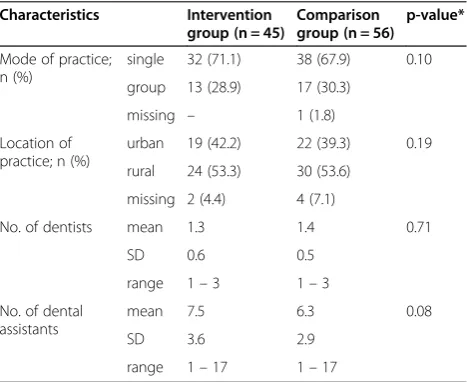
The practices included in the intervention (second assess-ment) and comparison groups did not differ significantly in the relevant covariates of practice characteristics (Table 1).
Figure 1Selection of private dental care practice for the intervention and comparison.
Table 1 Characteristics of the study sample
Characteristics Intervention group (n = 45)
Comparison group (n = 56)
p-value*
Mode of practice; n (%)
single 32 (71.1) 38 (67.9) 0.10
group 13 (28.9) 17 (30.3)
missing – 1 (1.8)
Location of practice; n (%)
urban 19 (42.2) 22 (39.3) 0.19
rural 24 (53.3) 30 (53.6)
missing 2 (4.4) 4 (7.1)
No. of dentists mean 1.3 1.4 0.71
SD 0.6 0.5
range 1–3 1–3
No. of dental assistants
mean 7.5 6.3 0.08
SD 3.6 2.9
range 1–17 1–17
SD, standard deviation.
Domains of the European practice assessment
Changes in the scores for the five domains and all dimen-sions for both the intervention group (first and second as-sessment) and comparison groups are shown in Table 2. We observed an improvement in quality management in the intervention group, with a change in score of 4.4 encompassing all 281 indicators within the five domains. A higher score occurred in the intervention group in all five domains, particularly in the domains “information” (T0 82.6, T1 89.0) and “quality and safety” (T0 82.4, T1 88.7), which showed an improvement over 6.0. Compared with the comparison group at first assessment, the intervention group at second assessment had signifi-cantly better scores for the domains “infrastructure” (T1 94.2, Comparison group 84.0) and “quality and safety”(T1 88.7, Comparison group 78.1).
Improvements were observed in the intervention group in the dimensions “complaint management” and
“communication with other health care providers”. Com-pared with the comparison group at first assessment, the intervention group at second assessment had signifi-cantly better score in the dimensions such as “medical equipment, including drugs”, “staff management”, “ pre-vention”and“complaint management”.
Elements associated with each domain of the European practice assessment
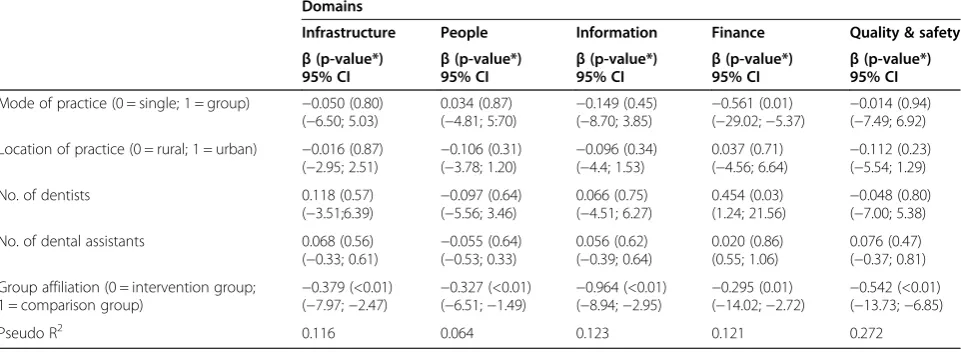
Table 3 shows the results of the regression analyses sep-arated for each of the five domains regarding practice characteristics and affiliation to intervention or compari-son group. The five regression models explained between 6.4% and 27.2% of the variance respectively. The only in-dependent variable that showed a significant association with each domain was intervention versus comparison group affiliation with the intervention group demonstrat-ing higher scores in each domain.
Discussion
To our knowledge, this is the first study that has evaluated and demonstrated quality improvement in primary dental care practices in Germany. In this study, a repeated meas-urement was used to evaluate the effect of the assessment process using the European Practice Assessment quality management program. The intervention and comparison group practices did not differ remarkably in comparison to general medical practice characteristics. Furthermore, the baseline data and the first assessment of the interven-tion group showed higher scores than in the comparison group within the five key domains (‘infrastructure’,
‘people’,‘information’,‘finance’, and‘quality and safety’). The comparison of the results of the second assessments in intervention practices with the baseline assessments in comparison group practices showed improvements across
all domains, but especially within the domains of ‘quality and safety’and‘infrastructure’.
Quality improvement depends on a set of valid and feasible quality indicators that are able to measure quality of care [23]. “Indicators are measurable elements of practice for which there is evidence or consensus that they reflect quality and hence help change the quality of care provided”[23,24]. The implementation of a quality management system in practices can be facilitated by the use of quality indicators. Quality indicators should yield positive assessment on a range of attributes such as clarity, feasibility, reliability, validity and transparency and in order to demonstrate sensitivity to change, bench-marking data are required so that health care providers can assess and compare their own quality of care with others [23,25]. Moreover, for assessment to lead to im-provement it must be part of an ongoing process such as the “plan-do-study-act” (PDSA) cycle [26]. A continuous quality improvement is an essential part of quality man-agement programs for health care services, which includes general medical practices and dental care practices in the primary sector [18].
The evaluation of quality of care requires a mixture of objective and subjective measures [27]. The European
Practice Assessment consists of a set of objective and subjective quality indicators, which evaluate the struc-ture and process of care from the perspective of practice owners, staff, patients and trained external facilitators [17]. For general medical practices, the effectiveness of the European Practice Assessment in showing higher scores at repeat assessment has already been shown [18,20]. These results regarding general medical practice are comparable to our results regarding the improve-ment for each domain at dental care practices [18,20]. The improvement of dimensions and domains in dental care practices follows a similar trend to that of the improvement in general medical practices.
There are different quality improvement activities being initiated in oral health services worldwide ranging from measurements of the process of technical restoration procedures to examination of long term health outcomes for the population [9]. Within this range, one important component is the measurement of dental care practice operations including structure, process and outcomes [9]. However, a systematic and organized agenda for qual-ity improvement in dentistry is still in its fledgling stage [7]. The results of this study suggest that the European
Practice Assessment provides a much needed mechanism for assessing quality in dental care practices and improv-ing quality and safety [28].
Table 2 Mean scores* for the domains and dimensions of the European practice assessment instrument
Domain No of
indicators
Intervention group (n = 45) Change in score (95% CI)
Score for comparison group2(n = 56)
Between-group difference in scores3(95% CI) Score at first
assessment
Score at second assessment
Infrastructure 77 90.8 94.2 3.4 (−1.9; 8.7) 84.0 10.2 (2.3; 18.1)*
Accessibility and availability 15 76.9 85.5 8.6 (0.4; 16.8) 76.1 9.4 (1.8; 17.0)*
Disabled access 5 55.0 59.2 4.2 (−1.7; 10.1) 57.3 1.9 (−1.7; 5.5)
Premises 20 89.4 92.8 3.4 (−1.9; 8.7) 88.6 4.2 (−1.1; 9.5)
Medical equipment, including drugs 14 89.7 91.7 2.0 (−2.1; 6.1) 83.5 8.2 (1.0; 15.4)*
Nonmedical equipment 3 83.4 90.9 7.5 (−0.2; 15.2) 83.0 7.9 (0.8; 15.0)*
Material management 5 95.9 97.7 1.8 (−2.1; 5.7) 98.9 −1.2 (−4.1; 1.7)
Laboratory management 9 94.7 95.1 0.4 (−1.4; 2.2) 90.4 4.7 (−0.8; 10.2)
IT-security 6 90.8 94.2 3.4 (−1.9; 8.7) 90.5 3.7 (−1.2; 8.6)
People 79 79.9 82.3 2.4 (−2.1; 6.9) 78.1 4.2 (−1.1; 9.5)
Perspective of patients 33 87.3 87.3 — 87.7 −0.4 (−2.1; 1.3)
Perspective of dental staff on working conditions
15 77.5 79.4 1.9 (−2.1; 5.9) 76.7 2.7 (−1.5; 6.9)
Perspective of dentists on working conditions 12 83.0 82.0 −1.0 (−3.9; 1.9) 78.7 3.3 (−1.4; 8.0)
Staff management 10 64.9 77.5 12.6 (2.9; 22.2) 60.2 17.3 (7.4; 27.2)*
Education and training 9 69.7 74.0 4.3 (−1.6; 10.2) 64.7 9.3 (1.7; 16.9)
Information 56 82.6 89.0 6.4 (−0.7; 13.6) 82.0 7.0 (0.3; 13.7)
Confidentiality and privacy 6 85.6 93.6 8.0 (0.01; 15.9) 82.3 11.3 (3.0; 19.6)*
Prevention 8 75.7 79.9 4.2 (−1.7; 10.1) 67.6 12.3 (3.7; 20.9)*
Clinical data, patients records 7 91.6 95 .7 4.1 (−1.7; 9.9) 91.3 4.4 (−0.9; 9.8)
Information for staff 3 81.6 89.5 7.9 (0.01; 15.9) 86.2 3.3 (−1.4; 8.0)
Information for patients on medical care 16 91.9 94.6 2.7 (−2.0; 7.4) 91.4 3.2 (−1.4; 7.8)
Use of computers 2 77.8 87.6 9.8 (1.1; 18.5) 82.9 4.7 (−0.8; 10.2)
Communication with other health care providers
5 79.9 92.7 12.8 (3.3; 22.6)* 84.1 8.6 (1.3; 15.9)*
Information for patients on practice, practice policy and community resources
9 66.3 76.8 10.5 (1.5; 19.5) 67.8 9.0 (1.5; 16.5)*
Finance 10 83.2 86.3 3.1 (−1.9; 8.2) 78.2 8.1 (0.9; 15.2)
Financial leadership and responsibilities 6 90.2 91.3 1.1 (−1.9; 4.1) 87.7 3.6 (−1.3; 8.5)
Financial planning 1 42.2 48.9 6.7 (−0.6; 14.0) 33.3 15.6 (6.1; 25.1)*
Annual report (retrospective) 3 82.9 88.9 6.0 (−0.9; 12.9) 73.5 15.4 (5.9; 24.9)*
Quality & Safety 59 82.4 88.7 6.3 (−0.7; 13.4) 78.1 10.6 (2.5; 18.7)*
Quality development, quality policy 10 76.1 80.5 4.4 (−1.6; 10.4) 69.1 11.4 (3.1; 19.7)*
Detection of quality and safety problems 11 83.1 88.7 5.6 (−1.1; 12.3) 77.4 11.3 (3.0; 19.6)*
Safety of staff and patients, hygiene, infection control
24 93.2 97.0 3.8 (−1.8; 9.4) 91.4 5.6 (−0.4; 11.6)
Provisions for emergency situations 6 74.2 83.3 9.1 (0.7; 17.5) 68.7 14.6 (5.4; 23.8)*
Complaint management 5 54.4 74.4 20.0 (8.3; 31.7)* 48.7 25.7 (14.3; 37.1)*
Analysis of critical incidents 3 78.1 83.3 5.2 (−1.3; 11.7) 72.0 11.3 (3.0; 19.6)*
Total 281 82.7 87.1 4.4 (−1.0; 9.8) 80.5 6.6 (0.1; 13.1)
T0, First assessment; T1, Second assessment. *Statistical significances of difference: P < 0.05.
1
Mean scores are on a scale of 0 to 100 and are based on the proportion of indicators for which a positive response was achieved by all of the practices.
2
Mean scores at first assessment.
3
make an important contribution to the evidence base related to quality in oral health services and also to improving patient outcomes. This is important if oral health services are to stay on par with other health ser-vices in terms of quality management [7,31]. Therefore, raising awareness regarding the development and con-tinuous measurement of quality in dental care practices is important for dentists and oral health services policy makers. One opportunity (enabler) would be the introduc-tion of performance-based reimbursement to incentivize good quality of care. The potential role of performance-based reimbursement for dentistry is currently under dis-cussion in the United Kingdom and it is being piloted [3,32]. However, performance-based reimbursement is also associated with unintended consequences [33,34]. For ex-ample, the introduction of performance-based reimburse-ment in general medical care practices has shown short-term gains, but the evidence for its effectiveness long-short-term is not compelling [35,36]. Therefore, it should be imple-mented with caution in dental care settings [2,37] and its implementation should only be considered within the con-text of a system wide quality improvement strategy [9].
Limitations
Our study has the following limitations. The sample of participating dental care practices was small and may not have been generally representative of dental care practices in Germany. However, all practices that had used the
European Practice Assessment twice were included. The allocation of practices to an intervention or a comparison group was not randomized and a baseline measurement in the comparison group was lacking. Moreover, the study design has a weakness in that the pre-post measurement was possible with the intervention group, but with only a single set of observations at a second point in time.
Although our results showed improvements in the inter-vention group, this may reflect a selection effect of dental practices volunteering for the first round of theEuropean
Practice Assessment. Therefore, the results of the study have to be interpreted carefully and need to be confirmed in further studies. In addition, although it is known, that a multifaceted quality management program motivates practices to change [38], there is no reliable evidence from this study about the impact on clinical outcomes because the data presented concentrates on structure and process of care. Because this was the first study evaluating effect-iveness of a quality management program in primary den-tal care settings in Germany, we have no experience on which to base our assessment as to how clinically relevant our results are. At this time, we have no reference stan-dards. This study provides preliminary results as basis for further studies. The study design was explorative. There-fore, no correction for multiple tests was needed. The observed effects should be examined in further study with a larger sample.
Conclusions
In summary, implementation of quality management in dental care practices requires a paradigm shift: there cannot longer be a singular focus on technical aspects, but also it is necessary to integrate organizational as-pects of service delivery and employ a team approach. Based on results from this study, this has the potential to result in better organizational quality in dental care practices. TheEuropean Practice Assessmentfor dental care practices provides such a quality management program, as it focuses on the improvement of struc-tural and organizational aspects to promote high qual-ity of care.
Table 3 Impact of the practice characteristics and group affiliation for each domain (results of linear regression analyses, under specification of standardized beta coefficient and 95% confidence interval (CI),α= 5%)
Domains
Infrastructure People Information Finance Quality & safety
β(p-value*)
95% CI β
(p-value*)
95% CI β
(p-value*)
95% CI β
(p-value*)
95% CI β
(p-value*) 95% CI
Mode of practice (0 = single; 1 = group) −0.050 (0.80) (−6.50; 5.03)
0.034 (0.87) (−4.81; 5:70)
−0.149 (0.45) (−8.70; 3.85)
−0.561 (0.01) (−29.02;−5.37)
−0.014 (0.94) (−7.49; 6.92)
Location of practice (0 = rural; 1 = urban) −0.016 (0.87) (−2.95; 2.51) −
0.106 (0.31) (−3.78; 1.20) −
0.096 (0.34) (−4.4; 1.53)
0.037 (0.71)
(−4.56; 6.64) −
0.112 (0.23) (−5.54; 1.29)
No. of dentists 0.118 (0.57)
(−3.51;6.39)
−0.097 (0.64) (−5.56; 3.46)
0.066 (0.75) (−4.51; 6.27)
0.454 (0.03) (1.24; 21.56)
−0.048 (0.80) (−7.00; 5.38)
No. of dental assistants 0.068 (0.56)
(−0.33; 0.61) −
0.055 (0.64) (−0.53; 0.33)
0.056 (0.62) (−0.39; 0.64)
0.020 (0.86) (0.55; 1.06)
0.076 (0.47) (−0.37; 0.81)
Group affiliation (0 = intervention group; 1 = comparison group)
−0.379 (<0.01) (−7.97;−2.47)
−0.327 (<0.01) (−6.51;−1.49)
−0.964 (<0.01) (−8.94;−2.95)
−0.295 (0.01) (−14.02;−2.72)
−0.542 (<0.01) (−13.73;−6.85)
Pseudo R2 0.116 0.064 0.123 0.121 0.272
Competing interests
BB and MB are employed by the AQUA-Institute which disseminates the European Practice Assessmentin Germany. JS is its director and stockholder. Other authors: No conflict of interest declared.
Authors’contributions
KG, SC and JS initiated and designed the study. MB and BB coordinated the study. KG carried out data analysis and wrote the manuscript. All authors (KG, SC, MB, BB, MW and JS) read earlier versions of the manuscript, provided critical comments and approved the final manuscript.
Acknowledgements
The authors thank the primary sector dental care practices and outreach facilitators who participated in the study. The authors also thank the European Practice Assessmentmanagement team at the AQUA-Institute and Sarah Berger for reviewing English language expression in this paper.
Author details
1Department of General Practice and Health Services Research, University of Heidelberg, Vosstr. 2, Building 37, Heidelberg D-69115, Germany.2Centre for Primary Care, Institute of Population Health, University of Manchester, Manchester, UK.3AQUA-Institute for Applied Quality Improvement and Research in Health Care, Goettingen, Germany.4Scientific Institute for Quality of Health Care, Radboud University Nijmegen Medical Centre, Nijmegen, The Netherlands.
Received: 12 July 2013 Accepted: 23 April 2014 Published: 28 April 2014
References
1. World Health Organization (WHO):Quality and accreditation in health services. A global review.Geneva (Switzerland): The Organization; 2003. 2. The Institute of Medicine (IOH):Crossing the quality chasm: a new health
system for the 21st century.Washington D.C: National Academies Press; 2001. 3. Mills I, Batchelor P:Quality indicators: the rationale behind their use in
NHS dentistry.Br Dent J2011,211:11–15.
4. Donabedian A:The quality of care. How can it be assessed?JAMA1988, 260:1743–1748.
5. Campbell SM, Roland MO, Buetow S:Defining quality of care.Soc Sci Med 2000,51:1611–1625.
6. Campbell SM, Tickle M:What is quality primary dental care?Br Dent J 2013,215:135–139.
7. Bader JD:Challenges in quality assessment of dental care.J Am Dent Assoc2009,140:1456–1464.
8. Greenfield D, Braithwaite J:Health sector accreditation research: a systematic review.Int J Qual Health Care2008,20:172–183. 9. Glassman P:Oral health quality improvement in the era of accountability.
Michigan: W.K. Kellogg Foundation; 2011.
10. Kenny DJ, Conway RM, Johnston DH:The development of IS09002 quality management standards for Canadian dental practices.J Can Dent Assoc 1999,65:105–108.
11. NHS Scotland:An Action Plan for Improving Oral Health and Modernising NHS Dental Services in Scotland.Scottish Executive Edinburgh; 2005. http://www. scotland.gov.uk/Resource/Doc/37428/0012526.pdf. [last accessed April 24, 2014].
12. Crall JJ, Spritzer KL, Hays RD:Development and implementation of a dental office assessment program.J Am Coll Dent2012,79:33–41. 13. Deming EW:Massachusetts Institute of Technology, Centre for Advanced
Engineering Study.Cambridge (MA): Out of Crisis; 1986.
14. Federal Joint Committee (GB-A):Quality management guideline for dental care; 2006. http://www.eazf.de/doc/Dokumente/QM-Richtlinie_GBA.pdf. [last accessed April 24, 2014].
15. Bergmann Krauss B, Boehme P:Qualitätsmanagement-Systeme für die Zahnarztpraxis.IDZ-Inform2005,5:4–38. in German.
16. Mettes TG, van der Sanden WJ, Bronkhorst E, Grol RP, Wensing M, Plasschaert AJ:Impact of guideline implementation on patient care: randomized trial.J Dent Res2009,89:71–76.
17. Engels Y, Dautzenberg M, Campbell S, Broge B, Boffin N, Marshall M, Elwyn G, Vodopivec-Jamsek V, Gerlach FM, Samuelson M, Grol R:Testing a European set of indicators for the evaluation of the management of primary care practices.Fam Pract2006,23:137–147.
18. Szecsenyi J, Campbell S, Broge B, Laux G, Willms S, Wensing M, Goetz K: Effectiveness of a quality-improvement program in improving management of primary care practices.CMAJ2011,183:E1326–E1333.
19. EPA Website:European Practice Assessment.http://www.epa-qm.de/epa/ front_content.php?idart=218. [last accessed April 24, 2014].
20. Götz K, Szecsenyi J, Broge B, Willms S:[Welche Wirkung hat Qualitätsmanagement in Arztpraxen? Ergebnisse aus Entwicklung und Evaluation des Europäischen Praxisassessments (EPA).].Göttingen: AQUA-Verlag; 2011. in German.
21. AQUA-Website:Institute for Applied Quality Improvement and Research in Health Carewww.aqua-institut.de. [last accessed April 24, 2014]. 22. Goderis G, Borgermans L, Heyrman J, Van Den Broeke C, Carbonez A,
Mathieu C, Verbeke G, Grol R:Monitoring modifiable cardiovascular risk in type 2 diabetes care in general practice. The use of an aggregated z-score.Med Care2010,48:589–595.
23. Campbell SM, Braspenning J, Hutchinson A, Marshall M:Research methods used in developing and applying quality indicators in primary care. Br Med J2003,326:816–819.
24. Lawrence M, Olesen F:Indicators of quality health care.Eur J Gen Pract 1997,3:103–108.
25. Braspenning J, Hermans R, Calsbeek H, Westert G, Campbell SM, Grol R: Quality and safety of care: the role of indicators.InImproving patient care: the implementation of change in health care practice.2nd edition. Edited by Grol R, Wensing M, Eccles M, Davis D. Oxford: UK John Wiley & Sons, Ltd; 2013.
26. Boaden R, Harvey G, Moxham C, Proudlove N:Quality improvement: theory and practice in healthcare.Coventry: NHS Institute for Innovation and Improvement; 2008.
27. Campbell SM, Eriksson T:Multiple strategies for quality improvement and patient safety–money alone is not the answer, nor is trust. Conclusions of the 6th April 2011.Euro J Gen Pract2011,17:238–240.
28. Lester HE, Eriksson T, Dijkstra R, Martinson K, Tomasik T, Sparrow N:Practice accreditation: the European perspective.Br J Gen Pract2012,62:273–274. 29. Minkman M, Ahaus K, Huijsman R:Performance improvement based on
integrated quality management models: what evidence do we have? A systematic literature review.Int J Qual Health Care2007,19:90–104. 30. Schouten LMT, Hulscher MEJL, Everdingen JJE V, Huijsman R, Grol R: Evidence for the impact of quality improvement collaboratives: systematic review.BMJ2008,336:1491–1494.
31. Niederman R, Leitch J:“Know what”and“Know how”: knowledge creation in clinical practice.J Dent Res2006,85:296–297.
32. Voinea-Griffin A, Fellows JL, Rindal DB, Barasch A, Gilbert GH, Safford MM: Pay for performance: will dentistry follow?BMC Oral Health2010,10:9. 33. Campbell SM, Kontopantelis E, Hannon KL, Burke M, Barber A, Lester HE: Framework and indicator testing protocol for developing and piloting quality indicators for the UK Quality and Outcomes Framework.BMC Fam Pract2011,12:85.
34. Tickle M, Campbell SM:How do we measure quality in primary dental care?Br Dent J2013,215:183–187.
35. Petersen LA, Woodard LD, Urech T, Daw C, Sookanan S:Does Pay-for-Performance improve the quality of health care?Ann Intern Med2006, 145:265–272.
36. Scott A, Sivey P, Ait Ouakrim D, Willenberg L, Naccarella L, Furler J, Young D: The effect of financial incentives on the quality of health care provided by primary care physicians.Cochrane Database Syst Rev2011, (9):CD008451.
37. Campbell SM, Tickle M:How do we improve quality in primary dental care?Br Dent J2013,215:239–243.
38. Grimshaw J, McAuley LM, Bero LA, Grilli R, Oxman A, Ramsay C, Vale L, Zwarenstein M:Systematic reviews of the effectiveness of quality improvement strategies and programmes.Qual Saf Health Care2003, 12:298–303.
doi:10.1186/1472-6831-14-41