R E S E A R C H
Open Access
Double and multiple knockout simulations for
genome-scale metabolic network
reconstructions
Yaron AB Goldstein
*and Alexander Bockmayr
Abstract
Background: Constraint-based modeling of genome-scale metabolic network reconstructions has become a widely used approach in computational biology. Flux coupling analysis is a constraint-based method that analyses the impact of single reaction knockouts on other reactions in the network.
Results: We present an extension of flux coupling analysis for double and multiple gene or reaction knockouts, and develop corresponding algorithms for anin silicosimulation. To evaluate our method, we perform a full single and double knockout analysis on a selection of genome-scale metabolic network reconstructions and compare the results. Software: A prototype implementation of double knockout simulation is available at http://hoverboard.io/L4FC.
Keywords: Constraint-based modeling, Metabolic network, Flux coupling analysis, Reaction knockout, Gene knockout
Background
Constraint-based modeling has become a widely used approach for the analysis of genome-scale reconstructions of metabolic networks [1]. Given a set of metabolitesM and a set of reactions R, the metabolic network is rep-resented by its stoichiometric matrixS ∈ RM×R, and a subset of irreversible reactions Irr ⊆ R. The flux cone C = {v ∈ RR | Sv = 0,vr ≥ 0,r ∈ Irr} contains all steady-state flux vectors satisfying the stoichiometric and thermodynamic irreversibility constraints. Based on this flux cone, many analysis methods have been proposed over the years (see e.g. [2] for an overview). Flux Bal-ance Analysis (FBA) [3,4] solves a linear program (LP) max{z(v) | Sv = 0,l ≤ v ≤ u}over the (truncated) flux cone in order to predict how efficiently an organism can realize a certain biological objective, represented by the linear objective functionz(v). For example, one may com-pute the maximal biomass production rate under some specific growth conditions.Flux Coupling Analysis(FCA) [5,6] studies dependencies between reactions. Here the question is whether or not for all steady-state flux vectors
*Correspondence: [email protected]
FB Mathematik und Informatik, Freie Universität Berlin, Arnimallee 6, 14195, Berlin, Germany
v∈ C, zero fluxvr = 0 through some reactionrimplies zero fluxvs=0, for some other reactions.
Knockout analysis has become an important technique for the study of metabolic networks and in metabolic engineering. Starting from flux balance analysis (FBA), various in silico screening methods for genetic modifi-cations have been developed, see [7,8] for an overview. On the one hand, complete methods have been proposed, which systematically explore all possible knockout sets up to a given size, e.g. [9,10]. On the other hand, there exist heuristic algorithms such as [11-14], which may be con-siderably faster, but in general are not complete. Klamt et al. [15-17] developed the related concept of minimal cut sets, which are (inclusion-wise) minimal sets of reac-tions whose knockout will block certain undesired flux distributions while maintaining others.
Recent progress in the development of algorithms for flux coupling analysis (FCA) [6,18] may lead to a dif-ferent approach. FCA [5] describes the impact of each possible single reaction knockout in a metabolic network. It analyzes which other reactions become blocked after removing one reaction (“directional coupling”), and which reactions are always active together (“partial coupling”). As we will see, using flux coupling information inside a
double or multiple knockout simulation may significantly reduce the search space, without loosing any information. In this paper, we present an algorithmic framework for double and multiple knockouts in qualitative mod-els of metabolic networks. We will use a lattice-theoretic approach [18], which includes classical constraint-based models at steady-state as a special case, but which is much more general. We illustrate and evaluate our method by computing full double knockout simulations on a selec-tion of genome-scale metabolic network reconstrucselec-tions. In particular, we compare the impact of single vs. double reaction knockouts on the other reactions in the net-work. We also show how our method can be extended to gene (in contrast to reaction) knockouts, and provide computational results for both cases.
Our algorithms are based on an efficient search for the maximal element in suitably defined lattices [18]. To simu-late all double or multiple reaction knockouts, we describe a method to select a subset of the reactions as represen-tatives for the whole system. More precisely, we partition the reaction set in equivalence classes ofpartially coupled reactions. This enables us to obtain the information about all possible double or multiple reaction knockouts much faster and to store the results in a compact format.
The approach developed in this paper is a qualita-tive method. We do not measure the quantitaqualita-tive impact of knockout sets on the cellular growth rate (or other metabolic fluxes) as this would be done in an FBA approach. Instead, we count how many reactions become blocked by a knockout, similar to theflux balance impact degreeintroduced in [19]. However, even though we do
not apply FBA to evaluate the impact of a knockout, the idea of working with representatives for reaction classes via partial coupling could also be applied in an FBA context. Thus, studies like [20] and even MILP-based approaches like [21] might benefit from this method.
Methods
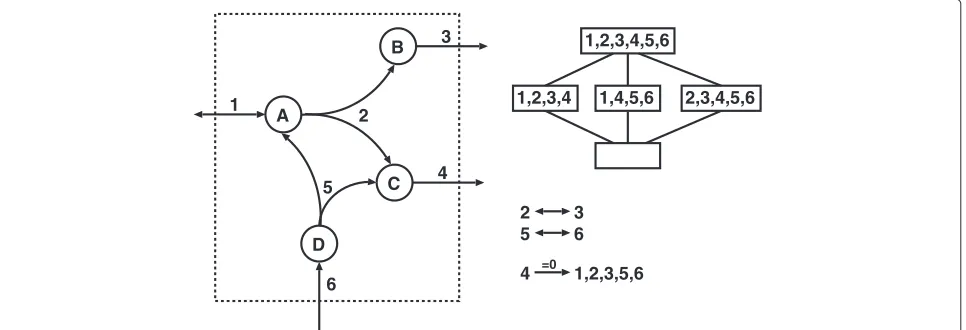
Reaction coupling in the context of knockout analysis We start from a metabolic network N = (M,R,S, Irr) given by a set of metabolitesM, a set of reactionsR, a stoichiometric matrixS∈RM×R, and a set of irreversible reactions Irr ⊆ R, see Figure 1 for an example. The set C = {v ∈ RR | Sv = 0,vr ≥ 0,r ∈ Irr} of all flux vectorsv∈RRsatisfying the steady-state (mass balance) constraintsSv= 0 and the thermodynamic irreversibility constraintsvr ≥0, for allr∈Irr, is called thesteady-state flux cone. A reactions ∈ Ris calledblockedifvs = 0, for all v ∈ C, otherwises isunblocked. Two unblocked reactionsr,sare calleddirectionally coupled[5], written r →=0 s, if for allv∈ C,vr = 0 impliesvs = 0. A possible biological interpretation is that the reactions directionally coupled torare those reactions that will become blocked by knocking out the reactionr.
To determine which reactions are coupled, a simple approach would be to solve for each pair of reactions (r,s) two linear programs (LPs) and to check whether max{vs|v ∈ C,vr = 0} = min{vs|v ∈ C,vr = 0} = 0. During the last years, efficient flux coupling algorithms have been developed [6,18] that drastically reduce the number of LPs to be solved, so that that genome-wide
1
3
A
B
C
D
4
6 2
5
1,2,3,4,5,6
1,2,3,4 1,4,5,6 2,3,4,5,6
2 3
5 6
4 =0 1,2,3,5,6
metabolic network reconstructions can now be analyzed in a few minutes on a desktop computer (compared to a couple of days of running time before).
Whether reactions are blocked or coupled does not depend on the specific flux values. It only matters whether or notvr =0 resp.vs=0. In this sense, flux coupling is a qualitative property that can be analysed by studying the setLC = {suppv|v ∈ C} of allsupportsof flux vectors v ∈ C, where supp v = {r ∈ R|vr = 0}. Each element a ∈ LC is the set of active reactions of some flux vector v∈C. Therefore, we can interpretLCas the set of all pos-sible reaction setsorpathwaysin the flux coneC. SinceLC does not contain any information about specific flux val-ues, we also speak of aqualitative modelof the metabolic networkN.
In [18,22], we have shown that flux coupling analysis can be extended to much more general qualitative models, where the space of possible pathwaysL⊆ 2Rcan be any non-empty subset of the power set 2R, e.g.L= {suppv| v ∈ C,vsatisfies thermodynamic loop law constraints}. The definition of flux coupling needs only be slightly mod-ified in order to be applicable to these qualitative models. A reactiont ∈ Ris calledblocked in Lif and only if for alla ∈ L, we havet ∈/ a. For reactionsr,s ∈ Rthat are unblocked in L, we definer →=0 s inL, if for all a ∈ L, r ∈/ aimpliess ∈/ a. To distinguish between the original flux coupling and its qualitative extension, we will call the latterreaction couplingfrom now on.
The goal of this paper is to study more general depen-dencies between reactions, where the flux through some reaction has to be zero, if the flux through two or more other reactions is zero.
Definition 1(Joint reaction coupling).Given a qualita-tive model L⊆2Rof a metabolic networkN, let r,s,t∈R be unblocked reactions in L such that neither r→=0t in L nor s→=0t in L holds. We say t is jointly coupled to the pair {r,s}in L, written{r,s}→=0t in L, if for all a∈L, r∈/a and s∈/a implies t∈/a.
More generally, given a setK⊆Rof unblocked reactions in L, we say that t is jointly coupled toKin L, writtenK→=0 t in L, if for all a∈L, a∩K= ∅implies t∈/a, andK =→0t in L does not hold for any∅ =KK.
Note that in the definition of the joint coupling{r,s}→=0 tinL, we require that the simple couplingsr→=0tinLand s→=0tinLboth donothold. Thus,jointcoupling is about the synergistic effect of a pair of reactionsr,s on some other reactiont, which cannot be obtained by eitherrors alone. Similarly,K →=0 tinLcan only hold ifK =→0tinL does not hold, for any smaller knockout set∅ =KK.
Lattices and maximal elements
In [18], we presented a generic algorithm for flux coupling analysis in qualitative models. This algorithm determines the pairs of coupled reactions by computing the maximal element in suitably defined lattices.
A family of reaction setsL ⊆ 2R is a (finite)latticeif ∅ ∈ Land for alla1,a2 ∈ L, we havea1∪a2 ∈ L. The biological interpretation of this property is that the com-bination of two metabolic pathways is again a pathway. In [18] we showed thatLCis a lattice. Any finite latticeLhas a uniquemaximal element1L(w.r.t. set inclusion), which is simply the union of all lattice elements, i.e., 1L=
a∈L a. For
any subset of reactionsK⊆R, we may define the family
L⊥K= {a∈L|a∩K= ∅}
calledL withoutKof those reaction setsa∈Lthat do not contain any reaction inK. IfLis a lattice, thenL⊥K is a lattice again, and thus it has a maximal element
1L⊥K =
a∈L,a∩K=∅ a.
Given any latticeL ⊆ 2R, we have shown in [18] that a reactionr ∈ Ris unblocked inLif and only ifr ∈ 1L. For two unblocked reactionsr,s ∈ 1L, the coupling rela-tionr →=0 s inL holds if and only ifs ∈/ 1L⊥{r}. In [18],
we also presented an efficient algorithm to compute 1L and 1L⊥{r}. Once these maximal elements have been found,
one can immediately determine the blocked and coupled reactions.
In this paper, we generalize these results to joint cou-plings. We present a method to compute the effects of double (resp. multiple) reaction knockouts based on the maximal element 1L⊥{r,s}(resp. 1L⊥K).
Proposition 1.If L ⊆ 2R is a lattice, then for any unblocked reactions r,s,t∈1Lwe have
{r,s}→=0t in L if and only if t∈1L⊥{r}∩1L⊥{s}
\1L⊥{r,s}.
More generally, for a set of unblocked reactionsK ⊆1L, we have
K→=0t in L if and only if t∈
k∈K 1L⊥K\{k}
\1L⊥K.
Proof.We prove only the first part. The second part follows by induction.
Assume{r,s}→=0tinL. By definition, we knowt∈/afor alla ∈ L⊥{r,s}, and thereforet∈/ 1L⊥{r,s}. If{r,s}
discussed in [18], we haver→=0tinLif and only ift∈1L\ 1L⊥{r}. Sincet∈1L, we concludet∈1L⊥{r}, and by the same
argumentt∈1L⊥{s}. Hence,t∈
1L⊥{r}∩1L⊥{s}
\1L⊥{r,s}.
If t ∈ 1L⊥{r}∩1L⊥{s}
\1L⊥{r,s} holds, thent ∈/ 1L⊥{r,s},
which impliest ∈/ afor alla ∈ L⊥{r,s}. Sincet ∈ 1L⊥{r}∩
1L⊥{s}, we can again apply [18] to see that r
=0 → t in L ands →=0 tinLdo not hold. Finally, sincer,s,t ∈ 1Lare unblocked, we get{r,s}=→0tinL.
In [22], we considered even more general qualitative models ∅ = P ⊆ 2R, where P needs not be a lattice. We showed there that qualitative flux coupling analysis can be done in the lattice LP = P that is generated byP. The results we will present in this paper would be applicable to those qualitative modelsP as well, but for simplicity we will continue to work with modelsLthat are lattices.
Classes of partially coupled reactions
To determine joint coupling relations K →=0 t in L, we will use as much as possible the information that can be obtained from standard couplingsr →=0 sinL, i.e., with normal FCA. Ifr→=0 sinL, any pathwaya∈ Lthat does not use reactionrwill also not use reactions. Thus, knock-ing outs in addition torwill not affect the system, i.e., {a∈L|r,s∈/a} = {a∈L|r∈/a}.
Additional improvements can be obtained by looking at partially coupled reactions. Two unblocked reactions r,s∈1Lare calledpartially coupledin the latticeL, writ-tenr ↔ s, if bothr→=0s inLands→=0rinL. The relation ↔ is reflexive, transitive and symmetric, and thus an equivalence relation. Any equivalence relation defines a partition of its ground set into equivalence classes. In our case, 1L = r∈1L[r]↔, where [r]↔ = {s∈1L|r↔s}.
An equivalence class can be represented by any of its ele-ments, i.e., [r]↔=[r]˜↔ifr↔ ˜r. By selecting one element from each equivalence class, we get a set of representa-tivesRep ⊆ 1L that covers all unblocked reactions, i.e., 1L = r∈Rep[r]↔. We will call [r]↔thecoupling classor
reaction classof reactionr. Biologically, coupling classes can be interpreted as subsets of reactions that are always active together, similarly to the notion of enzyme subsets in [23].
Forr,r˜ ∈ [r]↔ anda ∈ L, we haver ∈ aif and only if ˜r ∈ a. Thus, a knockout ofrhas the same impact as a knockout ofr. Furthermore,˜ rcan only be blocked by another knockout k ∈/[r]↔ if the same holds forr, i.e.,˜ k →=0 rinLif and only ifk → ˜=0 rinL. It follows that to analyse the effect of a knockout pair{˜r,˜s}, one can instead knockout the corresponding representatives{r,s}with˜r∈
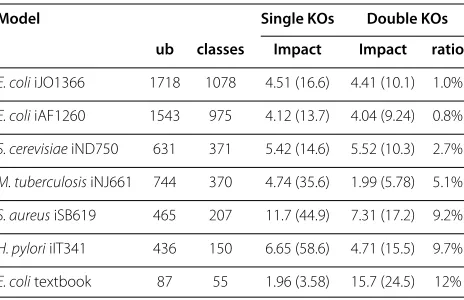
[r]↔inLand˜s∈[s]↔. To simulate all double knockouts, one does not have to check all pairs{{˜r,˜s} | ˜r,˜s∈1L}, but it is enough to iterate over a fixed set of representatives: {{r,s}|r,s ∈ Rep}, see Figure 1a) for illustration. As we will see, for many genome-scale network reconstructions, there are only about half as many different equivalence classes as there are unblocked reactions (Table 1). Thus, only about 1/4 of all original pairs need to be checked. As mentioned before, although we apply this compression to reaction coupling analysis, it could also be combined with FBA-based methods.
Algorithms
In [18], we introduced an algorithm that performs flux coupling analysis by computing maximal elements of suit-ably defined finite lattices L˜ (see also the section above on lattices and maximal elements). The basic ingredient of this algorithm is a method that checks if a given reac-tionr ∈ Ris blocked inL, and if not returns a pathway˜ a ∈ ˜Lwithr ∈ a. The maximal element 1L˜ ofL˜ is com-puted by improving lower and upper bounds lb,ub ∈ ˜L withlb⊆1L˜ ⊆ub. In each step of the algorithm, eitherlb is increased orubis decreased, until finallylb=ub=1L˜. The following Algorithm 1 is an extension of this method. It allows finding all the reactions inRthat are unblocked after a multiple knockoutK⊆1L.
Table 1 Knockout impact on different networks
Model Single KOs Double KOs ub classes Impact Impact ratio
E. coliiJO1366 1718 1078 4.51 (16.6) 4.41 (10.1) 1.0%
E. coliiAF1260 1543 975 4.12 (13.7) 4.04 (9.24) 0.8%
S. cerevisiaeiND750 631 371 5.42 (14.6) 5.52 (10.3) 2.7%
M. tuberculosisiNJ661 744 370 4.74 (35.6) 1.99 (5.78) 5.1%
S. aureusiSB619 465 207 11.7 (44.9) 7.31 (17.2) 9.2%
H. pyloriiIT341 436 150 6.65 (58.6) 4.71 (15.5) 9.7%
E. colitextbook 87 55 1.96 (3.58) 15.7 (24.5) 12%
ub:Number of unblocked reactions in the original network.
classes:Number of different reaction classes, i.e., equivalence classes w.r.t.
partial coupling↔.
Single KOs impact:Average impact of single reaction knockouts, i.e., average
number of reactions classes that become blocked by a single knockout. In brackets: Average number of reactions that become blocked (belonging to different reaction classes).
Double KOs impact: Averageadditionalimpact of double reaction knockouts,
i.e., average number of reactions classes that become blocked by a double knockout {r,s}, but are not blocked by a single knockout of eitherrors. In brackets: Average number of additional reactions that become blocked.
Double KOs ratio: Percentage of pairs of (uncoupled) reaction classes that have
joint coupling effects. The average numbers are determined by
1
|K|κ∈Kimpact(κ)withK=Repfor the single, andK={{r,s} |r,s∈Repwith
Algorithm 1.Multiple Knockout Analysis
Input:A set of knockout reactionsK⊆1L,|K| ≥2. From FCA we reuse:
• A set of representativesRep
• Maximum elements1L⊥{k}, fork∈K
• A set of previously computed pathwaysW⊆L
(witnesses)
Ouput:The set of reactions1L⊥Kthat are unblocked in the
subnetworkR\K.
functionMKO(K) lb=
a∈W⊥K
a, withW⊥K= {a∈W|a∩K= ∅}
ub=
k∈K1L⊥{k} forr∈Repdo
ifr∈ub\lbthen a=FINDPATH(r,K) ifr∈athen
lb=a∪lb
else
ub=ub∩1L⊥{r}
return1L⊥K =ub
functionFINDPATH(r,K)
return
a there exists a∈L : r∈a, a∩K= ∅, ∅ otherwise.
As discussed in [18], the flexibility of the lattice-based approach comes from hiding the search for specific path-ways in a separate function FindPath. For traditional steady-state based models, FindPath can be realized by solving the linear programs max{±vt|Sv = 0,vIrr ≥ 0,vk = 0,k ∈ K}. But, one can also use other model-ing hypotheses and correspondmodel-ing algorithmic methods (see [22] for the example of thermodynamic loop law con-straints). The skeleton of Algorithm 1 will remain the same, only the auxiliary function FindPath has to be changed.
In Algorithm 1, we perform a multiple knockout analy-sis with a fixed knockout setK. For a fulld-dimensional knockout analysis, we would have to iterate over allK ⊆ 1Lwith|K| =d, i.e., we would have to run the algorithm O|Rd|times. In each iteration, we have to solveO(|R|) linear programs. Since linear programming can be done in polynomial time, fulld-dimensional knockout analy-sis is still polynomial (for fixed d), but computationally very expensive as soon asd > 2. However, we can still use the partition of 1Linto equivalence classes of partially coupled reactions. Thus, our next Algorithm 2 calculates representatives of all jointly coupled reactions in the case of double knockouts.
Algorithm 2.Full Double Knockout Analysis Input:From FCA we reuse:
• A set of representativesRep
• Maximum elements1L⊥{r}, for r∈Rep
• A set of previously calculated pathwaysW⊆L (witnesses)
Output: The set dkos containing all joint couplings {r,s}→=0t in L, with r,s,t∈Rep.
dkos= ∅
forr,s∈Repwith r<sdo ifr∈1L⊥{s}and s∈1L⊥{r}then
lb= a∈W⊥{r,s}
a, withW⊥{r,s} = {a∈ W|r,s∈/a}
ub=known=1L⊥{r}∩1L⊥{s}
fort∈Rep do if t∈ub\lb then
a=FINDPATH(t,{r,s}) ift∈a then
lb=a∪lb
else
ub=ub∩1L⊥{t} dkos=dkos∪
{r,s}→=0t in L|t∈known\ub
return dkos
In Algorithm 2, we iterate over a subset of all possible double knockouts without loosing any information. For this, we filter redundant knockout pairs such asr→=0sin L(by checkings∈ 1L⊥{r}). It is unnecessary to test such a
pair, because a knockout of{r,s}is equivalent to the single knockout ofr, see Figure 1b) for illustration. For higher-dimensional knockout sets one can proceed in a similar fashion:
LetK= {k1,. . .,kd} ⊆Repbe ad-dimensional knock-out set. Then we do not need to test K, if any of the following conditions is fulfilled:
• ki→=0kjinLfor two reactionski,kj∈K,
• ki1,ki2 =0
→kjinLfor three reactionski1,ki2,kj∈K,
• ki1,ki2,ki3 =0
→kjinLfor four reactions ki1,ki2,ki3,kj∈K,
• etc.
Standard FCA finds all pairs of reactions that are direc-tionally coupled. This allows us to iterate in Algorithm 2 over all{r,s} ∈K2,1with
K2,1=
{k1,k2} ⊆Rep|notk1→=0k2inLand notk2→=0k1inL
.
If one is interested to perform a full triple knock-out analysis and joint coupling information is available, one can adapt the filtering technique and iterate over all {r1,r2,r3} ∈K3,1(orK3,2) with
K3,1 =
{k1,k2,k3} ⊆Rep|notki=
0 →kjinL, for alli =j∈ {1, 2, 3},
K3,2 =
{k1,k2,k3} ⊆Rep|notki1=
0 →kjinL
and not ki1,ki2 =0
→kjinL, for all pairwise
differenti1,i2,j∈ {1, 2, 3}
.
K3,1contains all 3-tuples of coupling class representatives that are not directionally coupled, andK3,2all triples that do not contain reactions that are coupled with respect to knockouts up to cardinality 2. Similarly one could define Kd,m.
While these techniques are applied here only to reaction coupling analysis, they could also be combined with FBA-based methods. Thus, if one is interested to measure the impact of all possible triple knockouts on FBA, it would be sufficient to solve max{vbiomass|Sv=0,vIrr≥0,vK=0} for all K ∈ K3,1 (if only FCA data is available) or all K∈K3,2(if FCA and joint coupling data is available).
The case of gene knockouts
Often metabolic networks contain regulatory rules for the gene products that catalyze the reactions, e.g. reactionr1 is catalyzed by the product of a geneg1 and reactionr2 is catalyzed by the gene product of g1 or g2. Here r1 is only possible if g1 is active, and r2 can only be blocked by a simultaneous knockout of the two genesg1andg2. Typically, there is no 1-1 relationship between the set of genes G and the set of reactions R. On the one hand, there are reactions that only get blocked by a combina-tion of two or more gene knockouts, as indicated above in r2≡g1∨g2. On the other hand, the knockout of a single geneg ∈Gmay block more than one reaction. For exam-ple, reactionsr1andr3may both depend on the geneg1. Then one immediately gets that a knockout ofg1implies v1= v3 =0. Let us further assume that FCA and double reaction knockout analysis have been performed, leading to 3 →=0 4 inLand{1, 3} →=0 6 inL. Based on this infor-mation, we can extend the reactions that are blocked by the knockout of geneg1to v1 = v3 = v4 = v6 = 0. Thus, in this example we have 2 reactions (r1,r3) that are associated to the gene g1 based on information that is directly available in the network reconstruction, but in total 4 reactions(r1,r3,r4,r6)that arecoupled to the gene g1. We formalize these notions in the following definition.
Definition 2 (Gene coupling).Consider a qualitative model L⊆2Rof a metabolic networkN with reaction set Rand gene setG. Letα: 2G →2R,→Kbe a function defining a set of reactionsKassociated to the knockout of all genes in the set. For an unblocked reaction r∈1Land ⊆Gwe define:
→=0r in L if and only if r∈/1L⊥K.
We say that the reaction r is coupled to the gene knockout . If= {g}is a single gene, we simply write g→=0r in L.
Given the function α : 2G → 2R, we can deter-mine the reactions coupled to the gene set by apply-ing Algorithm 1 to the set of associated reactions K. Note that the definition of gene coupling slightly differs from the one of joint reaction coupling. Here, we do not exclude reactions that are already knocked out by single (or smaller set of ) gene knockouts. This is to account for the possibility that, for example, a reactionrmay be asso-ciated to a single gene knockoutg1, but not to the double knockout{g1,g2}(assumer≡g1∨ ¬g2).
To simulate the impact of all single gene knockouts, one can perform an iteration over all genesg ∈ G. Similarly, one can determine all double gene knockout effects by an iteration over all pairs of genes{g1,g2} ⊆ G. However, in contrast to Algorithm 2, we cannot use gene class repre-sentatives to decrease the number of pairs that have to be analyzed.
Results and discussion
To evaluate our method, we simulated all single and double reaction knockouts for a number of genome-scale metabolic network reconstructions from the BiGG-database [24]. The computations were done on a Mac-Book Air (2012), with 1.8 GHz Intel Core i5, 4GB RAM, and runningJava Oracle JDK1.7.45 underMac OS X10.9. To solve linear programs (LPs), we used CPLEX Version 12.6.
Impact of double knockouts
knockouts of two uncoupled reaction classes{r,s} have an impact that exceeds the effects of the corresponding two single knockouts. InS. aureusiSB619, double knock-outs also have very strong combined effects. In addition to the reaction classes that would be knocked out byrors alone, in average more than 7 reaction classes are coupled to a double knockout corresponding to a joint coupling {r,s} →=0 t in L. But, even for the most robust system, M. tuberculosisiNJ661, a double knockout (if its impact is different from the two single knockouts) in average has a combined effect of 2 additional knocked out classes resp. 5.8 reactions.
Knockout options
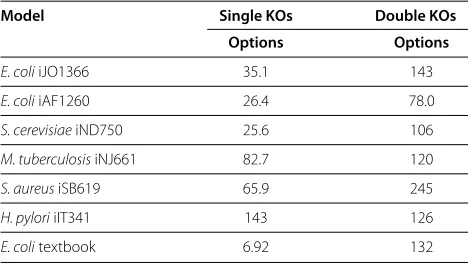
In our next experiment, we take the opposite perspective (Table 2). We analyse how robust an average reaction is to single or double knockouts. More precisely, we ask the following question: Given a reactiont, what are the possi-ble choices for a single reactionrresp. a pair of reactions {r,s}such thatr→=0tinLresp.{r,s}→=0tinLholds. This perspective corresponds to a lab experiment for finding knockout targets for the reactiont. Here, we consider sin-gle reactions instead of reaction classes. This means that for{r,s} →=0 t inL withr,s,t ∈ Rep, we get|[r]| · |[s]| knockout options for all the|[t]|reactions that belong to the same reaction class ast.
For most of the studied networks, the average number of knockout options for a given target reaction is in the range of 25-85 single reactions and 100-150 reaction pairs. With all double knockout information at hand, one can reduce the set of all possible knockout candidates for a wet lab experiment to a small number, and additionally decide beforehand which of them have the smallest side effects.
Table 2 Average number of knockout options
Model Single KOs Double KOs Options Options
E. coliiJO1366 35.1 143
E. coliiAF1260 26.4 78.0
S. cerevisiaeiND750 25.6 106
M. tuberculosisiNJ661 82.7 120
S. aureusiSB619 65.9 245
H. pyloriiIT341 143 126
E. colitextbook 6.92 132
Single KOs options:Average number of reactionsrthat lead as single
knockouts to inactivity of a target reactiont: 1
|1L|
t∈1L
r=→0tinL1.
Double KOs options:Average number of uncoupled reaction pairs {r,s} that lead
as double knockouts to inactivity of a target reactiont:|11L|
t∈1L
{r,s}=0
→tinL1.
Impact on biomass production
To finish our discussion, we study the impact of knock-outs on biomass production. To measure this, we counted the number of single and double knockouts that block the biomass reaction. Table 3 presents the results for the largest available models of the respective organisms. For two of them, more than one biomass reaction was avail-able. In the case ofE. coliiJO1366, we present the results for the two biomass reactions, forS. aureus, we selected 2 out of the 14 available reactions.
We observe that for most of the organisms, the num-ber of single knockouts that block biomass production is very similar to the number of different double knockouts (corresponding to joint couplings) having this property, although the number of double knockout candidates is much larger (quadratic in|1L|).
Algorithmic considerations
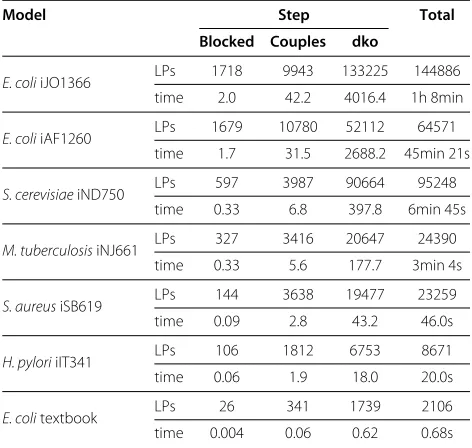
To perform a double knockout analysis, we first run standard flux coupling analysis (FCA) using the L4FC routine from [18]. Then we calculate the unblocked reac-tions for each double knockout of a pair of reaction class representatives. Table 4 presents the running times for six genome-scale network reconstructions and the cen-tral metabolism ofE. coli. Even for our largest network, E. coliiJO1366 with its 2583 reactions, the complete sim-ulation of all double reaction knockouts took less than 1h 10 min.
Next we discuss the number of LPs we have to solve in order to obtain this additional information. For all our networks, double knockout analysis required solving 5 to 20 times as many LPs than single knockouts, i.e., classical FCA. While this seems to be a large number, it is rela-tively small compared to the complexity of the problem. A full double knockout simulation is comparable to iter-ating over all reactionsr ∈ Rep, removing the reaction rand performing a single knockout simulation for each of the resulting subnetworks. Reusing known pathways as witnesses and including reaction coupling information as proposed in [18] allows performing|Rep|simulations with only 5 to 20 times the effort in LP solving. Table 1 shows that the median value for |Rep| is 370 for our networks.
In order to evaluate the runtime effect of our algo-rithmic improvements, we considered two variants of Algorithm 2:
Variant A (no representatives) In the main loop of Algorithm 2, we do not iterate over all representatives r,s∈Rep,r<s, but over all pairs of uncoupled reactions r,s∈1L,r<s, with notr=
0
Table 3 Number of knockouts for the biomass reaction in selected networks
Model Single knockouts Double knockouts reaction id cl. size classes reactions cl. pairs reac. pairs
E. coliiJO1366
Ec_biomass_iJO1366_WT_53p95M 20 101 343 130 339
Ec_biomass_iJO1366_core_53p95M 1 80 288 90 268
S. cerevisiaeiND750
biomass_SC4_bal 26 54 156 60 142
M. tuberculosisiNJ661
biomass_Mtb_9_60atp 160 64 154 48 83
S. aureusiSB619
SA_biomass_1a 8 25 63 59 157
SA_biomass_5a 1 58 215 54 100
H. pyloriiIT341
BiomassHP_published 189 36 76 41 81
class size: Number of reactions in the same coupling class as the biomass reaction, i.e., number of reactions that carry flux if and only if the biomass reaction carries flux.
Single Knockouts: Number of different single knockouts (classes and reactions) that block the biomass reaction. Only reactions that are not partially coupled to the
biomass (from a different reaction class) are counted.
Double Knockouts: Number of different double knockouts (class pairs and reaction pairs) that block the biomass reaction when combined. Only reactions that are not
directionally coupled to the biomass are counted.
These two experiments allow determining time savings due to representatives (comparing Algorithm 2 and Vari-ant A) and time savings due to warm starts based on knowledge of existing reaction sets (comparing Variant A and B). We should emphasize here that Variant B is is
Table 4 Runtime and number of solved LPs for double
reactionknockouts (Algorithm 2)
Model Step Total Blocked Couples dko
E. coliiJO1366 LPs 1718 9943 133225 144886 time 2.0 42.2 4016.4 1h 8min
E. coliiAF1260 LPs 1679 10780 52112 64571 time 1.7 31.5 2688.2 45min 21s
S. cerevisiaeiND750 LPs 597 3987 90664 95248 time 0.33 6.8 397.8 6min 45s
M. tuberculosisiNJ661 LPs 327 3416 20647 24390 time 0.33 5.6 177.7 3min 4s
S. aureusiSB619 LPs 144 3638 19477 23259 time 0.09 2.8 43.2 46.0s
H. pyloriiIT341 LPs 106 1812 6753 8671 time 0.06 1.9 18.0 20.0s
E. colitextbook LPs 26 341 1739 2106
time 0.004 0.06 0.62 0.68s
The computation was done in three steps: Calculation of the blocked reactions, flux coupling analysis to determine the coupled reactions, and finally the double knockout simulations.
Times are given in seconds if not specified otherwise (numbers may not add up due to rounding errors).
still more efficient than a naive brute force algorithm. The runtime results are given in Table 5, where we stopped computations after a timeout of 6h. Table 5 shows that the efficiency of Algorithm 2 is mostly due to the re-use of (up to 10000) pathways as witnesses (factor 10 in the case of E. coli textbook and factor 100 forS. aureus). Neverthe-less, iterating over the set of representatives adds another improvement of up to 50% (S. aureus). Since it takes a very small effort to calculate a set of representatives to profit from this additional speed-up, we highly recommend to iterate over representatives whenever possible.
Gene knockouts
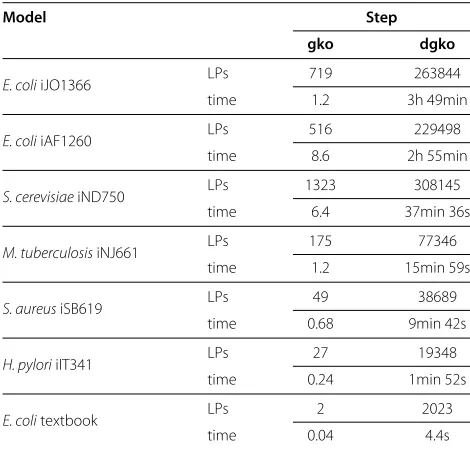
Table 6 gives the runtimes and the number of LPs for single and doublegeneknockouts. To determine the reac-tions associated to a (double) gene knockout, we used the library JEval that allows fast evaluation of logical
Table 5 Runtime of variants of Algorithm 2 for computing double reaction knockouts
Model Algor. 2 Variant A Variant B (no representatives) (no witnesses)
E. coliiJO1366 1h 8min 1h 59min >6h
E. coliiAF1260 45min 21s 1h 30min >6h
S. cerevisiaeiND750 6min 45s 8min 39s >6h
M. tuberculosisiNJ661 3min 4s 7min 42s >6h
S. aureusiSB619 46s 1min 59s 2h 32min
H. pyloriiIT341 20s 58.1s 52min
Table 6 Runtime and number of solved LPs for single and
doublegeneknockouts
Model Step
gko dgko
E. coliiJO1366 LPs 719 263844
time 1.2 3h 49min
E. coliiAF1260 LPs 516 229498
time 8.6 2h 55min
S. cerevisiaeiND750 LPs 1323 308145
time 6.4 37min 36s
M. tuberculosisiNJ661 LPs 175 77346
time 1.2 15min 59s
S. aureusiSB619 LPs 49 38689
time 0.68 9min 42s
H. pyloriiIT341 LPs 27 19348
time 0.24 1min 52s
E. colitextbook LPs 2 2023
time 0.04 4.4s
Times are given in seconds if not specified otherwise.
formulas given as Java strings. As expected we are con-fronted with longer runtimes up to almost 4h for double gene knockouts compared to< 70 min for double reac-tion knockouts. This is due to the fact that we need to check every single pair of genes instead of a representative selection like the one we could apply in double reaction knockout analysis. In spite of this, with the methods pro-posed here, a full simulation of double reaction or double gene knockouts on a genome-scale metabolic network reconstruction can still be performed in a reasonable time.
Conclusions
On the algorithmic side, this study presented the following main results:
• Algorithm 2 is an effective method for a complete double knockout analysis in genome-scale metabolic networks.
• Using Algorithm 1, it is possible to compute the impact of specific multiple knockout sets containing 3 or more reactions.
• By exploiting the information present in reaction coupling data (obtained by FCA), one can significantly decrease the number of candidates that need to be tested in double and multiple knockout simulations.
Regarding the biological data, we can make the following observations based on our computational experiments:
• In the genome-scale metabolic network
reconstructions that were considered in this study, 1-10% of the possible double knockout sets have joint
coupling effects. Thus, given a randomly chosen reaction pair, the probability is high that the combined effect of the double knockout (in terms of other blocked reactions) will be the same as for the two corresponding single knockouts.
• However, in all these networks, there exists a small number of double knockouts showing synergistic effects, blocking 5 to 20 additional reactions in average. These double knockouts cannot be predicted from the single knockout/reaction coupling data alone.
Due to the algorithmic improvements, we are now able to perform full double gene or reaction knockout simula-tions in a few hours of computation time. Thus, whenever one is interested in understanding the robustness of a net-work to knockouts, one should take the opportunity and run such anin silicosimulation, before starting other more time consuming and expensive experiments.
A prototype implementation of double knockout simu-lation is available at http://hoverboard.io/L4FC.
Competing interests
The authors declare that they have no competing interests.
Authors’ contributions
The paper is based on the PhD thesis of YG, which was supervised by AB. YG implemented the algorithms and performed the computational experiments. YG and AB together wrote the manuscript and approved the final version.
Acknowledgements
The PhD work of Yaron Goldstein was supported by the Berlin Mathematical School and the Gerhard C. Starck Stiftung.
Received: 30 March 2014 Accepted: 4 December 2014
References
1. Bordbar A, Monk JM, King ZA, Palsson B. Constraint-based models predict metabolic and associated cellular functions. Nat Rev Genet 2014;15(2):107–120.
2. Lewis NE, Nagarajan H, Palsson B. Constraining the metabolic
genotype-phenotype relationship using a phylogeny of in silico methods. Nat Rev Microbiol 2012;10(4):291–305.
3. Varma A, Palsson BO. Predictions for oxygen supply control to enhance population stability of engineered production strains. Biotechnol Bioeng 1994;43(4):275–285.
4. Orth JD, Thiele I, Palsson BO. What is flux balance analysis?. Nat Biotechnol 2010;28(3):245–248.
5. Burgard AP, Nikolaev EV, Schilling CH, Maranas CD. Flux coupling analysis of genome-scale metabolic network reconstructions. Genome Res 2004;14(2):301–312.
6. Larhlimi A, David L, Selbig J, Bockmayr A. F2C2: a fast tool for the computation of flux coupling in genome-scale metabolic networks. BMC Bioinformatics 2012;13(1):57.
7. Tomar N, De RK. Comparing methods for metabolic network analysis and an application to metabolic engineering. Gene 2013;521(1):1–14. 8. Zomorrodi AR, Suthers PF, Ranganathan S, Maranas CD. Mathematical
optimization applications in metabolic networks. Metabolic Eng 2012;14(6):672–686.
10. Tepper N, Shlomi T. Predicting metabolic engineering knockout strategies for chemical production: accounting for competing pathways. Bioinformatics 2010;26(4):536–543.
11. Patil KR, Rocha I, Förster J, Nielsen J. Evolutionary programming as a platform for in silico metabolic engineering. BMC Bioinformatics 2005;6(1):308.
12. Lun DS, Rockwell G, Guido NJ, Baym M, Kelner JA, Berger B, Galagan JE, Church GM. Large-scale identification of genetic design strategies using local search. Mol Syst Biol 2009;5(1): 296.
13. Rocha I, Maia P, Evangelista P, Vilaça P, Soares S, Pinto JP, Nielsen J, Patil KR, Ferreira EC, Rocha M. Optflux: an open-source software platform for in silico metabolic engineering. BMC Syst Biol 2010;4(1):45.
14. Ohno S, Shimizu H, Furusawa C. FastPros screening of reaction knockout strategies for metabolic engineering. Bioinformatics 2014;30(7):981–987. 15. Klamt S, Gilles ED. Minimal cut sets in biochemical reaction networks.
Bioinformatics 2004;20(2):226–234.
16. Jungreuthmayer C, Nair G, Klamt S, Zanghellini J. Comparison and improvement of algorithms for computing minimal cut sets. BMC Bioinformatics 2013;14(1):318.
17. von Kamp A, Klamt S. Enumeration of smallest intervention strategies in genome-scale metabolic networks. PLOS Comput Biol 2014;10(1): 1003378.
18. Goldstein YAB, Bockmayr A. A lattice-theoretic framework for metabolic pathway analysis In: Gupta A, Henzinger T, editors. Computational Methods in Systems Biology. Lecture Notes in Computer Science. Vol. 8130, Berlin: Springer; 2013. p. 178–191.
19. Zhao Y, Tamura T, Akutsu T, Vert J-P. Flux balance impact degree: a new definition of impact degree to properly treat reversible reactions in metabolic networks. Bioinformatics 2013;29(17):2178–2185. 20. Nogales J, Gudmundsson S, Thiele I. An in silico re-design of the
metabolism in thermotoga maritima for increased biohydrogen production. Int J Hydrogen Energy 2012;37(17):12205–12218. 21. Suthers PF, Zomorrodi A, Maranas CD. Genome-scale gene/reaction
essentiality and synthetic lethality analysis. Mol Syst Biol 2009;5(1):301. 22. Reimers AC, Goldstein YAB, Bockmayr A. Qualitative and thermodynamic
flux coupling analysis. Technical Report #1054, Matheon (March 2014). http://nbn-resolving.de/urn:nbn:de:0296-matheon-12801
23. Pfeiffer T, Sánchez-Valdenebro I, Nuño JC, Montero F, Schuster S. METATOOL: for studying metabolic networks. Bioinformatics 1999;15: 251–257.
24. Schellenberger J, Park JO, Conrad TM, Palsson BO. BiGG: a biochemical genetic and genomic knowledgebase of large scale metabolic reconstructions. BMC Bioinformatics 2010;11(213):213.
Submit your next manuscript to BioMed Central and take full advantage of:
• Convenient online submission
• Thorough peer review
• No space constraints or color figure charges
• Immediate publication on acceptance
• Inclusion in PubMed, CAS, Scopus and Google Scholar
• Research which is freely available for redistribution