R E S E A R C H
Open Access
Optimal computation of all tandem repeats in
a weighted sequence
Carl Barton
1*, Costas S Iliopoulos
1,2,3and Solon P Pissis
1Abstract
Background: Tandem duplication, in the context of molecular biology, occurs as a result of mutational events in which an original segment of DNA is converted into a sequence of individual copies. More formally, arepetitionor tandem repeatin a string of letters consists of exact concatenations of identical factors of the string. Biologists are interested in approximate tandem repeats and not necessarily only in exact tandem repeats. Aweighted sequenceis a string in which a set of letters may occur at each position with respective probabilities of occurrence. It naturally arises in many biological contexts and provides a method to realise the approximation among distinct adjacent occurrences of the same DNA segment.
Results: Crochemore’s repetitions algorithm, also referred to as Crochemore’s partitioning algorithm, was introduced in 1981, and was the first optimalO(nlogn)-time algorithm to compute all repetitions in a string of lengthn. In this article, we present a novel variant of Crochemore’s partitioning algorithm for weighted sequences, which requires optimalO(nlogn)time, thus improving on the best knownOn2-time algorithm (Zhang et al., 2013) for computing allrepetitions in a weighted sequence of lengthn.
Keywords: Tandem repeats, Weighted sequences, IUPAC notation
Background
A fundamental structural characteristic of a string of let-ters is its periodicity. Closely related to periodicity is the notion ofrepetition. Repetitions in strings are highly peri-odic factors, that is, two or more adjacent identical factors.
For instance, the stringTATAis a repetition in the string
CTATAGT. Clearly a string may contain a quadratic
num-ber of repetitions. In 1981, it was shown by Crochemore
that there could be O(nlogn) maximal repetitions in
a string of length n and an O(nlogn)-time, thus
opti-mal, algorithm was presented [1]. In 1999, Kolpakov and
Kucherov presented anO(n)-time algorithm to compute
the most compact representation of all repetitions known asruns[2].
Tandem duplication, in the context of molecular biology, occurs as a result of mutational events in which an original segment of DNA is converted into a sequence of individual copies. It usually results from replication slippage or from certain recombination events, such
*Correspondence: [email protected] 1King’s College London, London, UK
Full list of author information is available at the end of the article
as unequal crossing-over or unequal sister chromatide exchange [3]. In this context, the result of a tandem
dupli-cation event is termed atandem repeat. It appears in both
eukaryotic [4] and prokaryotic [5] genomes.
Through time, individual copies within a tandem repeat may change by additional, uncoordinated, mutations, and so only approximate tandem copies may be present. The major bottleneck in identifying biologically relevant tan-dem repeats in genomic sequences is a certain variation threshold that must be admitted between the copies of the repeated segment. In other words, biologists are
inter-ested inapproximatetandem repeats and not necessarily
only in exact tandem repeats. A plethora of algorithms and tools for the identification of tandem repeats mea-suring this approximation have already been released (for instance, see [6-8]).
The simplest and perhaps most widely-used notion for measuring this approximation is the notion of Hamming distance [9]. Another way of measuring this approxima-tion is using a probabilistic model of biological sequences. Single nucleotide polymorphisms, as well as errors intro-duced by wet-lab sequencing platforms during the process of DNA sequencing, can occur in some positions of a
DNA sequence. In some cases, these uncertainties can
be accurately modelled as adon’t careletter. However, in
other cases they can be more subtly expressed, and, at each position of the sequence, a probability of occurrence can be assigned to each letter of the nucleotide
alpha-bet; this process gives rise to a weighted sequence. For
instance, consider a IUPAC-encoded [10] DNA sequence,
where the ambiguity letter Moccurs at some position of
the sequence, representing either baseAor baseC. This
gives rise to a weighted DNA sequence, where at the
cor-responding position of the sequence, we can assign toA
andCan occurrence probability of 0.5.
A great deal of research has been conducted for comput-ing various types of regularities in weighted sequences (for instance, see [11-15]). The efficiency of the proposed algo-rithms relies on the assumption of a given constant, the cumulative weight threshold, defined as the minimal prob-ability of occurrence of factors in the weighted sequence.
Recently, the authors of [16] proposed an On2-time
algorithm for computing all tandem repeats in a weighted
sequence of lengthn.
Our contribution
In this article, we present the first optimal algorithm for computing all tandem repeats in a weighted sequence. We improve on the time complexity of the best-known algo-rithm for computing all tandem repeats in a weighted
sequence of length n from time On2 to an optimal
O(nlogn). A preliminary version of this work appeared in [17].
Preliminaries
In order to provide an overview of our results and algo-rithms, we begin with a few definitions, generally follow-ing [18].
Analphabetis a finite non-empty set of sizeσ, whose
elements are called letters. A string on an alphabet
is a finite, possibly empty, sequence of elements of .
The zero-letter sequence is called theempty string, and is
denoted byε. Thelength of a stringx is defined as the
length of the sequence associated with the stringx, and is
denoted by|x|. We denote byx[i], for all 0≤i < |x|, the letter at indexiofx. Each indexi, for all 0≤i < |x|, is a position inxwhenx=ε. It follows that thei-th letter ofx is the letter at positioniinx.
Theconcatenationof two stringsxandyis the string of the letters of xfollowed by the letters ofy. It is denoted byxy. A stringxis afactorof a stringyif there exist two
stringsuandv, such thaty = uxv. Consider the strings
x,y,u, andv, such thaty=uxv. Ifu=ε, thenxis aprefix ofy. Ifv=ε, thenxis asuffixofy. Letxbe a non-empty
string andybe a string. We say that there exists an
occur-renceofxiny, or, more simply, thatx occurs in y, when
xis a factor of y. Let xandybe two strings on, such
that|y| ≥ |x|andx=yi. .j. We say thatxoccurs at the starting position iiny.
A weighted stringxon an alphabetis a finite sequence
of n sets. Every x[i], for all 0 ≤ i < n, is a set of
ordered pairs sj,πi
sj
, where sj ∈ and πi
sj
is the probability of having lettersjat positioni. Formally, x[i] = sj,πi
sj
|sj=sforj=, and jπi
sj
=1.
A letter sj occurs at position i of a weighted stringx if
and only if theoccurrence probabilityof lettersjat posi-tion i, πi(sj), is greater than 0. A stringu of length m is a factor of a weighted string if and only if it occurs
at starting position iwith cumulative occurrence
proba-bility mj=−01πi+j
uj > 0. Given a cumulative weight
threshold 1/z ∈ (0, 1], we say that factor u isvalid, or
equivalently that factor u has a valid occurrence, if it
occurs at starting positioniand mj=−01πi+juj≥1/z. For clarity of presentation, in the rest of this article, a set of ordered pairs in a weighted string is denoted by [(s0,πi(s0)),. . .,(sσ−1,πi(sσ−1))].
Example 1. Let the following weighted string x and the cumulative weight threshold1/z=1/4.
TGTCATis not a factor of x;TATCCTis a factor of x starting
at position 3; andTATCATis a valid factor of x starting at position 3 with cumulative occurrence probability 0.3.
For every stringxand every natural numbern, we define
then-th power of the stringx, denoted byxn, byx0 = ε andxk = xk−1x, for all 1 ≤ k ≤ n. A string is said to beprimitiveif it cannot be written asve, wheree ≥ 2. A
repetition inxis a non-trivial power of a primitive string
occurring inx.
Formally, a repetition ue, e ≥ 2, in x is defined
as a triple (i,p,e) such that: u = xi. .i+p−1 = xi+p. .i+2p−1=. . .=xi+(e−1)p. .i+ep−1; ue+1does not occur at positioni; anduis primitive. A
rep-etition is maximal ifi−p < 0 orue does not occur at
xi−p. The integerspandeare called theperiodand the exponentof the repetition, respectively. In other words, a
repetition is a primitively-rooted integer poweruewhich
is not followed by another occurrence ofu; and a maximal
repetition is a primitively-rooted integer poweruewhich
is not followed or preceded by another occurrence ofu. If
e=2 the repetition is calledsquare.
A repetition v = ue, e ≥ 2, in a weighted string
x is defined as a quadruple (i,p,b,e) such that u =
v0 . .p−1 = vp. . 2p−1 = . . . = v[(e − 1)
at positioni, and each occurrence ofuinvis a valid factor ofx;ue+1does not occur at positioni;uis primitive; andb is a set of ordered pairs(j,a), where 0≤j<panda∈,
denotinguj = a. A repetition is maximal ifi−p < 0
or ue does not occur at xi−p. The need for setb in
uniquely defining a repetition can be seen in Example 2.
Example 2.Let x=aab[(a, 0.5)(b, 0.5)][(a, 0.5)(b, 0.5)] baband1/z = 1/2. Then(1, 3{(2,a)}, 2)is a repetition in x, such that u=abaand v=abaaba.
In this article, we are mainly concerned with the follow-ing problem.
Problem 1.Given a weighted string x of length n and a cumulative weight threshold1/z ∈ (0, 1], find all repeti-tions in x.
Algorithm
In the following discussion, we assume that each position contains at least one letter with occurrence probability
greater than or equal to 1/z. If this is not the case, the
weighted string can be split around these positions, and each resulting weighted string can be processed separately according to the algorithm with no time penalty.
The first stage of the algorithm is to perform a simple filtering on the weighted string to filter out all those let-ters that are below the threshold. This is required as if the alphabet is not constant, we may have many letters with low occurrence probability that are not of interest. We simply read the entire string and keep only those letters
with occurrence probability greater than or equal to 1/z;
these are at mostzfor each position, so still constant. We
are thus left with a string of sizeO(n), and the entire stage takes timeO(σn). For clarity of presentation, in the rest of this article, we assume that the string resulting from this filtering step is the input weighted stringx.
After this filtering stage, we perform a colouring stage
on x, similar to the one before the construction of the
weighted suffix tree [12], which assigns a colour to every
position inxaccording to the following scheme:
• mark positioniblack (B), ifnone of the possible letters at positionihas occurrence probability greater than1−1/z.
• mark positionigrey (G), ifone of the possible letters at positionihas occurrence probability greater than
1−1/z.
• mark positioniwhite(W), ifone of the possible letters at positionihas occurrence probability of occurrence 1.
It should be noted that the colouring stage only applies
whenz≥2; should it be less than 2, then all positions are
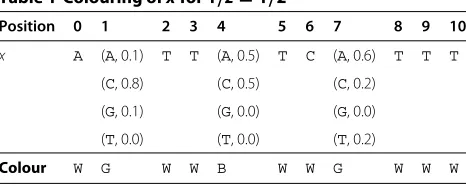
either grey or white. An example of the colouring stage can be seen in Table 1. Intuitively, black positions are the only positions where multiple letters may be chosen for any valid factor that includes the black position. Due to this, black positions are also calledbranching positions.
After the colouring stage, we perform a generation stage, similar to the one performed during the construc-tion of the weighted suffix tree, where a set of factors ofx
is generated; we refer to this set asextended factors. The
intuition behind extended factors is to generate a set of strings such that all the valid factors of the weighted string occur in at least one extended factor. The generation of extended factors is performed once from each black
posi-tion. We scanx from left to right and for the currently
considered black position, we create a list of possible extended factors starting from this position. We generate a factor starting with each letter at the black position and one empty string. These will then be extended to create the extended factors starting from that black position. For each extended factor, the cumulative occurrence probabil-ity is maintained during its generation, and when it breaks the threshold we stop extending it. This probability is updated by considering the actual occurrence probability for letters at black positions, but letters at grey positions are treated as letters at white positions (only one possible choice). Extending these factors is performed by
continu-ing to scanxand appending to the currently considered
factors the same single letter if the position is white or grey and by creating new factors at black positions. At a black position, we copy each current extended factor and append one letter from the black position to each copy. We stop extending an extended factor when we reach a black position which causes it to violate the threshold. The procedure outlined above is similar to the generation step in [12], however, here, we generalise the procedure to any finite alphabet, by noting that the branching factor for any
finite alphabet can be no more than 1/(1/z)+1 =z+1
for the first branching andzfor the rest; as no more thanz letters can have an occurrence probability greater than or equal to 1/z.
Example 3.Let x=aab[(a, 0.5)(b, 0.5)][(a, 0.5)(b, 0.5)] bab and 1/z = 1/2. The colouring corresponding to x
is WWWBBWWW. We scan x from left to right and extend
Table 1 Colouring ofxfor 1/z=1/2
Position 0 1 2 3 4 5 6 7 8 9 10
x A (A, 0.1) T T (A, 0.5) T C (A, 0.6) T T T
(C, 0.8) (C, 0.5) (C, 0.2)
(G, 0.1) (G, 0.0) (G, 0.0)
(T, 0.0) (T, 0.0) (T, 0.2)
until the first black position. At this point we have factor aab and at the black position we branch and get aaba and aabb. Extending these any further will violate the threshold so we stop. The extended factors generated from position 0 of x are as follows: aabaandaabb. We con-tinue with factorsa,b, andεat the black position 3. We then reach the black position 4 and for factorsaandbthis violates the threshold so we stop. However, the empty string can be extended, so we split it into two strings, as we are at a black position, and continue extending it. The extended factors generated from the black position 3 are as follows:a, b,abab, andbbab. We continue with factorsa,b, andεat the black position 4. The extended factors generated from the black position 4 are as follows:abab,bbab, andbab.
We recall an important lemma on how many black posi-tions may be contained within any valid (or extended) factor of a weighted string. We also give a slightly modified proof for any finite alphabet.
Lemma 1([12]).Given a weighted string x and a cumu-lative weight threshold1/z ∈ (0, 1], any valid factor of x contains at most
logz/log
z z−1
black positions.
Proof. Consider a valid factoruofxcontainingblack positions and no grey positions. Any letter at a black
position has occurrence probability at most 1−1/z. The
cumulative occurrence probability ofuwithblack
posi-tions is no more than(1−1/z), and it must be the case
that(1−1/z) ≥1/zsinceuis valid; by rearranging and taking logarithms we obtain the claimed result.
Note that, additionally, Lemma 1 holds exactly for extended factors as they are factors which are treated as only containing black and white positions. From the generation of extended factors we get the following.
Lemma 2([12]).Given a weighted string x and a cumu-lative weight threshold1/z ∈ (0, 1], any valid factor of x occurs in at least one extended factor.
To achieve the main result of the article, we first solve
a related sub-problem on the computation ofvalid
repe-titions. Additionally, we define the notion of anextended repetitionin the process. Anextended repetitioninxis a
repetition occurring in an extended factor of x. Avalid
repetitioninxis a repetitionuesuch that the cumulative occurrence probability ofueis at least 1/z. We are now in a position to define the following subproblem.
Problem 2.Given a weighted string x of length n and a cumulative weight threshold1/z ∈ (0, 1], find all valid repetitions in x.
Intuitively, the difference between Problems 1 and 2 is
that in Problem 1 we want to find repetitionsuesuch that
each uoccurs with cumulative occurrence probability at least 1/z; whereas in Problem 2 we want to find repetitions
ue such that theentirefactorue occurs with cumulative
occurrence probability at least 1/z.
Lemma 3.Given a weighted string x and a cumulative weight threshold 1/z ∈ (0, 1], any valid repetition in x occurs in at least one extended factor.
Proof. By Lemma 2, any valid factor of x occurs in at least one extended factor. By the definition of valid repetitions, any valid repetition is a valid factor.
For each generated extended factor, we run
Crochemore’s partitioning algorithm for maximal rep-etitions; the output is all maximal extended repetitions
in x. After computing all maximal extended repetitions,
we cannot simply report all of these as valid repetitions. All valid factors must occur in an extended factor but extended factors may contain factors which are not valid. This is a consequence of treating grey positions as white during the generation of extended factors [12]. Since not all maximal extended repetitions are valid repetitions, we must therefore break up these maxi-mal extended repetitions into valid repetitions to solve Problem 2.
In order to break up the maximal extended repetitions, we must compute some additional information. To deter-mine how long any valid repetition should be, we must
know, for each positioniin an extended factor, the length
of the longest valid factor starting at positioni. The com-putation is based on the observation that the longest fac-tor with cumulative occurrence probability greater than or
equal to 1/zfor the positioni+1 has length greater than
or equal to that of positioni. To compute this we maintain
an additional cumulative weight thresholdπ. This
addi-tional threshold is reused so that we can easily compute
the longest valid factor for some positioni+1 from
posi-tioni. We store the computed lengths in an array LFof
integers.
We start with the first position in an extended fac-tor and compute the longest facfac-tor within the threshold by multiplying together the occurrence probability of the
letters we encounter and storing this in π. If
multiply-ing the probability of some letter at position j > 0
causes π < 1/z, we set LF[0] := j − 1. To
pro-ceed, we remove by division the occurrence probability
of the first letter from π. If π < 1/z, then we set
LF[1] := j− 1; otherwise, we continue as before
mul-tiplying the occurrence probability of letters at positions
j+1,j+2, and so on, until the threshold is once again
set LF[i] := max|u|: |ju=|−01πi+j
uj≥1/z, where non-empty factoruoccurs at starting positioniofx.
Example 4.Let x=[(a, 0.6)(c, 0.4)]bab[(a, 0.6)(d, 0.4)] baband1/z = 1/2. The colouring corresponding to x is
GWWWGWWW. The only extended factor generated by this
weighted string isabababab. Starting at position 0, we set π :=0.6, that is, the probability thataoccurs at position 0. We then consider the cumulative occurrence probability of factorsab,aba, andabab, the probability of whose is also 0.6. Now we consider the next letter at position 4 and setπ := 0.36 < 1/2. We setLF[0] := 4, and remove the occurrence probability of the first letter from the cumula-tive occurrence probability by settingπ:=0.36/0.6=0.6. Now we continue as before and consider the following factors (which now start from position 1)baba, babab,
bababa, andbababab. We reach the end of the string
without breaking the threshold, and so we setLF[1] := 7, LF[2] :=6,LF[3] :=5, and so on untilLF[n−1] :=1.
For each extended factor this takes time and space pro-portional to its length. The sum of lengths of the extended
factors is linear innby Lemma 5. We give an alternative
proof to the one given in [12] for any finite alphabet, both for completeness and as we improve the bounds on the constants slightly. For this alternative proof, we first need to show the following lemma.
Lemma 4.Given a weighted string x and a cumula-tive weight threshold1/z ∈ (0, 1], any valid factor of x occurs in at most z(2+1)extended factors of x, where
=
logz/logz−z1.
Proof.By the definition of extended factors, each black position initially generatesz+1 extended factors;z includ-ing the current black position and one that does not. At each subsequent black position, each extended factor may
branch at mostztimes, and this occurs no more than
times. From this we get that a black position generates no
more than z +z extended factors;z from those that
initially include the current black position and anotherz
from the one that does not.
Now consider some position i in the weighted string
x. Position i can only be in extended factors generated
by black positions to the left of it or at position iitself; and we know that an extended factor can contain at most
black positions. Position i can only be contained in
extended factors generated from the + 1 black
posi-tions to the left. For the first to the left, it can be
contained in any extended factor but for the+1th black
position to the left, it can only be contained in those
extended factors which do not include the+1th black
position.
By Lemma 2, all valid factors occur in extended fac-tors and no valid factor can occur in strictly more extended factors than its respective single-letter valid fac-tors. Therefore it is sufficient to determine, for some
position i, the maximum number of occurrences of its
single-letter valid factors in extended factors. From the abve analysis, we can see that each position can be in at
mostz+z=z(2+1)extended factors.
We are now ready to establish the sum of lengths of extended factors.
Lemma 5([12]). Given a weighted string x of length n and a cumulative weight threshold1/z∈(0, 1], the sum of lengths of the extended factors of x isO(n).
Proof.Following the proof of Lemma 4, we see that each
position is in no more thanz(2+1)extended factors. To
establish the sum of lengths of extended factors it is suffi-cient to count how many extended factors each position is in; therefore the sum of lengths of all extended factors is
no more thanz(2+1)n=O(n).
The next step is to determine the set b for each
maximal extended repetition. This can be done in con-stant time per maximal extended repetition. We
com-pute an array NB of integers of size n, such that for
each position i in x, NB[i] stores the index of the
left-most black position j > i; this can be done in
lin-ear time in n. For each maximal extended repetition
ue, we check all black positions in the first occurrence
of u. By Lemma 1, there can only be a constant
num-ber of black positions in u; finding the black positions
using NBtakes time proportional to their number. It is
now a simple case of recording the position and the let-ter present in the extended factor; this takes constant time per maximal extended repetition, so time propor-tional to the number of maximal extended repetitions in total.
Given all the maximal extended repetitions, we can now begin to break them up into valid repetitions. To achieve this, we can check the length of the longest valid
fac-tor starting at positioniof the extended factor, and then
determine the longest valid repetition starting fromi. We
can continue checking the maximal extended repetition in this manner reporting the length as we go. Note that in the
worst case, for each maximal extended repetitionue, we
may check the starting position of each occurrence ofu.
As we show later (Lemma 7), this can be done efficiently. We now establish the maximal number of extended
rep-etitions in x. Note that the work done by the algorithm
Lemma 6.Given a weighted string x of length n and a cumulative weight threshold1/z ∈ (0, 1], there could be
O(nlogn)extended repetitions in x.
Proof. Consider the string x partitioned into q
non-overlapping segments Ni, 1 ≤ i ≤ q, each of which
contains =
logz/logz−z1 black positions. Each segment starts with the first black position of the segment and ends immediately before what would otherwise be the
+1th black position of the segment. For some segment
Ni, each black position may generate 2zextended factors. By the definition of extended factors, each extended
fac-tor may contain no more thanblack positions; so none
of the extended factors can extend past the next segment
Ni+1. Each of these extended factors may contribute to
the number of extended repetitions. There may be no
more than 2zextended factors from anyNi, and each is
of length no more than|Ni|+|Ni+1|; so each extended fac-tor may contribute O(|Ni| + |Ni+1|)log(|Ni| + |Ni+1|) extended repetitions. Each segment may contribute no
more than O2z(|N
i| + |Ni+1|)log(|Ni| + |Ni+1|) = O(|Ni| + |Ni+1|)log(|Ni| + |Ni+1|) extended repe-titions. Summing the extended repetitions that each segment may contribute, we achieve our claim that the number of extended repetitions isO(nlogn).
As previously mentioned, whilst breaking some
maxi-mal extended repetitionueinto valid repetitions, we may
need to check up toepositions. The maximum number
of checks required will be the sum of the exponents of all maximal extended repetitions returned by Crochemore’s partitioning algorithm. Now we establish the maximal sum of the exponents of maximal extended repetitions in a weighted string.
Lemma 7.Given a weighted string x of length n and a cumulative weight threshold1/z∈(0, 1], the sum of expo-nents of maximal extended repetitions in x isO(nlogn).
Proof. Any primitive repetitionuecan also be seen as a sequence of overlapping primitive squares (as shown in Example 6). We know that the maximal number of occurrences of primitive squares isO(nlogn)[19]; clearly the sum of the exponents of primitive squares is also O(nlogn). By the definition of maximal extended rep-etitions each square is only in one maximal extended repetition. Therefore the sum of exponents of maxi-mal extended repetitions is less than or equal to the sum of exponents of primitive squares. This is also O(nlogn).
Note that an analogous version of Lemma 6 holds for valid repetitions. We are now in a position to state our first result.
Theorem 1.Problem 2 can be solved in optimal time
O(nlogn).
Proof. Consider the string x partitioned into q
non-overlapping segments Ni, 1 ≤ i ≤ q, each of which
contains =
logz/logz−z1 black positions. The proof can follow, almost identically, that of Lemma 6 but instead of considering extended repetitions, we con-sider the time contributed by each segment; this too is O(|Ni| + |Ni+1|)log(|Ni| + |Ni+1|)
per segment.
At this point, we have solved the subproblem which forms the basis for our solution. Intuitively, the
subprob-lem finds repetitionsv = ue, where factorvoccurs with
cumulative occurrence probability greater than or equal
to 1/z. The idea behind our solution to Problem 1 is based
on the observation that a repetition of exponent e ≥ 3
is composed of overlapping occurrences of smaller repeti-tions. We intend to compute smaller repetitions and, from this, derive larger ones. Part of the process of computing valid repetitions was to break up maximal extended repe-titions below the threshold into smaller valid reperepe-titions. To determine the repetitions specified in Problem 1, we
reverse this process andcomposelonger repetitions from
small valid repetitions.
In order to solve Problem 1, we start by solving
Problem 2 for thresholdk = 1/z2. The number of valid
repetitions reported forkcan be shown to beO(nlogn)
by the same argument as for Lemma 6; and the num-ber of black positions in a valid factor is only a constant amount higher than for the original threshold by a
simi-lar argument to the proof of Lemma 1. We pickk =1/z2
as we wish to guarantee that we will at least find squares such that each half may have cumulative occurrence
prob-ability greater than or equal to 1/z. We may also find
repetitions with a higher exponent and repetitions which
have a cumulative occurrence probability less than 1/z,
but we will explain how to filter these out using the same techniques as for Problem 2.
We alter the solution to Problem 2 to simplify the solution to Problem 1. Instead of breaking up maxi-mal extended repetitions into valid repetitions, we break them into all their valid overlapping squares. There are
no more thanO(nlogn) valid squares [19]. This can be
shown by an almost identical argument as Lemma 6. To split maximal extended repetitions into their valid overlapping squares, we process them one by one and create a new square for each overlapping square in the maximal extended repetition. We only need to per-form this on maximal extended repetitions of
expo-nent e ≥ 3, and this will take time proportional
To perform the filtering step, we must check if both
halves of the square are above the threshold 1/z. To
check each half, we compute, for each position i in an
extended factor, the length of the longest valid factor
starting at positioni. During the generation of extended
factors for the thresholdk, we at the same time determine
the longest factor with cumulative occurrence
probabil-ity greater than or equal to 1/z by computing an array
LFwhich stores the analogous information. Filtering the
squares in time proportional to their number can be done by checking that the length stored in the array is greater than or equal to the period of the square.
After the filtering step, we have a set of quadruples (i,p,b,e)representing all primitive squares such that each half of a square has cumulative occurrence probability at
least 1/z. Now, for every position i in x, we declare an
arrayAiof linked lists, such that the linked listAi
fi(j)
,
fi : [1,n/2] →
0,O
logφn
, stores all the squares
which occur at positioniwith periodj ∈ [1,n/2]. We
now wish to establish the size ofAi and the size of the
linked lists stored at anyAi
fi(j)
.
Lemma 8.Ai is of size O
logφn
, where φ =
1+√5
/2, and the size of any linked listAi
fi(j)
is
O(1).
Proof.There is a constant number of valid factors
start-ing from positioni, and it is well known that a string can
contain no more than logφnprefixes that are squares [19].
By Lemma 4, positioniis only inO(1)extended factors.
The suffixes starting fromiin each extended factor
con-tain no more than logφnprefixes that are squares; this
achieves the first part of our claim. For the second part, it is enough to note that each suffix of an extended factor
starting fromi, which there isO(1)of, can only contain
one square of a given period.
We can now construct the repetitions specified in
Problem 1. For each position i, we iterate through the
linked lists of arrayAi. We iterate through each linked list
Ai
fi(p)
, where pis the considered period. We process
each square element(i,p,b,e) ∈ Ai
fi(p)
to extend the corresponding square as much as possible, by checking for
an occurrence of the square at positioni+p. For a
lin-ear string, it is simple to determine this. For each pair of overlapping squares, the second half of the first square is the first half of the second square; so it suffices to check
whether there exists a square at positioni+pwith the
same period.
Example 5.Consider y=abababthat contains the fol-lowing primitive squares:(0, 2, 2),(1, 2, 2), and(2, 2, 2); we wish to find the repetition(0, 2, 3). We start at position 0
of y with(0, 2, 2) and check if there is a square of period 2 starting at position 2. A matching square exists so we extend the repetition and check position 4. There is no square at position 4 so we report the repetition(0, 2, 3).
For weighted strings the approach is very similar, with the addition of a few, constant-time, checks. We must check, for each pair of overlapping squares, if the black positions from the first square match with the black posi-tions from the second square. There is a constant number of black positions so this takes constant time. Each time we find such overlapping squares, we extend our
repe-tition and delete the square at positioni + pfrom the
corresponding list. As soon as we find a position where we cannot extend the repetition we stop. We continue doing this until we have found all repetitions.
Example 6.Let x = aab[(a, 0.5)(b, 0.5)] [(a, 0.5) (b, 0.5)]aband1/z =1/4. We would like to report repe-tition v = ababab, defined by(1, 2{∅}, 3). For i= 1, we iterate through the linked lists of arrayA1. For p = 2, we
iterate through the linked listA1
f1(2)
. We find the square abab, defined by(1, 2{∅}, 3). We check for an occurrence of the same square at position i+p=1+2=3, and find (3, 2,{(0,a),(1,b)}, 2)inA3
f3(2)
. We have to check if the black positions from the first square match with the black positions from the second square. They do, so we extend our square to repetitionababab, defined by(1, 2{∅}, 3), and delete the square at position i+p = 3from the list A3f3(2).
Each time we iterate through a linked list, a square may be added to the repetition we are extending; this takes constant time per list by Lemma 8. After each square is added to the repetition, it is deleted so is not
consid-ered again. There areO(nlogn)squares in the array and
from the above description we can see that each square is considered a constant number of times. It is clear that we construct no more repetitions than there are primi-tive squares, so the number of constructed repetitions is alsoO(nlogn). These repetitions will be maximal, and to report repetitions specified in Problem 1, we may check the start of each occurrence in the repetition and report them. This takes no more than the sum of exponents
which isO(nlogn). We can now state the main result of
this article.
Theorem 2.Problem 1 can be solved in optimal time
O(nlogn).
Conclusions
algorithm for computing all tandem repeats in weighted
sequences from On2 to an optimal O(nlogn), and
showed that Crochemore’s partitioning scheme can be used efficiently in weighted sequences.
A most obvious drawback of the proposed algorithm is the hidden constant due to the generation of extended factors. This constant appears throughout the work. The high constant factor in the other operations is due to them being performed on extended factors—not due to an inherently large constant in the operation itself. It should also be noted that the existing algorithms for the compu-tation of repetitions in weighted strings also suffer from this problem. All the algorithms make the assumption that the cumulative weight threshold is constant and gener-ate the valid factors in one way or another, pruning out those that violate the threshold to avoid a combinatorial explosion. This exponential dependency is explicitly men-tioned in [20], where an exponential constant is derived, and also in [16]. The difference between our approach and that of [16] is that we also improve the complexity from On2to the optimalO(nlogn).
For future work, we intend on devising an algorithm to compute a most compact representation of all maximal repetitions in weighted strings similar to the one for regu-lar strings [2]. It seems as though the techniques we have developed here are not directly applicable to this compu-tation. Perhaps new methods will need to be developed to achieve a linear-time computation.
Competing interests
The authors declare that they have no competing interests.
Authors’ contributions
CB, CSI, and SPP devised the algorithms. CB and SPP wrote the manuscript. The final version of the manuscript is approved by all authors.
Acknowledgements
The publication costs for this article were funded by the Open Access funding scheme of King’s College London. CB is supported by an EPSRC grant (Doctoral Training Grant #EP/J500252/1).
Author details
1King’s College London, London, UK.2University of Western Australia, Crawley,
Australia.3Curtin University, Bentley, Australia.
Received: 31 March 2014 Accepted: 11 July 2014 Published: 16 August 2014
References
1. Crochemore M:An optimal algorithm for computing the repetitions in a word.Inf Process Lett1981,12(5):244–250. [http://dblp.uni-trier.de/ db/journals/ipl/ipl12.html#Crochemore81]
2. Kolpakov R, Kucherov G:Finding maximal repetitions in a word in linear time.InSymposium on Foundations of Computer Science. Washington, DC, USA: IEEE Computer Society; 1999:596–604. 3. Brown TA:Genomes. London, UK: BIOS Scientific Publishers; 1999. 4. Mitas M:Trinucleotide repeats associated with human disease.
Nucleic Acids Res1997,25(12):2245–2253. [http://nar.oxfordjournals.org/ content/25/12/2245.abstract]
5. van Belkum A, Scherer S, van Alphen L, Verbrugh H:Short-sequence DNA repeats in prokaryotic genomes.Microbiol Mol Biol Rev1998,
62(2):275–293.
6. Benson G:Tandem repeats finder: a program to analyze DNA sequences.Nucleic Acids Res1999,27(2):573–580. [http://nar. oxfordjournals.org/content/27/2/573.abstract]
7. Kolpakov R, Bana G, Kucherov G:mreps: efficient and flexible detection of tandem repeats in DNA.Nucleic Acids Res2003,31(13):3672–3678. [http://nar.oxfordjournals.org/content/31/13/3672.abstract] 8. Boeva V, Regnier M, Papatsenko D, Makeev V:Short fuzzy tandem
repeats in genomic sequences, identification, and possible role in regulation of gene expression.Bioinformatics2006,22(6):676–684. [http://bioinformatics.oxfordjournals.org/content/22/6/676.abstract] 9. Kolpakov R, Kucherov G:Finding approximate repetitions under
Hamming distance.Theor Comput Sci2003,303:135–156. [http://www. sciencedirect.com/science/article/pii/S0304397502004486]. [Logic and Complexity in Computer Science]
10. Nomenclature committee of the international union of biochemistry (NC-IUB):Nomenclature for incompletely specified bases in nucleic acid sequences. Recommendations 1984.Eur J Biochem1985,150:1–5. [http://www.biomedsearch.com/nih/Nomenclature-Committee-International-Union-Biochemistry/2410266.html]
11. Iliopoulos CS, Perdikuri K, Theodoridis E, Tsakalidis A, Tsichlas K:Motif extraction from weighted sequences.InProc. 11th Symposium on String Processing and Information Retrieval (SPIRE), Volume 3246 of LNCS. Berlin, Heidelberg: Springer; 2004:286–297.
12. Iliopoulos CS, Makris C, Panagis Y, Perdikuri K, Theodoridis E, Tsakalidis A:
The weighted suffix tree: an efficient data structure for handling molecular weighted sequences and its applications.Fundam Inf2006,
71(2,3):259–277. [http://dl.acm.org/citation.cfm?id=1227505.1227512] 13. Iliopoulos CS, Mouchard L, Perdikuri K, Tsakalidis AK:Computing the
repetitions in a biological weighted sequence.J Automata Lang Combinatorics2005,10(5/6):687–696.
14. Christodoulakis M, Iliopoulos CS, Mouchard L, Perdikuri K, Tsakalidis AK, Tsichlas K:Computation of repetitions and regularities of biologically weighted sequences.J Comput Biol2006,13(6):1214–1231.
15. Zhang H, Guo Q, Fan J, Iliopoulos CS:Loose and strict repeats in weighted sequences of proteins.Protein Pept Lett2010,
17(9):1136–1142.
16. Zhang H, Guo Q, Iliopoulos CS:Locating tandem repeats in weighted sequences in proteins.BMC Bioinformatics2013,14(S-8):S2. 17. Barton C, Pissis SP:Optimal computation of all repetitions in a
weighted string.InICABD: CEUR-WS.org; 2014:9–15.
18. Crochemore M, Hancart C, Lecroq T:Algorithms on Strings. New York, NY, USA: Cambridge University Press; 2007.
19. Crochemore M, Ilie L, Rytter W:Repetitions in strings: algorithms and combinatorics.Theor Comput Sci2009,410(50):5227–5235.
[Mathematical Foundations of Computer Science (MFCS 2007)]. 20. Christodoulakis M, Iliopoulos CS, Mouchard L, Perdikuri K, Tsakalidis A,
Tsichlas K:Computation of repetitions and regularities of biological weighted sequences.J Comput Biol2006,13(6):1214–1231.
doi:10.1186/s13015-014-0021-5
Cite this article as:Bartonet al.:Optimal computation of all tandem repeats in a weighted sequence.Algorithms for Molecular Biology20149:21.
Submit your next manuscript to BioMed Central and take full advantage of:
• Convenient online submission
• Thorough peer review
• No space constraints or color figure charges
• Immediate publication on acceptance
• Inclusion in PubMed, CAS, Scopus and Google Scholar
• Research which is freely available for redistribution