Exploring the potential relevance of
human-specific genes to complex disease
David N. Cooper
1*and Hildegard Kehrer-Sawatzki
21
Institute of Medical Genetics, School of Medicine, Cardiff University, Cardiff, UK
2Institute of Human Genetics, University of Ulm, Ulm, Germany
*
Correspondence to:
Tel:
þ
44 2920 744062; Fax:
þ
44 2920 746551; E-mail: [email protected]
Date received (in revised form): 21st November 2010
Abstract
Although human disease genes generally tend to be evolutionarily more ancient than non-disease genes, complex
disease genes appear to be represented more frequently than Mendelian disease genes among genes of more
recent evolutionary origin. It is therefore proposed that the analysis of human-specific genes might provide new
insights into the genetics of complex disease. Cross-comparison with the Human Gene Mutation Database
(http://www.hgmd.org) revealed a number of examples of disease-causing and disease-associated mutations in
putatively human-specific genes. A sizeable proportion of these were missense polymorphisms associated with
complex disease. Since both human-specific genes and genes associated with complex disease have often
experi-enced particularly rapid rates of evolutionary change, either due to weaker purifying selection or positive
selec-tion, it is proposed that a significant number of human-specific genes may play a role in complex disease.
Keywords:
human-specific genes, evolution, disease genes, complex disease, mutations, polymorphisms
Human ‘disease genes’ have been known for some
time to differ significantly from ‘non-disease genes’
in terms of their higher degree of evolutionary
con-servation.
1 – 3Further, with respect to their
evol-utionary age, human disease genes appear not to be
simply a random subset of all genes in the genome
but are instead biased toward being of ancient (early
metazoan) origin.
4Concomitantly, a pronounced
paucity of human lineage-specific genes is also
evident among disease genes.
4These initial findings
were subsequently confirmed and elaborated upon
by Cai
et al.
,
5who determined the approximate age
of evolutionary emergence of all human genes and
then proceeded to compare disease genes with
non-disease genes with respect to whether they were
‘young’, ‘middle-aged’ or ‘old-aged’. For the
pur-poses of their study, the origin of a given gene was
determined by retracing its orthologues back to the
species most distantly related to human. Genes that
originated during the period since the adaptive
radiation of the Laurasiatheria were described as
(ie human-specific) genes might well provide new
insights into the genetics of complex disease.
Considerable efforts have been made to identify
those genes that have been inactivated in the human
lineage but which are still present in other higher
primate species, including chimpanzee.
6 – 9However,
somewhat less attention has been paid so far either to
human genes of relatively recent origin that are
specific to the human lineage
10,11or to those genes
that have been retained in the human genome
despite having been lost in other primate species.
12The first reported attempts to identify putative
human-specific gene duplications were those of
Fortna
et al.
13and Cheng
et al.
14The dataset of
Cheng
et al.
comprised 88 complete gene
dupli-cations that were considered to have occurred since
the divergence of human and chimpanzee. Of
these, it was found that 13 have been reported in
association with human inherited disease (see
Human Gene Mutation Database (HGMD)
15).
These are the genes encoding Fc fragment of IgG,
high affinity Ia, receptor (
FCGR1A
), DEAD box 1
protein (
DDX11
), cholinergic nicotinic
acetyl-choline receptor, alpha 7 subunit, exons 5 – 10 and
family with sequence similarity 7A, exons A – E
fusion
(
CHRFAM7A
),
aryl
sulphotransferase
(
SULT1A1
)
,
CC
chemokine
ligand
4-like
1
(
CCL4L1
), killer cell immunoglobulin-like
recep-tor, three domains, long cytoplasmic tail, 1
(
KIR3DL1
), mammalian STE20-like kinase 1
(
MST1
), dopamine receptor D5 (
DRD5
), succinate
dehydrogenase complex (
SDHA
), survivor motor
neurone 2 (
SMN2
), general transcription factor 2-I
repeat domain-containing protein 2 (
GTF2IRD2
),
neutrophil cytosolic factor 1 (
NCF1
), and
aqua-porin 7 (
AQP7
). Despite Cheng
et al.
14presenting
expression data to support their claim that their 88
gene duplications involved functional duplicated
gene
copies,
however,
a
question
mark
has
remained over whether or not some of these genes
may actually represent pseudogenes.
Probably, the most reliable dataset of
human-specific gene duplications so far produced is that of
Itan
et al.
16These workers identified 138
human-specific complete gene duplications that appear to
have occurred since the divergence of human and
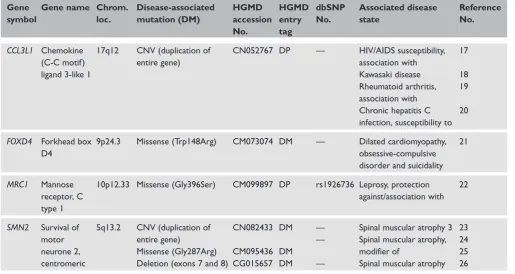
chimpanzee. It was found that four of these
human-specific genes are listed in the HGMD as
having been reported in association with human
inherited disease (Table 1). Indeed, these genes
have been shown to harbour a number of different
disease-causing mutations (DMs; including missense
mutations
and
copy
number
variations)
or
disease-associated polymorphisms that may confer
increased risk of a given disease state. In two of the
four cases, the reported disease association was
between a disease-associated polymorphism and a
complex disease phenotype (ie susceptibility to
infectious disease).
Intuitively, it might be supposed that those
human genes that are present in more than one
copy, as a consequence of a human lineage-specific
increase in copy number, are better protected
against the consequences of mutation in their
func-tional parent genes by virtue of their newly
acquired genetic redundancy.
27,28Using fairly
strin-gent selection criteria, at least 27 human genes
have so far been identified as having experienced
a
human
lineage-specific
increase
in
copy
number.
13,29 – 32Contrary to expectation, nine
of these genes (
AQP7
), cadherin 12, type 2
(
CDH12
),
CHRFAM7A
,
DRD5
,
FCGR1A
,
observation that five of the nine genes listed in
Table 2 can harbour clinically important mutations.
Another approach to this whole issue is to
ident-ify a set of human genes whose orthologues have
been lost from the chimpanzee genome and then
to ascertain how many of these genes are known to
be involved in human inherited disease. The initial
analysis of the chimpanzee genome (Chimpanzee
Sequencing and Analysis Consortium, 2005)
ident-ified a total of 55 genes that are present in human
but have been lost (or irrevocably disrupted) in
chimpanzee. It should be noted that these genes
may not necessarily be
bona fide
human-specific
genes, since although they are absent from the
chimpanzee genome, they may still be present in
the genomes of other higher primates. This
not-withstanding, cross-checking with the HGMD
revealed that eight of these genes are known to be
associated with either human inherited disease or
disease susceptibility (Table 3). In seven of these
eight cases, the reported disease association was
between a disease-associated polymorphism and a
complex disease phenotype (susceptibility to
infec-tious disease or autoimmune disease). Although the
numbers involved are clearly small, it would appear
that there is at least a tendency for human-specific
genes to harbour a greater-than-expected number
of examples of polymorphisms associated with
complex disease by comparison with the number
of mutations causing Mendelian disease (bearing in
mind that disease-associated polymorphisms
consti-tute only a small minority of the lesions logged in
the HGMD; see legend to Table 3).
Another intriguing finding emerges if Tables 1–3
are considered together:
NAIP
,
OCLN
and
SMN2
are all located at 5q13.2;
GTF2IRD2
and
NCF1
are
both located at 7q11.23, whereas butyrophilin-like 2
(
BTNL2
), HLA complex P5 (
HCP5
) and MHC
class I polypeptide-related sequence A (
MICA
) are all
located at 6p21.3. The most likely explanation for
the clustering of the human-specific genes at 5q13.2
and 7q11.23 is that both of these chromosomal
regions became duplicated specifically during the
human lineage. On the other hand, the clustering of
Table 1.
Human-specific genes that have been associated with inherited disease. The four genes listed were taken from a total of 138
human-specific genes identified by Itan
et al.
16Gene
symbol
Gene name Chrom.
loc.
Disease-associated
mutation (DM)
HGMD
accession
No.
HGMD
entry
tag
dbSNP
No.
Associated disease
state
Reference
No.
CCL3L1
Chemokine
(C-C motif)
ligand 3-like 1
17q12
CNV (duplication of
entire gene)
CN052767 DP
—
HIV/AIDS susceptibility,
association with
Kawasaki disease
Rheumatoid arthritis,
association with
Chronic hepatitis C
infection, susceptibility to
17
18
19
20
FOXD4
Forkhead box
D4
9p24.3
Missense (Trp148Arg)
CM073074 DM
—
Dilated cardiomyopathy,
obsessive-compulsive
disorder and suicidality
21
MRC1
Mannose
receptor, C
type 1
10p12.33 Missense (Gly396Ser)
CM099897 DP
rs1926736 Leprosy, protection
against/association with
22
SMN2
Survival of
motor
neurone 2,
centromeric
5q13.2
CNV (duplication of
entire gene)
Missense (Gly287Arg)
Deletion (exons 7 and 8)
CN082433
CM095436
CG015657
DM
DM
DM
—
—
—
Spinal muscular atrophy 3
Spinal muscular atrophy,
modifier of
Spinal muscular atrophy
23
24
25
26
T
able
2.
Hu
man
genes
identified
as
ha
ving
experienced
a
human
lineage-specific
incr
ease
in
cop
y
num
ber
and
which
harbour
muta
tions
causing,
or
associa
ted
wi
th,
inherited
disease.
The
nine
genes
lis
ted
w
e
re
tak
en
fr
om
a
total
of
27
hum
an
genes
identified
as
ha
ving
e
xperienced
a
human
lineage-specific
incr
ease
in
cop
y
num
ber
.
13,30 – 3 2Gene
symbol
Gene
name
Chr
om.
loc.
Disease-associa
ted
muta
tion
(DM)
HGMD
a
ccession
No
T
able
3.
Human
genes
associa
ted
with
an
inherited
disease
tha
t
h
av
e
been
los
t
fr
o
m
the
chimpanzee
genom
e.
The
eight
genes
lis
ted
w
e
re
tak
en
fr
om
a
total
of
55
gen
es
tha
t
ar
e
p
resent
in
human
but
which
ha
ve
been
los
t
o
r
been
irr
e
vocably
disrupted
in
chimpanzee.
46Gene
symbol
Gene
nam
e
Chr
om.
loc
.
Disease-associa
ted
muta
tion
(DM
)
HGMD
a
ccession
No
.
HGMD
entr
y
ta
g
dbSNP
No
.
Associa
ted
disease
st
a
te
R
efer
ence
No
.
AP
OL1
Apolipopr
otein
L1
22q12.3
Missense
(Ser342Gly)
Missense
(Ile384Met)
Micr
odeletion
(6
bp)
CM105041
CM105043
CD105044
DFP
DFP
DFP
rs73885319
rs60910145
rs71785313
R
esis
tance
to
tr
ypanosomes
47
BTNL2
Butyr
ophilin-lik
e
2
6p21.32
Splice
site
muta
tion
(IVS5
DS
-1
G
.
A)
CS051245
DFP
rs2076530
Sar
coidosis,
associa
tion
with
48
CD24
CD24
molecule
6q21
Missense
(Ala57V
al
)
CM035761
DFP
rs52812045
Multiple
scler
osis,
modifier
of
susceptibility
to
Lupus
er
ythema
tosus,
susceptibility
to
Chr
onic
hepa
titis
B
infection,
risk
of
49
50
51
HCP5
HLA
comple
x
P
5
6p21.3
Missense
(V
al112Gly)
CM074273
DP
rs2395029
R
educed
HIV
vir
al
load,
associa
tion
with
52
MIC
A
MHC
class
I
polypeptide-
rela
ted
sequence
A
6p21.33
Missense
(L
ys196Glu)
Missense
(V
al152Met)
CM0910116
CM058256
DP
DP
rs1051794
rs1051792
Rheuma
toid
arthritis,
associa
tion
with
Ankylosing
spondylitis,
early
onset,
associa
tion
with
53
54
NBEA
Neur
obea
chin
13q13.3
Balanced
tr
ansloca
T
able
3.
C
ontinued
Gene
symbol
Gene
name
Chr
om.
loc.
Disease-ass
ocia
ted
muta
tion
(DM)
HGMD
a
ccession
No
.
HGMD
entr
y
ta
g
dbSNP
No
.
Associa
ted
dise
ase
st
a
te
R
efer
ence
No
.
RNASE3
Ribonuclease,
RNase
A
family
,
3
14q11.2
Missense
(Thr124Arg)
CM025442
DFP
rs2073342
Expr
ession
of
allergic
symp
toms
Schis
tosoma
mansoni
infection,
risk
of
56
57
SFTP
A1
Surfa
ctant
pr
otein
A1
10q22.3
Missense
(Leu50V
al
)
Missense
(Arg219T
rp)
CM033024
CM033026
DP
DP
rs1136450
rs4253527
Idiopa
thic
pulmonar
y
fibr
osis,
associa
tion
with
Idiopa
thic
pulmonar
y
fibr
osis,
associa
tion
with
Tuberscler
osis,
susceptibility
to
58
58
59
Abbr
e
via
tions:
Chr
om.
loc.,
chr
omosomal
localisa
tion;
dbSNP
,
the
Single
Nucleotide
P
olymorphism
da
tabase;
DFP
,
disease-associated
polymorphi
sm
with
suppor
ting
e
vidence
of
functionality;
DP:
disease-associated
polymorphism
in
st
atis
tically
significant
associa
tion
with
a
particular
disease
st
at
e
but
la
cking
experimental
e
vidence
of
functionality
.
O
f
105,
018
unique
muta
tions
curr
ently
lis
ted
in
the
HGMD
(October
2010),
99,716
ar
e
DMs,
2,065
ar
e
DPs,
2,238
ar
e
functional
polymorphisms
(FPs)
and
999
ar
e
DFPs.
Of
the
3,851
differ
ent
human
genes
lis
ted
in
the
HGMD
,
2,629
contain
DMs,
while
1,222
contain
only
DFPs
or
FPs
(in
the
absence
of
the
BTNL2
,
HCP5
and
MICA
genes at 6p21.3 is
likely to be due to the loss of this chromosomal
region in chimpanzee. The clustering of
human-specific genes at 5q13.2 has been noted
pre-viously.
13The present data, however, suggest that at
least two additional genomic regions (7q11.23 and
6p21.3) contain clusters of human-lineage specific
genes.
Despite the above cited examples, there still
appear to be relatively few ‘young’
(human-specific) genes among human disease genes. It may
therefore be inferred that only a few young genes
perform functions of sufficient importance to
ensure that they have immediately come to clinical
attention when mutated. This view is certainly
sup-ported by the observation that younger human,
primate and mammalian genes tend to evolve more
rapidly and are subject to weaker purifying
selec-tion than their more ancient counterparts.
45,60 – 62If it is assumed that the underlying mutation rate
does not differ markedly between these categories
of gene, there are essentially two potential
expla-nations for very young genes experiencing a
par-ticularly rapid rate of evolutionary change: weaker
purifying selection or an increase in positive
selec-tion. The available evidence suggests that both
explanations
are
likely
to
pertain.
62 – 65The
majority of newly duplicated genes experience a
period of relaxed purifying selection, while only a
relatively small proportion exhibits a signature of
positive selection consequent to the acquisition of
new biological functions.
66Presumably, in between
the initial post-duplicational redundancy and
event-ual neofunctionalisation through genetic
diver-gence, there is a ‘half-way house’ state in which a
gene is relatively free to explore the acquisition of
new functions while still being constrained to some
extent by selection against the loss of those
func-tions it has already acquired.
67Whereas mutant alleles responsible for single
gene disorders are usually under negative selection,
alleles associated with complex disease appear to
have been either under much less stringent
purify-ing selection or may even have been subject to
positive selection.
3,68,69Genes that have
experi-enced positive selection during the human lineage
are likely to be characterised by human-specific
functional adaptations. Since genes that have been
subject to positive selection during human
evol-ution have frequently also been implicated in
disease,
70we may surmise that the underlying
pathological mutations may sometimes have
inter-fered
with
these
newly
acquired
functions.
Consistent with this interpretation, Lappalainen
et al.
71have reported a statistically significant
corre-lation between those regions of the human genome
that have experienced recent positive selection in
northern European populations and those regions
that have been implicated in complex disease. This
observation is also compatible with the tendency
observed by the present authors for human-specific
genes to harbour a disproportionate number of
polymorphic variants associated with complex
disease.
In terms of their expression profiles, there
appears to be a tendency for rapidly evolving
younger genes to be tissue-specific, whereas the
more slowly evolving older genes are more broadly
expressed.
72 – 76It remains to be seen whether
complex disease genes differ from Mendelian
disease
genes
in
terms
of
their
expression
characteristics.
ground for those seeking to identify genes that play
a key role in complex disease.
References
1. Huang, H., Winter, E.E., Wang, H., Weinstock, K.G. et al. (2004), ‘Evolutionary conservation and selection of human disease gene ortho-logs in the rat and mouse genomes’,Genome Biol. Vol. 5, p. R47. 2. Tu, Z., Wang, L., Xu, M., Zhou, X.et al. (2006), ‘Further understanding
human disease genes by comparing with housekeeping genes and other genes’,BMC GenomicsVol. 7, p. 31.
3. Blekhman, R., Man, O., Herrmann, L., Boyko, A.R. et al. (2008), ‘Natural selection on genes that underlie human disease susceptibility’, Curr. Biol. Vol. 18, pp. 883 – 889.
4. Domazet-Losˇo, T. and Tautz, D. (2008), ‘An ancient evolutionary origin of genes associated with human genetic diseases’, Mol. Biol. Evol. Vol. 25, pp. 2699 – 2707.
5. Cai, J.J., Borenstein, E., Chen, R. and Petrov, D.A. (2009), ‘Similarly strong purifying selection acts on human disease genes of all evolutionary ages’,Genome Biol. Evol. Vol. 1, pp. 131 – 144.
6. Kehrer-Sawatzki, H. and Cooper, D.N. (2007), ‘Understanding the recent evolution of the human genome: insights from human-chimpanzee genome comparisons’,Hum. Mutat. Vol. 28, pp. 99 – 130. 7. Yu, G. (2009), ‘An exon-based comparative variant analysis pipeline to
study the scale and role of frameshift and nonsense mutation in the human-chimpanzee divergence’,Comp. Funct. Genomics, Article ID 406421. 8. Schrider, D.R., Costello, J.C. and Hahn, M.W. (2009), ‘All
human-specific gene losses are present in the genome as pseudogenes’, J. Comput. Biol. Vol. 16, pp. 1419 – 1427.
9. Kim, H.L., Igawa, T., Kawashima, A., Satta, Y.et al. (2009), ‘Divergence, demography and gene loss along the human lineage’, Philos. Trans. R. Soc. BVol. 365, pp. 2451 – 2457.
10. Nahon, J.L. (2003), ‘Birth of “human-specific” genes during primate evolution’,GeneticaVol. 118, pp. 193 – 208.
11. Stahl, P.D. and Wainszelbaum, M.J. (2009), ‘Human-specific genes may offer a unique window into human cell signalling’,Sci. Signal. Vol. 2, p. e59.
12. Knowles, D.G. and McLysaght, A. (2009), ‘Recent de novo origin of human protein-coding genes’,Genome Res. Vol. 19, pp. 1752 – 1759. 13. Fortna, A., Kim, Y., MacLaren, E., Marshall, K. et al. (2004),
‘Lineage-specific gene duplication and loss in human and great ape evol-ution’,PLoS Biol. Vol. 2, p. E207.
14. Cheng, Z., Ventura, M., She, X., Khaitovich, P. et al. (2005), ‘A genome-wide comparison of recent chimpanzee and human segmental duplications’,NatureVol. 437, pp. 88 – 93.
15. Stenson, P.D., Mort, M., Ball, E.V., Howells, K. et al. (2009), ‘The Human Gene Mutation Database: 2008 update’,Genome Med. Vol. 1, p. 13.
16. Itan, Y., Bryson, K. and Thomas, M.G. (2010), ‘Detecting gene dupli-cations in the human lineage’,Ann. Hum. Genet. Vol. 74, pp. 555 – 565. 17. Gonzalez, E., Kulkarni, H., Bolivar, H., Mangano, A.et al. (2005), ‘The
influence of CCL3L1 gene-containing segmental duplications on HIV-1/AIDS susceptibility’,ScienceVol. 307, pp. 1434 – 1440.
18. Mamtani, M., Matsubara, T., Shimizu, C., Furukawa, S. et al. (2010), ‘Association of CCR2-CCR5 haplotypes and CCL3L1 copy number with Kawasaki disease, coronary artery lesions, and IVIG responses in Japanese children’,PLoS OneVol. 5, p. e11458.
19. McKinney, C., Merriman, M.E., Chapman, P.T., Gow, P.J.et al. (2008), ‘Evidence for an influence of chemokine ligand 3-like 1 (CCL3L1) gene copy number on susceptibility to rheumatoid arthritis’,Ann. Rheum. Dis. Vol. 67, pp. 409 – 413.
20. Gru¨nhage, F., Nattermann, J., Gressner, O.A., Wasmuth, H.E. et al. (2010), ‘Lower numbers of the chemokine CCL3L1 gene in patients with chronic hepatitis C’,J. Hepatol. Vol. 52, pp. 153 – 159.
21. Minoretti, P., Arra, M., Emanuele, U., Olivieri, V. et al. (2007), ‘A W148R mutation in the humanFOXD4gene segregating with dilated cardiomyopathy, obsessive-compulsive disorder, and suicidality’, Int. J. Mol. Med. Vol. 19, pp. 369 – 372.
22. Alter, A., de Le´se´leuc, L., Van Thuc, N., Thai, V.H. et al. (2010), ‘Genetic and functional analysis of commonMRC1exon 7 polymorph-isms in leprosy susceptibility’,Hum. Genet. Vol. 127, pp. 337 – 348. 23. Jedrzejowska, M., Ryniewicz, B., Kabzin´ska, D., Drac, H.et al. (2008),
‘A patient with both Charcot-Marie-Tooth disease (CMT 1A) and mild spinal muscular atrophy (SMA 3)’, Neuromuscul. Disord. Vol 18, pp. 339 – 341.
24. Prior, T.W., Krainer, A.R., Hua, Y., Swoboda, K.J.et al. (2009), ‘A posi-tive modifier of spinal muscular atrophy in the SMN2 gene’, Am. J. Hum. Genet.Vol. 85, pp. 408 – 413.
25. Vezain, M., Saugier-Veber, P., Goina, E., Touraine, R.et al. (2010), ‘A rareSMN2variant in a previously unrecognized composite splicing regu-latory element induces exon 7 inclusion and reduces the clinical severity of spinal muscular atrophy’,Hum. Mutat. Vol. 31, pp. E1110 – E1125. 26. Srivastava, S., Mukherjee, M., Panigrahi, I., Shanker Pandey, G. et al.
(2001), ‘SMN2-deletion in childhood-onset spinal muscular atrophy’, Am. J. Med. Genet. Vol. 101, pp. 198 – 202.
27. Hsiao, T.-L. and Vitkup, D. (2008), ‘Role of duplicate genes in robust-ness against deleterious human mutations’, PLoS Genet. Vol. 4, p. e1000014.
28. Ng, P.C., Levy, S., Huang, J., Stockwell, T.B.et al. (2008), ‘Genetic vari-ation in an individual human exome’,PLoS Genet. Vol. 4, p. e1000160. 29. Popesco, M.C., Maclaren, E.J., Hopkins, J., Dumas, L. et al. (2006),
‘Human lineage-specific amplification, selection, and neuronal expression of DUF1220 domains’,ScienceVol. 313, pp. 1304 – 1307.
30. Dumas, L., Kim, Y.H., Karimpour-Fard, A., Cox, M. et al. (2007), ‘Gene copy number variation spanning 60 million years of human and primate evolution’,Genome Res. Vol. 17, pp. 1266 – 1277.
31. Armengol, G., Knuutila, S., Lozano, J.J., Madrigal, I. et al. (2010), ‘Identification of human specific gene duplications relative to other pri-mates by array CGH and quantitative PCR’, Genomics Vol. 95, pp. 203 – 209.
32. Sudmant, P.H., Kitzman, J.O., Antonacci, F., Alkan, C. et al. (2010), ‘Diversity of human copy number variation and multicopy genes’,Science Vol. 330, pp. 641 – 646.
33. Kondo, H., Shimomura, I., Kishida, K., Kuriyama, H. et al. (2002), ‘Human aquaporin adipose (AQPap) gene. Genomic structure, promoter analysis and functional mutation’, Eur. J. Biochem. Vol. 269, pp. 1814 – 1826.
34. Rudd, M.F., Webb, E.L., Matakidou, A., Sellick, G.S. et al. (2006), ‘Variants in the GH-IGF axis confer susceptibility to lung cancer’, Genome Res. Vol. 16, pp. 693 – 701.
35. Raux, G., Bonnet-Brilhault, F., Louchart, S., Houy, E. et al. (2002), ‘The -2 bp deletion in exon 6 of the “alpha 7-like” nicotinic receptor subunit gene is a risk factor for the P50 sensory gating deficit’, Mol. PsychiatryVol. 7, pp. 1006 – 1011.
36. Cravchik, A. and Gejman, P.V. (1999), ‘Functional analysis of the human D5 dopamine receptor missense and nonsense variants: differences in dopamine binding affinities’,PharmacogeneticsVol. 9, pp. 199 – 206. 37. van de Winkel, J.G., de Wit, T.P., Ernst, L.K., Capel, P.J.et al. (1995),
‘Molecular basis for a familial defect in phagocyte expression of IgG receptor I (CD64)’,J. Immunol. Vol. 154, pp. 2896 – 2903.
38. Tipney, H.J., Hinsley, T.A., Brass, A., Metcalfe, K.et al. (2004), ‘Isolation and characterisation ofGTF2IRD2, a novel fusion gene and member of the TFII-I family of transcription factors, deleted in Williams-Beuren syndrome’,Eur. J. Hum. Genet. Vol. 12, pp. 551 – 560.
39. Roy, N., Mahadevan, M.S., McLean, M., Shutler, G.et al. (1995), ‘The gene for neuronal apoptosis inhibitory protein is partially deleted in indi-viduals with spinal muscular atrophy’,CellVol. 80, pp. 167 – 178. 40. Roos, D., de Boer, M., Ko¨ker, M.Y., Dekker, J.et al. (2006), ‘Chronic
41. O’Driscoll, M.C., Daly, S.B., Urquhart, J.E., Black, G.C.et al. (2010), ‘Recessive mutations in the gene encoding the tight junction protein occludin cause band-like calcification with simplified gyration and poly-microgyria’,Am. J. Hum. Genet. Vol. 87, pp. 354 – 364.
42. Lynch, M. and Force, A. (2009), ‘The probability of duplicate gene pres-ervation by subfunctionalization’,GeneticsVol. 154, pp. 459 – 473. 43. Shakhnovich, B.E. and Koonin, E.V. (2006), ‘Origins and impact of
con-straints in evolution of gene families’, Genome Res. Vol. 16, pp. 1529 – 1536.
44. Conrad, B. and Antonarakis, S.E. (2007), ‘Gene duplication: A drive for phenotypic diversity and cause of human disease’,Annu. Rev. Genomics Hum. Genet. Vol. 8, pp. 17 – 35.
45. Han, M.V., Demuth, J.P., McGrath, C.L., Casola, C. et al. (2009), ‘Adaptive evolution of young gene duplicates in mammals’,Genome Res. Vol. 19, pp. 859 – 867.
46. Chimpanzee Sequencing and Analysis Consortium (2005), ‘Initial sequence of the chimpanzee genome and comparison with the human genome’,NatureVol. 437, pp. 69 – 87.
47. Genovese, G., Friedman, D.J., Ross, M.D., Lecordier, L. et al. (2010), ‘Association of trypanolytic ApoL1 variants with kidney disease in African Americans’,ScienceVol. 329, pp. 841 – 845.
48. Valentonyte, R., Hampe, J., Huse, K., Rosenstiel, P. et al. (2005), ‘Sarcoidosis is associated with a truncating splice site mutation in BTNL2’,Nat. Genet. Vol. 37, pp. 357 – 364.
49. Zhou, Q., Rammohan, K., Lin, S., Robinson, N.et al. (2003), ‘CD24 is a genetic modifier for risk and progression of multiple sclerosis’,Proc. Natl. Acad. Sci USAVol. 100, pp. 15041 – 15046.
50. Sa´nchez, E., Abelson, A.K., Sabio, J.M., Gonza´lez-Gay, M.A. et al. (2007), ‘Association of aCD24gene polymorphism with susceptibility to systemic lupus erythematosus’, Arthritis Rheum. Vol. 56, pp. 3080 – 3086.
51. Li, D., Zheng, L., Jin, L., Zhou, Y.et al. (2009), ‘CD24polymorphisms affect risk and progression of chronic hepatitis B virus infection’, HepatologyVol. 50, pp. 735 – 742.
52. Fellay, J., Shianna, K.V., Ge, D., Colombo, S. et al. (2007), ‘A whole-genome association study of major determinants for host control of HIV-1’,ScienceVol. 317, pp. 944 – 947.
53. Kirsten, H., Petit-Teixeira, E., Scholz, M., Hasenclever, D.et al. (2009), ‘Association ofMICAwith rheumatoid arthritis independent of known HLA-DRB1 risk alleles in a family-based and a case control study’, Arthritis Res. Ther. Vol. 11, p. R60.
54. Amroun, H., Djoudi, H., Busson, M., Allat, R. et al. (2005), ‘Early-onset ankylosing spondylitis is associated with a functionalMICA polymorphism’.Hum. Immunol. Vol. 66, pp. 1057 – 1061.
55. Castermans, D., Wilquet, V., Parthoens, E., Huysmans, C.et al. (2003), ‘The neurobeachin gene is disrupted by a translocation in a patient with idiopathic autism’,J. Med. Genet. Vol. 40, pp. 352 – 356.
56. Jo¨nsson, U.B., Bystro¨m, J., Sta˚lenheim, G. and Venge, P. (2002), ‘Polymorphism of the eosinophil cationic protein-gene is related to the expression of allergic symptoms’, Clin. Exp. Allergy Vol. 32, pp. 1092 – 1095.
57. Eriksson, J., Reimert, C.M., Kabatereine, N.B., Kazibwe, F.et al. (2007), ‘The 434(G.C) polymorphism within the coding sequence of eosino-phil cationic protein (ECP) correlates with the natural course of Schistosoma mansoniinfection’,Int. J. Parasitol. Vol. 37, pp. 1359 – 1366. 58. Selman, M., Lin, H.M., Montan˜o, M., Jenkins, A.L. et al. (2003),
‘Surfactant protein A and B genetic variants predispose to idiopathic pul-monary fibrosis’,Hum. Genet. Vol. 113, pp. 542 – 550.
59. Malik, S., Greenwood, C.M., Eguale, T., Kifle, A.et al. (2006), ‘Variants of theSFTPA1andSFTPA2genes and susceptibility to tuberculosis in Ethiopia’,Hum. Genet. Vol. 118, pp. 752 – 759.
60. Alba`, M.A. and Castresana, J. (2004), ‘Inverse relationship between evol-utionary rate and age of mammalian genes’,Mol. Biol. Evol. Vol. 22, pp. 598 – 606.
61. Wolf, Y.I., Novichkov, P.S., Karev, G.P., Koonin, E.V.et al. (2009), ‘The universal distribution of evolutionary rates of genes and distinct charac-teristics of eukaryotic genes of different apparent ages’,Proc. Natl. Acad. Sci. USAVol. 106, pp. 7273 – 7280.
62. Cai, J.J. and Petrov, D.A. (2010), ‘Relaxed purifying selection and poss-ibly high rate of adaptation in primate lineage-specific genes’,Genome Biol. Evol. Vol. 2, pp. 393 – 409.
63. De, S., Lopez-Bigas, N. and Teichmann, S.A. (2008), ‘Patterns of evol-utionary constraints on genes in humans’, BMC Evol. Biol. Vol. 8, p. 275.
64. Nguyen, D.Q., Webber, C., Hehir-Kwa, J., Pfundt, R. et al. (2008), ‘Reduced purifying selection prevails over positive selection in human copy number variant evolution’,Genome Res. Vol. 18, pp. 1711 – 1723. 65. Kelley, J.L. and Swanson, W.J. (2008), ‘Positive selection in the human
genome: From genome scans to biological significance’, Annu. Rev. Genomics Hum. Genet. Vol. 9, pp. 143 – 160.
66. Lynch, M. and Conery, J.S. (2000), ‘The evolutionary fate and conse-quences of duplicate genes’,ScienceVol. 290, pp. 1151 – 1155.
67. Chung, W.Y., Albert, R., Albert, I., Nekrutenko, A.et al. (2006), ‘Rapid and asymmetric divergence of duplicate genes in the human gene coex-pression network’,BMC BioinformaticsVol. 7, p. 46.
68. Nielsen, R., Hubisz, M.J., Hellmann, I., Torgerson, D. et al. (2009), ‘Darwinian and demographic forces affecting human protein coding genes’,Genome Res. Vol. 19, pp. 838 – 849.
69. Beekman, M., Nederstigt, C., Suchiman, H.E.D., Kremer, D. et al. (2010), ‘Genome-wide association study (GWAS)-identified disease risk alleles do not compromise human longevity’,Proc. Natl. Acad. Sci. USA Vol. 107, pp. 18046 – 18049.
70. Vamathevan, J.J., Hasan, S., Emes, R.D., Amrine-Madsen, H. et al. (2008), ‘The role of positive selection in determining the molecular cause of species differences in disease’,BMC Evol. Biol. Vol. 8, p. 273. 71. Lappalainen, T., Salmela, E., Andersen, P.M., Dahlman-Wright, K.et al.
(2010), ‘Genomic landscape of positive natural selection in northern European populations‘,Eur. J. Hum. Genet. Vol. 18, pp. 471 – 478. 72. Winter, E.E., Goodstadt, L. and Ponting, C.P. (2004), ‘Elevated rates of
protein secretion, evolution, and disease among tissue-specific genes’, Genome Res. Vol. 14, pp. 54 – 61.
73. Zhang, L. and Li, W-H. (2004), ‘Mammalian housekeeping genes evolve more slowly than tissue-specific genes’, Mol. Biol. Evol. Vol. 21, pp. 236 – 239.
74. Liao, B.Y. and Zhang, J. (2006), ‘Low rates of expression profile diver-gence in highly expressed genes and tissue-specific genes during mamma-lian evolution’,Mol. Biol. Evol. Vol. 23, pp. 1119 – 1128.
75. Hao, L., Ge, X., Wan, H., Hu, S. et al. (2010), ‘Human functional genetic studies are biased against the medically most relevant primate-specific genes’,BMC Evol. Biol. Vol. 10, p. 316.
76. Park, S.G. and Choi, S.S. (2010), ‘Expression breadth and expression abundance behave differently in correlations with evolutionary rates’, BMC Evol. Biol. Vol. 10, p. 241.
77. Khalturin, K., Hemmrich, G., Fraune, S., Augustin, R. et al. (2009), ‘More than just orphans: are taxonomically-restricted genes important in evolution?’,Trends Genet. Vol. 25, pp. 404 – 413.
78. Blekhman, R., Oshlack, A., Chabot, A.E., Smyth, G.K. et al. (2008), ‘Gene regulation in primates evolves under tissue-specific selection press-ures’,PLoS Genet. Vol. 4, p. e1000271.